Showing posts with label sacrilege. Show all posts

Monday, August 11, 2025

Catholic mockery in Nebraska; apology issued; Bishop Conley decries the scandal


University of Nebraska apologizes for ‘drag Mass,’ investigates controversial performance

Bishop James Conley of Lincoln, Nebraska (pictured in St. Peter’s Square in 2019) criticized the University of Nebraska for allowing a student to mock the Mass in a drag show. | Credit: Daniel Ibañez/CNA
Daniel Payne

By Daniel Payne

The University of Nebraska has officially apologized for sanctioning a profane “drag” performance that mocked the Catholic Mass earlier this year, with the school undertaking an investigation into the incident after Catholic outcry against it. 

Bishop James Conley of Lincoln, Nebraska, publicly criticized the so-called “drag Mass” in June, calling it “a blatant public display of faith-based discrimination.”  

The event was put on in April by music doctoral student Joseph Willette, who claimed the performance was meant to “bridge the gap between queerness and spirituality.”

The demonstration “imitated various parts of the Mass, including the Kyrie, Gloria, Credo, Sanctus, and Agnus Dei.

On Aug. 8 the bishop said in a public statement that he had met with University of Nebraska President Jeffrey Gold and other leaders of the university after the incident. The university told the prelate that an “investigation into the matter was already underway.”

Conley wrote that University of Nebraska, Lincoln, Chancellor Rodney Bennett subsequently sent a follow-up letter in which the administrator told the bishop: “We regret deeply that the matter we met to discuss has caused disruption, and we sincerely apologize.”

The university will “fully embrace the opportunity this incident has prompted to consider carefully how we educate members of our community about the impact individual acts may have on people and communities — both positively and negatively, and whether intended or inadvertent,” Bennett wrote, according to Conley.

In his Aug. 8 letter Conley said the school was also establishing a university advisory group meant to reduce the likelihood of such incidents occurring in the future. 

It is unclear if the university has concluded its investigation into the event or if the inquiry is still ongoing. The school did not immediately respond to a request for comment on Aug. 8. 

The school’s President’s Advisory Roundtable on Community Engagement will help advise the school on “addressing sensitive and often emotional matters for which there are strong convictions.”

Representatives from the local Catholic community will be included on the panel, Conley said. 

In addition to backlash from the bishop’s office, state lawmakers also reportedly criticized the performance. 

Nebraska Sen. Dan Lonowski told the higher education news website the College Fix that he and a dozen colleagues wrote to the university condemning the display. 

Lonowski, a Catholic, told the Fix that the performance “[did] not appear to advance music nor faith in any manner.” Lonowski said the university confirmed that it was undertaking an investigation.

Conley, meanwhile, expressed hope that the school was apologizing not just for the controversy surrounding the incident but “for the substance of the incident itself.”

“On behalf of Catholics and all people of faith, I would like to see a more concrete commitment from the university to provide training and education on why this behavior is offensive to Catholics,” the bishop wrote.

Mocking the Eucharist, Conley said, “should never be an action that is rewarded with a degree, but instead should be condemned for its ignorance and evil.”

Tuesday, October 22, 2024

Outrage: A Satanic black mass scheduled for Atlanta


Atlanta Catholics plan prayer and reparation amid planned ‘Satanic black mass’


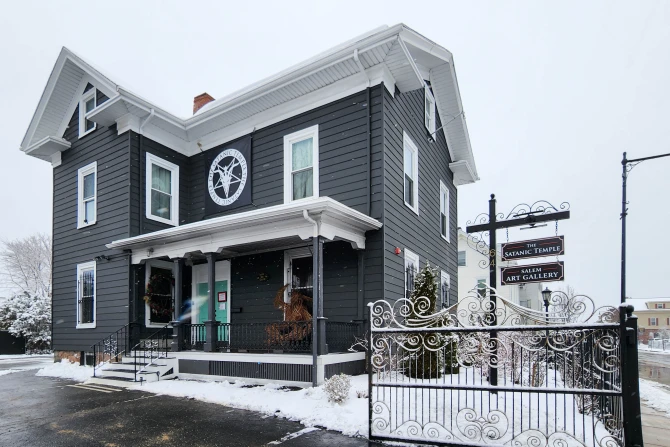
The headquarters of the Satanic Temple, a political activist group known for protesting religious symbolism in public spaces and mocking Christianity, is located in Salem, Massachusetts. | Credit: Crisco 1492/Wikipedia, CC BY-SA 4.0

Jonah McKeown

Catholics in Atlanta plan to fervently pray and make reparation ahead of and during an upcoming “black mass,” a sacrilegious event planned for Oct. 25 by the so-called Satanic Temple. 

Archbishop Gregory Hartmayer of Atlanta in an Oct. 8 memo urged all Catholics to counter the Satanic Temple’s “attack on the faith” through prayers of reparation and penance, calling the planned Friday event “a blasphemous and obscene inversion of the Catholic Mass.”

The Satanic Temple, which, according to its website, denies the existence of God and Satan, is a political activist group known for protesting religious symbolism in public spaces and mocking Christianity by offering “unbaptism” and hosting “black masses.”

In 2014, a planned “black mass” at Harvard University sparked considerable outcry from Catholics, as did another one later that year in Oklahoma City. 

A direct mockery of the Catholic Mass, a so-called “black mass” sometimes entails the desecration of the Eucharist, stolen from a Catholic church. The Satanic Temple website briefly describes the “black mass” as “a celebration of blasphemy, which can be an expression of personal liberty and freedom.”

The Atlanta Satanic Temple is selling tickets to the “mass,” which is set to be held at a performance venue northeast of downtown.

Hartmayer reiterated that Catholics should respond to “this attack to our faith through prayer, penance, and prayers of reparation.” He said he has asked each Atlanta parish to conduct a Eucharistic Holy Hour with Benediction to honor the real presence of Christ in the Eucharist, ideally on or before Friday, Oct. 25, at 9 p.m. ET.

“Using a consecrated host they claim they obtained illicitly from a Catholic church and desecrating it in the vilest ways imaginable, the practitioners offer it in sacrifice to Satan,” the archbishop said. 

“This terrible sacrilege is a deliberate attack on the Catholic Mass as well as the foundational beliefs of all Christians. It mocks Our Lord Jesus Christ, whom we Catholics believe is truly present under the form of bread and wine in the Holy Eucharist when it has been consecrated by a validly ordained priest.”

“We commend our efforts to the Lord through the loving intercession of Mary, the mother of God,” he concluded.

In recent years, the Satanic Temple has engaged in pro-abortion advocacy, losing the various lawsuits it filed against state pro-life laws in Missouri and Indiana. It also announced last year the creation of an “After School Satan Club” at a Connecticut elementary school.

Critics have long suspected that the group is a hoax or simply exists to “troll” religious people, though the group strongly denies this. 

Saturday, March 2, 2024

Outrageous sacrilege at Catholic chapel in Spain as two men stage a civil union


Catholic chapel where two men celebrated ‘marriage’ now subject to deconsecration


The private Catholic chapel where two Spanish men celebrated their civil “marriage” last weekend is subject to “canonical effects” and deconsecration, according to the Archdiocese of Madrid and a Catholic priest with jurisdiction in the area.

The Holy Trinity Chapel, located on the grounds of the Finca El Campillo, a property used as a wedding venue in the town of El Escorial, was the scene of a celebration of the two men’s civil marriage last Saturday.

Cristina González Navarro, who owns the property, told ACI Prensa, CNA’s Spanish-language news partner, that at the event inside the chapel “there was no priest” and that “a wedding wasn’t held,” but she refused to offer more details about what the ritual consisted of.

What is known, through images posted on social media, is that the chapel was full of guests and that the men, dressed in formal attire and holding hands, left the chapel walking down the aisle as a Catholic bride and groom do at the conclusion of a wedding ceremony for the sacrament of marriage.


According to photos on social media, some elements of the Catholic liturgy apparently were used during the ceremony, including an image of the Virgin of Hakuna by sculptor Javier Viver. 

The two men exchanged rings and at one point knelt on white kneelers in front of the sculpture of the Virgin and before a cross made of two branches tied together.

On the shoulders of the men was draped a white cloth with blue stripes in a gesture similar to the one used in the veiling rite of the Mozarabic liturgy. In this Catholic rite, the wife’s head and the husband’s shoulders are covered and as they kneel they receive a blessing.

Statement from the archdiocese

Father Florentino de Andrés, pastor of St. Bernabé Parish in El Escorial, told ACI Prensa that the chapel has not been deconsecrated and that the ceremony was carried out without his knowledge. The priest was emphatic that “it was not with my permission.”

De Andrés also said that he will speak with the owners of the property to determine what took place and if confirmed as reported, he will call for the chapel to be deconsecrated.

The Archdiocese of Madrid also weighed in with a statement confirming that “it was not informed or consulted about the possibility of holding said celebration, being a unilateral act of the property [owners] that will have canonical effects in this regard. In no case is it permitted to perform a civil marriage within a religious venue.”

The Feb. 26 statement stressed that “family chapels can only be used for the purpose that the Church grants them,” and therefore “they cannot be a place for public religious celebrations, unless expressly authorized by the diocese.”

In addition, the archdiocese specified that “they cannot be used for commercial purposes or as places for civil celebrations of any kind. In fact, at the time [they were built] they were intended to be solely for the private devotional use of the family that owned it and in no case to be offered as an optional for-profit service of a company that plans social events.”

Beyond the controversy over the improper use of a Catholic church, those who own chapels that are located on private land are subject to ecclesiastical regulations (canons 1115 et seq.) for the correct use of these sacred places, as summarized by the Archdiocese of Madrid in its statement.

This story was first published by ACI Prensa, CNA’s Spanish-language news partner. It has been translated and adapted by CNA.

Monday, January 8, 2024

Catholic Priest guilty of soliciting sex during confessions


A Missouri Catholic priest was found guilty by the church of soliciting sex from an adult during a confession, an act the church described as "a sacrilege" and a "grave form of abuse" that cannot be tolerated.

Father Ignazio Medina of the Diocese of Jefferson City is now prohibited from holding office in the church, hearing confessions and celebrating or leading Mass publicly without the explicit permission of his diocesan bishop, the diocese said in a statement.

The diocese received a report on April 15, 2022, through the diocese’s abuse hotline alleging sexual solicitation of an adult on the occasion of the Sacrament of Reconciliation.

Canon 1385 of the Code of Canon Law says a priest "who in the act, on the occasion, or under the pretext of confession solicits a penitent to sin against the sixth commandment of the Decalogue is to be punished according to the gravity of the delict, by suspension, prohibitions, privations; and in more grave cases, he is to be dismissed from the clerical state."

Bishop W. Shawn McKnight of Jefferson City launched an investigation after learning of the report and placed temporary restrictions on Medina, including banning him from hearing confessions and from being alone with anyone other than his family on church property.

Medina, who served as a priest at Our Lady of the Lake Parish in Lake Ozark, was found guilty by decree by the Dicastery for the Doctrine of the Faith in Rome on Nov. 27, 2023. Medina did not appeal the decision.

"I want to be clear that sexual solicitation during confession is a sacrilege, a crime in our Church, and a grave form of abuse; it cannot be tolerated," McKnight said. "With God’s help we must work to continue to eradicate abuse from all corners of our Church. Please join me in prayer for all who are left in pain and confusion when a trusted leader abuses their position of sacred trust and power for sinful purposes."

"I have met with Father Medina to express my concerns and informed him he will not be allowed to celebrate or concelebrate Mass publicly except for funeral Masses of his immediate family, at the gathering of priests at their annual conference in October, and at the Chrism Mass during Holy Week," he continued.

Medina remains a priest of the Diocese of Jefferson City and continues to receive support as a retired priest, the diocese said.

"I thank the victim in this case for stepping forward, and I pray for healing," McKnight said. "I also thank all who helped during the investigation and disciplinary process. In addition, I am very grateful for our clergy, parish staff and parishioners who are dedicated to ensuring our diocesan Safe Environment protocols are followed. As we move forward together, I seek the renewal of our Church by facing the awful reality of abuse with the hope and grace of the Gospel which provides the healing we all need."

This comes after Medina was found guilty in April 2023 of abuse of ecclesiastical power after transferring roughly $300,000 in parish funds to personal accounts.

Tuesday, May 9, 2023

Catholic Church displays "God is Trans" Exhibit


Archdiocese Investigating Catholic Church's 'God Is Trans' Exhibit


The Archdiocese of New York is investigating one of its parishes after reports of a new art exhibit surfaced on Monday.

The Church of St. Paul the Apostle in Manhattan surprised parishioners when it displayed the three-painting work by artist Adah Unachukwu, which depicts the spiritual journey of an LGBTQ+ person. The display, titled "God Is Trans: A Queer Spiritual Journey," isn't the first time the church has publicly welcomed members of the LGBTQ+ community, but the exhibit is now a concern for the archdiocese.

Nationally, the LGBTQ+ community is regularly in the news as politicians debate issues relating to gender-affirming care, gender identity and inclusion. The topics are often debated in public schools and have been taken up in some churches as well. Some Catholic churches offer a safe place for LGBTQ+ parishioners, while others follow the Vatican's view that gender is assigned at birth and cannot be changed.

Parishioners have expressed mixed opinions about the exhibit, according to a New York Post story, which called the church "very liberal." A spokesperson for the Archdiocese of New York told Newsweek that it was unaware of the exhibit until alerted by the media and is now looking into it.

"We had no knowledge of it beforehand," the spokesperson said. "If media reports are accurate, then we would have concerns. We are investigating and looking to speak with the pastor of the parish to get more information."

Newsweek reached out for comment to the Church of St. Paul the Apostle by phone and through an online contact form.

On its website, the church said it offers a ministry and outreach program for LGBTQ+ parishioners called "Out at St. Paul."

The work is divided into three paintings titled "Sacrifice," "Identity" and "Communion." According to descriptions adorning the exhibit, the "Sacrifice" painting is about the shedding of an old life to focus on one's spiritual needs. "Identity" is intended to evoke questions from the viewer, such as "What does holiness look like?," "What does your god look like?" and "Are these two portrayals that can be merged?"

"Communion" is concerned with "placing God and the mortal on the same plane to speak to one another," according to the description.

Responses from parishioners have varied from angry to supportive, according to the Post's story. The newspaper reported that several parishioners said that the church should not promote the topic. Others were supportive and said the church's liberal views were the reason they attended.

Monday, March 20, 2023

German Bishops, German Synod continues to mock Christ and His Church


German bishops announce plans to bless same-sex unions, allow laypeople to baptize and preach at Mass


Following the conclusion of the German Synodal Way, several bishops have announced plans to put into practice resolutions passed by the process, including liturgical blessings of same-sex unions in their churches. 

The Synodal Way, which concluded in Frankfurt on March 11, “give[s] us the tailwind we need for concrete changes in our diocese,” Bishop Franz-Josef Bode of Osnabrück said March 14.

Bode — who is vice president of the German Bishops’ Conference — said his diocese encouraged “all couples in our diocese who cannot or do not want to marry in church but still want to put their relationship under a church blessing” to “get in touch with us.” He added that such celebrations were already available in some parishes of his diocese.

Bode on Tuesday also announced that laypeople would be able to baptize babies and “regularly” preach at homilies, CNA Deutsch reported.

Another German prelate, Bishop Heiner Wilmer of Hildesheim, added his support, telling staff in his diocese: “It is of great importance to me that LGBTQ people are accompanied pastorally, spiritually, and liturgically. I welcome the Synodal Way’s endorsement of establishing a task force to develop a handout for celebrations of blessing for same-sex couples as well as remarried divorcees,” CNA Deutsch reported.

On Friday last week, the German bishops and other delegates of the Synodal Way passed a resolution to develop and provide Church blessings to same-sex unions. 

Titled “Blessing ceremonies for couples who love each other,” the measure was opposed by only nine of 58 bishops, while 11 bishops abstained. 

German bishops who have previously voiced public support for the blessing of same-sex unions in the Catholic Church include Cardinal Reinhard Marx of Munich and Freising and Bishop Heinrich Timmerervers of Dresden-Meißen.

In March 2022, Cardinal Marx said he had personally blessed a same-sex couple in Los Angeles.

One year earlier, in March 2021, the Vatican confirmed that the Catholic Church does not have the power to give liturgical blessings to homosexual unions. Answering the question “does the Church have the power to give the blessing to unions of persons of the same sex,” the Congregation — now the Dicastery — for the Doctrine of the Faith responded: “Negative.”

In an accompanying note, the Vatican’s doctrine office explained that blessings are sacramentals, and “consequently, in order to conform with the nature of sacramentals, when a blessing is invoked on particular human relationships, in addition to the right intention of those who participate, it is necessary that what is blessed be objectively and positively ordered to receive and express grace, according to the designs of God inscribed in creation, and fully revealed by Christ the Lord.”

Wednesday, December 14, 2022

Grown women continue to play dress up; they are not priests, they do not say Mass and they are not ordained to One, Holy Catholic and Apostolic Church. They are indeed excommunicated.


Excommunicated: The women fighting to be priests


These ordinations are illicit and not recognized by the Vatican

Anne Tropeano is ironing her clothes in preparation for a busy day ahead. She gets out her white alb and her ornately embroidered chasuble, garments worn by Catholic priests around the world. On a calendar on her wall, bold red pen marks that tomorrow is "Ordination day".

But she is also on the phone hiring a security guard for the service in a church in Albuquerque, New Mexico, where she lives - as she anticipates there could be hostility.

"It's a tense issue, not everybody is open to even considering the possibility of women being called to priesthood," she says. It's not only harassment in person that Tropeano is concerned about. Since sharing her hopes of becoming a Catholic priest, she says she's experienced "breath-taking" online harassment.

Tropeano is one of over 200 women across the world who are part of the Roman Catholic woman priest movement, a group who are taking part in unauthorised ordination services to become priests, in an act of defiance against the Roman Catholic Church.

The Catholic Church does not allow women to be priests. In fact, the Vatican sees it as a serious crime in canon law that is punishable by excommunication. This means the women, once they've taken part in an 'ordination', are unable to receive the sacraments, including communion, or have a church funeral.

"Excommunication was the reason I wasn't able to entertain becoming a priest for a long time," she says. "I was going to mass every single day. I worked for a parish, my whole life was in the church. So to think about giving that up, I couldn't even really imagine it."

Tropeano is a devout Catholic, who after years of doing other jobs including managing a rock band, felt the call to priesthood: "I would hear this. You are my priest, you are a priest. I want you to be a priest."

The only option open to her as a woman was to serve the Church in another role - such as a nun or as a lay contributor to her diocese. Or she could walk away from Catholicism entirely, to another Christian denomination that would welcome her as a priest.

After years of personal discernment, she realised the limitations of the Vatican rules were not going to let her live out this call: "Once I recognised that this was the next step, the excommunication was just part of the journey."

Tropeano, and other women like her, are also seeing their choice to be 'ordained' as a way to campaign against what they consider a sexist rule by the Church.

From Reform Judaism to many Protestant denominations, other faiths are open to the ordination of women. Yet for the Catholic Church the ban on women's access to priesthood is based, among other arguments, on Biblical records that Christ chose his 12 Apostles only from among men, and the Church has gone on to imitate Christ ever since.

For Tropeano, the impact of this rule is far-reaching.

"By the Church teaching through its actions of excluding women from [priestly] ordination, it's teaching that women are inferior. Women learn this, little kids learn this, men learn this… So they go out into the world and they live that way."

Ceremony on a cruise

The movement for women priesthood gained visibility in 2002. A group of seven women took part in an illicit ordination service aboard a ship on the Danube River, on international waters to avoid conflict with any ecclesiastical region.

Yet there were reports of previous secret 'ordinations', such as Ludmila Javarova's, who during the Communist rule of Czechoslovakia in the 1970s took part in a service led by a Roman Catholic bishop.

The women's ordination movement is now mostly a European and US group, but it has expanded its representation in other parts of the world.

Colombian Olga Lucía Álvarez Benjumea was the first female 'priest' in Latin America, a bastion for the Catholic Church with more than 40% of the 1.3 billion global Catholic population.

Her ceremony in 2010 was a secret, but she says she has got support from the Church's local hierarchy: "There was a bishop… a Roman Catholic whose name we do not say so as not to get him in trouble with the Vatican."

"I was very afraid that people would suddenly start insulting me or throwing things at me at the altar, in this very conservative society I live in.

"So the support I received from people was a great surprise, and that strengthened and reinforced my mission," says Álvarez. She has now been promoted to bishop within the Association of Roman Catholic Women Priests (ARCWP), which is not recognised by the Vatican.

Álvarez comes from a very devout Catholic family but had the support of her mother, a former nun. Her brother, a priest, gave her a gift of a chalice which she sees as a form of silent support.

Álvarez is insistent that there is nothing in Scripture to exclude women from the priesthood: "It's a human law, a Church law, and an unjust law need not be adhered to."

This is a sentiment shared by the Women's Ordination Conference (WOC), a group that lobbies the Vatican for women's access to the priesthood through calls for dialogue and demonstrations.

Executive director Kate McElwee says her favourite work is what they call the Ministry of Irritation - which has seen supporters doing everything from releasing pink smoke during the Conclave to lying in the road as the Pope's motorcade came through the city. For their actions, they have been detained by Vatican Police.

"We walk with these women in their vocation and they're waiting for the Vatican to open its doors and really confront its sins of sexism," says McElwee. "But meanwhile for other women it would be impossible to wait, the call is so loud and so clear from God that they have no choice but to break an unjust law."

A 'closed door'

The Church sees these ordinations not just as illicit but also invalid.

After the Danube Seven story became public, Cardinal Joseph Ratzinger, later Pope Benedict, declared that since the women gave no indication of repentance, "for the most serious offense they have committed, they have incurred excommunication".

Pope Francis has himself ruled out a woman ever serving as a priest. In 2016, when asked about any chance this could change, he referenced a 1994 document from John Paul II that said that the "door is closed" to women's ordination, which the Pope said "stands".

Sister Nathalie Becquart works from an office in Vatican City, with a picture of her and Pope Francis behind her. In February 2021, she was the first woman to ever be appointed as an Under Secretary to the Synod of Bishops, a body which advises the Pope.

She puts the current position on women priests simply: "For the Catholic Church at this moment, from an official point of view, it's not an open question."

"It's not just a matter of you feeling you are called to priesthood, it's always a recognition that the Church will call you to be a priest. So your personal feeling or decision is not enough," says the French nun.

Sister Becquart is one of a few women given key senior roles under Pope Francis' pontificate. Her position makes her the first woman in the Vatican with voting rights.

She believes there is an evolution happening, allowing more women to take up leadership roles, yet roles that are "disconnected from ordination."


"I think we need to broaden our vision of the Church. There are many, many ways for women to serve the Church," Sister Becquart says.

But she also notes that change is never easy, and always faces "fears and resistance".


What does the Catholic Church say?

  • Catholic doctrine, or its legal interpretation, reference priesthood as being a prerogative of men - stating that "a baptized male alone receives sacred ordination validly" (Canon 1024).
  • A 2021 revised version of Church law (Canon 1379) explicitly criminalized conferring sacred orders on women latae sententiae - a legal term which means that the penalty is incurred automatically, without the need for a judgment.

A different way

In a hushed Cathedral Anne Tropeano approaches the nave, faces her bishop and proclaims full of emotion, "Here I am, I am ready."

It's a day she has waited for for 14 years. The 'ordination' ceremony follows a similar liturgy to that which men becoming Catholic priests would experience - including the laying on of hands and prayer of consecration.

During the ceremony, Bishop Bridget Mary Meehan lifted Tropeano's arms and presented her to the clapping congregation. The newly 'ordained' Anne said she felt "embraced".

Tropeano prides herself on being the face of a different ministry, one with more participation and less hierarchy. As well as one that is open to groups traditionally questioned by the Church.

"Nobody is turned away from communion. Whether or not you've been divorced, none of that matters. Everybody is welcome, LGBTQ people are welcome at the table," she says.

Olga Lucía Álvarez also sees female priesthood as an opportunity to redefine the relationship of lay Catholics with their altar representatives.

There is an opportunity in the current state of the Church, says the Colombian woman 'bishop', given the dwindling number of vocations and the clerical sex abuse scandals that have severely damaged trust in priests.

"How can they say they are the sole representatives of God on Earth? They have no shame," she says about the series of abuse allegations worldwide.

Pope Francis has apologised to the victims of sexual abuse committed by clerics, and has condemned the Church's "complicity" in hiding the "grave crimes".

Álvarez sees women's ministry as an answer. At 80, she spends her time mentoring younger women who are hoping to become priests.

"It is urgent to show another face of the priesthood. We cannot let history repeat itself."

The movement for women's ordination wants an open debate on the ban, as they are confident to have the support of lay Catholics.

In Brazil, the country with the largest Catholic population in Latin America, almost eight-in-ten Catholics said they were supportive of women priests. In the US, the figure was six-in-10, according to a 2014 survey. Yet the movement for women's ordination has not yet taken off in Africa, the region with the fastest-growing Catholic population.

When it comes to the possibility of change, Tropeano appeals to the Pope himself to open up a dialogue.

"You need to have an audience with women who are called to priesthood. Whether they have been 'ordained' as part of this movement or not, you need to hear our experience and take that into your prayer."

While the fight for women's ordination to priesthood still looks as though it could be a long one, Tropeano thinks it is vital for the future of the Church.

"The Church will not be able to fulfil its mission unless there's equal participation. At the moment there is nothing more important."