Showing posts with label movie review. Show all posts

Tuesday, July 18, 2023

Sound of Freedom movie about human trafficking


‘Sound of Freedom’ makes history at the box office


“Sound of Freedom,” an anti-human-trafficking film made by Catholic filmmakers Eduardo Verástegui and Alejandro Monteverde and starring Catholic actor Jim Caviezel, continues to top the box office charts.

The film currently sits behind the new “Mission Impossible” at the No. 2 spot on the box office charts, beating out other expected summer hits, according to Box Office Mojo.

“Sound of Freedom” was released in theaters across the country on July 4 and had an incredibly successful opening day in which it reached No. 1 at the box office, beating out Disney’s fifth “Indiana Jones” installment and raking in $14.24 million.

The film was originally produced under 20th Century Fox and finished in 2018, but it was dropped after Disney bought the studio. Only after being acquired by Angel Studios, known for its TV show “The Chosen,” did “Sound of Freedom” finally make it into theaters.

In over one week, the film increased its weekly gross revenue from $20 million to $27 million, totaling a gross revenue of $85.5 million since its opening.

Additionally, “Sound of Freedom” made box office history when its revenue increased by 37% from the previous week’s earnings.

Bradon Purdie, head of theatrical distribution for Angel Studios, said in a press release published on July 16: “There have only been 10 wide-release movies in box office history that have had a second-weekend increase greater than 35% over their opening weekend. All of them achieved this milestone during Christmas. Angel Studios is the only studio to accomplish this feat during the summer blockbuster season with ‘Sound of Freedom.’”

“While the entire summer movie box office lineup is underperforming, our small independent film continues to grow week over week. Driven by millions of fans and supporters, ‘Sound of Freedom’ has become a national — and soon international — movement for change,” said Jared Geesey, senior vice president of global distribution at Angel Studios.

“Sound of Freedom” tells the true story of Tim Ballard, a Homeland Security agent who, after rescuing a young boy from traffickers, learns that the boy’s sister is still captive. He quits his job and puts his life at risk as he embarks on a dangerous journey through the Colombian jungle to save the little girl. During the mission, Ballard ends up saving 123 people, 55 of whom are children.

In a June interview with CNA, Caviezel said that “Sound of Freedom“ “is the best film I’ve done since the ‘Passion of the Christ.’”

Verástegui shared in an interview with ACI Prensa, CNA’s Spanish-language news partner, that he sees the movie’s success as a “miracle.” He explained why he believes this is the case.

“Many doors were closed to us over these years; Disney, Netflix, Amazon, and other distribution houses said ‘no, this film is not for us, it’s not good business, nobody is going to see a film about child trafficking,’ they claimed. Faced with these refusals, we had two options: Give up and throw in the towel, or — when it comes to saving lives — don’t give up, keep going and persevere for as long as necessary.”

“And the movement for freedom is already a fact, it’s underway, and it’s growing, growing, growing without stopping; they can’t stop it. That is the miracle: That in a world of lies and attacks, the truth makes its way, takes first place, and many lives will be saved thanks to this. Because in times of universal lies, Orwell said, telling the truth constitutes a revolutionary act,” Verástegui said.

Wednesday, June 7, 2023

Problems with the much-anticipated Padre Pio movie


Sacrilege in Shia LaBeouf’s New Padre Pio Film?

Yes, God brings good out of evil, but we are never permitted to do evil that good may come of it.


Disclosure One: I have not seen the recently released R-rated film about Padre Pio.

Disclosure Two: I refuse to ever watch the film.

The reason for my refusal is that the film contains a sexualized scene of sacrilege involving an image of the Blessed Virgin Mary. (For obvious reasons, I am not going to give any more detail here — and it is with significant trepidation that I mention even that.)

Some might say that mine is an overreaction — that this is only a portrayal, rather than textbook sacrilege. But that is parallel to saying that a sexual act committed in a pornographic film merely constitutes actors playing out a scene. The underlying act, however, is the same. The only difference is that it was captured on film. Similarly, a cinematic depiction of sacrilege against an image of Mary — especially an explicitly sexual-themed one — constitutes a sin. Some might argue about the textbook definition of sacrilege, but at minimum, such a scene constitutes a sin against religion.

Sadly, this is not the first movie to do so. In 1973, a film titled The Exorcist was released. The movie contains a scene of sexual-themed sacrilege involving a crucifix. Nevertheless, the film had its fair share of Catholic defenders. Some claimed that the film reinvigorated the Catholic Faith. No doubt, the same claim will be made about this new movie.

But even if this is the case — that some people might become Catholic by watching this movie — it does not excuse the sin. It is a fundamental moral principle that a person cannot, under any circumstances, commit a sin even if he believes it will lead to great good. This is the stuff of situation ethics, which has been formally and consistently condemned. Bluntly, I am not morally permitted to commit a sin even if that sin leads to the conversion of the entire world. Yes, God brings good out of evil, but I am never permitted to commit sin.

There’s something else here that needs to be discussed, and it is addressed far too infrequently. Though scenes like those described above should offend the sensibilities of every Catholic, they are terribly damaging to those of us who suffer from scrupulosity. As Father Alfred Wilson explains in Pardon and Peace, a scruple can be defined as “an uneasy and unfounded fear of having committed sin, based on feeling rather than on reason.” Though scrupulosity has not afflicted every saint in history, it has afflicted many of them, including some of the most brilliant, including St. Alphonsus Liguori and St. Thérèse of Lisieux.

Scrupulosity is often a quiet and lonely struggle. I would know. Over the years, I have suffered from scrupulosity. With the help of a heroically patient and saintly confessor, I have been largely able to largely overcome scrupulosity. Yet, there it remains in my rear-view mirror. And I remember the agony.

In the course of my research, I came to understand that although scrupulosity has its common denominators among men and women and children, it can manifest in varying ways. One of those ways is that it can be difficult for a scrupulous person to look at religious pictures without feeling like he is somehow sinning in doing so. To many of you readers, that might sound bizarre. But based on my experience and research, it’s not uncommon.

Father Thomas Santa directs an apostolate called Scrupulous Anonymous. In an effort to assist people and alleviate their anxiety, Father Santa has written a series of 10 directives (“Commandments”) for scrupulous persons. Number five reads, “You shall not hesitate to look at any crucifix or at any statue in church or at home or anywhere else because you may get bad thoughts in your mind and imagination.”

Father Santa explains, “Although this commandment deals with a situation that is not necessarily a problem for all scrupulous persons, it is nevertheless a real burden for some. If you try to avoid the problem by not looking, the problem will tend to become more severe.”

Practically speaking, if you watch The Exorcist, it may be difficult for you to look at a crucifix ever again.

If a scrupulous person happens to watch the referenced scene in the Padre Pio movie, it may be difficult for him to look at a picture or statue of Mary again. Ever.

We are told that the Padre Pio movie had Catholic consultants. Thus, it’s curious how such a movie could so significantly violate Catholic sensitivities. And it’s terribly unfortunate that this film contains a scene that will undoubtedly wreak havoc in the hearts and minds of scrupulous souls.

But as for me and mine, we will never view this film.

Padre Pio, pray for us.

Wednesday, March 29, 2023

The Padre Pio film to be released on June 2nd


Shia LaBeouf stars in ‘Padre Pio’ film to be released June 2


A new movie about St. Padre Pio, starring Catholic convert Shia LaBeouf will be available for public viewing beginning June 2. 

The movie will be released and distributed in North America by Gravitas Ventures, according to deadline.com. The company did not respond in time for publication to inquiries about whether the film would be released in theaters and through streaming services. 

One of the most popular Catholic saints of the 20th century, St. Pio of Pietrelcina, commonly known as Padre Pio, was a Capuchin Franciscan friar, priest, and mystic.

Padre Pio is mostly known for his deep wisdom about prayer and peace; his stigmata; miraculous reports of his bilocation; being physically attacked by the devil, and mastering the spiritual life.


The film premiered at the Venice Film Festival in September 2022 and played again at the Mammoth Film Festival in early March 2023. 

LaBeouf, who plays the role of Padre Pio, spent four months living with Capuchin friars while preparing for the film. 

The film features a subplot about the rise of fascism in Italy, AP reported, focusing on the 1920 massacre of 14 people in the village of San Giovanni Rotondo near the monastery where Padre Pio lived.

Abel Ferrara, who had made a documentary about Padre Pio before working on the movie the film’s director, told AP he felt that the intersection between the saint’s spiritual battles and the political bloodshed at San Giovanni Rotondo made sense as a scope for the film.

“I thought the confluence between the massacre and his stigmata both happening in the same place at the same time … I mean how could you not make a movie about that?” he told the AP. 

Ferrara told AP that Church officials and Capuchin friars were supportive of the film project despite his having produced pornography and extremely violent films early in his career. 

“Given the list of films I’d made you’d be wondering,” Ferrara said.

“It’s just that these cats have got that optimistic take,” Ferrara said of the Church. “Don’t judge someone on their worst moment.”

LaBeouf made headlines in August after he revealed in an 80-minute-long interview with Bishop Robert Barron of the Diocese of Winona-Rochester, Minnesota, and Word on Fire, that his on-screen portrayal of Padre Pio led him to a love of the Catholic faith. 

“I start feeling a physical effect from it,” he said of going to Communion. “I start feeling a reprieve, and it starts feeling, like, regenerative, and [I] start enjoying it to such a degree I don’t want to miss it, ever.”

LaBeouf, 36, says he was agnostic before finding God. More about his conversion, his devotion to the rosary, and the Traditional Latin Mass can be read here.


Thursday, September 1, 2022

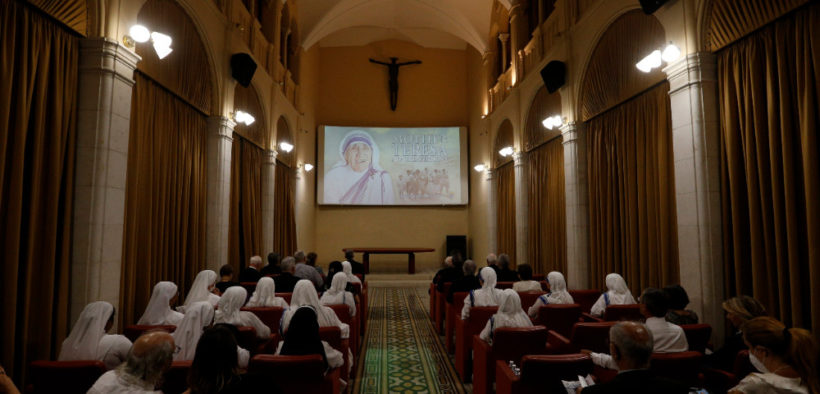
Knights of Columbus produces new movie about St. Mother Teresa


New film on Mother Teresa seeks to put 20th-century saint back in spotlight


VATICAN CITY (CNS) — With St. Teresa of Kolkata’s death 25 years ago, there is an entire generation of young men and women who did not see much about her life and legacy, serving “the poorest of the poor.”

That meant it was time to put her back in the spotlight, said a panel of those who were promoting a new documentary about the life of this saint, known popularly as Mother Teresa, who founded the Missionaries of Charity.

At her beatification in 2003, St. John Paul II called her a “courageous woman whom I have always felt beside me.”

Mother Teresa was “an icon of the good Samaritan” who went “everywhere to serve Christ in the poorest of the poor. Not even conflict and war could stand in her way,” the late pope said.

Supreme Knight Patrick Kelly said at a news conference hosted at Vatican Radio Aug. 31 that the Knights made this film “to reach a new generation with the witness and example of Mother Teresa” and to inspire them.

Produced by the Knights of Columbus, “Mother Teresa: No Greater Love,” had its Vatican premiere Aug. 31, ahead of its release to more than 900 theaters Oct. 3 and 4.

“Thank you for all the efforts made to capture the life of this saint, whose life and testimony have borne much fruit,” wrote Pope Francis, who canonized her at the Vatican in 2016.

“Thank you for promoting this type of initiative that helps, in a creative manner, to make accessible the zeal for evangelization, especially for the young generations promoting the desire to follow the Lord who loved us first,” the pope said in an Aug. 25 letter written to Kelly, replying to news of the Vatican premiere.

Mother Teresa was born Agnes Ganxhe Bojaxhiu to Albanian parents in Skopje, now capital of North Macedonia, on Aug. 26, 1910. On Sept. 5, 1997, she died of cardiac arrest at the motherhouse of the Missionaries of Charity in Kolkata, India.

The documentary, by Emmy award-winning filmmaker, David Naglieri, features archival footage and interviews with dozens of commentators who knew Mother Teresa personally. It was filmed on five continents, providing interviews with many Missionaries of Charity and offering on-the-ground images of their work following in Mother Teresa’s footsteps, serving in what Cardinal Seán P. O’Malley of Boston called “the most hellish places” on earth to “bring the light and the love and the mercy of God.”

The cardinal was overcome with emotion at the news conference, recalling attending a talk Mother Teresa gave in the 1960s before her work was widely known and when he was still a young brother preparing for ordination as a priest of the Order of Friars Minor Capuchin.

He said, “this was one of the most inspiring talks I ever heard in my life.” He and the small number of people who had come to hear her speak, he said, “we were all weeping after a while, we were aware that we were in the presence of holiness.”

The documentary shows the work Mother Teresa inspired and, “when she was feeding the hungry or holding the hands of someone as they lay dying, she was treating them as she would the most important person in her life, Jesus Christ himself,” Kelly said in a media release.

“She was teaching us to have a heart that sees, and if we can learn to see as she did, the world would be a radically different and, I would say, better place,” he said.

Friday, August 28, 2020

The movie is here: Fatima

Fatima’: An inspired retelling of 1917 miracle that shook the world


FATIMA MOVIE


Veteran actor Harvey Keitel co-stars in the new film, which revisits the story of the Virgin Mary appearing to three children in Portugal.

Things change. Take movies for instance. In 1952, director John Brahm brought to the big screen The Miracle of Our Lady of Fatima, the true story of three children in 1917 Portugal whose visions of the Virgin Mary shook the world. Chances are better than average that most Catholics of a certain age have seen Brahm’s work, and why not? It’s a well-crafted, pious work tailor made to capture the hearts of true believers everywhere.

Ah, but things change, don’t they? For one, it’s not so easy these days to get modern moviegoers to watch the classics, no matter how well made they are. Acting styles are different now; so is the technology. To the present-day viewer, an old movie from 1952 often just seems, well … old. That being the case, the time is probably right for a film that revisits the story of those three children. And now we have one in director Marco Pontecorvo’s new feature, Fatima.

Those familiar with the story will find the basic facts all in place. With World War I in full force, the people of Portugal were desperate for any sign of peace. That sign came in the spring of 1917, when nine-year-old Lúcia dos Santos and her younger cousins Jacinta and Francisco Marto claimed they were receiving messages from an apparition of the Holy Virgin. As word spread and pilgrims started to flock to

he parish of Fátima, the intensely anti-clerical authorities tried to put a stop to it all, though to no avail. The visions culminated in the famous Miracle of the Sun, in which thousands of witnesses purported to see Sol turn into a spinning disc and hurtle towards the Earth before returning to its natural state.
Like its well-known predecessor, Fatima is a well-crafted retelling of these events, albeit in a manner more fitting of the times. The acting is more naturalistic, with Stephanie Gil in particular turning in a fine performance as the young Lucia. The settings are less stagey than the Brahm movie and look more like what you would expect from an impoverished village suffering under wartime conditions. And when it comes to set pieces like the Miracle of the Sun, well, there’s this little thing now called CGI that the filmmakers use to liven such scenes up a bit.
As for the reverential tone of the 1952 film, that also mostly remains intact in Fatima. But things do change. Piety, alas, is not a big draw for a lot of today’s more secular minded audiences. They need a different way into the story, and that comes in the form of Harvey Keitel. In a series of fictionalized vignettes interspersed throughout the film, the venerable actor plays a skeptical professor/author come to interview the 82-year old Lucia, now a Discalced Carmelite nun known as Sister Maria Lúcia of Jesus and of the Immaculate Heart. (In reality, Sister’s Lúcia’s status as a cloistered nun prevented her from such visitors, though she communicated with the wider world in books and letters, and made four brief return visits to Fátima on the occasion papal pilgrimages.)

It is the professor’s intent to pick at Lucia’s memories until he confirms his pet theory regarding the events surrounding Fatima. Said theory is that Lucia crafted an imaginary maternal figure to provide her the love and attention she wasn’t getting from her real mother. The cousins, they simply played along because it was fun. The Miracle of the Sun, of course, could easily be dismissed as a freak meteorological disturbance. The fact that a few kids somehow predicted an unpredictable event to the day it happened, that was just lucky coincidence. In short, Keitel’s skeptic already has all his conclusions in hand before ever talking to Lucia; he just wants her to admit he’s right. She doesn’t.


The gentle back-and-forth between Keitel and the wonderful Sônia Braga, who plays the older Lucia, is fine, but whether it’s necessary will be up to personal taste. Those who might prefer a simple updated version of the story may find the later-day scenes intrusive. Those who don’t mind a bit of religious debate thrown into the mix will appreciate them. Either way, Fatima is still a respectful revisit to the tale of Lucia and her family. It’s also, in the end, a reaffirmation of the message delivered to those children back in 1917, that the world needs our penance and our prayers, and it needs them right now. Some things, it seems, never change.

Thursday, May 31, 2012

The movie for Greater Glory sheds light on the Cristero War in Mexico

The Cristero War: the Story Behind the Cover Up


Historian Gives Evaluation of Film, Explains What Happened in 1920s Mexico


By Kathleen Naab
MEXICO CITY, MAY 30, 2012 (Zenit.org).- If one asks a young Mexican about the basics of the Cristero War -- what it was and when it happened -- it's entirely possible to get a blank stare in response. Though one of the most important chapters in 20th-century Mexico, the war has been largely covered up.
The film "For Greater Glory," which opens Friday in the United States and has found great success in Mexico since it opened in April, aims to correct that injustice and bring the war and its heroes to light.
"For Greater Glory" (titled Cristiada in Spanish) is essentially historically accurate, says historian Ruben Quezada, who has written “For Greater Glory: The True Story of Cristiada" as a companion book to the film. The companion volume is being published by Ignatius Press and will be released June 15 in English and Spanish.
ZENIT asked Quezada for an overview of the history of the Cristero War, and about some of the heroes of the conflict -- heroes both for society and for the Church.
ZENIT: Neither a film nor a ZENIT interview is sufficient to explain all the historical intricacies of such a complex epoch. Still, could you give us a brief overview of the Cristero War?
Quezada: The Cristero War is a chapter in Mexico’s history in the 1920s, when thousands of Catholics answered this crucial question [of religious freedom] at the cost of their very lives. President Plutarco Calles launched a direct attack on the Catholic Church using articles from Mexico’s Constitution, which created this uprising and counter-revolution against the Mexican government during that time. The original rebellion was set off by the persecution of Roman Catholics and a ban on their public religious practices.
There are two important dates to point out here.
The persecution began on Aug. 1, 1926, when the government re-enacted the penal code and forced the closure of all Catholic churches throughout the entire country with its new anticlerical laws. However, the first coordinated uprising for religious freedom did not occur until Jan. 1, 1927.
It was not until mid June 1929 when the truce was officially signed, bringing an end to the Cristero War.
ZENIT: Is For Greater Glory a historically accurate film?
Quezada: Apart from some “artistic license” the film is essentially accurate.
ZENIT: The movie alludes to some discrepancy between the Vatican's position regarding the religious persecution, and that of the Cristero fighters. Could you explain this?
Quezada: When the oppression was about to begin, the Vatican granted permission -- requested by the Mexican bishops -- to cease any Catholic religious services in order to avoid confrontations. Additionally, the Holy See wrote letters to the government requesting they abolish the Calles Law. The government ignored each request. As the war intensified, Rome continued to have direct communications with President Calles to ask for leniency. Not only were Vatican officials [in Mexico] dismissed, but diplomatic relations were broken off by the government. Lastly, Pope Pius XI wrote an encyclical letter to the clergy and the faithful of Mexico to give them courage and hope during this persecution. There was really not much else the Holy See could do. On Nov. 18, 1926, the Pope sent the encyclical letter Iniquis Afflictisque (On the Persecution of the Church in Mexico) to offer prayers and encouragement during this difficult time.
ZENIT: Some of the characters of the film are real-life blesseds or saints. Who are they and what is their story?
Quezada: Anacleto González Flores (played by actor Eduardo Verástegui of Bella) was born on July 13, 1888, in Tepatitlán, Jalisco, Mexico.
He was greatly involved in social and religious activities and was an enthusiastic member of the Catholic Association of Young Mexicans (ACJM). He taught classes in catechism, was dedicated to works of charity and wrote articles and books with a Christian spirit. In 1922 he married María Concepción Guerrero and they had two children.
By 1926, the situation in Mexico had worsened and Anacleto, who up until this time had advocated passive, non-violent resistance, joined the cause of the National League for the Defense of Religious Freedom upon learning of the murder of four members of the ACJM.In January 1927 guerrilla warfare spread throughout Jalisco; and from his many hiding places, Anacleto wrote and sent bulletins and studied major strategies. The young man was captured on the morning of April 1, 1927, in the home of the Vargas González family, along with the three Vargas brothers.
He was taken to Fort Colorado where his torture included being hung by his thumbs until his fingers were dislocated and having the bottom of his feet slashed. He refused, however, to supply his captors with any information. Anacleto González Flores was condemned to death and was shot together with the Vargas González brothers and Luis Padilla Gómez on that same day, April 1, 1927.
It is important to note here that Anacleto González Flores along with Miguel Gómez Loza both received the “Pro Ecclesia Et Pontifice” award for their incredible works of service to the Catholic Church.
Miguel Gómez Loza (played by actor Raúl Mendez) was born on Aug. 11, 1888, in Tepatitlán, Jalisco, Mexico. From a young age he had a strong love for God and a great devotion to the Blessed Mother.When he was 26, Miguel entered the University of Morelos where he earned a law degree, and eventually opened an office in Arandas (state of Jalisco) as an attorney.In 1915 he became a member of the ACJM, and in 1919 he established a national congress of Catholic workers to unify industry workers, commercial employees and agricultural laborers. He also worked tirelessly to defend the rights of the needy, which caused him to be arrested 59 times for organizing protests against the government.In 1922, Miguel married María Guadalupe Sánchez Barragán and they had three children. He joined the "National League for the Defense of Religious Freedom" in 1927, but believed in non-violence in order to resist the persecution.
After the death of Anacleto, he was appointed by Catholics as governor of Jalisco and strove by all the means at his disposal to defend liberty and justice.By March of 1928, Miguel was living on a ranch near Atotonilco, Jalisco. On March 21, federal forces who had been hunting for him discovered his whereabouts; he was executed by firing squad the same day.
José Sanchez del Rio (played by actor Mauricio Kuri) was a young Cristero soldier who joined the uprising to defend religious liberty. He was horrified to see the attacks on the priests and the desecration of churches in his small hometown of Sahuayo, Michoacan.When the Cristero War broke out in 1926, his brothers joined the rebel forces, but his mother would not allow him to take part [because of his young age]. The rebel general, Prudencio Mendoza, also refused his enlistment.The general finally relented and allowed José to become the flag bearer of the troop. He was known to be one of the youngest members of the Cristero movement.After his arrest we know of the gruesome events that transpired after the government's failure to break José's resolve on the evening of Feb. 10, 1928: “Consequently they cut the bottom of his feet and obliged him to walk around the town toward the cemetery. They also at times cut him with a machete until he was bleeding from several wounds. He cried and moaned with pain, but he did not give in. At times they stopped him and said, ‘If you shout ‘Death to Christ the King’ we will spare your life.’ José would only shout, "I will never give in. Viva Cristo Rey!" When they reached the place of execution, they stabbed him numerous times with bayonets. He only shouted louder, "Viva Cristo Rey!" The commander was so furious that he pulled out his pistol and shot Blessed José Sanchez del Rio in the head.
We do have a list of priests and laymen who have been beatified and canonized from this persecution in Mexico.
St. Agustín Caloca
St. Atilano Cruz Alvarado
St. Cristobal Magallanes
St. David Galván Bermudes
St. David Roldán Lara
St. David Uribe Velasco
St. Jenaro Sánchez Delgadillo
St. Jesús Méndez Montoya
St. José Isabel Flores Varela
St. José Maria Robles Hurtado (Priest)*
St. Jóven Salvador Lara Puente
St. Julio Álvarez Mendoza
St. Justino Orona Madrigal
St. Luis Batiz Sáinz (Priest)*
St. Manuel Morales
St. Margarito Flores García
St. Mateo Correa Magallanes (Priest)*
St. Miguel De La Mora (Priest)*
St. Pedro de Jesús Maldonado Lucero (Priest)*
St. Pedro Esqueda Ramírez
St. Rodrigo Aguilar Alemán (Priest)*
St. Román Adame Rosales
St. Sabas Reyes Salazar
St. Tranquilino Ubiarco
St. Toribio Romo González
Blessed Anacleto González Flores
Blessed Andrés Solá Molist (Priest)*
Blessed Ángel Darío Acosta Zurita (Priest)
Blessed Ezequiel Huerta Gutiérrez
Blessed Jorge Vargas González
Blessed José Sánchez del Río
Blessed José Trinidad Rangel Montaño (Priest) *
Blessed Leonardo Pérez Larios *
Blessed Luis Magaña Servín
Blessed Luis Padilla Gómez
Blessed Miguel Gómez Loza
Blessed Mateo Elías del Socorro Nieves (Priest)
Blessed Miguel Agustin Pro Juárez (Priest)
Blessed Ramón Vargas González
Blessed Salvador Huerta Gutiérrez
* Indicates member of Knights of Columbus
Our site http://www.vivacristorey.com/ will have documentation on the lives of each one along with the new book “For Greater Glory: The True Story of the Cristiada.” It’s the official companion book to the film published in English and Spanish by Ignatius Press. As an expert on the Cristero War, I was honored to write it. The book also includes a foreword by Archbishop José Gomez of Los Angeles and an introduction by Eduardo Verástegui, and there is an essay by Knights of Columbus Supreme Knight Carl Anderson.
ZENIT: The Cristero War is a page mostly lost to history, even for young Mexicans, who don't learn about it in school. How is this possible?
Quezada: As recently as the 1980s it was difficult to find a single book that mentioned anything substantive about the Cristiada. If it was mentioned, it usually was no more than a single sentence in President Calles’ biography. School systems did not include the Cristiada as part of its history so that future generations would soon lose any knowledge of it.
But even today, it is important to note a crucial difference between the official state narrative and the Catholic understanding of events. The Mexican government portrays the Cristiada as a rebellion because the Cristeros “rebelled” against the enforcement of the Calles Law. But rebellion is hardly a fitting way to describe an attempt to restore customs in place for centuries before the Mexican Revolution. Catholics see the Cristiada as a response, albeit a violent one, to unjust persecution because Catholics were persecuted by unjust laws that inhibited their religious freedom.
There is more freedom of the press today, and a large volume of untold stories about the Cristiada -- testimonies and images that were illegal to print or publish for many years -- are finally emerging. There are literally thousands of testimonies coming to light that reveal an inspiring history that has been hidden for decades under a dark shadow of fear and denial.
--- --- ---
On the Net:
“For Greater Glory: The True Story of Cristiada”: http://www.forgreaterglorybook.com/