reflections, updates and homilies from Deacon Mike Talbot inspired by the following words from my ordination: Receive the Gospel of Christ whose herald you have become. Believe what you read, teach what you believe and practice what you teach...
In St. Peter’s Basilica in Vatican City, on June 29, the feast day of Saints Peter and Paul, Archbishop Checchio and the new metropolitan archbishops (that’s an archbishop who is the leader of an archdiocese) from around the world will receive a special garment called the pallium from Pope Leo XIV.
The pallium is a circular band made of soft white wool that is worn over an archbishop’s shoulders during important Masses. It has two woolen strips that hang down: one in the front and one in the back. Only an archbishop or the pope can wear a pallium.
The pallium is rich with meaning. Its shape looks like a yoke, the wooden beam that farm animals wear when pulling a plow in a field. A yoke usually connects two animals so they can work together. Jesus said that his yoke is easy and his burden is light, so when we work together with Jesus, he helps us even when the work seems too hard. This reminds the archbishops that God has called them to work with the pope and with Jesus to faithfully to care for the people in the part of the world given to them.
The six black crosses on the pallium remind us of the wounds Jesus received during his crucifixion. In three of those crosses there are metal pins, which represent the nails that held Jesus to the Cross. The ends of the hanging strips are covered in black cloth, making them look like the legs of a lamb. This helps us remember Jesus, the Lamb of God, and the gentle care a bishop should show to the people entrusted to him.
Even the wool used to make the pallium is special. It comes from lambs that are blessed by the pope each year on the Feast of Saint Agnes, January 21. The lambs are later shorn, and their wool is woven into the pallia. This reminds us that just like Jesus, the Good Shepherd, lovingly carries his sheep on his shoulders, our archbishop loves and cares for us too.
The night before they are given to the new archbishops, the pallia are placed near the tomb of Saint Peter beneath the main altar of Saint Peter’s Basilica. They stay there all night until it is time for the Mass.
The pallium is much more than a piece of clothing. It is a sign that bishops are called to be loving shepherds who care for God’s people. It also shows their unity with the Pope and their mission to help others grow closer to Jesus Christ.
When you see the pallium, you can remember that Jesus loves us very much and has given us an archbishop to love, teach and guide us.
Pope Leo XIV presented with lambs on feast of St. Agnes
Two lambs were presented to Pope Leo XIV on Tuesday on the liturgical feast of St. Agnes, in keeping with an ancient tradition of the Roman Church.
Vatican News
On Wednesday, January 21, in the Vatican’s Urban VIII Chapel, Pope Leo XIV was presented with two lambs on the occasion of the Memorial of St. Agnes of Rome.
Following an ancient tradition, the animals were later blessed in the Basilica of St. Agnes Outside the Walls in northern Rome, where the young 4th-century martyr is buried.
As is customary, the wool from these lambs will be used to make the Pallia for the new Metropolitan Archbishops.
The Pallium is a liturgical insignia of honor and jurisdiction worn by the Pope and Metropolitan Archbishops in their churches and in those of their ecclesiastical provinces. It consists of a narrow band of white woolen cloth decorated with six black silk crosses.
The rite of blessing and imposition of the pallia is performed by the Pope on June 29, the Solemnity of Sts. Peter and Paul.
An ancient tradition
The first mentions of the tradition of blessing two lambs on the feast of St. Agnes date back to the 6th century.
It is tied to an ancient legend about her life that says that she appeared to her parents after her death when they came to pray at her tomb. They saw her surrounded by a choir of virgins and holding a pure lamb in her arms.
Historical records also indicate that two lambs were once considered the “rent” paid by the monks of the Basilica of St. Agnes Outside the Walls to the Basilica of St. John Lateran. Members of the Lateran Chapter would present these lambs to the Pope for his blessing.
For many centuries, lambs from the Trappist farm at the Abbey of the Three Fountains in southern Rome were taken directly from the Basilica of St. Agnes to the Pope to be blessed.
Then the lambs would be sent to the Benedictine nuns of the Basilica of St. Cecilia in Trastevere, who would shear them during Holy Week, so that the wool could be woven into the pallia for the new archbishops.
In recent years, some aspects of this tradition have changed as the Trappists no longer maintain the sheep farm, and the Pope does not bless the lambs at the Vatican. However, the Benedictine nuns still shear the lambs to make the new pallia.
The lambs of St Agnes: An ancient tradition of the Roman Church
Keeping with an ancient tradition, two lambs are blessed on the feast of Saint Agnes at the basilica bearing her name on Via Nomentana in Rome – the traditional site of her burial. The wool from these lambs will be woven into palliums for new archbishops, continuing a sacred tradition deeply rooted in history.
By Dorota Abdelmoula-Viet – Vatican City
The first mentions of the custom of blessing lambs at the tomb of St. Agnes, a young Roman martyr from the early 4th century, date back to the 6th century. The tradition is tied to an ancient legend about St. Agnes, who is said to have appeared to her parents after her death. Having come to pray at her tomb, they saw her surrounded by a choir of virgins and holding a pure lamb in her arms. Historical records also indicate that two lambs were once considered the “rent” paid by the monks of the Basilica of St. Agnes Outside the Walls to the Basilica of St. John Lateran. Members of the Lateran Chapter would present these lambs to the pope for his blessing.
A record from the archives of the Basilica of St Peter in Chains also documents the blessing of lambs in 1550, along with an explanation of the custom’s origins. “The origin of these lambs as rent paid to St John [Lateran] stems from St. Constantina, the daughter of Emperor Constantine, who endowed the church (though some say it was King Charles I). She founded the church and monastery of St. Agnes, granting them significant assets. Since this monastery was a fief of the world’s first church, it annually paid two lambs to the canons as a token of acknowledgment. During the solemn Mass, after Communion, the lambs were blessed and handed over to the canons [...] A notary would draft a document confirming the handover. Those delivering the lambs to the pope received a few gold coins as payment,” the chronicle states.
Wool for Palliums for Archbishops
For centuries, lambs from the Trappist farm at the Abbey of Tre Fontane were taken directly from the Basilica of St Agnes to the Holy Father. He would receive them in a solemn procession and bless them. Later, the pope entrusted the lambs to the Benedictine nuns of the Basilica of St Cecilia in Trastevere, who sheared them after a few months. Their wool was then woven into palliums for newly appointed archbishops.
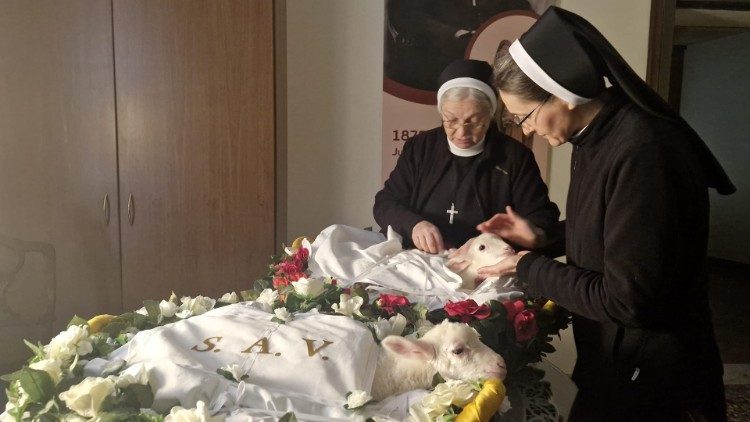
In recent years, some aspects of this tradition have changed: the Trappists no longer maintain the sheep farm, and the Holy Father no longer blesses the lambs in the Vatican. However, the tradition of entrusting the lambs to the Benedictine nuns remains unchanged. During Holy Week, the nuns shear the lambs to weave their wool into palliums. Before this, the lambs are prepared for the blessing ceremony at the Basilica of St Agnes by the Sisters of the Holy Family of Nazareth, who have overseen this task at their home on Via Machiavelli for over 140 years. This year, the preparation of the lambs carried special significance: it coincided with the ongoing Jubilee Year and the 150th anniversary of the Congregation’s founding.
Caring for the Lambs: A Reflection of Hidden Life in Nazareth
In the 1880s, the newly established Congregation of the Sisters of the Holy Family of Nazareth was asked to take over the care of the lambs, replacing the sisters who previously handled this responsibility.
“Our Foundress, Blessed Maria Frances Siedliska, saw helping to prepare the lambs for the feast of St Agnes as an expression of our service to the Church,” said Sister Dorota Podwalska, CSFN, the provincial superior of the Sisters of the Holy Family of Nazareth in Rome, in an interview with Vatican Media. “Even today, our involvement in this tradition shows our love and fidelity to the Church.”
The preparation of the lambs has mainly remained the same over the years: on the eve of St. Agnes’ feast day, they are brought to the Holy Family Sisters’ house on Via Machiavelli. The sisters wash, feed, and care for the lambs overnight. The next day, the lambs are placed in two baskets. One basket is adorned with red roses, symbolizing martyrdom, and marked with the initials S.A.M. (Sant Agnese Martire). The other basket is decorated with white roses, symbolizing virginity, and marked with the initials S.A.V. (Sant Agnese Vergine).
A car from the Basilica of St. John Lateran arrives in the morning at the sisters’ home. Accompanied by two Lateran chamberlains, the lambs are taken to a solemn Mass at the Basilica of St Agnes Outside the Walls. The Abbot General of the Canons Regular of the Lateran usually celebrates this Mass. From there, the lambs are entrusted to the Benedictine nuns in Trastevere.
“One more element of our spirituality connects us to the tradition of the lambs,” said the provincial superior of the Sisters of Nazareth. “Our care for them and their preparation for the blessing is simple and hidden, just as the life of the Holy Family in Nazareth was hidden and ordinary.”