Showing posts with label indigenous peoples. Show all posts

Monday, June 17, 2024

USCCB apologizes for abuses against Native Americans


US Catholic bishops apologize to Native Americans for abuses, promise new outreach


June 14 (Reuters) - U.S. Catholic bishops offered an apology to Native Americans on Friday for the church's role in inflicting trauma on their communities and adopted new guidelines for ministering to indigenous Catholics.
The new policies, approved by the U.S. Conference of Catholic Bishops, call on church leaders to set up listening sessions with local Native leaders, incorporate tribal customs into sacred rites and improve access to Catholic universities and other educational opportunities for Native Americans, among other directives.
The document chronicled some of the abuses that Native Americans suffered at the hands of the church, including its operation of more than 80 government-sponsored boarding schools that were part of a decades-long forced assimilation program.
The schools were created by the federal government in the 19th century and lasted for 150 years, during which Native children were removed from their homes, forbidden to speak their own languages and given new English names.
A government investigation into the system found widespread physical, sexual and emotional abuse, as well as hundreds of deaths.
"The Church recognizes that it has played a part in traumas experienced by Native children," the document said, saying "these tragedies" led to addiction, domestic abuse, abandonment and neglect that harmed families.
Elsewhere, the bishops said, "We apologize" for the wrongs.
The guidelines call on church members to "be open to cooperating with Tribal and other government investigations into any Catholic involvement in ethnic abuse," including boarding schools.
Many of the new policies are aimed at addressing the chasm that some Native Americans believe separates their tribal backgrounds and their Catholic identities, the document said.
"For Native Catholics who feel this tension, we assure you, as the Catholic bishops of the United States, that you do not have to be one or the other," the document said. "You are both. Your cultural embodiment of the faith is a gift to the Church."

More than 340 U.S. parishes out of more than 16,000 serve predominantly Native American congregations, and approximately 20% of all Native Americans consider themselves Catholics, according to the bishops conference.

Thursday, May 18, 2023

Vatican efforts towards reconciliation with Australia's Indigenous peoples


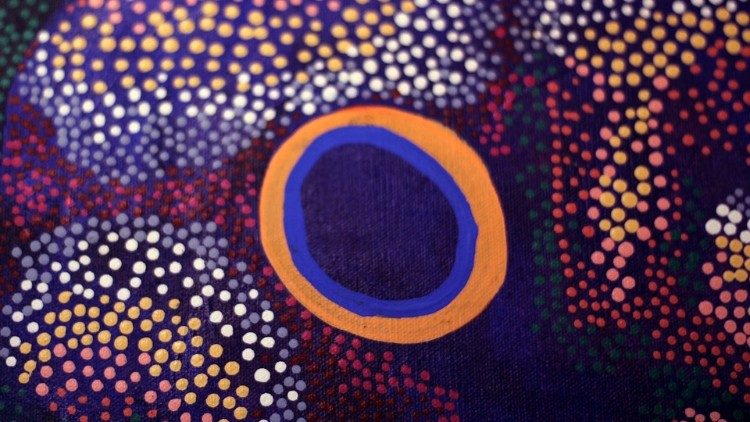
An example of Aboriginal artAn example of Aboriginal art 

Aboriginal elder to visit Vatican for Australia's Reconciliation Week

During her stay in the Vatican, Dr Ungunmerr Baumann will meet with senior officials, discussing faith, ecology, and reconciliation with Indigenous peoples.

By Joseph Tulloch

Dr Miriam-Rose Ungunmerr Baumann, an Australian aboriginal elder, teacher and artist, will be in the Vatican from the 29th May to the 3rd June.

During her week-long visit, she will speak on themes of spirituality, ecology, and reconciliation between the Church and Indigenous Australians. 

Dr Ungunmerr Baumann is expected to meet with Pope Francis, and attend a number of events with senior figures in the Vatican. 

The Australian Ambassador to the Holy See, Chiara Porro, said on Thursday that she was “thrilled” to announce the trip, calling it an “emotive journey by one of our country’s most respected Indigenous leaders.”

Elder, teacher, artist, activist

Dr Ungunmerr Baumann was born in 1950 in Australia’s Northern Territory, and has worked as a teacher, artist, and advocate for Indigenous rights. 

In 1975, she became the first fully-qualified Aboriginal teacher in the entire country. In 1993, she was appointed Principal of St Francis Xavier School in Daly River. 

In 1986, meanwhile, she co-founded the Merrepen Arts Centre, which aims to foster spiritual growth through the visual arts. She has worked extensively with Aboriginal children, helping them to use art to explore their relationship with the natural world.  

Her leadership has earned her an Order of Australia Medal and the 2021 Senior Australian of the Year award.

The visit

Dr Ungunmerr Baumann’s visit to the Vatican is timed to coincide with Australia’s Reconciliation Week, an annual celebration of Indigenous history and culture.

Aside from her meeting with Pope Francis, the main event of her trip will be an evening reception at the Vatican Museums on the 30th May. There, Dr Ungunmerr Baumann – whose artistic work draws on both Aboriginal and Christian traditions – will present a new specially commissioned piece. 

On the 31st May, she will participate in a public discussion with Bishop Paul Tighe, Secretary of the Vatican’s Dicastery for Education and Culture.

That evening, Cardinal Roche, Prefect of the Vatican’s liturgy Dicastery, will preside over a Mass marking 50 years since the first Aboriginal Liturgy. The following day, Dr Ungunmerr Baumann will speak on the subject of “An Indigenous perspective on integral ecology: the concept of Dadirri.”

The final event of the week will be a lecture by Fr Frank Brennan SJ, an advocate for Indigenous Australians, on the 1992 ‘Mabo’ judgement, a milestone legal victory for Indigenous rights.

A “unique opportunity”

Announcing the visit, Ambassador Porro said that she was “thrilled to announce Dr Ungunmerr Baumann’s visit to Rome.”

Referring to the discussions on ecology, education, and Indigenous affairs, she said that the visit would be “a unique opportunity to exchange perspectives on many priority issues for both Australia and the Holy See.”

“It will also be,” she added, “an emotive journey by one of our country’s most respected Indigenous leaders, and it stands to be an inspiration and an example that will resonate strongly with Aboriginal communities across Australia.”

Thursday, March 30, 2023

Vatican repudiates Doctrine of Discovery; defends the human rights of indigenous peoples


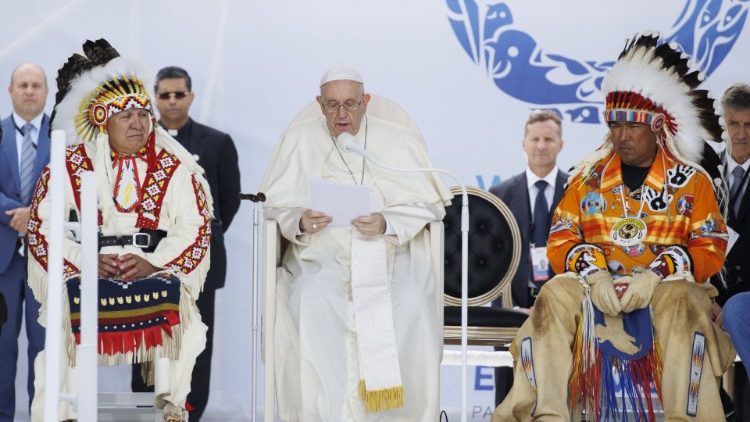
Pope Francis meets with indigenous people and communities during his penitential piligrimage to Canada in July 2022Pope Francis meets with indigenous people and communities during his penitential piligrimage to Canada in July 2022  (2022 Getty Images)

Church defends Indigenous peoples: ‘Doctrine of Discovery’ was never Catholic

A “Joint Statement” from the Dicastery for Culture and the Dicastery for Integral Human Development formally repudiates "those concepts that fail to recognize the inherent human rights of indigenous peoples, including what has become known as the legal and political ‘doctrine of discovery’."

Vatican News

Thanks to dialogue with indigenous peoples, “the Church has acquired a greater awareness of their sufferings, past and present, due to the expropriation of their lands … as well as the policies of forced assimilation, promoted by the governmental authorities of the time, intended to eliminate their indigenous cultures,” according to a “Joint Statement” issued by the Dicastery for Culture and Education and the Dicastery for Promoting Integral Human Development, and published on Thursday.

The document states that the “Doctrine of Discovery” – a theory that served to justify the expropriation by sovereign colonizers of indigenous lands from their rightful owners – “is  not a part of the teaching of the Catholic Church.” It further affirms that the papal bulls that granted such “rights” to colonizing sovereigns have never been a part of the Church’s Magisterium.
 

This important text, coming eight months after Pope Francis' penitential journey to Canada, clearly reaffirms the Catholic Church's rejection of the colonizing mentality. “In the course of history,” the document recalls, “the Popes have condemned acts of violence, oppression, social injustice, and slavery, including those committed against indigenous peoples.” It also notes the numerous examples of bishops, priests, women and men religious and lay faithful who gave their lives in defense of the dignity of those peoples.” At the same time, it acknowledges that “many Christians have committed evil acts against indigenous peoples for which recent Popes have asked forgiveness on numerous occasions.”

Regarding the so-called “Doctrine of Discovery", the Statement explains: “The legal concept of ‘discovery’ was debated by colonial powers from the sixteenth century onward and found particular expression in the nineteenth-century jurisprudence of courts in several countries, according to which the discovery of lands by settlers granted an exclusive right to extinguish, either by purchase or conquest, the title to or possession of those lands by indigenous peoples.” According to some scholars, this “doctrine” found its basis in several papal documents, specifically two bulls of Nicholas V, Dum diversas (1452) and Romanus Pontifex (1455); and Alexander VI’s bull Inter caetera (1493). These are legal acts by which these two Pontiffs authorized the Portuguese and Spanish sovereigns to seize property in colonized lands by subjugating the original populations.

“Historical research clearly demonstrates that the papal documents in question, written in a specific historical period and linked to political questions, have never been considered expressions of the Catholic faith,” the Statement declares. Nonetheless, “the Church acknowledges that these papal bulls did not adequately reflect the equal dignity and rights of indigenous peoples.” The Statement goes on to say that “ It adds that “the contents of these documents were manipulated for political purposes by competing colonial powers in order to justify immoral acts against indigenous peoples that were carried out, at times, without opposition from ecclesiastical authorities.” The two Dicasteries, therefore, affirm, “It is only just to recognize these errors, acknowledge the terrible effects of the assimilation policies and the pain experienced by indigenous peoples, and ask for pardon.”

The Statement then quotes the words of Pope Francis: “Never again can the Christian community allow itself to be infected by the idea that one culture is superior to others, or that it is legitimate to employ ways of coercing others.” The Statement goes on to say that, “in no uncertain terms, the Church’s Magisterium upholds the respect due to every human being,” and concludes, “The Catholic Church therefore repudiates those concepts that fail to recognize the inherent human rights of indigenous peoples, including what has become known as the legal and political ‘doctrine of discovery’.”

“The Catholic Church therefore repudiates those concepts that fail to recognize the inherent human rights of indigenous peoples, including what has become known as the legal and political ‘doctrine of discovery’.”

The Statement recalls the “numerous and repeated” declarations of the Church and the Popes in favour of the rights of indigenous peoples, beginning with the 1537 bull Sublimis Deus of Paul III, which solemnly declared that indigenous peoples “are by no means to be deprived of their liberty or the possession of their property, even though they be outside the Christian faith; and that they may and should, freely and legitimately, enjoy their liberty and possession of their property; nor should they be in any way enslaved; should the contrary happen, it shall be null and have no effect.”

Concluding, the Statement notes that, more recently, “the Church’s solidarity with indigenous peoples has given rise to the Holy See’s strong support for the principles contained in the United Nations Declaration on the Rights of Indigenous Peoples.” It adds, “the implementation of those principles would improve the living conditions and help protect the rights of indigenous peoples as well as facilitate their development in a way that respects their identity, language, and culture.”