reflections, updates and homilies from Deacon Mike Talbot inspired by the following words from my ordination: Receive the Gospel of Christ whose herald you have become. Believe what you read, teach what you believe and practice what you teach...
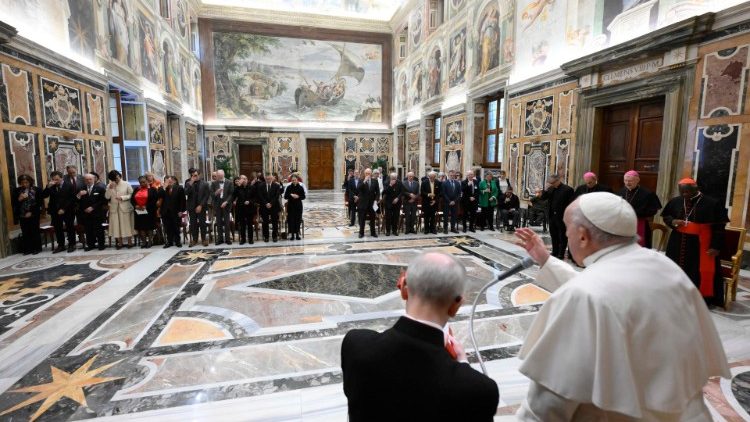
Pope Francis meets with members of the Pontifical Academy of Social Sciences (VATICAN MEDIA Divisione Foto)
POPE
Pope Francis advocates for inclusion and dignity for people with disabilities
Pope Francis addresses the Pontifical Academy of Social Sciences, and emphasises the need for inclusive societies that recognise the dignity and rights of persons with disabilities, denouncing the throwaway culture and advocating for integral inclusion and solidarity.
By Francesca Merlo
On the occasion of their plenary assembly, thirty years since its foundation, members of the Pontifical Academy of Social Sciences discussed the theme, "Disability and the Human Condition. Changing the Social Determinants of Disabilities and Building a New Culture of Inclusion”.
"I appreciate the fact that you have chosen this as the theme", Pope Francis said on Thursday, 11 April, as he met with members of the Academy in the Vatican.
"In recent years, the international community has made significant progress in acknowledging the rights of persons with disabilities", said the Pope. He noted, however, that whilst many countries are moving forward in this direction, in others "this acknowledgment is still partial and uncertain". Where progress has been made, he added, we have seen "how individuals can flourish and the seeds can be sown for a more just and solidary society".
The Church’s social teaching is very clear in this regard: “Persons with disabilities are fully human subjects, with rights and duties” and every human being has the right to live with dignity and to develop integrally. “Even if they are unproductive, or were born with or develop limitations, this does not detract from their great dignity as human persons, a dignity based not on circumstances but on the intrinsic worth of their being. Unless this basic principle is upheld, there will be no future either for fraternity or for the survival of humanity”.
Vulnerability and frailty
Pope Francis went on to note that vulnerability and frailty are part of the human condition, and not something proper only to persons with disabilities.
Sadly, however, in various parts of the world many persons and families continue to be isolated and forced to the margins of social life because of disabilities. "This not only in poorer countries", stressed the Pope, "but also in situations of greater prosperity", where, at times, disabilitis are considered a “personal tragedy” and the disabled are “hidden exiles”, treated as foreign bodies in society.
The throwaway culture
Turning to the concept of the throwaway culture, Pope Francis noted that it truly has no borders. In today's throwaway culture there is what the Pope described as "a less visible but extremely insidious factor that erodes the value of the disabled in the eyes of society and in their own eyes". This, he explained is "the tendency to make individuals view their life as a burden both for themselves and for their loved ones"; the spread of this mentality, he said, "turns the throwaway culture into a culture of death".
A culture of inclusion
To combat this throwaway culture, Pope Francis continued, what is necessary is the promotion of a culture of inclusion "by forging and consolidating the bonds of belonging within society". The Holy Father noted that in poorer countries this remains, for the most part, a goal to be achieved and "governments that are committed in this regard must thus be encouraged and supported by the international community". At the same time, he continued, "it is necessary to support the organisations of civil society, since without their networks of solidarity, in many places people would be left to themselves".
Integral inclusion
Then Pope Francis noted that what is necessary in the development of a culture is integral inclusion. "Subsidiarity and participation are the pillars of effective inclusion", he said, adding that "in this regard, we can appreciate the importance of associations and movements of disabled persons that work to promote their participation in society".
Bringing his discourse to a close, Pope Francis encouraged those present to continue to recognise that all people are our brothers and sisters, and that "seeking forms of social friendship that include everyone, is not merely utopian."
Finally, he thanked all those present and expressed his gratitude for their "concrete concern" and work in bettering the world for our sisters and brothers with disabilities.
NEW ORLEANS — It’s homecoming season, but one 16-year-old is missing the rite of passage this year.
The sophomore, who has cerebral palsy and uses a wheelchair, is home-schooled — and not by choice.
The teen’s family has sued two local Catholic schools over what it describes as discriminatory admissions practices against students with physical, emotional, or learning disabilities. Now, it has joined a class-action lawsuit that claims that the Archdiocese of New Orleans asks illegal questions about students’ disabilities on its schools’ application forms.
The lawsuit said this kind of practice has denied students with disabilities the opportunity to go to a Catholic school run by the archdiocese.
“We’re very angry at the Catholic Church. We have not been back to church since this happened,” said her mom, who asked that she and her family not be named to protect her daughter’s identity. “The fact that the Catholic schools did this to us and no one from the Church even stepped up to make a comment, tried to help us, or offer any kind of empathy and support — it’s very disheartening.”
It’s hard for her daughter, identified only by the initials E.R. in court documents, to watch social media and listen to her friends talk about everyday school milestones that she won’t experience, her mother said.
“She shouldn’t be judged on what school she can go to, depending upon if she walks on two feet or she rolls in a chair. That has nothing to do with where she should go to school,” she added.
What the lawsuit says
E.R.’s family initially sued two separate schools in 2020 when the then-13-year-old started looking for a high school. The latest class-action lawsuit includes her as well as two other students: an 8-year-old boy with dyslexia and a 16-year-old boy with attention deficit hyperactivity disorder (ADHD).
The lawsuit claims that by asking unlawful questions about disabilities and requesting medical information of prospective students before they are enrolled, New Orleans-area Catholic schools are violating the Louisiana Human Rights Act, which does not have a religious exemption, and the Louisiana Civil Rights Act for Persons With Disabilities, which explicitly prohibits asking such questions as a matter of admissions.
The suit also alleges “widespread segregation” of prospective students with disabilities in New Orleans-area Catholic schools, accusing the Archdiocese of New Orleans of directing parents of students with disabilities to apply to a small handful of schools for “exceptional learners,” in violation of both acts.
The lawsuit, originally filed in 2022, was put on hold for close to a year by a judge overseeing the archdiocese’s bankruptcy proceedings, which now includes 500 claims of child sex abuse by priests and other clergy. This year, another judge said the outcome of the bankruptcy process would have no bearing on the discrimination case and allowed the suit to move forward.
A trial date has not been set.
The archdiocese canceled an interview with the PBS NewsHour about its admissions and enrollment and has not returned requests for comment on its practices or on the latest figures for how many students with disabilities or special needs are enrolled at its schools.
On the Archdiocese of New Orleans’ website, data from the 2019-2020 school year indicates that 34,182 students attended Catholic schools in the area. However, it reported that only 205 students — less than 1 percent of total enrollment — attended two schools for students with special needs. The archdiocese did not respond to questions about where students with disabilities are enrolled in their education system. On its website, the archdiocese said there are 74 elementary and high schools.
By comparison, the U.S. Department of Education reported that 12.4 percent of Louisiana school-aged students received special education services under the Individuals with Disabilities in Education Act (IDEA) in 2021, as did 14.3 percent of students nationally.
“The Archdiocese of New Orleans supports and encourages the ministry of Catholic education. We have and always will welcome and encourage children with disabilities to apply to our high schools and parish elementary schools,” according to the statement. “The thousands of children with disabilities that thrive in our programs are a testament to that fact. The Archdiocese of New Orleans encourages and supports the efforts of Catholic schools to find the resources to implement or expand their ability to provide adjustments in the learning environment for children with exceptional learning needs,” spokesperson Sarah McDonald said in a statement to the NewsHour.
Christopher Edmunds, a disability rights attorney who filed the latest case on behalf of the families, said “there is no non-discriminatory reason why the school needs to know this information before making an offer of admission.”
Schools need to know information that will help them prepare for accommodations before a child begins — for instance if a child with ADHD needs extra time or a different environment to take tests, he said. Under this process, if a school cannot provide an accommodation — for instance, providing a one-on-one aide at its own expense — admission could be lawfully rescinded, he added.
“They’re just shutting people out at the front door essentially. It is illegal under state law to ask these questions in application forms or at any point in the application process, but they use it as a screening device,” Edmunds said. “A lot of parents see these questions and they’re dissuaded from applying in the first place because they’re uncomfortable disclosing the information or they just know that it’s going to be used against them.”
The lawsuit does not seek monetary damages but is asking the court to order the church to remove the questions, change policy, and provide staff with anti-discrimination training. It also asks for legal fees and for the archdiocese to post a public notice that students of all abilities are welcome to attend Catholic schools.
‘A lot of tears shed’
In the New Orleans area, family tradition plays a large role in high school experiences, especially for those attending Catholic schools.
Louisiana has one of the highest rates of private school enrollment in the nation, in part because of the local Catholic culture. More than 518,000 of the 1.2 million people in the New Orleans area identify as Catholic, according to the archdiocese. Twenty-five percent of New Orleans-area students attend private school, more than twice the national average, according to the Cowen Institute at Tulane University, which studies the city’s public education system.
The girl’s mother hoped her daughter would carry on a family tradition of attending the same school. Instead, she said her daughter was blatantly discriminated against and the family received backlash after filing the lawsuits.
“There are a lot of tears shed and friends were lost over this. We’re now at home school. We didn’t just lose friends. We lost the high school experience, and we lost our church community. It was absolutely horrible,” E.R.’s mom, a lifelong Catholic, said. “There were still a lot of repercussions for what we did. I have had nasty things said about me. Hell yeah, it was hard, but I would do it again in a heartbeat.”
Does federal funding make a difference?
Edmunds and families of students with disabilities believe it’s time to hold the Catholic Church accountable, especially if they are accepting state dollars.
Under Louisiana’s Civil Rights Act for Persons with Disabilities, educational institutions that receive state money are prohibited from using an application for admissions that “elicits or attempts to elicit information … concerning the disability of an otherwise qualified applicant for discriminatory purposes,” according to the lawsuit.
Records from the Louisiana Department of Education show the archdiocese and other local Catholic schools received at least $8 million from the state for the 2019-20 school year, according to WWL-TV. The funding was used, in part, for textbooks, school lunches and required services.
“They’ve designated certain schools as schools for kids with learning disabilities, and that’s just not legal. Every school needs to accommodate kids with disabilities. I’ve had instances where schools refuse to accept kids with epilepsy or diabetes,” Edmunds said, referring to complaints he’s received from parents. “One plaintiff in this lawsuit went to just about every Catholic school in the area for her child who has dyslexia and they all turned her down and said, ‘No, we can’t accept a child with dyslexia. We don’t have any way to accommodate dyslexia.'”
The suit cites specific questions and schools asking “unlawful questions about disabilities in their applications for admission,” including a request to list “any physical limitations” or “learning disabilities,” and asking if a child has “a vision, hearing, speech or developmental delay, among others.”
The earlier lawsuits E.R.’s family filed also raised questions about local Catholic schools’ use of federal dollars.
Religious organizations often have an exemption to anti-discrimination laws, but since both schools, Mount Carmel Academy and Cabrini High School, accepted federal pandemic funds under the Paycheck Protection Program, Edmunds believed they violated both the Americans with Disabilities Act (ADA) and Section 504 of the Rehabilitation Act and had to abide by federal anti-discrimination laws. This meant religious schools that took federal pandemic dollars were subject to federal anti-discrimination suits, he said.
Cabrini accepted between $350,000 and $1,000,000 and Mount Carmel received between $1,000,000 and $2,000,000, according to the lawsuit. Guidance from the Small Business Administration, which administered the Payroll Protection Program, said that applicants for PPP loans must agree to “not discriminate in any business practice,” including employment practices and services to the public on the basis of “age, race, color, religion, sex, handicap, or national origin.”
In the Mount Carmel case, where the girl’s mother is an alumna, administrators left a voicemail saying, “I do want to tell you that we do not have the capabilities of accepting your child. She is just precious–perhaps one day I will meet her,” according to the complaint. “However, we don’t have the accommodations, and I do think our academic program would be substantially difficult for her.”
In court documents, Edmunds argued that Cabrini refused to make a “reasonable accommodation” for the girl. The complaint said a Cabrini administrator initially told the family that the girl would not be allowed to bring an aide to school, which she requires because she was not independently able to use the bathroom. She was allowed to use the aide, paid for by her parents, at a previous school.
Mount Carmel’s website states the school does not discriminate on the basis of race, color, creed, national or ethnic origin. There’s no mention of disability.
Both lawsuits, which sought compensatory damages, were settled out of court before trial.
Edmunds said the overt discrimination is significant for families because it can also involve retaliation in the broader church community as they fight to continue the legacy of a Catholic high school education in their families. Many are now visiting open houses as the lawsuit awaits trial.
“The Archdiocese and Catholic schools operate sort of like a cabal. There’s this culture of retaliation where if you try to challenge us in any way, well, we’re going to blackball you from the community — your kid, your other children, and your cousins, none are gonna get into this school or that school,” said Edmunds, whose own family has a long tradition of attending the same Catholic high school, including brothers, cousins, uncles, nephews and his grandfather. “I get calls all the time from parents who are furious with the way that they’ve been treated, but they are terrified of actually doing anything because of the retaliation that they think that they’re going to from the church.”
Shortly after the class-action suit was filed, Edmunds said the archdiocese tried to stop the lawsuit by claiming it removed questions from school applications. Edmunds believes the schools are still seeking that information verbally or by other means.
The archdiocese did not return requests for comment on its admissions or enrollment practices.
E.R. and her family will miss out on many high school activities because she’s being homeschooled, but they have learned a valuable lesson on the importance of making sure kids with disabilities do not face more scrutiny than kids without them.
“Not only did it bother me about what they were doing to my kid, but how many other kids were they doing that to? It’s been going on for years and years. Nobody did anything about it,” she said. “No matter how hard it is. If you don’t stand up for your child, nobody else will. That’s the bottom line. Standing up for your disabled child is not an easy thing, but you have to do it. You may lose things but you’re also going to gain things.”
WYD - Pope in Fatima: Blessings in families for generations
Our correspondent in Portugal, Francesca Merlo, describes the scene in Fatima as Pope Francis prays the Rosary with young people with disabilities and takes his time to greet and bless as many people as possible, making their hours of waiting worth it.
By Francesca Merlo - Fatima, Portugal
A dark hue covered the sky over Fatima, making the Sun, recently risen, blood red, whilst the moon on the other side of the Shrine was white as snow.
Along the streets of Fatima, outside the sanctuary, pilgrims continued to walk down the roads towards the entrance to the sanctuary, where Pope Francis would be arriving in under two hours, some carried stools, others carried icons, and others held their children, in their arms or by the hand.
Meanwhile, inside the Shrine, thousands of other pilgrims had already gathered. Some were sleeping, having arrived in the early hours of the morning to get front row seats. They packed up their mattresses and sleeping bags and drank out of their flasks. The railings were filled with banners and messages.
There was a different kind of energy surrounding the Shrine of Fatima on Saturday morning, different to any we have experienced over the last few days here at World Youth Day in Lisbon.
Pope Francis’ visit to Fatima, in fact, is not being counted as part of the World Youth Day celebrations, but as a separate visit.
Of the faithful gathered at the site, very few were wearing WYD credentials around their necks or little white hats. Instead, those queued up were generations of families, at times three or four generations. There were couples with newborn babies and young children; grandparents with their grandchildren; one couple, from Brazil, was there with their fourteen children.
In this sense of familiarity, those who arrived early seem to have done well to do so.
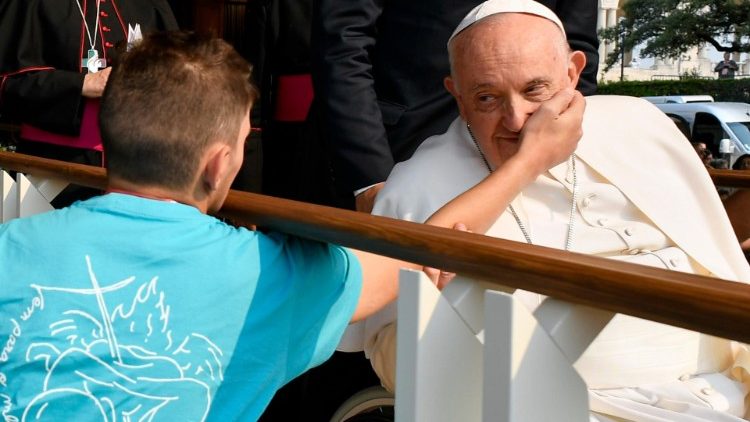
As Pope Francis drove down in his Popemobile, he really took his time, stopping and blessing countless babies and young children. The youngest looked just a few days old, and the oldest may have been around 4. That in itself seems like a good enough reason to get up early!
Then, the Pope led the Rosary in the Chapel of the Apparitions. Inside the chapel were around 100 young ill people, as well as a smaller number of inmates from Portugal’s Leicia prison.
Leading the faithful in a decade of the Rosary was a young lady with disabilities from Italy, Samantha, who admirably lead all 200,000 people in the prayer of the rosary, which ended with a round of applause.
The Holy Father, then, took his time to greet all the young people with disabilities present, demonstrating, once again, his closeness to all those who had been waiting a very long time for this moment.
Pope: Indifference is a sign of a desperate and mediocre society
Pope Francis addresses members of an association working for victims of accidents in the workplace and urges them to learn to recognise the various forms of disabilities, as well as the various struggles each worker faces.
By Francesca Merlo
On Thursday morning, Pope Francis met with representatives of INAIL, Italy’s Insurance Association for Industrial Accidents.
In his address, Pope Francis thanked them for their commitment to building a society in which nobody is left behind.
The Holy Father began by noting that often, unjustly, the burden of an accident is “placed on the shoulders of the family.”
The situation worsened with the arrival of the pandemic, noted the Pope, and in this regard he expressed his gratitude to the association “for the extra care you have put in place at the height of the health crisis, especially towards the most fragile categories of the population.”
“The last few months have also seen an increase in the number of female accident cases, reminding us that the full protection of women in the workplace has not yet been achieved,” added the Pope.
Life has no price
“Life has no price,” stressed the Pope, explaining that among the consequences of not investing in safety in the workplace is the increase in accidents. “A person's health cannot be exchanged for a few extra euros or someone's individual interest,” he said.
Pope Francis then went on to note that “the clear separation of family and work environments has had negative consequences not only on the family, but also on the work culture.” He explained that it has reinforced the idea that the family is the place of consumption and the enterprise the place of production. This strengthens the mindset that people are worth what they produced. But they are not, stressed the Pope.
Disabilities are not only physical
With this in mind, Pope Francis urged those present to “look into the face of all forms of disability that arise,” and not only the physical ones, “but also the psychological, cultural and spiritual ones.”
“There is no such thing as the 'injured person' but the name and face of the person who has suffered an injury,” stressed the Pope, and for this reason you must not give up compassion, because it is “the premise of sharing.”
Finally Pope Francis asked that everyone be close to one another, helping to bridge the gap, “placing oneself on the same plane of shared fragility.” “The more one feels that one is fragile, the more one deserves closeness,” stressed the Pope, explaining that “in this way, barriers are broken down to find a common plane of communication that is our humanity.”
Bringing his discourse to a close, Pope Francis asked that we allow ourselves to be challenged by the wounds of our sisters and brothers and “trace paths of fraternity.”
“Indifference is a sign of a desperate and mediocre society,” he concluded, before entrusting all those present to the protection of St Joseph, patron of all workers.
Pope encourages association for visually impaired to promote inclusiveness
Pope Francis meets members of the Italian Union of Blind and Partially Sighted Persons (UICI), and encourages them to be signs of hope in Italian society as it faces difficult times, like their Patroness St. Lucy did.
By Lisa Zengarini
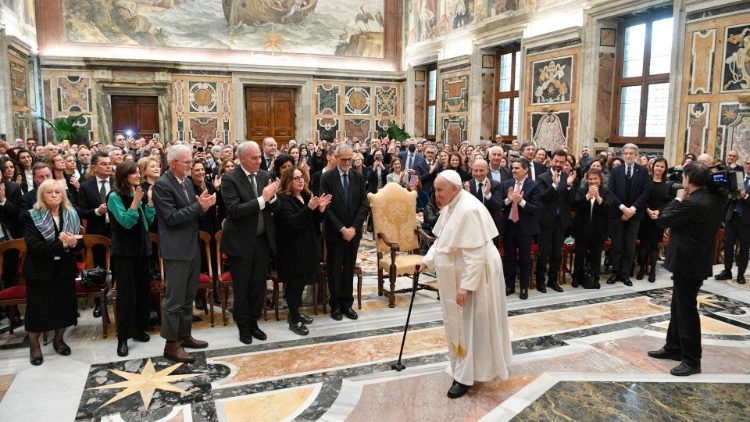
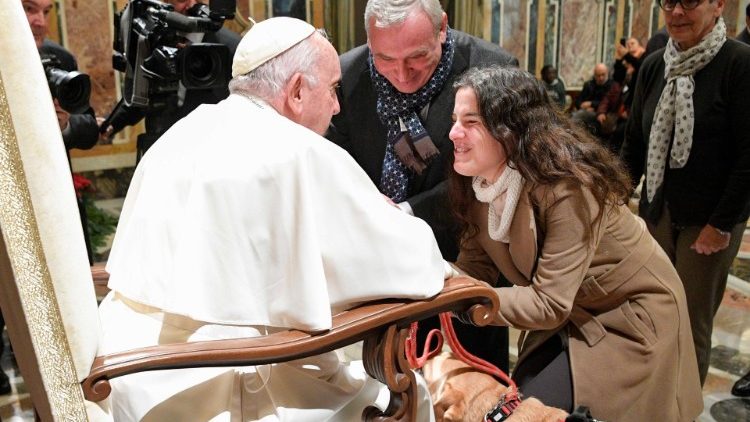
Pope Francis on Monday welcomed members of the Italian Union of Blind and Partially Sighted Persons (UICI) in the Vatican as they prepare to celebrate their Patron Saint Lucy of Syracuse, on December 13.
UICI is a non-confessional and non-profit association founded in 1920 and is a member of the World Blind Union (WBU), which was established to advocate for making the world a better and safer place for visually impaired people and eliminate social prejudices against them in order to achieve their full integration in society.
The courage of Saint Lucy of Syracuse
In his address in the Clementine Hall, Pope Francis expressed appreciation for UICI’s choice of meeting him on the eve of the liturgical feast of Saint Lucy, who he said, expresses the “traditional religious sense of the Italian people”.
He highlighted that Lucy of Syracuse - a 3rd-century Christian martyr who died for her faith during Emperor Diocletian’s Persecution and had her eyes plucked out to avoid marriage to a pagan before dying - reminds us with her example that the “highest dignity of the human person consists in bearing witness to the truth, following one's conscience whatever the cost, without duplicity or compromise”.
“This – he said - means being on the side of the light, serving the light, as the very name ‘Lucia’ evokes.”
“Be clear, transparent, sincere people; communicate with others in an open, clear, respectful way. This helps to spread light in the environments in which we live, to make them more human, more livable.”
Pope Francis lauded the Italian association as a “constructive force” in society, especially in Italian society, "which is going through a difficult moment", noting that the Church does not consider visually impaired persons as people in need of assistance or sometimes compassion.
Disabled people are a resource to be valued in society
Indeed, from the Christian point of view disability should not be addressed with a “pietistic attitude or assistentialism”, but rather “with the awareness that fragility, assumed with responsibility and solidarity, is a resource for the entire society and ecclesial community”.
The Pope further insisted that visually impaired people, led by ethical principles and civic conscience, are at the forefront in building inclusive communities, “where everyone can participate without being ashamed of their limitations and weaknesses, cooperating with others to support each other”.
“We all need each other, not only people with physical fragilities. We all need the help of others to move forward in life, because we are all weak at heart, all of us.”
Transmitting hope to society
He, therefore, encouraged the association to go forward with “an ever more constructive, and proactive style, as a force that transmits trust and hope”, and to follow the example of Saint Lucy, who did not bow to threats and flattery and, instead, courageously stood up to the judge who was interrogating her.
“Italian society needs hope, and this comes above all from the testimony of people who, in their condition of fragility, do not close themselves up, or feel sorry for themselves, but work together with others to improve things.”