Showing posts with label apologetics. Show all posts

Wednesday, April 24, 2024

From Deacons Bench: The AI miscalculation at Catholic Answers


CATHOLIC ANSWERS UNVEILS ‘FATHER JUSTIN,’ AN AI PRIEST — UPDATED


Welcome to 2024. Catholic Answers is now using a computer-generated “priest” to answer questions.

Color me skeptical. And a little weirded-out. UPDATE: I’m not the only one. Scroll to the bottom for an update.  “Father Justin” is now offering absolution for sins.

Details, from X:

Catholic Answers, the number-one lay Catholic apostolate of apologetics and evangelization, is excited to announce the release of our new “Father Justin” interactive AI app. This innovative digital application employs the latest artificial intelligence technology to provide users with faithful and educational answers to questions about Catholicism. Seekers may also engage in a back-and-forth interaction to pursue further information with the 3D AI character.

“Our goal with the Father Justin app is to leverage the power of large language models—or ‘LLMs’—to create an engaging and informative experience for those exploring the Catholic faith,” says Chris Costello, director of I.T. at Catholic Answers. “Although this is not a substitute for human interaction with a priest, teacher, or spiritual advisor, we believe it can be a valuable tool to help our users better understand and articulate the teachings of the Catholic faith.”

The decision to use a parish priest character was purposeful. “We wanted to convey the spirit and nature of the responses users can expect—authoritative yet approachable, drawing from the deep well of Catholic tradition and teaching,” Costello explains. “We believe that the presentation of Father Justin honors real-life priests and the role they play in people’s lives, yet we are confident that our users will not mistake the AI for a human being.”

The name “Father Justin” was chosen for this AI priest as a tribute to St. Justin Martyr, an early Christian convert and Church Father who is one of the patron saints of apologetics. The Father Justin app is available now on the Catholic Answers website, catholic.com. Users are encouraged to explore the app, utilize the search feature on the site for additional resources, and seek guidance from their local parish priests or spiritual advisors on serious matters or for further clarification. As a leading Catholic apostolate, Catholic Answers is committed to leveraging the latest technologies to advance its mission of explaining and defending the Catholic faith. The Father Justin app is the latest example of this commitment, providing a new and appealing way for searchers to begin or continue their journey of faith.

There’s more here.

Meanwhile, Eric Sammons at Crisis weighs in:

Not only is “Father Justin” dressed as a priest, but in one answer “he” gave me, “he” actually started his answer with, “As a Catholic priest…” I understand this was done to give “him” a certain air of authority; as Catholic Answers said, “We wanted to convey the spirit and nature of the responses users can expect—authoritative yet approachable.”

But there’s a reason impersonating a priest is a serious canonical crime: a priest is sacramentally “another Christ” and gets his authority not from knowing the most Catholic theology, but from his ordination. Having a lay person as the AI character would definitely make it seem less authoritative and less distinctly Catholic to the average user, but I’m not sure making “him” a priest was for the best…

 I understand that the reality is that we live in a world where many people engage in question-and-answer exchanges with AI, so having a faithfully Catholic option is an understandable desire of many Catholics. Yet I can’t help but think that there’s deeper issues here, ones that threaten to undermine a Catholic incarnational understanding of the world, all while sincerely trying to advance Catholicism.

I think the backlash against this is growing. What seemed like a foolish idea is turning out to be an awful misjudgment. I predict “Father Justin” will be laicized very soon.

Another dissenting voice belongs to Amy Welborn

The issue, it seems to me – is in the dynamic element – that Fr. Bot is “answering” “your questions” in the present. We all know that when we enter queries into search engines or through AI elements what we receive is fallible and incomplete. We hope it’s as complete as possible, but we know – especially now – that what we receive is mediated and incomplete.

Anyone will know this is true of Fr. Bot as well, but the appearance of having these results conveyed involving the image of a “priest” with a name implies an authority that the answers just do not have.

Finally, this is not the “evangelization” anyone needs right now. We need more actual human beings, we need a call to find the answers to our questions in person, in community, IRL.

Friday, June 8, 2018

Lizzie Answers takes on infant baptism

As a new Catholic she is becoming quite the Catholic apologist; here she tackles infant Baptism and demonstrates that not only can you find it in the Bible, but shows it was the practice of the earliest church (which we know was Catholic).

Here is her video on infant baptism:

https://www.youtube.com/watch?v=8oJntkddYOg

Thursday, November 21, 2013

The death of C.S. Lewis 50 years ago on the same day that JFK was killed

The Triumph of C.S. Lewis

By Robert Barron
Two famous men died on November 22, 1963. The first did so in the most dramatic way possible, assassinated in the full glare of publicity on the streets of Dallas; the second in relative obscurity, in the upstairs bedroom of his simple home on the outskirts of Oxford, England.
John F. Kennedy's legacy has, of course, been enormous, but I wonder whether C.S. Lewis has actually, in the course of these past 50 years, had a greater impact on the culture than his counterpart. When he died at the age of 65, Lewis's reputation was on the wane, but he has enjoyed an extraordinary posthumous vogue, as two successive generations have delighted in his literary criticism, his novels, and above all, his clever and incisive Christian apologetics.


One reason why Lewis has proven so persuasive to so many is that he was compelled to undergo a transition -- halting, painful, anguished -- from non-belief to belief. Though he had been brought up in a Christian environment, he had lost his faith by the time he entered university. He was not someone to whom religious conviction came naturally or effortlessly; he had to work his way to it, in the face of often harsh opposition, both interior and exterior. This very personal struggle gives him credibility with the millions today who want to believe but who find ideological secularism and militant atheism enormously challenging.
A second reason why Lewis was successful was that he came at Christian apologetics primarily from a literary rather than a philosophical point of view. I want to be careful not to overstate the case here: Lewis certainly understood philosophy and used it at times in his apologetics both effectively and creatively. Think, for instance, of the subtle analysis offered in his book Miracles. But Lewis was, first and foremost, a man of letters -- a poet and storyteller. His area of academic specialization was the literature of the 16th century -- he wrote with tremendous insight on Milton -- and his first published writings were poems.
This background allowed him to see something which is often overlooked in more academic and analytical presentations of the Christian faith, namely, that Christianity is, at bottom, a narrative, a story, an account of the dramatic things that God has done. Certainly doctrinal statements can be distilled from the Biblical revelation (in fact, that's what most of formal theology does), but revelation is contained primarily in narrative form -- and this matters profoundly. The Bible tells the story of how God's good creation, sullied by sin, is restored through the return of God himself as king. This account contains many subplots and it is surrounded by a plethora of poetry, psalms, wisdom sayings, and other material that support it -- but finally, the Bible is a rollicking adventure story, full of drama, reversals, adventure, and marked by a happy and triumphant ending.
Throughout his career, and in a variety of works, Lewis exulted in telling and re-telling this story. Thus, in his most famous work of apologetics, Mere Christianity, he explained that the one God had to do battle with the dark spiritual power that had unjustly taken possession of his world -- which is why the Christ child was obliged to arrive so surreptitiously, so clandestinely, sneaking, as it were, behind enemy lines. The very same tale is told in the Chronicles of Narnia. But in that imaginative setting, the devil becomes the White Witch, who has plunged Narnia into a 100 years of winter, and Christ becomes Aslan the lion who offers his own life in order to liberate the land. In The Screwtape Letters, Lewis illustrates how the general calamity plays itself out in the life of a very ordinary Christian and the low-level devil assigned to torment him. It is precisely Lewis's confidence in the victory of Christ that enabled him to disempower the devil through mockery.
J.R.R. Tolkien, who was a great friend to and Christian fellow-traveler with Lewis, presented his own version of the Biblical tale in The Lord of the Rings. In Tolkien's invented world, the devil appeared as Sauron the Dark Lord and Christ under the guise of Frodo the priest, Gandalf the prophet, and Aragorn, the king who returned after a great battle to take possession of his rightful kingdom. Both Lewis and Tolkien wanted to "evangelize the imagination," to plant the seeds of the Gospel and the rhythms of the Biblical narrative in the minds of their readers. The fact that both The Chronicles of Narnia and The Lord of the Rings have, in recent years, been made into wildly popular films can only be characterized, therefore, as a triumph of evangelization.
C.S. Lewis intuited something that has become a commonplace among postmodern philosophers, namely, that the avatar of one worldview overcomes another, not so much through argument, but through telling a more compelling story, by "out-narrating" his opponent. He knew that the Christian evangelist, despite any personal flaws he might exhibit or institutional baggage he might carry, still possessed the greatest story ever told. Lewis told that story with particular verve, bravado, intelligence, imagination, and panache -- and that is why it is well and good that we should celebrate him on the 50th anniversary of his passing.

Father Robert Barron is the founder of the global ministry, Word on Fire, and the Rector/President of Mundelein Seminary.

Tuesday, April 17, 2012

One of the best defenses I have every read about calling Priests "Father"

If We Can't Call Priests “Father,” It Doesn't Leave Much

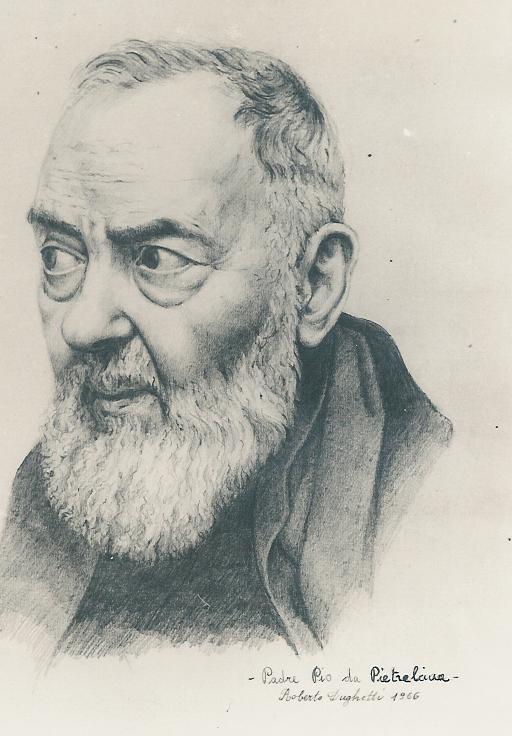
Padre Pio de Pietrelcina
Some time ago, I wrote a post on why we Catholics call our priests “Father.”  In a nutshell, this is a recognition of the priest's spiritual fatherhood. St. Paul sets the pattern for this in 1 Cor. 4:15, when he tells Timothy, “I became your father through the Gospel.”  The typical objection to this title is based on Jesus' words in Matthew 23:9 (“call no man your father upon the earth: for one is your Father, which is in heaven”). But these words aren't meant to be taken literally, as passages like Matthew 1:2, Mt. 10:37, Mark 10:29, Ephesians 6:2, James 2:21, and Romans 9:10 make clear.

Rather, Jesus is telling us in Matthew 23:9 to have no allegiances apart from Him.  So it's right to have St. Paul as a spiritual father (1 Cor. 4:15), but not in such a way that it turns into factionalism that damages or diminishes the Body of Christ (1 Cor. 1:12-13).

But let's say you disagree.

Let's say you think Matthew 23:9 has to be taken literally to forbid the use of “Father,” at least as a title or honorific.  What options does that leave you with, exactly?

Well, most Protestants use a title like “Reverend” or “Doctor,” or perhaps “Pastor” to refer to their spiritual leaders.  But “Reverend” comes from the word for “revered,” and literally means “One who is to be respected” or “One who is to be revered.”  Are Protestants comfortable embracing that?  After all, St. Peter tells us that “God is no respecter of persons” (Acts 10:34).  And, of course, the exact same Protestants who attack Catholics for using the title Father also attack Catholics for revering anyone other than God, saying things like “A definition of ‘venerate’ is ‘to regard with respect or reverence.’ Nowhere in the Bible are we told to revere anyone but God alone.”  So the folks who reject “Father” can't really substitute “Reverend” in its place.

What about “Pastor,” then?  Well, Christ says in the New Covenant, “there shall be one fold, and one shepherd” (John 10:16).  Taking this literally would seem to foreclose the use of “Pastor,” too.

The Reverend Doctor Martin Luther King, Jr.
“Doctor” fares the worst, since it comes from the Latin word for “teacher.”  That is, it falls under the exact same prohibition as “Father.” Here's what Jesus says in Matthew 23:8-9 (NIV),
But you are not to be called ‘Rabbi,’ for you have one Teacher, and you are all brothers. 9 And do not call anyone on earth ‘father,’ for you have one Father, and he is in heaven. 10 Nor are you to be called instructors, for you have one Instructor, the Messiah.
And the same passage in the KJV:
8But be not ye called Rabbi: for one is your Master, even Christ; and all ye are brethren. 9And call no man your father upon the earth: for one is your Father, which is in heaven. 10Neither be ye called masters: for one is your Master, even Christ.
And as John 20:16 explains, “Rabbi” means “Teacher.” So, then, someone claiming that we have to take the middle part of this passage as a literal ban on the title “Father,” can't replace it with a title meaning “Teacher” without engaging in some pretty brazen hypocrisy.  So “Doctor” is out, as well.

Well, perhaps we could just get rid of the special title, and go with a simple “Mister,” instead?  Nope.  Mister is a variation on the title “Master”, which Christ condemns in this very same passage.

Conclusion

Mister Rogers (Fred Rogers)
My point here is simple.  If we're going to insist on using passages like Matthew 23:8-10 in a literal and legalistic way, it's going to make it very awkward to communicate.  Can you call your dad “father”?  What about Abraham?  Can you call your surgeon “doctor”?  Or what about the practice of kids calling their teachers “teacher”?  Is saying, “Mr. Rogers' Neighborhood” a violation of Matthew 23?

You get my point.

Thankfully, the New Testament shows no signs of this legalistic neurosis.   Abraham is described throughout the New Testament as “Father Abraham” (Luke 16:24; Luke 16:30), “our father in the sight of God” (Rom. 4:17),  and “Abraham our father” (James 2:21).  Both St. Paul (Romans 4:11-18) and Jesus Christ (John 8:39) make clear that this title is due to Abraham being our father in faith, rather than a biological ancestor.  That is, the New Testament does exactly what modern Catholics do: refers to spiritual leaders as “fathers.”  That's because we believe that all fatherhood comes from God (Ephesians 3:15).  So every father, spiritual or biological, shares in some sense in God's singular Fatherhood.  Thus, Matthew 23 is violated only if you set up a rival fatherhood or a rival authority to God's.

Christ isn't calling us to some letter of the law obedience to use and not use certain words. He's reminding us that in the end, there's only one true Father, Pastor, Teacher, Master, Lord.  The clergy are called to cooperate in God's leadership, not compete against it.  Following a rival father, pastor, teacher, master, or lord is what's forbidden.  That's what Matthew 23:8-10 is about.  On the other hand, Christ says to those He commissions: “he that hears you, hears Me.” (Lk 10:16).  So the authentic clergy of Christ are not a threat to God, since they're the ways He makes His Fatherhood visible in the world.  And it's right that we should follow the New Testament practice of calling such men “Father,” as a result.
 
 
>>>This is taken directly from one of my new favorite blogs: Shameless Popery