Showing posts with label Zambia. Show all posts

Tuesday, February 3, 2026

All nations (even in the USA) could use this advice from the Bishops of Zambia concerning politics


Zambia's Catholic BishopsZambia's Catholic Bishops 

Zambia’s Catholic Bishops urge priests and faithful to steer clear of partisan politics

As Zambia prepares for the August Presidential and General Elections, the Catholic Bishops have issued a Pastoral Letter advising politicians, the faithful, and all Zambians of goodwill to work towards creating a peaceful and civil electoral environment. Zambian Bishops have pledged that the Church will remain non-partisan, asserting, “Church premises must not be used for political campaigns.”

Paul Samasumo – Vatican City


The Bishops urge Zambia’s Catholic clergy not to align themselves with partisan political interests, as this comprises their sacred calling.

The Pulpit is not for political opportunism

In their Pastoral Letter, the Bishops also insist that “the Church is not and must never be a mouthpiece for any political party or candidate. Our duty is to form consciences, promote the common good, and speak truth to power,” the Pastoral Letter reads in part.

Churches, say the Bishops, should always remain houses of prayer, reflection, and reconciliation, not partisan campaign platforms.

To this end, the Bishops have directed that: “Church premises must not be used for political campaigns; No clergy or lay leader should accept political donations in exchange for influence; The pulpit must remain a place of prophetic truth and moral clarity, not political opportunism.

Commit to respecting the results

The wide-ranging Pastoral Letter on elections urges Zambians to view politics as a noble calling that should never be about accumulating personal privilege. They call for credible and transparent elections and advise citizens to embrace civility, especially during the campaign period.

Other key concerns raised include advocating for issue-based campaigns and, above all, urging “all political parties to commit — publicly and unequivocally — to respect the outcome of free, fair, and credible elections.”

Last weekend, Zambia’s President Hakainde Hichilema assured Zambians and the international community of transparent, free, and fair elections. He made the remarks during a meeting with Ambassadors and High Commissioners accredited to Zambia.

Presidential and General elections are due to be held in Zambia on 13 August 2026 to elect the president, members of the National Assembly, councilors, mayors, and local council chairs.

Below is a link to the full document of the ZCCB Pastoral Letter:

https://l.facebook.com/l.php?u=https%3A%2F%2Fdrive.google.com%2Ffile%2Fd%2F1GzEJjXiAv4IN2Lw59YijzIMb06aihi88%2Fview%3Fusp%3Dsharing&h=AT2fXnb-Yh88fV1j5Exe7C2PDl-E1bjJwUKz0vCIJRHyMQNqrC5TohLy3BKoRd5lWxRy0GKrJrDJEZlFVJrfuQcHoKmlg39GJ0Z2V_mmi3pzUcPNkWfPpy5i4ThDNAtZ9LTcbpgHLxV03PrsGrq-Yv752Kn_aq2HFH0r2uw&__tn__=-UK*F

Saturday, July 15, 2023

Cardinal Parolin ordains new Bishop and Nuncio for Zambia and Malawi


Episcopal ordination of Msgr. Gian Luca PericiEpiscopal ordination of Msgr. Gian Luca Perici  (VATICAN MEDIA Divisione Foto)

Cardinal Parolin at ordination: A Bishop gives his life for his flock

Cardinal Pietro Parolin confers episcopal ordination on Msgr. Gian Luca Perici, appointed Apostolic Nuncio to Zambia and Malawi last month by Pope Francis, and in his homily notes that the bishop is to be a 'watchman' who keeps unity and hope alive among the people entrusted to him.

By Amedeo Lomonaco

Cardinal Pietro Parolin, Vatican Secretary of State, presided over the morning Mass in Saint Peter's Basilica with the episcopal ordination of Msgr. Gian Luca Perici, appointed apostolic nuncio to Zambia and Malawi by Pope Francis on 5 June 2023. In his homily, Cardinal Parolin addressed a key question regarding the role of a bishop, recalling in particular the duties to "bring the Good News to the poor" and "bind up the wounds of the broken-hearted."

Bishop safeguards community

The bishop is a "sign of Christ", Cardinal Parolin explained, recalling words of Pope Francis during his apostolic journey to Canada: "Precisely because we are a sign of Christ, the Apostle Peter urges us to tend the flock, to guide it, not to let it go astray while busy about our own affairs.  Care for it with devotion and tender love." The bishop, the Cardinal emphasized, is like "a good watchman" who scans the horizon and "warns the community of any approaching danger." A watchman who gives guidance "in listening to the Word of God, in prayer, in frequenting the sacraments, in humility and in charity, the powerful ways to overcome every obstacle and maintain fraternal cohesion and living hope."

Looking to the Good Shepherd

The bishop is called to direct his gaze towards "the heart of Jesus that shines with infinite love," to the Good Shepherd, "willing to give his life for the sheep" and "not to flee before the wolves." Cardinal Parolin added that the bishop is called to focus always to "this heart that shines and emanates charity," to this "source of mercy" that rejects no one and offers to everyone "a joyful proclamation of true liberation." The invitation that a bishop must accept is that of "integrally transforming every care of the heart and transferring it to God." The bishop is called "to show the sweetness of the yoke of Christ so as to lift the sad yoke of sin from the shoulders of the people entrusted to him."

Messengers for the Pope

Cardinal Pietro Parolin finally recalled the specific task entrusted to Archbishohp Perici: "that of sharing the word of the Pope with Churches and governments" of the countries where he is being sent. At the same time, the bishop must be "a tireless peacemaker in this world troubled by wars and cruel conflicts" and to promote the defence of the "fundamental rights of the human person, often threatened by ideologies that instrumentalize and manipulate them in the name of a humanism that, in truth, no longer has anything human about it." Finally, he encouraged him to be "an authentic bridge capable of presenting the needs, problems, hopes and fears of the individual local Churches to the universal Church, helping them be aware of the paternal care of the successor of the Apostle Peter." 

Archbishop Perici entered the diplomatic service of the Holy See on 1 July 2001 and has served in apostolic nunciatures in Mexico, Haiti, Malta, Angola, Brazil, Sweden, Spain and Portugal.

Thursday, June 1, 2023

The universality of the Catholic Church: a glimpse into the church in Zambia


Bishop Kasonde of solwezi Diocese in Zambia.Bishop Kasonde of solwezi Diocese in Zambia. 

Zambia: AMECEA President Charles Kasonde invites the faithful to always embrace love.

Bishop Charles Kasonde of Zambia recently celebrated his thirteenth episcopal anniversary with the Catholic faithful of Solwe in his Diocese.

Fr Stephen Kapalu - Solwezi, Zambia.

AMECEA President and Solwezi Diocese Bishop Charles Joseph Sampa Kasonde, reminded the faithful that only in peace and unity can the Church grow and prosper. The Church cannot grow or be successful if, among Christians themselves, there were elements of tribalism and hatred, he admonished.

In a colourful Eucharistic celebration held at St. Daniels Cathedral, Bishop Kasonde also called on the country’s leaders to selflessly serve those who elected them. He said God has granted the country abundant natural resources that must be used wisely.

The Diocese of Solwezi is home to some of the country’s biggest mines.

Pray for countries experiencing conflict

The Solwezi prelate, in his capacity as AMECEA President, also condemned conflicts in Sudan and the war between Russia and Ukraine. He appealed to the world’s leaders to accept mediation and ceasefire arrangments. 

The Bishop appealed and asked the faithful to continue praying for these countries in order to save humankind from needless suffering. 

Re-translating the Bible into Lunda, Luvale, and Kaonde

Bishop Kasonde was ordained and installed as Bishop of Solwezi Diocese on 29 May 2010.

Since he was installed as Bishop of Solwezi Diocese, many Churches and institutions have since been constructed. Under his leadership, the Diocese undertook the mammoth task of re-translating and updating the Bible into Lunda, Luvale, and Kaonde. The three languages are widely spoken and used in the Diocese.


Present at the anniversary Mass were several priests, religious sisters and brothers, and scores of the laity from within Solwezi town and neighbouring districts.

Wednesday, December 28, 2022

African nation of Zambia abolishes the death penalty


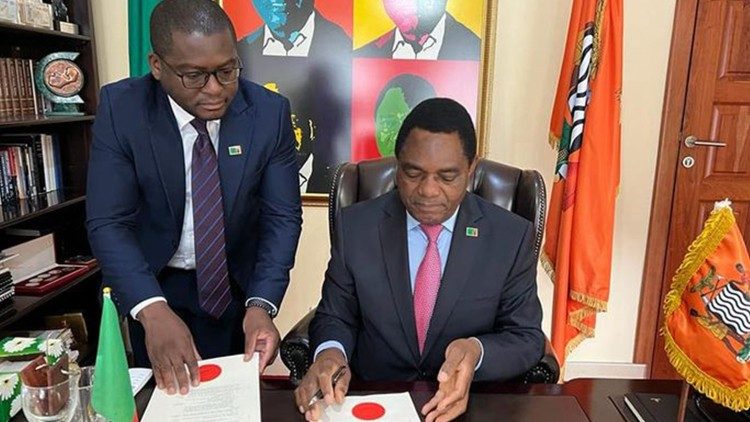
President Hakainde Hichilema of Zambia amending the law on the death penalty.President Hakainde Hichilema of Zambia amending the law on the death penalty. 

The community of Sant'Egidio commends Zambian president for abolishing the death penalty.

The Community of Sant'Egidio has expressed great satisfaction with the decision by President Hakainde Hichilema of the Republic of Zambia to abolish the death penalty.

Paul Samasumo – Vatican City.

Signing the legislation, two days before Christmas day, Zambian President Hakainde Hichilema said that the abolition was a fulfilment of his campaign promise to amend laws that inhibit the growth of democracy, good governance, and human rights in Zambia.

"Fellow Zambians, during our campaigns for the presidency, we promised to amend all laws that inhibit the growth of democracy and good governance, impede human rights and basic freedoms. Today we have delivered," said Hichilema.

Sant'Egidio on the abolition

The abolition of the death penalty is among the key areas of global engagement by one of the Catholic Church's most influential movements lead by lay people – the Community of Sant'Egidio. The organisation is dedicated to evangelisation, social justice and charity in more than 70 countries worldwide.

In a statement, Sant'Egidio expressed satisfaction with developments in Zambia and said in 2011 and 2018, delegations from Sant'Egidio travelled to Zambia to meet with state officials and other actors as part of the abolitionist campaign. It said the abolition of the death penalty in Zambia was a step forward for Africa to become a capital punishment-free continent.

Law Association of Zambia

The Law Association of Zambia (LAZ) also praised President Hakainde Hichilema for abolishing the death penalty. OHCHR, the lead United Nations entity mandated to promote and protect human rights, also joined in praising Zambia for the abolition.

Amnesty International said the announcement by President Hichilema was a good and progressive move that shows the country's commitment to protecting the right to life.

Abolition in practice

In effect, Zambia has been abolitionist in practice since 1997. Although the country's courts continued to pass the death sentence, no Zambian President has issued a death warrant in the last 25 years.

Last Friday, Zambian President Hakainde Hichilema codified into law the abolition by assenting to the Penal Code (Amendment) Bill 2022 abolishing the death penalty in Zambia.

Death penalty for the poor

The intersection between the death penalty, racism, economic inequality, and poverty is stark. Zambian national Kafumu Kalyalya writing under the Southern African Institute for Policy and Research, has previously said that there has been increasing recognition among the international community that the death penalty primarily affects those with fewer economic means. The poorest in society are less likely to be able to afford a lawyer and, in turn, enjoy their right to effective representation or even appeal. Therefore, it is no surprise that individuals currently on death row worldwide are overwhelmingly from poor backgrounds.