Showing posts with label St. Pope Paul VI. Show all posts

Tuesday, January 13, 2026

Such important advice from Pope Leo XIV, belonging over numbers, never a waste of time to catechize


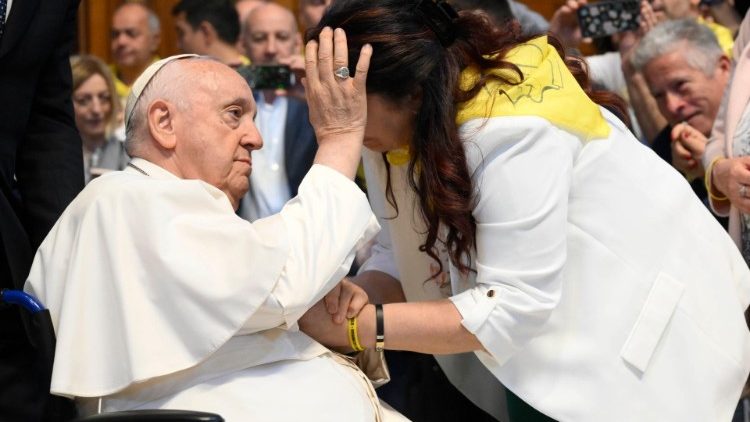
Pope Leo XIV greeting pilgrims in the VaticanPope Leo XIV greeting pilgrims in the Vatican  (@Vatican Media)

Pope: Sense of belonging more important than numbers of people in Church

In the January edition of the Piazza San Pietro magazine, Pope Leo XIV encourages a Swiss catechist struggling to get families involved in her parish by saying that “hours dedicated to catechesis are never wasted”.

By Vatican News

The January edition of the Italian magazine, Piazza San Pietro, is dedicated to the theme of peace and in it, Pope Leo XIV responds to Nunzia, a 50-year-old Swiss catechist who wrote him a letter detailing her struggle to get families involved in the parish. 

Families and children are increasingly difficult to reach

In her letter Nunzia - who lives in Laufenburg, a small municipality with 620 inhabitants – explains how “in Switzerland, it is difficult to get parents involved and, sometimes, even children and young people to trust in God.”

“I sow seeds, but the seedlings struggle to grow. Children and families prefer sports and parties,” she writes, adding how families are often indifferent to religious practice and Churches seem to be increasingly emptier or populated by the elderly.  

Nunzia ends her letter by asking Pope Leo XIV to pray for the young people entrusted to her care and for herself, so that she may not be discouraged.

Pope Leo’s response

In the same edition, Pope Leo acknowledges Nunzia’s concerns and places them in a wider context: “The situation in which you live is no different from that of other countries with ancient Christian traditions.”

The Pope invites us to look beyond the numbers of attendance: “The hours dedicated to catechesis are never wasted, even if there are very few participants.”

He also relaunches an ecclesial challenge: “The problem is not the numbers — which, of course, make one reflect — but the increasingly evident lack of awareness in feeling part of the Church, that is, of being living members of the Body of Christ, all with unique gifts and roles, and not merely users of the sacred, of the sacraments, perhaps out of mere habit.”

The Pope also offers an encouragement to Nunzia, and all who experience similar difficulties. “As Christians, we always need conversion. And we must seek it together,” he writes. He recalls that the true door of faith “is the Heart of Christ, always wide open.”

Pope Leo’s concluding appeal is rooted in the legacy of Paul VI: “What we can do is bear witness to the joy of Christ's Gospel, the joy of rebirth and resurrection.”

Thursday, May 29, 2025

Today is also the feast day of St. Paul VI

 St. Paul VI

Patron Saint of the Archdiocese of Milan and the Second Vatican Council


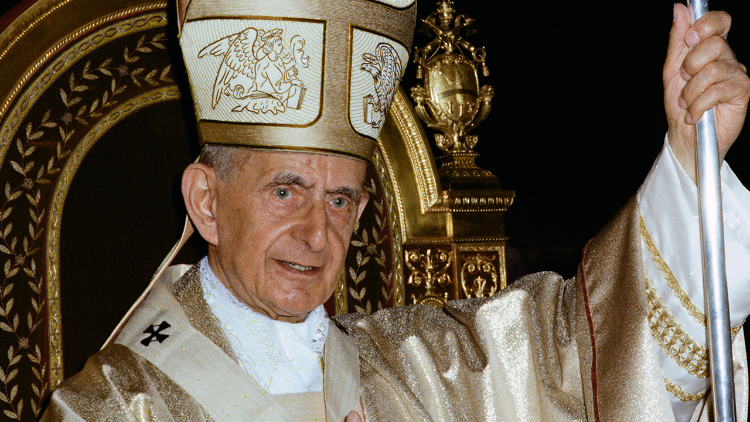
St. Paul VI, born Giovanni Montini, was pope from 1963 to 1978. While Archbishop of Milan, he was a close companion of Pope John XXIII and participated in the Second Vatican Council. After the death of the pope, he was elected by the College of Cardinals and took the name Paul. He continued reforming the Church through the Second Vatican Council, and shaped the church as we know it today. In addition to these reforms, Paul VI is remembered for his ecumenicalism, Mariology, and commitment to Church teaching in uncertain times. "We must see to it that enthusiasm for the future does not give rise to contempt for the past." -St. Paul VI

Catholic Apostolate Center St. Paul VI Portal

Thursday, July 11, 2024

No legit apparition in Amsterdam per Pope Paul VI and confirmed by the Dicastery of the Doctrine of the Faith


"Our Lady of All Nations" of Amsterdam: Pope Paul VI approved a negative judgment

The Dicastery for the Doctrine of the Faith makes public the unanimous decision approved by Pope Paul VI, which confirmed the finding of "non-supernaturality" regarding the alleged Dutch apparitions linked to the city of Amsterdam.

By Vatican News

On Thursday, the Dicastery for the Doctrine of the Faith made public the negative and definitive 1974 judgment of its Cardinal Members, who unanimously agreed to declare the non-supernaturality of the alleged apparitions of "Our Lady of All Nations" of Amsterdam.

The decision was approved by Pope Paul VI.

In a press release, the Dicastery said that in recent years, it typically “did not reveal decisions regarding alleged supernatural phenomena.”

However, “faced with persistent doubts raised about the alleged apparitions and revelations from 1945-1959 in Amsterdam, related to the devotion of the 'Lady of All Nations,' the Dicastery for the Doctrine of the Faith is making known the outcome of the Ordinary Session of the then Sacred Congregation for the Doctrine of the Faith, held on March 27, 1974."

The following are the judgments made at that session:

“1. Regarding the doctrinal judgment: OMNES 'constat de non supernaturalitate.'
2. Regarding further investigation of the phenomenon: OMNES: 'negative.'”

These decisions, reads the communiqué, "were approved by the Holy Father Paul VI during the audience granted to the Prefect of the Sacred Congregation for the Doctrine of the Faith, Cardinal F. Šeper, on April 5, 1974. This is communicated so that the holy People of God and their pastors can draw the appropriate conclusions.”

Before the new Norms, which came into force in May 2024, the Dicastery only communicated the formal decision to the local bishop, and at most published a more general notice.

Now, to clarify any confusion, the decision approved by the Pope is made public, which in this case is the most negative judgment, noting the non-supernaturality.

The new Norms allow such a judgment, saying it “must be based on concrete and proven facts and evidence” attesting to the non-authenticity of the alleged phenomenon.

On March 25, 1945, on the 600th anniversary of the Eucharistic miracle of Amsterdam, Ida Peerdeman claimed to have seen the Blessed Virgin Mary, who introduced herself to her with the title "Lady of All Nations."

Born in Alkmaar in 1905, the youngest of five children, Ida was orphaned of her mother at the age of 8 and moved with her family shortly afterwards to Amsterdam, where she remained until her death in 1996.

Following the alleged apparition on March 25, she later claimed to have seen 55 more, lasting until 1959.

According to Ida’s account, over the span of 14 years, the Madonna revealed to her in advance several events, including the death of Pope Pius XII, and showed her an image of herself, later painted by the artist Heinrich Repke based on the description of the alleged seer.

Today, that image is kept in a chapel built in 1973 at 3 Diepenbrockstraat, in a residential area in the southern part of Amsterdam.

In 1956, the then Bishop of Haarlem-Amsterdam, Johannes Petrus Huibers, stated that the alleged Marian apparitions "non constat de supernaturalitate."

His judgment made more severe in May 1974 by the then Congregation for the Doctrine of the Faith (CDF), which confirmed the definitive negative judgment "constat de non supernaturalitate" with the personal approval of Pope Paul VI.

In 1996, Bishop Huibers' successor, Henny Bomers, after consulting with the Holy See, allowed the veneration of "Our Lady of All Nations" without recognizing the alleged apparitions. In contrast, his successor, Bishop Jos Punt, in 2002 recognized their authenticity, though without consulting the Holy See.

Three years later, in 2005, the CDF removed several words from the prayer that the Virgin Mary allegedly left to Ida Peerdeman, as they were not in conformity with Catholic doctrine.

Finally, on December 30, 2020, the new Bishop of Haarlem, Johannes Hendriks, "after consulting with the Congregation for the Doctrine of the Faith and in agreement with it," stated that "the use of the title Our Lady of All Nations for Mary is theologically permissible.”

However, he added that “the recognition of this title cannot be understood as even an implicit recognition of the supernaturality of certain phenomena," since the Congregation had given "a negative judgment," which was "approved by Paul VI" in 1974.

The various messages that the Virgin Mary allegedly left to Ida included a request for the Church to recognize the dogma of Mary as "co-redemptrix,” a request allegedly dating back to December 8, 1952.

Regarding this title, it is worth noting Pope Francis’ statements on at least two occasions.

On April 3, 2020, in his homily at the morning Mass at the Casa Santa Marta, the Pope said, "The Madonna did not take any title away from Jesus... She did not ask for herself to be a quasi-redeemer or a co-redeemer: no. The Redeemer is one, and this title is not duplicated."

He reiterated this affirmation at the General Audience on March 24, 2021: "Christ is the only Redeemer: there are no co-redeemers with Christ."

Wednesday, May 29, 2024

Today is the Feast of Saint Paul VI, Pope


May 29: Saint Paul VI, Pope—Optional Memorial

1897–1978
Patron Saint of Vatican Council II
Canonized by Pope Francis on October 14, 2018
Liturgical Color: White


Quote:
And most important of all, on taking my leave of this earthly scene, and going to face the judgment and mercy of God, there are so many things I should say, indeed so many. On the state of the Church; let her give ear to some words of ours which we uttered on her behalf seriously and lovingly. On the Council: let it be brought to a good conclusion, and let its prescriptions be put into effect. As regards ecumenism: the approach to the separated Brethren must go on, with great understanding and patience, with great love; but without deflecting from the true Catholic doctrine. As regards the world: one must not think to help it by following its ways of thought, its habits and tastes, but by studying it, loving it and serving it. I close my eyes on this sorrowful, dramatic and magnificent world, invoking once again on her behalf the divine goodness. Again I bless everyone, especially Rome, Milan and Brescia. For the Holy Land, the land of Jesus, where I went as a pilgrim of faith and peace, a special greeting and blessing. ~Last Testament, Paul VI

Reflection: Giovanni Battista Montini was born in northern Italy, about fifty miles east of Milan. He was the second of three boys. His father was an attorney who ran a Catholic newspaper in the Province of Brescia and a member of the Italian Catholic Action, a lay organization that advocated for a greater influence of the Catholic faith within society. His mother was from a wealthy noble family, but her parents’ death when she was young resulted in her spending much of her teenage years in a boarding school in Milan run by French nuns. As a child, Giovanni was called “Battista” by his family. He was educated by Jesuits, and enjoyed sports and playing cards. When he was twelve, Battista was diagnosed with a chronic heart flutter and suffered from intestinal difficulties. He often missed long periods of school, spending time at the family villa and receiving private tutoring.

Though he had long thought of becoming a journalist like his father, Battista entered the seminary at the age of eighteen and was ordained a priest four years later. Shortly after his priestly ordination, Father Montini was sent to Rome to study canon law. Though ill health continued to plague him, he obtained his doctorate in canon law, studied for the Vatican diplomatic corps, briefly served at the Apostolic Nunciature in Warsaw, Poland, and then returned to Rome. In Rome, he began his service as a diplomat in the papal household under Pope Pius XI and assisted at the Supreme Tribunal of the Apostolic Signatura, the Holy Office, and the Secretariat of State. When Pope Pius XII was elected in 1939, Monsignor Montini worked with him daily, eventually acting as the pope’s de facto personal secretary.

In 1939, World War II broke out and Monsignor Montini assisted the pope as he navigated through the chaos. As thousands of refugees fled to Rome, Monsignor Montini organized the Vatican’s efforts to care for them, giving them shelter and food, keeping them hidden, and supporting their mental and spiritual needs. In 1952, Monsignor Montini was appointed Pro-Secretary of State for General Affairs and in 1954, was ordained the Archbishop of Milan and the Secretary of the Italian Bishops’ Conference. In Milan, Archbishop Montini’s organizational skills flourished. He built many new churches, organized diocesan-wide catechesis, and sought new and innovative ways to share the Word of God. In an attempt to confront the rise of Marxisit ideology, he showed great interest in upholding the dignity of the worker with his support of unions and immigrants. His ministry went beyond Catholics, seeking ways to reach out to other Christians, Jews, Muslims, and those without any faith.

When Pope Pius XII died in 1958, many people thought that Archbishop Montini would be a good successor. However, he was not a cardinal. It came to light later that Pope Pius XII had offered to make him a cardinal on at least two occasions, but Monsignor Montini had turned the office down. Therefore, when the college of cardinals entered the conclave to vote, they chose Cardinal Roncalli, the Patriarch of Venice, who took the name Pope John XXIII. Pope John was no stranger to Archbishop Montini and had a great fondness for him. Within a year of his papal election, the pope raised Archbishop Montini to the cardinalate and appointed him to various Vatican posts, in addition to being Archbishop of Milan. With those responsibilities, Cardinal Montini frequented the Vatican, continuing his service as a trusted papal advisor.

From 1958–1960, Cardinal Montini took a special interest in the Universal Church, making visits to several African countries, South America, the United States, and all parts of Europe. In 1961, Pope John XXIII appointed Cardinal Montini to a special commission meant to prepare for Vatican II. The pope had announced his intention to hold an ecumenical council just two years prior, much to the surprise of Cardinal Montini. Though uncertain of the wisdom of such a move, the cardinal was a loyal churchman and assisted in every way he could.

On October 11, 1962, Pope John XXIII formally opened the Second Vatican Council. In less than a year, however, the pope would die of stomach cancer. The pope’s vision for the council was to bring the ancient faith of the Church into closer connection to the modern world. He foresaw a new Pentecost, or a new springtime for the Church. The Holy Father also wanted to reach beyond the Catholic Church to seek greater union with people of all faiths and those with no faith at all. Though the central mission of the Church was to preach the saving message of Jesus Christ, he also saw the Church as a necessary institution sent by God to assist all peoples with the emerging issues of the day, such as modernization, communism, economic progress, war, and poverty. The Church needed to be an active force within every human and societal structure.

After the death of Pope John XXIII, Cardinal Montini was elected pope on June 21, 1963. His lifelong service to the Church prepared him well  for the task. As pope, he re-opened and presided over the remaining sessions of the Second Vatican Council and oversaw the implementation of its schema. He also implemented new liturgical rites for the sacraments and a new liturgical calendar. Pope Paul VI was the first traveling pope, making apostolic journeys to seventeen different countries. In the Holy Land, he met with the Greek Orthodox Patriarch Athenagora of Constantinople; the two mutually lifted the excommunications imposed upon the leaders of each Church since 1054. During the rest of his journeys he exhorted churches and nations to address world peace, social justice, poverty, illiteracy, ecumenism, and world unity.

Perhaps the most difficult decision Pope Paul VI made was the promulgation of the encyclical Humanae Vitae, in which he reiterated the long-standing Church teaching on contraception. Though many bishops and theologians recommended the moral acceptance of contraception, the pope prayerfully followed his conscience, which resulted in outrage among some, especially in the Western World. He stood firm and suffered quietly through it all. His encyclical included various prophecies about what would result from the liberal use of contraception: infidelity, moral decline, diminished respect for women, governmental abuse of power, and an erroneous belief that humans have an unlimited dominion over their own bodies. Those prophecies have all come true.

Pope Saint Paul VI was one of the first popes to face the many challenges and blessings that have come from modernization. He sought to keep the ancient faith of the Church ever ancient while also making it ever new and relevant to a world in need. He sought unity among Christians, peace among nations, and respect for the dignity of all. As we honor this recent saint, ponder the effects that he has directly had upon your life. His prayerful decisions, especially regarding the way we celebrate the liturgy, have led many to engage the sacraments in a more active way, participating more fully in the sacred offering of the Most Holy Body and Blood of Christ to the Father in Heaven. Nothing in life is more important than that.

Prayer: Pope Saint Paul VI, you were a faithful servant of Christ and His Church. You prayerfully sought to share the ancient and glorious faith of the Church with the whole world in any way you could. Please pray for me, that I will also be a faithful servant of Christ’s Church, doing all I can to further its mission of bringing the grace and mercy of God to all. Pope Saint Paul VI, pray for me. Jesus, I trust in You.

Wednesday, January 17, 2024

Pope Francis lends support to book about St. Paul VI


Pope St. Paul VIPope St. Paul VI 

Pope Francis pens preface of book on St. Paul VI, the “martyr” Pope

The Vatican Publishing House (LEV) is set to publish the book “Paul VI: Doctor of the Mystery of Christ” which collects the homilies that Cardinal Marcello Semeraro, the Prefect of the Dicastery for the Causes of Saints, gave from 2008 to 2014 on the anniversary of the passing of St. Paul VI. Pope Francis has written the preface, which we publish here.

By Pope Francis

I am glad that Cardinal Marcello Semeraro has decided to publish the series of homilies he gave on the day of the Transfiguration of the Lord, which is also the anniversary of the passing of Saint Paul VI from "this painful, dramatic and magnificent land", as he called it in his Testament, to the House of the Father. I am also happy that he chose to do so in 2023, the 60th anniversary of the the beginning of Giovanni Battista Montini’s Petrine ministry.

Paul VI! I have often wondered whether this Pope should not be considered a "martyr"! Once, in a private meeting shortly before the beatification of Pope Montini, I also shared this with Bishop Marcello. I asked him, half-jokingly, whether I had to wear red or white liturgical clothes in the rite. He didn't understand me and observed that the colour red was the one prescribed in the funeral rites of the Popes... I explained what I meant and he remained  pensive.

Indeed, on 15 December 1969, on the occasion of the classic exchange of Christmas greetings with the College of Cardinals and the Roman Curia, Paul VI mentioned the fact that Vatican II had “produced a state of attention, and, under certain aspects, of spiritual tension”, including the crisis of many priests. In that context he said: "This is our crown of thorns."

The exhortation to love the Church was among the most frequent and repeated calls in Paul VI’s  magisterium. He considered it as the mirror in which to see Christ, the space in which to meet Christ and this was, for him, the unum necessarium. We all remember his prayer to Christ, the only one necessary! And it is this unique and absolute love for Christ that Cardinal Semeraro intended to underline in his homilies  contextualized in the mystery of the Transfiguration.

Saint Paul VI was the contemplator, the preacher, and the witness of the Transfigured Christ. We could say he wanted to enter that evangelical scene as a companion of the three apostles chosen by Jesus. What's more,  his intimate and secret desire has always been to be "cum ipso in monte" and this made his life itself transfigured.

I am glad these reflections are published, because the figure of Saint Paul VI has always attracted me too. I have already said on another occasion how some of his  speeches - such as those in Manila, in Nazareth... - have given me spiritual strength and have done so much good in my life. It is a known fact that my first Apostolic Exhortation Evangelii Gaudium was intended to be a bit like the other side of the coin of the Exhortation Evangelii Nuntiandi, a pastoral document that I love very much. Everyone, on the other hand, has often heard me repeat the expression that fell into my heart from there: the sweet and comforting joy of evangelizing. I repeated it when I was bishop of Buenos Aires and I repeat it today.

The title chosen for this collection draws from a phrase by Fr. Marie-Joseph Le Guillou, a great Dominican theologian that I also appreciate very much. He wrote it in a volume dedicated to the prophetic, spiritual, doctrinal, pastoral and missionary greatness of the Second Vatican Council. From this too, then, I would like to draw inspiration before concluding these lines of presentation. As the 2025 Jubilee event approaches, I have in fact asked everyone to prepare for it by taking up the fundamental texts of the Second Vatican Ecumenical Council.

Now, in that book of his, Fr. Le Guillou describes Vatican II as an act of contemplation of the Face of Christ. The Magisterium of Vatican II must be reread, studied, explored, implemented also in this light. During a meeting in Vilnius, Lithuania, I replied to a Jesuit who had asked me how he could help me, saying: “Historians say that it takes 100 years for a Council to be implemented. We're halfway there. Therefore, if you want to help me, act in such a way as to carry forward the Council in the Church."

Contemplate the face of Christ! In Evangelii Gaudium I wrote that every preache “has to contemplate the Word, but he also has to contemplate his people.” I would like to say that this is also the case with the Synodal Church. A Church that contemplates the Word and also the holy faithful people of God. I sincerely hope that the reflections written in these pages also encourage this.

Saturday, June 3, 2023

Pilgrims and Pope Francis remember Sts. John XXIII and Paul VI


Pope Francis blesses a pilgrims from northern ItalyPope Francis blesses a pilgrims from northern Italy  (VATICAN MEDIA Divisione Foto)

Pope Francis: God makes us saints in the ‘worksite’ of daily life

Pope Francis greets pilgrims from the birthplaces of Sts. John XXIII and Paul VI in northern Italy, and urges them to appreciate the roots of their faith and become saints themselves.

By Devin Watkins

A sizable group of pilgrims from northern Italy met with Pope Francis on Saturday morning, to mark the 60th anniversary of the encyclical Pacem in terries, the death of Pope John XXIII and the election of Pope Paul VI.

The pilgrims hail from the towns of Sotto il Monte and Concesio, the birthplaces of the two saintly Popes.

Importance of family

In his address, Pope Francis recalled that his two predecessors lived in a time of great enthusiasm surrounding the Second Vatican Council, as well as one of daunting challenges including terrorism and the Cold War.

He thanked God for the Christian witness of these two Popes, and urged the pilgrims from their homelands to follow in their saintly footsteps.

“These men were able to be great pastors because they encountered good companions along their way, witnesses of the Gospel who helped them grow in faith, until the light of the call was kindled in them,” said the Pope.

He added that the two Popes’ families instilled in them a love for solid Christian piety through hard work.

“God doesn’t create saints in a laboratory,” said Pope Francis. “He creates them in vast worksites in which the work of all, under the guidance of the Holy Spirit, digs deep to make a solid base on which to build, taking care to construct in an ordered and perfect manner, with Christ as the cornerstone.”

Roots help defend against selfishness

The Pope went on to encourage the pilgrims from the two northern Italian towns to draw inspiration from John XXIII and Paul VI, as well as from their parents and grandparents who worked hard in joy and hardship to build a better future for their children.

“Always appreciate your roots, not so much as to build them into a defensive wall, but as a richness to share with others,” he said. “We work the ground together, on behalf of peace.”

Pope Francis also warned against selfishness and divisions in Christian communities, which threaten the faithful in many parts of the world.

John XXIII and Paul VI as cultural heritage

In conclusion, the Pope recalled that the regional capitals of Bergamo and Brescia have been chosen as the “Italian Capital of Culture” for 2023.

And he urged local residents to imbibe their rich heritage in the faith to help build up their parishes and families, according to the example of John XXIII and Paul VI.

Monday, May 29, 2023

Pope Francis awards the Paul VI International Prize on Feast day of Paul VI


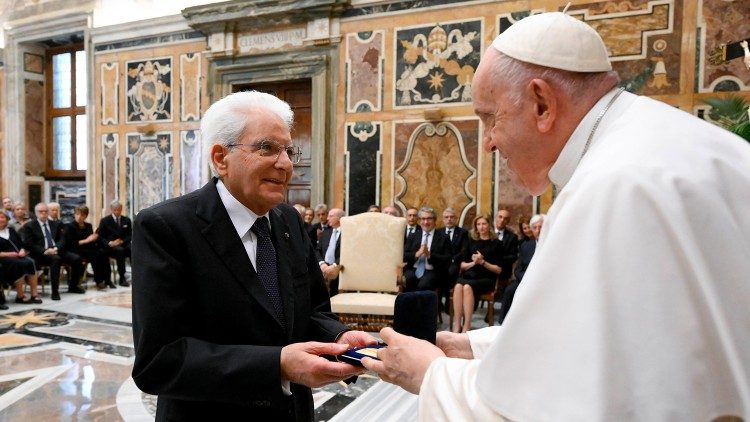
2023.05.29 Consegna del Premio Paolo VI di Brescia al Presidente della Repubblica Italiana Sergio Mattarella

Pope awards Paul VI International Prize to Italian President

Pope Francis awards Italian President, Sergio Mattarella, the Paul VI International Prize, commending him for his service and responsibility.

By Francesca Merlo

Pope Francis on Monday awarded the Paul VI prize, on the feast day of the Saint, to Italian President, Sergio Mattarella.

The prize, awarded in memory of Pope Montini was established in 1979 by the Paul VI Institute and is awarded to individuals or institutions “who, with their studies and their works, have contributed to the growth of the religious meaning in the world”.

Addressing the participants in the award ceremony in the Vatican’s Clementine Hall, the Pope recalled that Pope Saint Paul VI is also to be thanked for the Second Vatican Council which, amongst other things, emphasised the role of the lay faithful. “Prominent amongst their occupations is politics”, he said, describing politics as “one of the highest forms of charity”. But, the Pope continued, ”We may ask ourselves - how to make political action a form of charity and, on the other hand, how to live charity within political dynamics?"

Service

The answer lies in the word “service” the Pope continued. St. Paul VI said that those who exercise public power must regard themselves "as the servants of their fellow countrymen, with the disinterestedness and integrity befitting their high office".

Christ himself spoke of the difficulty of serving and doing for others, noted the Holy Father, who stressed his idea that ‘'he who does not live to serve does not live to live. I believe that today the awarding of the Paul VI Prize to President Mattarella is a beautiful occasion to celebrate the value and dignity of service, the highest style of living, which puts others before one's own expectations”.

Addressing President Mattarella directly,  the Pope went on to stress that this is true for him, a fact “witnessed by the Italian people”. He recalled how the President recently renounced his long-awaited retirement when he stepped back in and took on a new mandate “in the name of the service required of you by the State”.

Responsibility

Pope Francis then went on to stress that to make service complete one must also apply responsibility. “Service goes hand in hand with responsibility”, said the Pope. “It is, as the word itself indicates, the ability to offer answers, drawing on one's own commitment, without waiting for others to give them”, explained the Pope, before turning to President Mattarella once more and noting “how many times, Mr President, first by example and then by words, have you called for this!”

Bringing his discourse to a close the Pope reiterated that “yes, the sense of responsibility and the spirit of service were for St. Paul VI at the basis of the construction of social life”. He left behind a legacy of building communities of solidarity, and that was his dream.

"I am happy," Pope Francis said bringing his discourse to an end, “to make myself an instrument of gratitude on behalf of all those, young and old, who see in you a teacher, but above all a consistent and courteous witness of service and responsibility”. Pope Montini would be pleased, he concluded, and quoting him saying: "Contemporary man listens more willingly to witnesses than to teachers, or if he listens to teachers he does so because they are witnesses".

Wednesday, May 10, 2023

Pope Francis and Coptic Pope jointly write preface for new book celebrating the Joint Christological Declaration


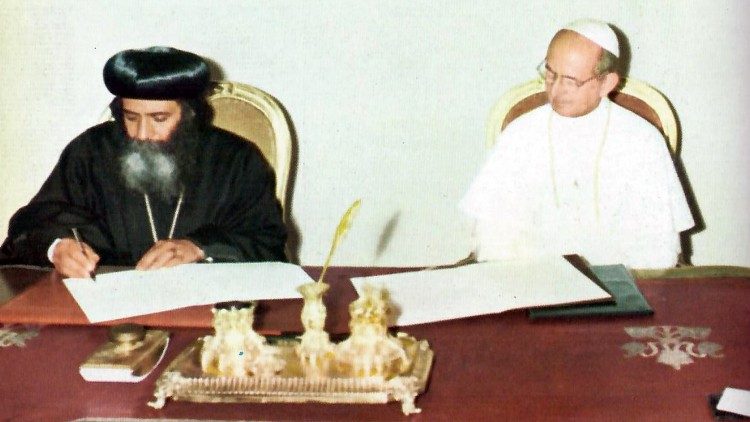
Pope Paul VI and Pope Shenouda III sign the Joint Christological Declaration in 1973Pope Paul VI and Pope Shenouda III sign the Joint Christological Declaration in 1973 

Pope Francis and Pope Tawadros II praise ongoing Catholic-Coptic dialogue

Pope Francis and the Coptic Orthodox Pope Tawadros II release a jointly-written preface for a new book, celebrating the 50th anniversary of the historic “Joint Christological Declaration” that continues to strengthen ties between the Catholic and Coptic Churches.

By Devin Watkins

As the Catholic and Coptic Orthodox Churches mark fifty years since the first modern meeting between their leaders, Pope Francis and Pope Tawadros II have penned a joint preface for a new book.

Set to hit bookshelves on Wednesday, the book is entitled “The Catholic Church and the Coptic Orthodox Church. 50th Anniversary of the Meeting between Pope Paul VI and Pope Shenouda III (1973-2023)”.

The preface, released on Tuesday, traces the path of dialogue which led to that historic encounter and the fruits which it has borne over the last half century.


Ongoing journey towards full communion

The two Popes begin the preface by expressing the desire of their Churches to “journey towards full communion”, while also recalling the progress that has been made thus far.

“We also need to give thanks to God by remembering the steps already taken and the distance already travelled, which are often much more important than we imagine,” they write, adding that this recollection of history represents the purpose of the book.

Pope Paul VI met with Pope Shenouda III in the Vatican on 9-13 May 1973, the first such meeting between “a Bishop of Rome and a Pope of the Coptic Orthodox Church” in over 1,000 years, during which they signed the landmark Joint Christological Declaration.

The declaration crowned years of ecumenical and theological dialogue between the Catholic and Coptic Orthodox Churches following the Second Vatican Council.

It also marked the end of the Christological controversy which had arisen in the wake of the Council of Chalcedon in 451.

Growing mutual understanding

The meeting between Paul VI and Shenouda III continued to bear fruit in ecumenical relations, including the creation of the Joint International Commission between the Catholic Church and the Coptic Orthodox Church.

The Commission’s work, note Pope Francis and Pope Tawadros II, led to the signing of the Principles for Guiding the Search for Unity between the Catholic Church and the Coptic Orthodox Church in 1979 between Shenouda III and John Paul II.

“This commission in turn paved the way for the foundation, in 2003, of the theological dialogue between the Catholic Church and the entire family of Oriental Orthodox Churches, a dialogue that has already produced important documents testifying to the growing understanding between our Churches,” say the two leaders.

United in fraternal love and friendship

Pope Francis and Pope Tawadros II also recall their first meeting, which took place in Rome on 10 May 2013, a date which they established as the annual “Day of Friendship between Copts and Catholics”.

The two Popes conclude their preface by expressing their hopes that the ecumenical journey between their two Churches might continue to bear fruit in response to Christ’s prayer “that they may all be one”.

“May the fraternal love and friendship that unite our Churches continue to grow until the blessed and longed-for day when we can celebrate together at the same Altar and receive from the same chalice, ‘so that the world may believe’!”