Showing posts with label Panama. Show all posts

Thursday, March 21, 2024

Pope Francis says he too is a child of migrants


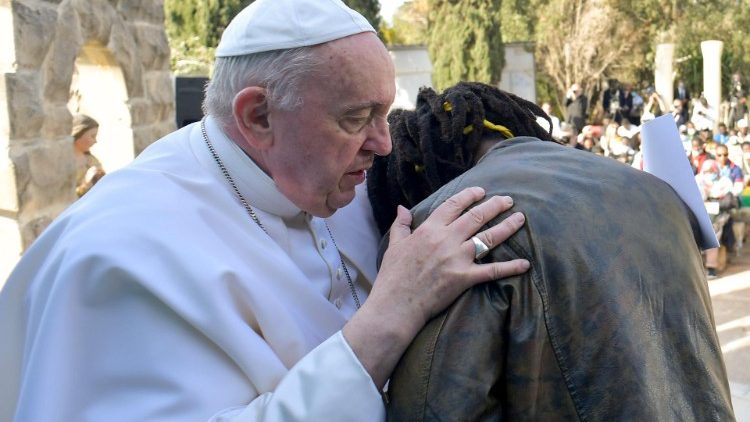
File photo of Pope Francis with a young migrantFile photo of Pope Francis with a young migrant  (Vatican Media)

Pope Francis: 'I too am a child of migrants'

Pope Francis sends a message to a group of migrants gathered in Lajas Blancas, Panama, referring to migrants as “the face of Christ”, whom the Church lovingly offers “relief and hope.”

By Sr. Francine-Marie Cooper

In a letter dated March 21, Pope Francis addressed a group of migrants gathered in Lajas Blancas, Panama.

The Pope spoke of wanting to accompany them personally, and expressed his understanding for their situation.

“I too am a child of migrants,” he said, “who set out in search of a better future.”

He thanked the bishops and pastoral workers who take his place in serving them.

The Pope said they represent “the face of a mother Church who walks with her sons and daughters, in whom she discovers the face of Christ and, like Veronica, lovingly offers relief and hope on the Way of the Cross of migration.”

The Holy Father added that migrants "represent the suffering body of Christ when they are forced to leave their country, to face the risks and tribulations of a difficult journey, when they find no other way out.”

He appealed to the migrants to never forget their human dignity, and not to “be afraid to look others in the eye,” as they are “not disposable.”

He reassured them that they “are also part of the human family and the family of God's children.”

The Pope thanked the migrants for their presence and asked them to pray for him.

Tuesday, January 29, 2019

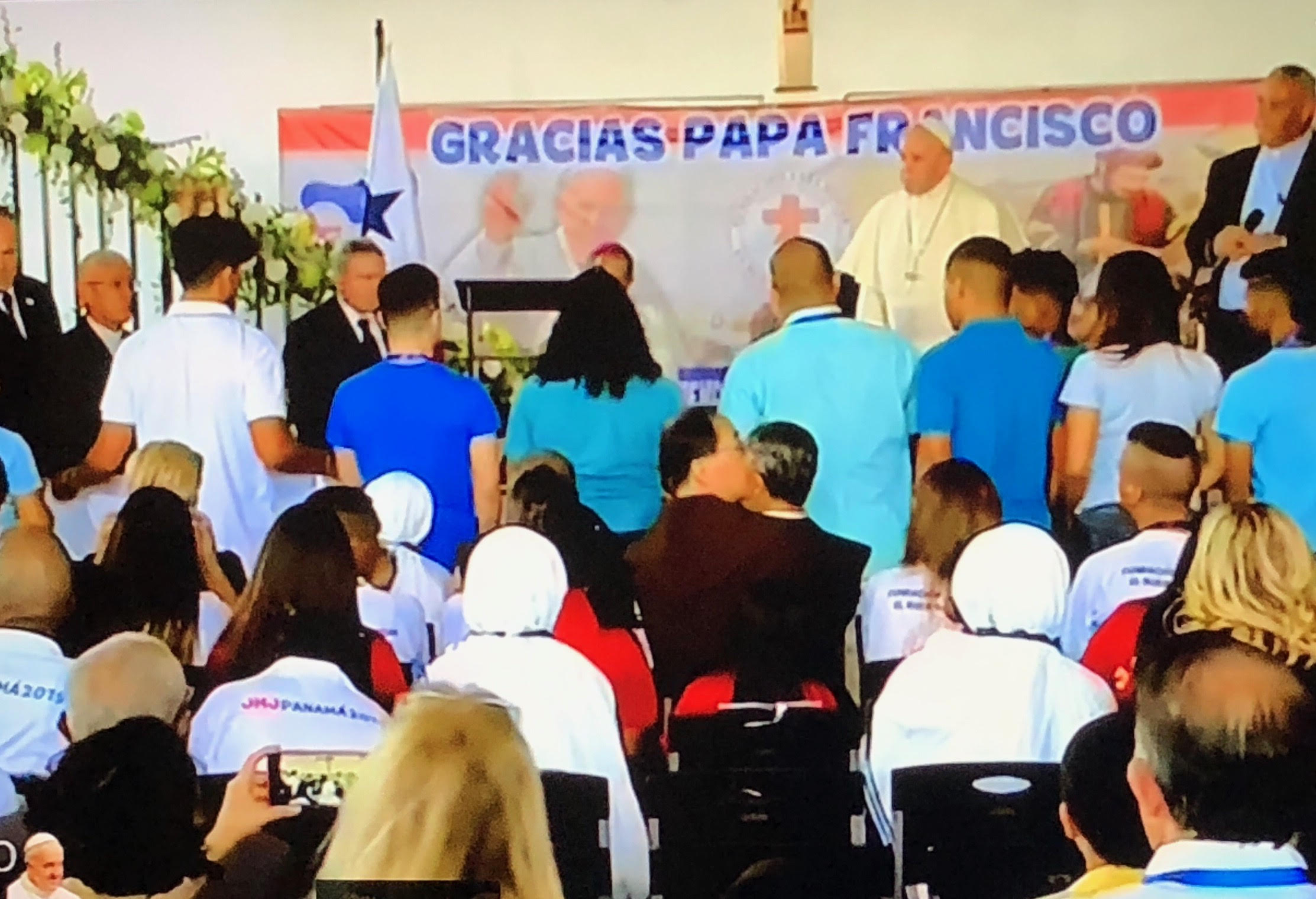
Pope Francis delivered his weekly Angelus Address in Panama

Vatican Media Screenshot

Pope’s Angelus at Casa Hogar El Buen Samaritano in Panama (Full Text)

‘That is how the miracle takes place: we feel that here we are reborn, here we are all reborn, because we feel God’s caress that enables us to dream of a more human world, and therefore of a world more divine’

Below is the Vatican-provided text of Pope Francis’ Angelus at Casa Hogar El Buen Samaritano in Panama, during his final day of his Apostolic Visit to the country to celebrate World Youth Day 2019, Jan. 22-28, 2019:
***
Dear Young Friends,
Dear Directors, Associates and Pastoral Workers,
Dear Friends,
Thank you, Father Domingo, for your words of greeting on behalf of all present. I have been looking forward very much to this meeting with you here from this Good Samaritan Home, and also with the other young people from the John Paul II Centre, the Saint Joseph Home of the Sisters of Charity and the “House of Love” of the Congregation of the Brothers of Jesus of Kkottonngae. Being with you today gives me reason for renewed hope. Thank you for giving me this.
In preparing for this meeting, I was able to read the testimony of a member of this Home that touched my heart. It said: “Here I was reborn”. This home, and all the centres you represent, are a sign of the new life that the Lord wants to give us. It is easy to confirm the faith of some of our brothers and sisters when we see it at work in anointing wounds, renewing hope and encouraging faith.
Nor are those we might call the “primary beneficiaries” of your homes the only ones to be reborn; here the Church and the faith are also born and continually recreated through love.
We begin to be reborn when the Holy Spirit grants us eyes to see others, as Father Domingo said to us, not only as the people we live with – and that is already saying a lot – but as our neighbours.
The Gospel tells us that Jesus was asked one day: “Who is my neighbour?” (cf. Lk 10:29). He did not respond with theories, or give a fine, lofty speech. Instead he told a story – the parable of the Good Samaritan – a concrete example drawn from the real life that you all know and experience. My
neighbour is before all else a face that I meet along the way, one that makes us move and be moved. To move from our fixed ways of doing things and our priorities, and to be moved so deeply by what that person is experiencing that we stop and make room for him or her on our journey. That is what the Good Samaritan realized when he saw the man left half-dead on the side of the road, not only by bandits but also by the indifference of a priest and a levite who could not be bothered to come to his aid. For indifference can also wound and kill. Some for a few miserable coins, others for fear of becoming unclean.
Whatever their reason, whether contempt or social aversion, they saw nothing
wrong in leaving that man lying on the roadside. The Good Samaritan, whether in the parable or in all of your homes, shows us that our neighbour is first of all a person, someone with a real, particular face, not something to avoid or ignore, whatever his or her situation may be. And that face reveals
our humanity, so often suffering and overlooked.
Our neighbour, then, is a face that wonderfully inconveniences our lives, because it reminds us and points our steps towards what is really important, and it frees us from all that is trite and superficial in the way we follow the Lord.
To be here is to touch the maternal face of the Church, which is capable of prophesying and creating a home, creating community. The Church’s face is usually unseen; it passes by unnoticed.
Yet it is a sign of God’s concrete mercy and tender love, a living sign of the good news of the resurrection that even now is at work in our lives.
To create a “home” is to create a family. It is to learn to feel connected to others by more than the utilitarian and practical bonds that make us feel that our life is a bit more human. To create a home is to let prophecy take flesh and make our hours and days less cold, indifferent and anonymous.
It is to create bonds by simple, everyday acts that all of us can do. A home, and this we all know very well, demands that everyone work together. No one can be indifferent or aloof, since each is a stone needed to build the home. And that also means asking the Lord to grant us the grace to learn to be patient, to forgive one another, to start over each day. How many times should I forgive and start over? Seventy times seven times, as many times as necessary. To create strong bonds requires confidence and trust nurtured daily by patience and forgiveness.
That is how the miracle takes place: we feel that here we are reborn, here we are all reborn, because we feel God’s caress that enables us to dream of a more human world, and therefore of a world more divine.
I thank all of you for your example and your generosity. I also thank your institutions, and the volunteers and benefactors. I thank all those who have made it possible for God’s love to become ever more concrete and real by gazing into the eyes of those around us and acknowledging that we
are all neighbours. Now that we are about to pray the Angelus, I entrust you to our Blessed Lady. We ask her, as a good Mother, full of tender love and closeness, to teach us to make an effort each day to discover who our neighbours are, and to help us go out quickly to meet them, to give them a home, an embrace, where care and fraternal love meet. This is a mission involving every one of us.
I encourage you now to place beneath her mantle all your concerns and needs, all your sorrows and hurts, so that, as a Good Samaritan, she will come to us and aid us by her maternal love and with her smile, the smile of a Mother.
Angelus Domini …

Monday, January 28, 2019

Pope Francis post Panama WYD discusses many things and shuts door on married Priesthood

Bishops must realize seriousness of abuse crisis, pope says

By Junno Arocho Esteves Catholic News Service
1.28.2019 8:54 AM ET
 

ABOARD THE PAPAL FLIGHT FROM PANAMA (CNS) -- The primary goal of the Vatican's February summit on clerical sexual abuse and child protection is to help bishops understand the urgency of the crisis, Pope Francis said.
During a news conference with journalists Jan. 27 on his flight to Rome from Panama, the pope said the presidents of the world's bishops' conferences have been called to the Feb. 21-24 meeting at the Vatican to be "made aware of the tragedy" of those abused by members of the clergy.
"I regularly meet with people who have been abused. I remember one person -- 40 years old -- who was unable to pray," he said. "It is terrible, the suffering is terrible. So first, they (the bishops) need to be made aware of this."
The pope's international Council of Cardinals suggested the summit after realizing that some bishops did not know how to address or handle the crisis on their own, he said.
"We felt the responsibility of giving a 'catechesis' on this problem to the bishops' conferences," he said. "That is why we convoked the presidents" of the conferences, the heads of the Eastern Catholic churches and representatives of the leadership groups of men's and women's religious orders.
The meeting, he said, will address "in a clear way" what protocols bishops need to follow when handling sexual abuse.
Asked about the expectations for the meeting, especially the expectations of Catholics who have grown frustrated with the repeated reports of abuse and cover-up by some bishops, the pope said people need to realize "the problem of abuse will continue."
"It is a human problem, a human problem (that is) everywhere," he said.
But if the church becomes more aware of the tragedy of sexual abuse, the pope said, it can help others face the crisis of abuse, especially in families "where shame leads to covering up everything."
Speaking with journalists for nearly an hour, the pope was asked whether he would consider a general acceptance of married men into the Latin-rite priesthood in a way similar to the practice of the Eastern Catholic churches.
"In the Eastern rite, they can do it. They make the choice between celibacy or marriage before they're ordained into the diaconate," he explained. "When it comes to the Latin rite, a phrase said by St. Paul VI comes to mind: 'I would rather give my life than change the law on celibacy.'"
The pope said he personally believes that "celibacy is gift to the church" and that while the prospect of married priests could one day be considered in remote areas that lack priests, he did not agree "with allowing optional celibacy."
"My decision is: no optional celibacy," the pope said. "I will not do this. I don't feel like I could stand before God with this decision."
Pope Francis also was asked about his response to the political crisis in Venezuela as well as the Vatican's seemingly neutral stance despite widespread belief that the election giving a second term to President Nicolas Maduro was rigged.
Earlier in the day, while visiting a Catholic-run hospice in Panama, the pope prayed for the people of Venezuela and expressed his hope that a "just and peaceful solution may be sought and achieved to overcome the crisis."
Although the United States and several European countries have recognized National Assembly President Juan Guaido as the country's legitimate head of state, the Vatican has not.
Pope Francis told journalists that while he fully supports the suffering people of Venezuela, picking a side in the crisis "would be pastoral imprudence on my part and would cause damage."
"That is why I had to be -- I don't like the word 'balanced' -- I must be a shepherd to all and if they need help, then they must come to an agreement and ask for it," he said.
The pope said that he thought carefully about his words to the people of the country because "I suffer for what is happening in Venezuela in this moment."
"What is it that scares me? Bloodshed," the pope said. "And that is why I ask for generosity from those who can help resolve the problem."
Pope Francis also addressed the issue of abortion, which was among the themes of the Via Crucis at World Youth Day Jan. 25.
During the 14th Station -- Jesus is laid in his tomb -- a young pilgrim read a reflection on all the tombs where those who have died violent deaths have been laid. "However," the reflection said, "there is one tomb that cries to heaven and denounces the terrible cruelty of humanity: it is the tomb that opens in the wombs of mothers who rip out innocent life."
Asked how the words could be in harmony with his calls for mercy, including for women who have had abortions, Pope Francis said that the "message of mercy is for everyone, including the human being that is gestating."
Forgiving women who have had abortions is not the problem, he said; rather it is learning to accompany women who have understood and regret what they have done.
People do not understand the trauma women go through after an abortion, the pope said. Often those who regret their abortions "feel the need to reconcile and rejoin their child."
"I tell them, 'Your child is in heaven, talk to him, sing them the lullaby you were never able to sing to them,'" Pope Francis said. "There, a path of reconciliation can be found between mother and child. Forgiveness with God is already there. God always forgives."