Showing posts with label Our Lady of Mount Carmel. Show all posts

Wednesday, July 15, 2026

Devotion to Our Lady of Mount Carmel, Carmelite Order, the Brown Scapular


Our Lady of Mount Carmel


Ordinary Time: July 16th

Sacred Scripture celebrated the beauty of Carmel where the prophet Elijah defended the purity of Israel's faith in the living God. In the twelfth century, hermits withdrew to that mountain and later founded the Carmelite order devoted to the contemplative life under the patronage of Mary, the holy Mother of God.

Devotion to Our Lady of Mount Carmel is worldwide, and most Catholics are familiar with the Scapular of Our Lady of Mount Carmel, also known as the Brown Scapular. The feast of Our Lady of Mount Carmel was instituted for the Carmelites in 1332 and extended to the whole Church by Benedict XIII in 1726.

Our Lady of Mount Carmel
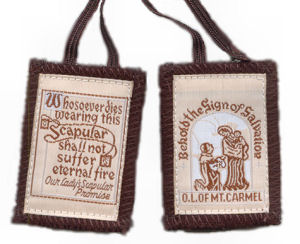
Today is the principal feast day of the Carmelite Order. Through the efforts of the crusader Berthold, a group of hermits living on Mount Carmel were organized into an Order after the traditional Western type about the year 1150. Oppressed by the Saracens, the monks slowly emigrated to Europe. During the night preceding the sixteenth of July, 1225, the Blessed Virgin is said to have commanded Pope Honorius III to approve the foundation. Since the Carmelites were still under constant harassment, the sixth General of the Order, St. Simon Stock, pleaded with the Blessed Virgin for some special sign of her protection. On July 16, 1251, she designated the scapular as the special mark of her maternal love. That is why the present feast is also known as the feast of the Scapular. The scapular, as part of the habit, is common to many religious Orders, but it is a special feature of the Carmelites. A smaller form of the scapular is given to lay persons in order that they may share in the great graces associated with it.
—Excerpted from The Church's Year of Grace, Pius Parsch

Highlights and Things to Do:

  • If you have not already done so, have a priest enroll you in the Scapular of Our Lady of Mount Carmel, or popularly known as the "Brown Scapular" and begin wearing it as a sign of your love for Our Lady. A priest enrolls people in the Brown Scapular only once. The Scapular can then be replaced afterwards by other scapulars or the scapular medal, which has on one side the image of the Sacred Heart of Jesus and on the other, the image of Mary. The medal needs to be blessed by a priest, but the cloth scapulars do not require a blessing (separate from enrollment).
  • Wearing the Brown Scapular is not an automatic guarantee of salvation. It is not a magical charm, nor is it an excuse to live in a way contrary to the teachings of the Church. It is a sacramental which has been approved by the Church for over seven centuries and is a sign of one's decision to follow Jesus as did Mary, the perfect model of all the disciples of Christ. In addition to being an introduction into the Family of Carmel, the Brown Scapular is an expression of our belief that we will meet God in eternal life, aided by the intercession and prayer of Mary. While sacramentals prepare us to receive grace if we are in the right disposition, the Church emphasizes that only sacraments can confer sanctifying grace. (See Catechism, no. 1670.)
  • Periodically the Church reexamines devotions and popular piety to make sure they are "not at odds with the centrality of the Sacred Liturgy. Rather, in promoting the faith of the people, who regard popular piety as a natural religious expression, they predispose the people for the celebration of the Sacred Mysteries" (John Paul II, September 2001). In accordance with Vatican II, the Congregation for Divine Worship and the Discipline of the Sacraments issued the Directory on Popular Piety in 2001 to reevaluate different devotions and popular piety. Though the Brown Scapular is included in the document as a wonderful pious practice, the Directory does not mention the Sabbatine Privilege, which continues to present historical difficulties. The Directory rather emphasizes the beautiful sign of the "filial relationship" with the faithful and Mary:

    205. The history of Marian piety also includes "devotion" to various scapulars, the most common of which is devotion to the Scapular of Our Lady of Mount Carmel. Its use is truly universal and, undoubtedly, it is one of those pious practices which the Council described as "recommended by the Magisterium throughout the centuries."

    The Scapular of Mount Carmel is a reduced form of the religious habit of the Order of the Friars of the Blessed Virgin of Mount Carmel. Its use is very diffuse and often independent of the life and spirituality of the Carmelite family.

    The Scapular is an external sign of the filial relationship established between the Blessed Virgin Mary, Mother and Queen of Mount Carmel, and the faithful who entrust themselves totally to her protection, who have recourse to her maternal intercession, who are mindful of the primacy of the spiritual life and the need for prayer.

    The Scapular is imposed by a special rite of the Church which describes it as "a reminder that in Baptism we have been clothed in Christ, with the assistance of the Blessed Virgin Mary, solicitous for our conformation to the Word Incarnate, to the praise of the Trinity, we may come to our heavenly home wearing our nuptial garb."

    The imposition of the Scapular should be celebrated with "the seriousness of its origins. It should not be improvised. The Scapular should be imposed following a period of preparation during which the faithful are made aware of the nature and ends of the association they are about to join and of the obligations they assume."

  • Pope John Paul II has worn the scapular for a long time. The Holy Father's talk on the Scapular of Carmel, A Treasure for the Church mentions:

    Therefore two truths are evoked by the sign of the Scapular: on the one hand, the constant protection of the Blessed Virgin, not only on life's journey, but also at the moment of passing into the fullness of eternal glory; on the other, the awareness that devotion to her cannot be limited to prayers and tributes in her honor on certain occasions, but must become a "habit", that is, a permanent orientation of one's own Christian conduct, woven of prayer and interior life, through frequent reception of the sacraments and the concrete practice of the spiritual and corporal works of mercy. In this way the Scapular becomes a sign of the "covenant" and reciprocal communion between Mary and the faithful: indeed, it concretely translates the gift of his Mother, which Jesus gave on the Cross to John and, through him, to all of us, and the entrustment of the beloved Apostle and of us to her, who became our spiritual Mother.

Wednesday, July 16, 2025

The Feast Day of Our Lady of Mt. Carmel


Why the feast of Our Lady of Mt. Carmel is on July 16


Public Domain via Wikimedia


Dr. Annabelle Moseley, T.O.Carm. - published on 07/16/25

And what it has to do with Elijah, Scripture, and being wrapped in a mantle of graces.

The Feast of Mount Carmel is celebrated on July 16 because that is the day (July 16, 1251) that the Blessed Mother gave the brown scapular to St. Simon Stock.

St. Simon Stock had been visiting the Holy Land, and when he returned to England in 1251, he received an apparition of Our Lady in which she said, “Receive, my Beloved Son, this scapular of thy Order; it is the special sign of my favor, which I have obtained for thee and for thy children of Mount Carmel. He who dies clothed with this habit shall be preserved from eternal fire. It is the badge of salvation, a shield in time of danger, and a pledge of special peace and protection.” 

Although the wearing of the Brown Scapular is a Carmelite privilege, this privilege has been extended to all Catholics. Any Catholic may wear a Brown Scapular (be sure to have it blessed!).

But did you know that you should also be formally enrolled into the Brown Scapular and that with it comes extraordinary graces? Any priest can enroll you, but more churches offer this officially on or near the Feast of Our Lady of Mt. Carmel.

It’s a great time to see if a church near you is doing so; or to suggest that they do it. Here is the formula for enrollment.

Wrapped in protection

It’s no wonder a friend of mine smiles and calls the brown scapular “fire insurance.” What an incredible grace the Queen of all Saints provides in her scapular!

If you don’t yet have a scapular, why not purchase one from a convent of Carmelite nuns and therefore support their holy work at the same time? Here is one option, and another.

Why not put on your “to-do” list, or mark on your calendar, to be enrolled in the brown scapular by a priest and if possible join an investiture ceremony. You only need to be enrolled once in a lifetime.

Here’s more details on the graces and answers to questions about enrolling and investiture in the brown scapular.

I am a Third Order Carmelite, and one of the things I love most about wearing the brown scapular is that it is an experience of being wrapped in Our Lady’s mantle. Furthermore, for Carmelites, the scapular is very symbolic. Elijah was known for wearing a cloak, or mantle. 

When Elijah heard the whisper of God on Mt. Horeb and recognized the presence of God, he “wrapped his face in his mantle,” (1 Kings 19:12) and when Elijah made Elisha his disciple, he wrapped his cloak around him. Elisha later asked for a double portion of Elijah’s spirit.

When Elijah was carried up to heaven in a chariot, he dropped his mantle down to Elisha who caught it, a sign that Elisha would indeed receive this grace.

When we wear the brown scapular, it is a tangible and visible way to ask for and receive the spirit of Elijah, being ever more zealous for the Lord and witnessing to our faith.  

Saturday, July 15, 2023

Sunday is Feast Day of Our Lady of Mount Carmel


Our Lady of Mount Carmel


The feast of Our Lady of Mount Carmel, celebrated  on July 16, was first instituted in the late 14th century in commemoration of the approval of the rule of the Carmelite Order a hundred years earlier. According to legend, a religious community was established even before the time of Christ on Mount Carmel. This is the mountain overlooking the Mediterranean Sea on which the prophet Elijah successfully challenged the priests of Baal and won the people to the true God. The feast of Our Lady of Mount Carmel entered the Calendar of the universal Church in the early 18th century.

Although there is no historical evidence for the pre-Christian Carmelite community, references in the 12th century record a community of monks on the holy mountain. Despite continual difficulties, the community built a monastery and church dedicated to the Virgin Mary on Mount Carmel in 1263. Saint Louis, King of France, had visited Mount Carmel in 1254, and brought back six French hermits for whom he built a convent near Paris.

Mount Carmel was taken by the Muslims in 1291, and the brothers were killed and the convent burned. The spread of the Carmelites in Europe is largely attributable to the work of Saint Simon Stock (1247-1265). The Carmelite Order was formally approved in 1274 at the Council of Lyon.

The Scapular of Our Lady of Mount Carmel

The brown Scapular of Our Lady of Mount Carmel, according to the Carmelite tradition, was presented by Our Lady to St. Simon Stock, the then Father General on July 16, 1251.  Our Lady gave St. Simon a scapular for the Carmelites with the following promise, saying : "Receive, My beloved son, this habit of thy order: this shall be to thee and to all Carmelites a privilege, that whosoever dies clothed in this shall never suffer eternal fire .... It shall be a sign of salvation, a protection in danger, and a pledge of peace."

Another important aspect of wearing the Scapular is the Sabbatine Privilege. This concerns a promise made by Our Lady to Pope John XXII. In a papal letter he issued, he recounted a vision that he had had. He stated that the Blessed Virgin had said to him in this vision, concerning those who wear the Brown Scapular: "I, the Mother of Grace, shall descend on the Saturday after their death and whomsoever I shall find in Purgatory, I shall free, so that I may lead them to the holy mountain of life everlasting."

Many popes and saints have strongly recommended wearing  the Brown Scapular to the Catholic Faithful. Pope Pius XII  said: "The Scapular is a practice of piety which by its very simplicity is suited to everyone, and has spread widely among the faithful of Christ to their spiritual profit." In our own times, Pope Paul VI said: "Let the faithful hold in high esteem the practices and devotions to the Blessed Virgin ... the Rosary and the Scapular of Carmel" and in another place referred to the Scapular as: "so highly recommended by our illustrious predecessors."

According to Church tradition, there are three conditions necessary to participate in this Privilege and share in the other spiritual benefits of the Scapular: wear the Brown Scapular, observe chastity according to your state in life, and pray the Rosary. In addition to the Sabbatine Privilege, enrollment in the Brown Scapular also makes a person part of the Carmelite family throughout the world. They therefore share in all of the prayers and good works of the Carmelite Orders.

In order to receive the spiritual blessings associated with the Scapular, it is necessary to be formally enrolled in the Brown Scapular. The enrollment is made only once by a priest or authorized person. The Scapular can be replaced afterwards by a medal, which has on one side the image of the Sacred Heart of Jesus and on the other, the image of Mary.

There a short  form for giving the scapular: "Receive this Scapular, a sign of your special relationship with Mary, the Mother of Jesus, whom you pledge to imitate. May it be a reminder to you of your dignity as a Christian in serving others and imitating Mary. Wear it as a sign of her protection and of belonging to the family of Carmel, voluntarily doing the will of God and devoting yourself to building a world true to his plan of community, justice and peace."

The scapular  stands for:

- A commitment to follow Jesus, like Mary, the perfect model of all the disciples of Christ. This commitment finds its origin in baptism.

- It leads  into the community of Carmel, a community of religious men and women, which has existed in the Church for over eight centuries.

- It reminds of the example of the saints of Carmel, with whom it establishes a close bond as brothers and sisters.

- It is an expression of the  belief that the bearers of the scapular will meet God in eternal life, aided by the intercession and prayers of Mary.

The Carmelites insist that the  scapular is not:

- A magical charm to protect someone.
- An automatic guarantee of salvation.
- An excuse for not living up to the demands of the Christian life

It is instead a sign which has been approved by the Church for over seven centuries and which stands for the decision to

- Follow Jesus like Mary:
- Be open to God and to his will.
- Be guided by faith, hope, and love.
- To pray at all times
- To discover God present in all that happens around us.

Tuesday, May 16, 2023

On this feast of St. Simon Stock, let's learn more about scapulars, especially the Brown Scapular


In its original form, the scapular is a part of the monastic habit (the outfit that monks wear). It is composed of two large pieces of cloth, connected in the middle by narrower strips of cloth, much like an apron that covers both the front and the back of the wearer. The narrower strips provide an opening through which the monk places his head; the strips then sit on his shoulders, and the large pieces of cloth hang down in front and in back. The scapular gets its name from the Latin word scapulae, which means "shoulders."

The Devotional Scapular

Today, the term scapular is used most often to refer to a sacramental (a religious object) that has essentially the same form as the monastic scapular but is composed of much smaller pieces of wool cloth (usually only an inch or two square) and thinner connecting strips. Technically, these are known as "small scapulars," and they are worn by lay faithful as well as those in religious orders. Each small scapular represents a particular devotion and often has a certain indulgence or even a revealed "privilege" (or special power) attached to it.

The Brown Scapular

The most famous of the small scapulars is the Scapular of Our Lady of Mount Carmel (the "Brown Scapular"), revealed by the Blessed Virgin Mary herself to St. Simon Stock on July 16, 1251. Those who wear it faithfully as an expression of devotion to the Blessed Virgin Mary, it is said, will be granted the grace of final perseverance—that is, to remain firm in the faith even in the moment of their death.

Pronunciation: ËˆskapyÉ™lÉ™r

Common Misspellings: scapula

Examples: "Every year, on the Feast of Our Lady of Mount Carmel, Father blesses Brown Scapulars and distributes them to the parishioners."