reflections, updates and homilies from Deacon Mike Talbot inspired by the following words from my ordination: Receive the Gospel of Christ whose herald you have become. Believe what you read, teach what you believe and practice what you teach...
Pope Leo poses with pilgrims on an ecumenical Orthodox-Catholic pilgrimage led by Cardinal Joseph Tobin (l) and Metropolitan Elpidophoros (r) (@VATICAN MEDIA)
Pope Leo XIV: Seek grace to pursue path of unity and fraternal charity
At Castel Gandolfo, Pope Leo XIV received Greek Orthodox, Byzantine Catholic, and Latin Catholic pilgrims from the United States who are taking part in an ecumenical pilgrimage to Rome, Constantinople, and Nicea.
By Christopher Wells
A joint Orthodox-Catholic pilgrimage to Rome, Constantinople, and Nicea “is one of the abundant fruits of the ecumenical movement aimed at restoring full unity among all Christ’s disciples,” Pope Leo XIV told participants in the pilgrimage on Thursday, as he welcomed them to the papal summer residence at Castel Gandolfo.
The pilgrimage “From Rome to New Rome” comprises fifty Greek Orthodox, Byzantine Catholic, and Latin Catholic pilgrims from the United States, and is being led by the Greek Orthodox Archbishop Elpidophoros of America and Cardinal Joseph Tobin, Archbishop of Newark, New Jersey.
In his greetings, Pope Leo noted that the pilgrimage is intended “to return to the sources”: to Rome, where Sts Peter and Paul were martyred; Constantinople—now Istanbul—associated with St Andrew; and to Nicea, the site of the first Ecumenical Council 1700 years ago this year.
The Pope went on to highlight the common celebration of Easter in 2025, observed on the same date by those who follow both the Gregorian and Julian liturgical calendars, which allowed all Christians to proclaim together the Easter Alleluia, “Christ is risen! He is truly risen!”
Those words, Pope Leo XIV said, proclaim the passion and resurrection of Jesus, “the Lamb that was slain” to redeem us from “the darkness of sin and death.” The redemption won by Christ “inspires us with great hope” while also calling us “to be witnesses and bearers of hope,” recalling the motto of the Jubilee Year, pilgrims of hope.
“It is my hope that your pilgrimage will confirm all of you in the hope born of our faith in the Risen Lord!” Pope Leo said.
Looking ahead to the group’s visit to Constantinople, the Pope asked the pilgrims to convey his greetings to the Patriarch Bartholomew, saying he hoped to meet him again in person during the ecumenical commemoration of the anniversary of the Council of Nicea.
The Holy Father went on to describe the group’s ecumenical pilgrimage as one of the many signs that “already manifest the theological progress and the dialogue of charity that mark recent decades,” especially since the Joint Declaration of Pope Paul VI and Patriarch Athenagoras removing the mutual excommunications that followed the break in relations between Rome and Constantinople in 1054.
“For our part,” the Pope said, “we too must continue to implore from the Paraclete, the Consoler, the grace to pursue the path of unity and fraternal charity.” Looking ahead to the two-thousandth anniversary of the Redemption, Pope Leo said, “Spiritually, we must all return to Jerusalem, the City of Peace,” where the Apostles received the Holy Spirit before going on to bear witness to Christ “to the ends of the earth.”
Pope Leo concluded his address with the prayer, “May our return to the roots of our faith make all of us experience the gift of God’s consolation and make us capable, like the Good Samaritan, of pouring out the oil of consolation and the wine of gladness on today’s humanity.”
Metropolitan Archbishop Fulop Kocsis of Hajdudorog, Hungary (C) speaks with then-Archbishop Robert Francis Prevost as they await the arrival of Pope Francis at the Buda Castle in Budapest on 28 April 2023. Archbishop Michael Wallace Banach, Apostolic Nuncio to Hungary, stands to the left. (Photo: Magyar Kurir/Attila Lambert)
Eastern Church leaders welcome election of Pope Leo XIV
Leaders of Eastern-rite Catholic Churches and Orthodox Churches have welcomed the election of Cardinal Robert Prevost as Pope Leo XIV.
By Barb Fraze and Laura Ieraci - CNEWA
Church leaders in the Christian East welcomed the election of Pope Leo XIV on 8 May, noting his first words to the crowd in St. Peter’s Square were about peace.
Ecumenical Patriarch Bartholomew of Constantinople was at an event in his honor in Athens when he learned of the election, according to a report in The Orthodox Times.
In an English-language video message published by the Ecumenical Patriarchate, he welcomed the new Bishop of Rome, adding he hopes Pope Leo will “be a dear brother and collaborator … for the rapprochement of our churches, for the unity of the whole Christian family, and for the benefit of all of humankind.”
Bartholomew spoke of his collaboration with Pope Francis in the areas of dialogue and care for creation. “We have done a lot,” he said.
The Ecumenical Patriarch, who had hoped to visit Iznik, Turkey, with Pope Francis in May to mark the 1,700th anniversary of the First Ecumenical Council of Nicaea, said he hoped Pope Leo would “combine a visit to Nicaea with an official visit to the Ecumenical Patriarchate, on the occasion of our feast of St. Andrew on 30 November.”
“We look toward the new pontiff with Christian hope,” he told those gathered at the event in Athens, adding that he intends to attend Pope Leo XIV’s Mass of Inauguration in Rome.
“May he inspire the Church and the world with the universal ideals of freedom, equality, justice and solidarity. May he help end wars in Ukraine, the Middle East, and prevent conflict between India and Pakistan,” he said. “I hope we can inaugurate a new era in our bilateral relations and in relations between East and West.”
In a message posted on the website of the Ukrainian Greek Catholic Church, Major Archbishop Sviatoslav Shevchuk of Kyiv-Halych noted that the first words Pope Leo spoke from the balcony were “Peace be with you.” He said that “suffering Ukraine hears these words as words of hope and special God’s blessing.”
“His Holiness Pope Leo XIV expressed the wish these words ‘reach all nations, all the earth.’ We sincerely believe the new bishop of Rome will become for the long-suffering Ukrainian people a herald of peace that comes from the risen Lord,” said Archbishop Shevchuk.
Metropolitan Fulop Kocsis, Archbishop of Hajdudorog, Hungary, who heads the Hungarian Greek Catholic Church, also commented on the Pope’s words of peace.
“Not only did he literally wish them peace, but he quoted the risen Christ, who also greeted the apostles with these words,” he said. “Of course, peace after the resurrection is quite different, since Jesus Christ gives peace in a way that is different from the way the world gives it.”
The new pontiff had visited Hungary twice in recent years, first as Bishop of Chiclayo, Peru, for the 52nd International Eucharistic Congress in Budapest in September 2021, and then as Prefect of the Dicastery for Bishops in April 2023, when he accompanied Pope Francis on his Apostolic Visit to Hungary, which included a visit to the Greek Catholic Protection of the Mother of God Church in Budapest.
The Metropolitan Archbishop said the choice of the name Leo expresses the Pope’s intention to “emphasize his social sensitivity, since Pope Leo XIII wrote the first encyclical on the subject in 1891, ‘Rerum Novarum,’ which was about poverty and the working class.”
Leo XIII was also the first pontiff to acknowledge the dignity of the Eastern Catholic Churches within the Catholic communion with his 1894 encyclical, “Orientalium Dignitatis” (“On the Churches of the East”), he noted.
“So, the choice of the name Leo is particularly dear to us,” Archbishop Kocsis said, referring to Eastern Catholics.
While he thought the new Pope would choose the name Francis II, he said he was “glad the Pope dared to reach back into tradition.”
“I am convinced that Leo XIV will take the same line as Pope Francis. Dialogue and the inclusion of the poor are important to him,” Archbishop Kocsis said. “The two of them were excellent collaborators; they discussed many things together.”
In New York, Greek Orthodox Archbishop Elpidophoros of America recognized Pope Leo’s election “with fraternal esteem” and renewed the church’s “unwavering commitment to strengthening dialogue and fellowship between our churches, guided by humility, openness and mutual respect.”
“His ministry, deeply inspired by the example of Pope Francis, resonates strongly with the enduring commitment of His All Holiness Ecumenical Patriarch Bartholomew toward ecumenical dialogue, reconciliation and care for the most vulnerable among us,” he said.
Mar Joy Alappatt of the Syro-Malabar Catholic Eparchy of St. Thomas of Chicago, where Pope Leo XIV was born, said Eastern Catholics “anticipate a renewed focus on synodality, honoring liturgical identity, and engaging in genuine dialogue with our ancient practices.”
In his first message to the crowd in St. Peter’s Square after his election on 8 May, Pope Leo XIV underlined the importance of walking as a synodal Church.
Mar Alappatt said, as a Cardinal, the new pontiff had served as a member of the Dicastery for the Eastern Churches since 2023, and “witnessed the beautiful unity of our universal Catholic communion between East and West.”
The bishop said the Pope’s previous ministry in Peru “showcases a pastor who truly listens, walks humbly with his community, and amplifies the voices from the margins."
“His deep love for the impoverished and his presence among Indigenous populations strongly reflect the many missions led by Eastern churches around the world,” Mar Alappatt said. He noted especially the numerous pastoral and charitable works of the Syro-Malabar Catholic Church in mission territories across central and north India.
The Pope’s “pastoral spirit, nurtured in Chicago and Peru, now opens pathways in the East through a welcoming and enriching approach,” he continued. “His papacy will inspire us to embrace our missionary calling with greater courage and compassion.”
The Order of St. Augustine, which the Pope entered as a friar, posted on its website an interview he gave when he was created a Cardinal in 2023. In that interview, he said, “Being a synodal Church that knows how to listen to everyone is the way not only to live the faith personally, but also to grow in true Christian brotherhood.”
“The Church is fully such only when it truly listens,” he said, “when it walks as the new people of God in its wonderful diversity, continually rediscovering its own baptismal call to contribute to the spread of the Gospel and the Kingdom of God.”
Parish priest: ‘Gaza is full of ordinary people who pose no threat to anyone'
Fr. Gabriel Romanelli, parish priest of the Holy Family Church in Gaza, says his community needs peace and humanitarian corridors. His appeal for a halt to the bombings was recorded on Tuesday, the day before an air strike caused extensive damage to the area adjacent to the parish where hundreds of refugees are sheltered.
By Linda Bordoni
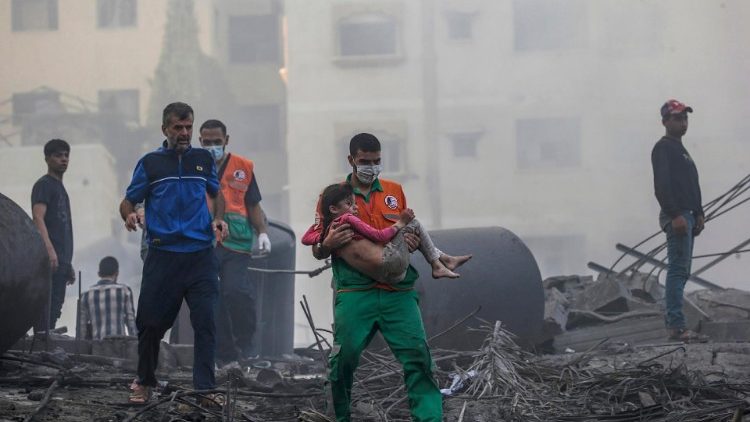
Gaza’s Holy Family Catholic Parish was amongst those assisting some of the people who were injured in the blast that devastated a Greek Orthodox Church on 19 October, killing at least 18 Christian Palestinians sheltering there.
The Holy Family parish priest, Fr. Gabriel Romanelli, was stranded in Bethlehem when the war broke out on 7 October, but he has remained in constant contact with his parish and flock since then.
His appeal to halt the bombings and establish humanitarian corridors for the ordinary citizens of Gaza "who pose no threat to anyone" was recorded the day before an airstrike hit the area just beside the parish on Wednesday evening, 25 October. At the time of publication of this article, there was no news regarding casualties and damage, only images of the bombed site.
In his appeal recorded on Tuesday, Fr. Gabriel explained that the parish is only about 400 meters from the Greek Orthodox church that was struck last week.
They are our neighbours, he said, and everyone has been deeply affected by the tragedy.
“They are all relatives, friends, people we care about, people we loved.”
He said that those most seriously injured have been taken to the hospital while the others have sought refuge in the parish.
Now, he said, together with the refugees who were already sheltering in our church, “there are approximately seven hundred people, including the children of Mother Teresa's mission.”
“The situation is critical. The bombings occur day and night.”
Appeal to stop the bombings
Lamenting the fact that the number of casualties throughout the Gaza Strip has exceeded 5,100 people, with thousands more injured, Fr. Gabriel said, “What we are asking for is a stop to this war and the creation of humanitarian corridors to ensure the well-being of everyone.”
“This is what we are asking and praying for the good of all.”
Most urgent, he continued, is the need to stop the bombings, which are killing people.
“As I'm recording this, there are people dying,” he said, pointing out that there are also many trapped under the rubble and “the hope of finding them alive is almost non-existent, including some eight hundred children.”
Fr. Gabriel expressed his gratitude for the many religious who have chosen to remain with the people, with the children they care for, with the disabled and with the elderly. Like them, he said, they have no safe place to go.
“There is no safe place in the entire Gaza Strip.”
His parishioners are asking for prayers, he continued, as they live in fear that they too may be struck like their neighbours at the Greek Orthodox church.
Civilians who pose no danger to anyone
Fr. Gabriel said the hundreds of people sleeping there have become like the early Christian communities, sharing what little they have and with a common plea for the bombings to stop.
“They ask for this message to reach the Israeli authorities and the authorities of other foreign or Arab countries: Please, let them know that the parish, for example, is filled with ordinary people and Muslim neighbors. These are civilians who pose no danger to anyone.”
"May the Virgin Mary, Our Lady of Peace, grant us peace, and we pray for all the victims, for those who are injured, and we also pray for all those who offer sacrifices for the good of the people in the Holy Land, especially those who tirelessly pray for the small Christian community in the Gaza Strip."
Orthodox Patriarch of Jerusalem: ‘My heart is saddened for suffering brothers’
After 18 Christians were killed in last week's bombing of the Orthodox Church of St. Porphyrios in Gaza, Patriarch Theophilos III recalls the duty of Christians to “be peacemakers and seek justice” in an interview with the Osservatore Romano.
By Roberto Cetera
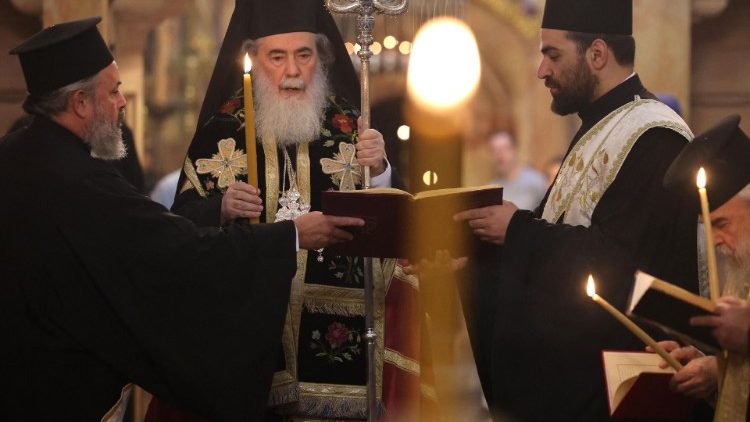
A special prayer for peace was held on Sunday morning at the "Catholicos" of the Basilica of the Holy Sepulcher in Jerusalem.
The celebration, presided over by the Orthodox Patriarch Theophilos III, was also attended by the Apostolic Nuncio to Israel, Archbishop Adolfo Tito Yllana, and the Custos of the Holy Land, Father Francesco Patton.
At the end of the ceremony, Patriarch Theophilos granted the following interview to the Osservatore Romano.
Q: What is the situation of the Christians who survived the horrible tragedy of the bombing of your church in Gaza?
The tragic bombing of our church in Gaza has left a profound impact on the Christian community in Gaza and the rest of the Holy Land.
The survivors of this horrific bombing are resilient and filled with the spirit of Christ. They have displayed faith through the aftermath of this horrific ordeal. We have come together as a community to support one another, praying for healing and strength in the face of adversity.
As faithful Christians, we are called to be peacemakers and to seek justice. Our response to this war crime should serve as a beacon of hope, demonstrating the transformative power of faith and the capacity of the human spirit to rise above the darkness of war.
Q: Which initiatives are you taking to protect and to support them?
In these trying times, it is our sacred duty to extend our hand in support and protection to our Christian brethren and all those affected by the tragedy in Gaza. T
he Christian community, through the Patriarchs and Heads of Churches in Jerusalem, are working tirelessly to provide humanitarian aid and relief to those who have suffered the most. Our charitable organizations are collaborating with local partners to ensure that essential needs such as food, shelter, and medical care are met to the best of our ability given the Israeli decision to cut off water, electricity, food and medicine since 7 October.
Through prayer, advocacy, and practical support, we are resolute in our mission to protect and support those affected by this tragedy, following the teachings of Christ who calls us to be instruments of peace and agents of healing in a world in need of love and compassion.
Q: What is the sentiment among your people in Palestine and Israel?The sentiment among our Christian communities is one of hope, resilience, and a deep commitment to our faith. While the region has faced complex and challenging circumstances, our Christian brothers and sisters remain steadfast in their determination to live out the teachings of Christ.
In this diverse and often contentious land, we continue to promote peace, and coexistence. We actively participate in interfaith dialogues and collaborative efforts, striving to build bridges among people of different backgrounds and beliefs. Our communities serve as living witnesses to the message of love, forgiveness, and reconciliation that is at the core of Christianity.
At the same time, we cannot deny the difficulties and hardships that many in the region face, especially those living under the horrors of air strikes and artillery bombings in Gaza.
Ultimately, our message is one of unwavering faith, commitment to peace, and the belief that, as Christians, we are called to be peacemakers in this land, embodying the hope for a brighter and more harmonious future for all its inhabitants. We continue to pray and work for peace, justice, and the well-being of every soul in this sacred and troubled region.
Q: I can imagine your personal pain and suffering and the difficult position you are in at the moment. What are your personal feelings?
As the Patriarch of Jerusalem, and along with our fellow Heads of Churches in Jerusalem, I bear the weight of responsibility for the spiritual welfare and well-being of our Christian communities in this region and safeguarding pilgrimage to the Holy Land on behalf of all Christians in the world.
It is a position that often brings with it great challenges and difficult decisions, especially in times of turmoil and conflict. Our personal feelings in such moments are rooted in the teachings of Christ, which guide me to maintain faith, hope, and love.
I do, indeed, feel a deep empathy for the suffering of our people, and my heart aches for those who endure the hardships of this land. I also feel a profound responsibility to lead by example, demonstrating Christ's message of compassion, forgiveness, and reconciliation to all.
In the face of challenges and personal difficulties, I am reminded of the words of Saint Paul, "I can do all things through Christ who strengthens me" (Philippians 4:13). It is with this strength and the support of our faith community that I navigate the complex role I hold in the pursuit of justice, peace, and the betterment of all God's children in this sacred land.
Churches condemn air strike on Greek Orthodox building in Gaza
An air strike on a building adjacent to St. Porphyrios Greek Orthodox Church has killed several people taking shelter there, and has drawn strong condemnation from Christian Churches.
By Vatican News staff reporter
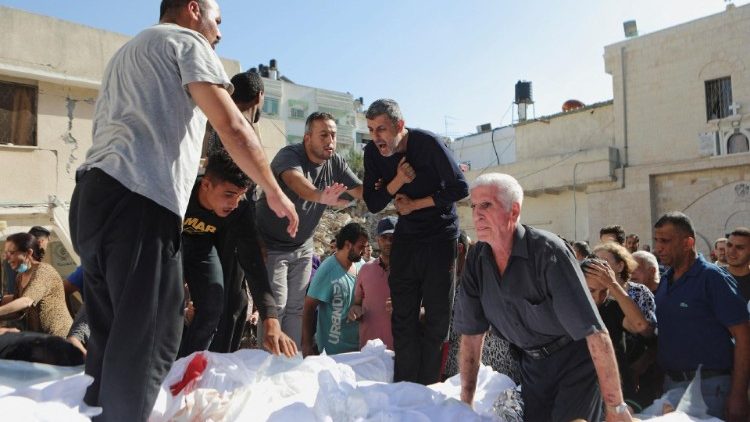
At least 16 Christians, including 10 from one family, were killed on Thursday evening during an air attack on one of the buildings within the compound of the St. Porphyrios Greek Orthodox Church in Gaza. Several other people reportedly remained trapped under the debris.
The building—affiliated with the church, which is one the oldest churches in Gaza—collapsed in the explosion, caused by Israeli missile strikes, according to the Greek Orthodox Patriarchate.
Some 400 people, mostly Christians, had found shelter in the compound when the war began nearly two weeks ago.
The Patriarchate reported that a large number of people were injured by the blast—some seriously—among refugees Christians and Muslim families who were taking shelter in the church adjacent to the destroyed building which wasn’t directly hit.
According to Aid to the Church in Need (ACN), among the victims are several young Christians who were part of the “Employment Generation Project” for Christian youth, run by the Latin Patriarchate of Jerusalem.
The building is located a few hundred metres from the Holy Family Catholic Church, where a further 500 Christians are sheltering.
Many families from the Greek Orthodox compound have had to relocate to the Holy Family parish church, which is already filled to capacity. According to ACN’s sources, the Catholic compound was also hit on Thursday evening, by stun bombs.
A war crime that cannot be ignored
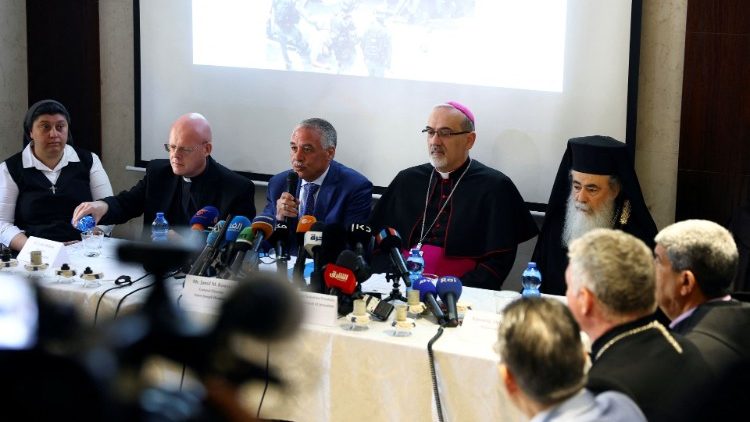
In a strongly-worded statement, the Greek Greek Orthodox Patriarchate condemned the strike.
A statement released 19 October stressed that “targeting churches and its affiliated institutions, in addition to the shelters they provide to protect innocent citizens, especially children and women who lost their homes as a result of the Israeli bombing of residential areas during the past thirteen days, constitutes a war crime that cannot be ignored.”
The World Council of Churches (WCC) has also strongly condemned the attack.
“We condemn this unconscionable attack on a sacred compound and call upon the world community to enforce protections in Gaza for sanctuaries of refuge, including hospitals, schools, and houses of worship,” said the WCC general secretary Rev. Jerry Pillay. “Our prayers go out for healing to all those wounded, along with our condolences to Patriarch Theophilos II and all our Greek Orthodox brothers and sisters in Christ.”
Churches in Holy Land condemn violence at funeral of slain journalist
Latin Patriarch of Jerusalem Pierbattista Pizzaballa, Greek Orthodox Patriarch Theophilus III, the bishops and the faithful of the Christian communities underscore in a common statement their condemnation of a violent intrusion carried out last Friday by the Israeli police in the funeral procession carrying the body of reporter, Shireen Abu Aqleh.
By Giancarlo La Vella
The incident took place as Shireen Abu Aqleh's coffin was being transported from St. Joseph's Hospital to the Greek-Melkite Cathedral Church. The denunciation of the Churches in the Holy Land issued with a common statement decried the attitude of the Israeli police, who broke into the hospital, "disrespecting the memory of the deceased and forcing the pallbearers almost to drop the coffin."
The condemnation follows that already expressed by UN Secretary-General, Antonio Guterres, after news of the death of the reporter, who worked for the Al Jazeera television network. Shireen Abu Aqleh was shot in the head during an operation by the Israeli security forces in the city of Jenin, in the West Bank. Guterres called for an independent investigation to clarify the facts of what happened.
A grave violation of human rights
"The Israeli Police's invasion and disproportionate use of force," the statement reads, "attacking mourners, striking them with batons, using smoke grenades, shooting rubber bullets, frightening the hospital's patients, is a severe violation of international norms and regulations, including the fundamental human right of freedom of religion, which must be observed also in a public space."
Renewed commitment to healing
"The St. Joseph Hospital has always proudly been a place of encounter and healing for all, regardless of their religious or cultural belonging, and it intends to continue to be so," the statement points out. The Church leaders conclude: "What happened last Friday deeply wounded not only the Christian community, the Sisters of St. Joseph of the Apparition, owner of the Hospital, and all the hospital staff, but also all peoples who in that place have found and still find peace and hospitality. The Sisters and the staff of St. Joseph Hospital will keep their commitment to be a place of healing. The tragic episode of last Friday makes this commitment even stronger than ever."
The Pan Orthodox Church of St. Spyridon (San Espiridion) in Trujillo Alto, PR community were received into the Catholic Church as a Greco Catholic Byzantine community under the “Omophorion” (jurisdiction) of the Latin Archbishop, Metropolitan Roberto González, O.F.M.
According to gloria.tv website, the welcome ceremony was presided over by the Vicar General of the Archdiocese, father Alberto Figueroa Morales on behalf of the Archbishop.
This makes San Espiridión the first Eastern Catholic community in Puerto Rico. The priests and parishioners of San Espiridión, despite being in the Catholic Church, will continue celebrating the Divine Liturgy and sacred mysteries according to the Byzantine tradition. The liturgy will be in English, Spanish, and Slavic, as well as follows the liturgical calendar Julian (old calendar).
The community was under the authority of the Ecumenical Patriarchate of Constantinople (Istanbul). Now it is under the jurisdiction of the Archbishop of San Juan of Puerto Rico. Thereafter, it may pass to any of the Slavonic Byzantine Eastern Catholic churches, although they continue to remain under the local Latin metropolitan authority.