Showing posts with label Greek Melkite. Show all posts

Wednesday, December 18, 2024

In Syria, church bells ring again, Holy Mass is celebrated


One week after regime change, Syrian church bells ring out in hope


Holy Mass is celebrated in Mariamite Greek Melkite Catholic Cathedral, Damascus, on Dec. 15, 2024. | Credit: Lama Ghosn/ACI MENA


After more than 13 years of death, oppression, and destruction, the bells of Syrian churches are once again ringing with hope. It is a hope for the rebirth of Syria — a once-lost aspiration whose absence has been a source of profound anguish for Syrians everywhere.

This past Sunday, churches in Syria witnessed a remarkable surge in attendees across cities and towns as people gathered to pray freely with a renewed spirit of hope.

Not a single incident of assault or restriction was reported. Christmas decorations adorned church facades and even some neighborhoods with a significant Christian presence. The Latin Church in Latakia announced plans to illuminate its Christmas tree on the evening of Dec. 17.

During the Sunday Mass at the Holy Cross Church in Damascus, the Greek Orthodox patriarch of Antioch and all the East, John X (Yazigi), emphasized that Christians are not mere guests in this land but rather “a deep-rooted part of Syria, as ancient as the jasmine of Damascus and the apostolic heritage of Antioch — this land that has marked the world with the name of Jesus Christ.”

He addressed Muslims directly, declaring: “My Muslim brothers, between the ‘you and us,’ the divisive ‘and’ should fall… Leaving behind it ‘we.’ We are one, sharing a history filled with victories and downfalls, and we share one destiny.”

Articulating the vision for Syria’s future, Yazigi explained: “We want a civil state where everyone is equal in rights and duties, preserving the personal status laws for all components. We want a state of citizenship, coexistence, and civil peace. A state governed by laws, where religion, freedom, and human rights are respected. A democratic state, where power transitions peacefully.”

The patriarch stressed that achieving these goals hinges on drafting a new constitution. He cautioned against misappropriating Christian narratives in the media and warned of false rumors propagated through media outlets and social media.

In a similar vein, Syriac Catholic Patriarch Ignatius Joseph III Younan called for the establishment of a transitional government that upholds transparency, reconciliation, and justice for all citizens. He urged a smooth political transition that shields Syrians from retaliation and revenge. Younan also warned against any ventures aimed at demographic or religious changes in the country.

The Sunday liturgies coincided with the return of students to schools and universities. 

George Daekh, principal of the Melkite Catholic Al-Woroud School in Aleppo, revealed to ACI MENA, CNA’s Arabic-language news partner, that Christian schools resumed on Monday, maintaining Sunday as a day off along with Saturday. He shared that the administrative and support teams had spent hours in the preceding days removing symbols of the old regime and raising Syria’s new flag.

As Christmas approaches, church groups and associations across Syria have launched humanitarian, service-oriented, and spiritual initiatives. These include visiting the elderly, cleaning and painting streets and sidewalks, distributing awareness flyers, organizing Christmas markets with sales stalls, and hosting evenings of carols and prayer.

Monday, October 9, 2023

Monday's opening Mass ahead of Synod activities for Monday


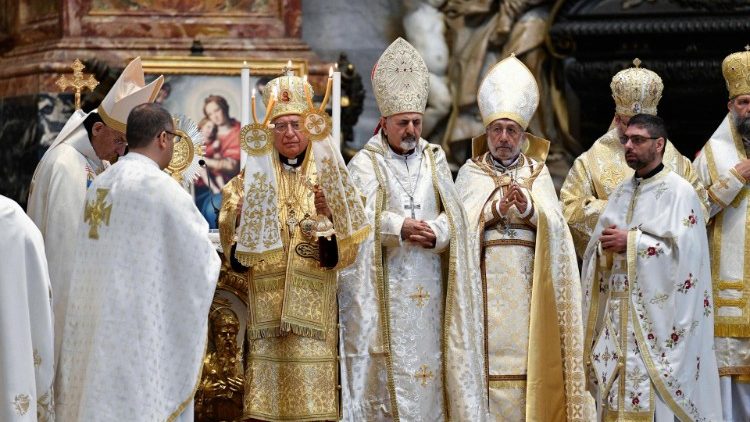
Patriarch Absi (center left) presides over the Byzantine rite MassPatriarch Absi (center left) presides over the Byzantine rite Mass  (Vatican Media)

Cardinal Raï at Mass: Synodal path helps us respond to global crises

Cardinal Béchara Boutros Raï, the Maronite Patriarch of Antioch, delivers the homily at daily Mass for Synod members, and urges Christians to imbibe a synodal way of living to confront the many issues that face our world.

By Devin Watkins

Members of the Synod General Assembly celebrated Mass together in St. Peter’s Basilica on Monday morning, ahead of the presentation of the fourth General Congregation.

Patriarch Youssef Absi, the Greek Melkite Patriarch of Antioch, presided over the Mass celebrated according to the Byzantine rite at the Altar of the Chair.

Cardinal Béchara Boutros Raï, the Maronite Patriarch of Antioch, delivered the homily at the Mass, reflecting on Jesus’ invitation to pray for workers for God’s abundant harvest.

Harvesting situations of suffering

In his homily, the Cardinal Patriarch noted that Jesus felt compassion for the large crowd which was following Him and so told His disciples: “The harvest is abundant but the laborers are few; so ask the master of the harvest to send out laborers for his harvest.”

Cardinal Raï said Jesus’ words offer a starting point to understand the current state of the Church and the challenges facing society.

He reflected first on the abundant harvest as a symbol of various pressing global issues that require attention and action from the Church and all Christians.

These issues, he said, include the pursuit of just peace amid ongoing wars, addressing climate change and protecting the environment, challenging exploitative economic systems, aiding persecuted individuals, and healing the wounds inflicted by various forms of abuse.

Cardinal Raï added that the harvest includes the need to promote human dignity, foster ecumenical and interfaith dialogue, care for the marginalized and vulnerable, and engage with contemporary societal challenges.

Laborers guided by the Spirit

The Maronite Patriarch of Antioch went on to consider the laborers who are called to gather the harvest.

Cardinal Raï said the Synod Instrumentum Laboris (working document) identifies these laborers as every person sent by Christ and guided by the Holy Spirit.

God’s Spirit, said Cardinal Raï, is the true “protagonist of the mission entrusted to the Church and thus of the entire synodal journey.”

Every laborer needs to receive formation and guidance from the Holy Spirit to embrace a synodal way of living.

Such training, he said, “involves formation for a life of communion, mission, and participation, as well as synodal spirituality at the heart of the Church's renewal.”

Our mission to heal wounds of others

In conclusion, Cardinal Raï invited Christians to feel compassion, as Jesus did, for our world’s situations of suffering and the conditions in which people find themselves.

He said the suffering of the poor, discarded, refugees, innocent victims of wars, and the homeless all stir Christ’s compassion and should stir our own.

Christ, concluded Cardinal Raï, “has chosen each one of us to heal these wounds and strive for a better world, where we can inhabit our common home in peace and tranquility.”

Monday, June 20, 2022

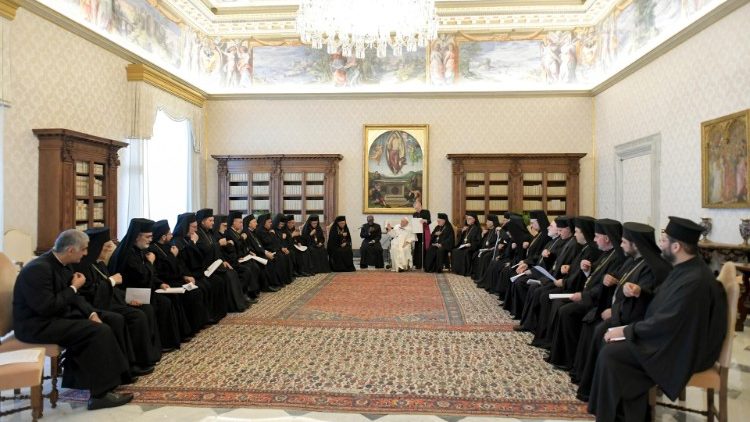
Pope Francis meets with Greek Melkite Catholics


Pope Francis meets with members of the Synod of Bishops of the Greek Melkite ChurchPope Francis meets with members of the Synod of Bishops of the Greek Melkite Church  (Vatican Media)

Pope: 'Never forget plight of Syria and Christians in Middle East'

Pope Francis greets members of the Synod of Bishops of the Greek Melkite Catholic Church, and urges them to seek to unite Christians in the Middle East, and to always beware of destructive "chatter".

By Francesca Merlo

Pope Francis on Monday greeted participants in the Synod of Bishops of the Patriarchal Church of Antioch of the Greek Melkites, and especially thanked Patriarch Youssef Absi of Antioch.

The Holy Father opened his discourse by noting the bishops asked to celebrate their annual convocation in Rome, at the tombs of the Holy Apostles Peter and Paul.

"We need their intercession," said the Pope, "so that even in our time....the Christian community may have the courage to bear witness to the name of Christ, author and perfecter of our faith."

A long look at Syria

The Pope went on to note that some of the successors of Peter were born in Syria. This, he explained, "makes us feel, on the one hand, the Catholic breath of the Church of Rome, called to preside in charity and to have the sollicitudo Ecclesiarum omnium ("care for the entire Church"), and on the other hand, it makes our minds travel as pilgrims to the land where some of you, starting with Patriarch Youssef, are Bishops: the beloved and tormented Syria."

In recent months we have turned our gaze to the east of Europe, said the Pope, but this "must not make us forget what has been going on for twelve years in your land."

He recalled a night of prayer, called for during his first year as Pope, in St Peter's Square, where many Muslims joined and prayed for their "beloved and tormented Syria."

“We cannot allow the last spark of hope to be taken away from the eyes and hearts of young people and families! And so I renew my appeal to all those who have responsibilities, within the country and in the international community, so that a fair and just solution to the drama in Syria may be found.”

Bearing witness as Church

Pope Francis went on to stress that the bishops of the Greek Melkite Church are called to ask themselves how, as Church, they bear their witness: "heroically and generously, but always in need of being placed in the light of God so that it may be purified and renewed."

"You are a Synod," stressed the Pope, "because of those characteristics that you have been recognised as a Patriarchal Church, and it is necessary that you question yourselves on the synodal style of your being and acting, according to your capacity to live the communion of prayer and intent between yourselves and with the Patriarch, between the Bishops and the priests and deacons, with the religious men and women, and with the lay faithful, all together forming the Holy People of God."

Concern for Christians in the Middle East

Pope Francis went on to speak of Christians in the Middle East, stressing that there is rightfully concern for their survival.

Their plight is a challenge, he said, noting on the other hand that, "for decades now, the presence of the Melkite Church has had a worldwide dimension."

The Pope said many of the bishops hail from various parts of the world: from Australia, the United States and Venezuela "to name only a few".

Although there are many obstacles, he said, "it is also a great opportunity: that of remaining rooted in your own traditions and origins, while being open to listening to the times and places in which you are scattered, in order to respond to what the Lord is asking of your Church today."

Woodworm of "chatter"

Turning his thoughts to the Synod the bishops are holding in Rome, the Pope encouraged them to exercise their competencies wisely.

He noted that they will be addressing the role of the Bishops Emeritus and the election of bishops, for which he urged that each member "always reflect well and pray to the Holy Spirit to enlighten you, preparing adequately and well in advance the material and information on the various candidates, overcoming any mindset of partisanship and balances between Religious Orders of origin."

Bringing his speech to a close, the Pope took some time to discourage the bishops from "chatter".

Please, he urged, "if someone has something to say to another, say it to his face, with charity, but to his face."  Never never speak ill of the other with another, concluded the Pope, as it is "a woodworm that destroys the Church."

"Let us be brave and find real unity," stressed the Pope, and he blessed the Synod of the Greek Melkite Church and entrusted the bishops to the Holy Virgin.