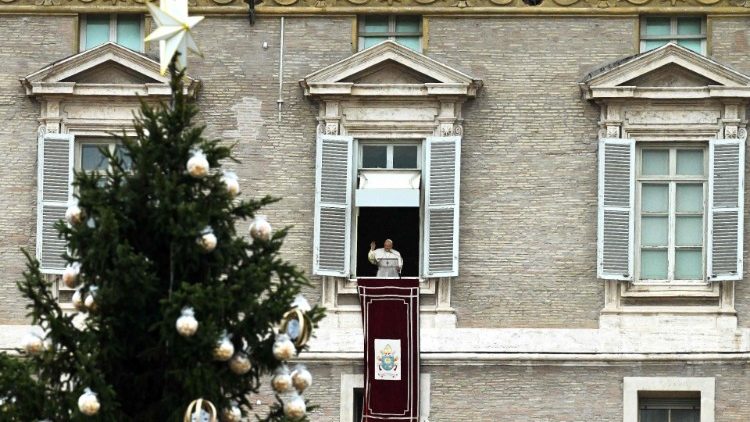
During the talk with journalists on board the flight bringing him back to Rome from Greece, Pope Francis spoke of the Apostolic Visit, of migrants, of fraternity with the Orthodox, and of the resignation of Archbishop Aupetit of Paris, a victim “of gossip.”
By Vatican News
“The EU document on Christmas is an anachronism” of “watered-down secularism”. This is one of the things Pope Francis said while answering questions put to him by journalists on board the flight bringing him to Rome at the end of his Apostolic Journey to Cyprus and Greece.
Constandinos Tsindas (CYBC): [Your Holiness], your strong remarks on interreligious dialogue in both Cyprus and Greece have reverberated strongly internationally and have caused quite challenging expectations. They say that apologising is the hardest thing to do, while you have done that in a spectacular fashion in Athens. But what is the Vatican planning in practical terms, bringing together Orthodox and Catholic Christianity. Is a synod perhaps on the cards?... Along with the Ecumenical Patriarch Bartholomew, you called Christians to celebrate in 2025, 17 centuries from the first Ecumenical Synod of Nicaea. How is this process progressing? [Finally, a question of the EU document concerning, among other things, the terminology about Christmas].
Pope Francis: Yes, thank you. I apologised; I apologised before Ieronymos, my brother Ieronymos. I apologised for all the divisions that there are among Christians, but above all those that we have provoked: the Catholics.
I also wanted to apologise, because during the war for independence — Ieronymos pointed this out to me — some Catholics sided with European governments to prevent Greek independence. On the other hand, in the islands, the Catholics of the islands supported independence; they even went to war, some gave their lives for their country. But the centre, let's say, at that moment was siding with Europe... I don't know which government there... but that's how it was. And also to apologise for the scandal of division, at least for that for which we are to blame.
The spirit of self-sufficiency — we keep our mouths shut when we hear that we must apologise — always makes me think that God never tires of forgiving, never, never... It is we who grow tired of asking forgiveness; and when we do not ask God for forgiveness, we will scarcely ask our brothers and sisters. It is more difficult to ask forgiveness from a brother than from God, because we know that He says: “Yes, go on, you are forgiven.” Instead, with our brothers and sisters... there is shame, and humiliation... But in today's world we need the attitude of humiliation and apologising. So many things are happening in the world, so many lives lost, so many wars... How come we don't apologise?
Coming back to this, that I wanted to apologise for the divisions, at least for those that we have caused. The others… [it is for] those who are responsible to ask for it, but for ours I apologise, and also for that episode in the war where part of the Catholics sided with the European government, and those from the islands went into the war to defend... I don't know if that's enough...
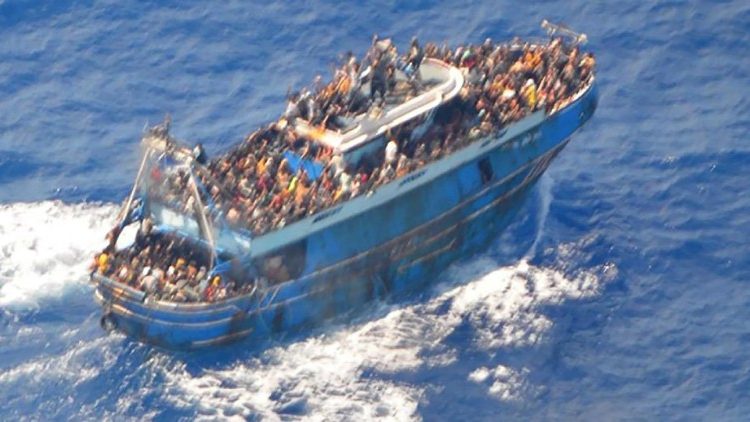
And also a last apology — this one came from my heart — an apology for the scandal of the tragedy of migrants, for the scandal of so many lives drowned at sea, and so on.
Question on the possibility of a synod
Yes, we are one flock, it’s true. And making this division — clergy and laity — is a functional division, yes, of qualifications, but there is a unity, a single flock. And the dynamic between the differences within the Church is synodality: that is, listening to one another, and going forward together. Syn hodòs: to take the road together. This is the meaning of synodality: that your Orthodox Churches, and also the Eastern Catholic Churches, have preserved this. On the other hand, the Latin Church had forgotten about the Synod, and it was St Paul VI who restored the synodal path 54 or 56 years ago. And we are making a journey to get into the habit of synodality, of walking together.
Question on Christmas
You refer to the European Union document on Christmas... this is an anachronism. In history many, many dictatorships have tried to do so. Think of Napoleon: from there... Think of the Nazi dictatorship, the communist one... it is a fashion of a watered-down secularism, distilled water... But this is something that throughout hasn’t worked.
But this makes me think of something, talking about the European Union, which I believe is necessary: the European Union must take in hand the ideals of the founding fathers, which were ideals of unity, of greatness, and be careful not to take the path of ideological colonisation. This could end up dividing the countries and [causing] the European Union to fail. The European Union must respect each country as it is structured within, the variety of countries, and not want to make them uniform. I don't think it will do that, it wasn't its intention, but be careful, because sometimes they come, and they throw projects like this one out there and they don't know what to do; I don't know what comes to mind... No, each country has its own peculiarity, but each country is open to the others. The European Union: its sovereignty, the sovereignty of brothers in a unity that respects the individuality of each country. And be careful not to be vehicles of ideological colonisation. That is why [the issue] of Christmas is an anachronism.
Iliana Magra (Kathimerini): Holy Father, thank you for your visit to Greece. You spoke in the presidential palace in Athens about the fact that democracy is retreating, particularly in Europe. To which nations are you referring? What would you say to those leaders who profess to be devout Christians but at the same time promote undemocratic values and policies?
Pope Francis: Democracy is a treasure, a treasure of civilisation, and it must be guarded; it must be preserved. And not only guarded by a superior entity, but guarded by the countries themselves, [it is necessary] to guard the democracy of others.
I see two dangers to democracy today: one is that of populism, which is here and there, and is beginning to show its claws. I am thinking of a great populism of the last century, Nazism, which was a populism that, defending national values, as it said, ended up annihilating democratic life, indeed life itself with the death of the people, in becoming a bloody dictatorship. Today I will say, because you asked about right-wing governments, let's be careful that governments — I'm not saying right-wing or left-wing, I'm saying something else — let's be careful that governments don't slip down this road of populism, of so-called political "populisms", which have nothing to do with popularism, which is the free expression of peoples, who express themselves with their identity, their folklore, their values, their art... Populism is one thing [popularism is another].
On the other hand, democracy is weakened, [it] enters a path where it slowly [weakens] when national values are sacrificed, are watered down towards, let's say — an ugly word, but I can't find another one — towards an 'empire', a kind of supranational government, and this is something that should make us think.
Nor should we fall into populism, where the people — we say the people, but it is not the people, but a dictatorship of “us and not the others” (think of Nazism) nor fall into drowning our identities in an international government. On this there is a novel written in 1903 (you will say, “How old-fashioned this Pope is in literature!”) written by [Robert Hugh] Benson, an English writer, The Lord of the World, that imagines a future in which an international government through economic and political measures governs all the other countries. And when you have this kind of government, he explains, you lose freedom and you try to achieve equality among all; this happens when there is a superpower that dictates economic, cultural, and social behaviour to the other countries.
The weakening of democracy is caused by the danger of populism, which is not popularism, and the danger of these references to international economic and cultural powers. That's what comes to mind, but I'm not a political scientist, I'm just saying what I think.
Manuel Scharz: Migration is not only a central issue in the Mediterranean. It also concerns other parts of Europe. It concerns Eastern Europe. Think about the barbed wires. What do you expect from Poland, from Russia, for example? And from other countries such as Germany, from its new government...
Pope Francis: About this, I will say this, that people who prevent migration or close the borders… It is fashionable nowadays to make walls or barbed wire or even concertina wire (the Spanish know what that means). It is usual to do these things to prevent access...
The first thing I would say is: Think back to the time when you were a migrant and they wouldn't let you in. It was you who wanted to escape from your land and now it is you who want to build walls. This is good. Because those who build walls lose the sense of history, of their own history, of when they were slaves of another country. Those who build walls have this experience, at least a large part of them: that of having been slaves. You could say to me, “But governments have a duty to govern. And if such a wave of migrants arrives, they can’t govern.” I would say this: Every government must say clearly “I can receive so many...” Because the rulers know how many migrants they can receive. This is their right. This is true.
But migrants must be welcomed, accompanied, promoted, and integrated. If a government cannot take in more than a certain number, it must enter into dialogue with other countries, who take care of others, each one. That is why the European Union is important. Because it can make harmony among all governments for the distribution of migrants. Let's think about Cyprus, or Greece, or even Lampedusa, Sicily. The migrants arrive and there is no harmony between all the countries to send them here or there. This general harmony is missing. I repeat the last word I said: integrated. Integrated. Because if you don't integrate the migrant, this migrant will have a citizenship of the ghetto. I don't know if I said it on the plane once.
The example that struck me most was the Zaventem tragedy. The young men who committed that catastrophe at the airport were Belgian, but the children of ghettoised, non-integrated migrants. If you don't integrate a migrant with education, with work, with care, you risk having a guerrilla, someone who then does these things. It's not easy to welcome migrants, to solve the problem of migrants, but if we don't solve the problem of migrants, we risk making a shipwreck of civilisation, today, in Europe, as things stand, our civilisation. Not just shipwreck in the Mediterranean. No, our civilisation. Let the representatives of European governments come to an agreement.
For me, a model of integration, of reception, was Sweden, which took in Latin American migrants fleeing dictatorships (Chileans, Argentines, Brazilians, Uruguayans) and integrated them. Today in Athens I went to a boarding school. I looked. And I said to the translator, “But here there's a melting pot [It. macedonia, literally, a fruit salad] of cultures.” They are all mixed together. I used a domestic expression. He replied: “This is the future of Greece.” Integration. Growing in integration. It’s important. But there is another drama I want to underline. It's when migrants, before arriving, fall into the hands of traffickers who take all the money they have and transport them on boats. When they are sent back, these traffickers take them back. And there are films at the Dicastery for Migrants showing what happens in the places where they go when they are sent back.
Just as we can't just welcome them and leave them, but have to accompany them, promote them fully; so if I send a migrant back I have to accompany him and promote and integrate him into his country; not leave him on the Libyan coast. This is cruelty. If you want more ask the dicastery for immigration, which has this film. There is also a film by “Open arms” that shows this reality. It's painful. But we risk civilisation. We risk civilisation.
Cecile Chambraud (Le Monde): On Thursday, when we arrived we learned that you had accepted the resignation of the Archbishop of Paris Aupetit. Why was there such haste? And regarding the Sauvé report on abuse: the Church had an institutional responsibility and the phenomenon had a systemic dimension. What do you think of this statement, and what does it mean for the universal Church?
Pope Francis: I’ll start with the second question. When these studies are done, we have to be careful in the interpretations that we make for portions of time. When you do a study over such a long time, there is a risk of confusing the way the problem is felt in one period 70 years before the other. I would just like to say this as a principle: an historical situation should be interpreted with the hermeneutics of that time, not our own. For example, slavery. We say: “it is a brutality”. The abuses of 70 or 100 years ago are a brutality, but the way they lived it is not the same as today. For example, in the case of abuse in the Church, the attitude was to cover it up. It is an attitude that is unfortunately also used in a large number of families, in the neighbourhoods. We say, “No!” this cover-up is not right.
But we must always interpret with the hermeneutics of the time, not with our own. For example, the famous Indianapolis study failed because of the lack of a correct interpretation: some things were true, others not. They were mixed up. Sectorizing helps. As regards the report, I have not read it, I have listened to the comments of the French bishops. The bishops will come to see me this month, and I will ask them to explain it to me.
Regarding the Aupetit case, I ask myself what he did that was so serious that he had to resign. Someone answer me, what did he do? And if we do not know the charge we cannot convict.
Cecile Chambraud: We do not know, a government problem or something else.
Pope Francis: Before answering I will say: Conduct an investigation, OK? Because there is a danger of saying: he was convicted. Who condemned him? Public opinion, gossip... we don't know…if you know, why not say so? Otherwise, I cannot answer. And you will not know, because it was a failing on his part, a failing against the sixth commandment, but not total, of small caresses and massages that he did to the secretary; this is the accusation. This is sin but it is not of the most serious sins, because the sins of the flesh are not the most serious.
The most serious are those that [have more to with] 'angelicality' [It: angelicalità]: pride, hatred. Therefore, Aupetit is a sinner, as am I… Perhaps, as Peter was, the bishop on whom Jesus Christ founded the Church. How come the community of that time accepted a sinful bishop, one that had sinned with much 'angelicality', as it was to deny Christ! Because it was a normal Church, it was used to feeling that it was always sinful, everyone. It was a humble Church. We can see that our Church is not used to having a sinful bishop. We pretend to say: “My bishop is a saint”. No! this little red cap…we are all sinners. But when the chatter grows, grows, grows and takes away a person’s fame; no, he will not be able to govern because he has lost his reputation. Not because of his sin, which is sin – like Peter’s, like mine, like yours – but because of people’s chatter. That is why I accepted the resignation, not on the altar of truth but on the altar of hypocrisy.
Vera Scherbakova (Itar-Tass): You met with the heads of the Orthodox Churches and you said beautiful words about communion and reunification: what are your common plans when you meet Kirill, and what difficulties are you finding on this path?
Pope Francis: A meeting with Patriarch Kirill is on the not-too-distant horizon; I believe that next week Hilarion will visit me to agree on a possible meeting. The Patriarch has to travel, maybe to Finland, and I am always willing to go to Moscow, to dialogue with a brother. To dialogue with a brother, there are no protocols, an Orthodox brother named Kirill, Chrysostomos, Ieronymos, and when we meet we don't dance the minuet; we say things to each other's face, but as brothers. And it is good to see brothers bickering because they belong to the same mother, Mother Church, but they are a little bit divided, some because of heritage, some because of history that divided them.
But we must try to go together, work and walk in unity and for unity. I am grateful to Ieronymos, Chrysostomos, and all the patriarchs who have this desire to walk together. The great Orthodox theologian Zizioulas, who studies eschatology, once jokingly said: unity will be found in the Eschaton! There it will be unity. But it is a way of saying: we must not stand still waiting for theologians to agree. What they say is that Athenagoras said to Paul VI: let's put all the theologians on an island to discuss and we'll go somewhere else together. But this is a joke.
Let theologians continue to study because this is good for us and leads us to understand how to find unity better. But in the meantime, we go forward together, praying together, doing charity together. I know for example that in Sweden, I believe, the Lutheran and Catholic Caritas are together. We can work and pray together, we can leave the rest that we do not understand how to do to the theologians.