Showing posts with label Diocese of Fresno. Show all posts

Thursday, September 17, 2026

How can this happen: The Diocese of Fresno end retirement benefits to all past and present employees


‘Devastating’: Fresno Diocese retirees lose benefits


FRESNO, Calif. (KSEE/KGPE) – Retired Fresno Diocese employees will no longer receive retirement benefits starting next year.

Hundreds of former employees are now left scrambling over what to do with their financial future now up in the air.

In a letter to retirees last month, the diocese said the retirement plan was frozen at the end of June.

The church says they contributed the agreed-upon amount negotiated in employee contracts,

But the diocese says Christian Brothers Services, the company responsible for managing the money, is the reason there isn’t enough to continue payments.

The diocese says it explored legal options to transfer the money into a retirement plan of their own. But said that plan would not be possible with the church filing for bankruptcy.

The church is facing a multimillion-dollar lawsuit involving more than 150 claims of sexual abuse by members of the clergy.

Joan Pacella worked at St. Helens Catholic school for more than a decade and is trying to figure out what to do next after Christian Brothers says her last payment would be in December.

“To find out you are going to lose a huge portion of your income, especially for the people who worked there for decades, it’s devastating,” Pacella said.

Pacella says when she called the diocese and the Christian Brothers services to ask questions, she was given the runaround by both.

She is now working with a dozen former employees to weigh the legal options and has a message for Bishop Brennan.

“Please respond to us,” Pacella said. “Please accept the responsibility to us that was promised in our contracts. These people served the church.”

The Fresno Diocese released this statement, which read in part:

The Diocese of Fresno has and will continue to communicate with its current and former employees regarding the matter.

Current diocese employees are no longer receiving retirement benefits as of now. The church says they are working to start a separate plan for employees with similar benefits to the previous one.


Monday, September 22, 2025

It seems Charlie Kirk was about to "cross the Tiber", a California Bishop says he was on a path to the "fullness of truth"


Charlie Kirk to a California bishop: ‘I’m this close’ to becoming Catholic

 | Ad Rem


The Charlie Kirk memorial at Turning Point USA Headquarters in Phoenix, Arizona on September 13, 2025. (Shutterstock)

Our dad loved John Wayne. If there was a John Wayne movie on TV on any Sunday afternoon, we were going to watch it. If there was a Duke movie on the Late Show, he would stay up to watch it.

Both our parents were of a generation that “bought” into the Hollywood dream machine that created, managed and protected images for fans to adulate both on and off screen. There were no cell phones or no tabloid TV shows to burst the bubble of stardom that had been so carefully crafted and guarded.

Not that mom nor dad were that naïve, either. They knew how the world worked and knew instinctively that these stars’ images were mostly artifice. Our dad played along until something happened that openly contravened his religious sensibilities, like Catholic movie stars such as Tyrone Power or Don Ameche who made scandalous headlines by divorcing their wives and marrying other women.

John Wayne was different. His multiple marriages notwithstanding, the Duke was the closest thing to being star-struck our dad ever got. When John Wayne was dying of cancer, so was our dad. It was almost as if they were on the same journey together.

When he was sick, I was the last of my siblings still living at home. The pall that hung over that big old house was oppressive, especially during the worst days of his illness.  

One day while driving my car, I heard the news that John Wayne had died on the radio. I did not want to go home that day, imagining the state he would be in. When I did muster the courage to walk in through the back door and into the living room where he sat, you could taste the grief.

But a few days later came more news. John Wayne, a man with Catholic children, had entered the Church while on his deathbed. When I came home that evening, my dad was a changed man. He was still very sick with a disease that was slowly killing him, but the revelation about this icon of American culture with whom he felt a strange connection was better medicine than anything any of his oncologists had ever prescribed. For that joy and comfort John Wayne provided to my dad, I will always be grateful.

To this day, I experience a special kind of joy when I learn of someone deciding to become Catholic, whether they be a celebrity or someone I know personally. I can understand what my dad felt about John Wayne.

Catholics from across the Phoenix area gather next to a statue of Mary at Desert Horizon Park in Scottsdale, Ariz., Sept.10, 2025, to pray for conservative activist Charlie Kirk, who was shot and killed that day during a Turning Point USA event at Utah Valley University in Orem. (OSV News photo/Caitlin O'Hara, Reuters)


I will never know if my dad would have thought of the late Charlie Kirk in the same way he thought about John Wayne. But I am sure he would have taken notice of certain “tells” Charlie Kirk was tipping that he just might have crossed the Tiber one day. Now, we will never know. But I know of two distinctive events that took place prior to his murder.

One was a recent video Kirk made suggesting to his Protestant co-religionists that they did not give the Blessed Mother her due. It was a video that could have been shown in a Catholic school religion class. He even suggested her example was a Christian template applicable across other denominations.

The other was a personal exchange between Charlie Kirk and a Catholic bishop who happens to be my brother: Bishop Joseph Brennan of Fresno. The bishop has given me permission to divulge the content of that conversation.

A little more than a week before his murder, Kirk attended a pro-life prayer breakfast in Visalia, California, which is in the Diocese of Fresno. The bishop was among those in attendance and had a brief, private moment with Kirk.

It was there that Kirk told the bishop about his Catholic wife and children and how he attended Mass with them. He punctuated this conversation with “I love my Catholic pastor.”  

As they were parting to attend the more public portion of the prayer breakfast, Kirk mentioned speculation regarding his contemplating entering the Catholic Church, saying: "I'm this close."

My dad would have loved hearing that story from his son. It would have given him joy to contemplate how a man could be loved into the Church by a faithful wife. And how fitting one of Charlie Kirk’s last videos was about the preeminent mediatrix of all time and space. In his own way he was reaching out to her, and now, I am convinced, she is returning the favor.  

Robert Brennan

Ad Rem

Robert Brennan writes from Los Angeles, where he has worked in the entertainment industry, Catholic journalism, and the nonprofit sector.

Wednesday, August 14, 2024

How one diocese and parish approached the Priest shortage; build a mega-Church


Catholic priest shortage gives rise to California "megachurch" as parishes expand


 By 


Visalia, California — For Catholics in Central California, bigger means better — and St. Charles Borromeo Church feels heaven-sent. The largest Catholic parish church in North America has 3,200 seats, sprawls nearly an acre and cost $21 million to build.

"This is a Catholic megachurch," said Bishop Joseph Brennan, who leads the Diocese of Fresno.

Father Alex Chavez, a pastor at the church, is still struck by its massive scale. And as big as it is, it could be even bigger.

"There's room for growth. I could always add masses," Chavez said.

The Catholic Church is facing a labor crisis decades in the making. Over a half-century, the average size of a parish increased by 60%, while the number of priests dropped by 40%, according to the Center for Applied Research in the Apostolate.

"It's huge, and it's really across the board," Brennan said. "It's complicated, but there are all kinds of issues."

Among them are inadequate recruiting of young men, societal issues including materialism and career success, family issues such as broken homes and the legacy of the church's sex abuse scandals, according to Vocation Ministry.

The Fresno Diocese recently ordained six new priests — their most since 1968. But Brennan says he could use 25 every year.

"I think nowadays, especially for my generation, commitment's a strong word," said Jimmy Millan, one of the new priests at St. Charles Borromeo.

Joseph Klinge, another newly ordained priest, says the Catholic Church's history of sexual abuse have marred the image of the priesthood.

"I've had people call me a pedophile, just for wanting to become a priest. There's wounds or scars, because that's a horrible thing," Klinge said.

Still, the new priests are hopeful things could turn around.

Until it does, this megachurch merges four parishes into one behemoth. Across three Sunday masses, 8,000 parishioners in total fill the pews.

"We're responding to a very real need. So, Jesus would walk through the door and say, 'Well it's not what I had in mind, but way to go, guys. It's a creative approach.'"

Friday, March 10, 2023

Fresno California now the home to the largest Catholic Church in all of North America


St. Charles Borromeo Church ‘Creates an Environment Which Makes You Think of the Eucharist’

Diocese of Fresno has dedicated the largest parish church in North America.


VISALIA, Calif. — The Diocese of Fresno in central California has dedicated St. Charles Borromeo, the largest parish church in North America, with Bishop Joseph Brennan presiding at the Feb. 2 dedication Mass. The church, with seating for 3,200 faithful, serves 14,000 registered families in the growing farming community of Visalia. 

The new Catholic church is one of four in the city all under the umbrella of Good Shepherd parish, served by two diocesan priests, including the pastor, Father Alex Chavez. It is open for Mass only on Sundays, and reflecting the large community it serves, two of its three Sunday Masses are offered in Spanish (with other Visalia churches used for weekday Masses, weddings and funerals). 

Due to its central location in the diocese, San Joaquin Valley locale and large capacity, it will henceforth be used for major diocesan gatherings, such as chrism Masses and ordinations, as well as for special events.

“We had not initially envisioned a church that large for that site, but instead had thought it would be a more typical-sized church, with a seating capacity of 1,500,” explained Bishop Brennan to the Register. “But with the projections of population growth in the area, and the diminishing number of priests, the diocese has to serve our people, the church size grew, and necessarily so.”

The new church encompasses 33,000 square feet of space, “a football field under a roof,” Msgr. Patrick McCormick, 76, a diocesan priest involved in its planning and who serves as a spiritual adviser for its artwork, joked to the Register.

The diocesan chancery is located in Fresno, about a 45-minute drive away from St. Charles. The diocese was founded in 1924, and St. John’s parish church in Fresno, with a seating capacity of only 500, was selected at the time to be the diocese’s cathedral. The building of a new, larger church in a more central location of the diocese had been the “dream” of previous Fresno Bishop John Steinbock (1937-2010), Msgr. McCormick said, which began with the building of St. Charles’ parish hall in 2011. 

The new church is being built in three phases; phase one, now finished, included the completion of some of the interior of the church, the installation of an electronic Allen organ, retablo (decorative altar piece), cupola (altar dome), sanctuary and baptismal font.

The initial price tag of the church was $21 million, Msgr. McCormick said. Phases two and three will commence as funds are raised and will include the installation of stained-glass windows, two alcoves with shrines to Our Lady of Guadalupe and Our Lady of Fatima, and confessionals. 

The church is designed in the California Mission style, with roots in Spanish architecture dating back centuries. The retablo has images of angels and the saints facing a central crucifix, with the saints selected coming from the parish churches of the diocese, as well as images of San Joaquin Valley farmland and cattle. A redwood tabernacle is below the crucifix. The altar has images of the apostles surrounding it. Three bells over the entry symbolize the Trinity. Its narthex includes paintings of the four churches of Visalia that make up Good Shepherd parish. 

“There is so much I like about this church, starting with the cupola over the sanctuary, which creates an environment which makes you think of the Eucharist,” Bishop Brennan said.

Above the sanctuary, he continued, “It also has a beautiful image, sort of a star cluster cloud, a painting of an image taken from the Hubble Telescope, that leads you to think, as we are all gathered at the altar, of God’s incredible creation of the universe and how we fit into it.”

Parishioner Steve Perry, who served as chairman of the St. Charles building committee, believes the crucifix behind the altar is the church’s most impressive feature. It was designed to have the Crucified Christ looking up at an image of the Father behind the cross with an image of the Holy Spirit just above the Father. In order to be seen from throughout the church, the corpus had to be seven feet tall; paintings of angels and saints throughout the church are life size, Perry said. “Because the church is so large, everything has to be proportionate.”

Among the painted images are depictions of St. Joseph, St. Thérèse of Lisieux and St. Anthony, favorite saints of longtime parishioner Bea West. “It’s fabulous,” she said of the church. “We love it. It’s like being in one of the great churches of France.”

Outside the church is a large plaza area to which will be added an image of Christ the Good Shepherd with four lambs, symbolizing the four churches of Visalia. Future plans for the church also include the creation of a columbarium in which cremated remains of loved ones can be interred according to Church teaching. 


Standing-Room Only

Since the church opened to the public, Masses have been standing room only, reported Father Chavez. Many are locals coming for Mass who work in agriculture or at a large hospital that serves the region, but some have come from throughout California after reading media reports about the new church. 

Perry added, “It’s been phenomenal. The church has become a destination. The old saying is true: ‘If you build it, they will come.’”

Because of the large crowds, Perry continued, parishioners’ have pointed out a shortage of parking. “Our Ash Wednesday attendance was off the charts,” he said. “I can’t imagine what our first Easter services will be like.” 

West advises visitors to come early if they want to get a seat close to the front.

The diocese’s upcoming “I Thirst Fresno” event, sponsored by Spirit Filled Hearts Ministry, on Saturday, March 18, featuring Mass with Bishop Brennan and presentations by prominent Catholic speakers, is part of the diocese’s plan to promote the National Eucharistic Revival among its parishioners.

Bishop Brennan will keynote the event with Mass; the day will also include music, time for prayer and presentations, including a talk in Spanish by Bishop Brennan. There will be both English- and Spanish-language tracks; Bishop Brennan has invited all interested Catholics to participate.

“I Thirst Fresno” is part of the Jesus Thirsts for America movement, which visits dioceses nationwide for Mass and prayer led by the bishop, a call to conversion and follow-up. The movement is the brainchild of Deacon Steve Greco, president of Spirit Filled Hearts Ministry and director of evangelization and formation for the Diocese of Orange, California. Speakers for the Visalia event include EWTN’s Teresa Tomeo and Father Chavez.

“We’re delighted that Bishop Brennan has welcomed the Jesus Thirsts for America movement to St. Charles Borromeo Church,” said Deacon Greco. “Its central location, large capacity and beautiful religious artwork make it an ideal location for a large revival event such as ‘I Thirst Fresno,’ and we’re confident that with Bishop Brennan’s participation, it will be a huge success.”

The parish awaits those attendees — and pilgrims of all sorts.

“People have been coming from San Francisco to San Diego to look at the artwork and architecture,” said Msgr. McCormick. “I believe that once we complete our two shrines, St. Charles will become a site for pilgrimage.”

Wednesday, July 27, 2022

Vandalism against Catholic Churches continues post overturning of Roe v Wade


Catholic Mother Mary statue destroyed in California small town


Parishioners were saddened seeing the Virgin Mother Mary statue destroyed Saturday morning when arriving to mass.

The Kingsburg Holy Family Catholic Church removed the statue to a secure location.

All three heads of Mary, Joseph and baby Jesus were ripped off and pieces strewn around the beautiful sitting area.

The statue was crafted by a local artist.

Parish staff believes it can be repaired.

A police report was filed.

One parishioner told the Fresno Diocese the Covenant Church was vandalized a couple of weeks ago. It is located about three blocks away.

Friday, November 20, 2020

Bishop calls foul on Covid19 vaccine bandwagon


Fresno bishop urges Catholics not to ‘jump on the COVID-19 vaccine bandwagon’

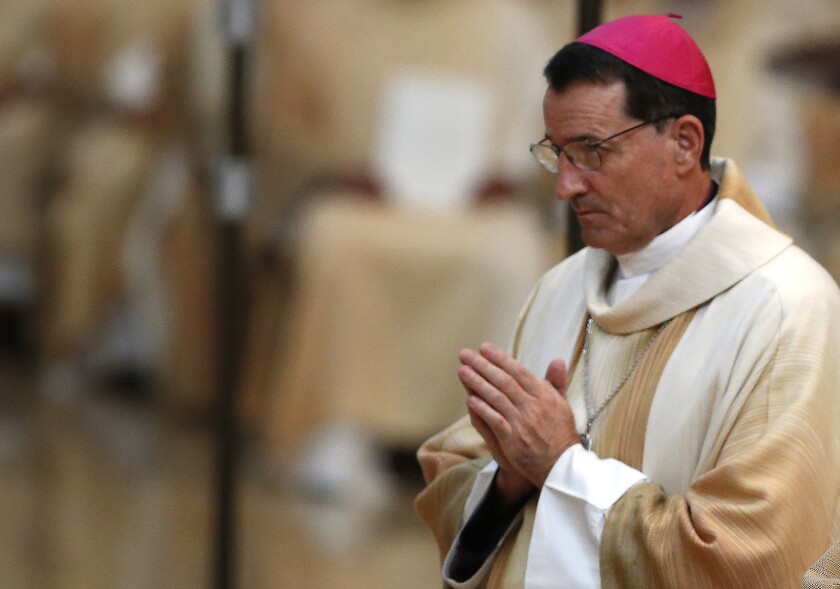
Then auxiliary Bishop Joseph Brennan during ordination Mass at Cathedral of Our Lady of the Angels in Los Angeles in 2015.
(Brian van der Brug / Los Angeles Times)

Citing ethical concerns about the use of fetal cells in vaccine development, Bishop Joseph Brennan of the Diocese of Fresno is urging Catholics not to “jump on the COVID-19 vaccine bandwagon.”

In a video shared by the diocese this week, Brennan said that some of the researchers racing to produce a coronavirus vaccine have made use of cells derived from an aborted fetus, and perhaps other “morally objectionable” materials.

“I try to maintain a joyful spirit, so I don’t like to rain on anyone’s parade,” Brennan said. “But I’m going to rain on a parade today: the vaccine parade.”

In his message, Brennan said the use of fetal cells at any stage of a vaccine’s development means Catholics cannot avail themselves of its scientific results.

“I won’t be able to take a vaccine, brothers and sisters, and I encourage you not to, if it was developed with material from stem cells that were derived from a baby that was aborted, or material that was cast off from artificial insemination of a human embryo,” he said. “That’s morally unacceptable for us.”

That mention of artificial insemination appears to be a reference to in vitro fertilization, an assisted reproduction technique that creates human embryos in a lab dish. Some couples that were left with excess embryos have donated them to scientists, who used them to make human embryonic stem cells.

Brennan said he is not opposed to vaccines in general, and noted that he has received vaccines for the flu and pneumonia, but said he is specifically opposed to vaccines derived from babies “whose lives were taken.”


He cited the Pfizer vaccine by name, which — along with another vaccine from Moderna — has been roundly celebrated as a breakthrough in the fight against the coronavirus.

Brennan did not explain why he singled out Pfizer’s COVID-19 vaccine for criticism. There is no indication that it was developed using either fetal cells or human embryonic stem cells.

“Not a single stage has had it,” Pfizer spokeswoman Jerica Pitts said Thursday.

The Pfizer and Moderna vaccine candidates are made with a snippet of the coronavirus’ genetic code, and both are estimated to be roughly 95% effective.

Brennan joins a growing chorus of Catholic organizations concerned about fetal cells and COVID-19 vaccines. In April, more than 20 Catholic leaders and prominent members of the U.S. Conference of Catholic Bishops signed a letter to the commissioner of the Food and Drug Administration urging the federal government to follow “moral principles” in the development of a coronavirus vaccine.

“It is critically important that Americans have access to a vaccine that is produced ethically,” they wrote. “No American should be forced to choose between being vaccinated against this potentially deadly virus and violating his or her conscience.”

The Charlotte Lozier Institute, an antiabortion organization, has flagged five COVID-19 vaccine candidates that were developed with the help of fetal cells. One of them, developed by Oxford University and AstraZeneca, is in late-stage testing. So is another developed by Johnson & Johnson.

Both the Pfizer and Moderna vaccines are listed as “ethically uncontroversial” by the institute.


In July, the Philadelphia-based National Catholic Bioethics Center shared a statement in which President Joseph Meany described the potential reliance on a vaccine developed with fetal cells as a “nightmare scenario” that would “cause major conscience problems for pro-lifers and Catholics.”

Meany went on to say that he is confident that researchers can develop a vaccine for the virus without making use of such cells, something Brennan stated as well.

“Thank goodness there are some that are being developed ... that have no connection at all with any of that material,” Brennan said. “I don’t want to cause anyone pain. I don’t want to cause anyone to be less hopeful than they normally would be about coming to grips with this terrible pandemic.”

But his words come amid an alarming nationwide surge of COVID-19. More than a million new cases were recorded last week alone, and California is currently sustaining its highest-ever counts for daily cases, surpassing 10,000 new daily cases four times in the last week and recording a single-day high of more than 5,000 new cases on Thursday.

Neither Meany, Brennan nor the chancellor of the Fresno Diocese responded to requests for comment.