Showing posts with label Christmas eve. Show all posts

Tuesday, December 23, 2025

The traditional legend of Christmas Eve as the Feast Day of Adam & Eve


Happy Feast Day of Sts. Adam & Eve (Dec 24) – Did you know some Old Testament people are Saints?


Today is the Feast Day of St. Adam and St. Eve.  What? those original sinners are saints? Yes, and so are many of the figures of the Old Testament.

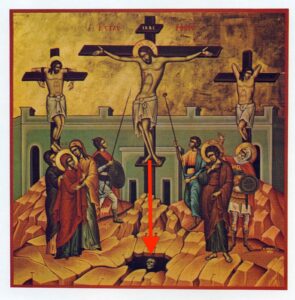
In the picture above you see the resurrection of Adam and Eve. The Last Adam pulls the 1st Adam from the grave. Notice that Eve, embarrassed by her hand that took the fruit to eat, has her hand covered. 

Adam and Eve have liturgical feast days. So do Moses, Elijah, Elisha, Elijah, Jeremiah, King David and many others.
  • Save
It is perfect to remember today the sin of Adam and Eve that brought evil and corruption, suffering and death into God’s perfect creation. It sets the stage for the marvelous redemption God planned — to bring a New Adam into the world to redeem and raise us up into the very life of the Trinity. “O happy fault of Adam that brought us such a great redeemer” we sing at Easter.


(Picture to leftNotice the blood of Christ drips on the skull of the 1st Adam below bringing redemption to his sinful ancestor.)

Remembering Adam and Eve today sets the stage for the birth of Christ, the 2nd or Last Adam and the new humanity it will bring. Praise God!

The Roman Martyrology (1600) lists saints recognized up to that point including many saints not in the Church’s general calendar. Some that it remembers are Habakkuk (Jan. 15); Isaiah (July 6); Daniel and Elias/Elijah (July 20 and 21); the seven Maccabees and their mother (Aug. 17); Abraham (Oct. 9); and King David (Dec. 29).

We in the West have not discussed it much, but the Eastern Churches remember them every year and their churches are full of their images.

The Catechism of the Catholic Church states,

“The patriarchs, prophets, and certain other Old Testament figures have been and always will be honored as saints in all the Church’s liturgical traditions” (CCC 61).

Here is an interesting article Dr. Jeremy Holmes who teaches Theology at Wyoming Catholic College? Old Testament Saints and Events.

It not only explains the “sainthood” of Old Testament heroes but gives a list of the dates for various prophets, kings, and virtuous men and women before Christ. For this article and calendar, click here.

**********************

In answer to the question on air about the redemption of Adam and Eve, I promised a bit of information. The Catechism 489 states, “Throughout the Old Covenant the mission of many holy women prepared for that of Mary. At the very beginning there was Eve; despite her disobedience, she receives the promise of a posterity that will be victorious over the evil one, as well as the promise that she will be the mother of all the living. “

Another quote CCC 635

“Today a great silence reigns on earth, a great silence and a great stillness. A great silence because the King is asleep. The earth trembled and is still because God has fallen asleep in the flesh and he has raised up all who have slept ever since the world began.… He has gone to search for Adam, our first father, as for a lost sheep. Greatly desiring to visit those who live in darkness and in the shadow of death, he has gone to free from sorrow Adam in his bonds and Eve, captive with him—He who is both their God and the son of Eve.… “I am your God, who for your sake have become your son.… I order you, O sleeper, to awake. I did not create you to be a prisoner in hell. Rise from the dead, for I am the life of the dead.”
Soshestvie-vo-ad
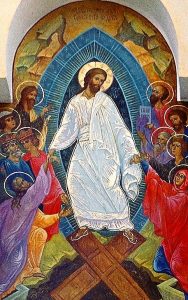
(Picture to right: Jesus raises Adam and Eve from their graves. Notice they are wearing halos. Notice a similar picture at the top of the post.)

One Journal I own states it well, though I don’t agree with the article overall:

“In this first dispensation, there is a clear illustration that the only way of salvation is by the grace and personal provision of God. After the judgment section of Chapter 3, the literal translation states that the Lord God himself “made garments of skin for Adam and for his wife, and He caused to clothe them.”

The Lord God initiated and was the causative agent (Hiphil stem— “cause to”) of the personal redemption of Adam and Eve by providing a method of restoring the personal relationship with Him. Some conclude that the personal faith of Adam was expressed by naming his wife, Eve (living or life-giver), and believing that (strong textual emphasis) “she, she will be (the) mother of all living.”

This act would have verified that he believed in the future promise of God (3:15) and in the prospect of continued life after judgment (3:20). In a similar way, having acknowledged that the Lord was the source of her first-born son, Eve confirmed her personal faith in the Lord and His previous promises of children (3:15–16; 4:1).

“Considering that this was a possible theophany of God, the full impact of the statement may be realized. This would be Christ himself who had performed this sovereign act of divine grace for Adam and Eve, another Old Testament verification that Christ was involved providentially in the affairs of mankind from the beginning!”   Conservative Theological Journal Volume 2 2, no. 7 (1998): 455–456.


Tuesday, December 24, 2024

Holy Mass the night before Christmas, Holy Doors open, Jubilee 2025 begins


Pope Francis 'throws open' Holy Door to inaugurate 2025 Jubilee

Pope Francis opens the Holy Door of Saint Peter's Basilica thereby officially inaugurating the 2025 Jubilee of Hope. He reassures during his Christmas evening Mass that the Christ Child of Bethlehem offers the world infinite hope and joy.

By Deborah Castellano Lubov

As Pope Francis opened the Holy Door of Saint Peter's Basilica, the evening of 24 December 2024, he ushered in the widely-anticipated 2025 Jubilee of Hope.

With the liturgical gesture of the Door's opening at the start of the Christmas Mass during the Night, as explained in the papal bull for the Jubilee Spes non confunditthe Pope inaugurated the Ordinary Jubilee, a historic event taking place every 25 years.

The Ordinary Jubilee will conclude with the closing of the same Holy Door on 6 January 2026, the Solemnity of the Epiphany of the Lord.

The significance of the Holy Door 

The Holy Door is deemed 'Holy' since it calls all those who enter through it to walk in holiness of life. In the footsteps of the Pope, during the singing of the Jubilee hymn, representatives of the entire People of God crossed its threshold, as a prelude to the countless pilgrims of hope from every country and language who will visit St. Peter's Basilica and celebrate the mysteries of salvation during the Holy Year. 


Pope Francis at the threshold of the opened Holy Door of Saint Peter's Basilica


The origin of the custom goes back to Pope Martin V who, for the Extraordinary Jubilee of 1423, opened a Holy Door to enter the Lateran Basilica. In St. Peter's, it was first used for the Jubilee of 1450.

Its location, the rear wall of the chapel dedicated by Pope John VII to the Mother of God, corresponds to a place where it is found today. Pope Alexander VI, in 1500, endowed this symbol of the opening of the Jubilee with a ritual that remained virtually unchanged over the centuries, until the turn of the millennium, when in the year 2000, the removal of the former brick wall was replaced by the ceremonial opening of the bronze Door already in 1983.

The last opening of the Holy Door for an Ordinary Jubilee was when Pope St. John Paul II had done so in the Year 2000. Pope Francis opened the Holy Door in 2015 for his 2016 Extraordinary Jubilee of Mercy.

Jubilee to strengthen faith and recognize Christ in our midst

"During the Holy Year," the Pope has prayed, "may the light of Christian hope illumine every man and woman, as a message of God’s love addressed to all! And may the Church bear faithful witness to this message in every part of the world!"

The Holy Father invited us to pray, to prepare ourselves throughout this year, so that this Jubilee may “strengthen us in our faith, helping us to recognize the Risen Christ in the midst of our lives, transforming us into pilgrims of Christian hope."

Restoring us to Our Father's embrace

The Pope picked up the Jubilee theme of hope in his homily. He began recalling the Gospel passage according to St. Luke which recounts when the angel of the Lord, bathed in light, illumines the night and brings glad tidings to the shepherds: 'I bring you good news of great joy that will be for all the people.  For unto you is born this day in the city of David a Saviour, who is Christ the Lord' (Lk 2:10-11).  

At that moment, the Holy Father reflected on how Heaven breaks forth upon earth amid the wonder of the poor and the singing of angels.  "God," he highlighted, "has become one of us to make us like Himself; He has come down to us to lift us up and restore us to the embrace of the Father."

Little Child offers hope for the world

In Emmanuel, 'God with us,' the Pope reiterated, we find our hope.

"The infinitely great," he marveled, "made Himself tiny" and "the glory of heaven appeared on earth as a little child."  

"If God can visit us, even when our hearts seem like a lowly manger," the Pope continued, "we can truly say: Hope is not dead; hope is alive and it embraces our lives forever!"

“If God can visit us, even when our hearts seem like a lowly manger, we can truly say: Hope is not dead; hope is alive and it embraces our lives forever!”

'There is hope for you'

The Pope reminded that with the opening of the Holy Door, the new Jubilee was inaugurated, which exhorts each one of us to enter into the mystery of this extraordinary event.

"Tonight, the door of hope has opened wide to the world" and "God speaks to each of us and says: 'there is hope also for you!'" he said.

"With haste," therefore, he said, "let us set out to behold the Lord who is born for us, our hearts joyful and attentive, ready to meet him and then to bring hope to the way we live our daily lives.  For Christian hope is not a 'happy ending' which we passively await, but rather, a promise, the Lord’s promise, to be welcomed here and now in our world of suffering and sighs." 

“With haste, let us set out to behold the Lord who is born for us, our hearts joyful and attentive, ready to meet Him and then to bring hope to the way we live our daily lives”

The end to wallowing in mediocrity

Significantly, Pope Francis underscored, the Jubilee "is a summons not to tarry, to be kept back by our old habits, or to wallow in mediocrity or laziness." 

“It is a summons not to tarry, to be kept back by our old habits, or to wallow in mediocrity or laziness”

The Pope recalled Doctor of the Church Saint Augustine's having suggested that hope calls us to be upset with things that are wrong and to find the courage to change them. 

With this in mind, as disciples of the Lord, the Holy Father encouraged, "we are called to find our greater hope in Him, and then, without delay, carry that hope with us, as pilgrims of light amid the darkness of this world."

Rediscovering joy of encounter with the Lord

"Brothers and sisters," the Pope reminded, "this is the Jubilee." 

"This is the season of hope in which we are invited to rediscover the joy of meeting the Lord," he stressed, adding how the Jubilee "calls us to spiritual renewal and commits us to the transformation of our world, so that this year may truly become a time of jubilation."

Pope Francis concluded by offering some food for thought.

"Dear sister, dear brother, on this night the 'holy door' of God’s heart lies open before you.  Jesus, God-with-us, is born for you, for us, for every man and woman. With him, joy flourishes; with Him, life changes; with Him, hope does not disappoint."

“Dear sister, dear brother, on this night the 'holy door' of God’s heart lies open before you.”

Opening of Holy Doors

On Christmas Day, Pope Francis will deliver his Urbi et Orbi message to the people of the city of Rome and the world from the central loggia of St. Peter's Basilica at noon.

On 26 December, for the first time in the Jubilee tradition, Pope Francis will open a fifth sacred portal in a Roman prison, a gesture of hope that shows his ongoing closeness to detainees.

On Sunday, 29 December, the Pope will open the Holy Door of his cathedral, Saint John Lateran, which on 9 November this year celebrated the 1700th anniversary of its dedication.

Then, on 1 January 2025, the Solemnity of Mary, Mother of God, the Holy Door of the Papal Basilica of Saint Mary Major will be opened.

Lastly, Sunday, 5 January 2025, will mark the opening of the Holy Door of the Papal Basilica of Saint Paul Outside the Walls.

These last three Holy Doors will be closed on Sunday, 28 December 2025.

Sunday, December 24, 2023

The little known Christmas Eve feast day of Adam and Eve


Today is the Feast Day of Adam and Eve (Plus, the Origin of Christmas Trees)


Christmas Eve is also the feast day of Saint Eve…and Saint Adam, too.
“Virgin Mary Consoles Eve”Crayon and pencil by Sr. Grace Remington, OCSOCopyright 2005, Sisters of the Mississippi Abbey
Yes, Adam and Eve are saints in the Catholic Church, and they are traditionally honored on December 24th, Christmas Eve. They are the exemplars of humble penance for their original crime against God.
Previously, medieval Christians enjoyed performances on Christmas Eve called “Paradise Plays” that recounted how Adam and Eve lost their innocence by eating the fruit of the tree. Some have speculated that the placement of a tree decorated with red apples for this dramatic paradise play is the true origin of the Christmas Tree decorated with red apples or red ornaments. Soon, the people copied the practice and placed “paradise trees” in their homes.
The paradise play recounts how when Adam and Eve sinned, God promised them a Redeemer born of a Woman who would crush the serpent’s head:
“I will put enmities between you and the woman, and your seed and her seed: she shall crush your head, and you shall lie in wait for her heel” (Gen 3:15).
This drama anticipated the reversal of the Fall with the miraculous birth of the Christ Child from the stainless womb of the Immaculate Virgin Mary.
The symbolism of this drama is that Adam is the chief peccator and that Eve is the co-peccatrix who brought all of mankind into the bondage of original sin. Christmas introduces Jesus Christ as the New Adam Redemptor and Mary as the New Eve Coredemptrix as those who liberate mankind from sin into grace and glory.
Mary is the foretold “Woman” of Genesis 3:15 who bears the Redeeming “Seed” who is Jesus Christ. The long expectation of Adam and Eve for the birth of the promised Child has finally arrived.
So happy feast day of Adam and Eve!

Pope prays fro victims of war and reminds all that celebration does not mean consumerism


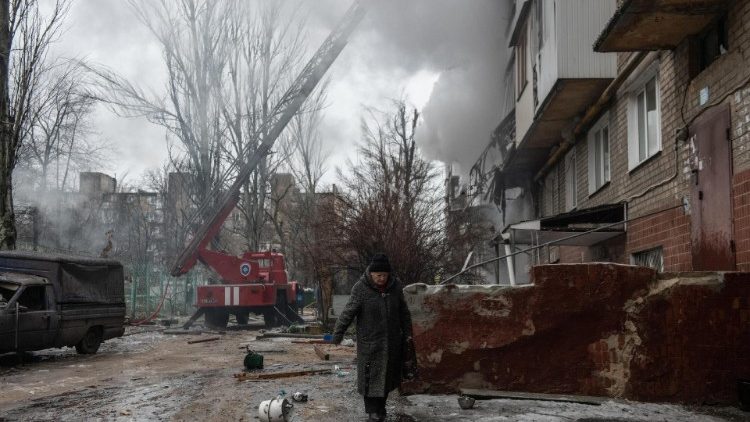
An elderly woman in Donetsk walks past a building damaged by shellingAn elderly woman in Donetsk walks past a building damaged by shelling  (ANSA)

Pope: At Christmas, we are close to brothers and sisters suffering from war

Pope Francis expresses his closeness to victims of war, and urges the faithful to avoid consumerism at Christmas, and to celebrate the birth of Jesus without waste, by sharing what we have with those in need.

By Christopher Wells

“We are close to our brothers and sisters who are suffering from war,” Pope Francis said during his recitation of the Angelus on Sunday.

“We are thinking of Palestine, Israel, Ukraine. We are thinking, too, of all those who suffer from misery, from hunger, from slavery.”
 

On Christmas Eve – which this year falls on the Fourth Sunday of Advent – the Holy Father invited Christians to spend the day “in prayer, in the warmth of affection, and with sobriety.”

“Let us not confuse celebration with consumerism!” he pleaded. He urged the faithful to celebrate Christmas with simplicity, without waste, “and by sharing with those who lack necessities or companionship.”

Looking ahead to the celebration of the birth of Jesus, Pope Francis prayed that “the God who took a human heart for Himself might infuse humanity into human hearts.”

And, as usual, he asked the faithful not to forget to pray for him, before wishing everyone a very Merry Christmas.

Papal Sunday Angelus on Christmas Eve


Pope at Angelus: Open your hearts to God's love, show kindness to all

On the Fourth Sunday of Advent, Pope Francis encourages us to open our hearts to God's loving kindness and to respond to His call to be gentle, respectful, and caring for others.

By Thaddeus Jones

Welcoming pilgrims and visitors to Saint Peter's Square for the midday Angelus on the eve of Christmas, Pope Francis offered reflections on the Gospel reading for today's Fourth Sunday of Advent, which recounts the scene of the Annunciation as the Angel tells Mary she will conceive Jesus and "the power of the Most High will overshadow you."

Shade that shelters

Focusing on the importance of the word "shadow," the Pope explained how the Holy Land has so many sunny days per year with intense summer heat, and how shade can offer relief and protection, whether provided by a passing cloud, a tree, or a tent.

The shade that is created is "a gift that refreshes," the Pope remarked, and is frequently mentioned in the Bible.

“The angel describes how the Holy Spirit descends upon Mary, and that this is god's way of acting: God always acts as a gentle love that embraces, that fertilizes, that protects, without doing violence, without infringing freedom.”

Kindness that protects

The shadow symbolizes the kindness of God, the Pope explained, where God offers Mary - and even us today - Himself as a refuge, a shelter under His shadow. "This is how God’s fruitful love operates," he noted, and something we can experience in ways with "gentle and respectful, caring for others with kindness" shown to family, friends, and those we meet in life.

“This is how God loves, and He calls us to do the same: welcoming, protecting, and respecting others.”

Caring for others

The Pope added we need to remember everyone, especially the marginalized and those who are far from experiencing the joy of Christmas during these days, and hoped that we may all remember and reflect "the kindness of God."

Opening our hearts

In conclusion, the Pope recommended that at this time of Christmas Eve we look at our own lives and how to open our hearts to God's kindness, gentleness, and meekness, "drawing near to His forgiveness, to the Eucharist." Then he suggested we reach out to lonely or needy people we might know, offering ourselves as "a refreshing shadow, a comforting friend.”

“May Mary help us to be open and welcoming to the presence of God, who with meekness comes to save us.”