reflections, updates and homilies from Deacon Mike Talbot inspired by the following words from my ordination: Receive the Gospel of Christ whose herald you have become. Believe what you read, teach what you believe and practice what you teach...
Sitting on billions, Catholic dioceses amassed taxpayer aid
When the coronavirus forced churches to close their doors and give up Sunday collections, the Roman Catholic Diocese of Charlotte turned to the federal government’s signature small business relief program for more than $8 million.
The diocese’s headquarters, churches and schools landed the help even though they had roughly $100 million of their own cash and short-term investments available last spring, financial records show. When the cash catastrophe church leaders feared didn’t materialize, those assets topped $110 million by the summer.
“I am gratified to report the overall good financial health of the diocese despite the many difficulties presented by the Covid-19 pandemic,” Bishop Peter Jugis wrote in the diocese’s audited financial report released last fall.
As the pandemic began to unfold, scores of Catholic dioceses across the U.S. received aid through the Paycheck Protection Program while sitting on well over $10 billion in cash, short-term investments or other available funds, an Associated Press investigation has found. And despite the broad economic downturn, these assets have grown in many dioceses.
Permanent deacons, candidates mark feast of St. Lawrence
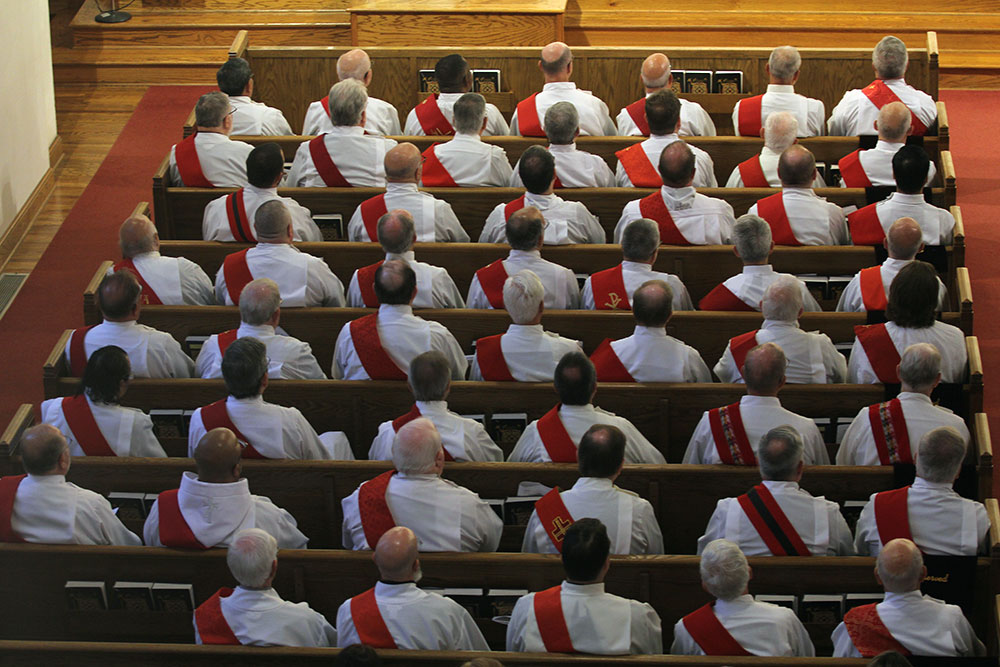
CHARLOTTE — Bishop Peter Jugis processed into St. Patrick Cathedral amid a sea of red stoles Aug. 10 to celebrate the Mass for the Affirmation of Ordination Promises by permanent deacons, held annually around the feast of St. Lawrence, deacon and martyr.
This year Bishop Jugis also installed 13 deacon candidates for the permanent diaconate into the Ministry of Lector during Mass. This is the second step on the men’s journey, having gone through the Rite of Candidacy last August.
Joseph Becker, Eduardo Bernal, Carl Brown, Margarito Franco, Charles Hindbaugh, Todd Labonte, John Langlois, Thomas Martin, William Melton Jr., Richard Michaels, Francisco Piña, Herbert Quintanilla and Joseph Smith all presented themselves before Bishop Jugis when their names were called during Mass.
During his homily, Bishop Jugis said, “The Lord gives us a joyous day in witnessing our brother deacons affirm their promises of ordination and our deacon candidates being instituted into the Ministry of Lector. It is a joy to see all of you offering yourselves for the ministry of the Church.”
He explained what the 13 deacon candidates will be responsible for upon becoming lectors.
“You will now have a very special office within the Church in the service of Jesus. There are several different things for which you will be responsible,” he said. “The most important will be the proclamation of the Word of God at Mass. You are placing yourselves and your voices at the service of God to communicate His word, His message of salvation to His people. And through those words of God which you will be pronouncing, God is offering His people spiritual nourishment through His word and forming them – forming their hearts, forming their minds and consciences on His teaching.”
“The Lord gives you the graces you need to fulfill this special ministry,” he said. “But you must also do your part. You must cultivate that grace, through your prayer and through an intimate friendship with Jesus so that you grow in holiness as you exercise your ministry.”
All of us have an obligation to grow in holiness, the bishop emphasized.
“You must deny yourself and follow Him. You must die to self to follow Him. In other words, Jesus must possess the first place in your heart.
“Deny yourself, let people see Christ,” he said. “May everyone see in you a servant who loves and is faithful to the Lord.”
After the homily, each man approached Bishop Jugis and knelt, one at a time, reaching out to hold the lectionary he extended to them as he conferred on them the Ministry of Lector.
Father Brian Becker, parochial vicar of St. Mark Church, whose father Joseph Becker was instituted as a lector at Mass, shared that he found himself moved by the bishop’s words in his homily as he reflected of the ministry of lector.
“When the Scriptures are proclaimed in the liturgy – that is God speaking to His people. So the joy that we celebrate in my father being incorporated into the Ministry of Lector is (he is) getting to become that channel through which Our Lord speaks humanly to His people,” Father Becker said. “That is a joyful thing to celebrate – to be an instrument in Our Lord’s salvation. I myself have experienced that, and now I get to watch my father be a part of that channel that Our Lord gives us freely. It’s a joy to be a part of.”
“To take on the role of lector in the Church and to possibly progress towards the diaconate, it can only happen with the grace of God,” Joseph Becker said. “It’s only going to happen if I die to myself and receive the grace of God to do what He wants me to do. Kneeling before the Bishop made it very real.”
Charles Hindbaugh of Our Lady of the Americas Church in Candor, said, “It is a special moment when the entire Church can celebrate that we are taking steps to serve God.”
Francisco Piña of St. Aloysius Church in Hickory commented, “Today really means big things for me. I feel it is a big responsibility to receive the Bible so we can proclaim it. It is a big load because we are supposed to be a herald for Jesus.”
Deacon Scott Gilfillan, director of formation for the permanent diaconate program, said, “The men have worked really hard to get to this point. I’ve seen a lot of growth in this past year – not only academically, but spiritually, emotionally and pastorally. Their marriages have become even stronger and centered in prayer. For me, seeing this type of growth is the most satisfying part of being the director of formation.”
“Today is another step in the discernment of these candidates, along with their wives,” said Deacon John Martino, director of the permanent diaconate program. “May their faith and the faith of those they touch grow stronger as instituted lectors of the Church of Charlotte.”
The 13 deacon candidates are scheduled to be instituted as acolytes in 2020, with ordination to the permanent diaconate expected in 2021.
Let married men become priests, says pastor of America’s largest Catholic church
By Tim Funk tfunk@charlotteobserver
He started his Charlotte career in 1974 as the first priest ordained in the brand new Catholic diocese here. He ends it this month as pastor of St. Matthew, the largest Catholic parish in the United States.
At 75, Monsignor John McSweeney will soon leave affluent Ballantyne – where this parish named for the patron saint of bankers was built – and move to Jamaica or Haiti, where he hopes to spend his retirement years living with and ministering to the poorest of the poor.
“I’m going to try to walk in the sandals of the Lord,” he says.
He exits Charlotte with a wish that the city had more affordable housing and less traffic congestion, but says a more diverse Queen City has done a better job in recent years in integrating its various cultures and developing more green space.
His parting advice for Charlotte and its leaders: “Remember that it is a city for all people, not just a select few.”
On Sunday, McSweeney will give his farewell homily, or sermon, at St. Matthew – he plans a message of thanks to his flock of 10,000-plus families.
The native New Yorker is also not shy about sharing his strong opinions about what needs to change in the church and the 46-county diocese he’s served for more than 40 years. (St. Matthew is the 12th parish he’s led.)
During an interview with the Observer, he spoke candidly about a Catholic Church he thinks has often put the Book of Law before the Book of Love.
Echoing Pope Francis – the fifth pontiff to reign during McSweeney’s time as a priest – he’d like the church and the diocese to be more about hospitality and less about judgment. That means, he said, being more welcoming: Of divorced-and-remarried Catholics, of LGBTQ persons, and of others who have long felt excluded by the church.
With too few diocesan priests, including in Charlotte, where the Catholic population is booming, McSweeney said he’d also support the church re-opening the door to married priests by making celibacy optional – as it was the first 1,000 years of Roman Catholicism.
The monsignor – a title for priests who have rendered valuable service to the church – said he’s been around many married Protestant ministers who are “doing great work.”
“And many men I was in the (Catholic) seminary with would be great priests today except for one thing,” he added, that one thing being their desire to get married.
Revolt brewing?
McSweeney said he’s also “very concerned” that many of the priests graduating from seminaries these days are too conservative and could spur a revolt by Catholics in the pews against the priests’ efforts to stifle the reforms of the Second Vatican Council. Also known as Vatican II, this council in the 1960s embraced church reform, including expanding the role for lay Catholics and celebrating the Mass in the local language more so than in Latin.
“The population that is the worshiping Catholic community have no understanding or history of pre-Vatican II,” he said. “They weren’t born (yet). The same with these young priests.”
McSweeney said Vatican II called for active lay participation in the liturgy, or Mass. “What I see happening (at some parishes) is that is not happening,” he said. “It’s being stopped.”
Lay people, particularly women, are not being permitted, for example, to dispense Communion as Eucharistic ministers. Altar boys are allowed, but not altar girls.
These young priests, McSweeney said, “are trying to reform the reform. ... I don’t endorse what they’re doing to God’s people.”
Recently, at a Catholic church in Waynesville, which is part of the Charlotte diocese, the pastor resigned after many from the congregation left to protest his insistence, for example, of replacing popular hymns with the ancient Gregorian chant.
McSweeney said such rebellion could also happen in some Charlotte parishes, adding only half jokingly, “I’ll lead it.”
Bishop Peter Jugis, who heads the Charlotte diocese, is a conservative who seems less in sync with Pope Francis than with former Pope John Paul II, who named him bishop in 2003. Last month, Jugis ordained five new priests for the diocese, four of whom he had sent to the Pontifical College Josephinum in Columbus, Ohio, a school with a reputation for graduating priests with traditionalist views.
McSweeney, whose many jobs over the years included being chancellor, or CEO, of the diocese, said he’d like to see Charlotte area churches get priests from a broader pool of seminaries, the way they used to.
“In our history, we would have men in training in different seminaries so we’d get a broader aspect of the church,” he said. “And I think that’s what should be done now. Not just one place.”
Monsignor John McSweeney, 75, is retiring this month after more than 40 years as a priest in the Catholic Diocese of Charlotte. Since 1999, he's been pastor of St. Matthew Catholic Church (in background), which has grown to become the largest Catholic parish in the United States.
Jenna Eason jeason@charlotteobserver.com
‘Stay out of the way’
To take over as pastor of St. Matthew, McSweeney convinced Jugis to appoint the Rev. Pat Hoare, who has most recently been pastor at St. John Neumann Catholic Church
“I had suggested very clearly to Bishop Jugis that (Hoare) might be my successor because of his sense of care of people and also because of his professional business background,” said McSweeney, who called Hoare a moderate.
Having a business background – Hoare has a master’s degree in business administration and was a commercial insurance underwriter at Liberty Mutual – can come in handy in running a megachurch. Before he became a priest, McSweeney worked in his family’s funeral and real estate businesses in Oneida, New York.
Also key in promoting Hoare: His previous ties to St. Matthew. He was a member and a deacon at the church, and was ordained there in 2007.
McSweeney’s advice to his successor: “Stay out of the way a little bit and let God’s people do what they’re called to do. I’ve been quoted and I mean it, that the star here is not a priest.” It’s Jesus, he said, and the church is like a jigsaw puzzle, with each person fitting in in some capacity.
McSweeney also points to the front of St. Matthew’s weekly bulletin, which calls the church “a welcoming parish” no matter what your status is with the Catholic Church or your current marital situation or your sexual orientation – to name just a few of the examples listed.
Questions on inclusion
Some may question McSweeney’s record on inclusion. In 2013, for example, St. Matthew bowed out of hosting Mecklenburg Ministries’ annual interfaith Thanksgiving service rather than formally invite music director Steav Bates-Congdon to help organize the event. Bates-Congdon had been fired the year before by another Catholic church after he traveled to New York to marry his longtime male partner and then put the wedding photos on Facebook.
McSweeney, who participates in celebrating an annual Mass for gay and lesbian Catholics in the the diocese, said his issue with Mecklenburg Ministries was “you don’t tell me who to invite.” Also, at the time, Bishop Jugis had just championed a 2012 campaign to amend the N.C. Constitution to reaffirm the state’s ban on same-sex marriage. (That ban was later thrown out by federal courts.)
McSweeney also said he “won’t go there” in taking a stand on whether women should be ordained priests in the Catholic Church. Recent popes, including Francis, have said it will never happen, even though several large mainline Protestant denominations have been ordaining women clergy for years.
But McSweeney does favor letting women become deacons, which would give them the authority to preach at Mass, baptize and perform weddings.
And the monsignor said about 95 percent of his 63 staffers at St. Matthew are women, including the church’s chief financial officer, its chief of facilities and most of its clinical counselors.
‘Never say no to Jesus’
This weekend, 1,400 volunteers at St. Matthew will do what they’ve done every year for 15 years: Pack 335,000 meals bound for local food banks and for Haiti and Jamaica – the two countries McSweeney is considering as his next home.
He plans to work with the Missionaries of the Poor, a Catholic group at work on the ground in both countries.
McSweeney feels called.
“I’ve had the privilege of being in many different roles in ministry. ... But I think I need now to to experience (poverty),” McSweeney said. “I have a little motto: ‘You never say no to Jesus.’ And he keeps talking to me.”
Read more here: http://www.charlotteobserver.com/living/religion/article160165564.html#storylink=cpy