Showing posts with label Cardinal Robert Prevost. Show all posts

Thursday, July 30, 2026

During Pope Leo XIV interview with NBC News he said he is a Pope who happens to be American; expressed


Pope Leo on his ancestry, and how he’s a ‘pope who happens to be American’

Pope Leo XIV applauds as Italian tenor Andrea Bocelli and a 164-member children's choir sing for the pontiff at the "Canticle of Peace" event in the Vatican Gardens at Castel Gandolfo on the evening of July 29, 2026. (OSV News photo/Matteo Pernaselci, Vatican Media)


(OSV News) — Pope Leo XIV spoke with Tom Llamas of NBC News July 29 about being the first American pope, his diverse ancestry and whether he might be coming to the U.S. soon.

“You are the first American pope. It’s something you don’t speak about often,” Llamas noted, asking, “How important is being American to you, and what do you love about America?”

“First of all, just to clarify, I think of myself more as the pope who happens to be American,” Pope Leo responded, “not to belittle what it means to be American. I was born in the United States, my family is still in the United States. I have great love for America. But I understand my mission, having a very important dimension, which is precisely being pastor of a universal Church and having a voice and opportunity to speak to people throughout the world. So, I will put things in that order.”

“And yet, at the same time,” he added, “I will acknowledge that for myself as well as the people of the United States, judging by the response that we’ve seen since May 8 of last year, that there is great significance in being the first American pope.”

Speaking to Llamas at a July 29 Concert for Peace at Castel Gandolfo outside Rome, which featured Andrea Bocelli and an interfaith choir of 200 children from conflict-affected regions around the world, Pope Leo said he loves “so many things” about America: “What America stands for, the sense of freedom, the sense of opportunity, the sense of having invited, for generations, people from around the world to be part of America.”

Discussing his ancestry, he noted that, “I come from a family that — my grandparents were immigrants. On my mother’s side, we have people who were both slaves and slave owners. There’s a history of, if you will, growing up in the kind of experience that helps me to recognize, myself, one of the greatest wealth of the United States. And I continue to hold the principles that have been a part of being American for so many years. That will continue.”

Llamas asked if Americans can expect a papal visit soon.

“They will see me there,” Pope Leo replied, “by coincidence, today we were looking at the calendar for the next couple of years. Nothing is set in stone yet, but I certainly hope to be there soon.”

Julio Vaqueiro, anchor of Noticias Telemundo, also spoke with Pope Leo following the pope’s concert.

Pope Leo told Vaqueiro that the concert “featuring children from various countries, of different races, perhaps from different traditions — all singing together to beautiful music,” offered “a beauty that I believe was an invitation to all of us to look beyond, to see the beauty that can be created or in which we can share when we set aside certain differences and recognize the richness of being one — of all being created in the image of God.”

Tuesday, July 15, 2025

Nothing but love and respect for Pope Leo XIV from his diocese of Chiclayo


Chiclayo locals hope their Bishop Roberto will stay a 'team builder' as Pope Leo XIV


Victoria Herrera, a Chiclayana, holds photos of her grandchildren with Bishop Robert Prevost, during an outdoor Mass in Chiclayo, Peru, on May 10, where thousands prayed for Prevost's success in his new role as Pope Leo XIV. (GSR photo/Manuel Rueda)

by Manuel Rueda

Posters of Pope Leo XIV line the main streets of the Peruvian city of Chiclayo, where a life-sized cutout of him sits on the balcony of city hall, waving at pedestrians who pass by the city's main square.

The American pope, who as Bishop Robert Prevost served the Chiclayo Diocese from 2015 to 2023, has become a celebrated figure in this city of half a million people, where he is widely treated as if he had been born here. 

Today, locals who knew Leo hope the same "Bishop Roberto," famous for driving around the diocese in a battered pickup truck, will keep his pragmatic and charismatic leadership as Pope Francis' successor as bishop of Rome. Leo was elected to lead the worldwide Catholic Church on May 8.

The picture that emerges from Leo's time in Chiclayo is one of a gregarious pastor who was not afraid to roll up his sleeves and get involved in the community's problems, such as supporting newly arrived migrants and supporting anti-trafficking ministries. He's remembered as a leader who brought religious and secular people together to tackle various issues and spread what Sr. Maria Ramos described as the "love of God."

Chiclayanos treasure their pictures with Prevost, and happily share their anecdotes about his time in this hectic city on Peru's arid northern coast, a region where 20% live in poverty, according to the World Bank.

Ramos recalled how the bishop would visit a home for the elderly run by her congregation — Little Sisters of the Abandoned Elderly — to chat with residents and play the role of "judge" in a mock beauty pageant that included dancing and singing shows.

Betania Rodríguez, a teacher from Venezuela, talked about how the pope encouraged migrants from her country to set up an association that now helps newcomers get residency papers.

Silvia Vásquez, a survivor of human trafficking, said Prevost would visit a house run by the Sisters of the Sacred Sacrament to offer Mass to sex workers who were learning new trades and invite them to spiritual retreats.

Janinna Sesa, an engineer and former director of the local Caritas, said Prevost convinced local businesses to donate tens of thousands of dollars during the pandemic to build two oxygen plants in impoverished neighborhoods, where coronavirus patients could not afford to buy oxygen cylinders.

Now that "Roberto" is Leo, many Chiclayanos are eager to see him carry on the same spirit in Rome that he displayed during his time in the Peruvian city.

"He is someone who will focus on building communities" around different topics, "and delegating responsibilities" said César Piscoya, a Peruvian theologian who worked closely with Leo during his time in Chiclayo.

When the pope was Chiclayo's bishop, Piscoya was the executive secretary of the social vicariate, taking on a role that had previously been reserved to priests.

Piscoya said that, like Francis, Leo is concerned with building a church that tends to those on the margins of society. But he expects his old friend to be more of a "team builder."

"For him, as an Augustinian, communities are the building blocks of pastoral work" Piscoya said. "He believes in the concept of co-responsibility, of clergy and laypeople, working together toward the same goals."

The municipal government of Chiclayo, Peru, has placed posters of Pope Leo XIV in several corners of the city: "Welcome to Chiclayo, the city of Pope Leo XIV." (GSR photo/Manuel Rueda)

"He is someone who will focus on building communities" around different topics, "and delegating responsibilities" said César Piscoya, a Peruvian theologian who worked closely with Leo during his time in Chiclayo.

When the pope was Chiclayo's bishop, Piscoya was the executive secretary of the social vicariate, taking on a role that had previously been reserved to priests.

Piscoya said that, like Francis, Leo is concerned with building a church that tends to those on the margins of society. But he expects his old friend to be more of a "team builder."

"For him, as an Augustinian, communities are the building blocks of pastoral work" Piscoya said. "He believes in the concept of co-responsibility, of clergy and laypeople, working together toward the same goals."

Changing Chiclayo

In 2015, Prevost took over a diocese that had previously been run for six decades by Opus Dei bishops.

Piscoya said that as a bishop, Prevost started to get the diocese more involved in social issues that had been ignored by previous administrations, creating a youth ministry and also a ministry for imprisoned people.

In 2017, when migrants from Venezuela began to arrive in Peru in massive numbers, Prevost asked parishes and congregations within the diocese to work together to provide emergency assistance to the newcomers under an umbrella group known as the Commission for Human Mobility and Human Trafficking. 

"Our parks were becoming camps where migrants slept in tents with their children," said Sesa, then the local director of Caritas. "Bishop Prevost asked us to work together so that we could maximize our resources and not send aid to the same places twice."

Betania Rodríguez, a teacher from Venezuela, shows a photo of herself and some other Venezuelan migrants with then-Bishop Robert Prevost. Her family lives in a housing project for migrants that was funded partly by the Diocese of Chiclayo, Peru. (GSR photo/Manuel Rueda)

Betania Rodríguez, a teacher from Venezuela, shows a photo of herself and some other Venezuelan migrants with then-Bishop Robert Prevost. Her family lives in a housing project for migrants that was funded partly by the Diocese of Chiclayo, Peru. (GSR photo/Manuel Rueda)

As thousands of migrants with little money and no residency papers passed through Chiclayo, some churches became temporary shelters. The commission also set up food pantries and began to help the migrants who stayed in the city to apply for work permits and residence in Peru.


But Prevost also made an effort to ensure that migrants became involved in their local parishes, said Rodríguez, who is now a volunteer in several church projects that serve her fellow Venezuelan migrants.

"During sermons, he would have us walk up to the altar and would introduce us to the community. ... He would celebrate the International Day of Migrants and would remind locals in sermons that Jesus was a migrant, too."

Rodríguez and several other Venezuelan migrants in Chiclayo have now formed an association called Asovenchi, which helps migrants apply for residency and runs projects for schoolchildren. Her group still works closely with the diocese and local parishes.

"The bishop encouraged us to register our association," Rodriguez said. "And he taught us that human dignity has no frontiers."

As bishop, Prevost also backed efforts to tackle human trafficking.

Sr. Dora Fonseca, of the Handmaids of the Blessed Sacrament, said that Prevost sought regular meetings with her congregation — which focuses on helping victims of prostitution — to learn about the situation of vulnerable women in the diocese.

Prevost then ministered to women who took part in workshops funded by the congregation that teach sex workers and former victims of human trafficking to learn new skills such as sewing or cosmetology.

"He was a bishop who was aware of the realities women go through and was willing to walk with us," Fonseca said.

In 2019 the congregation had to shut down its house in Chiclayo, after Fonseca and some of its other leaders were transferred to Lima. 

But Prevost encouraged laypeople who stayed in Chiclayo to carry on with the work of the sisters. He asked members of the congregation to provide the volunteers with online courses on how to approach sex workers and trafficking victims — and also took the online training himself, Fonseca said.

"He was very committed to our cause."

A legacy of diplomacy, friendship

For Fonseca, one of Prevost's greatest talents was his capacity to listen to different groups within the diocese before taking action.

It's a trait that could be useful for the pope as he takes on global issues such as the war in Ukraine, the role of artificial intelligence, or immigration policies, Piscoya said.

Piscoya added that the pope has long been respectful of "institutions" and is likely to work through diplomatic channels — such as bishops' conferences or the Vatican's embassies — when discussing controversial topics with the world's governments.

"He is not someone who seeks confrontation because he knows that does not build unity," Piscoya said. "Before making a decision, he likes to discuss the topic with several parties."

Rodríguez said Prevost would constantly ask migrants how they were being treated in Peru: He encouraged them to form groups within their parishes that would conduct surveys on the needs of migrants and come up with projects that they could propose to Caritas or the diocese's commission.

The process led to the creation of a shelter for short-term stays, as well as projects funded by international donors and executed by Caritas that helped migrants start their own businesses.

Juanita Zunini, a restaurant owner in the town of Lambayeque (within the diocese) said Prevost would enjoy sitting with elderly people and listening to their stories after he offered Mass at the Asilo de Ancianas Hogar San José, the sister-run nursing home in Chiclayo, which he would visit during special festivities like Mother's Day and the congregation's anniversary.

Zunini volunteers at the nursing home. She said she was at the facility delivering food for a Mother's Day celebration on the day that Prevost became Leo XIV.

When the news was announced on television, people broke out in tears, hugged each other, and rang the bells of the nursing home's chapel, Zunini recalled.

"He has left a great legacy of peace, friendship and love" in Chiclayo, the restaurant owner said. "And the fact that he emerged from a poor place like Chiclayo, is sort of mind-blowing."

Friday, May 9, 2025

Our new Pope Leo XIV is descended from Creole 7th Ward New Orleanians


New Pope Has Creole Roots in New Orleans

His ancestry, traced to a historic enclave of Afro-Caribbean culture, links Leo XIV to the rich and sometimes overlooked Black Catholic experience in America.

Richard Fausset and 


Image of a grave marker in Chicago for members of the Martinez family, including the new pope’s grandparents.Credit...via Jari C. Honora


Robert Francis Prevost, the Chicago-born cardinal selected on Thursday as the new pope, is descended from Creole people of color from New Orleans.

The pope’s maternal grandparents, both of whom are described as Black or mulatto in various historical records, lived in the city’s Seventh Ward, an area that is traditionally Catholic and a melting pot of people with African, Caribbean and European roots.

The grandparents, Joseph Martinez and Louise Baquié, eventually moved to Chicago in the early 20th century and had a daughter: Mildred Martinez, the pope’s mother.

The discovery means that Leo XIV, as the pope will be known, is not only breaking ground as the first U.S.-born pontiff. He also comes from a family that reflects the many threads that make up the complicated and rich fabric of the American story.

The pope’s background was unearthed Thursday by a New Orleans genealogist, Jari C. Honora, and confirmed to The New York Times by the pope’s older brother, John Prevost, 71, who lives in the Chicago suburbs.

“This discovery is just an additional reminder of how interwoven we are as Americans,” Mr. Honora said in a text message late Thursday. “I hope that it will highlight the long history of Black Catholics, both free and enslaved, in this country, which includes the Holy Father’s family.”

It’s unclear whether the new pope has ever addressed his Creole ancestry in public, and his brother said that the family did not identify as Black. The announcement of his election in Rome focused on his early life in Chicago and decades of service in Peru.

Mr. Honora, who works at the Historic New Orleans Collection, a museum in the French Quarter, began investigating the pope’s background because of his French-sounding name, Prevost, but quickly found connections to the South instead.

His trail of evidence linking Leo to New Orleans includes the grandparents’ marriage certificate from their Seventh Ward wedding in 1887, a photo of the Martinez family grave marker in Chicago, and an electronic birth record of Mildred Martinez that shows she was born in Chicago in 1912.

The birth record lists Joseph Martinez and “Louis Baquiex” as Mildred’s parents. The father’s birthplace is listed as the Dominican Republic; the mother’s, New Orleans.

Mr. Honora also found records from the 1900 Census that list Mr. Martinez as “Black,” his place of birth as “Hayti,” and his occupation as “cigar maker.” Mr. Martinez’s details appear on the sixth line of a page of the census that Mr. Honora shared with The Times.

“Both Joseph Norval Martinez and Louise Baquié were people of color, no doubt about it,” Mr. Honora said.

Joseph Martinez’s exact place of birth remains a bit of a mystery — Mr. Honora also found an 1870 Census record that says the pope’s maternal grandfather was born in Louisiana. But he said it was not uncommon for people to change their responses on official records.

Joseph Martinez and Louise Baquié married at Our Lady of the Sacred Heart in New Orleans. Until it was destroyed by a hurricane in 1915, the church building was on Annette Street in the city’s Seventh Ward, a historic center of Afro-Creole culture.

Creoles, also known as “Creole people of color,” have a history almost as old as Louisiana. While the word Creole can refer to people of European descent who were born in the Americas, it commonly describes mixed-race people of color.

Many Louisiana Creoles were known in the 18th and 19th centuries as “gens de couleur libres,” or free people of color. Many were well educated, French-speaking and Roman Catholic.

Over the decades, they established a foothold in business, the building trades and the arts, particularly music, with significant contributions to the development of jazz. They continue to be an important strand in the city’s famously heterogeneous culture.

The revelation of the new pope’s heritage is a tremendous moment for the history of Louisiana Creoles, said Lolita Villavasso Cherrie, a co-founder with Mr. Honora of The Creole Genealogical and Historical Association.

“I hate to say it, but we feel, many of us, that our history was hidden from us,” said Ms. Villavasso Cherrie, 79, a retired teacher. In part, she said, that’s because many Creoles have been able to “pass” as white over the years.

It was only with the advent of the internet, she said, that many people began to research their family history and became aware of their Creole roots. She noted that a significant number of Louisiana Creoles migrated to the Chicago area in the 20th century.

John Prevost, the pope’s brother, said that their paternal grandparents were from France, and that his father had been born in the United States. He said he and his brothers didn’t discuss their Creole roots.

“It was never an issue,” John Prevost said.

What all of this means, when it comes to the pope’s racial identity, touches on some of the thorniest questions in U.S. society, but also reflects the rich diversity of the American experience.

“We are all just a few degrees (or less than a few degrees) removed from each other,” said Mr. Honora, the genealogist.

Celebrations in Peru where Pope Leo XIV was Bishop Robert


Diocese of Chiclayo in Peru celebrates former bishop Prevost’s election as Pope Leo XIV


Eduardo Campos Lima


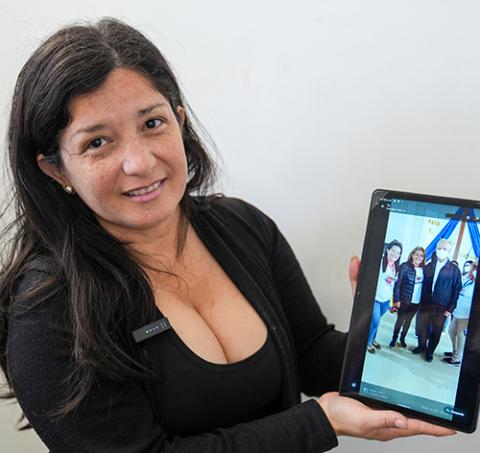
Ximena Valdivia Muro, a coordinator of the Youth Pastoral Ministry, during her visits to Cardinal Robert Prevost – now Pope Leo XIV – in the Vatican. (Credit: Private photo given to Crux.)

SÃO PAULO, Brazil – Many people who worked with Pope Leo XIV when he was Bishop Robert Prevost of Chiclayo, Peru, couldn’t hold back tears when his election was announced on May 8.

For them, it was not just a sign that God answered their prayers for a new pope who would follow Francis’s path, but also the confirmation that they had been guided by an extraordinary leader.

“Since the moment he arrived, we noticed that he was a person touched by the Lord,” Father Carlos Samame told Crux.

Rita Paredes, a lay member of the diocesan team of pastoral animation, said that Prevost “has a spirituality that emerges from his skin, as if he was surrounded by the Holy Spirit.”

“He has great charisma, but he’s humble and has a gentle way of addressing the people,” she explained.

The pope’s appearance of holiness may have been boosted by the role he played during the COVID-19 pandemic. Lambayeque, the region where Chiclayo is located – in the northern part of Peru – was one of the most impacted areas in the South American country after the outbreak of the novel coronavirus.

“There was some inertia. He decided to take the lead and discussed with the authorities how to face the catastrophe. After his initiative, other social segments joined the efforts,” Samame recalled.

He said Prevost would not fear contagion and was always out of his house helping those in need. Due to such efforts, two oxygen plants were implemented in Chiclayo. Cylinders would be distributed to people who could not afford to buy one.

“That action certainly saved many lives,” Samame said.

Videos on social media show Prevost, accompanied by priests, walking on the empty streets of Chiclayo with the monstrance in his hands, praying in front of the people’s houses.

In different years, heavy rains also hit the region, causing enormous damages and isolating entire districts. Prevost again talked to the authorities and gathered distinct social actors to coordinate relief.

“That’s why the people here don’t forget him. In the worst time of their lives, he was with them,” Samame said.

Indeed, Rita Paredes affirmed that she will “never forget the wave of solidarity he promoted during the pandemic.”

The pope will not forget the people of Chiclayo as well. During his inaugural speech as the new pontiff, Leo XIV saluted “those of my dear diocese of Chiclayo, in Peru, where a faithful people has accompanied their bishop, has shared its faith and has given so, so much in order to keep being a Church that is loyal to Jesus Christ.”

Created in the 1950s, the Diocese of Chiclayo was headed for 30 years by Spanish-born Bishop Ignacio de Orbegozo y Goicoechea, a member of the Opus Dei and one of the preferred pupils of founder Saint Josemaria Escrivá.

After his death in 1998, he was replaced by Spanish-born Bishop Jesús Moliné, who has been identified by different sources as an Opus Dei member as well. Although he publicly denied it on one occasion years ago, he studied at the University of Navarra, kept by the group, and has been present to numerous ceremonies in honor of Escrivá over the years. He also wrote a biography of Orbegozo.

The social perspective of Prevost’s work apparently inaugurated a new era in the Diocese. The prelate who replaced him after he left for the Vatican in 2023, Bishop Edinson Farfán – also an Augustinian – said during a press conference on May 8 that Prevost made in Peru a preferential “option for the poor,” echoing the Latin American Liberation Theology formulation.

Despite that, it has never been possible to see any division in Prevost’s guidance of that particular Church, said Ximena Valdivia Muro, who heads the Youth Pastoral Ministry.

“We know there are in our diocese Traditionalists, people connected to the Charismatic Catholic Renewal or to Liberation Theology. But I never saw him turning his back to any person or to any group. He always worked for communion,” she told Crux.

As a leader of the youth group, Valdivia would always discuss with the bishop the activities that were being planned. At times, she would invite him for one of them. Prevost would never play dead or give excuses not to participate, she said.

“He would always talk to us and be there when the members of the group needed. He is very humble and frequently agreed to hold Q&A sessions with the teenagers,” Valdivia said.

At times, Prevost would ask her how things were going in the pastoral ministry. She would answer him, but soon would realize that he already had all the information.

“He accompanied everything that happened in the diocese,” Valdivia said.

The genuine concern he demonstrated about the group and about her always gave her the “impression that an amorous father was taking care of his children.”

“For me, that feeling is connected to Jesus,” she said.

Valdivia traveled to the Vatican after Prevost left Peru. She was present during the consistory, when he was created a cardinal.

“He told us on more than one occasion that Francis’s efforts towards synodality were a very positive thing, that it was a way of being closer to the people. I think he will keep that direction,” she said.

Samame agrees. The priest said that Prevost was always a good example of a Church that goes out – given that he was always the first to do so during hard times.

He described the pope as a demanding man, both in relation to himself and to others.

“He was always very concerned about our pastoral work, whether we were close to our communities or not. And he never missed an opportunity to talk to us priests when possible,” he recalled.

Samame lived at the rectory with the bishop for many years. He said the most impacting characteristic Prevost has is that “he never leaves you alone.”

“When my mother got seriously ill, he never forgot to ask me how she was doing. Those details are not secondary. They marked my experience with him,” he said.

Samame thinks that Prevost’s deep knowledge of the Peruvian reality and all he learned during his visits to other Latin American countries and to Africa as the prior of the Augustinians will help him deal with the complex realities a pope faces.

“He combines the ability to work hard that the Americans have with a Latin American spirit, and he’s very talented as an administrator,” he said.

In the opinion of Rita Paredes, Prevost’s election is a sign that God heard her – and many other people’s – prayers.

“We had been praying for a new pope that would keep Francis’s pastoral direction. God answered our needs. I’m sure the new pope has that particular charisma of knowing how to work with the poor,” she said.