Showing posts with label Archdiocese of Miami. Show all posts

Tuesday, July 22, 2025

Miami Archbishop and 25 Knight of Columbus on motorcycles go to pray at Alligator Alcatraz


Archbishop Wenski leads Knights on Bikes to pray rosary at Alligator Alcatraz


Motorcycles ridden by Archbishop Thomas G. Wenski of Miami and Knights on Bikes are parked in front of the entrance to Alligator Alcatraz, a controversial immigration detention facility some 55 miles from Miami in the Florida Everglades. The archbishop and his fellow bikers stopped to pray a rosary for detainees July 20, 2025. (OSV News photo/Archbishop Thomas G. Wenski)

(OSV News) — Archbishop Thomas G. Wenski of Miami and some 25 Knights of Columbus saddled up their motorcycles to pray a rosary at the entrance of Alligator Alcatraz, the controversial migrant detention center recently opened in the Florida Everglades.

The archbishop posted images of the July 20 gathering to his X account, saying that he and his fellow riders — members of the Knights of Columbus’ Knights on Bikes International fraternal organization — “stopped at the entrance of Alligator Alcatraz and prayed a rosary for the detainees.”

Images shared by the archbishop showed the men standing in a circle, bikes parked and heads bowed in prayer, with the Knights of Columbus logo and a cross prominently stitched on the back of their vests.

In his post, Archbishop Wenski noted that the Archdiocese of Miami “is still waiting for approval to access” Alligator Alcatraz “to provide Mass for detainees.”

According to a recent report by organizations affiliated with Catholic and evangelical Christian churches, Christians account for approximately 80% of all of those at risk of deportation. The Christians most at risk of deportation are Catholics, 61% of the total.

Alligator Alcatraz, located some 55 miles from downtown Miami at the Dade Collier Training and Transition Airport, consists of tents with groups of bunk beds in cage-like units of chain-link fencing, and exposed communal toilets. 

Water, sewage management, power and air conditioning are supplied by portable units, according to Florida Governor Ron DeSantis. The facility, estimated to hold 3,000, has plans to be expanded to accommodate 5,000.

Alligator Alcatraz has drawn condemnation from clergy and Democratic lawmakers alike for its conditions and location — with Trump, Homeland Security Kristi Noem and DeSantis, a Catholic, touting the hostile environment as a security feature and immigration deterrent during their July 1 tour inaugurating the opening of the facility.

“It basically is in a swamp,” Archbishop Wenski told OSV News in a July 15 interview. “There are numerous alligators and pythons (and) boa constrictors, and tons and tons of mosquitoes.”

The tarmac on which the tents have been built “becomes even hotter because it’s reflecting the heat of the day,” he said.

Detainees have told The New York Times that the frequent rains have created leaks and insect intrusions, while access to showers, full meals and medication is limited. Illness, sleep deprivation and unrest is also in evidence, they said.

NBC 6 South Florida reported that from July 1-18, there were 34 emergency calls to 911 from Alligator Alcatraz, an average of two per day.

Archbishop Thomas G. Wenski of Miami and Knights on Bikes pray the rosary for detainees at the entrance to Alligator Alcatraz, a controversial immigration detention facility in some 55 miles from Miami in the Florida Everglades, July 20, 2025. (OSV News photo/Archbishop Thomas G. Wenski)

Speaking to OSV News July 15, Archbishop Wenski also noted that the site is “far removed from hospitals.”

One government official, speaking on condition of anonymity, told the Times that most of those detained at Alligator Alcatraz do not have criminal convictions. 

Records obtained by The Miami Herald/Tampa Bay Times show only a third of those currently housed at the site have criminal histories.

“There’s more questions than answers about this place,” Archbishop Wenski told OSV News July 15.

He said, “We don’t want dangerous people walking the streets freely. But the majority of the immigrants are not bad actors. They’re basically people that have tried to, through hard work, create a future of hope for themselves and their children. And as such, they have contributed to the prosperity of our nation. And some have done so for years, even decades.”

The archbishop added, “There’s no home to go back to, because home is here.”

Gina Christian is a multimedia reporter for OSV News. Follow her on X @GinaJesseReina.

Monday, February 13, 2023

Miami Archbishop will house Priests and Seminarians exiled from Nicaragua


Miami Archbishop Offers To House Exiled Nicaraguan Priests, Seminarians


MIAMI (OSV News) — Archbishop Thomas G. Wenski spoke to the Florida Catholic Feb. 11 about the expected arrival in Miami of some of the political prisoners released by the Nicaraguan government and flown to the U.S. Feb. 9.

“Most of the people expelled were politicians or candidates for public office that (Daniel) Ortega locked up before the elections,” the archbishop said, but among them were “four or five priests, a couple of seminarians, a deacon and an organist.”

Although they would be taken in at first by Nicaraguan families, Archbishop Wenski said he offered the priests and seminarians longer term housing at St. John Vianney College Seminary in Miami.

“I’m offering them the hospitality of the seminary as well as the opportunity to get acclimated, acculturated and see what the next steps would be after that,” he said. At the seminary they could take “intensive English classes” while finalizing their immigration paperwork.

Although the expectation is that many of the priests and seminarians would stay in Miami, “I’ve already heard from a few bishops who need Spanish-speaking priests who would be happy to help them out,” Archbishop Wenski said.

He added that Catholic Charities and Catholic Legal Services of the Archdiocese of Miami were standing by to provide aid and to help the exiles with their immigration paperwork.

“Refugees or migrants arriving in Miami is sort of like a summer thunderstorm,” the archbishop said, noting that a few days earlier 114 Haitians had arrived by boat.

The Nicaraguans were expected to arrive from Washington Feb. 12 and take part in the 1 p.m. Mass normally celebrated at St. Agatha Church by exiled Nicaraguan Bishop Silvio José Báez, auxiliary bishop of Managua. He was expected to hold a news conference after the Mass.

Bishop Báez was forced to leave Nicaragua in 2019 after receiving death threats for his criticism of Ortega’s government. He now teaches Scripture at St. Vincent de Paul Regional Seminary in Boynton Beach but celebrates that weekly Mass at St. Agatha, which is livestreamed via Facebook to Nicaragua.

St. Agatha’s pastor, Father Marcos Somarriba, is a native of Nicaragua. The parish is located near an area of Miami known as Sweetwater, which, since the late 1970s, has been home to a large concentration of Nicaraguan exiles.

“Miami is the epicenter for the Nicaraguan community in the U.S. just like Miami is the epicenter for the Cuban community,” Archbishop Wenski said.

“There’s a lot of pathos in this whole thing,” he added, because a few days earlier, speaking in front of Cuban government officials Feb. 8 at the University of Havana, a papal envoy, Cardinal Benjamin Stella, had mentioned a potential amnesty for those jailed in Cuba after the anti-government protests in July 2021. Cardinal Stella was visiting the island to mark the 25-year anniversary of the historic visit of St. John Paul II.

“What happened in Nicaragua could be something similar to what might happen in Cuba with those political prisoners, so Miami might be on an emotional roller coaster the next few weeks,” Archbishop Wenski said.

Tuesday, February 15, 2022

Archbishop of Miami speaks out against Florida Governors immigration comments


Miami archbishop calls out Florida governor for views on migrant children


WASHINGTON, D.C. — The archbishop of Miami said Republican Gov. Ron DeSantis of Florida had hit a “new low” after the politician said it was “disgusting” to compare Cubans who fled the island-nation as unaccompanied minors in the 1960s with present waves of migrant children from Central America.

“Children are children — and no child should be deemed ‘disgusting’ — especially by a public servant,” said Archbishop Thomas G. Wenski in Feb. 10 news conference.

The incumbent Republican governor is running for a second term and has been taking swipes at groups of migrants and present-day immigration.

But he was able to seek the backing of some Cuban immigrants in Florida, part of a group of over 14,000 minors brought to the U.S. through Operation Pedro Pan, a program organized by the Catholic Church with the help of the U.S. government in the 1960s.

One of them was Maximo Alvarez, a beneficiary of Operation Pedro Pan.

“Let me assure you that they knew exactly who I was, they knew who my parents were. They are using this program to convince people that this is similar to what is happening today. Not even close,” he said during the Feb. 7 event with DeSantis.

“What is happening right now, you see children as merchandise and these cartels are using these kids as merchandise for personal gain,” Alvarez said. “When I came, we came directly into the hands of the church, and we were treated like family

The Miami archbishop said that the lack of solidarity by immigrants who were former unaccompanied minors from Cuba and went through similar circumstances as migrant children today was “disappointing.”

“Even while recognizing the good care afforded them by Catholic Charities 60 years ago, they begrudge that same care being extended to migrant children today. Msgr. Bryan O. Walsh, the revered ‘father’ of the Operation Pedro Pan children, is rolling over in his grave,” he said.

Wenski, who tends to a large flock that includes many immigrants in his flock of more than 1 million in South Florida, was accompanied by Mike Fernandez, one of a two Pedro Pan beneficiaries who supported migrant children and their families.

Fernandez, a Republican donor to the state’s GOP, said the governor’s words and actions were shameful. He also attacked policies by DeSantis targeting agencies that assist migrant children, noting that the children arriving today “are not inferior in any way.”

Wenski said the DeSantis event amounted to “political theater attacking (Joe) Biden’s admittedly chaotic immigration policies.”

“It showed that the governor has a powerful machine in South Florida capable of mobilizing (and manipulating) a segment of our community to advance his political agenda — but his bullying of kids also showed weakness,” the archbishop said.

He added that “the success of the Pedro Pan kids made possible by the freedom and opportunity of this great land makes clear that magnanimity rather than mean-spiritedness is a best practice in resolving our immigration challenges.”

The event, peppered with posters that read “children yes, politics no,” also featured brief comments by a boy in his teens who had been helped by Catholic Charities’ Children’s Village in Florida, part of a network of shelters that help “unaccompanied, undocumented, immigrant children 0-17 years of age,” according to its website.

The Catholic nonprofit came under attack by the governor, who passed an executive order last year cutting off state funding to groups that help unaccompanied migrant minors who entered the country without permission.

At his event, DeSantis said that “to equate what’s going on with the southern border with mass trafficking of humans, illegal entry, drugs, all this other stuff with Operation Pedro Pan, quite frankly, is disgusting.”

Fernandez said the governor’s words and actions were shameful.

“Let me tell you what I think is disgusting — a proposed heartless policy toward immigrant children,” he said. “The actions being proposed, the law being implemented is cruel, and those promoting it should be embarrassed by this crusade which they have totally embraced.”

Monday, January 10, 2022

Mask mandates popping up in dioceses across the country


Mask mandates return in several dioceses as omicron variant surges

20220107T0715-ROUNDUP-MASK-MANDATES-1515307

People in New York City exit St. Patrick's Cathedral following Mass Dec. 19, 2021, amid the coronavirus pandemic. (CNS photo/Andrew Kelly, Reuters)

By: Catholic News Service

Date: January 7, 2022

WASHINGTON (CNS) — The rapid spread of the omicron variant of the coronavirus has led bishops in dioceses nationwide to reimpose mask mandates for students and staff at schools as well as for Mass attendees regardless of vaccination status.

Since mid-December, the mandates have been put in place in the archdioceses of Miami and Boston and all dioceses in New York and were to continue through mid-January.

In numerous other dioceses, bishops did not reinstate a mask mandate, but rather reiterated their encouragement so that parishioners wear face masks while attending Mass or other parish events.

Unlike at the start of the pandemic in early 2020, Mass schedules continued as usual although some parishes reinstituted social distancing requirements and some returned to sanitizing portions of church interiors between liturgies.

In Miami, archdiocesan leaders announced in early January that all students and staff at archdiocesan schools, as well as everyone attending Mass or other parish events, would be required to wear a mask.

Schools Superintendent Jim Rigg announced the requirement in a Jan. 1 email, two days before classes resumed after the Christmas holiday break. Archbishop Thomas G. Wenski sent an email to archdiocesan priests Jan. 4 announcing his decision on masks.

“Given the rapid spread of the omicron variant of COVID, I ask you to resume requiring the use of face masks, even for the vaccinated, during the celebration of the liturgy and other parish functions as well as maintain proper social distancing,” Archbishop Wenski wrote.

Effective the weekend of Nov. 5-6, 2021, the archbishop had relaxed the rules for Mass, allowing those who were vaccinated to forgo using a mask if they chose to do so. A similar protocol had been announced for archdiocesan elementary and secondary schools Nov. 15, 2021, with opt-out options added Nov. 30, 2021, based on parental request or consent.

The Jan. 1 announcement rescinded those opt-out options until Jan. 21. It noted that “conditions within the community will be monitored on a regular basis. This suspension may be extended, modified, or ended based on the circumstances in the community and the policy amended as needed.”

The updated guidance comes after a substantial increase in positive cases for the coronavirus since mid-December.

The Centers for Disease Control and Prevention reported that the seven-day positivity rate in Florida had risen to nearly 25% in the weeks leading to Jan. 4. The rate for Miami-Dade County was nearly 28%, with cases increasing by 354% from the previous seven days; for Broward, the positivity rate sat at nearly 30%, with cases increasing by 400%; and for Monroe it was nearly 23%, with a 250% increase in cases.

Based on those numbers, the CDC rated the rate of community transmission as “high” and advised that “everyone should wear a mask in public, indoor settings.”

“From my observations, most people have resumed (wearing masks) ever since the highly contagious omicron appeared,” Archbishop Wenski wrote to the priests.

“Even if as some allege that masks are not totally effective, they do help,” he said.

“Since the pandemic began in March 2020, we have said that the measures we have taken only mitigate but not eliminate the risk of infection. The research of the CDC has validated the benefit of masks with the N95 mask being the most effective,” he added.

The archbishop suggested that parishes might want to “have available at the door of the church a supply of masks to distribute to those who arrive without one.”

In New York, Gov. Kathy Hochul issued a directive Dec. 13 reinstating a mask mandate for all indoor gatherings, including religious services. The dioceses of Buffalo and Rockville Centre issued brief statements saying they would adhere to the requirement.

The statement from the Office of Communications in the Rockville Centre Diocese said that the masking requirement would apply to anyone participating in any activity on parish grounds.

The Buffalo Diocese’s Office of Worship specifically noted the requirement applied to all liturgy participants “regardless of vaccination status.”

“As in the past, the only exception given to this will be for clergy and other liturgical ministers when they are fulfilling a significant speaking role,” the statement said, advising that they should remain at least six feet from others “during those limited occasions.”

The policy was to remain in effect at least through Jan. 15.

In calling for masks to be worn at all Masses, Boston Cardinal Seán P. O’Malley said the step was to protect everyone participating in any liturgy. “Mass celebrants, deacons, readers, servers, choir members and instrumentalists should all wear masks except when they are speaking,” the archdiocese’s announcement said.

When it comes to singing, members of the congregation “should keep their masks on” although choir members would not be required to do so, the archdiocese added.

The mandate will remain in effect until Jan. 17.

In dioceses without a mask mandate, church leaders encouraged that masks be worn by people attending Mass or joining other activities.

Msgr. Steven P. Hurley, vicar general in the Diocese of Wilmington, Delaware, said in an early January letter to priests that the next several weeks will be critical as health experts predicted coronavirus infection rates would continue to rise.

In guidance that returns some of the practices that were in place earlier in the pandemic to limit spread of COVID-19, he called on pastors to encourage all Mass attendees to be masked. All Massgoers older than 5 who are not vaccinated are now required to wear a mask, however.

The detailed correspondence also encouraged clergy and volunteers to obtain COVID-19 vaccines and boosters, suggested that nonliturgical activities and ministries be held virtually, asked parishes to consider social distancing during Mass and reminded clergy and extraordinary ministers of holy Communion to adhere to proper hand sanitizing.

Bishop David A. Zubik of Pittsburgh was among several bishops urging people to not let their guard down while attending Mass during the current massive surge in coronavirus cases despite their vaccination status.

In a Dec. 31 announcement, he also suspended the practice of extending a sign of peace at Mass until further notice and said the distribution of holy Communion would continue to be limited to bread.

“As we mark the end of 2021 and look with hope to a new year filled with God’s continued blessings, please join me in praying for an end to the spread of COVID-19 and for health and happiness for all,” Bishop Zubik said.

While Pima County, Arizona, officials in mid-December reinstated a mask mandate for indoor activities, such a requirement was not put in place in the Diocese of Tucson. Still, Bishop Edward J. Weisenburger, urged pastors Dec. 22 “to encourage their parishioners to make use of face masks and social distance for all parish activities and public worship” as the omicron variant spreads and hospitalizations rise.

“Christianity has always acknowledged a balance between individual rights and the rights of the community,” he said in his announcement. “At this critical juncture in history we must do all that we can for the health and well-being of the community.”

Friday, July 2, 2021

Leaning on the Rosary amid the tragedy in Surfside Florida


Florida Catholics find comfort in rosary as search continues amid rubble

20210701T1100-MIAMI-BUILDING-SCHOOLS-ROSARY-1251208

People pray at St. Joseph Catholic Church in Surfside, Fla., June 30, 2021, as emergency crews continued the search and rescue operations for survivors of a collapsed condo building. (CNS photo/Marco Bello, Reuters)

By: Jim Davis

Date: July 1, 2021

MIAMI (CNS) — Following the sudden collapse of a multistory building with people trapped inside, many Catholics around South Florida have fled to a common refuge: the comforting presence of Mary.

So it was that several schools in the Miami Archdiocese reacted to the June 24 fall of the Champlain Towers South condo in Surfside by praying the rosary. Reflecting on its glorious, joyful, sorrowful and luminous mysteries, they called on the Mother of God for aid and comfort.

“I think everyone understands that in pain, you turn to your mother,” said Wency Ortega, who helped organize a virtual online rosary June 27 for students, teachers, families and alumni of Christopher Columbus High School. “And in turning to our Mother, we turn to Jesus.”

About 2,000 people tapped into Columbus’ virtual rosary, coordinated by a group of instructors and alumni of the Marist school in Miami. Taking part through YouTube, LinkedIn and Facebook Live, they were knitted together via the StreamYard platform.

Individuals submitted their own intentions in chat boxes. They also prayed for members of a half-dozen families in the school’s “greater family” who remained missing.

As of July 1, at least 18 people were confirmed dead and authorities put the number of those still unaccounted for at 145. Miami-Dade County’s mayor said two of the 18 fatalities were children, ages 10 and 4.

Other schools also have held or planned their own rosaries. On June 28, Belen Jesuit Preparatory School in Miami drew 300 people to a “Prayer for Surfside.” Seated in the campus’ Roca Theater, they also heard words of encouragement from Jesuit Father Guillermo Garcia-Tuñon, school president.

Father Garcia-Tuñon first prayed for victims of the building collapse, as well as those who were still missing. Standing next to a statue of Our Lady of Belen, he also explained why the rosary was the chosen vehicle for such prayers.

“As Catholics, we place so much of our hope and fears, our sadness and anger in the hands of the Mother of Jesus,” he said. “She experienced his joy and his sadness. She experienced his fear, anger and sorrow. She experienced his death. It is only natural that in times of such sorrow and pain that we run to our Mother for help.”

Our Lady of Lourdes Academy announced a rosary for July 1, the one-week anniversary of the building collapse. The event, on Instagram Live, was planned especially for families who were still awaiting news of their loved ones — uncles, aunts, cousins, grandmothers and others.

“Each decade (of the rosary) will be for one of the families,” Lourdes Academy spokesperson Olga Martinez said ahead of the rosary. Different representatives from the community were to represent the families during the prayers.

Faculty and staff have been collecting donations for the affected families at Lourdes, Martinez said. She added that the school’s president, Sister Carmen Fernandez, an Immaculate Heart of Mary sister, has offered support to them as well.

The experience of community has been a vital part of the group prayer, according to Thomas Kruczek, president of Columbus High School, who gave a welcome address the night of June 27.

“It felt good as a Catholic family to do the rosary,” he told the Florida Catholic, newspaper of the Miami Archdiocese. “All of us felt helpless as we saw the videos, and read the newspaper. (But) prayer is something we do. This is a way of serving the community.”

Ironically, the speedy birth of the Columbus High School rosary was a byproduct of the COVID-19 pandemic. Fifteen months ago, a 1988 alumnus, Dr. Glenn Barquet, a cardiologist, took ill with the virus, then died.

His 1988 classmates began nightly prayer meetings on Zoom, at first just among themselves, then including friends. The virtual congregation grew to 150.

Some even began logging in from sites as diverse as Austin, Texas, the District of Columbia, Venezuela and the Dominican Republic. “Afterward, we’d stay on for three or four hours, reconnecting with people we hadn’t spoken to in many years,” Ortega said.

After Barquet died, his wife and children asked the class of 1988 to continue the nightly rosaries, according to Ortega. “They said the rosary helped them, comforted them, gave them strength to go through the mourning process.”

Each night, one of the 1988 alumni leads the prayers, with 15 to 25 regular attendees, Ortega said.

Friday, June 25, 2021

Mass, prayers and financial support pledged by the Church for the disaster in Miami Florida


Residential Building In Miami Area Partially CollapsesResidential Building In Miami Area Partially Collapses  (2021 Getty Images)

Prayers and Church aid pledged following Miami building collapse

Holy Mass was being offered on Friday in Surfside near Miami in the US for all those affected by the collapse of a tower block. As rescue teams continued to search for survivors, the Archbishop of Miami, Thomas Wenski said his heart went out to all those affected by the tragedy.

By Lydia O’Kane

Search teams are continuing to sift through rubble in order to reach survivors after the partial collapse of an oceanfront apartment block near Miami in Florida.

At least three people are known to have died and nearly 100 are missing.

Authorities said rescue crews heard banging and other noises but no voices from the ruins  of the tower block which crashed to the ground in the early hours of Thursday morning.

It’s still not known what caused the 40 year old building to collapse, but officials said the Champlain Towers South condominium in Surfside, was undergoing roof construction and other repairs.

Fears for those missing

Surfside Mayor Charles Burkett said he feared for those missing.

“The problem is the building has literally pancaked… that is heartbreaking because it doesn’t mean to me that we are going to be as successful as we would want to be to find people alive.”

Meanwhile, Miami-Dade Police Director Freddy Ramirez said fire and rescue teams were in search-and-rescue mode, and would continue looking for survivors.

This eye witness spoke of seeing a young boy amid the debris.

“I was able to hear the boy that was pulled from the rubble yelling, and as he was yelling I responded to him I began to climb the debris to get to him.”

Church support

The Archbishop of Miami, Thomas Wenski said in a statement, “We all woke up learning about the tragic news of the partial collapse of a 12-story condominium in Surfside.

Search and rescue teams continue to sift through the rubble to find survivors and to recover the bodies of those who did not. Our hearts go out to all those affected by the tragedy.

Our Catholic Charities and local clergy have joined with other voluntary agencies and faith leaders to assist in whatever way they can.

We also pledge our prayers for the victims, their families, and first responders.

May the Lord give them strength.”   

Holy Mass was also being offered at St Joseph’s Church in Surfside on Friday for all those affected by the tragedy.

Federal aid

US President Joe Biden has approved an emergency declaration for Florida, which means that state agencies will receive help from the Federal Emergency Management Agency in the  relief effort.

Florida Governor Ron DeSantis, who toured the scene Thursday afternoon, later signed an executive order declaring a state of emergency for Miami-Dade County to hasten access to federal disaster assistance.

Thursday, February 15, 2018

Pope Francis sends telegram mourning the victims of the Florida High School shooting

Pope Francis Mourns Florida High School Shooting Victims
Francis Appeals for Senseless Acts of Violence to Cease

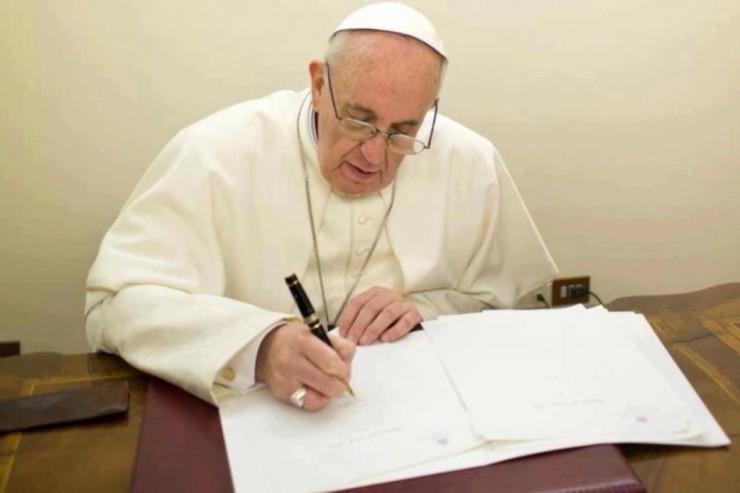
Pope writing a letter
Pope Francis has condemned the tragic and senseless shooting in Florida.
In a telegram sent to the Archbishop Thomas Wenski of Miami, by Vatican Secretary of State, Cardinal Pietro Parolin, on the Pope’s behalf, Francis expressed his deep sadness for the tragic event.
Yesterday, Feb. 14, 2018, Nikolas Cruz, 19, went on a shooting rampage, killing 17 and wounding more than 15, including students and teachers, at Marjory Stoneman Douglas High School in Parkland, Florida, north of Miami.
In the telegram, the Pope assured all those affected by the “devastating attack” of his spiritual closeness, praying that Almighty God grant eternal rest to the dead and healing and consolation to the wounded and those who grieve.
Before Pope Francis invoked upon all involved divine blessings of peace and strength, he expressed his hope “that such senseless acts of violence may cease.”
Here is the Vatican-provided text of the Pope’s telegram:
***