reflections, updates and homilies from Deacon Mike Talbot inspired by the following words from my ordination: Receive the Gospel of Christ whose herald you have become. Believe what you read, teach what you believe and practice what you teach...
Showing posts with label Archbishop Aquila. Show all posts
Showing posts with label Archbishop Aquila. Show all posts
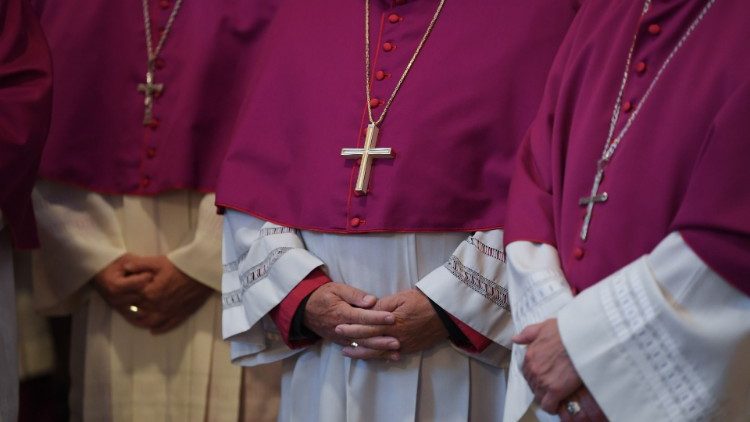
Pope appoints James Golka as new Archbishop of Denver, Colorado
Pope Leo XIV accepts the resignation of Bishop Samuel Joseph Aquila and appoints James R. Golka as the new Archbishop of Denver, Colorado in the United States.
Vatican News
The Holy See Press Office has announced that Pope Leo XIV has accepted the resignation of the U.S. Archbishop of Denver, Colorado, Samuel Joseph Aquila.
As his successor, Pope Leo appointed Bishop James R. Golka of Colorado Springs, Colorado, U.S.
Brief biography
Born in Grand Island, Nebraska in the United States on September 22, 1966, Golka earned a degree in Philosophy from the Creighton University. After completing his time at Saint Paul Seminary in Minnesota with a Master of Divinity, he was ordained to the priesthood in 1994.
He has held the following offices: Parish Vicar of Saint James in Kearney (1994-2000) and Holy Rosary in Alliance (2000-2001), Parish Priest of Our Lady of Guadalupe in Scottsbluff (2001-2006) and Saint Patrick in North Platte (2006-2016); Vicar General (2018-2021) and Rector of the Cathedral of the Nativity of the Blessed Virgin Mary (2016-2021).
He was appointed Bishop of Colorado Springs on April 30, 2021, and received episcopal consecration on June 29, 2021.
Denver Archbishop calls for end to violence that ‘only fuels hatred’
Expressing his deep sadness at news of an antisemitic attack in Boulder, Colorado, the Archbishop of Denver, Samuel Aquila, calls for prayers for victims, saying, “This type of violence must come to an end, as it only fuels hatred.”
By Christopher Wells
Archbishop Samuel Aquila of Denver says he was “deeply saddened” by news of the attack on a demonstration calling for Hamas to release Israeli hostages, “especially as it seems our Jewish brothers and sisters were targeted."
The attack took place at a “Run for Their Lives” rally aimed at remembering hostages still being held by Hamas in Gaza. On Sunday, a 45-year-old Egyptian man yelling “Free Palestine” threw makeshift firebombs into a crowd of people who had gathered in downtown Boulder, Colorado.
Twelve people were injured in the attack, including six who had to be hospitalized; four of those were subsequently released.
The suspect had planned the attack for more than a year, specifically targeting what he described as a “Zionist group.”
“When interviewed about the attack, he said he wanted them all to die, he had no regrets, and he would go back and do it again,” Acting U.S. Attorney J. Bishop Grewell for the District of Colorado said during a news conference Monday.
Authorities filed charges against the suspect, including attempted murder, assault, and a federal hate crime. More charges are expected.
'This type of violence must come to an end'
In his statement on Monday, Archbishop Aquila said, “This type of violence must come to an end, as it only fuels hatred.”
He invited prayers “for everyone affected by this horrific attack,” saying, “We ask the Lord to bring comfort, healing, and peace in the face of such hatred. May we listen to the voice of God who calls us to love one another!”
Archbishop Aquila’s statement follows the teaching of the Second Vatican Council, which stated, “In her rejection of every persecution against any man, the Church, mindful of the patrimony she shares with the Jews, and moved not by political reasons but by the Gospel’s spiritual love, decries hatred, persecutions, displays of anti-Semitism, directed against Jews at any time and by anyone.”
Nostra aetate, the Council’s document on the Church and non-Christian religions, adds, “The Church reproves, as foreign to the mind of Christ, any discrimination against men or harassment of them because of their race, colour, condition of life, or religion.”
On April 14, America magazine, as part of its ongoing series, The Conversation with America Media, published an article by Archbishop Samuel Aquila: “For the church to live in eucharistic coherence, we must be willing to challenge Catholics persisting in grave sin.”
Archbishop Aquila argued that eucharistic coherence demands that those who partake of the Eucharist, including Catholic politicians, are to be in communion with the Church. That is, they must adhere to the Church’s fundamental doctrinal and moral teaching. Not to do so would contravene St. Paul’s exhortation: “Whoever, therefore, eats the bread or drinks the cup of the Lord in an unworthy manner will be guilty of profaning the body and blood of the Lord. Let a man examine himself, and so eat of the bread and drink of the cup. For anyone who eats and drinks without discerning the body eats and drinks judgment upon himself.” (1 Cor 11:27-30)
Within a few hours after Archbishop Aquila’s article was published, Cardinal Blase Cupich wrote a letter to him criticizing his article. The Cardinal’s critique was in no way relevant to what Archbishop Aquila wrote, though it did allow him to fabricate a criticism whereby he could express his displeasure. Nonetheless, the letter did serve a positive end, for it enabled the Archbishop to write a “clarification” to ward off any ambiguity concerning the point he was making. In so doing, the Archbishop was able to develop his point even more strongly.
Now, the interchange between Archbishop Aquila and Cardinal Cupich is part of a larger discussion – that of offering Holy Communion to Catholic politicians even though it is well known that they approve and promote behavior contrary to the Church’s teaching, such as abortion, contraception, euthanasia, same-sex “marriage,” and various forms of gender ideology.
Some bishops argue that such Catholic politicians should not be refused Communion, for to do so would politicize the Eucharist. The refusal on the part of bishops or priests would indeed cause a political and media fuss, and prudence may suggest, in certain circumstances, that Communion should not be refused. An argument could easily be made, however, that refusal should be made so as to avoid scandal and protect the integrity of the sacrament.
To refuse to give Holy Communion to dissident Catholic politicians, however, is not to politicize the Eucharist. The politicizing of the Eucharist occurs in the act of the Catholic politician presenting himself or herself to receive Communion even though he or she is well aware that to do so is contrary to what the Church teaches. Those who are objectively in the state of mortal sin, or who dissent from or promote contrary positions to the Church’s fundamental dogmatic or moral teaching are forbidden to receive the body and blood of Jesus, for they have made themselves unworthy to do so.
Thus, such Catholic politicians, in presenting themselves, are using – and so abusing – the Eucharist for seemingly political purposes – to present themselves as “devout” Catholics. Therein lies a threefold irony.
First, those who are unquestionably devout Catholics do not need to identify themselves as such – it is evident to all that they are. Everyone knows that they believe and uphold, and even promote, all that the Church teaches. When they sin against God’s commandments as taught by the Church, they go to Confession, resolve to amend their lives, and so obtain sacramental absolution. Such Catholics are devout without needing to trumpet it.
*
Second, when a dissident politician declares that he or she is a devout Catholic, one immediately perceives that something is awry. Catholic politicians emphasize their devotedness – and their supporters echo the declaration – because there is something about their behavior that is suspect.
Appearances notwithstanding, it is claimed, there’s no problem here. While they may affirm and promote abortion, same-sex relationships, etc., they are, NONETHELESS, “devout” Catholics. How do they manifest their devotedness? They go to Communion! Ironically, such Catholic politicians do the very thing that no truly devout Catholic would ever do. The very “devout” action they perform, that of receiving Holy Communion, is an enacted declaration that they lack authentic Catholic devotion.
The third irony is that no one is fooled by this charade, except maybe the self-deluded politician. Faithful Catholics know that there is an irreconcilable disconnect between what is being held by such Catholic politicians and their receiving Communion. And they see that it’s the dissenting Catholic politician who is politicizing the Eucharist.
The motives behind such moves may vary. Politics itself is, to some degree, an essential motivation. To be religious in America is still a good thing – it wins votes. Votes are also won by holding and promoting non-Catholic policies. Of course, these stances are contradictory, but then politicians are not known for consistency.
There may, nonetheless, be a deeper motivation. Although one may uphold and promote what is contrary to the Catholic faith, deep down within one’s heart and mind there could be the inerasable belief that Jesus is the one Savior and that the Catholic Church is the one true Church. To be “Catholic,” then, is essential to one’s salvation, for to receive Jesus in the Eucharist is to be truly in communion with he who saves.
Thus, one claims to be a devout Catholic and receives Communion in the hope that, somehow, someday, it will all work out. This comes dangerously close to a sentimental “Catholic” superstition – which is the most charitable interpretation of why dissident Catholic politicians insist on receiving Holy Communion.
What should most concern the Church is that such Catholic politicians do not simply hold many things that are in opposition to the Catholic faith, but they also actively attack, through the laws they propose and enact, the Catholic Church, the very church to which they claim devotion.
In the end, what cannot be denied in all this deception, is the work of the devil. He, above all, wishes to politicize the Eucharist – to reduce it to political marketing. Nothing could be more deceptive than “devout” Catholic politicians wreaking havoc on the Catholic Church and Catholic bishops approving such devilish behavior.
The Catholic faithful must pray, therefore, not only for the conversion of so-called “devout Catholic” politicians, but also for the Lord’s protection of his Holy Church.
A troubling trend is appearing as our country grapples with social unrest and the impact of the coronavirus, but it’s not a new trend. Catholics and other people of faith are singled out for derision and sometimes physical violence. For the sake of our Church and our society, we must respond by defending the right to religious freedom, both when we vote and through our own personal witness.
The attacks on Catholics have shifted from the 19th century discrimination and claims that we can’t be loyal citizens, to the recent assertions that Catholics are judgmental and hateful towards women and sexual minorities.
Just as the arguments of the Know Nothing Party in the 1850s and the Ku Klux Klan in the 1920s demonstrated a failure to understand what Catholics believe, so too do the modern attacks fail to understand and appreciate what we believe about the human person.
However, the goal of these attacks is the same: to shame and sideline Catholics within society and to increase the influence of those who do not accept God’s design for human nature.
In recent years, the lashing out against the Church in the U.S. has increased in its intensity, turning from criticizing her in the media and online to labeling Catholics as discriminatory in various ministries like adoption services or health care. Within the last several months this has even turned into physical violence against our symbols, church buildings and people, as frequently occurs in places like France, parts of Africa and elsewhere in the world.
The American Founders recognized that our self-government relies on a virtuous people. The increase in intolerance and violence we see today underscores this. John Adams addressed the need for virtue directly in a 1798 letter to Massachusetts militia officers, writing, “Our Constitution was made only for a moral and religious people. It is wholly inadequate to the government of any other.” As our country moved closer toward Civil War, Abraham Lincoln emphasized that a self-governing society thrives or dissolves based on its people: “If destruction be our lot, we must ourselves be its author and finisher. As a nation of freemen, we must live through all time, or die by suicide” (Address Before the Young Men’s Lyceum of Springfield, IL, 1838).
We are quickly approaching the national election on November 3, when our country will be asked to determine who is best suited to represent us in our legislature and as president. Among the premier concerns for Catholics when they vote are: Who will protect human life at every stage? Who will protect natural marriage and the family? And finally, who will defend religious freedom, protect consciences and the right of people to live out their faith in every sphere of society?
A society that has no common belief in God, and therefore in each person’s identity as his beloved son or daughter, will become less human and less tolerant. When there is no God, something or someone becomes god to fill the void, leading to tragedy, and eventual societal collapse. Now is the time for us to stand up for the place of full-throated Catholic belief in public life and the valuable contributions of people of faith to society.
Essential for every Catholic to fulfill his or her duty as a citizen is knowing where candidates stand on the issues of life, family and religious freedom. It is not possible to be a Catholic in good standing and support abortion or assisted suicide, to promote unnatural sexuality, or to seek to push people of faith out of the public square. Those who do so – Catholic or not – are helping hollow out our culture and contributing to its demise. The further away we get from a virtuous and moral life the more likely will we look like Greece or Rome when they fell, or like Venezuela today. Every Catholic needs to inform themselves on where each candidate stands on these issues by reading news outlets that cover these topics, such as Catholic News Agency or the National Catholic Register.
In the early 1900s it worked for Catholics to develop our own school system, establish hospitals and run our businesses according to our faith. We served and continue to serve the poor and homeless with the charity of Christ, especially seen in the work of Catholic Charities. This was how we protected and grew our faith over the last 100 years, but the “cancel culture” that seeks to silence the sincerely held beliefs of individuals will also not tolerate the presence of these faith-driven entities if we allow it to gain enough momentum. We cannot adopt the mentality of, “it’s fine for others to act that way, but we won’t.” The morals of society will impact us, and we cannot turn a blind eye to evil.
If we want our country to flourish, then out of charity for our fellow citizens and future generations, Catholics need to strongly advocate for the necessity of religious freedom and vote accordingly.
May God bless each of you and may God bless America!
This past week I was on my annual silent retreat and the accusations against Archbishop McCarrick were a part of my prayer. Faithful have written to me and have asked questions about the situation. Some have felt that the Lord has abandoned the Church. Other bishops have spoken out on this tragedy, and today I offer to you, the faithful of the archdiocese and my brother priests and deacons, the following reflections.
As noted by Cardinal DiNardo, president of the U.S. bishops conference, the revelations about Archbishop McCarrick have caused both bishops and the laity “anger, sadness, and shame.” Personally, I am deeply sorry that both laity and clergy have had to experience this type of betrayal. In response, I am asking every priest in the archdiocese to offer a Mass each month in reparation for the sins committed by cardinals, bishops, priests and deacons, and for all sins committed by clergy and lay people against the commandments of our Lord, as well as to pray for healing for the victims of sin. This Mass is to be announced publicly so the lay faithful can attend and offer prayers in reparation for these grave sins that have wounded so many and for their own sins.
The staff of the Archdiocese of Denver and I strive to make every effort to ensure that such things do not occur here. Our preventative measures include: background checks, safe environment classes, mandatory reporter training, creating a conduct response team that is primarily made up of lay people, an annual independent audit of our abuse reporting structures, having a laywoman (Christi Sullivan, 303-715-3241 or Christi.Sullivan@ArchDen.org) serve as the coordinator of our Safe Environment Office, which deals with all cases of any type of abuse against minors by clergy or laity, and providing psychological screening for candidates for the priesthood.
We also have a Victim’s Assistance Coordinator, Jim Langley, Psy.D., who can be contacted at 720-239-2832 or Victim.Assistance@ArchDen.org. If anyone in the archdiocese has an abuse situation concerning any member of the clergy or a lay employee of the archdiocese with a minor or the elderly, they may contact one of them. Both Bishop Rodriguez and I take these matters with the utmost seriousness.
During my retreat, my director encouraged me to pray with the calls of Isaiah, Jeremiah and Samuel. In praying with the call of Samuel, I was struck by the Lord’s words to Samuel concerning Eli. The Lord told Samuel to tell Eli, “…I will fulfill against Eli all that I have spoken concerning his house from beginning to end. And I tell him that I am about to punish his house forever, for the iniquity which he knew, because his sons were blaspheming, and he did not restrain them. (1 Samuel 3: 12-13, emphasis added). Too many seminarians, priests and bishops knew of Archbishop McCarrick’s behavior and did not restrain him.
Due to this, I call on the U.S. bishops’ conference to ask for and allow an independent investigation that includes members of the lay faithful and those clergy who had nothing to do with the matter. Since the oversight of bishops and cardinals falls under the jurisdiction of Rome, I humbly ask Pope Francis to conduct an independent investigation like he did in Chile.
Like Jesus weeping over Jerusalem, so have I wept for the Church and for the innocent victims. I remember when I visited Auschwitz for the first time in 1988. As I walked with horror in my heart over the palpable evil present, pondering how could human beings do this to other human beings, I heard in prayer, only Jesus Christ and he alone can redeem this evil. The same is true with the sexual abuse crisis of today, as well as with the emptying of our pews, and the abandonment of God by the world. So, what must we do?
We must recognize that complacency about evil and sin is present both in the Church and the world and has led us to where we are today. This culture of complacency among clergy and laity must come to an end!
We have also failed to recognize that the spiritual battle is real. Some say the Lord has forsaken the Church, but this is not true. Rather, there are some within the Church who have forsaken Jesus and the Gospel. Pope Francis speaks often in his homilies of the devil and his workings. The devil is real and pulls us away from the ways of Jesus and the love of the Father. The devil uses confusion, chaos, discouragement, and negative thinking to draw us away from Jesus. When one looks at salvation history one sees, beginning with Adam and Eve, moving through the Old and New Testaments, and down through the centuries to now, that it is human beings who abandon the ways of God. When the ways of God are abandoned, God lets human beings go their own way and there are always dire consequences.
Jesus tells his disciples in John 15 that “apart from me you can do nothing” and he further tells us that if we separate ourselves from the vine, Jesus, we will wither. Perhaps the reason for our empty pews, the sharp decline of the faith in Europe and the west, the decimation of many religious orders, and the sexual abuse crisis is that we are not attached to Jesus, the true vine. At the heart of this crisis today is a spiritual crisis that depends more on the solutions of men than on the Gospel and Jesus. The cost of discipleship is real and it includes dying to ourselves, a complete surrender to Jesus, who loves us and desires only our good and joy (Lk 9: 23-26; Lk 14: 25-35; Mt 16: 24; Jn 15:11).
Thus, our response to this complacency must be a return to the ways of God, which lays out the path of grace that preserves us from the real dangers of sin and the attacks of the evil one. The Father has given us his son Jesus, the Beatitudes, the Gospels, the truth, and his commandments out of love for us to keep us on the narrow way of love. He is merciful in all that he has given to us. Charity and truth must always go together. A disciple should never lead someone into sin or condone sin. Jesus never condoned sin! But rather taught that for the unrepentant, the consequence for doing so is hell (Mk 9:42, Lk 17: 1-4). Just as a parent provides boundaries for their children for their own good and protection, so has the Lord provided for us.
All of us within the Church, including the Holy Father, cardinals, bishops, priests, deacons, consecrated and laypersons need to examine our consciences and ask ourselves: Do I truly know, love and serve the Father, Jesus, and the Holy Spirit? And do I follow the ways of Jesus or the ways of the world? In the formation of my conscience do I listen to the voice of God, the voice of the world, or my own voice, and do I test the voice I hear to make sure that it is in accord with the Gospel? Have I personally put my faith in Jesus Christ, and in this time of tribulation do I keep my eyes fixed on “Jesus the leader and perfecter of faith” (Heb 12: 2)? Do I know where I have come from; that God loves me and knew me before I was born (Ps 139)? Do I know where I am going, that I am created for eternal life and to know the Father, as Jesus knows him (Jn 8:14)? Do I truly believe that intimacy with Jesus can heal the wounds of my sins, weakness, or brokenness? And finally, as Jesus so frequently reminds his disciples in John 14 and 15, those who love him keep the commandments, just as he kept the Father’s commandments. Do I do that?
Pope Francis and every pope since Blessed Paul VI, has called us to a deeper encounter with Jesus Christ. This encounter leads to faith in Jesus Christ and a deep personal relationship with him, who in turn leads us to the Father and the Holy Spirit. His desire is for each disciple to be one with the Father and him. Once we put our faith in Jesus, love him and keep the commandments, then the Father and the Son will make their home in our hearts (Jn 14:23). Each one of us must pray for a deeper faith in Jesus each day, the faith that will move mountains (Mt 17:20) and make us into missionary disciples. With God “all things are possible,” (Mk 10:27) and that includes the forgiveness of our sins, the healing of our wounds, becoming a saint, and living a life of holiness and virtue, including chastity. And that brings me to another important aspect of this crisis.
Cardinal DiNardo noted in his statement that “the Church is suffering from a crisis of sexual morality” and it is not just the Church, it is the world. Sadly, too many, both clergy and lay, have listened more to the world than to Christ and the Church when it comes to human sexuality. The consequences of the worldly approach to sexuality are clear in the distortion of this precious gift and the confusion about sexuality that grows daily.
The teaching of the Church on human sexuality has been clear over the centuries, and St. John Paul II helped tremendously with his positive message about the Theology of the Body. Furthermore, those who have received the teaching of the Church and have been accompanied in a loving and merciful way, both young and old, have testified to the truth contained in this teaching, as well as the healing, freedom and joy it brings. This is observed in many of the young people whom I have encountered through the Fellowship of Catholic University Students program, those who have walked in the Neocatechumenal Way, those who have shared in Living Waters or Courage retreats, or participated in Sexaholics Anonymous. Their witness, joy and freedom are real, and it embraces the truth of who they are in the merciful eyes of the God. The God who heals and restores order.
Amidst the darkness of the sexual revolution and all that it has brought about, the Church must decisively return to the truth, dignity and beauty of human sexuality.
We must teach that every sexual act that takes place outside of a marriage between a man and woman, is not in keeping with God’s plan for our happiness. When one separates the procreative aspect from sex, one can justify just about any sexual act. As Blessed Paul VI noted in Humanae Vitae, this separation has had and will continue to have negative consequences on the Church and society.
We must also teach that, according to the Sacred Scripture and tradition, “homosexual acts are intrinsically disordered.” They are contrary to the natural law and they “do not proceed from a genuine affective and sexual complementarity.” (Catechism of the Catholic Church, 2357).
We must also be sure to carefully form seminarians, as we have been doing in the archdiocese for quite some time. However, all seminaries need to devote special attention to the formation of our future priests and their education in chastity, so that they can develop an authentic maturity, and embrace celibacy for the Kingdom of God, respecting and fostering the nuptial meaning of their bodies (Pastores Dabo Vobis, 44). Chastity is a great good that needs to be lived!
The sexual revolution occurring in our culture, which essentially says, “Anything goes if adults consent to it,” is not the way of God and only leads to where we are today. We must be willing to accompany people into the truth of Jesus Christ who will set them free to live the virtues, which bring true freedom, peace and joy.
In closing, I ask all of us to remember to pray and stay close to the heart of Jesus, to ask for the humility of Jesus and the gift of loving others as Jesus loves (Jn 13:34). Every disciple must pray for the gift of faith and a deeper trust and confidence in Jesus, most especially in his healing power. We must pray for all victims of sexual abuse in our culture today, for their healing and their encounter with Jesus Christ, who can bring healing to them.
We must pray for the clergy of the Church, the Pope, cardinals, bishops, priests and deacons, that the Holy Spirit will stir into flame the gifts he has bestowed on them, help them to be faithful to Christ and the Gospel, and to be true servants of the faithful with the heart of Christ. We must pray for the Church, our Mother, that is holy, though having sinners in her midst, and suffers for the offenses of all her members.
Let us pray for the virtue of hope, so that we come to the awareness that we can do all things in Christ, who gives us the strength to be saints (Phil 4:13). Let us ask for the gift of piety, so that we truly behave as God’s children and reverence our own and each other’s bodies as temples of the Spirit. Let us beg for the grace to have pure hearts (Mt 5: 7).
Finally, as those who belong to Jesus, we must pray for our enemies and those who persecute us. We can never wish evil or seek vengeance on another (PV 24:29; Mt 5: 44-48; Col 3:13; Rom 12:19-21). Every human being is a sinner whom Jesus loves and is in need of the mercy of Jesus. Jesus forgave every human being from the Cross when he said, “Father forgive them for they know not what they do.” No matter how egregious the sin, the Lord is willing to forgive us if we “repent and believe in the Gospel” (Mk 1:15). This forgiveness, like his love, must be received. He reminds us to be merciful as his Father is merciful and that the Father loves both the just and unjust (Mt 5:44-48). In this time of darkness, may we put our faith, trust and love in Jesus who is our Savior and Redeemer, the one who will free us, and may we live in his truth and light!
I have voted in every presidential election since 1972 and I have never experienced an election like this year’s. Both candidates are disliked, lack credibility, and have made comments that make the hair on the back of your neck stand up. The American public is fed up with politics as usual and with the establishment in both parties. So, what should Catholics do when we vote in November?
That question is one that I have been asked by the faithful more this year than in any previous election. Recently in a dinner discussion with a group of Catholics, the conversation turned to politics and became vigorous, as some at the table supported Clinton and some Trump. All eyes turned to me and one of them asked, “Archbishop, what do you think?”
First, I shared my aversion for both candidates. Then I said that they need to reflect on the platforms of both parties, with an emphasis on the human life issues. Everyone at the table knew well the teaching of the Church on life and the dignity of life. They knew that Catholics in good conscience cannot support candidates who will advance abortion. All pretty much agreed that, when it comes to life issues, Catholic politicians on both sides of the aisle have put party ideology before their faith and living their faith in the public square.
This is the most important guidance I can give: allow your ongoing personal encounter with Jesus Christ and the Church to guide your political decisions. I say this because we believe that the truth about ourselves and the world we live in is revealed in and through him. Our society suffers and has suffered for quite some time because too few people live an integrated life – one that does not divide “the personal” from “the public.”
This year there are some critical changes to the two major parties’ platforms that some at the dinner were not aware of. Most important is that this year the Democratic party platform calls for the overturning of the Hyde Amendment, a provision that both parties have voted to include in the federal budget and on other spending bills for 40 years. The Hyde Amendment prohibits federal taxpayer money from being used for abortion. The platform is aggressively pro-abortion, not only in funding matters, but in the appointment of only those judges who will support abortion and the repealing of the Helms Amendment, which prevents the U.S. from supporting abortion availability overseas. Conversely, the Republican party platform is supportive of the Hyde Amendment and just this year strengthened its support for life by calling for the defunding of Planned Parenthood, banning dismemberment abortion and opposing assisted suicide.
Our conversation then turned to the understanding of the freedom of religion, the freedom of conscience, and the ability for faith-based organizations like the Church to provide charity through shelters, hospitals, homes for the elderly, etc., without fear of government interference and the existence of a respect for religious values.
In that vein, the subject was raised of the Health and Human Services mandate. This regulation requires the provision of contraceptives, sterilizations and some abortifacients through employer’s health plans. Most surprising to me was that all at the table were practicing Catholics who are involved in their faith, and a couple of them had neither heard of the difficulty the Obama Administration has created for the Little Sisters of the Poor, nor the litigation that has occurred trying to force them to violate their consciences.
Catholic voters must make themselves aware of where the parties stand on these essential issues. The right to life is the most important and fundamental right, since life is necessary for any of the other rights to matter. There are some issues that can legitimately be debated by Christians, such as which policies are the most effective in caring for the poor, but the direct killing of innocent human life must be opposed at all times by every follower of Jesus Christ. There are no legitimate exceptions to this teaching.
The health of our nation depends on a deep respect for human life from the moment of conception until natural death, and the future of our society depends on how we protect that right. If we don’t, eventually we will go the way of Rome and Greece and other great civilizations that have risen and fallen.
Some, both in politics and in the Church, have stated that it is the Church that needs to change her teaching to include abortion, same-sex unions, and even euthanasia. Yet, in faithfulness to Jesus Christ, to the Gospel and to Sacred Tradition, the Church cannot change her teaching on these issues without denying Christ. She would cut herself from the vine and only wither away, as promised by Christ. The further we move away from Jesus Christ and his teachings, the more will our churches empty.
We are where we are today because too many Catholics and other people of faith have embraced the ways of the world and not the ways of Christ. They have not served as leaven that transforms society, but rather have condoned evil and the throw-away culture that Pope Francis frequently reminds us to reject.
When we fail to do this, the government will step in to fill the void. Indeed, the government will become “god” and impose its beliefs on the citizens. One only needs to look to the Health and Human Service contraceptive mandate, or the attempt by President Obama to force a transgender agenda onto public schools. We may even soon see the federal funding of abortion and the approval of physician-assisted suicide in Colorado. We are witnessing the dictatorship of relativism and the erosion of true freedom. And as Pope Francis often preaches, the devil gets in the mix quickly, especially when people no longer believe in God.
So my advice to Catholics in voting in this presidential election is to first look at who forms you and your conscience. Is it your personal encounter with Jesus Christ and the Church, the voice of God which cannot contradict the truth or revelation, or is it the ideology of some political party? Secondly, look at how you have been a leaven in society. How have you sought the common good and the values of the Gospel, especially by serving the poor, the needy, the unborn and the dying. If you truly live your Catholic faith, you will not find complete alignment with any political party, and that is okay. Thirdly, look at how each party platform supports human life from conception through natural death, the freedom of religion and the freedom of conscience, the family, and the poor. Finally, do vote, as every Catholic has an obligation to participate in the political process.
For many, the presidential election will involve a choice between the lesser of two evils. On the Colorado ballot, we will also face the evil of physician-assisted suicide, known as Proposition 106. In conforming our hearts and minds with the Gospel and its clear teaching on life, all Catholics are called to vote “no” on this issue. A “yes” vote only furthers the throw-away society, and the culture of death. You will be hearing much more on this in the days and weeks ahead. Let us keep our country and state in our daily prayers, praying for God’s protection and blessings in these challenging, difficult times in which we live. And let us in charity pray for the conversion of those who support a throw-away culture of death!
This week I want to share with you two important themes that have come to me in prayer: the need for prayer and reparation for the atrocity of abortion, and the way that Christ sustains and builds our faith through the Eucharist.
Every person of good will has been shocked by the revelations that Planned Parenthood has been selling body parts from aborted children to biotech companies. The findings are horrific, and the fact that people can speak so cavalierly about the selling of body parts of aborted children while eating lunch and sipping wine demonstrates how deadened the consciences of many people have become.
One day, everyone who has promoted or supported abortion in any way will have to answer for his or her actions before the judgment throne of God. This is where prayer comes in, as we must pray that the conscience of every person will be awakened to the evil of abortion. We must bring before the Lord those whose deadened and erroneous consciences support abortion and Planned Parenthood. We must pray that they will encounter Christ’s mercy and love, and that their consciences will be enlightened with the truth.
There will be three opportunities for prayer in the Archdiocese of Denver. The first is a weeklong prayer campaign organized by Priests for Life that runs Aug. 22-29. Details can be found at PrayerCampaign.org. On Aug. 22, a peaceful protest sponsored by 40 Days for Life and the Pro-Life Action League will be held from 9 a.m.-11 a.m. at the main Planned Parenthood of the Rockies clinic, located at 7155 E. 38th Ave. in Denver. And finally, my fellow bishops and I have called for a statewide day of fasting, prayer, and reparation on Friday, Aug. 28. I encourage you to mark all the dates on your calendar and plan now how you will pray for the conversion of those who participate in abortion.
This brings me to the second point, and that is the gift of the Eucharist, which has been a part of my prayer recently. It has been on my mind and heart because it is through the Eucharist that Jesus nourishes us and helps us engage in prayer during times of trial, when evil seems to be winning.
Every three years the Church reads from the Gospel of Mark, the shortest of the four Gospels. But for five weeks of that cycle, the Church inserts the sixth chapter of John for the Gospel reading. We are presently in the final week of hearing from John’s Eucharistic chapter before returning to Mark.
John 6 provides the deepest teaching we have from our Lord on the Eucharist, and I would like to take this opportunity to explain how God sustains and strengthens us with Scripture and the Eucharist.
I encourage you to begin by taking 20 minutes of time this week to sit down with this chapter, either by yourself or as a family. Begin with a prayer to the Holy Spirit asking him to help you be attentive and listen to the Lord. Read the entire chapter out loud. Then take 5-7 minutes in quiet prayer to see where the Lord speaks to your heart. If you do this alone, simply enter into prayer, speaking heart-to-heart with Jesus about where the passage speaks to you personally. If you do it as a family, let each person speak about what word or passage spoke to their heart. Simply listen to one another. To close, lift up your heart in gratitude to the Lord for the Eucharist and this teaching!
John 6 begins with the invitation to faith from the Lord and concludes with a statement of faith, and it is our faith that Christ wants to strengthen with his Word. Allow me to share some of the reflections that came to me in prayer and strengthened me.
The chapter begins with the miracle of the multiplication of the bread and fish, after which the people want to make Jesus king, but he disappears. Then, he walks on water, which is followed by his teaching on how he is the true bread from heaven. The miracle of the loaves and fish and Jesus walking on the water demonstrate that he is true God and true man. His power and authority over the material world reveal his divinity.
The people only want earthly bread, but Jesus begins to reveal to them that it is the gift of his body and blood in the Eucharist. His teaching causes division and there are those who leave because of it. But Jesus never backs off from the reality and truth of his flesh being true food and his blood true drink. Instead, he issues an invitation to faith that he gives to us today, “This is the work of God, that you believe in him whom he has sent.” Jesus invites them and us to put our faith, confidence and trust in him. He identifies himself as “the true bread” that the Father gives from heaven so that the world may have eternal life.
When the people murmur and dispute among themselves about his teaching, Jesus makes clear that the Eucharist is not a simple sign or symbol, but truly his body and blood. He invites them to a deeper faith, “Truly, truly I say to you, he who believes has eternal life … the bread which I shall give for the life of the world is my flesh.” Jesus teaches us that at every Mass his one sacrifice on the Cross is made present and we participate in it by offering our lives with Jesus to the Father.
He states further, “For my flesh is food indeed, and my blood is drink indeed. He who eats my flesh and drinks my blood abides in me, and I in him.” Jesus speaks of the intimate communion we have with him when we receive his body and blood at Mass. The Eucharist nourishes us and sustains us as authentic disciples of Jesus. That is why we go to Mass every Sunday, we keep holy the Sabbath, so that with Jesus we may worship the Father and abide with him. The Eucharist strengthens us to give witness to Christ in the world, to intercede for others—including our enemies—and to invite others to encounter him.
At the conclusion of the sixth chapter we learn that many of his disciples found this a “hard teaching” and “withdrew” from him. Jesus turns to the twelve and asks an all-important question that is addressed to us today, “Will you also go away?” Peter answers for the 12 with a statement of faith, “Lord, to whom shall we go? You have the words of eternal life; and we have believed, and have come to know that you are the Holy One of God.”
May our love for the Eucharist grow each time we attend Mass, and may we always give witness to the dignity of every human life from conception until natural death!


 I have voted in every presidential election since 1972 and I have never experienced an election like this year’s. Both candidates are disliked, lack credibility, and have made comments that make the hair on the back of your neck stand up. The American public is fed up with politics as usual and with the establishment in both parties. So, what should Catholics do when we vote in November?