Happy birthday, Vatican Radio: 95 years of serving the Pope
By Massimiliano Menichetti
It is deeply moving to reflect that 95 years on, the voice of Vatican Radio continues to travel the world, carrying everywhere the proclamation of the Gospel, hope, and the words of the Successor of Peter. It crosses every border and distance, leaving no one alone.
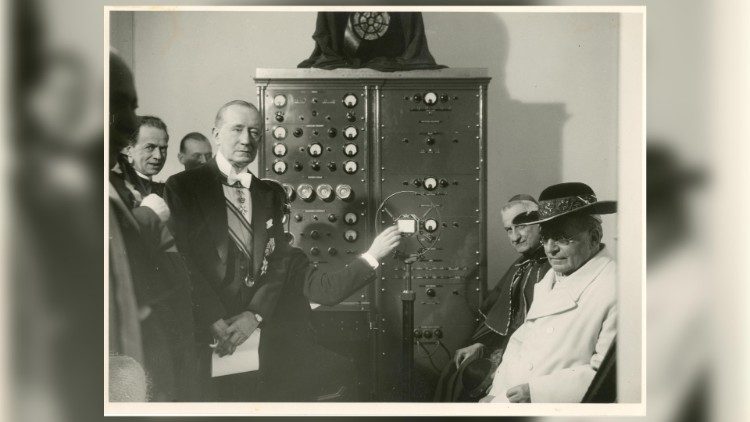
Today, our thoughts inevitably return to 12 February 1931, when the first voice to speak through the microphones of the Statio Radiophonica Vaticana was that of the scientist Guglielmo Marconi. Pope Pius XI had entrusted Marconi with the task of designing and building this remarkable instrument of communication, and entrusted the Jesuits with running it.
The father of radio announced that, for the first time, the voice of the Pope could “be perceived simultaneously over the entire surface of the earth,” and the Pope, speaking in Latin, sent the first radio message in Vatican history, addressed “to all peoples and to every creature,” in words of great beauty. A 78-rpm record was then played, containing excerpts from a Beethoven symphony.
That intuition of the Pope testified to a profound trust in the possibilities of technology placed at the service of human communication and the mission of the Church. It was not a mere technical experiment, but a precise pastoral choice: to use the most advanced means of the time to reach the hearts of people.
From that moment on, Vatican Radio has passed through history, through wars and peace agreements, poverty and aid, devastation and reconstruction, exclusion and welcome, social, political, and technological transformations, and has always done so carrying the Christian proclamation, the light of hope, and interpreting events through the lens of Catholic social teaching.
To date, Vatican Radio has served nine Popes. It helped reunite thousands of missing persons during the Second World War. It was a beacon during the dark years of totalitarian regimes. It chronicled the Second Vatican Council, the Jubilees, the challenges of the universal Church, and the many, too many, conflicts, including recent ones in Ukraine, the Middle East, Congo, Myanmar, Yemen, and Syria. It has been, and continues to be, a path of prayer, information, and formation.
Multiculturalism is a distinctive hallmark and a precious key for reading the world. Today, those who work for the pontifical broadcaster come from sixty-nine nations, and through 34 language editorial offices, plus a multimedia one, we reach the geographical and existential peripheries of the world, giving voice to communities often far from major media circuits and accompanying the life of local Churches. In many countries, the Popes' Radio has been for decades, and in some places still is, a discreet but fundamental presence for Christian communities and beyond.
In recent years, the Pope’s Radio has undergone a profound transformation within the broader reform of communications initiated by Pope Francis. The establishment of the Dicastery for Communication and the integration of the various media entities into a more unified and coordinated system have required organizational, professional, and cultural changes. It has not been an easy journey and it is still ongoing, but it is sustained by a clear awareness of our mission in the service of the Holy Father and of the Truth, within a constantly evolving context in which tools and forms of expression are rapidly changing.
Along this path, we are encouraged by the words of Pope Leo, who has repeatedly welcomed our work and recalled the importance of unity, of serving the truth, and of accompanying the life of the People of God through a “disarmed and disarming communication,” capable of contributing to the building of a more fraternal, supportive, welcoming, and peaceful society.
Vatican Radio produces and sustains the digital ecosystem of Vatican News, which in 56 languages, through written, spoken, and sign language, reaches audiences via radio waves, satellite, streaming, podcasts, social media, video, and digital platforms.
The ninety-fifth anniversary of Vatican Radio falls in the era of artificial intelligence, a technology that is profoundly reshaping the world of media and communication as well. AI is undoubtedly a valuable aid, a useful tool, but algorithms cannot and must not replace what is human: thought, creativity, and judgment.
Since 2012, our anniversary has coincided with World Radio Day, established by UNESCO on 13 February, which this year is dedicated to the theme: “AI is a tool, not a voice.” This expression resonates deeply with the Holy Father’s Message for the 2026 World Communications Day, which recalls personal responsibility, discernment, and the irreplaceable human value of communication.
Always attentive to technological frontiers, Vatican Radio certainly explores the possibilities offered by artificial intelligence, but it will never abandon the conviction that radio is an encounter between persons, a word that arises from a face, a conscience, and a responsibility.
In this sense, the Popes' Radio continues to testify that this technology continues to be at the service of the human person, and not the other way around.
Today, as in 1931, the Popes' Radio continues its mission: to spread the message of the Gospel, the voice of the Pope, and the papal Magisterium throughout the world, encountering communities, listening, and serving.
Happy birthday, Vatican Radio.

No comments:
Post a Comment