Saturday, November 30, 2019

Another great story on what hopefully will be the 2nd official miracle for Blessed Seelos

Church investigates case of a newborn who was given hours to live and survived


CARSON COYLE

Share
1k


Thanks to a crucifix belonging to Blessed Xavier Seelos, Carson Joseph survived a brain hemorrhage and went home.

When Carson Joseph was born early in March, 2019, doctors gave the little boy just hours to live. He arrived after a difficult delivery with a blueish skin tone and after examination, doctors concluded he had neurological damage and also suffered a brain hemorrhage.
Alarmingly, the baby also went from 6 to 8 pounds, with swelling blocking his ears, and the medical team advised the parents to call family members to let them know their son would not make it through the night. Having already been through two miscarriages, the parents offered up their prayers to God, as reported in the Daily Mail.
In the middle of the night a stranger, Judge Dennis Waldron, visited the family to say prayers for the little boy, touching him with a crucifix. Incredibly, the next day little Carson was on the mend and breathing independently. A new MRI revealed that there was no sign of neurological damage and just 14 days later the newborn left hospital to go home.
Carson’s parents, Michelle and Brandon, describe the dramatic improvement in their son’s health as a miracle. The Catholic Church is now investigating the case since the crucifix placed on the baby by Waldron — who volunteers in a center named after Blessed Xavier Seelos, a missionary priest who died looking after the sick of New Orleans — was the actual crucifix used by Father Seelos during his ministry work in the 19th century.
As the church undertakes their investigation, baby Carson is thriving and is now a bundle of eight-month-old joy. A little miracle indeed!

Friday, November 29, 2019

The Apostle who first encountered Jesus and brought Simon Peter to him

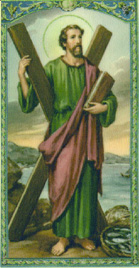
St. Andrew the Apostle


Image of St. Andrew the Apostle


St. Andrew, also known as Andrew the Apostle, was a Christian Apostle and the older brother to St. Peter.
According to the New Testament, Andrew was born in the village of Bethsaida on the Sea of Galilee during the early first century. Much like his younger brother, Simon Peter, Andrew was also a fisherman. Andrew's very name means strong and he was known for having good social skills.
In the Gospel of Matthew, it is said Jesus was walking along the shore of the Sea of Galilee and saw Andrew and Simon Peter fishing. It is then he asked the two to become disciples and "fishers of men."
In the Gospel of Luke, Andrew is not initially named. It describes Jesus using a boat, believed to be solely Simon's, to preach to the multitudes and catch a large amount of fish on a night that originally was dry. Later, in Luke 5:7, it mentions Simon was not the only fisherman on the boat, but it is not until Luke 6:14 that there is talk of Andrew being Simon Peter's brother.
However, the Gospel of John tells a separate story, stating Andrew was a disciple of John the Baptist. When Jesus walked by one day, John the Baptist stated, "Behold, the Lamb of God!" It is then that Andrew and another made the decision to follow Jesus.
Little else is said about Andrew in the Gospels, but it is believed Andrew was one of the closer disciples to Jesus. It was he who told Jesus about the boy with the loaves and fishes, according to John 6:8. When Philip wanted to speak to Jesus about Greeks seeking him, he spoke to Andrew first. Andrew was also present at the last supper.
Per Christian tradition, Andrew went on to preach the Good News around the shores of the Black Sea and throughout what is now Greece and Turkey. Andrew was martyred by crucifixion in Patras. He was bound, rather than nailed, to a cross, as is described in the Acts of Andrew. He was crucified on a cross form known as "crux decussata," which is an X-shaped cross or a "saltire." Today this is commonly referred to as "St. Andrew's Cross." It is believed Andrew requested to be crucified this way, because he deemed himself "unworthy to be crucified on the same type of cross as Jesus."
Andrew's remains were originally preserved at Patras. However, some believe St. Regulus, who was a monk at Patras, received a vision telling him to hide some of Andrew's bones. Shortly after Regulus' dream, many of Andrew's relics were transferred to Constantinople by order of Roman emperor Constantius II around 357. Regulus later received orders in a second dream telling him to take the bones "to the ends of the earth." He was to build a shrine for them wherever he shipwrecked. He landed on the coat of Fife, Scotland.


In September 1964, Pope Paul VI had all of St. Andrew's relics that ended up in Vatican City sent back to Patras. Now, many of Andrew's relics and the cross on which he was martyred are kept in the Church of St. Andrew in Patras.
St. Andrew is venerated in Georgia as the first preacher of Christianity in that territory and in Cyprus for having struck the rocks creating a gush of healing waters upon landing on the shore.
His saltire cross is featured on the flag of Scotland and is represented in much of his iconography. He is commonly portrayed as an old man with long white hair and a beard, often holding the Gospel book or a scroll.
St. Andrew is the patron saint of fishermen and singers. He is also the patron saint to several countries and cities including: Scotland, Romania, Russia, Ukraine and Patras and his feast day is celebrated on November 30.

Some 26 men and women on way to Sainthood

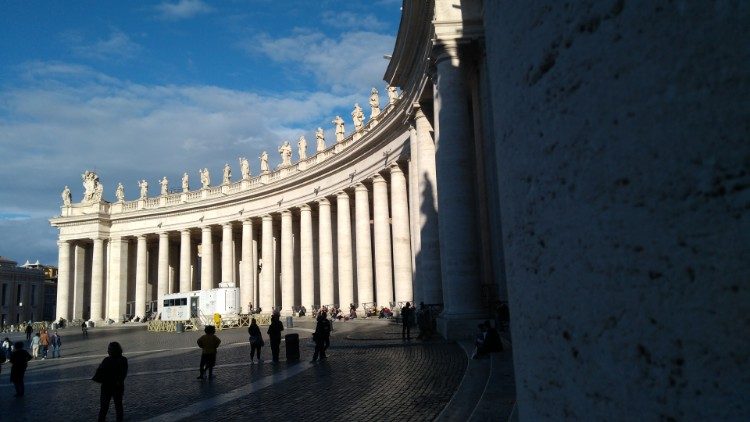
The inside of the cupola of St. Peter's Basilica, Vatican City.  


The inside of the cupola of St. Peter's Basilica, Vatican City. Pope authorizes new decrees on candidates to sainthood


Pope Francis on Thursday took 26 men and women a step closer to sainthood, including an Italian priest who has been cleared for canonization.


By Robin Gomes
Pope Francis authorized Cardinal Angelo Becciu, the Prefect of the Vatican Congregation for the Causes of Saints, to promulgate 11 decrees on 3 miracles, 2 martyrdoms and 6 heroic virtues of men and women from Italy, Spain, Poland Canada and Germany.

Miracles

A decree recognized a miracle through the intercession of Italian priest Father Luigi Maria Palazzolo, the founder of the Sisters of the Poor, Palazzolo Institute.  He was born on December 10, 1872, in Bergamo and died on 15 June 1886.  He has been cleared for canonization whose date will be decided at a later date.
Another miracle was attributed to the intercession of Italian priest Father Olinto Marella. He was born on June 14, 1882, in Pellestrina and died on September 6, 1969, in San Lazzaro di Savena.  He has been cleared for Beatification.
A miracle attributed to the intercession of  Italian Comboni priest Father Giuseppe Ambrosoli.  Born in Ronago on July 25, 1923, he died on March 27, 1987, in Lira (Uganda).

Martyrdom

The decrees recognized the martyrdom of Gaetano Giménez Martín and 15 priests and lay companions of Spain who were killed in hatred of the Faith, during the country’s civil war in 1936.
Another martyrdom that was recognized was that of Polish priest Father John Francis Macha.  Born on January 18, 1914, in Chorzów, he was killed in hatred of the Faith, in Katowice on December 3, 1942.
They all have been cleared for beatification.

Heroic virtues

Six decrees were on the heroic virtues of the following:
  • Canadian Bishop Ovide Charlebois of the Congregation of the Missionary Oblates of Mary Immaculate, Apostolic Vicar of Keewatin. Born on February 17, 1862, in Oka, he died on November 20, 1933, in Le Pas.
  • Auxiliary Bishop Michael Wittmann of Regensburg, Germany.  He was born on January 22, 1760, in Finkenhammer and died on March 8, 1833, in Regensburg.
  • Italian priest Father Olinto Fedi, founder of the Congregation of the Franciscan Sisters of the Immaculate. Born on October 3, 1841, in Signa, he died there January 23, 1923.
  • Italian Conventual Franciscan Friar Giacomo Bulgaro, who was born on January 29, 1879, in Corticelle di Pieve and died on January 27, 1967, in Brescia.
  • Italian Sister Giovanna Maria Battista Solimani (born: Maria Antonia), of the Romite Nuns of Saint John the Baptist and Romite Nuns and of the Missionaries of St. John the Baptist.  Born on May 12, 1688, in Genoa, she died there April 8, 1758.
  • Spanish Sister Anna di Gesù De Lobera (born: Anna) of the Order of Discalced Carmelites.  She was born on November 25, 1545, in Medina del Campo and died on March 4, 1621, in Brussels (Belgium).

Pope Francis visits Caritas in Rome

2019.11.27 Visita di Papa Francesco il 29 novembre alla Cittadella della carità della Caritas di Roma Visit of Pope Francis to the Cittadella della Carità run by Caritas of Rome 


Pope Francis set to visit the Cittadella della Carità in Rome


On the occasion of the 40th anniversary of its institution, Pope Francis is visiting the Cittadella della Carità [Citadel of Charity], a group of charitable organizations under the auspices of Caritas Roma.


By Vatican News
Pope Francis on Friday afternoon will visit the Cittadella della Carità, the “Citadel of Charity”, a collection of charitable programs including the Dental Centre, the “Santa Giacinta” Home, the “Emporium of Solidarity”, and the Cafeteria. He is expected to meet with the director, Fr Benoni Ambarus, along with more than 200 guests and volunteers. Friday’s encounter will be the fifth time Popes have visited the works of Caritas Rome.
In December of 2015, Pope Francis opened the Holy Door of Charity at the Don Luigi Di Liegro Hostel to mark the opening of the Jubilee of Mercy. On Friday, another special occasion, the 40th anniversary of the institution of Caritas Roma, once again brings him to the Diocesan charitable organization. The encounter is set to begin at 4 p.m. Rome time, at the Citadella della Carità.

The reason for the visit

“The Pope’s visit”, explained Fr Ambarus, “is part of the celebration for the 40th anniversary of the establishment of Caritas in the Church of Rome”.
“Let us experience this event, together with our Bishop, with a memory of gratitude to the Lord for having chosen us servants and collaborators”, he continued. The Citadel of Charity “aspires to be a place of witness to the city [of Rome] and to the Church”, providing charitable services as concrete signs through which thousands of guests and volunteers pass each year.

The program

The visit will begin in the Church of Santa Giacinta, the heart of the complex. The Church has been granted the use of the historically significant 19th century buildings by the City of Rome, and undertook the recovery and restoration of the buildings with great care.
Pope Francis will then visit the Dental Centre, where more than 40 volunteer dentists care for more than 350 patients, including numerous minors. Last year alone, more than two thousand medical services were provided.
Afterwards, the visit will continue at the Emporium of Solidarity, the first free supermarket in Italy. It was founded in 2008, and each year welcomes more than 1,500 families. In 2018, more than 490 tons of food products, with an estimated value of 770 thousand euros, were distributed.
From there, the Pope will have a tour of the Santa Giacinta Home, which houses 82 people over the age of 50 who are experiencing social and economic hardship.
Then, in the Cafeteria, the Holy Father will meet with about fifty people living in different facilities, including hostels, family houses, refugee facilities, homes for single mothers, and centres for unaccompanied foreign minors.
Finally, in the main hall, there will be an assembly with guests, volunteers, and workers representing parishes and diocesan centres from around the city.

The fifth papal visit to Caritas centres in Rome

Today’s visit by Pope Francis marks the fifth papal visit to Caritas in Rome. They began with Pope John Paul II, who visited the “Mensa di Colle Oppio” (a soup kitchen operated by Caritas Roma) in 1992. Fifteen years later, in 2007, Pope Benedict XVI also visited the Mensa; and in 2010, he met with guests and workers at the Caritas facilities on Via Marsala on the occasion of the European Year for Combatting Poverty. And, as mentioned previously, Pope Francis continued the tradition of visits to Caritas centres when he opened the Holy Door of Charity on 18 December 2015.

No black Friday for the Pope, he offers Mass today

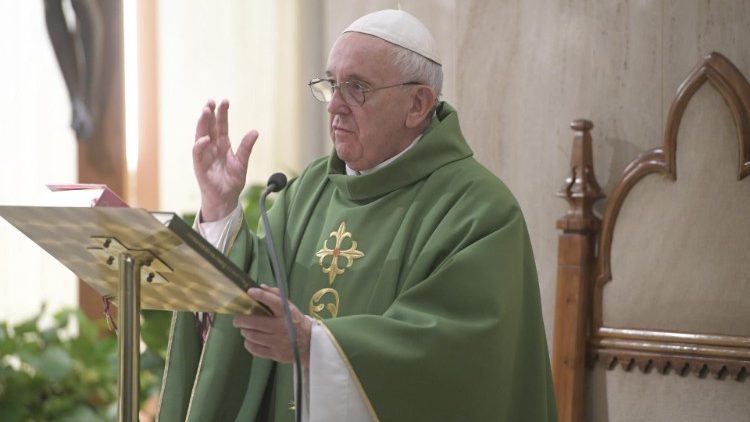
Pope Francis celebrates Mass at the Casa Santa Marta Pope Francis celebrates Mass at the Casa Santa Marta  (Vatican Media)


Pope at Mass: 'look to your moment of death with hope and trust in the Lord'


Pope Francis reflects on our mortal end, speaking of death as a moment of encounter with the Lord, a moment for which we must be prepared.


By Linda Bordoni
Pope Francis celebrated morning Mass at the Casa Santa Marta on Friday recalling that in this last week of the liturgical year the Church invites us to reflect on the end: the end of the world and the end of each of us.
This theme, he said, is echoed in the Gospel reading in which Luke repeats Jesus’s words: “Heaven and earth will pass away, but my words will not pass away.”

Human vulnerability

The Pope centered his homily on how “everything will end” but “He will remain” and he invited the faithful to reflect on the moment of their death.
None of us knows exactly when it will happen; indeed, he noted, we tend to put off that thought believing ourselves eternal, but it is not so.
“We all have this weakness, this vulnerability,” the Pope said and he mentioning an article just published in the Jesuit publication Civiltà Cattolica highlighting the fact that vulnerability is something we all have in common.
We are all equal in vulnerability, he said, and pointing out that at a certain point this vulnerability leads us to death, he commented on how we turn to doctors or to psychologists in search of healing for our bodies or for our minds.

Hope in the Lord

The Pope told those present that in his own country, people would pay for their own funerals in advance in the illusion of saving money for the family. But when it came to light that some funeral companies were scamming people, the trend ended.
“How many times are we cheated by an illusion?” the Pope said, like the illusion of being eternal.
The certainty of death, he said, is written in the Bible and in the Gospel, but the Lord always presents it to us as an “encounter with Him” and accompanies it with the word “hope.”
“The Lord tells us to be prepared for the encounter, death is an encounter: it is He who comes to visit us, it is He who comes to take us by the hand and take us with Him,” he said.
 The Lord, he said, will knock on each or our doors one day.
Therefore, the Pope said, it is necessary to prepare well for that moment.
“My invitation,” he concluded, is to be ready for it: “think about your death, (…) pray for one another and, in order to be able to open the door with trust and confidence when the moment comes,” pray to God saying  “Lord, prepare my heart to die well, to die in peace, to die with hope.” 

Thursday, November 28, 2019

Saints beat Atlanta despite Saints

1.  Saints biggest enemy tonight: the Saints.
2.  So Atlanta recovers 3 onsides kicks, 2 that count, and made this game incredibly uncomfortable.
3.  Saints won, won the South, 3 time champs, and I'm mostly pissed.
4.  Saints offense looks like trouble and we cant blame the two back-up O-linemen.
5.  Alvin Kamara: tell us what's wrong.  You looked terrible most of the night and directly cost us one of those onside kicks.
6.  Where was Latavious Murray?  What he got?  2 carries.  Ridiculous.  Was he hurt?
7.  Can any other Saint called a Wide Receiver do anything to contribute to a win?
8.  Jared Cook: Catch the damn ball.
9.  Ted Ginn:  Catch the damn ball.
10. Drew Brees:  not your best game.
11.  Overall, I am very concerned about this offense.
12. Cam Jordan, stupid penalty again but I'll let that go: You had 4 sacks!
13.  Saints generated 4 turnovers tonight.
14.  Saints played outstanding defense except for Eli Apple.  Eli, cut him.
15.  Will Lutz; what can you say.
16.  Saints offense, again: why do we settle for so many FG's?
17.  In hindsight, Saints managed a NFC South championship before end of December.  There is something to be said for that but please clean up the comedy of errors.
18.  Taysom Hill, 2 TD's and a partially blocked punt.  Wow.
19. Will the Saints slow down or will they actively compete for the top spot?
20.  Can the Saints beat SF?

Early Bishop, Martyr, Saint


St. Saturninus


Image of St. Saturninus


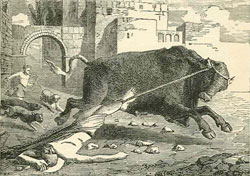
St. Saturninus Bishop of Toulouse and Martyr November 29 A.D. 257     St. Saturninus went from Rome by the direction of pope Fabian, about the year 245, to preach the faith in Gaul, where St. Trophimus, the first bishop of Arles, had some time before gathered a plentiful harvest. In the year 250, when Decius and Gratus were consuls, St. Saturninus fixed his episcopal see at Toulouse. Fortunatus tells us, that he converted a great number of idolaters by his preaching and miracles. This is all the account we have of him till the time of his holy martyrdom. The author of his acts, who wrote about fifty years after his death, relates, that he assembled his flock in a small church; and that the capitol, which was the chief temple in the city, lay in the way between that church and the saint's habitation. In this temple oracles were given; but the devils were struck dumb by the presence of the saint as he passed that way. The priests spied him one day going by, and seized and dragged him into the temple. declaring that he should either appease the offended deities by offering sacrifice to them, or expiate the crime with his blood. Saturninus boldly replied: "I adore one only God, and to him I am ready to offer a sacrifice of praise. Your gods are devils, and are more delighted with the sacrifice of your souls than with those of your bullocks. How can I fear them who, as you acknowledge, tremble before a Christian?" The infidels, incensed at this reply, abused the saint with all the rage that a mad zeal could inspire, and after a great variety of indignities, tied his feet to a wild bull, which was brought thither to be sacrificed. The beast being driven from the temple, ran violently down the hill, so that the martyr's scull was broken, and his brains dashed out. His happy soul was released from the body by death, and fled to the kingdom of peace and glory, and the bull continued to drag the sacred body, and the limbs and blood were scattered on every side, till, the cord breaking, what remained of the trunk was left in the plain without the gates of the city. Two devout women laid the sacred remains on a bier, and hid them in a deep ditch, to secure them from any further insult, where they lay in "wooden coffin" till the reign of Constantine the Great. Then Hilary, bishop of Toulouse, built a small chapel over this his holy predecessor's body Sylvius, bishop of that city towards the close of the fourth century, began to build a magnificent church in honor of the martyr, which was finished and consecrated by his successor Exuperius, who, with great pomp and piety, translated the venerable relics into it. This precious treasure remains there to this day with due honor. The martyrdom of this saint probably happened m the reign of Valerian, in 257.