Saturday, September 27, 2014

Deacons in convocation; every diocese should do this!

Deacons attend a day of formation and prayer

Deacons attend a day of formation and prayer
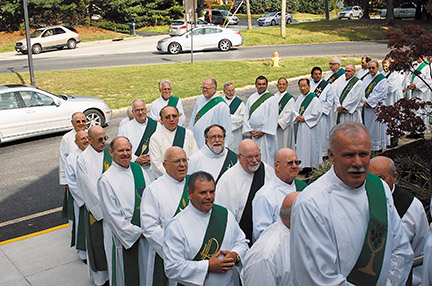
Photo by James A. McBride Deacons of the Diocese of Camden wait to enter St. Charles Borromeo Church, Sicklerville, for the closing liturgy of the permanent deacon convocation on Sept. 20. Deacons and 18 men in formation gathered for prayer, fellowship and continuing education.
Photo by James A. McBride
Deacons of the Diocese of Camden wait to enter St. Charles Borromeo Church, Sicklerville, for the closing liturgy of the permanent deacon convocation on Sept. 20. Deacons and 18 men in formation gathered for prayer, fellowship and continuing education.
By Peter G. Sánchez

At the Camden Diocesan Diaconate Convocation, held Sept. 20 at St. Charles Borromeo Parish in Sicklerville, permanent deacons and men in formation heard a closing address from Bishop Dennis Sullivan, who encouraged them in their ministry as witnesses of the Catholic faith who spread the Gospel message to Catholics and those in the public forum alike. He also asked all to pray for an increase in vocations to the permanent diaconate.
Bishop’s words came near the end of a day where 89 permanent deacons of the diocese, and 18 men in formation, gathered for “prayer, fellowship, and continuing education,” said Deacon Michael Carter, co-director of the Office of the Permanent Diaconate.
The day was a time for the men to “get grounded,” he said, and be reinforced in the four pillars of diaconate spirituality: intellectual, spiritual, pastoral and human. “It’s what the deacons are becoming, not just what they are doing,” he said.
The morning address was given by Father James Bartoloma, chancellor, who advised the men on their duties as ministers of the church, sharing the sacrament of holy orders, along with bishops and priests.
The men also participated in sessions facilitated by Steve Obarski, director of Worship for the Camden Diocese, who spoke on the role of the deacon in the Eucharistic celebration; Father Robert Sinatra, adjutant judicial vicar for the Tribunal on marriage dispensation; and Father Francis Danella, pastor of Our Lady Star of the Sea, Cape May, on deacon spirituality.
The convocation closed with liturgy in St. Charles of Borromeo church.

Sports and cultural heroes are ok; but we forget the real heroes; and hero worship should be reserved for God!

It's good to have heroes and it's natural, especially how far we have come culturally over the past 50 years, to look to sports and entertainment for heroes.  Currently there is much being made over Derek Jeter, and as an athlete and beyond, deservedly so.  Down here in these parts, there is no bigger hero than Drew Brees, and again, deservedly so.  Yet both Jeter and Brees dismiss the idea of hero worship.  Jeter even said just the other night, I'm doing my job.  And as the crowd continued to heap praise on Jeter, he quietly walked to the spot on the baseball diamond where he played shortstop, bent down in prayer, complete with the beautiful sign of the cross, the way Christians should always begin and end prayer!  As a young boy my heroes were indeed from the New Orleans Saints, especially Archie Manning and Danny Abramowicz.  Both remain heroes to me, because they talk now about faith.  The other night thousands upon thousands of moms and more brought their little 8-15 year old daughters to the Superdome to scream and faint over something called One Direction.  Not sure what that is but it must be something like whatever boy band my wife brought my Elizabeth to see in the dome too.  Years ago our rock n roll heroes were the Beatles and Elvis and many more.  Heroes.  Do we really understand heroes?


Yes, I want to tell you about heroes.  For me my hero is Jesus Christ but I don't always think of Him as a hero because in my personal relationship with Him, I know he is more than hero; he is my Lord & Savior!  The incarnate Word of God, sent to earth to be like us in all things except sin, lived and died heroically.  His death on a cross remains and always will be the greatest act of love ever and his resurrection is the greatest hope anyone can ever have.  Jesus indeed is my hero and there are many others whose lives of faith are heroic.  The examples of the saints & martyrs and so many faithful men and women through the ages, the parish priest or the faithful bishops, like a Philip Hannan; these too are my heroes!


It's a shame we place ball players and rock stars and TV personalities ahead of servants.  Now this is not a knock against these people because in my examples above, they deserve some recognition for their accomplishments and who they are as people.  The reason it's a shame is because we gave them so much more of our time and effort and admiration than we do to servants: police, fireman, members of our armed forces, teachers, doctors and nurses, volunteers, hospice workers, child care providers and I could go on and on.


This weekend, as you prepare for your next round of favorite football games and other forms of entertainment, can we sincerely ask ourselves: do I give the same effort to Jesus Christ and my faith life and do I think about and support those servant and servant leaders like I do my rock star hero or my sport hero?


Hero worship should be reserved for God alone; having heroes from our culture and sports is ok too, as long as we recognize who real heroes are!


Needs to be said!

More garbage from Planned Parenthood, using actress Lena Dunham from HBO's show Girls; all pure garbage

Lena Dunham is Terrified of Sex Posted by Matt Yonke (September 26, 2014 at 5:01 pm) Lena Dunham’s picture in her email from Planned Parenthood You may have heard of Lena Dunham. She’s the star of HBO’s hit show Girls, which centers around a set of rich, white 20-somethings struggling heroically to figure out what to do with their lives in the face of their crippling privilege and wealth. If you haven’t, don’t worry. You’re not missing much. But whether you’ve heard of her or not, her voice carries a lot of weight among her peers, which is why the nation’s largest abortion chain, Planned Parenthood, recruited her to send an email to their supporters earlier this week encouraging them to vote in the upcoming elections. As was noted in the New York Times recently, we are facing a crisis of adulthood in America right now, and young Lena seems to be calling her compatriots to rise to the occasion and take on some adult civic responsibility. But as she laid out her third reason to vote—the weary old trope that politicians are trying to take away your birth control—she said something that made me stop in my tracks: When you can’t get access to affordable birth control, suddenly your sex life is ruled by fear. All I could think when I read that was, “How sad.” How very, very sad to be completely unable to relate to your partner sexually without fear unless you’re aided by pills or contraptions. Who’s REALLY Afraid of Sex? Ironically, part of Dunham’s public persona is that she’s open and unafraid sexually. On her show, which nobody should ever watch for this reason among many, she takes her clothes off with frightening regularity and engages in all manner of sexual activity with a variety of partners, much of it degrading and devoid of any genuine love or connection. This stance of “sex positivity”—supposed to be the antidote to the old, stodgy, Victorian mindset of her forebears—constantly accuses older generations of being “afraid of sex.” But it seems that it’s Dunham and her cohorts who are scared of sex unless they’re properly medicated or neutered. Religion is often accused of being the root of older generations’ supposed fear of sex. But it’s interesting to note that, in this age where sex is plastered on every screen and billboard, it is religion that is still calling people to the root of sexual union that sends Dunham running scared: the wild adventure of fertility and family. It is religion that reminds us that the begetting of children is the primary functional purpose of sex, that bades us not to disconnect sex and fertility, but to welcome God’s gift of life into our lives through the thrilling conduit of sexual congress. Dunham thinks the gutsy thing is taking your clothes off and jumping into bed, but she’s wrong. What takes real courage is facing down the fear of accepting new life into your care and committing yourself to becoming responsible for it. True openness to sex is opening your heart to the life that God may choose to give when you enter into the marital embrace. It’s not easy, and I don’t blame her for shying away. Your body has the power to create a human being, Lena! You should be in healthy awe of that. And without the grace of God and a committed marriage, answering God’s call to bring forth the next generation is a fool’s errand. But it’s a bit rich to call on Planned Parenthood’s supporters to rise to the challenges of adult responsibility while admitting that you’re too scared to take it on yourself. Perhaps this generation would do better to listen to the grown-ups that were brave enough to bring them into existence instead of taking their life advice from Girls. - See more at: http://prolifeaction.org/hotline/2014/dunham/#sthash.rezTFI2j.dpuf

Friday, September 26, 2014

The Apostle of Charity


Image of St. Vincent de Paul

Facts

Feastday: September 27
Patron of charitable societies

St. Vincent was born of poor parents in the village of Pouy in Gascony, France, about 1580. He enjoyed his first schooling under the Franciscan Fathers at Acqs. Such had been his progress in four years that a gentleman chose him as subpreceptor to his children, and he was thus enabled to continue his studies without being a burden to his parents. In 1596, he went to the University of Toulouse for theological studies, and there he was ordained priest in 1600.
In 1605, on a voyage by sea from Marseilles to Narbonne, he fell into the hands of African pirates and was carried as a slave to Tunis. His captivity lasted about two years, until Divine Providence enabled him to effect his escape. After a brief visit to Rome he returned to France, where he became preceptor in the family of Emmanuel de Gondy, Count of Goigny, and General of the galleys of France. In 1617, he began to preach missions, and in 1625, he lay the foundations of a congregation which afterward became the Congregation of the Mission or Lazarists, so named on account of the Prioryof St. Lazarus, which the Fathers began to occupy in 1633.
It would be impossible to enumerate all the works of this servant of God. Charity was his predominant virtue. It extended to all classes of persons, from forsaken childhood to old age. The Sisters of Charity also owe the foundation of their congregation to St. Vincent. In the midst of the most distracting occupations his soul was always intimately united with God. Though honored by the great ones of the world, he remained deeply rooted in humility. The Apostle of Charity, the immortal Vincent de Paul, breathed his last in Paris at the age of eighty. His feast day is September 27th. He is the patron of charitable societies.

The first ever Beatification to take place on U.S. soil set for next week in New Jersey

Blessed in the U.S.A.  

Sister Miriam Demjanovich’s Oct. 4 beatification will mark the first such event on U.S. soil.


09/25/2014 Comments (6)
Sister Miriam's college photo
Official portrait of Sister Miriam Teresa
Photos courtesy of the Sisters of Charity of St. Elizabeth
NEWARK, N.J. — On Oct. 4, at the Cathedral-Basilica of the Sacred Heart in Newark, N.J., the first beatification ever held in the United States will take place, as Sister Miriam Teresa Demjanovich, a young Sister of Charity who died in the Garden State in 1927, will be formally raised to the altars.
In the history of the Church, 18 other men and women with U.S. ties have been beatified, with 12 of them proceeding on to canonization. But with the exception of St. Damien de Veuster, who was beatified in Brussels in 1995, all of their beatification and canonization ceremonies have taken place at the Vatican.
It will be a moment of special joy for the Church in the United States when Cardinal Angelo Amato, the prefect of the Congregation for the Causes of Saints, pronounces the formula never before heard on our shores, solemnly declaring Sister Miriam Teresa beata in the presence of a 1,800-strong crowd in Newark’s stunning Gothic cathedral. The beatification ceremony will be broadcast live on EWTN at 9:30am Eastern Time.
The event is noteworthy, however, not just because it will be the first of what we hope will be many beatifications to take place in our country in the future. Every saint and blessed is proposed to the faithful as a model disciple and a proven intercessor, and Sister Miriam Teresa has much to teach us and much to suggest her as a potent and pertinent advocate before God.


Read more: http://www.ncregister.com/daily-news/blessed-in-the-u.s.a/#ixzz3ESvl6nfX

Francis & Benedict together again this weekend

Benedict XVI will attend encounter with elderly on Sunday


Pope Francis greets Pope-emeritus Benedict XVI

26/09/2014

(Vatican Radio) The Holy See Press Office announced on Friday Pope-emeritus Benedict XVI will attend the encounter with Pope Francis and the elderly on Sunday morning in St. Peter’s Square.   The encounter is preceding the Mass  with Grandparents and the Elderly scheduled to begin at 10:30 am.   More than 40 thousand seniors and grandparents from more than 20 countries – many from Italy, Spain, Argentina and the United States  - will participate in the morning’s liturgy.  The Pontifical Council for the Family says more than fifty elderly priests from parishes around the world will concelebrate the liturgy with the Holy Father.  The main concelebrants will include the oldest priest of the Rome diocese, and one elderly priest each from the Democratic Republic of Congo, India and Argentina. Pope-emeritus Benedict XVI will not be at the Mass.

No Cross No Christian says Pope Francis

A Christian Life Without the Cross Isn't Christian, Says Pope in Morning Homily

Exhorts Faithful to Follow Example of Simon of Cyrene

Vatican City,    

A Christian cannot understand Christ the Redeemer without the Cross, without being ready to bear the Cross with Jesus. That was Pope Francis’ message at Friday’s morning Mass at the Casa Santa Marta.


To be a Christian means to be a “Cyrene,” that is, to be like Simon of Cyrene, who helped Jesus carry his cross, he said. Having the faith consists in this: You belong to Jesus if you bear the weight of the Cross with Him. Otherwise you are going along a path that seems “good” – but is not “true.”
The basis for the Pope’s reflections was the day’s Gospel, in which Christ asks His disciples what the people are saying about Him, and receives the most disparate answers. This episode, the Pope noted, takes place in the context of the Gospel that sees Jesus guarding “in a special manner His true identity.” On several occasions, when someone came close to divulging His identity, “He stopped them,” just as many times He prevented the demons from revealing His nature as the “Son of God,” Who had come for the salvation of the world.
This, the Poe explained, was because the people misunderstood and thought of the Messiah as a military leader who would expel the Romans. It was only privately, to the Twelve, that Jesus “began to do the catechesis on His true identity”:
“‘The Son of Man, that is, the Messiah, the Anointed must suffer greatly, must be rejected by the elders, the chief priests, and the scribes, and be killed and on the third day be raised.’ This is the path of your liberation. This is the path of the Messiah, of the Just One: the Passion, the Cross. And He explains His identity to them. They don’t want to understand; and in the passage from Matthew, one sees how Peter refuses this: ‘No! No, Lord…’ But He begins to open up the mystery of His true identity:
‘Yes, I am the Son of God. But this is my path: I must go along this path of suffering.’”
This, Pope Francis said, is the “pedagogy” that Jesus uses “to prepare the hearts of the disciples, the hearts of the people, to understand this mystery of God”:
“Sin is so ugly, but God’s love is so great that He saves us in this way: with this identity in the Cross. You can’t understand Jesus Christ the Redeemer without the Cross: you can’t understand! We can come to believe that he is a great prophet, he does good things, he’s a saint. But without the Cross you can’t understand Christ the Redeemer. The hearts of the disciples, the hearts of the people were not prepared to understand it. They didn’t understand the Prophecies, they didn’t understand that He Himself was the Lamb for the sacrifice. They were not prepared.”
It is only on Palm Sunday, the Pope noted, that Christ allowed the crowds to proclaim, “more or less,” His identity, when they cried out “Blessed is He who comes in the name of the Lord!”
And this, Pope Francis said, was because “if the people did not cry out, the stones would have cried out.” On the other hand, it is only after His death that the identity of Jesus appears in its fullness; the “first confession” came from the Roman centurion, the Pope noted.
He concluded: “Step by step [Jesus] prepares us so that we can understand better. He prepares us to accompany Him with our crosses, along His path to Redemption”:
“He prepares us to be ‘Cyrenes’ to help Him bear the Cross. And our Christian life without this is not Christian. It is a spiritual life, good… ‘Jesus is the great prophet, and He has saved us. But He and I, no… No, you with Him! Taking the same path. Still our identity as Christians must be guarded, not believing that being Christian is a merit; it is a spiritual path of perfection. It is not a merit, it is pure grace.”

Thursday, September 25, 2014

Brothers, Doctors, Saints; named in the Roman Canon(Eucharistic Prayer 1)


Image of Sts. Cosmas & Damian

Facts

Feastday: September 26
Patron of Druggist

Sts. Cosmas and Damian were brothers, born in Arabia, who had become eminent for their skill in the science of medicine. Being Christians, they were filled with the spirit of charity and never took money for their services. At Egaea in Cilicia, where they lived, they enjoyed the highest esteem of the people. When the persecution under Diocletian broke out, their very prominence rendered them marked objects of persecution. Being apprehended by order of Lysias, governor of Cilicia, they underwent various torments about the year 283. Their feast day is September 26th. They are patron saints of pharmacists.

St. Joseph Abbey and Seminary College located north of New Orleans celebrates 125 years of service

A powerhouse of prayer: St. Joseph Abbey turns 125

The powerful oasis of prayer that is St. Joseph Abbey cannot be underestimated.

For 125 years, Benedictine monks have prayed, formed seminarians and directed retreats in south Louisiana. The 1,200 piney acres near Covington on which they pray and work – a pristine oasis amid suburban sprawl – are a tangible expression of the beauty of God’s creation, all at the service of prayer.


“The monastery has been a stable presence of prayer throughout all these years,” said Benedictine Abbot Justin Brown of St. Joseph Abbey. “The monks have been praying in southeast Louisiana for 125 years – every day, seven days a week, 365 days a year. That’s quite an amazing thing. Through that, we’ve offered not only to the seminary but to many other people a place for spiritual nourishment and retreat.”

The Benedictine community will celebrate that rich, spiritual history Oct. 4 with a Mass of Thanksgiving at 11 a.m. in the Abbey church. Archbishop Gregory Aymond, a 1971 graduate of St. Joseph Seminary College, will be the principal celebrant and homilist, and he will be joined by bishops from across Louisiana and Mississippi.

Benedictine abbots
Other distinguished celebrants will be three Benedictine abbots: Archabbot Justin DuVall of St. Meinrad Abbey, from which St. Joseph Abbey was established in 1889; Abbot Hector Sosa Paz of the Abbey of Jesus Christ Crucified in Esquipulas, Guatemala, established by St. Joseph Abbey in 1959; and Abbot Vincent Bataille, the president of the Swiss-American Congregation.

Prayer is the hallmark of any monastery, said Abbot Justin, who has served as abbot since 2001. The monks gather four times each day – at 6 a.m., 7 a.m., 5:30 p.m. and 7:15 p.m. – to pray the Divine Office, and they celebrate Mass at 11:15 a.m. Quite often the monks are joined by neighbors who immerse themselves in the monastery’s spiritual rhythms.

“We have regulars – both Catholics and Protestants,” Abbot Justin said. “The psalms are all from the Bible.”

St. Benedict, who lived in the sixth century, called monks to do two things, Abbot Justin said – “to pray and to work within a community.”

“Prayer is central to our lives and the most important thing that we do,” he said. “But then, so is our work, and the work can take on many different possibilities.”

Preparing seminarians
The abbey’s primary work is the operation St. Joseph Seminary College, which was the reason the monastery was established in 1889 in a small town near Ponchatoula. Archbishop Francis Janssens asked the Benedictines to establish a monastery and seminary so that native clergy could be raised up.

The monastery moved to its current site in 1902, and following a 1907 fire, a large brick and steel building was constructed in 1908. The abbey church was dedicated in 1932, the same year that Abbot Columban Thuis became abbot. Abbot Columban served for 25 years, followed by Abbot David Melancon from 1957-82. Abbot Patrick Regan was elected in 1982 and served through 2001.

From its establishment, the abbey conducted a six-year program of seminary studies that included four years of high school and the first two years of college. After changes brought about by Vatican II, it converted to a four-year college program in 1964.

The K.C. Abbey Youth Camp opened on the abbey grounds in 1960, and the Abbey Christian Life Center opened for retreats in 1965.

Besides operating the seminary in conjunction with the Archdiocese of New Orleans, the abbey offers retreats, provides priests for parish ministry, operates a Pennies for Bread bakery, makes soap and hand-crafts simple cypress caskets. The abbey also has a cemetery available to the general public.

“The monastic life is a very simple life together,” Abbot Justin said. “The emphasis is on ‘together’ in the community. Unlike other religious, we take a unique vow of ‘stability of place.’ We stay and live within this community and this monastery all our lives. Each monastery is a family, and that is very much our charism.”

The connection to the surrounding community also is important.

“What I hear repeatedly from people is a sense of peace they feel when they cross over the bridge above the Bogue Falaya River, and come onto the abbey property,” Abbot Justin said. “Maybe it’s leaving a very busy, hectic world and coming to a place where the pace appears to be slower.”