Monday, May 1, 2023

One of the Great Church Fathers, battled Arianism, promoted the divinity of Christ


St. Athanasius


St. Athanasius, also known as Athanasius the Great and Athanasius the Confessor, was a bishop and doctor of the church. He is called the "Father of Orthodoxy," the "Pillar of the Church" and "Champion of Christ's Divinity." Athanasius became one of the most dedicated opponents of the heresy of Arianism. Much of his life was a testimony to the divinity of Jesus Christ.

Born in either 296 or 298 in Alexandria, Egypt to a prominent Christian family, Athanasius received a wonderful education in Christian doctrine, Greek literature, philosophy, rhetoric and jurisprudence.

He was well studied in the Hebrew Scriptures and the Gospel accounts and the Christian texts which would later be recognized by the Church as the canon of the New Testament. He credited the confessors during the Christian persecution under the Roman Emperor Maximian as his teachers of theology.

Bishop Alexander of Alexandria became a strong influence in Athanasius' life after Alexander witnessed him playing at administering Baptism as a young boy, with other children. Alexander called the boys over and after questioning them, he determined the baptisms were valid and decided to train them for priesthood.

As he grew up, Athanasius befriended many monks and hermits of the desert, including St. Antony. He later wrote the biography of Antony.

Athanasius became Alexander's secretary in 318 after being ordained a deacon. Around this time, Athanasius wrote his first work, a theological treatise on the Incarnation which is still quoted extensively in Christian theological studies and spiritual literature.

Around 323, Arius, an ambitious priest of the Alexandrian Church, denied the Divinity of Christ, and began spreading word that Jesus Christ was not truly divine, but merely created in time by the Eternal Father.

Alexander demanded Arius produce a written statement on the false doctrine. It was condemned as heresy after two dissenting Bishops came forward. Arius and 11 other priests and deacons were deposed, or removed from their office, for teaching false doctrine.

Arius left for Caesarea, but continued to teach his false doctrine and enlisted support from the Bishop of Nicomedia, Eusebius and other Syrian prelates.

Athanasius, as Alexander's secretary, was present during the great Church debate. He may have even composed the letter that announced Arius' condemnation. Athanasius stood alongside Alexander during the famous Council of Nicaea to determine the matters of dogma.

It was during this meeting, summoned by Emperor Constantine, that Arius' sentencing was officially confirmed and the Nicene Creed was adopted as the Creed of the Church and a worthy symbol of the orthodox Christian faith.

The early Christian Church, still undivided, rejoiced at the defense of the true nature of Jesus Christ. To this day, Athanasius is considered the great defender of the Faith in both the Orthodox and Catholic Churches.

Just five months later, Alexander died and Athanasius succeeded him after being unanimously elected. He was consecrated as the new Bishop of Alexandria in 328 and continued the fight against Arianism.

In 330, Eusebius approached Emperor Constantine and convinced him to command Athanasius to allow Arians back into communion. Athanasius refused, noting the Catholic Church could not hold communion with heretics who attacked the divinity of Christ.

However, Eusebius did not give up on his cause. He wrote to Athanasius trying to justify Arius and he wrote to the Egyptian Meletians in efforts to have Athanasius impeached.

The Meletians charged Athanasius with the crimes of exacting a tribute of linen for use in his church, sending gold to Philomenus, treason against the emperor and authorizing one of his deputies to destroy a chalice being used at the altar by a Meletian priest.

He was tried and proved his innocence on all accusations.

The Arians didn't stop there though; they came forward with another charge, claiming he murdered a Meletian bishop. Athanasius was ordered to attend a council at Caesarea, but knowing the bishop was alive and in hiding, Athanasius ignored the summons.

In 335, Emperor Constantine commanded Athanasius to go to the Council of Tyre, Lebanon. The council was full of Athanasius' opponents and was led by an Arian. Athanasius realized his condemnation was already pre-decided.

Athanasius was exiled for the first time to Trier, Germany. While there, he kept in touch with his flock by letter.

Athanasius' exile lasted for two and a half years. He returned to Alexandria in 338 to find both Emperor Constantine and Arius had died. Constantine's empire was divided between his three sons, Constantine II, Constantius and Constans.

After he returned to Alexandria, his enemies continued to try to bring him to exile. They accused him of raising sedition, of promoting bloodshed, and detaining his own use of corn.

Eusebius was able to obtain a second sentence of deposition against Athanasius and get the election of an Arian bishop for Alexandria approved.

After this, a letter was written to Pope St. Julius asking for his intervention and a condemnation of Athanasius. The case for Athanasius was set forth, and the pope accepted the suggestion offered by Eusebius for a synod to discuss the situation.

Meanwhile, a Cappadocian named Gregory was installed in Alexandria, and Athanasius went to Rome to await his hearing.

Athanasius was completely vindicated by the synod, but was unable to return home to Alexandria until the death of the Cappadocian Gregory in 345.

Athanasius returned to Alexandria to scenes of people rejoicing after he had been absent for eight years.

However, in 353 Athanasius would face more condemnations by the Arians in the councils at Arles, France and again in 355 in Milan, Italy.

Persecution continued against Athanasius and escalated to physical attacks against him. While he was celebrating a vigil Liturgy in a church in Egypt, soldiers forced their way in and killed some of the congregation. Athanasius managed to escape and hid in the desert, where a group of monks kept him safe for six years.

During his years as a hermit, he wrote his Apology to Constantius, the Apology for His Flight, the Letter to the Monks, and the History of the Arians.

Athanasius returned to Alexandria after the death of Constantius in 361 and the new emperor, Julian, revoked all sentences of exile enacted by his predecessor.

This lasted only a few months though. Emperor Julian's plan for paganizing the Christian world couldn't get very far so long as Athanasius, the champion for Catholic faith, was around. Therefore, Julian exiled Athanasius and he once again sought refuge in the desert.

He stayed there until 363 when Julian died and the next emperor, Emperor Jovian reinstalled him. Jovian's reign was a short one, and Athanasius was again banished just eight months later.

Jovian's successor, Valens issued an order banning all Orthodox bishops who were exiled by Constantius.

Four months later, Valens revoked his own order and Athanasius was restored permanently.

Over the course of his life, Athanasius was banished five times and spent 17 years of his life in exile for the defense of the doctrine of Christ's divinity.

However, the last years of his life were peaceful and he died on May 2, 373 in Alexandria.

His body was transferred, first to Constantinople, then to Venice.

St. Athanasius is often shown as a bishop arguing with a pagan, a bishop holding an open book or a bishop standing over a defeated heretic. He is a patron saint of theologians, and faithful Orthodox and Roman Catholic Christians and hailed to this day as a great Defender of the Faith.

His feast day is celebrated on May 2.

May 1st is also the feast day of the Saint known for assisting those who battle cancer


St. Peregrine Laziosi


Feastday: May 1
Patron: of Cancer Victims
Birth: 1260
Death: 1345


Peregrine Laziosi was born of a wealthy family at Forli, Italy, in 1260. As a youth he was active in politics as a member of the anti-papal party. During one uprising, which the Pope sent St. Philip Benizi to mediate, Philip was struck in the face by Peregrine. When Philip offered the other cheek, Peregrine was so overcome that he repented and converted to Catholicism. Following the instructions of the Virgin Mary received in a vision, Peregrine went to Siena and joined the Servites. It is believed that he never allowed himself to sit down for thirty years, while as far as possible, observing silence and solitude. Sometime later, Peregrine was sent to Forli to found a new house of the Servite Order. An ideal priest, he had a reputation for fervent preaching and being a good confessor. When he was afflicted with cancer of the foot and amputation had been decided upon, he spent the night before the operation, in prayer. The following morning he was completely cured. This miracle caused his reputation to become widespread. He died in 1345 at the age of eighty-five, and he was canonized by Pope Benedict XIII in 1726. St. Peregrine, like St. Paul, was in open defiance of the Church as a youth. Once given the grace of conversion he became one of the great saints of his time. His great fervor and qualities as a confessor brought many back to the true Faith. Afflicted with cancer, Peregrine turned to God and was richly rewarded for his Faith, enabling him over many years to lead others to the truth. He is the patron of cancer patients.

A new Bishop for Providence Rhode Island


Pope Francis Accepts Retirement of Bishop Thomas J. Tobin; Bishop Richard G. Henning Succeeds Him...


Pope Francis Accepts Retirement of Bishop Thomas J. Tobin; Bishop Richard G. Henning Succeeds Him as Bishop of Providence


PROVIDENCE, R.I. — The Holy Father, Pope Francis, has accepted the resignation of Most Reverend Thomas J. Tobin, D.D., from the pastoral governance of the Diocese of Providence. As required by the Code of Canon Law, Bishop Tobin presented a letter of resignation to the Holy Father upon reaching the age of 75 on April 1.

Most Reverend Richard G. Henning, S.T.D., who was appointed November 23, 2022, by Pope Francis as Coadjutor Bishop of Providence, automatically succeeds as the 9th Bishop of Providence. 

The changes were effective at Roman Noon (6 a.m. Eastern Time) today and were publicized in Washington, D.C. by Archbishop Christophe Pierre, apostolic nuncio to the United States.
 

###


Statements by Bishop Tobin and Bishop Henning: 
Bishop Tobin and Bishop Henning have both made individual statements on this occasion which are below


Statement of Bishop Thomas J. Tobin on the Occasion of His Retirement from Active Ministry

May 1, 2023


I have fought the fight; I have finished the race; I have kept the faith.
(2 Tim 4:7)


On this day dedicated to St. Joseph the Worker, and as we begin this month dedicated to our Blessed Mother, the Virgin Mary, it is with profound gratitude and personal peace that I have received word that our Holy Father, Pope Francis, has accepted my request to resign from office, that is, to retire from the active ministry. On this occasion I wish to offer these few brief words to our diocesan family.

In the homily for my Mass of Installation eighteen years ago, I said: “On occasions like this we sometimes say that a bishop takes possession of a diocese. In truth, I think it’s really the other way around – a diocese takes possession of a bishop. In that spirit, today I joyfully and willingly surrender myself to you. I give you my heart and soul. I promise to work hard for you and to do the very best I can. But keenly aware of my own weakness, limitations and needs, I will also depend on your cooperation, support and prayers.”
 
With that reminder of how we began our journey together, first, a word of enormous gratitude to all the members of our diocesan church who have indeed assisted me, and supported me in so many ways during my time as your bishop. You have been so good to me! Thank you to the priests, deacons, consecrated women and men, our diocesan staff, and all the faithful lay members of our church! Thank you for your patience and your prayers. Any good that we have been able to accomplish during the past eighteen years is a result, first of all, of your faith, your generosity, and your hard work.

For the mistakes I’ve made, for my faults and failures, I am deeply sorry. And for those times when some individuals were offended by my words and deeds, I am truly sorry for that too. It can be very difficult to preach the Gospel of Christ, and to carry on the mission of the church in the world today, but that’s what we are called to do. There are many pitfalls, and it is a daily challenge to strike a perfect balance of courage and prudence; to be simultaneously “strong, loving and wise” (2 Tim 1:7) in the service of the Lord.

Finally, I urge all the members of the church to remain steadfast in your faith, to be proud of the good work you are doing, and to be determined to carry on the work that Jesus has entrusted to you. I will continue to pray fervently for you, especially for our wonderful new shepherd, my brother, Bishop Richard Henning, as he assumes the heavy burden of episcopal leadership. And please remember me and pray for me, as I begin a new chapter in my life as a disciple and priest of Our Lord, Jesus Christ. 
 

*  *  *


Statement of Bishop Richard G. Henning


May 1, 2023


Praised be the name of Jesus Christ…now and forever.

For the last several months, I have been visiting communities across this “State of Hope.” My gratitude to God for this new ministry in the Diocese of Providence has only deepened as I have come to know its clergy, religious, and people.

I am particularly grateful for the time with Bishop Tobin whose own ministry as Diocesan Bishop for 18 years offers me a powerful witness of faith and a model of selfless service to the People of God.

As the Holy Father accepts Bishop Tobin’s retirement, I express my gratitude to Pope Francis and to Bishop Tobin for the gift they have given to me. I also wish to express my gratitude for the priests of this Diocese who are my brothers and co-workers in the vineyard.

Deeply aware of my need for mercy, I entrust myself and my ministry to the grace of Our Lord Jesus Christ.

May God bless the Diocese of Providence and may we all live in the “State of Hope!”

Federal judge recuses in case of Archdiocese of New Orleans Bankruptcy


Judge in Catholic bankruptcy recuses over church donations


A federal judge overseeing the New Orleans Roman Catholic bankruptcy recused himself in a late-night reversal that came a week after an Associated Press report showed he donated tens of thousands of dollars to the archdiocese and consistently ruled in favor of the church in the case involving nearly 500 clergy sex abuse victims.

U.S. District Judge Greg Guidry initially announced hours after the AP report that he would stay on the case, citing the opinion of fellow federal judges that no “reasonable person” could question his impartiality. But amid mounting pressure and persistent questions, he changed course late Friday in a terse, one-page filing.

“I have decided to recuse myself from this matter in order to avoid any possible appearance of personal bias or prejudice,” Guidry wrote.

The 62-year-old jurist has overseen the 3-year-old bankruptcy in an appellate role, and his recusal is likely to throw the case into disarray and trigger new hearings and appeals of every consequential ruling he’s made.

But legal experts say it was the only action to take under the circumstances, citing federal law that calls on judges to step aside in any proceeding in which their “impartiality might reasonably be questioned.”

“This was a clear and blatant conflict that existed for some time,” said Joel Friedman, a longtime legal analyst in New Orleans who is now a law professor at Arizona State University. “It creates the exact problem the rules are designed to avoid, the impression to the public that he’s not an impartial decisionmaker.”

Guidry’s recusal underscores how tightly woven the church is in the city’s power structure, a coziness perhaps best exemplified when executives of the NFL’s New Orleans Saints secretly advised the archdiocese on public relations messaging at the height of its clergy abuse crisis.

AP’s review of campaign-finance records showed that Guidry, since being nominated to the federal bench in 2019 by then-President Donald Trump, gave nearly $50,000 to local Catholic charities from leftover political contributions from his decade serving as a Louisiana Supreme Court justice. Most of that giving, $36,000, came in the months after the archdiocese sought Chapter 11 bankruptcy protection in May 2020 amid a crush of sexual abuse lawsuits.

Guidry also served on the board of Catholic Charities, the archdiocese’s charitable arm, between 2000 and 2008, as the archdiocese was navigating an earlier wave of sex abuse lawsuits.

In the bankruptcy, Guidry frequently issued key rulings that altered the momentum of the bankruptcy and benefited the archdiocese.

Just last month, he upheld a $400,000 sanction against Richard Trahant, a veteran attorney for clergy abuse victims who was accused of violating a sweeping confidentiality order when he warned a local principal that his school had hired a priest who admitted to sex abuse. He also rebuffed at least one request to unseal secret church documents, part of a trove of records detailing clergy abuse in New Orleans going back decades.

Guidry referred the potential conflict to the Washington-based Committee on Codes of Conduct, which noted that none of the charities he donated to “has been or is an actual party” in the bankruptcy.

It also noted that Guidry’s eight years on the board of Catholic Charities ended more than a decade before the bankruptcy and that his church contributions amounted to less than 25% of the campaign funds he had available to donate.

“Based upon that advice and based upon my certainty that I can be fair and impartial, I have decided not to recuse myself,” Guidry told attorneys in the case on April 21.

But it was not clear what details Guidry shared with the committee, and he refused to release its advisory opinion. The opinion also raised eyebrows because one of the judges Guidry consulted on the potential conflict, Jennifer Walker Elrod, is scheduled to hear an appeal from the bankruptcy next week for the 5th U.S. Circuit Court of Appeals.

“We have no reason to rely on this secret opinion because we have no idea what the analysis is,” said Kathleen Clark, a legal ethics professor at Washington University in St. Louis, adding it was “utterly reasonable to question Guidry’s ability to be impartial under these circumstances.”

“The public shouldn’t have to rely on a judge’s personal certainty about his own rectitude,” Clark added. “The fact that he would even make this assertion shows how misguided and ethically blind this judge is.”

Charles Hall, a spokesman for the Administrative Office of the U.S. Courts, said Guidry had no comment beyond the recusal order.

James Adams, a creditor in the bankruptcy who alleges he was abused by a priest as a fifth grader in 1980, says the judge’s recusal was long overdue.

“Like the church, some federal judges will often do the right thing only after the press begins to investigate and question them,” he said. “Inflated ego and arrogance can be a dangerous side effect of putting on a black robe.”

___

Mustian reported from New York. Contact AP’s global investigative team at Investigative@ap.org.

Vocations and Catholic vitality in Vietnam


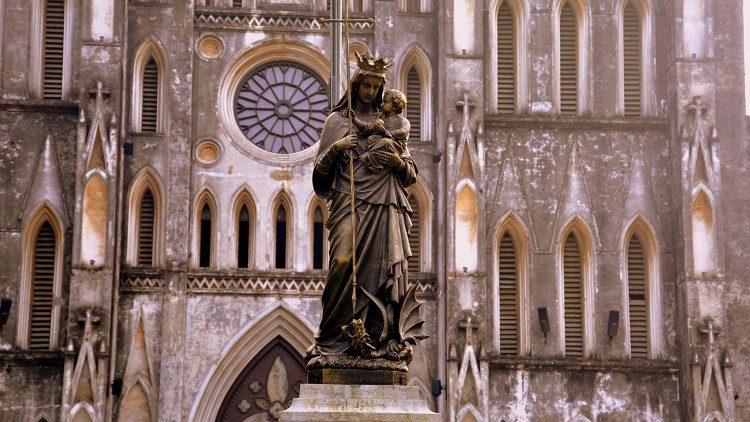
Cathedral of St. Joseph in Hanoi, VietnamCathedral of St. Joseph in Hanoi, Vietnam 

Vietnam celebrates Vocations Sunday with diaconate ordinations

The Church in Vietnam rejoices as eight men are ordained to the diaconate in the Archdiocese of Hanoi, ahead of World Vocations Day.

By Devin Watkins

As the Church celebrated the World Day of Prayer for Vocations on Sunday, Catholics in Vietnam’s capital expressed their support for eight men who recently took an important step on their journey toward the priesthood.

Archbishop Joseph Vu Van Thien had ordained eight new transitional deacons for his Archdiocese of Hà Nội.

He celebrated the Mass at Hanoi’s Cathedral of St. Joseph on 26 April, and presided over the ordination rite.

In his homily, Archbishop Van Thiên spoke to the new deacons about the three orders of the clerical state: diaconate, priesthood, and episcopate.

He pointed out that the three orders “are not titles or honors that indicate privilege, but tasks in service.”

“You are called to serve the Church and serve your brothers and sisters.”

Papal message for Vocations Day

In his message for the 60th World Vocations Day, Pope Francis said that there can be no vocation without mission, since Christians find true happiness and self-realization in offering others the new life we have discovered in Christ.

“Our mission finds expression in works of material and spiritual mercy,” said the Pope, “in a welcoming and gentle way of life that reflects closeness, compassion and tenderness, in contrast to our throwaway culture and general indifference.”

The Holy Father also pointed out that the Lord’s call to the ordained ministry represents a unique mission within the vocational call of all Christians to bring the Gospel to others.

First gathering since outbreak of pandemic

Meanwhile, the Archdiocese of Hanoi recently celebrated its first large-scale gathering of young people after the Covid-19 pandemic.

Some 5,000 young Catholics took part in the 7th Diocesan Youth Day on Sunday, 23 April.

They gathered under the theme of “Mary rose and went in haste”, which will form the background for World Youth Day in Lisbon in early August.

At the event in Hanoi, Archbishop Van Thiên celebrated Mass and led a half-hour of Eucharistic Adoration.

Seven groups of young Catholics wrapped up the meeting with artistic expressions of what it means for them to walk together with Mary in their lives.

Papal in-flight press conference from Hungary back to Rome


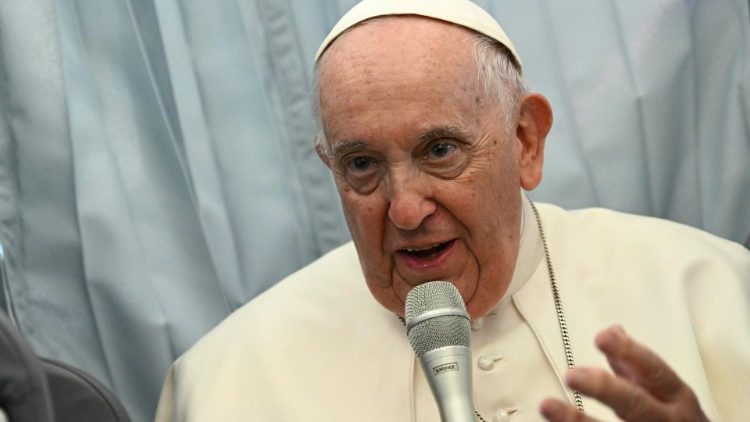
Pope Francis speaks to journalists aboard the papal planePope Francis speaks to journalists aboard the papal plane  (VATICAN MEDIA Divisione Foto)

Pope: Holy See will work to return Ukrainian children taken to Russia

Pope Francis speaks to journalists traveling with him on the return flight to Rome from his Apostolic Journey to Hungary, and discusses the Holy See’s efforts to facilitate a truce in Ukraine and the return of Ukrainian children from Russia, as well as his recent hospitalization and recovery.

By Vatican News

In his traditional press conference aboard the return flight to Rome from Budapest, Pope Francis spoke to reporters about a range of issues.

These included the Holy See's efforts to facilitate the return to Ukraine of Ukrainian children taken to Russia during the war, hopes for peace, and contacts with the Kremlin, along with ecumenical dialogue. He also mentioned his health following his hospitalization at Rome’s Gemelli Hospital the week before Palm Sunday.

The Pope also spoke about the return of the Parthenon artifacts to Greece, calling it an example for similar gestures in the future.

The following is a working translation of the Pope's inflight press conference from the original Italian.

[Antal Hubai (Rtl Klub)] - What is your personal experience of your encounters in Hungary?

I enjoyed a first experience of encounters [with Hungarians] in the 1960s, at a time when many Hungarian Jesuits had been kicked out of their country. Then, several schools came… there was a school twenty kilometers from Buenos Aires, and I would visit it twice a month. Then I also had a relationship with a society of Hungarian lay people working in Buenos Aires. I did not understand their language. But there were two words I understood well: Gulash and Tokai (laughs). It was a good experience. I was so affected by their pain of being refugees and not being able to go home. The Mary Ward sisters stayed there [in Hungary], hiding in apartments so that the regime would not kick them out. Later, I learned more about the whole affair to convince Cardinal Mindszenty to come to Rome. And I also experienced the brief enthusiasm of 1956 and then the subsequent disappointment.

[Antal Hubai]: Has your opinion changed since then?

It has not changed. It has become richer, in the sense that the Hungarians I have met enjoy a great culture....

[Antal Hubai]: What language did you speak?

They normally spoke German or English. Hungarian is not spoken outside of Hungary. Only in Heaven, because they say it takes forever to learn it [laughs].

[Eliana Ruggiero, AGI]: Holy Father, you launched an appeal to open - to re-open - the doors of our selfishness to the poor, to migrants, to those who are not [legally] in order. In your meeting with Hungarian Prime Minister Orbán, did you ask him to reopen the borders of the Balkan route that he has closed? Then, in recent days, you also met Metropolitan Hilarion: Can Hilarion and Orbán himself become channels of openness towards Moscow to accelerate a peace process for Ukraine, or to make a meeting between you and President Putin possible? Thank you.

I believe that peace is always made by opening channels; peace can never be made by closure. I invite everyone to open relationships, channels of friendship ... This is not easy. The same things I have said in general I have said to Orbán and everywhere.

On migration: I think it's a problem that Europe must take in hand, because there are five countries that suffer the most: Cyprus, Greece, Malta, Italy, Spain, because they are the Mediterranean countries and the majority of migrants land there. And if Europe does not take charge of this, of a fair distribution of migrants, the problem will only be for these countries. I think Europe must give people the sense that it is the European Union even in the face of this.

There is another problem that is related to migration, and that is the birth rate. There are countries like Italy and Spain that have ... no children. Lately ... last year I spoke at a meeting for families about this, and lately I have seen that the government and other governments are also talking about it. The average age in Italy is 46, for Spain it is higher still and there are small deserted villages.

A migration programme that is well carried out with a model that some countries have had with migration - I am thinking for example of Sweden at the time of the Latin American dictatorships - can also help these countries that have a low birth rate.

Then, in the end ... what was the last one? Ah, yes, Hilarion: Hilarion is someone I respect very much, and we have always had a good relationship. And he was kind enough to come and see me, then he came to the Mass, and I saw him here at the airport as well. Hilarion is an intelligent person with whom one can talk, and these relationships need to be maintained, because if we talk about ecumenism - I like this, I don't like this - we must have an outstretched hand with everyone, even receive their hand.

With Patriarch Kirill I have spoken only once since the war began, 40 minutes via zoom, then through Anthony, who is in Hilarion's place now, who comes to see me. He is a bishop who was a parish priest in Rome and knows the environment well, and always through him I am in connection with Kirill.

There was a meeting that we were to have in Jerusalem in July or June last year, but it was suspended because of the war: that will have to take place. And then, with the Russians I have a good relationship with the ambassador who is now leaving; he has been the ambassador in the Vatican for seven years, he is a great man, a man comme il faut, a serious, cultured and balanced person. My relationship with the Russians is mainly with this ambassador.

I don't know if I have said everything. Was that it? Or did I skip something?

[Eliana Ruggiero]: If somehow Hilarion and also Orbán could accelerate the peace process in Ukraine and also make a meeting between you and Putin possible, if they could act “as intermediaries”?

You can imagine that in this meeting we not only talked about Little Red Riding Hood, right? We talked about all these things. We talked about this because everyone is interested in the road to peace. I am willing. I am willing to do whatever needs to be done. Also, there is a mission going on now, but it is not public yet. Let's see how ... When it is public I will talk about it.

[Aura Maria Vistas Miguel, Rádio Renascença]: Your next stop is Lisbon. How do you feel about your health? We were taken by surprise when you went to hospital; you said you fainted. So do you feel you have the energy to go to World Youth Day? And would you like an event with a Ukrainian and a Russian youth as a sign for the new generations?

First of all, [my] health. What I had was a sudden, strong illness at the end of the Wednesday Audience. I didn't feel like having lunch; I laid down for a bit. I didn't lose consciousness, but yes, I had a very high fever and at three in the afternoon the doctor immediately took me to hospital. I had severe acute pneumonia in the lower part of the lung—thank God, I can tell you about it—to such an extent that the organism, the body, responded well. Thank God. This is what I had.

About Lisbon: The day before I left I spoke with Bishop Americo [Aguiar, auxiliary bishop of Lisbon], who came to see how things are there. I will go. I will go. I hope to make it. You can see that it is not the same as two years ago, with the cane. Now it is better. For the moment the trip is not cancelled.

Then there's the trip to Marseilles, then there's the trip to Mongolia, then there's the next one, I can't remember where... my schedule keeps me moving.

[Aura Vistas]: And about the youth of Russia and Ukraine?

[Pope Francis]: Americo has something in mind. He told me he is preparing something. He is preparing it well.

[Nicole Winfield, Associated Press]: Holy Father, I wanted to ask you something a little different. You recently made a very strong ecumenical gesture. You donated, on behalf of the Vatican Museums, three fragments of the Parthenon sculptures to Greece. This gesture has also resonated outside the Orthodox world, because many museums in the West are discussing precisely the return of the colonial period, as an act of justice towards these people. I wanted to ask you if you are also available for other restitutions. I am thinking, in particular, of the indigenous peoples and groups in Canada who have made a request for the return of objects from the Vatican collections as part of the process of reparation for the damage suffered during the colonial period.

This is the seventh commandment: if you have stolen [something], you must return [it]. But, there is a whole history, i.e. that sometimes wars and colonisation lead to decisions being made to take the good things of others. This was a correct gesture; it had to be done: the Parthenon, to give something [back]. And if the Egyptians come tomorrow and ask for the obelisk, what will we do? But then again you have to make a discernment in each case.

With regard to the restitution of indigenous objects to Canada, it is ongoing, or at least we had agreed to do it. I will ask how that is going. 

But the experience with the indigenous people in Canada has been very fruitful. Even in the United States, the Jesuits are doing something with the group of indigenous people inside the United States. The [Superior] General told me about it the other day.

But back to restitution. To the extent that it is something that you can return, that it is necessary, that it is seen as a gesture, then it is better to do it. Sometimes one can’t; there is no political, real, concrete possibility. But when you can give [things] back, then please do so; this is good for everyone, so as to not get used to putting your hand in other people's pockets.

[Eva Fernandez, Radio COPE]: The Ukrainian Prime Minister has asked for your help in bringing back the children forcibly taken to Russia. Are you thinking of helping him?

I think so, because the Holy See has acted as an intermediary in some prisoner exchange situations, and though the embassy it went well. I think it can also go well.

It is important. The Holy See is willing to act because it is right, it is just. And we must help to ensure that this is not a casus belli, but a human case. It is a question of humanity before it is a question of the spoils of war or a displacement caused by war. All human gestures help, but gestures of cruelty do not help. We must do everything humanly possible.

I want to say that I am also thinking of the women who come to our countries, Italy, Spain, Poland, Hungary, so many women who come with children and husbands, or they are wives... or they are fighting against the war. It is true that right now they are being helped, but we must not lose our enthusiasm for this, because if the enthusiasm wanes, these women are left without protection, with the danger of falling into the hands of the vultures who are always on the lookout for these situations.

Let us be careful not to lose this tension of help that we have for the refugees. This concerns everyone.

Hungary's Cardinal Erdo on the visit by Pope Francis


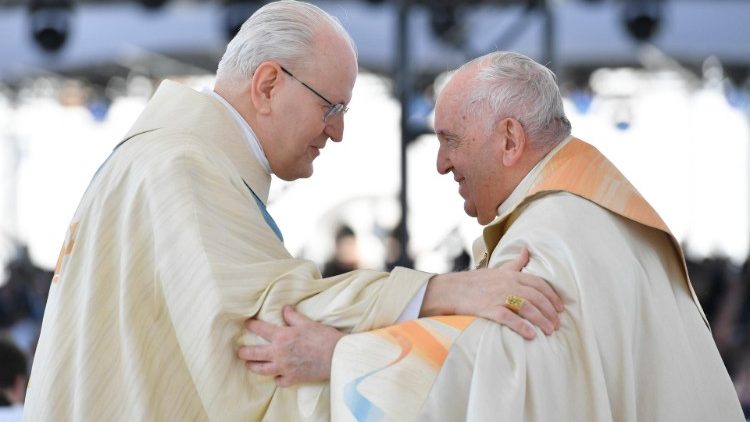
Pope Francis embraces Cardinal Erdo at Mass in BudapestPope Francis embraces Cardinal Erdo at Mass in Budapest  (Vatican Media)

Cardinal Erdő: Pope Francis came to Hungary with great love

Cardinal Péter Erdő, Archbishop of Esztergom-Budapest, in an interview with Vatican News, reflects on Pope Francis' Apostolic Journey to Hungary, and says the Pope came as a true pilgrim of peace and brought the faithful a sense of immense joy and a call to work for peace.

By Deborah Castellano Lubov - Budapest

"I have the feeling that the Holy Father came here first of all with great love, specifically love for us,” according to Cardinal Péter ErdÅ‘, Archbishop of Esztergom-Budapest.

In an interview with Vatican News in Budapest at the conclusion of Pope Francis’ 41st Apostolic Journey abroad, the Primate of Hungry said the “people felt the Holy Father’s warmth and responded to it, and that the Holy Father, amid these troubling times, truly came as a pilgrim of peace and man of faith."

"The visit of Pope Francis was a special joy for the Hungarian Catholic community in particular, but I believe also for the whole nation," said Cardinal Erdő.

Pastoral love for Hungary

“It is not some international event or other purpose that has brought him here, but specifically pastoral love; that he wanted to visit us,” he said, noting, “This is a great encouragement for us.”


“When we went to St. Stephen's Basilica, the city was full of people. Not only in the square in front of the basilica, but also along the streets, crowds were greeting him," he said, adding that the Pope expressed great affection for those whom he met.

The Cardinal also noted that Pope Francis frequently stopped his popemobile - or papal golf cart - to shake hands with the faithful and to show his affection for babies and young children.

"It was really a great, loving relationship with the faithful community," he said.

Christ coming to us in loving encounter

Cardinal ErdÅ‘ pointed out that there were many non-Catholics who turned out for the Pope's events.

“There were numerous ecumenical guests, representatives of social life, many of whom were not Catholics or non-believers," he said, “who were overjoyed to receive the Holy Father, because they saw that this journey is for us,” he said.

“Through the person of the Pope we experience that Christ is coming to us - and that is a very great thing," said the Cardinal. "Jesus comes in every Mass. We see Him in the poor person. And yet, when the Pope comes, we are emotionally affected by this reality."

Pilgrim of peace, with war next door

In his Regina Coeli address at the end of Mass on Sunday, Pope Francis offered Hungary and Europe to the protection of the Virgin Mary and prayed for peace.

"It was especially beautiful at the end of the Mass," said the Cardinal, "because we know that it was he who last year called on the bishops of the world to consecrate Ukraine and Russia to the Blessed Virgin Mary. And we Hungarians have a very old tradition of this, because it was Saint Stephen who, according to historical tradition, dedicated the whole country, the whole nation, to the Virgin Mary."

A statue of St Stephen, he recalled, still stands in Fatima in memory of that historic event.

Entrusting to Mary's miracles

"We made this gesture last year, and the faithful - Eastern and Western Christians - have come to understand that here we are truly entrusting this situation to Divine Providence and the intercessory love of the Virgin Mary, which we cannot resolve by human power alone," said the Cardinal.

Cardinal ErdÅ‘ recalled that Pope Francis prayed before the icon of the Blessed Virgin Mary at the end of Mass on Sunday.

"This is the icon which, according to historical tradition, found its way to the Bakócz Chapel when the city of Esztergom was liberated from the Turks, and this old icon was found under the ruins of the basilica," he said. “They displayed and prayed before it, and many of them thanked the Virgin Mary."

The Cardinal concluded the interview by reflection on a few highlights of the Apostolic Visit.

"Great encouragement was felt by bishops, priests, deacons, religious, teachers of the faith, and all those actively involved in the life of the Church, as well as by the poor, the disabled, the blind children, the homeless, and of course, refugees, and those who care for refugees," he said.

Cardinal ErdÅ‘ said the Hungarian faithful will never forget the unforgettable testimony offered by a refugee family in St. Elizabeth's Church, the Pope's reverent and moving visit to the Greek Catholic Community, and the contagious joy and peaceful and prayerful atmosphere of the Holy Mass in Parliament Square on Sunday morning.