Friday, December 2, 2022

Americans leaving churches; 1/3rd claim no religious affiliation


Why Americans are leaving their churches

For sociologist Stephen Bullivant, the question is why it took so long for the religious exodus to happen.


December 1, 2022

(RNS) — As many as a third of Americans now claim no religious affiliation, and British sociologist Stephen Bullivant has some ideas about why.

In his new book, “Nonverts: The Making of Ex-Christian America,” due this week from Oxford University Press, Bullivant reflects in often highly entertaining fashion about the trend lines. Although it’s full of statistics, “Nonverts” remains a lively read for ordinary people — a rare feat in a sea of dry data-driven books.

As a researcher, Bullivant wanted to know why Americans, once considered the exception to the secularization that has happened in Europe and elsewhere, are suddenly losing their religion.

And it is sudden, he notes. “This kind of religious change in a society doesn’t normally happen in the space of 20 or 30 years,” he told Religion News Service in a Zoom interview. “It’s been within the space of one or perhaps two generations that we’ve seen a sudden surge.”

In the 1990s, nonreligion began climbing from its baseline of around 7% of the population to what is between three and five times that figure now, depending on the survey. (All national surveys show the same rising trendline, but they differ as to the degree.)

Bullivant says the majority of this shift is caused by people actively leaving the religion of their childhood (the “nonverts” of the title), not because they were born into nonreligious families (though that trend is coming).

“So there is a story about why there is this rise of the nones. But to me, the more interesting story is why it didn’t happen earlier.” Why did this change start not in the 1960s, when American culture was in a state of upheaval, but in the ’90s?

Politics, say other scholars, who see nonreligion as a backlash against the GOP’s “Contract with America” and the rise of the religious right. That’s likely part of it, Bullivant said, pointing to how quickly the American public changed its mind on gay marriage. But he looks to three other developments to help us understand why people are leaving the fold.
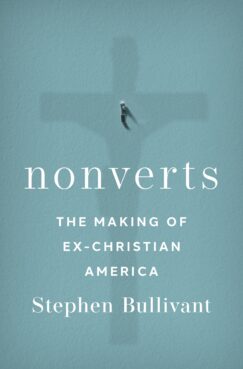
"Nonverts: The Making of Ex-Christian America" by Stephen Bullivant. Courtesy image

“Nonverts: The Making of Ex-Christian America” by Stephen Bullivant. Courtesy image

First, there was the end of the Cold War. For decades, “there was a big threat of ‘godless communism,’” making it hard for anyone with religious doubts to admit to them publicly. The social cost of being considered un-American was just too high, keeping the numbers of religious nones artificially low.

“Then suddenly the Cold War ends, and you have people able to admit to being nonreligious. In fact, by the time the New Atheists rise up in the mid-2000s, it’s no longer people with no religion who are the existential threat, but people with too much religion, especially extremist religion. The New Atheism is really interesting in how it positions itself as patriotic.”

A second factor is the sudden appearance of the internet, which made it possible for like-minded people to meet each other. “If you were brought up in small-town Kansas, you probably weren’t going to find other people who were having religious doubts. The internet opened up those spaces for people to play around with ideas, hang out with other people, and get really deep into various subcultures.”

The internet has been particularly important for people leaving conservative religions such as evangelical Protestantism or Mormonism. The Church of Jesus Christ of Latter-day Saints is actually the first main example Bullivant uses in the book, which is surprising because it’s such a tiny percentage of the population, around 1.5%.

Bullivant chose it because it’s a “canary in the coal mine” story — if even the Mormons are starting to bleed members, “that shows what a big issue this is for everyone else.” The erosion of Mormon attachment, he said, indicates “the breakdown of religious subcultures,” which has been especially profound in places such as Utah and southern Idaho where, in decades past, a person’s entire social and religious life could be spent around members of the LDS church.

The internet chips away at that enclave. “This was important for many of the Mormons I interviewed, who were encountering new things about Mormon history online. But even more than this, they’re starting to hang out with non-Mormons and ex-Mormons, people who are very much in your boat, and that becomes this other world you can inhabit.”

The third factor sounds like circular logic: The nones are rising because the nones are rising. But human beings are herd creatures, Bullivant explains in the book; we tend to do what our neighbors are doing. With every headline (like the one above) that heralds the seismic shift the nation is experiencing, more people become comfortable being nonreligious.

Bullivant himself bucks the trend. The 38-year-old researcher came from a family with no religion — “I wasn’t baptized, and that’s normal in Britain” — but deviated from that path by slowly coming to Catholicism as a student. He was doing the first of his two doctoral degrees (one in theology, the other in sociology) when he became friends with some Dominicans who would regularly invite him for dinner.

“In order to come to this guest dinner with loads of wine on a Sunday evening, you had to have gone to the Mass beforehand,” he said.

So he began attending Mass. He was impressed by the people he met, who were bright and kind. It was obvious that they lived what they believed and had made great sacrifices in order to become priests. Eventually, one of those friends offered to baptize him. So after a three-week research trip to Rome for his dissertation, Bullivant officially joined the Catholic Church. His wife is now also a member, and they are raising their four children as Catholics.

“So it’s strange: I do a lot of work on people leaving Catholicism. For every person in Britain who is raised nonreligious who becomes Christian, there’s something like 26 people who go the other way.”

It’s a helpful reminder that while social science charts trends that are sweeping and very real, each individual story is complex.

Remembering Ruth Prats; she loved God and loved the Church, particularly her parish of St. Peters in Covington La. Brutally murdered along with beloved Priest, Fr. Otis Young


Former parish employee identified as second victim of Louisiana double homicide


Joe Bukuras

The second victim in a Louisiana double homicide that also claimed the life of a local Catholic priest, Father Otis Young, has been identified. 

Ruth Prats, a 73-year-old former staff member who worked for Young when he was pastor at St. Peter Catholic Church in Covington, was identified as the second victim, St. Tammany Parish Coroner Dr. Charles Preston announced Thursday in a press conference.

Young’s death, which was confirmed Tuesday, was caused by “sharp- and blunt-force trauma,” the coroner’s office said. 

The homicides both occurred either Sunday night or Monday morning, the coroner’s office said. It was reported that both Young and Prats were reported missing on Sunday. 


The two bodies were found together “burned beyond recognition” less than a mile away from the church, according to police. The bodies were found in a back alley behind a glass store in downtown Covington, according to Sergeant James Hartman, a spokesman for the Covington Police Department. 

On Monday evening, police announced that they had taken a suspect, 49-year-old Antonio Donde Tyson of Covington, into custody.

Tyson was charged with two counts of first-degree murder, two counts of second-degree kidnapping, two counts of obstruction of justice, one count of resisting an officer, and one count of illegal possession of stolen things. 

Fox8live.com reported that Tyson was released from prison in August after serving part of a sentence he received in 1993. The outlet reported that he was serving time for charges of forcible rape and home invasion. 

There is no evidence that suggests that the suspect and the victims knew each other, Hartman said.

The St. Tammany Parish district attorney’s office said law enforcement is still investigating the matter. 

The office offered this statement: “All capital cases submitted to our office undergo a thorough review process before a decision is made regarding the pursuit of the death penalty. That review process begins once law enforcement officially tenders the case to our office by submitting a complete report of its investigation of the alleged offense.”

New Orleans Archbishop Gregory Aymond released a statement Wednesday offering prayers for both Young and Ruth Prats. At the time of the statement, Prats was not revealed as the second victim of the double homicide. She was, however, still listed as a missing person.

“The horror of the events that have unfolded here in Covington is beyond shocking. The pain, sadness, and disbelief that something like this could happen will stay with us, but particularly those who are most directly affected, for a very long time,” Aymond said in the statement. His full statement can be read here.

‘You taught us how to carry our crosses’

Young retired as a priest in July. Before his retirement, Prats offered a personal reflection on Young before a Mass for Young at St. Peter Catholic Church in June. The reflection can be watched in this YouTube video posted by the church. 

Addressing Young, Prats said: “It was an absolute gift to work with you as your pastoral associate for eight of the 10 years you were here at St. Peter parish.”

Prats reminisced over the wonderful renovations and improvements that Young brought to the church. She even reflected on Young’s joyful sense of humor. 

Prats said that “the greatest legacy” that Young would leave the parish is his example in showing the parishioners how to suffer. 

“You taught us how to carry our crosses,” Prats said. During her speech, she mentioned that she felt called to volunteer in a caretaking role for Young as his health declined, which led her to leave her role as a church staff member.

She described her time taking care of Young as “the most humble service” and said she was grateful.

In her speech, Prats mentioned a “sacred moment” when a glimpse of Young’s inner prayer life was revealed to the parish. The moment was when Young shared a prayer he prays before Mass to some young children making their first holy Communion. 

According to Prats, the prayer is: “Lord, grant me the grace to celebrate this Mass as if it was my first Mass, as if it was my last Mass, and as if it was my only Mass.”

“May Father Otis’ personal prayer become our prayer today at this Mass and from this day forward when we celebrate Mass,” she said.

“May we pass this prayer down to generations and to all who enter our doors here at St. Peter’s,” she said. “It will be in that prayer, his private prayer, that we will remember, Father Otis, that you walked in our midst as our pastor here at St. Peter’s and you touched our lives profoundly.”

Thursday, December 1, 2022

December devotion is The Immaculate Conception


Catholic Prayer: December Devotion: The Immaculate Conception

     
show

PRAYER CATEGORIES (1)

show

FEASTS (16)

Description:

Since the 16th century Catholic piety has assigned entire months to special devotions. The month of December is traditionally dedicated to the Immaculate Conception. The Blessed Virgin Mary, in the first moment of her conception, by a singular privilege of Almighty God, and in view of the merits of Jesus Christ, our Savior and hers, was preserved from all stain of original sin. This age-old belief of the Church was defined by Pope Pius IX in 1854 as an article of revealed truth.

Mary was in need of redemption and she was indeed f redeemed by the Precious Blood of Jesus Christ. The manner of Mary's redemption, however, was unique. Instead of being freed from original sin after having contracted it, she was preserved from contracting it. This was a most fitting favor for the Mother of the Redeemer.

Prayer:

INVOCATION O Mary, conceived without sin, pray for us who have recourse to thee.

TO THE VIRGIN IMMACULATE O Virgin Immaculate, Mother of God and my Mother, from thy sublime height turn upon me thine eyes of pity. Filled with confidence in thy goodness and knowing full well thy power, I beseech thee to extend to. me thine assistance in the journey of life, which is so full of dangers for my soul. And in order that I may never be the slave of the devil through sin, , but may ever live with my heart humble and pure, I entrust myself wholly to thee. I consecrate my heart to thee for ever, my only desire being to love thy divine Son Jesus. Mary, none of thy devout servants has ever perished; may I too be saved. Amen.

PRAYER OF PRAISE O pure and immaculate and likewise blessed Virgin, who art the sinless Mother of thy Son, the mighty Lord of the universe, thou who art inviolate and altogether holy, the hope of the hopeless and sinful, we sing thy praises. We bless thee, as full of every grace, thou who didst bear the God-Man: we all bow low before thee; we invoke thee and implore thine aid. Rescue us, 0 holy and inviolate Virgin, from every necessity that presses upon us and from all the temptations of the devil. Be our intercessor and advocate at the hour of death and judgment; deliver us from the fire that is not extinguished and from the outer darkness; make us worthy of the glory of thy Son, O dearest and most clement Virgin Mother. Thou indeed art our only hope, most sure and sacred in God's sight, to whom be honor and glory, majesty and dominion for ever and ever world without end. Amen. Saint Ephrem the Syrian

PRAYER OF POPE PIUS XII This prayer, dedicated to Mary Immaculate, was composed by the Pope for the Marian Year (December 8, 1953-December 8, 1954), which was proclaimed to mark the centenary of the definition of the dogma of the Immaculate Conception.

Enraptured by the splendor of your heavenly beauty, and impelled by the anxieties of the world, we cast ourselves into your arms, 0 Immacuate Mother of Jesus and our Mother, Mary, confident of finding in your most loving heart appeasement of our ardent desires, and a safe harbor from the tempests which beset us on every side.

Though degraded by our faults and overwhelmed by infinite misery, we admire and praise the peerless richness of sublime gifts with which God has filled you, above every other mere creature, from the first moment of your conception until the day on which, after your assumption into heaven, He crowned you Queen of the Universe.

O crystal fountain of faith, bathe our minds with the eternal truths! O fragrant Lily of all holiness, captivate our hearts with your heavenly perfume! 0 Conqueress of evil and death, inspire in us a deep horror of sin, which makes the soul detestable to God and a slave of hell!

O well-beloved of God, hear the ardent cry which rises up from every heart. Bend tenderly over our aching wounds. Convert the wicked, dry the tears of the afflicted and oppressed, comfort the poor and humble, quench hatreds, sweeten harshness, safeguard the flower of purity in youth, protect the holy Church, make all men feel the attraction of Christian goodness. In your name, resounding harmoniously in heaven, may they recognize that they are brothers, and that the nations are members of one family, upon which may there shine forth the sun of a universal and sincere peace.

Receive, O most sweet Mother, our humble supplications, and above all obtain for us that, one day, happy with you, we may repeat before your throne that hymn which today is sung on earth around your altars: You are all-beautiful, O Mary! You are the glory, you are the joy, you are the honor of our people! Amen.

Prayer Source: Prayer Book, The by Reverend John P. O'Connell, M.A., S.T.D. and Jex Martin, M.A., The Catholic Press, Inc., Chicago, Illinois, 1954

Friday Saint of the Day


Bl. Maria Angela Astorch


Maria Angela Astorch was born in Barcelona on September 1, 1592. In 1603, she entered the Capuchin Poor Clare monastery begun by Angela Serafina Prat. Because of her young age she waited five years as an aspirant before beginning the novitiate on 7 September 1608.

As novice master, she went to Zaragoza on 9 May 1614 to found a new monastery there. In 1624, she was vicar and three years later, abbess. On June 2, 1645, she went with four other sisters to found a new monastery at Murcia, under the title "The Exaltation of the Blessed Sacrament." The new monastery suffered frequent floods, especially in 1651 and 1653. Maria Angela remained abbess until 1661. Maria Angela Astorch died in 1665 at the age of 75.

Papal trip to Congo and South Sudan announced


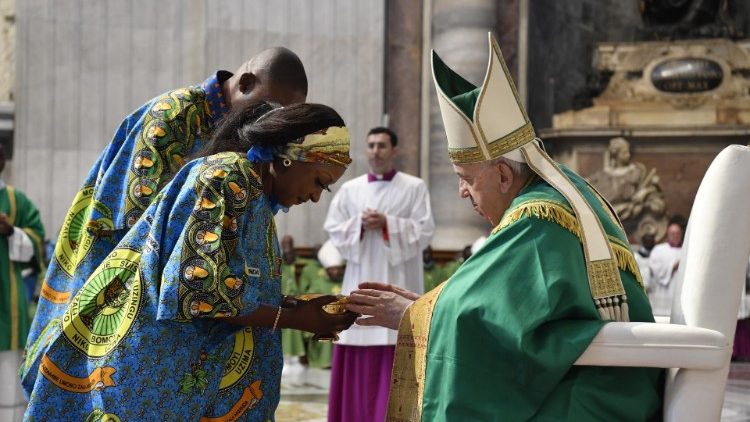
Pope Francis presides at Mass for the Congolese community of Rome earlier this yearPope Francis presides at Mass for the Congolese community of Rome earlier this year  (Vatican Media)

Pope to travel to DRC and South Sudan in early 2023

The Holy See Press Office announces that Pope Francis will travel to the Democratic Republic of the Congo and South Sudan for an ecumenical peace pilgrimage from 31 January to 5 February 2023, journeys postponed in the past due to health reasons.

By Vatican News staff writer

Pope Francis will travel to the Democratic Republic of the Congo and to South Sudan from 31 January to 5 February 2023. His visit had originally been scheduled for the summer of 2022, but had to be postponed due to health issues.

The Apostolic Journey was announced in a statement from the Director of the Holy See Press Office: "Accepting the invitation of their respective Heads of State and Bishops, His Holiness Pope Francis will make the announced Apostolic Journey to the Democratic Republic of Congo from 31 January to 3 February 2023, visiting the city of Kinshasa, and, together with the Archbishop of Canterbury and the Moderator of the General Assembly of the Church of Scotland, the Ecumenical Pilgrimage of Peace to Juba, South Sudan, from 3 to 5 February next."


Highlights of the Pope's Apostolic Journey will include a visit with representatives from charitable organizations in the Democratic Republic of Congo; and in South Sudan, a meeting with internally displaced persons and an Ecumenical Prayer service. 

Pope Francis affirms the relevancy of the teachings of his predecessor at the Ratzinger Prize ceremony


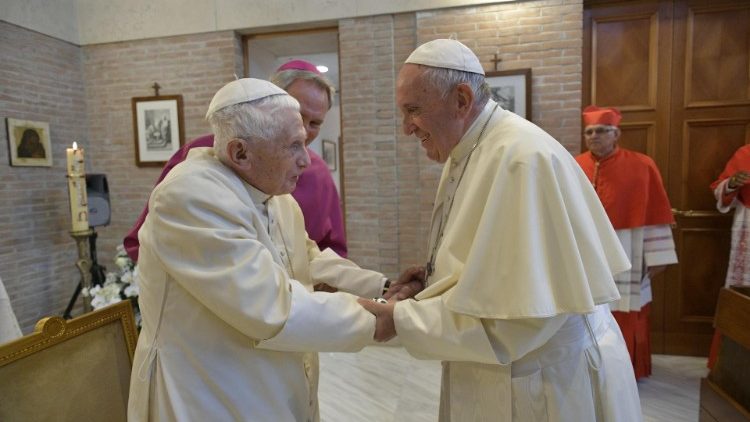
Pope Francis with Pope emeritus Benedict XVI (archive photo)Pope Francis with Pope emeritus Benedict XVI (archive photo)  (Vatican Media)

Pope Francis: Benedict XVI's theology is not for the past, but fruitful for the future

At the 2022 Ratzinger Prize award ceremony, Pope Francis highlights the significant contributions of the recipients - Fr. Michel Fédou, SJ, and Professor Joseph H.H. Weiler – and hails the prestigious award for providing indications of lines of commitment for study and life, which should be proposed to everyone.

By Benedict Mayaki, SJ

Pope Francis addressed participants at the 2022 Ratzinger Prize award ceremony on Thursday, during which this year's recipients - Father Michel Fédou and Prof. Joseph Halevi Horowitz Weiler - were presented with the prestigious award.

The Ratzinger award, launched in 2011, is given to scholars that have stood out for their scientific research in the theological field, much like Joseph Ratzinger/Pope Benedict XVI. Over the years, recipients have included composers, artists, and writers who have made notable contributions to the world of arts related to Christianity.

The contributions of Benedict XVI

In his speech, Pope Francis greeted those present for the occasion, and in particular, the two recipients of the 2022 Ratzinger Prize.

Pope Francis then highlighted the “spiritual presence and accompaniment in prayer” of Pope emeritus Benedict XVI for the whole Church, and highlighted that the occasion reaffirmed the contribution of his theological work and thought which “continue to be fruitful and operative.”

Recalling the recently commemorated 60th anniversary of the opening of the Second Vatican Council, Pope Francis pointed to Father Joseph Ratzinger's role at the Council, as an expert who helped in the creation of some of its documents; and then in his calling as Pope Benedict XVI to “lead the ecclesial community in its implementation, both alongside St. John Paul II and [then as Pastor of the universal Church.”

Even recently, Pope Francis noted, Benedict XVI still wanted to highlight how the Council enduringly exercises its crucial function, as it gave us the necessary guidelines to reformulate the central question of the nature and mission of the Church in our time (in his message for the 10th International Symposium of the Ratzinger Foundation, Oct. 7, 2022). In fact, Benedict XVI has “helped us to read the conciliar documents in-depth, proposing a "hermeneutic of reform and continuity."

Furthermore, Benedict XVI’s theological contributions are offered through the publication of the Opera Omnia, the German edition of which is nearing completion, while the translation in other languages continues to progress.

“These contributions, offer us a solid theological basis for the Church's journey: a ‘living’ Church, which he taught us to see and live as communion, and which is on the move - in "synod" - guided by the Spirit of the Lord, always open to the mission of proclaiming the Gospel and serving the world in which it lives.”

The Pope then encouraged collaboration between Vatican Foundations named after Blessed John Paul I and St. John Paul II, as well as the Joseph Ratzinger Foundation, noting that the service of the Benedict XVI Foundation is placed in the perspective of the conviction that his magisterium and thought “are not directed toward the past, but are fruitful for the future, for the implementation of the Council and for the dialogue between the Church and the world today, in the most topical and debated fields, such as integral ecology, human rights, and the encounter between different cultures.”

The awardees

Pope Francis then shifted his attention to the prizewinners – Father Michel Fédou and Prof. Joseph Halevi Horowitz Weiler – pointing at their accomplishments in the fields of study and teaching – fields considered by Ratzinger to be “of vital importance.”

Fr. Fédou

Concerning Fr. Fédou, the Pope noted that this “master of Christian theology” has dedicated his life to study and teaching, particularly of the works of the Eastern and Western Church Fathers and the development of Christology over the centuries. Also, in order not to focus his gaze only on the past, his knowledge of the faith tradition nourished in him a living thought, which was also able to address current issues in the field of ecumenism and in that of relations with other religions.

In Fr. Fédou, the Pope noted, “we recognize and pay tribute to a valiant heir and continuer of the great tradition of French theology, which has given the Church masters of the stature of Father Henri De Lubac and solid and courageous cultural enterprises such as the Sources Chrétiennes, whose publication began eighty years ago.”

“Without the contribution of this French theology, the richness, depth, and breadth of reflection on which the Second Vatican Council was nourished would not have been possible, and we must hope that it will continue to bear fruit for its implementation in the long run,” Pope Francis said.

Prof. Weiler

Pope Francis hailed Prof. Weiler as the first adherent of the Jewish faith to be awarded the prestigious prize. The Pope welcomed this, noting that Benedict XVI firmly and proudly affirmed that "an objective of his personal theological work had been from the beginning the sharing and promotion of all the steps of reconciliation between Christians and Jews taken since the Council."

The Holy Father further noted the harmony between Benedict XVI and Prof. Weiler in other issues, including the relationship between faith and juridical reason in the contemporary world; the crisis of juridical positivism and the conflicts generated by an unlimited extension of subjective rights; and the proper understanding of the exercise of religious freedom in a culture that tends to relegate religion to the private sphere.

Prof. Weiler, the Pope said, has not only conducted in-depth studies on them, but has also taken courageous positions, moving, when necessary, from the academic level to the level of discussion – or ‘discernment’ – in the search for consensus on fundamental values and the overcoming of conflicts for the common good.

“These awards, in addition to representing well-deserved recognition, offer the indication of lines of commitment, study, and life of great significance, which elicit our admiration and demand to be proposed for the attention of all.”

Concluding, Pope Francis reiterated his congratulations to the awardees and wished them the best in the continuation of their endeavors. He also invoked God’s blessing upon them, their families and friends, and the members and supporters of the Ratzinger Foundation.


Wednesday, November 30, 2022

First Saint of the Day for December


Saint Charles de Faucauld

Bl. Charles de Faucauld


* Canonized Saint May 15, 2022


Saint Charles de Foucauld Little Brother Charles of Jesus Charles Eugene, (Vicomte de) Foucauld 1858 - 1916 Died Age 58 Charles was left an orphan by the age of six, and he and his sister were brought up by their grandfather. By the time he was fifteen, less than a year after his First Communion, Charles had ceased to be a Christian and was an agnostic. In 1878, his grandfather died. Love for the old man had prevented Charles from indulging in the worst excesses, but at his death, Charles began to "live." On receiving his inheritance, he set about spending it in riotous living.  For a time he lived in Paris, where he took an apartment near a cousin, Marie de Bondy. Marie, who had first entered his life when he was about eleven, was a deeply spiritual young woman. Gradually, through her example, the gay and reckless young man began to change. His religion, when he rediscovered God, was a highly personal discipleship and love of the Person of Jesus Christ. Regarding his conversion, Charles said, "The moment I realized that God existed, I knew I could not do otherwise than to live for him alone." For a time after his return to the sacraments, Charles lived as a Trappist monk. Although he is remembered as an exemplary religious, the conviction grew that this was not his vocation. After being released from his temporary vows, Charles went to the Holy Land where he became a servant for the Poor Clare nuns.  Mother Elizabeth, the Superior of these Clarist sisters, was a woman of uncommon wisdom. She helped Charles to the realization that he should become a priest in order to serve God better. Charles finished his studies for the priesthood and was ordained in 1901. Later that year, he left for Algeria to take up the life of a hermit in the desert. Little Brother Charles of Jesus, as he called himself, thought up and wrote down a plan for two religious orders. The members of these orders would live a life patterned on the life of Jesus at Nazareth.  At the time of Brother Charles' death, neither his missionary contacts  nor his designs for new religious orders had borne visible fruit.  In 1916, living among the fierce Tuaregs of Tamanrasset, Charles de Foucauld was murdered in an attempt to warn two Arab soldiers of danger from a group of Senussi rebels.  The life of Charles de Foucauld was like the biblical seed which had to die before it sprouted into a healthy plant. Within twenty years after his death, there appeared three congregations which derived their inspiration, purpose, and Rules from Charles de Foucauld. These Little Brothers of Jesus, Little Sisters of the Sacred Heart, and Little Sisters of Jesus live in small groups all over the world, preaching by the lives they lead. Two other Orders, founded later, trace their heritage to Little Brother Charles of Jesus. Each of these groups bases its apostolate on the ideas of the Orders which the martyr of the desert had planned, but did not live to see. Knowledge of the life of Charles de Foucauld has spread throughout the Church. After preliminary investigations, all proved positive, and he was declared Venerable on April 13, 1978.

Preparing to Pray for the Pope's Intentions for December


Pope Francis’ 2022 Monthly Intentions


DECEMBER

Volunteer Not-for-profit Organisations


We pray that volunteer non-profit organisations committed to human development find people dedicated to the common good and ceaselessly seek out new paths to international cooperation.