Wednesday, April 3, 2019

Thursday Saint of the Day

St Isidore of Seville

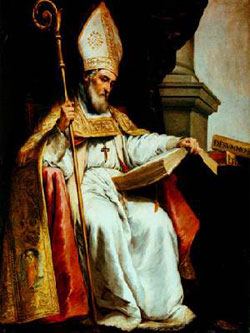
Image of St. Isidore of Seville


Isidore was literally born into a family of saints in sixth century Spain. Two of his brothers, Leander and Fulgentius, and one of his sisters, Florentina, are revered as saints in Spain. It was also a family of leaders and strong minds with Leander and Fulgentius serving as bishops and Florentina as abbess.
This didn't make life easier for Isidore. To the contrary, Leander may have been holy in many ways, but his treatment of his little brother shocked many even at the time. Leander, who was much older than Isidore, took over Isidore's education and his pedagogical theory involved force and punishment. We know from Isidore's later accomplishments that he was intelligent and hard-working so it is hard to understand why Leander thought abuse would work instead of patience.
One day, the young boy couldn't take any more. Frustrated by his inability to learn as fast as his brother wanted and hurt by his brother's treatment, Isidore ran away. But though he could escape his brother's hand and words, he couldn't escape his own feeling of failure and rejection. When he finally let the outside world catch his attention, he noticed water dripping on the rock near where he sat. The drops of water that fell repeatedly carried no force and seemed to have no effect on the solid stone. And yet he saw that over time, the water drops had worn holes in the rock.
Isidore realized that if he kept working at his studies, his seemingly small efforts would eventually pay off in great learning. He also may have hoped that his efforts would also wear down the rock of his brother's heart.
When he returned home, however, his brother in exasperation confined him to a cell (probably in a monastery) to complete his studies, not believing that he wouldn't run away again.
Either there must have been a loving side to this relationship or Isidore was remarkably forgiving even for a saint, because later he would work side by side with his brother and after Leander's death, Isidore would complete many of the projects he began including a missal and breviary.
In a time where it's fashionable to blame the past for our present and future problems, Isidore was able to separate the abusive way he was taught from the joy of learning. He didn't run from learning after he left his brother but embraced education and made it his life's work. Isidore rose above his past to become known as the greatest teacher in Spain.
His love of learning made him promote the establishment of a seminary in every diocese of Spain. He didn't limit his own studies and didn't want others to as well. In a unique move, he made sure that all branches of knowledge including the arts and medicine were taught in the seminaries.
His encyclopedia of knowledge, the Etymologies, was a popular textbook for nine centuries. He also wrote books on grammar, astronomy, geography, history, and biography as well as theology. When the Arabs brought study of Aristotle back to Europe, this was nothing new to Spain because Isidore's open mind had already reintroduced the philosopher to students there.
As bishop of Seville for 37 years, succeeding Leander, he set a model for representative government in Europe. Under his direction, and perhaps remembering the tyrannies of his brother, he rejected autocratic decision- making and organized synods to discuss government of the Spanish Church.
Still trying to wear away rock with water, he helped convert the barbarian Visigoths from Arianism to Christianity.
He lived until almost 80. As he was dying his house was filled with crowds of poor he was giving aid and alms to. One of his last acts was to give all his possessions to the poor.
When he died in 636, this Doctor of the Church had done more than his brother had ever hoped; the light of his learning caught fire in Spanish minds and held back the Dark Ages of barbarism from Spain. But even greater than his outstanding mind must have been the genius of his heart that allowed him to see beyond rejection and discouragement to joy and possibility.

Pope Francis plans his Holy Thursday at prison; will wash feet of 12 inmates

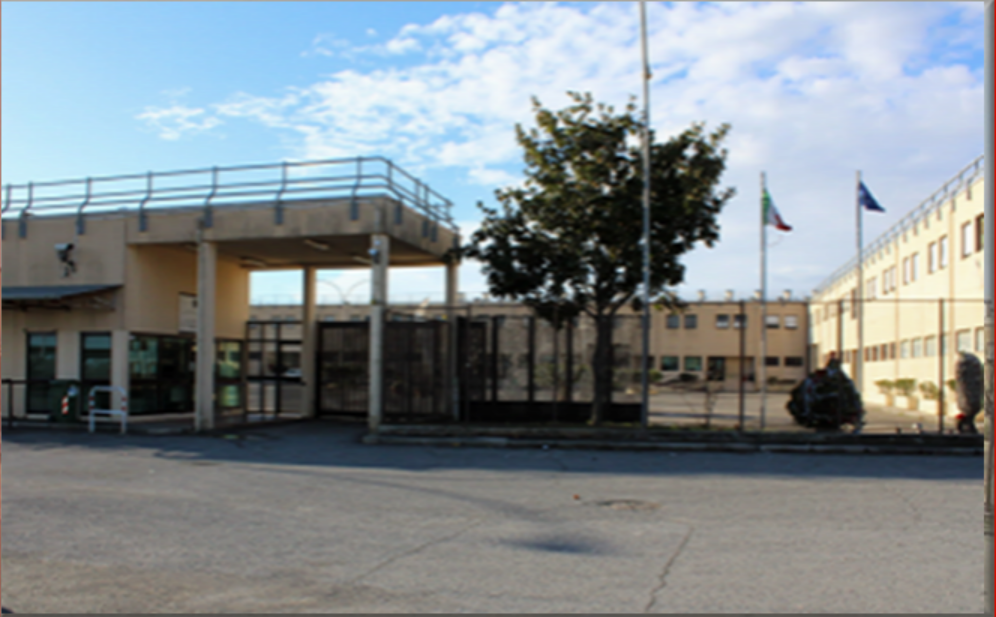
Velletri Prison © Circondarialevelletri.Altervista.Org

Pope Plans Holy Thursday Service at Velletri Correctional Facility

Will Wash the Feet of 12 Detainees

On Thursday, April 18, 2019, the Holy Father Francis will visit the Velletri Correctional Facility, Rome, for the celebration of Mass “in coena Domini”.
The visit will include encounters with the detainees, civil personnel, and Penitentiary Police officers, and the Eucharistic celebration with the rite of the washing of the feet of twelve detainees.
The Holy Father will be received by the director, Maria Donata Iannantuono, the deputy director Pia Palmeri, the commander of the prison police, Maria Luisa Abbossida, and the chaplain Don Franco Diamante.
The detention center, located one hour from the capital, was opened in 1991. It consists of two four-story pavilions, with 275 cells housing approximately 550 detainees (official figures from January 2018), and a police department.
This will be the fifth time that the Argentine pope will celebrate Holy Thursday with prisoners. Every year since his election in 2013, he has broken the tradition by celebrating this liturgy characterized by the rite of foot washing and the Gospel of the commandment of love, not in Saint-Jean-du-Latran or Saint-Jean-du-Latran. Pierre, but in significant places: prison, refugee center or for people with disabilities.

Wednesday General Audience 04.03.2019

General Audience © Vatican Media

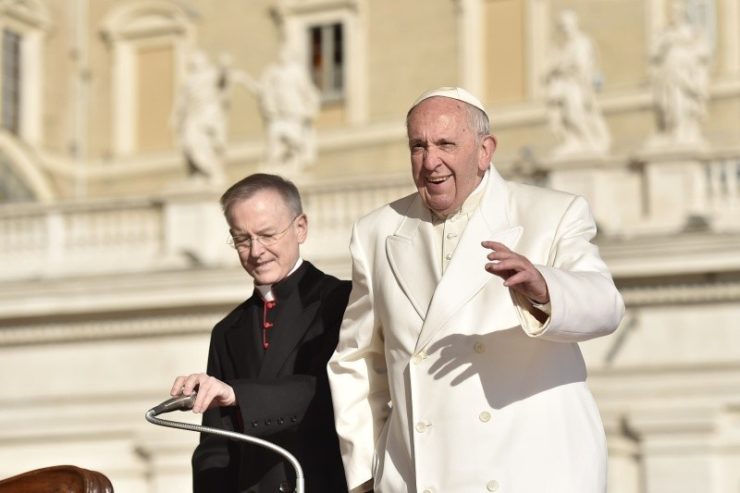
At General Audience, Pope Thanks the Lord for His Visit to Morocco

‘I thank the Lord for allowing me to take yet another step along the road of dialogue and encounter with our Muslim brothers and sisters, as a “Servant of hope” in today’s world’

Here is the Vatican-provided English-language summary of the Pope’s address at the General Audience this morning:
***
Speaker: Dear Brothers and Sisters:  Last Saturday and Sunday I completed an Apostolic Journey to Morocco, and I thank His Majesty King Mohammed VI and the other authorities, for their warm welcome.  Above all I thank the Lord for allowing me to take yet another step along the road of dialogue and encounter with our Muslim brothers and sisters, as a “Servant of hope” in today’s world.  To serve hope in our day is to build bridges between cultures, and it was a joy and honour for me to be able to do this in the noble Kingdom of Morocco, meeting both its people and its political leaders.  King Mohammed and I reiterated the essential role religions have in defending human dignity, promoting peace and justice, and in caring for creation, our common home.  The question of migration was of particular importance and I was able to thank the Church in Morocco for its commitment towards migrants, and to encourage those who give generous service in realizing the words of Christ: “When I was a stranger you welcomed me” (Mt 25:35).  After greeting priests, religious, consecrated men and women and the Ecumenical Council of Churches, thousands gathered for the Sunday Mass, where the parable of the prodigal son spoke to us of the beauty of God’s plan of forgiveness and reconciliation.  Indeed, knowing our need of God’s mercy is vital, for only those who have been reborn and live in the Father’s embrace, can be servants of hope for our world.
I greet the English-speaking pilgrims and visitors taking part in today’s Audience, especially those from England, Scotland, Ireland, Australia, China, the Philippines and the United States of America.  May the Lenten journey bring us to Easter with hearts purified and renewed by the grace of the Holy Spirit.  Upon you and your families I invoke joy and peace in Christ our Redeemer!

Tuesday, April 2, 2019

Wednesday Saint of the Day

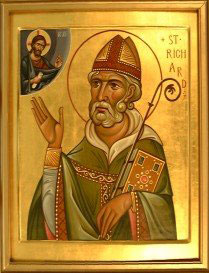
Image of St. Richard of WycheSt Richard of Wyche
Richard of Wyche, also known as Richard of Chichester, was born at Wyche (Droitwich), Worcestershire, England. He was orphaned when he was quite young. He retrieved the fortunes of the mismanaged estate he inherited when he took it over, and then turned it over to his brother Robert. Richard refused marriage and went to Oxford, where he studied under Grosseteste and met and began a lifelong friendship with Edmund Rich. Richard pursued his studies at Paris, received his M.A. from Oxford, and then continued his studies at Bologna, where he received his doctorate in Canon Law. After seven years at Bologna, he returned to Oxford, was appointed chancellor of the university in 1235, and then became chancellor to Edmund Rich, now archbishop of Canterbury, whom he accompanied to the Cistercian monastery at Pontigny when the archbishop retired there. After Rich died at Pontigny, Richard taught at the Dominican House of Studies at Orleans and was ordained there in 1243. After a time as a parish priest at Deal, he became chancellor of Boniface of Savoy, the new archbishop of Canterbury, and when King Henry III named Ralph Neville bishop of Chichester in 1244, Boniface declared his selection invalid and named Richard to the See. Eventually, the matter was brought to Rome and in 1245, Pope Innocent IV declared in Richard's favor and consecrated him. When he returned to England, he was still opposed by Henry and was refused admittance to the bishop's palace; eventually Henry gave in when threatened with excommunication by the Pope. The remaining eight years of Richard's life were spend in ministering to his flock. He denounced nepotism, insisted on strict clerical discipline, and was ever generous to the poor and the needy. He died at a house for poor priests in Dover, England, while preaching a crusade, and was canonized in 1262. His feast day is April 3.

US Bishops welcome publication of Christus Vivit

US Bishops Welcome Publication of ‘Christus Vivit’

‘A wonderful summons to the Church to more vigorously invest in youth and young adults, especially those on the peripheries and those disconnected from the Church’

The release of Pope Francis’s apostolic exhortation today is “a wonderful summons to the Church to more vigorously invest in youth and young adults, especially those on the peripheries and those disconnected from the Church,” said the President and committee chairmen of the United States Conference of Catholic Bishops (USCCB).
Cardinal Daniel N. DiNardo of Galveston-Houston and President of the USCCB, Cardinal Joseph W. Tobin, C.Ss.R, of Newark, chairman of the Committee on Clergy, Consecrated Life and Vocations, and Archbishop Charles J. Chaput, O.F.M. Cap., of Philadelphia, chairman of the USCCB Committee on Laity, Marriage, Family Life and Youth, have issued the following joint statement on the release of Christus Vivit.
The full statement follows: 
“The Church of the United States welcomes this teaching from Pope Francis as the fruit of the synodal journey in which we walked with and listened to young people. This exhortation is a wonderful summons to the whole Church to more vigorously invest in youth and young adults, especially those on the peripheries and those who are disconnected from the Church.
We encourage all Catholic leaders to read and study this exhortation and the pertinent documents of the Synod. They provide for us a framework from which we can build upon in our dioceses, parishes, and communities.
Now more than ever, we must turn our attention to our young people and engage them as ‘protagonists’ of the Church’s mission. Their insights can help us grow as a Church and guide us as we all learn to become better missionary disciples in an intercultural and intergenerational context. We look forward to what comes next, in collaboration with Catholic ministry leaders already working alongside young people. We look forward to the journey ahead and pray with St. John Paul II, a patron of young people whose passing we remember today, for the Church’s ongoing mission to all generations.
The post-synodal apostolic exhortation, Christus Vivit, is a significant milestone of the synodal process begun by Pope Francis in 2016. After two years of consultation by episcopal conferences, movements, and Catholic organizations, along with a worldwide online survey and a Pre-Synod Meeting with young adults in March 2018, the General Assembly of the Synod of Bishops met in October 2018 on the theme ‘Young People, the Faith, and Vocational Discernment.’ Bishops, clergy, religious, and lay people, including a number of young people, together with Pope Francis, addressed the challenges facing younger generations today and ways in which the Church can best respond. Now the work of the Holy Spirit, manifest in the sessions of the Synod, will bear fruit in the dioceses of the United States.”

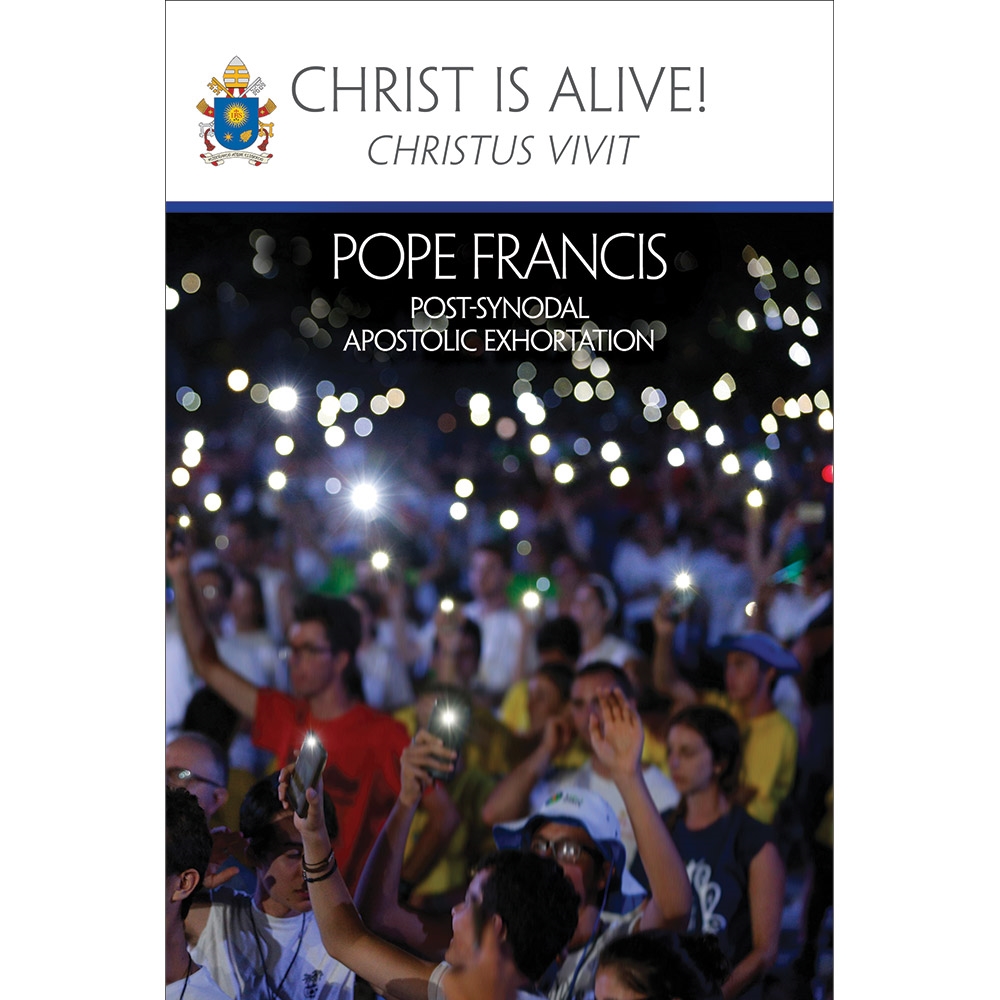
Christus Vivit - a document post Youth Synod signed today by Pope Francis


Copyright: Vatican Media

‘Christus Vivit’ — Pope Francis’ Post-Synodal Document on Young People, Published on April 2, the Memorial of the Death of Pope John Paul II (Full Summary)

Apostolic Exhortation Following 2018 Synod on Young People, the Faith and Vocational Discernment, Was Offered to Mary In Her ‘Holy House’ in Loreto

On March 25th, marking the Solemnity of the Annunciation of the Lord, Pope Francis visited the Italian hilltown of Loreto, in the  on the Adriatic Sea, a popular pilgrimage site for the Basilica of the Holy House of Mary, where Mary is believe to have grown up. On the occasion, Francis offered the Virgin Mary the Post-Synodal Exhortation of the Synod of Bishops on the theme: “Youth, faith and vocational discernment”, held in the Vatican from Oct. 3-28, 2018.
During the visit, the Pope celebrated Mass in the Holy House. At its conclusion, Francis signed the original Spanish Post-Synodal Letter to the Youth, titled: ‘Vive Cristo, esperanza nuestra.’
Vive Cristo, esperanza nuestra is the opening of the original text in Spanish of the post-Synodal Apostolic Exhortation, whose text was subsequently published today, April 2, with the signature of March 25.
It was announced by Director of the Holy See Press Office, Alessandro Gisotti, that the Exhortation named “Christus Vivit,” will be published on April 2, “the memorial of the death of John Paul II.”
The wish, he expressed during a briefing in Loreto, was “to link together the two pontificates, so loved by and close to the younger generations.” Pope John Paul II had been the first Pope to address a letter to young people in 1985 and he was the Pope who began the World Youth Days.
Today, April 2, the Pope’s Apostolic Exhortation was released for the first time. The full English text of the Exhortation can be read here.
The Vatican has provided different language summaries on the text. We publish here their English summary:
read:https://zenit.org/articles/christus-vivit-pope-francis-post-synodal-document-on-young-people-published-on-april-2-the-memorial-of-the-death-of-pope-john-paul-ii-full-summary/

Monday, April 1, 2019

Tuesday Saint of the Day


St Francis of Paola


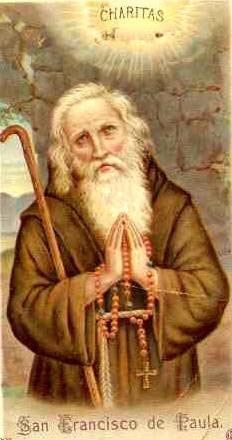
Image of St. Francis of Paola


Francis was born at Paola, Italy and was educated at the Franciscan friary of San Marco there, and when fifteen became a hermit near Paola. In 1436, he and two companions began a community that is considered the foundation of the Minim Friars. He built a monastery where he had led his eremitical life some fifteen years later and set a Rule for his followers emphasizing penance, charity, and humility, and added to the three monastic vows, one of fasting and abstinence from meat; he also wrote a rule for tertiaries and nuns. He was credited with many miracles and had the gifts of prophesy and insight into men's hearts. The Order was approved by Pope Sixtus IV in 1474 with the name Hermits of St. Francis of Assisi (changed to Minim Friars in 1492). Francis established foundations in southern Italy and Sicily, and his fame was such that at the request of dying King Louis XI of France, Pope Sixtus II ordered him to France, as the King felt he could be cured by Francis. He was not, but was so comforted that Louis' son Charles VIII, became Francis' friend and endowed several monasteries for the Minims. Francis spent the rest of his life at the monastery of Plessis, France, which Charles built for him. Francis died there on April 2nd and was canonized in 1519. His feast day is April 2.

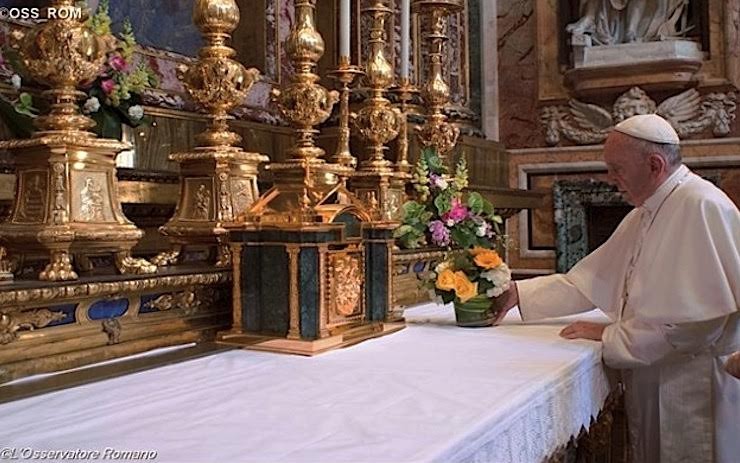
Pope home in Rome from Morocco; stops to pray at Santa Maria Maggiore

Pope Prays at Santa Maria Maggiore - © PHOTO.VA - OSSERVATORE ROMANO

Returning From Morocco, Pope Stops at Santa Maria Maggiore

After His 28th Apostolic Visit Abroad, Francis Prays Before Mary in Marian Basilica

Monday morning after having landed in Rome’s Ciampino Airport the evening of March 31, 2019, Pope Francis traveled to the Basilica of Santa Maria Maggiore to offer thanks for the success of his two-day Apostolic Visit to Morocco, March 30-31. ZENIT French Edition Director, Anita Bourdin, was on the papal flight, covering the trip.
After the stop, Director ‘ad interim’ of the Holy See Press Office, Alessandro Gisotti, on his Twitter, made the following tweet: “This morning on returning from his journey to Morocco, Pope Francis went to the Basilica of Saint Mary Major to pray.
It is already a usual detour for the Holy Father to go to the Marian Basilica; he always venerates the icon before and after his international apostolic trips.
During his time inside, Francis prayed before the ancient image of Mary, Salus Populi Romani, in silence for several minutes.

King of Morocco and Pope Francis sign appeal regarding Jerusalem

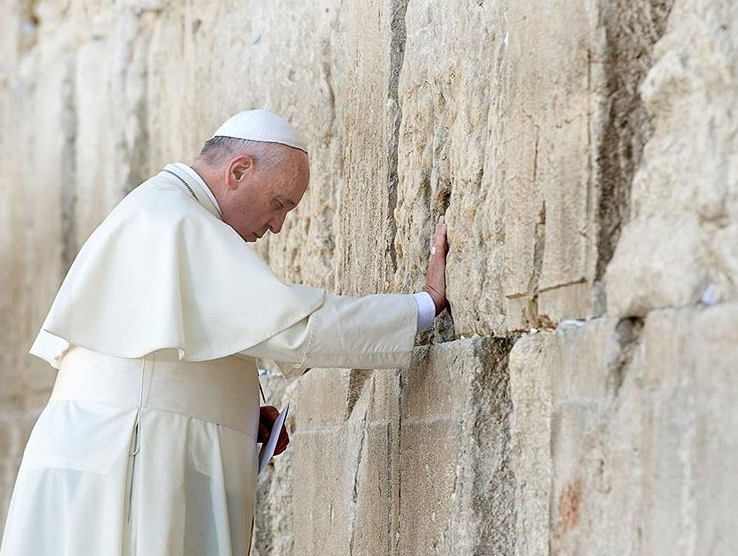
Jérusalem © Instagram Franciscus

‘We Are All Citizens of Jerusalem,’ Affirms Pope After Appeal Signed in Morocco

Press Conference during the Rabat to Rome Flight

“We are all citizens of Jerusalem,” affirmed Pope Francis, during the return flight from Rabat to Rome, on March 31, 2019. This is how he explained the appeal he signed the previous day with the King of Morocco, Mohammed VI, to defend “the specific multi-religious character, the spiritual dimension and the particular cultural identity” of the Holy City.
“The dialogue can’t be of a laboratory; it must be human, said once again the Holy Father, responding to a journalist’s question. “And if it’s human, it’s with the head, the heart, and the hands. And so one effects pacts.” He then greeted the joint appeal on Jerusalem as “a step forward.”
“An authority of Morocco and an authority of the Vatican did not make this appeal.” It was made “by believing brothers that suffer, seeing that this city of hope is not as universal as we would all like it to be. Jews, Muslims and Christians, we all want that.” In fact, Jerusalem symbolizes “religious fraternity.” “We are all — all believers — citizens of Jerusalem.”
In the joint text, the Pontiff and the Sovereign request that “full freedom of access be guaranteed to all faithful of the three monotheist religions, and the right of each to engage in his own worship there.”