The Pope's Monthly Intentions for 2025
September
For our relationship with all of creation
Let us pray that, inspired by Saint Francis, we might experience our interdependence with all creatures who are loved by God and worthy of love and respect.
For our relationship with all of creation
Let us pray that, inspired by Saint Francis, we might experience our interdependence with all creatures who are loved by God and worthy of love and respect.
Feastday: September 1
Patron: of beggars; blacksmiths; breast cancer; breast feeding; cancer patients; disabled people; Edinburgh (Scotland); epilepsy; fear of night; noctiphobics; forests; hermits; horses; lepers; mental illness; outcasts; poor peoples; rams; spur makers; sterility
Birth: 650
Death: 710

St. Giles, Abbot (Patron of Physically Disabled) Feast Day - September 1
St. Giles is said to have been a seventh century Athenian of noble birth. His piety and learning made him so conspicuous and an object of such admiration in his own country that, dreading praise and longing for a hidden life, he left his home and sailed for France. At first, he took up his abode in a wilderness near the mouth of the Rhone River, afterward near the river Gard, and, finally, in the diocese of Nimes.
He spent many years in solitude conversing only with God. The fame of his miracles became so great that his reputation spread throughout France. He was highly esteemed by the French king, but he could not be prevailed upon to forsake his solitude. He admitted several disciples, however, to share it with him. He founded a monastery and established an excellent discipline therein. In succeeding ages, it embraced the rule of St. Benedict. St. Giles died probably in the beginning of the eighth century, about the year 724.
By Devin Watkins
As Russia intensifies its attacks on cities across Ukraine, Pope Leo XIV has reiterated his appeal for an immediate ceasefire and serious efforts on behalf of dialogue.
“The voice of weapons must fall silent, and the voice of fraternity and justice must prevail,” said the Pope.
Speaking at the Sunday Angelus, the Pope renewed his closeness to the Ukrainian people, lamenting the continual destruction and death the war has caused.
He urged everyone to avoid succumbing to indifference but instead to draw near in prayer and concrete actions of charity, reiterating his call for a ceasefire.
“It is time for those in power to abandon the logic of weapons and to take up the path of negotiation and peace, with the support of the international community,” he said.
Switching to English, Pope Leo then prayed for the victims of the shooting at a Catholic school in the US city of Minneapolis, Minnesota.
“We include in our prayers the countless children killed and injured every day around the world,” he said. “Let us plead with God to stop the pandemic of arms, large and small, which infects our world.”
The Pope turned to the Blessed Virgin Mary, Queen of Peace, asking that she help humanity fulfill the prophecy of Isaiah: “They shall beat their swords into ploughshares and their spears into pruning hooks.”
Pope Leo XIV also recalled the death of at least 69 people—and the nearly 100 still missing—off the coast of Mauritania when a vessel carrying migrants capsized.
Seventeen people have been rescued so far, and survivors say the boat left The Gambia six days before the boat sank on Tuesday.
“This deadly tragedy is repeated every day around the world,” he said. “Let us pray that the Lord may teach us, as individuals and as a society, to fully put into practice His word: ‘I was a stranger, and you welcomed me’.”
In conclusion, the Pope prayed for everyone who has died. "We entrust all our injured, missing, and dead, everywhere, to our Saviour’s loving embrace."
By Thaddeus Jones
Speaking to pilgrims and visitors gathered in Saint Peter's Square for the midday Sunday Angelus, Pope Leo recalled in his reflections today's Gospel reading that speaks to us about the importance of humility, openness to others and a culture of encounter. The reading from Luke's Gospel recounts when Jesus was invited to a meal by one of the leading Pharisees, an example of how in every culture sitting at table together can be a sign of peace, communion, sharing and encounter.
Noting how genuine encounter is not always easy, Pope Leo explained how Jesus was "observed" closely when visiting the home of the religious leader with some suspicion by the more rigid interpreters of tradition, yet Jesus humbly attends the event as a good guest, with respect and sincerity, while also offering a teaching moment. The Lord shares a parable with them pertinent to the occasion that tells of a similar circumstance with people rushing to take the places of honour, perhaps to "be noticed" to show their importance, thereby creating a sense of competition rather than humbly being together in fraternity and sharing.
In a similar way, the Pope encouraged believers to listen to what the Lord has to teach us when we gather at the Eucharistic table. In a sense, the Lord "becomes our guest and he can tell us how he sees us." The Pope said it's important we try to see ourselves through the Lord's eyes and how frequently we can focus only on competition with each other, obtaining recognition, or comparing ourselves to others.
Jesus explains how humility allows for true freedom, the Pope went on to explain, since "humility is really freedom from ourselves" since "the Kingdom of God and its righteousness become our real concern" as we look beyond ourselves and ahead to the horizon of life. When we exalt or focus on only ourselves, we lose sight of how precious in God’s eyes we are as his children and the "sublime dignity" that comes from this reality.
In conclusion, before leading the recitation of the Angelus, the Pope asked everyone to "pray that the Church will always be a school of humility for everyone, a home where all are welcome, a place where rivalries are set aside and where Jesus still speaks to us and teaches us to imitate his own humility and freedom", invoking Mary, "Mother of that home" and to whom we pray.

Aidan of Lindisfarne, born in Ireland, may have studied under St. Senan before becoming a monk at Iona. At the request of King Oswald of Northumbria, Aidan went to Lindisfarne as bishop and was known throughout the kingdom for his knowledge of the Bible, his learning, his eloquent preaching, his holiness, his distaste for pomp, his kindness to the poor, and the miracles attributed to him. He founded a monastery at Lindisfarne that became known as the English Iona and was a center of learning and missionary activity for all of northern England. He died in 651 at the royal castle at Bamburgh.
Feastday: August 30
Patron: of the destitute elderly
Birth: October 25, 1792
Death: August 29, 1879
Beatified: Pope John Paul II on October 3, 1982
Canonized: Pope Benedict XVI on October 11, 2009

St. Jeanne Jugan, also known as Sister Mary of the Cross, L.S.P. was born on October 25, 1792 in the French region of Brittany during the French Revolution.
Jeanne grew up as the sixth of eight children to Joseph and Marie Jugan surrounded by a lot of religious and political upheavals. Her father became lost at sea when Jeanne was just four-years-old, and her mother struggled to provide for all the Jugan children.
Her mother worked diligently to make sure her children had everything they needed, including secret religious instruction when anti-Catholic persecutions were taking place.
From a young age, Jeanne learned to knit and spin wool and became a shepherdess. Barely able to read or write, Jeanne took a job as a kitchen maid for a noble family when she was 16.
Jeanne accompanied the Viscountess de la Choue when she visited the poor and the sick. As she matured, Jeanne began finding her passion in working with these people and turned down multiple marriage proposals. She told her mother God had other plans for her.
At 25, Jeanne became an Associate of the Congregation of Jesus and Mary, which was founded by St. John Eudes. She spent her time praying and working as a nurse in the town hospital. She stayed at the hospital for many years until her own health issues prevented her from performing her physically demanding tasks.
After leaving her job at the hospital, Jeanne became the servant of a member of the Eudist Third Order for 12 years. While working as a servant, Jeanne and her master found the same Catholic faith in each other and set out to begin teaching catechism to the town's children and caring for the poor.
In 1837, Jeanna and Francoise Aubert rented part of a small cottage and were joined by a 17-year-old orphan, Virgine Tredaniel. Together, they formed a small community of prayer devoted to helping the poor and teaching the catechism.
Two years later, Jeanne was approached by an elderly, blind and partially paralyzed woman named Anne Chauvin. With no one there for the woman, Jeanne carried her to her apartment and took it upon herself to begin caring for her. She let Anne have her bed and Jeanne slept in the attic.
A short time later, Jeanne took in two more old women in need of help and by 1841, she rented another space to house a dozen of elderly people. The next year, she attained an open convent and housed 40 more people.
With approval from her peers, Jeanne began focusing her attention on her new mission - assisting abandoned elderly women. This marked the beginning of the religious congregation known now as The Little Sisters of the Poor.
Jeanne constructed a simple Rule of Life for her new community of women. Each day they went around town requesting food, clothing and money for those in their care. Jeanne's carried on with her new life's work for the next four decades of her life.
More young women started to hear about Jeanne's mission and joined her. Through begging on the streets, Jeanne was able to open four more homes for her needy within those 10 years. By 1850, over 100 women had joined the congregation.
Jeanne was soon forced out of the leadership role, though. The local bishop appointed Abbe Auguste Le Pailleur as Superior General of the congregation. Jeanne was assigned to strictly begging on the streets until she was sent to retire in a life of obscurity for her final 27 years of life.
After The Little Sisters of the Poor communities began expanding throughout France, their work spread to England in 1851 and the United States founded five of their own communities from 1866 to 1871.
By 1879, Jeanne's community had over 2,400 Little Sisters. On March 1, 1879, Pope Leo XIII approved the Constitution for the congregation for seven years.
At the time of Jeanne's death, on August 29, 1879, most of the Little Sisters had no idea Jeanne was the real founder of the congregation. However, Le Pailleur was investigated and dismissed in 1890 and Jeanne became acknowledged once again as the foundress.
St. Jeanne Jugan passed away at the age of 86. She was beatified by Pope John Paul II on October 3, 1982 and canonized by Pope Benedict XVI on October 11, 2009.
During her canonization Pope Benedict XVI expressed, "In the Beatitudes, Jeanne Jugan found the source of the spirit of hospitality and fraternal love, founded on unlimited trust in Providence, which illuminated her whole life."
She is the patron saint of the destitute elderly and her feast day is celebrated on August 30.

WASHINGTON (OSV News) — President Donald Trump said at an Aug. 26 Cabinet meeting that capital punishment will be sought for all murders in Washington, D.C.
Trump’s comments came amid his federalization of the police force in the nation’s capital and after he activated the National Guard in what he called an effort to combat crime in Washington.
“Anybody murders something in the capital: capital punishment,” Trump said at the White House meeting. “Capital: capital punishment. If somebody kills somebody in the capital, Washington, D.C., we’re going to be seeking the death penalty.”
Trump argued the policy was “preventative,” a claim disputed by death penalty opponents.
“Perpetuating more violence in response to harm does not promise safety or an effective solution to crime,” Krisanne Vaillancourt Murphy, executive director of Catholic Mobilizing Network, a group that advocates for the abolition of capital punishment in line with Catholic teaching, told OSV News.
Vaillancourt Murphy said the District of Columbia like other major metropolitan areas “has challenges with crime and violence that should not be ignored.” But she said that to respond with capital punishment is “at best a terribly misguided approach.”
She said capital punishment “defiles the sacred dignity of life and deserves no place in our nation’s capital, our country, or any society.”
“Simply put, the death penalty is a failed system beyond repair,” she said. “Instead of providing real opportunities for healing and closure, capital punishment systematically perpetuates a cycle of violence.”
Among the first actions of his second term earlier this year, Trump signed an executive order directing the U.S. attorney general to “pursue the death penalty for all crimes of a severity demanding its use,” and to “seek the death penalty regardless of other factors for every federal capital crime” that involves the “murder of a law-enforcement officer” or a “capital crime committed by an alien illegally present in this country.”
Vaillancourt Murphy noted that “practically speaking, capital punishment is more expensive than other prison sentences and it is often applied arbitrarily.”
She pointed to information from the Death Penalty Information Center showing that at least 200 people — or one person for every eight persons executed since 1973 — have been wrongfully convicted and sentenced to death.
“For every eight people executed in the United States, one person has been exonerated. Additionally, the death penalty is not an effective deterrent to crime,” she said. “Research has consistently demonstrated that murder rates are lower in states that do not have the death penalty.”
“The people of Washington, D.C., deserve real safety, true accountability, and approaches to crime and violence that are rooted in the preservation of life,” she said.
The Catholic Church’s official magisterium opposes the use of the death penalty as inconsistent with the inherent sanctity of human life, and advocates for the practice’s abolition worldwide.
The late Pope Francis revised the Catechism of the Catholic Church in 2018 to clarify the church’s teaching that capital punishment is morally “inadmissible” in the modern world and that the church works with determination for its abolishment worldwide.
In his 2020 encyclical “Fratelli Tutti,” Pope Francis addressed the moral problem of capital punishment by citing St. John Paul II, writing that his predecessor “stated clearly and firmly that the death penalty is inadequate from a moral standpoint and no longer necessary from that of penal justice.”
About a decade prior to becoming Pope Leo XIV earlier this year, then-Bishop Robert Prevost wrote in a March 5, 2015, post on X, then known as Twitter, “It’s time to end the death penalty.”
Kate Scanlon is a national reporter for OSV News covering Washington. Follow her on X @kgscanlon.


By Tyler Arnold
Washington, D.C. Newsroom, Aug 27, 2025
A Mexican-born Catholic priest who has served in the Diocese of Laredo, Texas, for nine years must leave the United States because his application for residency was denied and his religious worker visa is expiring.
Father Alan Sanchez, the pastor of St. Joseph Church in La Pryor and St. Patrick Mission in Batesville, will return to his native country of Mexico on Wednesday, Aug. 27, amid the visa issues. He will be received into the Archdiocese of Monterrey in northeastern Mexico when he arrives.
“Originally, I was hopeful … [this would] be resolved,” Sanchez told CNA.
“I was sad [when I got the news] because of the community I was serving,” he said. “This is a very small and poor community in Texas, and this was my first role as a pastor.”

Sanchez applied for residency two years ago but said the process was repeatedly delayed and then his application was eventually denied in November 2024. He appealed the denial and later applied for a different visa but said he ultimately “ran out of time.” He still hopes the matter can be resolved so he can return to his parish at some point.
“I spoke to my bishop about it and the attorney, but there’s nothing else that [I] can do except return to Mexico,” he said.
Sanchez said the delay was caused by a backlog of applicants and that he was denied because of a lack of available spots for visas. He noted that asylum seekers and unaccompanied minors were given priority and that priests cannot have a “change of status for residency, because the spots are already taken.
He said the prioritization is “understandable” and “certainly fine” but added that many foreign-born priests also need to transition to residency.
“Because there is no availability, they are just denying it,” Sanchez said.
Sanchez explained that “I don’t think this is political” but rather “this is the process — this is what’s going on.”
“It’s just like the process, the way it is, and of course it’s heartbreaking to see that happening but it seems that it’s out of my hands,” he added.
Sanchez asked the faithful to pray for him and expressed hope that “this can be resolved.” He also said he hopes this raises awareness about issues with the current immigration system and warned that other priests are facing the same struggle, which could ultimately exacerbate the priest shortage if it is not addressed by Congress.
“It’s a call to make awareness that the immigration system needs to be expanded [to] a point and I think there is room for everybody as long as we can do it in a good way,” Sanchez said.
Bishop James Tamayo of the Diocese of Laredo appointed Father Heleodoro Lozano — who is the parochial vicar of St. Jude Church in Laredo — to take over Sanchez’s role beginning on Thursday, Aug. 28.
The diocese told CNA in a statement that Sanchez “will temporarily return to Mexico … until this process is resolved” and that the diocese helped him obtain legal counsel and will “continue to walk with him in prayer and assistance.
“We are profoundly grateful for the generosity of spirit, pastoral care, and joy [Sanchez] has brought to the people of St. Joseph and St. Patrick,” the diocese said.
“His presence is deeply cherished, and we remain hopeful that he will soon return to continue his mission of faith and service among us,” the statement added. “Like all dioceses, we long to keep our priests serving their communities, and we will continue to pray and work diligently so that Father Sánchez may once again minister among the faithful of our diocese.”
Sanchez noted that some lawmakers are trying to address the concern with the bipartisan Religious Workforce Protection Act. The proposed legislation would ease the process for extending religious visas.
Secretary of State Marco Rubio said in an interview earlier this month on EWTN’s “The World Over with Raymond Arroyo” that President Donald Trump’s administration is “committed” to fixing the backlog.
“I’ve been in touch with a number of our cardinals here in the United States and bishops about that as well,” Rubio said, “and it’s not only the Catholic Church — I mean there are other places that are being impacted, but we’re trying to streamline that process.”
Several bishops have endorsed the Religious Workforce Protection Act and have expressed concerns that without some type of action, the number of foreign-born priests being forced out of the United States will continue to increase.
The Church, having celebrated the earthly birthday of St. John the Baptist on June 24, today honors the anniversary of his martyrdom. Besides our Lord and our Lady, St. John the Baptist is the only one whose birth and death are thus celebrated. Today's Gospel relates the circumstances of his execution. He had the courage to blame Herod to his face for the scandal of his illegal union with his sister-in-law Herodias, whose husband was still alive. Herodias contrived to make Herod imprison him and took advantage of an unexpected opportunity to obtain through her daughter Salome the beheading of the saint.
Passion of John the Baptist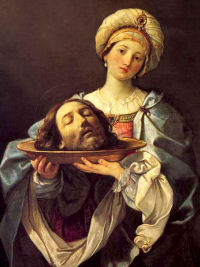 In addition to the feast of the nativity of St. John the Baptist (June 24), the Church, since the fourth century, commemorates the martyrdom of Christ's precursor. According to the Roman Martyrology, this day marks "the second finding of his most venerable head." The body of the saint was buried in Samaria. In the year 362 pagans desecrated the grave and burned his remains. Only a small portion of his relics were able to be saved by monks and sent to St. Athanasius at Alexandria. The head of the saint is venerated at various places. That in the Church of St. Sylvester in Rome belongs to a martyr-priest John. Also in the Dominican church at Breslau the Baptist's head is honored.
—Excerpted from The Church's Year of Grace, Pius Parsch
There is no doubt that blessed John suffered imprisonment and chains as a witness to our Redeemer, whose forerunner he was, and gave his life for him. His persecutor had demanded not that he should deny Christ, but only that he should keep silent about the truth. Nevertheless, he died for Christ. Does Christ not say: "I am the truth"? Therefore, because John shed his blood for the truth, he surely died for Christ.
Through his birth, preaching and baptizing, he bore witness to the coming birth, preaching and baptism of Christ, and by his own suffering he showed that Christ also would suffer.
Such was the quality and strength of the man who accepted the end of this present life by shedding his blood after the long imprisonment. He preached the freedom of heavenly peace, yet was thrown into irons by ungodly men. He was locked away in the darkness of prison, though he came bearing witness to the Light of life and deserved to be called a bright and shining lamp by that Light itself, which is Christ.
To endure temporal agonies for the sake of the truth was not a heavy burden for such men as John; rather it was easily borne and even desirable, for he knew eternal joy would be his reward.
Since death was ever near at hand, such men considered it a blessing to embrace it and thus gain the reward of eternal life by acknowledging Christ's name. Hence the apostle Paul rightly says: "You have been granted the privilege not only to believe in Christ but also to suffer for his sake." He tells us why it is Christ's gift that his chosen ones should suffer for him: "The sufferings of this present time are not worthy to be compared with the glory that is to be revealed in us."
—Saint Bede the Venerable

ST. PAUL, Minn. (OSV News) — Archbishop Bernard A. Hebda told media Aug. 27 that prayers offered from around the United States and world, including from Pope Leo XIV, have been “a source of hope” following that morning’s school shooting during Mass at Annunciation Catholic School in Minneapolis that left two children dead and 17 other victims injured.
“Brothers and sisters, we have to be men and women of hope,” said the archbishop, who leads the Archdiocese of St. Paul and Minneapolis. “It’s through prayer and that ‘prayer of the feet’ — through action — that we can indeed make a difference.”
Archbishop Hebda joined Annunciation Catholic School Principal Matt DeBoer and other city and state leaders in a media briefing outside Annunciation Catholic School and the adjacent Annunciation Catholic Church. Minnesota Gov. Tim Walz, Minneapolis Mayor Jacob Frey and Minneapolis Police Chief Brian O’Hara were present and also spoke at the afternoon press conference.
Speaking as the church bells tolled, Archbishop Hebda noted that “the bell in a Catholic church is always a call to prayer. … It’s a reminder to be praying.”
He commended DeBoer, Annunciation’s pastor Father Dennis Zehren, and Deacon Kevin Conneely for “how valiant” they and their staff were in responding to the tragic school shooting.
“How sad it is … not only for the families who are directly involved, but indeed for families everywhere who feel the threat that comes from an event, a tragedy like today’s,” he said.

Archbishop Hebda read in full that day’s message from Cardinal Pietro Parolin, Vatican secretary of state, that expressed Pope Leo’s prayers and “spiritual closeness” to the victims.
“We know that the Holy Father, Pope Leo, did his hospital training right here in Minneapolis, so he knows our community, and he’s been reminding anybody visiting from Minnesota that he spent some time here,” he said. “We’re very grateful for his blessing, but I … ask that you would continue to look for those ways of supporting those who have been impacted today, not only with your prayers, but also with your action.”
A 23-year-old gunman shot from the outside of the church through windows at the Mass attendees with a rifle, shotgun and pistol, killing two children, ages 8 and 10, before committing suicide. Among the 17 injured were 14 children, all expected to survive. Three adults who were shot were parishioners in their 80s.
Speaking immediately before Archbishop Hebda, DeBoer commended his staff for their actions during the school shooting and told his school community, “I love you.”
“You’re so brave, and I’m so sorry this happened to us today. Within seconds of this situation beginning, our teachers were heroes,” he said. “Children were ducked down. Adults were protecting children. Older children were protecting younger children, and … it could have been significantly worse without their heroic action.
“This is a nightmare,” he continued, “but we call our staff the dream team and we will recover from this. We will rebuild from this. … We as a community have a responsibility to make sure that no child, no parent, no teacher ever has to experience what we’ve experienced today.”

