US Catholics support progressive policies on 'culture war' issues, new study finds
Twice as many US Catholics identify as conservative than do as liberal, finds a new Religious Landscape Study by the Pew Research Center

Advocates of same-sex marriage cheer during a rally outside the 9th Circuit Court of Appeals in San Francisco on Feb. 7, 2012, moments before hearing the court's decision on Proposition 8. By a 2-1 vote, a three-judge panel struck down the California ban on same-sex marriage, saying that it violates the 14th Amendment to the U.S. Constitution. (CNS/Reuters/Beck Diefenbach)

by Heidi Schlumpf
February 26, 2025
Majorities of U.S. Catholics support progressive policies on "culture war" issues, such as abortion and gay marriage, according to a new survey of the country's religious landscape. Still, twice as many Catholics describe themselves as conservative than identify as liberal.
For example, nearly three quarters of Catholics believe homosexuality should be supported by society, 70% support same-sex marriage and 59% want abortion legal in all or most cases. Almost four in 10 Catholics said greater acceptance of people who are transgender is a change for the better. Acceptance of progressive policies has increased among Catholics, for the issues tracked over time.
In general, however, the more religious Americans are, the more likely they are to express traditional views, especially about gender roles, the study found.
The Religious Landscape Study — the third conducted by the Pew Research Center over the past 17 years — also looked at religious identification, spiritual beliefs and practice, the role of religion in family life and religion's place in society. Previous surveys were in 2007 and 2014. The latest iteration was delayed because of COVID.
Religion and political affiliation
The survey found that the trend continues of "political/religious sorting" — in which conservatives and Republicans tend to be more religious, and Democrats and liberals tend to be less so. The share of self-described political liberals who identify as Christians has fallen 25 percentage points since 2007, the report said [see the Pew Research Center graphic below].
In addition, higher levels of religious engagement are related to leaning toward the Republican Party, with Black Americans as a notable exception. At all levels of religiousness, most Black respondents identified with the Democratic Party. Hispanic Americans, Asian Americans and Americans of other races and ethnicities are also somewhat politically divided depending on religiosity, but the gaps are not as wide as with white Americans.
Among Catholics as a whole, 49% said they identify as Republican or lean Republican, compared to 44% who are Democrats or lean Democratic. Catholics' rates of conservatism are slightly higher than those of U.S. adults as a whole. The largest group of Catholics identify as moderate.
Hispanic Catholics favor the Democratic Party, however, while white Catholics favor the GOP. For decades, the Catholic vote in presidential elections had been evenly divided, until Donald Trump garnered as many as 58% of Catholics in 2024, according to exit polls.
"In terms of politics, the report suggests that many religious communities have become more homogenous politically, thus generating less internal controversies over political issues," said John C. Green, distinguished professor of political science at the University of Akon and a senior fellow with Pew Research Center.
This is especially true among evangelical Protestants and members of the Church of Jesus Christ of Latter-Day Saints (Mormons) on the conservative/Republican side, and of members of non-Christian religions and the unaffiliated on the liberal/Democratic side.
Government aid, immigration, environment
Catholics are not so easily categorized, given the majorities who support same-sex marriage and legal abortion. For some issues, however, political party affiliation seems to be more influential than religious teachings.
Catholics are actually less likely than the general population to believe the government should increase help to people in need, and more likely than Americans as a whole to support cutting assistance. In general the more religious people are, the less likely they are to support government aid to the needy, the study found.
Catholics' views on immigration are mixed. While a majority of Catholics are positive about the United States' openness to people from around the world, again their views are slightly more negative than the general population. Four in 10 Catholics say a growing population of immigrants has been a change for the worse. In general, white Americans and those who are highly religious are more likely to be negative about the country's diversity.
Survey questions designed to distinguish a "stewardship" mindset from a "dominionist" one on environmental issues found that many Americans hold both views. Catholics were more likely to agree with the stewardship statement that "God gave humans a duty to protect and care for the Earth" and to believe that stricter environmental regulations are worth the cost.
Family values and religiosity
A majority of Americans, and Catholics, support women in the paid workforce, but Catholics are more likely than the general population to say children with two parents are better off when a parent stays home to focus on the family. A quarter of Catholics believe that should be the mother.
Views about traditional, patriarchal gender and family arrangements are key to understanding recent religious trends, Penny Edgell, professor of sociology at University of Minnesota, said at a Feb. 19 press conference presenting the survey findings.
A rejection of traditional gender and family beliefs is contributing to a decline in commitment to mainstream religious institutions, she said. "It's not an effect of this polarization; it's driving it."
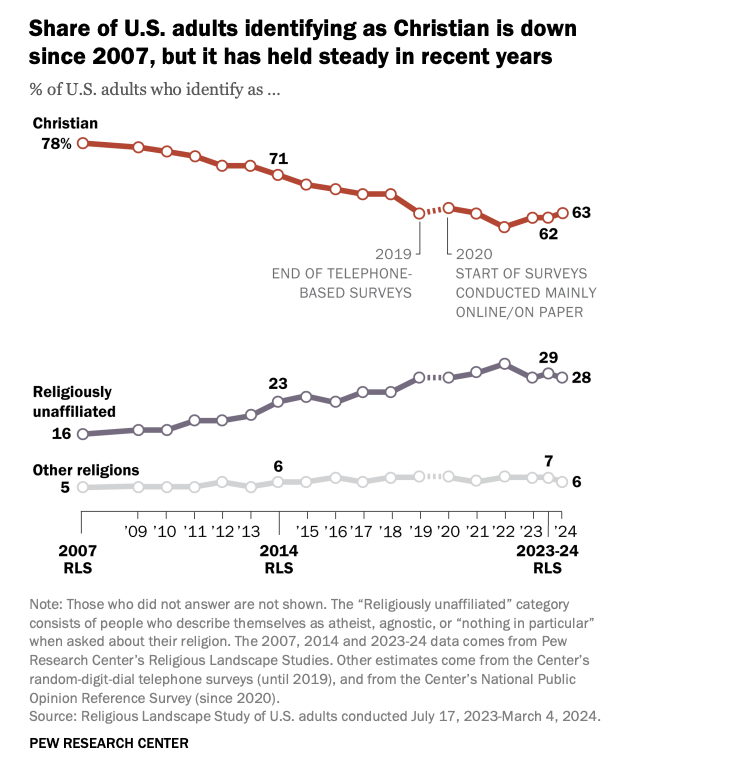
But the latest Pew survey found that the Christian population of the country has been relatively stable since 2019 and the rise of the "nones" or religiously unaffiliated has leveled off, for now.
"After many years of decline, it's very striking … to observe this recent period of stability in American religion," said Gregory A. Smith, senior associate director of research at Pew.
Nearly two thirds of respondents identify as Christians; almost 30% as unaffiliated and 7% belong to religions other than Christianity. The number for Catholics, who make up 19% of the population, are down significantly since 2007, but have been stable since 2014, the report says [see the Pew Research Center graphic below].
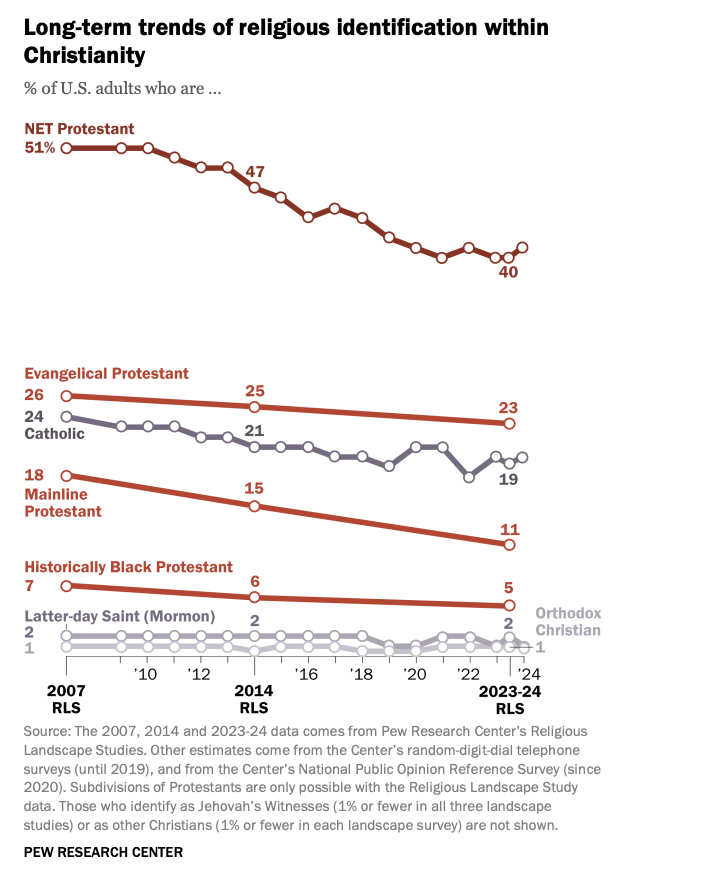
But further declines in the religiousness of the American public are likely, as young adults are far less religious than older adults and the "stickiness" of religious upbringing seems to be declining, the report said.
"The forces that undergirded the long-term declines we've seen in American religion are still in place, namely young adults continue to come of age with lower levels of religiousness than their elders, who themselves have grown less religious over time," Smith said.
The survey also found that some religious practices, such as praying and going to religious services, have held fairly steady in recent years. Large majorities maintain spiritual beliefs, in God, that people have a soul or spirit, that there is something spiritual beyond the natural world.
Among Catholics, less than half say religion is very important in their lives, and only 29% say they attend services weekly or more often. Four in 10 say they attend monthly or more often. Nearly half of Catholic attenders go to Mass at a church in which all or most other congregants are white, the report said. Just over a quarter of Catholic attenders go to a church that is mostly Hispanic or Latino, while one in five say they attend a church where no racial group makes up a majority.
Just over half of Catholics say they pray daily, although this is down from 2007 and 2014. Only a third of Catholics say they ever read Scripture outside of church and less than a quarter participate in prayer groups, scripture-study groups or religious education programs.
The infographics are from Pew Research Center's report on its third Religious Landscape Study.


