Showing posts with label Chaldean Catholics. Show all posts

Tuesday, March 10, 2026

Cardinal Sako resigns as Patriarch in Iraq


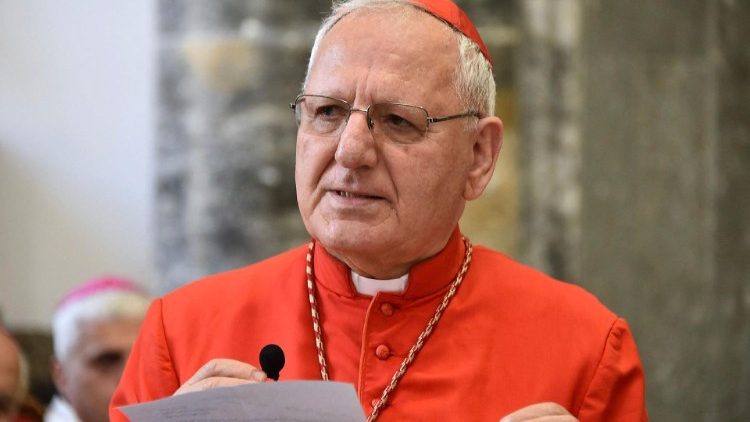
File photo of Cardinal Louis Raphaël SakoFile photo of Cardinal Louis Raphaël Sako  (AFP or licensors)

Cardinal Sako resigns as Chaldean Patriarch of Baghdad

Cardinal Louis Raphaël Sako, whose resignation as the Chaldean Patriarch of Baghdad has been accepted by Pope Leo XIV, issues a letter reflecting on his years of his ministry in Iraq, saying he led the Chaldean Catholic Church under extremely difficult circumstances and amid great challenges.

Vatican News

Pope Leo XIV has accepted the resignation submitted by Cardinal Louis Raphaël Sako from the office of Patriarch of Baghdad of the Chaldeans, in accordance with Canon 126 §2 of the Code of Canon Law of the Eastern Churches (CCEO).

Cardinal Sako’s letter

In a letter released on Tuesday, the Cardinal explains that he had considered resigning already two years ago, upon turning 75, had discussed it then with Pope Francis, and had been encouraged by him to remain.

The decision to submit his resignation to Pope Leo XIV—to be able to “dedicate himself quietly to prayer, writing, and simple service”—and to explain it in a letter “to avoid any misunderstanding,” confirms that he was not forced by anyone to do so and requested to resign voluntarily.

“I have led the Chaldean Church under extremely difficult circumstances and amid great challenges,” Cardinal Sako writes. “I have preserved the unity of its institutions and have spared no effort to defend it.”

Likewise, the Cardinal declares that he has acted for “the rights of Iraqis and Christians, taking a stand and maintaining a presence both inside and outside the country.”

A new Patriarch who believes in renewal

The Cardinal recounts that his 13 years of service in Baghdad “have been years of loving pastoral care, accompaniment, and growth,” thanking God “for the grace of love” granted to him, his family, those who have lived with him during the years he served as a priest in Mosul, Bishop in Kirkuk, and Patriarch in Baghdad, and his assistants.

“In these difficult times, I hope that the leadership of the Chaldean Catholic Church will be entrusted to a patriarch who possesses solid theological knowledge, courage, and wisdom,” Cardinal Sako hopes.

He also insists that in the Chaldean See of Baghdad, it is necessary to have “someone who believes in renewal, openness, and dialogue, and who also has a sense of humor.”

The testament

Finally, in the letter, the Cardinal reveals that he wrote his will while still a priest and has renewed it several times, adding that he possesses “about forty million Iraqi dinars, five thousand U.S. dollars, and five thousand euros” collected from “salaries over 52 years of priestly service, in addition to what was obtained from selling the family house in Mosul.”

Cardinal Sako further declares that he does not own a house or a car and that his “true wealth” is his “devoted service and the 45 books and numerous articles” he has published.

Thursday, July 25, 2024

Chaldean Catholic Cardinal reaffirms strong NO to same-sex unions


Chaldean Catholic Church reacts 7 months after gay blessings: will not give them 7 months later this important Catholic community reacted by replying to the statement of the Dicastery for the Doctrine of the Faith 

 (ZENIT News / Baghdad, 07.24.2024).- Cardinal Louis Raphaël Sako, Patriarch of the Chaldean Catholic Church, has reaffirmed the Church’s stance against blessing same-sex unions, asserting that such actions are inconsistent with Catholic teachings. On July 22, following the deliberations of the Chaldean Synod, the Church’s position was made unequivocally clear: «The Chaldean Church in Iraq and worldwide does not recognize same-sex unions as marriage. The legitimate and correct form of marriage for the Church is between a man and a woman, and therefore, we will not bless homosexual unions to preserve the sanctity of marriage, which is one of the seven sacraments.» Responding to further inquiries from Per Mariam, Cardinal Sako reiterated this position: «For us Chaldean Catholics, the blessing of a marriage is a sacrament, not merely a blessing. We cannot confer this sacrament on LGBT individuals. However, if an individual requests a prayer, we are willing to offer it, as we do for any person.» A few days earlier, Cardinal Sako had called on the Chaldean community to «return to the source of their authentic Chaldean spirituality.» He emphasized the importance of being «a star that leads people to Christ in our daily lives.» The Chaldean Catholic Church is one of the 23 Eastern Catholic Churches in communion with the Pope, enjoying autonomy in areas such as canon law. The Church holds significant importance in the Middle East, particularly in Iraq, where it maintains a notable presence. On December 18, 2023, the Dicastery for the Doctrine of the Faith issued the Fiducia Supplicans Declaration, which permits non-sacramental blessings for irregular couples. Seven months later, the Chaldean Catholic Church has responded, affirming its commitment to traditional marriage doctrine.

Chaldean Catholic Church reacts 7 months after gay blessings: will not give them | ZENIT - English

Wednesday, July 10, 2024

Hope grows for thr Catholics in Iraq


10 years after ISIS invasion, Christians in Iraq given ‘sign of hope’


As Iraq’s Nineveh Plains marks the 10th anniversary of the invasion by the so-called Islamic State (ISIS), the Christian community continues to live with the trauma of the tragic event.

Yet despite the efforts of the Islamist group to eradicate the Christian population, they are slowly rebuilding their presence in the area.

“Words cannot describe what we experienced 10 years ago, ISIS tried to eradicate us, but they failed”, said Syriac Catholic Archbishop Nizar Semaan of Adiabene in Northern Iraq.

“The people here are like olive trees. You can cut them, burn them, but after 10 or 20 years they will continue to give fruit. They tried everything, but we remain, and as a Church we do everything to give a sign of hope,” he said during an online conference organized by the international Catholic charity Aid to the Church in Need (ACN).

Chaldean Archbishop Bashar Warda of Erbil, Bashar Warda told the conference the current threat of a regional conflict involving Israel, Hamas, Lebanon and perhaps even Iran has Christians in the Middle East on edge.

“The tension is high between certain parties, very high, and it gives you the impression that something might happen that you have to be careful about, and be well prepared, but right now we have not seen that conflict become violent,” he said.

Semaan said even though ISIS itself no longer poses a serious threat to the Christian community, religious tensions are still there.

“ISIS didn’t want us here, but it didn’t want the Shias either. The problem with Iraq is that we are trying to create isolated islands for each community, with no common life. This is dangerous. You can live wherever you want, you can be proud of your identity, but don’t close your island to other people,” he said.

“There are two ways to get rid of this mentality: Firstly, we have to focus on education, not only with Christian schools, but we have to put pressure on the government to have a moderate education system to encourage people to respect others. The second way is to have a constitution built on humanity, not on religion. This will help the Christians to stay in Iraq, to get rid of this fear. We are always afraid. Whatever happens around us, Lebanon, Gaza, anywhere, the Christians are always affected,” Semaan said.

Warda told the conference Church leaders in Iraq are trying to end this attitude and said Christians – who have international help – were asked to provide aid to Muslims and the Yezidis in refugee camps.

“After the defeat of ISIS, we established the Pope Francis Scholarship Program, and we asked ACN if we could include Yezidis and Muslims in desperate need. It is my belief that we evangelize by sharing this goodness with the people, by showing them the gospel of solidarity. We let them breathe Christ through the works of kindness that we share with them,” the archbishop said.

The ACN sponsored rebuilding projects, which Warda said had positive results in securing the Christian population.

“In 2014, we had 13,200 families registered, 11,000 of these families stayed; 9,000 of those went back later to Nineveh. This is something to be thankful for. The 2,000 that left must have gone to Jordan, Lebanon and Turkey, and then on to the west,” he said.

Semaan noted that only half the Christians from Qaraqosh, the largest exclusively Christian town in Iraq, stayed after the ISIS occupation.

“Before ISIS we had 50,000 people in Qaraqosh, and now we have maybe 25,000,” he told the conference.

The two archbishops told the conference no matter what the difficulties and hardships the Christians in Iraq faced, their faith and love for the Church were never a matter of dispute.

“When we set up theological courses for the young displaced, to study and reflect on our faith, over 300 people registered. You have to understand that the people are very much attached to the Church, when they have a problem with the police, or a medical situation, they don’t go to the elected officials, or to the political parties, they come to the bishop,” Warda said.

“That is why I encourage you to help the Church pastorally, because if the Church is strong, the community will stay. If the priest leaves, the community will leave. The families stayed when they saw their shepherd with them. Here in Iraq, whatever families experience, they come to the Church, and there are no schedules, people will call at any time, and the priest will respond. You can’t say this is just a spiritual center for mass and prayer, everything is related,” he explained.

Michael Kelly, the Director of Public Affairs for the Irish office of Aid to the Church in Need, said the tenth anniversary of the ISIS invasion of Iraq is “sobering to think about the challenges still facing the Christian community there.”

“While ISIS are gone, the people of Iraq continue to live with the trauma of those dreadful experiences. It is heartening that thousands of Christians have returned to houses in the Nineveh Plains rebuild with the help of Aid to the Church in Need,” he told Crux.

“What is inspiring, is the deep love that the Christians of Iraq have for their Faith and their priests and bishops. The witness of the priests and bishops who are constantly available to their people is truly wonderful – a huge example of pastors with what Pope Francis describes as ‘the smell of the sheep’,” he said.

“When ISIS came, we feared that this would drive Christians from their homeland for good. It is great that about half of those displaced have come back, but it is still important to remember that half of the Christians from the Nineveh Plains have not returned,” Kelly said.

Regina Lynch, Executive President of Aid to the Church in Need International, told Crux that after the ISIS invasion, Christians fled to Iraq’s Kurdistan region, “where they were at least safe, but most of them had nothing to their name.”

“ACN was the first international organization to go to their assistance. Over the following years we helped first to secure the basic needs of the displaced, then housing, and finally the rebuilding of their homes, so that those who wished to return to their towns and villages could do so, once ISIS had been pushed back,” she said.

Follow Charles Collins on X: @CharlesinRome
Saturday, March 6, 2021

Pope Francis celebrates Divine Liturgy with the Chaldeans in Iraq


Pope at Divine Liturgy in Iraq: World is changed by Beatitudes, not power

Pope Francis celebrates the Divine Liturgy with Chaldean Catholics in Saint Joseph’s Cathedral in Baghdad. He delivers a homily explaining how witnessing to love in the Beatitudes helps fulfil God’s promises.

By Robin Gomes

Pope Francis on Saturday told Iraq’s Catholics that they are precious in the eyes of God because they witness to the Beatitudes of Jesus in their daily life. He said they are witnesses who, by living the Beatitudes, are helping God fulfil His promises of peace.

The Pope made the observation in the homily during his first public Eucharistic Celebration, called the Divine Liturgy in the Chaldean rite and in other Eastern rites, which he presided over in the evening in Saint Joseph’s Chaldean Cathedral in the capital, Baghdad.

He based his homily on the day’s reading on the Beatitudes from St. Matthew’s Gospel, and explained the wisdom of the Beatitudes and how they are practiced in daily life to help fulfil God’s promises.

Wisdom of the Beatitudes

The Pope pointed out that the search for wisdom has always attracted men and women. But often those with more means can acquire more knowledge and have greater opportunities, while those who have less are side-lined.

“Such inequality, which has increased in our time,” the Pope said, “is unacceptable." However, the Book of Wisdom reverses this logic, when its says, “the lowliest may be pardoned in mercy, but the mighty will be mightily tested.” The more powerful are subjected to rigorous scrutiny, while the least are God’s privileged ones. 

And Jesus, who is Wisdom in person, brings about this total reversal with the Beatitudes. The poor, those who mourn, the persecuted are all called blessed.

It is no longer the rich that are great, but the poor in spirit; not those who can impose their will on others, but those who are gentle with all; not those acclaimed by the crowds, but those who show mercy to their brother and sisters. 


Love: the heart of the Beatitudes

The Pope explained that the invitation of Jesus to love, which is the heart of the Beatitudes, even if it seems weak in the world’s eyes, in fact always triumphs.

On the Cross, love proved stronger than sin, and in the tomb, it vanquished death. It is the same love that made the martyrs victorious in their trials, Pope said, adding that in the last century there have been many more martyrs than in the past.

Love has also been the strength of Iraq’s Christians, who have suffered prejudice and indignities, mistreatment and persecutions for the name of Jesus. St Paul emphasizes this point in the second reading of the Divine Liturgy, when he tells the Corinthians, “Love never ends.”

“While the power, the glory and the vanity of the world pass away,” the Pope said, “love remains.”  The practice of the Beatitudes asks us to become witnesses, day after day, by living meekly, showing mercy and by having a pure heart. “Witness is the way to embody the wisdom of Jesus,” the Pope emphasized, adding that the world is changed “not by power and might, but by the Beatitudes”. 


Love is patient

St Paul further explains how one can bear witness to the love of Jesus. Love seems synonymous with goodness, generosity and good works, yet Paul says that “love is patient.”

First and foremost, the Bible speaks of God’s patience with men and women who throughout history have been unfaithful, falling into the same old sins, said the Pope. Yet the Lord always remained faithful, forgave and began anew. This patience to begin anew each time is the first quality of love. It does not get discouraged, give up, or surrender, but stays creative and responds to evil with good. God’s witnesses, the Pope said, are not passive or fatalistic but are constantly hopeful.

In the face of adversity, the Pope explained, there are always two temptations – either to run away and keep aloof, or react with anger and show force.  This was the case of the disciples in Gethsemane when many fled and Peter drew his sword. Yet neither flight nor the sword achieved anything.

Jesus, on the other hand, changed history with the humble power of love, with His patient witness, which is what we are called to do; and this is how God fulfils His promises.


Promises of the Beatitudes

The wisdom of Jesus embodied in the Beatitudes, the Pope continued, calls for witness and offers divine promises, such as the kingdom of heaven, comfort, satisfaction or seeing the face of God, which guarantee unrivalled joy and never disappoint.

The Pope said they are fulfilled through our weaknesses and inner poverty, and the Biblical figures, such as Abraham and his wife Sarah, Moses, Our Lady and Peter are proof of this.

The Pope thus urged Iraq’s Christians never to give in to feeling helpless and useless, saying “God wants to work wonders precisely through our weaknesses.”

In conclusion, Pope Francis thanked God with and for the Christians of Iraq, for the many witnesses “in our own time,” who are “often overlooked by the news," yet are "precious in God’s eyes.” They are “witnesses who, by living the Beatitudes, are helping God to fulfil His promises of peace.”