Showing posts with label Didache. Show all posts

Tuesday, February 4, 2014

The real reality of the Real Presence


The Early Christians Believed in the Real Presence

"So then, brethren, stand firm and hold to the traditions which you were taught by us, either by word of mouth or by letter." (2 Thes. 2:15)

"And what you have heard from me before many witnesses entrust to faithful men who will be able to teach others also." (2 Tim. 2:2)
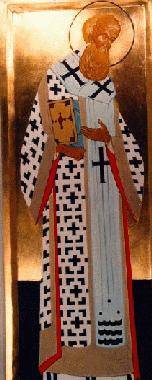
Icon of an Early Church Father
The BibleThe DidacheSt. Clement of Rome
St. Ignatius of AntiochSt. Justin MartyrSt. Irenaeus of Lyons
St. Clement of AlexandriaSt. Cyprian of CarthageAphraates the Persian Sage
SerapionSt. EphraimSt. Athanasius
St. Cyril of JerusalemSt. Hilary of PoitersSt. Basil the Great
St. Epiphanius of SalamisSt. Gregory of NazianzSt. Gregory of Nyssa
St. John ChrysostomSt. Ambrose of MilanEgeria
Aurelius Prudentius ClemensSt. JeromeApostolic Constitutions
St. Cyril of AlexandriaSt. AugustineMarcarius the Magnesian
St. Leo ISt. Caesar of ArlesSt. Fulgene of Ruspe


INTRODUCTION

Many Catholics and non-Catholics alike think that the Roman Catholic Church invented the doctrine of transubstantiation. Transubstantiation means that the bread and wine presented on the altar at the Mass become the the Body and Blood of Christ by the power of the Holy Spirit at the consecration. The consecration is the time when the priest calls upon the Holy Spirit to change the bread and wine into Christ's Body and Blood. However, the Body and Blood retain the appearance of bread and wine. The Roman Catholic Church, that is, the Latin Rite Catholic Church, and other Catholic Churches in communion with Rome believe that the Eucharist is the Real Presence of Jesus Christ, body, blood, soul and divinity. The Orthodox Churches and most other Churches of the East do so as well. Anglican [Episcopalian] and other Protestant denominations have interpreted Christ's presence at the celebration of the Lord's Supper or Eucharist to be either only spiritual, or symbolic, or non-existent. Thus, I decided to research what the Early Christians believed on this issue. I searched the indices for "Eucharist" in many volume sets on Early Christian writings, and I was astonished at my discovery. The Early Christians actually took the Real Presence for granted. It doesn't even seem as if there was much debate. I could not find anyone who denied the Real Presence of Our Lord in the Blessed Sacrament before the year 500 A.D. Following are the results of my search. Some Christians, e.g. St. Augustine, had very much to say about the Real Presence of Our Lord, so I did not include everything. Also, I want you to know that I did not include other Christians who believed in the Real Presence in this article because they later fell away from the Church for different reasons. Therefore, even though these Christians defended the Real Presence, e.g. Origen, Tertullian, Theodore of Mopsuetta, etc., I did not include their statements. I pray that this research article will inspire lukewarm Catholics to become excited about their Faith which has faithfully been passed on for over 2000 years. I pray that the Holy Spirit will grant you Faith to believe in Our Lord in the Blessed Sacrament and to receive Him at Mass and visit Him in the tabernacle. He is patiently waiting for you because he loves you and wants you to come home. Also, I pray that this research article will motivate non-Catholics to ask questions about the Blessed Sacrament to learn more. Our Lord is still with us in the flesh, and He is awesome! I pray that someday you will be able to experience the joy of receiving Him in the Mass and of praying at his feet.

THE BIBLE

"The cup of blessing which we bless, is it not a participation in the blood of Christ? The bread which we break, is it not a participation in the body of Christ? Because there is one bread, we who are many are one body, for we all partake of the one bread."
-1 Cor. 10:16-17
"For I received from the Lord what I also delivered to you, that the Lord Jesus on the night when he was betrayed took bread, and when he had given thanks, he broke it, and said, 'This is my body which is for you. Do this in remembrance of me.' In the same way also the cup, after supper, saying, 'This cup is the new covenant in my blood. Do this, as often as you drink it, in remembrance of me.' For as often as you eat this bread and drink the cup, you proclaim the Lord's death until he comes. Whoever, therefore, eats the bread or drinks the cup of the Lord in an unworthy manner will be guilty of profaning the body and blood of the Lord."
-1 Cor. 11:23-27

THE DIDACHE

The Didache or "The Teaching of the Twelve Apostles" is a manuscript which was used by 2nd century bishops and priests for the instruction of catechumens. Many early Christian writers have referenced it making this document relatively easy to date.
"Let no one eat and drink of your Eucharist but those baptized in the name of the Lord; to this, too the saying of the Lord is applicable: 'Do not give to dogs what is sacred'".
-Ch. 9:5 "On the Lord's own day, assemble in common to break bread and offer thanks; but first confess your sins, so that your sacrifice may be pure. However, no one quarreling with his brother may join your meeting until they are reconciled; your sacrifice must not be defiled. For here we have the saying of the Lord: 'In every place and time offer me a pure sacrifice; for I am a mighty King, says the Lord; and my name spreads terror among the nations.'"
-Ch 14


And so much more:    http://www.therealpresence.org/eucharst/father/a5.html

Friday, August 20, 2010

One of Christianity's best kept secrets: The Didache

>>>Along with many other writings of Church Fathers, the Didache points out that the Catholic Church has been around since, well since Jesus. A careful study of the Didache and it's role in affirming Scripture and Tradition was a contributing factor to my remaining faithful to Christ's Church when I was exploring my faith life.


Ancient Witnesses to The Catholic Faith: The Didache

By: Msgr. Charles Pope.

The Didache is one of the earliest written documents of the Church other than Scripture itself. It was written sometime between 90 and 110 AD. It may not have had a single author but may have been compiled from the Apostolic Teaching as a kind of early catechism and a summary of the essential moral tenets of the Faith. It’s existence demonstrates that many current teachings of the faith, often under attack by modernity, are in fact very ancient, going right back to the beginning. Let’s take a look at some excerpts from the Didache that are especially pertinent for today’s controversies.

Sins against life, sexual sins and abortion: You shall not commit murder, you shall not commit adultery, you shall not commit pederasty, you shall not commit fornication, you shall not steal, you shall not practice magic, you shall not practice witchcraft, you shall not murder a child by abortion nor kill that which is begotten. (# 2) Hence the teaching against abortion is not recent as some have tried to suggest. It was not proposed in the 1950s, it was not proposed in the Middle Ages. It goes right back to the beginning. “Pederasty” refers to a homosexual relationship between an older man and a post pubescent adolescent boy. It is distinct from pedophilia which involves a sexual relationship between an older person and a pre-pubescent child. In the modern sex abuse scandals, proper distinctions have not always been made. Cases of true pedophila are rare compared to pederasty (male homosexual involvement with adolescent boys), and statutory rape (the sexual violation of an underaged post pubescent female by a male). In the Greek world Homosexual activity was a widespread moral evil and the Didache’s specific mention of it (as also with Paul) indicates this. The statutory rape or sexual abuse of young females was probably more rare given the early age of marriage which took place soon after puberty for girls.

That the clergy ought to be worhty and then respected and honored - My child, him that speaks to you the word of God remember night and day; and you shall honour him as the Lord; for in the place whence lordly rule is uttered, there is the Lord (#4)…..Therefore, appoint for yourselves bishops and deacons worthy of the Lord, men meek, and not lovers of money, and truthful and proven; for they also render to you the service of prophets and teachers. Despise them not therefore, for they are your honoured ones (# 15)
That confession of sin should be frequent and precede the reception of Holy Communion and fellowship In the church you shall acknowledge your transgressions, and you shall not come near for your prayer with an evil conscience. This is the way of life. (# 4) It is thus, the long standing practice of the Church that one ought to confess serious sin prior to attending Mass and surely prior to receiving Holy Communion.

That Baptism may be conferred by pouring only if immersion is not easy or convenient – And concerning baptism, baptize this way: Having first said all these things, baptize into the name of the Father, and of the Son, and of the Holy Spirit, in living water. But if you have not living water, baptize into other water; and if you can not in cold, in warm. But if you have not either, pour out water thrice upon the head into the name of Father and Son and Holy Spirit. (# 7) Some, among the Protestants consider that Baptism must be administered by immersion. But this text indicates that in the ancient practice, simply pouring water over the head is sufficient. Living water (i.e. moving water such as in a stream) is preferred. Cold water is preferred over warm but warm water is allowed (perhaps in winter to avoid colds?). And yet, in the end, if such arrangements are not possible a simple infusion of water over the head suffices.

An Early Eucharistic Prayer or Hymn: Now concerning the Eucharist, thus give thanks. First, concerning the cup: We thank you, our Father, for the holy vine of David Your servant, which You made known to us through Jesus Your Servant; to You be the glory for ever. And concerning the broken bread: We thank You, our Father, for the life and knowledge which You made known to us through Jesus Your Servant; to You be the glory for ever. Even as this broken bread was scattered over the hills, and was gathered together and became one, so let Your Church be gathered together from the ends of the earth into Your kingdom; for Yours is the glory and the power through Jesus Christ for ever. But let no one eat or drink of your Eucharist, but they who have been baptized into the name of the Lord; for concerning this also the Lord has said, Give not that which is holy to the dogs. (# 9). This prayer of thanksgiving (Eucharistia) is beautifully preserved in the hymn “Father We Thank Thee.” The contents of this prayer mysteriously do not include the words of Institution (This is my Body….This is my Blood….). However, another more detailed description by Justin Martyr written around the same time does include these words (See video below). Note too that the restriction of the Eucharist to fully initiated Catholics is an ancient practice. The Eucharist, or Holy Communion was not to be shared except by those who had true communion by the Grace of God working through the sacraments. Namely, Baptism and Confirmation which both sanctified and incorporated one into and as a member of the Body of Christ. Holy Communion thus had to be preceded by the Communion effected by Baptism and Confirmation.

That Sunday Attendance at Mass was required – But every Lord’s day gather yourselves together, and break bread, and give thanksgiving after having confessed your transgressions, that your sacrifice may be pure. But let no one that is at variance with his fellow come together with you, until they be reconciled, that your sacrifice may not be profaned (# 14) Again note that attendance is required every Sunday and that such attendance be accompanied by any necessary confession of sins. See how ancient these practices are.

That the practice of the faith must be consistent and that without the practice of it and the attendance and reception of the Holy Mysteries we shall not attain to the holiness necessary to see God. But often shall you come together, seeking the things which are befitting to your souls: for the whole time of your faith will not profit you, if you be not made perfect in the last time….. (# 16).
Thus many of the current practices and teachings of the Church go right back to the beginning. Our Tradition is thus intact and ancient, reaching back to the Apostles and Jesus Christ.