Showing posts with label Scripture. Show all posts

Tuesday, February 17, 2026

Why Ashes on Ash Wednesday as we begin Lent

 The Biblical references to ashes as we prepare for Ash Wednesday:

God tells Adam after, after they disobey God by eating the fruit from the tree: " By the sweat of your face shall you get bread to eat, until you return to the ground, from which you were taken; for you are dirt, and to dirt you shall return."  Genesis 3:19.

When Abrahan was pleading with God on behalf of Sodom and Gomorrah, in total humility Abraham speaks, "see how I am presuming to speak my Lord, though I am but dust and ashes!"  Genesis 18:27.

When the people in Nineveh, after the efforts of Jonah, believed God and needed to repent, we read, "all of them, great and small put on sackcloth.  The King to covered himself with sackcloth and sat in the ashes."  Jonah 3:5-6.

In the book of Job, we see several examples of dust and ashes.  When Job taught his wife that we should accept good things from God; should we not accept evil?  He sat among the ashes.  Job 2:8. Also, they tore their garments and threw dust upon their heads.  Job 2:12. Job pleading his cause cry's out " I am leveled with dust and ashes.  Job 30:19. At the lowest point in his life, Job repents and proclaims, "I disown what I have said and repent in dust and ashes.  Job 42:6.

In the book of Esther we read, "the Jews were in deep mourning, with fasting and weeping, and lament; they all slept on sackcloth and ashes."  Esther 4:3.

Finally, in Ezekiel, over the lament of Tyre, we read, "shouting bitter cries. strewing dust on their heads, rolling in the ashes.  Ezekiel 27:30.

In summary of the Old Testament references to ashes, we see these themes: Repentance, Mourning & Sorrowing, Ritual & Sacrifice.

Additionally, reference to these Old Testament practices, particularly regarding Repentance are again mentioned in Paul's letter to the Romans (12:15) and 1st Peter (5:6).  Jesus makes mention of ashes and dust in the Gospel of Matthew.  

The traditional practice of Ash Wednesday dates back in the early church for over 1,500 years and is mentioned in the Council of Nicea.  By the year 1091, Pope Urban II recommended the use of ashes during the Holy Season of Lent.  Many Church Fathers refer to ashes to repent like Eusebius and Tertullian as well as Pope Zephyrinus in the 4th century.

So, there are real and powerful symbols that we receive ashes on our forehead on Ash Wednesday.

Remember, you are dust and to dust you shall return!


Monday, November 17, 2025

Pope Leo XIV pleads for increased access of the Word of God especially for young people


Pope Leo XIV kisses the book of the Gospels as he begins Rome's diocesan assembly at St. John Lateran on September 19, 2025Pope Leo XIV kisses the book of the Gospels as he begins Rome's diocesan assembly at St. John Lateran on September 19, 2025  (@Vatican Media)

Pope: Young people need easy access to Sacred Scripture

Meeting with the Catholic Biblical Federation, Pope Leo XIV encourages biblical scholars and pastoral ministers to make the Word of God easily accessible to all people, especially in digital spaces so that younger generations can encounter Christ.

By Devin Watkins

Pope Leo XIV met on Monday with the members of the Catholic Biblical Federation, expressing his gratitude for their service to the Word of God.

He reflected on the 60th anniversary of Dei Verbum, the Dogmatic Constitution on Divine Revelation, and the Second Vatican Council’s call for Sacred Scripture to be easily accessible and glorified everywhere.

The Pope said the document conveys “a strong desire, a firm conviction, and a pastoral approach”.

“The teaching of Dei Verbum is unequivocal,” he said. “We are called ‘to hear the Word of God with reverence and to proclaim it with faith,’ and ‘easy access to Sacred Scripture should be provided for all the Christian faithful’.”

The Catholic Biblical Federation shares that same goal, noted the Pope, as it seeks to make the Word of God a key part of pastoral ministry and offer it as a source of dynamic inspiration for the Church.

Pope Leo invited the biblical scholars gathered in Rome to renew their fidelity to their mandate, which he said is “nothing less than the proclamation of the kerygma, the saving mystery of our Lord Jesus Christ.”

The Church, he added, always draws her life from the Gospel by listening with attentive love to Christ.

“From the Gospel, she continually rediscovers the direction for her journey, under the guidance of the Holy Spirit, who teaches all things and reminds us of everything the Son has said.”

Pope Leo XIV then reflected on what the term “easy access” to Sacred Scripture means in our own time.

He noted that the faithful must be encouraged to read the Bible, so as to personally encounter the love of God expressed in human words.

“Today, new generations inhabit new digital environments where the Word of God is easily overshadowed,” he said. “New communities often find themselves in cultural spaces where the Gospel is unfamiliar or distorted by particular interests.”

The Pope invited members of the Catholic Biblical Federation to ask themselves how the Church can best help people who have never heard the Word of God gain access to it.

“I hope these questions inspire in you new forms of biblical outreach, capable of opening pathways to the Scriptures, so that God’s Word may take root in people’s hearts and lead all to live in His grace,” he said.

In conclusion, Pope Leo invited all Christians to become “‘living letters… written not in ink but by the Spirit of the living God,’ bearing witness to the primacy of God’s Word over the many voices that fill our world.”

“May the Blessed Virgin Mary, the Mother of God and the womb through which the Word became flesh,” he said, “teach us the art of listening, strengthen us in obedience to His Word, and guide us to magnify the Lord.”

Saturday, January 25, 2025

This Sunday is Word of God Sunday


Ordinary Time: January 26th

Third Sunday in Ordinary Time, Sunday of the Word of God


The Third Sunday in Ordinary Time is the Sunday of the Word of God, instituted by Pope Francis in 2019. See Note of the Congregation for Divine Worship and the Discipline of the Sacraments on the Sunday of the Word of God.

From today's Gospel:

Jesus returned to Galilee in the power of the Spirit, and news of him spread throughout the whole region. He taught in their synagogues and was praised by all (Luke 4:14-15).

The Optional Memorials of Saints Timothy and Titus, which are ordinarily celebrated today, are superseded by the Sunday liturgy.


Commentary on the Mass Readings for the Third Sunday in Ordinary Time, Year C:
The First Reading is taken from the Book of Nehemiah, 8:2-4a, 5-6, 8-10. Nehemiah and Ezra lived in the time when the people of Israel had been returned to their land after the years of the Babylonian Captivity and it was a time of rebuilding. The people had lost their connections to their faith.

The Second Reading is from the First Letter of St. Paul to the Corinthians, 12:12-30 and refers to the Mystical Body of Christ. St. Paul concludes his description of the different parts of the body by applying it to the Church, where variety of functions does not detract from unity.

The Gospel is from St. Luke 1:1-4; 4:14-21. In the first four verses of St. Luke's Gospel which have been read to you today, you will find reason to be grateful to him. He went to a lot of trouble in order to put in a permanent form, in a written record, the essential facts concerning Christ, his words and his works, so that we "would understand (like Theophilus) the certainty of the faith in which we have been instructed."

But while we must be grateful to St. Luke, we owe a bigger debt of gratitude still to the all-good, all-wise God who moved Luke and the other Evangelists to preserve for us in writing the essential truths of the Christian faith that has been handed down to us. The Apostles were companions of Christ. They witnessed his works and his words; they remembered most of his doings and his sayings, and what they might have forgotten the Holy Spirit recalled to their memory on that first Pentecost day in Jerusalem. The first two generations of Christians received the facts of the faith from these eye-witnesses and the miracles so frequent in the infant Church were confirmation of the truth of their teaching.

But God in his wisdom provided for the many generations to come who would not have this evident confirmation of their faith. He established a teaching body in his Church which would safeguard the purity of the Christian truths, for "he himself would be with it all days," and he gave us a written record of the facts of the faith in the Gospels and the ether writings of the New Testament.

How can we ever thank God sufficiently for his thoughtfulness in our regard? We Christians of today can be as certain, as assured, of the truth of the faith that we are trying to practice as was St. Luke who was converted by St. Paul. We have a living, teaching Magisterium in the Church, which authentically preserves and interprets for us the true facts of Christ's teaching and works as written down for us by a first-generation Christian under the impulse and guidance of God's Holy Spirit. If we needed further proof of the priceless value of our New Testament Books, the virulent attacks on their authenticity, on their objectivity, and on their veracity, by enemies of the faith down to and including our own day, should be sufficient.

But they have stood the test of time and the onslaughts of biased, prejudiced criticism, for they are the word of truth, which is eternal, and comes from God.

We have a priceless gift of God in the inspired Books of the Bible. Let us show true appreciation for that gift by using it to build up a better knowledge of the Christian faith which it teaches us. There should be a Bible, or at least the New Testament, in every Christian home. It should not be an ornament on a shelf, but a fountain and source from which we can draw strength and refreshment in the daily practice of our Christian faith. Almost two thousand years ago, God's infinite goodness provided this source of strength, the "fountain of living water," for us Christians of this century. Are we grateful for his thoughtfulness? Are we nourishing our faith at this blessed fountain of his infinite wisdom and love?
—Excerpted from The Sunday Readings by Fr. Kevin O'Sullivan, O.F.M.

Friday, August 2, 2024

Olympic Skateboarder from Brazil quotes John 14:6 in sign language after winning a bronze medal


Olympic skateboarder uses sign language to quote Scripture before winning bronze


Brazil’s Rayssa Leal reacts as she competes in the women’s street skateboarding final during the Paris 2024 Olympic Games at La Concorde in Paris on July 28, 2024. | Credit: KIRILL KUDRYAVTSEV/AFP via Getty Images

Rayssa Leal, a 16-year-old Brazilian skateboarder competing in the Paris Olympics, used sign language to quote Scripture before winning the bronze medal in the competition.

Leal, a Christian, won the bronze medal in the women’s street skateboarding final on July 28. At one point during the competition, Leal smiled into the camera and signed John 14:6, which reads: “Jesus said to him, ‘I am the way, and the truth, and the life. No one comes to the Father except through me.’”

The expression of faith was noteworthy given that French Olympians are barred from displaying religious symbols due to France’s secularism principle. In fact, Rule 50 of the International Olympic Committee charter states the importance “on both a personal and a global level, that we keep the venues, the Olympic Village, and the podium neutral and free from any form of political, religious, or ethnic demonstrations.”

Speaking to reporters following her win, Leal recounted her dreams “of becoming a skateboard athlete” from a very young age.

“And here I am, with a second Olympic medal from the Games,” she continued. “Once again, thank God I won a medal. I’m very happy to be here.”

Leal first rose to fame at age 7 when a viral video of her skateboarding in a blue fairy princess costume was shared by skateboarder Tony Hawk. She was also the youngest Brazilian to ever participate in the Olympics when she won the silver in street skateboarding at just 13 years old in 2021.

The skateboarder often thanks God and cites Scripture on her Instagram page. Her July 29 post featured a section of Joshua 1:9: “Didn’t I command you? Be strong and courageous! Don’t get carried away or discouraged.”

Regarding her religious gesture at the games, Leal told the Brazilian media outlet UOL that “I did it because I do it in every competition.”

“For me it is important; I am Christian, I believe a lot in God,” she stated. “There I asked for strength and sent a message to everyone, that God really is the way, the truth, and the life.”

Thursday, April 11, 2024

Pope Francis reflects on Jesus' example in Scripture of compassion to those suffering


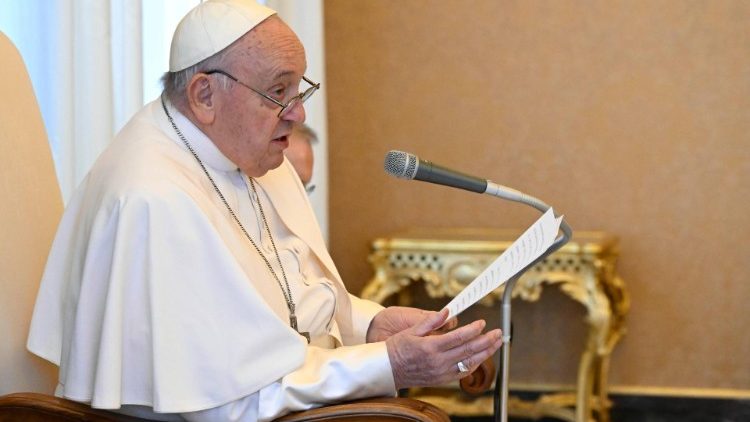
Pope Francis speaks with members of the Pontifical Biblical CommissionPope Francis speaks with members of the Pontifical Biblical Commission  (VATICAN MEDIA Divisione Foto)

Pope Francis: ‘Bible shows Jesus’ closeness to suffering humanity’

Pope Francis meets with members of the Pontifical Biblical Commission, and encourages biblical scholars to explore Jesus’ example of compassion and inclusion when faced with the suffering of others.

By Devin Watkins

The Pontifical Biblical Commission concluded its annual plenary assembly in Rome on Thursday, which focused on the theme of illness and suffering in the Bible.

Pope Francis met with members of the Commission to commend their work to explore this “deeply existential theme” that touches the life of every human person.

“Our wounded nature,” he said, “bears within itself the realities of limitation and finitude, and suffers the contradictions of evil and pain.”

Trasforming the ‘sieve of suffering’

The Pope said the topic of human suffering and illness is close to his heart, since these issues are “adversaries” that every Christian is called to confront in a humane way.

Rather than avoiding the topic of suffering like a taboo, he said, we should endure trials “by living in relation with others” and allow God to turn “the sieve of suffering” into an opportunity to mature and grow in faith.

Jesus, said Pope Francis, “exhorts us to take care of those living in situations of infirmity, with the determination to defeat illness. At the same time, He gently invites us to join our sufferings to His salvific offer, as a seed that bears fruit.”

Touching suffering, not offering trite words

Turning to the theme of compassion, the Pope noted the many Biblical passages in which Jesus is moved by those He meets who are suffering, such as the exhausted crowd which He feeds, the blind who beseech Him, and the many sick people whom He welcomes and heals.

“Jesus does not explain suffering but bends towards those who suffer,” said the Pope. “He does not approach pain with generic encouragement and sterile consolations, but accepts its drama, allowing Himself to be touched by it.”

Sacred Scripture, he added, does not offer us a “recipe book of feelings” or a handbook of prepared phrases to say to people in pain.

As is clear in the book of Job, the Bible “shows us faces, encounters, and concrete stories” that break the mould of “religious theories that link suffering with divine punishment.”

Christ, said the Pope, transformed human suffering by making it His own and offering it to the Father as a “gift of love.”

“Whoever assimilates Sacred Scripture,” he said, “purifies the religious imagination from wrong attitudes, learning to follow the path indicated by Jesus: to physically touch human suffering, with humility, gentleness, and seriousness, in order to bring, in the name of the incarnate God, the closeness of a salvific and concrete support.”

Antidote to self-closure in trials

Pope Francis then turned to the theme of “inclusion,” noting that the term is not found in the Bible but saying it “expresses a prominent trait of Jesus’ style.”

He said the Lord excluded no one from God’s salvation but rather welcomed all and offered everyone “total healing, in body, soul, and spirit.”

“Through the experience of suffering and illness,” said the Pope, “we, as the Church, are called to walk together with everyone, in Christian and human solidarity, opening opportunities for dialogue and hope in the name of common fragility.”

In conclusion, Pope Francis invited the members of the Pontifical Biblical Commission to delve into the topic of compassion and inclusion “with critical rigor and fraternal spirit.”

“The Word of God is a powerful antidote to every closure, abstraction, and ideologization of faith,” he concluded. “Understood in the Spirit in which it was written, it increases passion for God and man, ignites charity, and revives apostolic zeal.”

Sunday, January 21, 2024

For Word of God Sunday the incredible and excellent Scripture references all throughout the Holy Mass


Who says Catholics don’t hear the Bible at Mass?

Mark Haas


In fact, Scripture is cited more than 100 times.

Perhaps you have heard the common criticisms that “Catholics never read Scripture … Why don’t Catholics have the Bible with them at Mass? … The Bible is the Word of God, and Catholics don’t hear it regularly.”

Well, I would propose that Christians hear more Scripture at Catholic Mass than in any other form of worship.

The natural “go-to” response from Catholics to the above criticism is a reference to the Liturgy of the Word. This portion of the Mass typically includes a reading from the Old Testament, followed by a (sung) reading from the Book of Psalms, followed by a reading from the New Testament (the Epistles), and completed with a reading from the Gospels. So far, we count four Scripture readings total.

However, this is just the tip of the iceberg.  Almost everything the priest, deacon, or member of the assembly says within the liturgy is based in Scripture.


Here are more than 40 instances in which Catholics recite or reference Scripture (by order of appearance) within the context of the Mass:

Introductory Rites

  1. In the name of the Father, and of the Son, and of the Holy Spirit (Mt 28:19).
  2. Amen (1 Chr 16:36).
  3. The grace of our Lord Jesus Christ and the love of God, and the communion of the Holy Spirit be with you all (2 Cor 13:13).
  4. Grace to you and peace from God our Father and the Lord Jesus Christ (Eph 1:2).
  5. The Lord be with you (Ruth 2:4; 2 Tim 4:22). And with your spirit.

Penitential Act

  1. I confess to almighty God (Jas 5:16), and to you, my brothers and sisters, that I have greatly sinned (1 Chr 21:8), in my thoughts and in my words (Psalm 19:15), in what I have done and in what I have failed to do (Jas 3:5; Jas 4:17), through my own fault, through my fault, through my most grievous fault (Jas 5:16); therefore I ask blessed Mary, ever virgin, all the angels and saints, and you, my brothers and sisters, to pray for me to the Lord our God (1 Thess 5:25).
  2. May almighty God have mercy on us, forgive our sins, and bring us to everlasting life (1 Jn 1:9). Amen.
  3. Lord, have mercy. Christ, have mercy. Lord, have mercy (Tob 8:4; 1 Tim 1:2).

Gloria

  1. Glory to God in the highest, and on earth peace to people of good will (Lk 2:14). We praise you, we bless you, we adore you, we glorify you (Rev 7:12), we give you thanks for your great glory, Lord God, heavenly King, O God, almighty Father (Rev 19:6). Lord Jesus Christ, Only Begotten Son, Lord God, Lamb of God, Son of the Father (2 Jn 3), you take away the sins of the world, have mercy on us (Jn 1:29); you take away the sins of the world, receive our prayer; you are seated at the right hand of the Father (Rom 8:34), have mercy on us. For you alone are the Holy One (Lk 4:34), you alone are the Lord (Ps 83: 19; Rev 15:4), you alone are the Most High, Jesus Christ (Lk 1:32) with the Holy Spirit, in the glory of God the Father. Amen (Jn 14:26).

Profession of Faith

  1. I believe in God, the Father almighty, maker of heaven and earth (Gen 14:19), of all things visible and invisible (Col 1:16). I believe in one Lord, Jesus Christ, the Only Begotten Son of God (Jn 1:18), born of the Father before all ages (Lk 1:35), God from God, Light from Light, true God from true God, begotten, not made, consubstantial with the Father; through him all things were made (Jn 1:1-4). For us men and for our salvation he came down from heaven, and became man (Jn 3:13), and by the Holy Spirit was incarnate of the Virgin Mary, and became man (Mt 1:18). For our sake he was crucified under Pontius Pilate (Jn. 19:16); he suffered death and was buried, and rose again on the third day in accordance with the Scriptures (1 Cor. 15:3-4). He ascended into heaven (Lk 24:51) and is seated at the right hand of the Father (Col 3:1). He will come again in glory to judge the living and the dead (2 Tim. 4:1), and his kingdom will have no end (Lk 1:33). I believe in the Holy Spirit, the Lord, the giver of Life, who proceeds from the Father (Jn 15:26) and the Son, who with the Father and the Son he adored and glorified (Jn 14:16), who spoken through the Prophets (1 Pet 1:10-11). I believe in one holy catholic and apostolic Church (Mt 16:18). I confess one baptism for the forgiveness of sins (Acts 2:38; Eph 4:4-6), and I look forward to the resurrection of the dead, and the life of the world to come (Rom 6:5). Amen.

Preparation of the Altar

    1. Blessed are you, Lord, God of all creation (1 Chr 29:10; Ps 89:53; Rom 9:5) for through your goodness we have received the bread we offer you: fruit of the earth (Jas 5:7) and work of human hands, (Qo 3:13), it will become for us the bread of life (Jn 6:35). Blessed are you, Lord, God of all creation, for through your goodness we have received the wine we offer you: fruit of the vine and work of human hands, it will become our spiritual drink (Lk 22:17-18).
    2. Blessed be God forever (Ps 68:36).
    3. Pray, brethren, that our sacrifice may be acceptable to God, the almighty Father (Heb 12:28).
    4. May the Lord accept this sacrifice at your hands for the praise and glory of his name, for our good and the good of all his holy Church (Ps 50:23).
    5. The Lord be with you; And with your spirit; Lift up your hearts; We lift them up to the Lord (Lam 3:41).
    6. Let us give thanks to the Lord our God (Col 3:17).
    7. It is right and just (Col 1:3).
    8. It is truly right and just, our duty and salvation, always and everywhere to give you thanks, Father most holy, through your beloved Son (Col 1:13), Jesus Christ, your Word through whom you made all things (Jn 1:3), whom you sent as our Savior and Redeemer, incarnate by the Holy Spirit and born of the Virgin (Gal 4:4; Mt 1:18; Lk 1:26-35). Fulfilling your will and gaining for you a holy people (1 Peter 2:9), he stretched out his hands (Is 65:2; Rom 10:21) as he endures his Passion, so as to break the bonds of death (2 Tim 1:10) and manifest the resurrection. And so, with the Angels and all the Saints we declare your glory, as with one voice we acclaim …

Sanctus & Eucharistic Prayer

  1. Holy, holy, holy, Lord, God hosts (Is 6:3; Rev 4:8). Heaven and earth are full of your glory. Hosanna in the highest. Blessed is he who comes in the name of the Lord (Mt 21:9; Mk 11:9-10). Hosanna in the highest (Is 6:3).
  2. To you, therefore, most merciful Father, we make humble prayer and petition through Jesus Christ, your Son, our Lord (Eph 5:20): that you accept and bless these gifts, these offerings, these holy and unblemished sacrifices (2 Macc 1:26), which we offer you firstly for your holy catholic Church. Be pleased to grant her peace, to guard, unite and govern her throughout the whole world, together with your servant Francis our Pope, and N. our Bishop, and all those who, holding to the truth, hand on the catholic and apostolic faith (Jn 17:21; Acts 2:42).
  3. Remember, Lord, your servants N. and N. and all gathered here, whose faith and devotion are known to you. For them, we offer you this sacrifice of praise or they offer to for themselves and all who are dear to them: for the redemption of their souls, in hope of health and well-being, and paying their homage to you, the eternal God, living and true (Ps 106:4-5; Heb 13:15).
  4. In communion with those whose memory we venerate, especially the glorious ever-Virgin Mary, mother of our God and Lord, Jesus Christ, and blessed Joseph, her spouse, your blessed apostles and martyrs, Peter and Paul, Andrew, and all your saints; we ask that through their merits and prayers (1 Tim 2:1), in all things we may be defended by your protecting help. (Mt 1:2-16; Lk 16:9; 1 Cor 12:12, 20f; Rev 5:8).
  5. Therefore, Lord, we pray: graciously accept this oblation of our service, that of your whole family; order our days in your peace, and command that we be delivered from eternal damnation and counted among the flock of those you have chosen (Acts 20:28).
  6. Be pleased, O God, we pray, to bless, acknowledge, and approve this offering in every respect (Gen 4:4); make it spiritual and acceptable, so that it may become for us the Body and Blood of your most beloved son, our Lord Jesus Christ.
  7. On the day before he was to suffer, he took bread in his holy and venerable hands, and with eyes raised to heaven to you, O God, his almighty Father, giving you thanks, he said the blessing, broke the bread and gave it to his disciples says: Take this, all of you, and eat of it, for this is my Body, which will be given up for you (Mt 26:26-28).
  8. In a similar way, when supper was ended, he took this precious chalice in his holy and venerable hands, and once more giving thanks, he said the blessing and gave the chalice to his disciples saying: Take this, all of you, and drink from it, for this is my Blood, the Blood of the new and eternal covenant, which will be poured out for you and for many for the forgiveness of sins. Do this in memory of me (Mt 26:26-28).
  9. The mystery of faith (1 Tim 3:16).
  10. Therefore, O Lord, as we celebrate the memorial of the blessed Passion, the resurrection from the dead, and the glorious ascension into heaven of Christ, your son, our Lord, we, your servants and your holy people, offer to your glorious majesty from the gifts that you have given us, this pure victim, this holy victim, this spotless victim (1 Pet 1:18-21), the holy Bread of eternal life and the chalice of everlasting salvation (Jn 6:54).
  11. Be pleased to look upon these offerings with a serene and kindly countenance, and to accept them, as once you were pleased to accept the gifts of your servant Abel (Gen 4:4) the just, the sacrifice of Abraham, our father in faith (Gen 22:12), and the offering of your high priest Melchizedek (Gen 14:18), a holy sacrifice, a spotless victim (1 Pet 1: 19).
  12. In humble prayer we ask you, almighty God: command that these gifts be borne by the hands of your holy Angel to your altar on high in the sight of your divine majesty (Rev 8:3-4), so that all of us, who through this participation at the altar receive the most holy Body and Blood of your Son, may be filled with grace and heavenly blessing (Eph 1:3).
  13. Though we are sinners, we trust in your mercy and love. Do not consider what we truly deserve, but grant us your forgiveness (Ps 25:7).
  14. Through him you give us all these gifts. You fill them with life and goodness, you bless them and make them holy (Ps 104:27-28).

The Our Father & Doxology

  1. The Our Father prayer is recited. (Mt 6:9-13).
  2. Deliver us, Lord, from every evil and grant us peace in our day. In your mercy, keep us free from sin and protect us from all anxiety as we wait in joyful hope for the coming of our Savior, Jesus Christ. (Jn 17:15).
  3. Through him, and with him, and in him (Rom 11:36), O God, almighty Father, in the unity of the Holy Spirit (Eph 4:3), all glory and honor is yours (Eph 3:20-21; Rev 4:11), for ever and ever. Amen.

Agnus Dei & Sign of Peace

  1. Lord Jesus Christ, you said to your apostles: I leave you peace, my peace I give you. Look not on our sins but on the faith of your Church, and grant us the peace and unity of your kingdom where you live forever and ever (Jn 14:27). The peace of the Lord be with you always (Jn 20:19). Let us offer each other the sign of peace (Rom 16:16; 1 Cor 16:20; 2 Cor 13:12; 1 Thes 5:26; 1 Pet 5:14).
  2. Lamb of God, you take away the sins of the world, have mercy on us; Lamb of God, you take away the sins of the world, grant us peace (Jn 1:29).

The Eucharist

  1. May this mingling of the Body and Blood of our Lord Jesus Christ bring eternal life to us who receive it (Jn 6:54).
  2. Behold the Lamb of God, behold him who takes away the sins of the world (Jn 1:29). Blessed are those called to the supper of the Lamb (Rev 19:9).
  3. Lord, I am not worthy that you should enter under my roof, but only say the word and my soul shall be healed (Mt 8:8; Lk 7:6-7).

Blessing & Dismissal

  1. The Lord be with you; And with your spirit (Ruth 2:4).
  2. May almighty God bless you, the Father, and the Son, and the Holy Spirit (Lk 24:51).
  3. Go in the peace of Christ (Lk 7:50). Go and announce the Gospel of the Lord (Mk 16:15). Go in peace, glorifying the Lord by your life (1 Cor 10:31; 1 Pet 4:11).
  4. Thanks be to God (2 Cor. 9:15).

As you can see from the previous 125 biblical references (which do not include those used in alternate forms of the Mass), the Scriptures are uniquely presented to each congregant. (Special thank you to these fantastic sources: Pope John Paul II SocietyCompanions of the CrossCatholic Bible 101.)

While it is true, most Catholics do not participate in the liturgy with a Bible in hand, there is actually a very specific reason for this.

Hearing the Scriptures within the liturgy, and reading the Scriptures in a weekly Bible study group are quite different. The Scriptures are not simply read, but proclaimed within the liturgy.

During the Mass, the Holy Spirit is constantly kindling the hearts of the faithful as they listen to the Word of God (the Church actually encourages the faithful to review readings prior to attending the Mass.)  Therefore, the Church recognizes Holy Scripture as a tool intended to cooperate with the reception of Jesus – body, blood, soul and divinity – in the Eucharist.

Jesus himself is quite clear about how to pass on the faith. Upon founding his Church (Mt. 16:18), Jesus did not actually leave this visible society with a book. What he did leave is a clear set of instructions to “go and make disciples of all nations, teaching them everything that I have commanded you (Mt. 28:19).” These instructions are passed on through oral tradition, and through the liturgy (the Mass).

Of course, “The Church has always venerated the divine Scriptures as she venerated the Body of the Lord (Catechism of the Catholic Church [CCC], no. 141).”

While the Eucharist is the “source and summit of the Christian life” (CCC, no. 1324), the Scriptures are abundant within the very Mass that was instituted by Christ himself (Mt. 26:26-28).

Saturday, January 20, 2024

This 3rd Sunday in Ordinary Time is Word of God Sunday


Ordinary Time: January 21st

Third Sunday of Ordinary Time, Sunday of the Word of God


MASS READINGS

January 21, 2024 (Readings on USCCB website)

PROPERS [show]

COLLECT PRAYER

Third Sunday in Ordinary Time, Sunday of the Word of God: Almighty ever-living God, direct our actions according to your good pleasure, that in the name of your beloved Son we may abound in good works. Through our Lord Jesus Christ, your Son, who lives and reigns with you in the unity of the Holy Spirit, God, for ever and ever.

show

RECIPES (1)

show

ACTIVITIES (1)

show

PRAYERS (3)

LIBRARY (0)

show

BLOG & PODCASTS (8)


The Third Sunday of Ordinary Time has been designated as the "Sunday of the Word of God" (the Sunday usually falls between January 21-27). See Apostolic Letter Aperuit illis which instituted this observation, and the USCCB page with ideas for Catechetical, Ecumenical, Liturgical and Prayer Material.

As he passed by the Sea of Galilee, he saw Simon and his brother Andrew casting their nets into the sea; they were fishermen. Jesus said to them, "Come after me, and I will make you fishers of men." Then they abandoned their nets and followed him (Mark 1:16-19).

The Memorial of St. Agnes, which is ordinarily celebrated today, is superseded by the Sunday liturgy.


Commentary on the Mass Readings for the Third Sunday in Ordinary Time, Cycle B:
The First Reading is taken from the Book of the Prophet Jonah 3:1-5, 10 and tells the story of Jonah's call from God to go to a pagan city and preach repentance to the sinful people there.

The Second Reading is from the First Letter of St. Paul to the Corinthians. St. Paul admonishes his converts to do what our Lord himself advised his follower—always to be ready for the judgment.

The Gospel is from the Gospel of Mark 1:14-20. Jesus came to announce to all men the good news of God's eternal plan for them. He spent his public life convincing the Jews of Palestine of the truth of this message, and he died on the cross because he claimed to be that he was God's divine Son, who had come in human nature to raise all men to the standing and status of adopted sons of God. That very death, cruel and unjust though it was, was part of the divine plan. He conquered death and was raised from the grave to prove that we too, if we accept his divine gospel and live by it, will be raised from the dead and reign with Christ in the kingdom of his Father forever. Christ preached this doctrine in Palestine. It is the doctrine for which he gave his human life and which he gave to his Apostles to hand down to all future generations. This is the self-same doctrine preached by Christ's Church to all men today. It is the good news of God's mercy and love toward us weak, mortal creatures. To some it seems too good to be true; it would indeed be so if God were a limited, finite being like us, but he is Being itself. He is without limit, his goodness and love are limitless as is his nature. What God can see in creatures has ever been a puzzle to thinking man. One of the psalm-writers said centuries ago: "What is man that you should spare a thought for him, the son of man that you should care for him" (Ps. 8 :4)? Many a saint too, has repeated this remark ever since.

We cannot hope to fathom the mind of God, nor do we need to. He has gone to such a length as the humiliation of his divine Son in the incarnation in order to give us a new standing in relation to himself and a new mode of eternal living after death. We are still God's creatures, "the work of his hands," but through accepting Christ and his gospel—his message of divine truth—we are no longer mere mortals. We shall die, but death is the beginning of the true life which God has arranged for us. It is no wonder that St. Paul could cry out: "O death where is your victory, O death, where is your sting?"

We Christians should be the happiest people on earth. We know why we are here, we know where we are going and we know how to get there. There are trials and troubles which beset us on our journey; there are rough parts of the road and weaknesses in our human nature which often lead us off the right road, but we are not left to our own human resources. We have help from above to strengthen and comfort us on our journey. We have divine aids in the Church which Christ set us and we have the guarantee of our Good Shepherd that he will keep us in his fold or bring us back should we foolishly wander from it (Jn. 10: 14; Lk. 1.5:4-7).

We Christians can indeed be the happiest people on earth, if we live according to the divine good news revealed to us through Christ. "Repent and believe in the gospel," Christ told the people of Galilee. The same call goes out from our loving Savior to each of us today: repent—change your outlook on life— and see it as God sees it to be for us, a short journey toward heaven. If we really believe in the gospel of Christ, the revelation of God's plan for our eternal happiness, our earthly troubles will look small, our trials and temptations will appear to us as they really are—a means of earning the eternal victory. Christ, the innocent victim for our salvation, has gone before us, carrying his heavy cross; can we refuse to carry the relatively lighter cross which he places on our shoulders as our means of making atonement for our own failings and for those of our fellowmen? God forbid that we should! If we have failed in the past, let us repent today and show our belief in the truth of the Christian gospel, by living as true Christians who are on their way to heaven.
—Excerpted from The Sunday Readings by Fr. Kevin O'Sullivan, O.F.M.

Thursday, September 14, 2023

Pope encourages the ecumenical Bible study of the letters of St. Paul


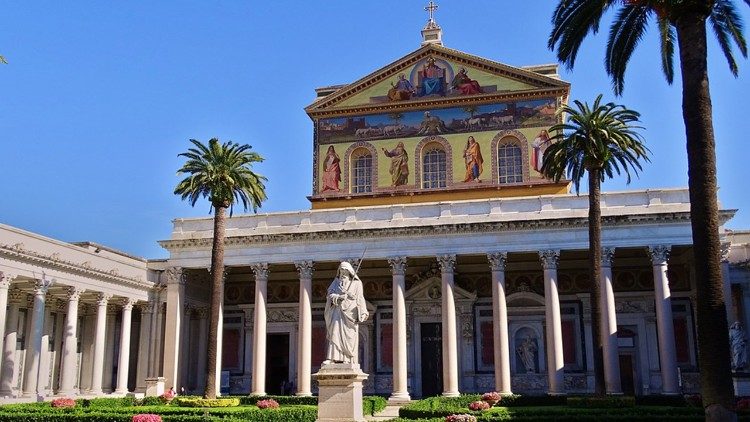
The Basilica of Saint Paul Outside the Walls, where scholars are meeting for a Colloquium on the Letters of St PaulThe Basilica of Saint Paul Outside the Walls, where scholars are meeting for a Colloquium on the Letters of St Paul 

Pope praises courageous, prophetic work of ecumenical scholars

Pope Francis meets with participants of the 26th Pauline Ecumenical Colloquium, and urges Biblical scholars to have confidence in God’s promises as a basis for fostering ecumenical dialogue.

By Christopher Wells

Pope Francis praised the work of an ecumenical group of scholars dedicated to the scriptural letters of St Paul, explaining that their “great contribution” is “the encounter between Christians who are diverse among themselves, yet united by the wisdom of Pauline teaching.”

In an address to participants of the 26th Pauline Ecumenical Colloquium, the Holy Father also emphasized the “rigorous and scholarly exegetical exchange” among academics that allows “the beauty of the Apostle’s letters and their importance for Christian and ecclesial life” to emerge.

A courageous and prophetic initiative

The Pope described the initiative as courageous in overcoming “barriers of defensiveness”; and prophetic in promoting a “healthy ‘impatience of the Spirit’” for fullness of unity and commitment to bearing witness.

“If throughout history divisions have been a source of suffering,” he said, “today we must commit ourselves to reversing course, moving forward on the paths of unity and fraternity, which begin precisely by praying, studying, and working together.”

God does not fail in His promises

Noting that Colloquium participants are focusing chapters 9-11 of St Paul’s Letter to the Romans, the Pope highlighted the “irrevocable” gifts and call of God described in Romans 11:29.

Here, he said, St Paul hands on to us a message of fundamental importance: "God does not fail in His promises of salvation and patiently carries them out, even through unexpected and surprising ways.”

Pope Francis said his support for the Colloquium’s work is based precisely on the foundation of our confidence in “the mercy and promises of God.”

While encouraging them to continue their fraternal and academic dialogue, he also invited them, “above all else,” to allow themselves “to be amazed by the countless spiritual resources contained in the Pauline letters, in order to offer Christian communities ‘new words’, able to communicate the Father’s merciful goodness, Christ’s newness of salvation and the Spirit’s renewing hope.”

He concluded with the hope that their work might foster “the ecumenical spirit” among believers, as an aid to “our common journey of seeking the Lord.”

Read the full text of the Pope's Address to Participants in the Twenty-sixth Pauline Ecumenical Colloquium.