Showing posts with label transgender. Show all posts

Wednesday, February 26, 2025

Surveys still show U.S. Catholics ok with social ills like abortion and same-sex marriage


US Catholics support progressive policies on 'culture war' issues, new study finds

Twice as many US Catholics identify as conservative than do as liberal, finds a new Religious Landscape Study by the Pew Research Center


Advocates of same-sex marriage cheer during a rally outside the 9th Circuit Court of Appeals in San Francisco on Feb. 7, 2012, moments before hearing the court's decision on Proposition 8. By a 2-1 vote, a three-judge panel struck down the California ban on same-sex marriage, saying that it violates the 14th Amendment to the U.S. Constitution. (CNS/Reuters/Beck Diefenbach)

by Heidi Schlumpf

February 26, 2025

Majorities of U.S. Catholics support progressive policies on "culture war" issues, such as abortion and gay marriage, according to a new survey of the country's religious landscape. Still, twice as many Catholics describe themselves as conservative than identify as liberal.

For example, nearly three quarters of Catholics believe homosexuality should be supported by society, 70% support same-sex marriage and 59% want abortion legal in all or most cases. Almost four in 10 Catholics said greater acceptance of people who are transgender is a change for the better. Acceptance of progressive policies has increased among Catholics, for the issues tracked over time.

In general, however, the more religious Americans are, the more likely they are to express traditional views, especially about gender roles, the study found. 

The Religious Landscape Study — the third conducted by the Pew Research Center over the past 17 years — also looked at religious identification, spiritual beliefs and practice, the role of religion in family life and religion's place in society. Previous surveys were in 2007 and 2014. The latest iteration was delayed because of COVID.

Religion and political affiliation

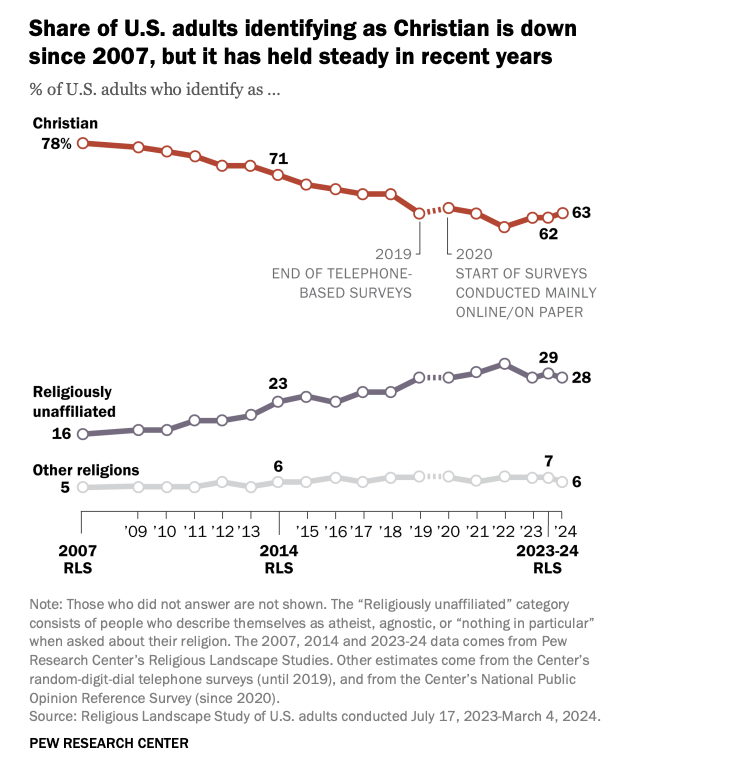
The survey found that the trend continues of "political/religious sorting" — in which conservatives and Republicans tend to be more religious, and Democrats and liberals tend to be less so. The share of self-described political liberals who identify as Christians has fallen 25 percentage points since 2007, the report said [see the Pew Research Center graphic below].
In addition, higher levels of religious engagement are related to leaning toward the Republican Party, with Black Americans as a notable exception. At all levels of religiousness, most Black respondents identified with the Democratic Party. Hispanic Americans, Asian Americans and Americans of other races and ethnicities are also somewhat politically divided depending on religiosity, but the gaps are not as wide as with white Americans.

Among Catholics as a whole, 49% said they identify as Republican or lean Republican, compared to 44% who are Democrats or lean Democratic. Catholics' rates of conservatism are slightly higher than those of U.S. adults as a whole. The largest group of Catholics identify as moderate.

Hispanic Catholics favor the Democratic Party, however, while white Catholics favor the GOP. For decades, the Catholic vote in presidential elections had been evenly divided, until Donald Trump garnered as many as 58% of Catholics in 2024, according to exit polls.

"In terms of politics, the report suggests that many religious communities have become more homogenous politically, thus generating less internal controversies over political issues," said John C. Green, distinguished professor of political science at the University of Akon and a senior fellow with Pew Research Center.

This is especially true among evangelical Protestants and members of the Church of Jesus Christ of Latter-Day Saints (Mormons) on the conservative/Republican side, and of members of non-Christian religions and the unaffiliated on the liberal/Democratic side.

Government aid, immigration, environment

Catholics are not so easily categorized, given the majorities who support same-sex marriage and legal abortion. For some issues, however, political party affiliation seems to be more influential than religious teachings.

Catholics are actually less likely than the general population to believe the government should increase help to people in need, and more likely than Americans as a whole to support cutting assistance. In general the more religious people are, the less likely they are to support government aid to the needy, the study found.

Catholics' views on immigration are mixed. While a majority of Catholics are positive about the United States' openness to people from around the world, again their views are slightly more negative than the general population. Four in 10 Catholics say a growing population of immigrants has been a change for the worse. In general, white Americans and those who are highly religious are more likely to be negative about the country's diversity.

Survey questions designed to distinguish a "stewardship" mindset from a "dominionist" one on environmental issues found that many Americans hold both views. Catholics were more likely to agree with the stewardship statement that "God gave humans a duty to protect and care for the Earth" and to believe that stricter environmental regulations are worth the cost.

Family values and religiosity

A majority of Americans, and Catholics, support women in the paid workforce, but Catholics are more likely than the general population to say children with two parents are better off when a parent stays home to focus on the family. A quarter of Catholics believe that should be the mother.

Views about traditional, patriarchal gender and family arrangements are key to understanding recent religious trends, Penny Edgell, professor of sociology at University of Minnesota, said at a Feb. 19 press conference presenting the survey findings.

A rejection of traditional gender and family beliefs is contributing to a decline in commitment to mainstream religious institutions, she said. "It's not an effect of this polarization; it's driving it."

But the latest Pew survey found that the Christian population of the country has been relatively stable since 2019 and the rise of the "nones" or religiously unaffiliated has leveled off, for now.

"After many years of decline, it's very striking … to observe this recent period of stability in American religion," said Gregory A. Smith, senior associate director of research at Pew.

Nearly two thirds of respondents identify as Christians; almost 30% as unaffiliated and 7% belong to religions other than Christianity. The number for Catholics, who make up 19% of the population, are down significantly since 2007, but have been stable since 2014, the report says [see the Pew Research Center graphic below].
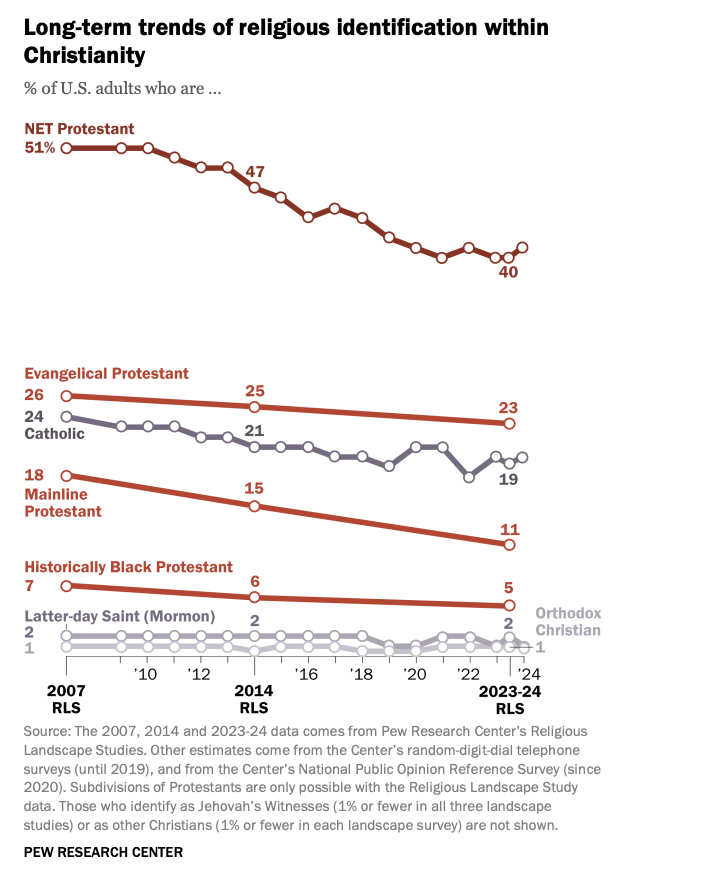
But further declines in the religiousness of the American public are likely, as young adults are far less religious than older adults and the "stickiness" of religious upbringing seems to be declining, the report said.

"The forces that undergirded the long-term declines we've seen in American religion are still in place, namely young adults continue to come of age with lower levels of religiousness than their elders, who themselves have grown less religious over time," Smith said.

The survey also found that some religious practices, such as praying and going to religious services, have held fairly steady in recent years. Large majorities maintain spiritual beliefs, in God, that people have a soul or spirit, that there is something spiritual beyond the natural world.

Among Catholics, less than half say religion is very important in their lives, and only 29% say they attend services weekly or more often. Four in 10 say they attend monthly or more often. Nearly half of Catholic attenders go to Mass at a church in which all or most other congregants are white, the report said. Just over a quarter of Catholic attenders go to a church that is mostly Hispanic or Latino, while one in five say they attend a church where no racial group makes up a majority.

Just over half of Catholics say they pray daily, although this is down from 2007 and 2014. Only a third of Catholics say they ever read Scripture outside of church and less than a quarter participate in prayer groups, scripture-study groups or religious education programs.

The infographics are from Pew Research Center's report on its third Religious Landscape Study. 

Thursday, January 30, 2025

Finally, U.S. Bishops like something President Trump did


U.S. bishops applaud Trump stopping federal support of transgender procedures for children


John Lavenburg


Bishop Robert E. Barron is shown in an undated photo. (Credit: Word on Fire via CNS.)


NEW YORK – Applauding an executive order that prohibits the federal government from promoting or funding transgender procedures for children, Bishop Robert Barron highlighted that “helping young people accept their bodies and their vocation as women and men is the true path to freedom and happiness.”

President Donald Trump signed the executive order, titled “Protecting Children from Chemical and Surgical Mutilation” on Jan. 28, which declares that “it is the policy of the United States that it will not fund, sponsor, promote, assist, or support” transgender surgeries for children, “and it will vigorously enforce all laws that prohibit or limit” these procedures.

“I welcome the President’s Executive Order prohibiting the promotion of federal funding of procedures that, based on a false understanding of human nature, attempt to change a child’s sex,” Barron, chair of the United States Conference of Catholic Bishops Committee on Laity, Marriage, Family Life, and Youth, said in a Jan. 29 statement.

“So many young people who have been victims of this ideological crusade have profound regrets over its life altering consequences, such as infertility and lifelong dependence on costly hormone therapies that have significant side effects,” Barron, the bishop of the Diocese of Winona-Rochester continued.

“It is unacceptable that our children are encouraged to undergo destructive medical interventions instead of receiving access to authentic and bodily-unitive care,” he said.

Explaining the executive order, Trump called the ability of adults to change a child’s sex through a series of irreversible medical interventions a “radical and false claim,” adding that “this dangerous trend will be a stain on our Nation’s history, and it must end.”

The president also said that countless children regret the transgender surgeries they receive.

“Countless children soon regret that they have been mutilated and begin to grasp the horrifying tragedy that they will never be able to conceive children of their own or nurture their children through breastfeeding,” the executive order states. “Moreover, these vulnerable youths’ medical bills may rise throughout their lifetimes, as they are often trapped with lifelong medical complications, a losing war with their own bodies, and, tragically, sterilization.”

The executive order classifies “child” or “children” as an individual under the age of 19.

The executive order instructs federal agencies to rescind or amend all policies that rely on guidance from the World Professional Association for Transgender Health (WPATH). It also instructs the Secretary of Health and Human Services to publish a review of the existing literature on best practices for promoting the health of children who assert gender dysphoria, rapid-onset gender dysphoria, or “other identity-based confusion.”

Barron said this aspect of the order is also important.

“I also applaud the Executive Order’s aim to identify and develop research-based therapies to aid young people struggling with gender dysphoria,” Barron said. “These individuals are loved by God and possess the same inherent dignity that all persons do.”

“They deserve care that heals rather than harms,” Barron added, also highlighting Pope Francis’s message in Dignitas Infinita that “we are called to accept the gift of our bodies created in God’s image and likeness as male and female.”

Monday, June 17, 2024

Bishops seek guidance after revelation that a diocesan hermit is transgendered

 US Bishops’ Canonical Committee To Offer Clear Analysis’ Of Transgenderism  And Consecrated Life


LOUISVILLE, Ky. (OSV News) — A number of the nation’s Catholic bishops have asked for guidance from their episcopal conference following the public disclosure of transgenderism by a Lexington diocesan hermit.

“This issue is now on our agenda,” Bishop Thomas J. Paprocki of Springfield, Illinois, chair of the U.S. Conference of Catholic Bishops’ Committee on Canonical Affairs and Church Governance, told OSV News. “Other bishops may be looking at this, and they’ve asked about this. And so we will try to give a clear analysis that will give the doctrinal and canonical guidelines that hopefully will be helpful to any bishop.”

Bishop Paprocki spoke to OSV News June 14 after the final public session of the USCCB’s 2024 Spring Plenary Assembly in Louisville.

Less than 100 miles from where the U.S. bishops convened, 39-year-old Brother Christian Matson, hermit for the Diocese of Lexington, Kentucky, came out as transgender on Pentecost Sunday (May 19, 2024), having been received as such when professing vows of poverty, chastity and obedience to Bishop John E. Stowe a year prior.

Bishop Stowe, who declined OSV News’ request for comment, told Religion News Service in a May 19 article that he regarded Matson as “a sincere person seeking a way to serve the church.”

The bishop also told the outlet that “hermits are a rarely used form of religious life … but they can be either male or female. Because there’s no pursuit of priesthood or engagement in sacramental ministry, and because the hermit is a relatively quiet and secluded type of vocation, I didn’t see any harm in letting him live this vocation.”

But Bishop Paprocki indicated to OSV News that following a “preliminary discussion” by the canonical affairs and governance committee, “the initial consensus … was that it’s not really possible for a (transgender) person to be admitted to the role of a hermit or consecrated life if they are not repentant of what they’ve done.”

Bishop Paprocki told OSV News that the issue “was not presented to us with a question of addressing any one particular bishop.”

“Consecrated life is vowing yourself to God, and the church’s teaching on transgender ideology is very clear,” Bishop Paprocki told OSV News. “Pope Francis has been very clear about that. And the Bible is also very clear. God made us male and female. And so someone who is claiming to be a transgender person is basically denying a biblical and a doctrinal teaching of the church, and so I would say it would be very difficult for a person like that to authentically enter consecrated life unless that person’s repented.”

However, he added, “at least as far as being a hermit is concerned, if that person has repented and somehow tries to take steps to reverse the decision they made, well, maybe there’s a possibility for a person in that situation. But that’s not the scenario that’s been presented to us.”

As a result, the case “also raises other questions in terms of Catholic teaching about mutilation of the body, which is also part of the church’s moral objection to transgender surgeries, unless it’s in those very rare cases of ambiguous sexuality that a baby may be born with. But that’s very rare.”

Bishop Paprocki also noted an apparent incongruence between Matson’s public disclosure and the hermit vocation, which — although tracing its roots to the third century — was only formally recognized by the universal church’s canon law in 1983.

“You also have a question of why is a hermit going public with making statements, when you can see the very nature of eremitical life is to withdraw and to dedicate yourself to a life of private prayer with God,” he said. “And so it seems that someone who is claiming to be a hermit and then is giving public interviews — it really raises some serious questions about the seriousness of that person’s commitment to this way of life.”

At a June 13 press briefing during the bishops’ spring assembly, the USCCB president, Archbishop Timothy P. Broglio of the U.S. Archdiocese for the Military Services, in response to a question from a member of the media, also noted concerns about the impact of the disclosure on the integrity of the eremitic vocation under canon law.

Asked by OSV News if the USCCB committee will consult with the Vatican regarding the issue, Bishop Paprocki said, “I think we can handle it here.

“Pope Francis has made some very clear statements,” he said, pointing as well to the declaration “Dignitas Infinita” released in April by the Vatican’s Dicastery for the Doctrine of the Faith.

“‘Dignitas Infinita’ has some very clear sections on gender ideology. So I think we have guidance already from the Holy See,” said Bishop Paprocki. “So … I would say this is within our competence. If in the course of our study we have any questions that seem not clear, I suppose we could bring those (to the dicastery). But for now, I think there’s some very clear guidance from the Holy See on this.”

Gina Christian is a multimedia reporter for OSV News. Follow her on X (formerly Twitter) at @GinaJesseReina. Contributing to this story was Gretchen R. Crowe, editor-in-chief of OSV News.

Tuesday, April 9, 2024

The transgender reaction to Vatican document Dignitas Infinita


Transgender Catholics say new Vatican document shows no understanding of their lives

Transgender Catholics — as well as a priest who welcomes them to his parish — expressed disappointment Monday with a new Vatican document rejecting the fundamental concept of changing one’s biological sex.

In essence, it was a restatement of longstanding Catholic teaching, but the dismay was heightened because recent moves by Pope Francis had encouraged some trans Catholics to hope the church might become more accepting.

The pope has welcomed a community of transgender women to his weekly general audiences. And last year, the Vatican said it’s permissible, under certain circumstances, for trans people to be baptized as Catholics and serve as godparents.

“A document like this is very hurtful to the larger LGBTQ+ community but especially to the trans community,” said Maxwell Kuzma, 32, a lifelong Catholic transgender man working as a film editor and writer in rural Ohio.

“We have seen the care and love Pope Francis has personally extended to the trans community in his personal interactions, yet this document fails to extend that same respect, love, and support,” Kuzma said via email.

RELATED COVERAGE

The new document never uses the word “transgender,” which troubled Michael Sennett, a transgender man who is involved with an LGBTQ+ ministry at St. Ignatius of Loyola Church in Chestnut Hill, Massachusetts.

“Avoiding the word ‘transgender’ speaks to limiting the dignity of transgender people,” Sennett said via email. “If the church is unable to name us or acknowledge our true selves, they can’t possibly engage us pastorally, even if that is the goal.”

He also was dismayed by the document’s admonition that God created man and woman as biologically different, separate beings, and that people must not tinker with that or try to “make oneself God.”

“Transgender people are beloved, intentional creations of God the same as cisgender men and women are,” Sennett said. “Trans people who take hormones or have surgeries are not playing God; we are respecting and accepting our authentic selves.”

“Time and time again studies have validated the negative impact on trans people, youth and adults, who are denied affirming care,” Sennet added. “Transitioning is not a medical agenda out to recruit people — it is a lifeline.”

Christine Zuba, a transgender woman from New Jersey, noted with dismay that the Vatican doctrine office’s 20-page document declared gender-affirming surgery to be a “grave violation of human dignity,” on par with such global ills as war and human trafficking.

“Transgender persons are being condemned for who we are, and more importantly we become subject to potential harm,” Zuba said in an email. “It again (sadly) gives fuel to those who continue to deny our existence.”

“We exist, but we do not. We have dignity, but we do not. I don’t even want to think about what the religious and political right will make of this.“

As for Pope Francis, Zuba praised him as “a good and holy man.”

“Our church however still has a LOT to learn,” she added. “We are Not an Ideology. Talk to us. Learn.”

The Catholic Church in the U.S. is not monolithic on transgender policies. Some dioceses have issued stern guidelines in effect forbidding acknowledgement of gender transitions. But some parishes have welcomed trans people, including the Church of Our Lady of Grace in Hoboken, New Jersey. Its priest, the Rev. Alexander Santora, invited Zuba a few years ago to deliver part of the homily at its annual Pride Mass.

Santora told The Associated Press that he was encouraged by some aspects of the new Vatican document, including its assertion that homosexuality should not be criminalized.

“I fear, though, that the tone of this document may bring more harm to trans individuals and fuel the hate that is proliferating in the U.S., with more oppressive laws that will lead to suicides and violence,” he said via email. “I hope the Vatican convenes some devout trans Catholics from around the world to dissect this document and make it more pastoral.”

Kuzma, the Ohio-based film editor and writer, said his dismay over the Vatican document was coupled with continued optimism.

“Currently we have a spotlight on us, yet we have existed throughout human history and have often been given special roles in cultures that recognized our unique gifts,” he said.

“The Catholic Church moves slowly, but my hope is that one day, the Vatican will truly recognize the beautiful and important gifts transgender people have to share with the church and the world.”

Monday, March 4, 2024

A group of U.S. Catholic Bishops meet with trans people and their families


US Catholic bishops listen to transgender people in closed-door meeting


As the number of state-based bills and Catholic diocesan policies that impact — and critics say harm — transgender individuals mount, a group of more than a dozen U.S. bishops gathered for a private meeting at St. Louis University in January to listen to trans people and their families, as well as to theologians, medical professionals and those in church ministry.

The day-and-a-half-long event was organized by New Ways Ministry, a Catholic LGBTQ advocacy group, and closed to the public and press. Participants told NCR the intent of the meeting was to help bishops better understand the experience of trans people and inform the pastoral care in their respective dioceses.

How trans people are viewed and welcomed varies widely across dioceses and parishes, with some offering robust LGBTQ outreach and others adhering to policies that circumscribe LGBTQ participation in church life.  

Bishop John Stowe of Lexington, Kentucky, was among the approximately 40 total attendees in St. Louis.

The bishop, a member of Order of Friars Minor Conventual and longtime advocate for the LGBTQ community, said he felt there was a consensus after hearing from medical experts and from transgender people "that we are not talking about something that is fabricated, that people have a right to be called as they wish to be called."

Bishop John Stowe of Lexington, Kentucky, in a 2019 file photo (CNS/Bob Roller)

Bishop John Stowe of Lexington, Kentucky, in a 2019 file photo (CNS/Bob Roller)

"And if we would all stop and hear the struggles that individuals went through," said Stowe, "we'd realize this is not just an issue of gender theory; it's people's lived experience."

The bishops present were eager to attend, according to Stowe, though not all invited prelates could make the trip. "We've all encountered pastoral situations related to transgender persons and for the most part felt inadequately prepared to deal with them," he said.

This is the second such meeting for bishops organized by New Ways Ministry, a nonprofit co-founded in 1977 by Loretto Sr. Jeannine Gramick. The religious sister was barred from ministering to LGBTQ Catholics in 1999 by then-Cardinal Joseph Ratzinger, the future Benedict XVI, but in recent years has been praised and befriended by Pope Francis.

Francis has called "gender ideology" dangerous because it "blurs the differences and the value of men and women." But he has met repeatedly with transgender people, and late last year approved a document saying trans individuals may be baptized or be godparents as long as the "danger of scandal" is avoided.

The first News Ways Ministry event for bishops was held in January 2023 at Georgetown University in Washington, D.C., and focused more broadly on LGBTQ individuals "in light of Pope Francis' continued call for church leaders to reach out pastorally to LGBTQ people," read a statement from the organization given to NCR last year.

New Ways Ministry chose not to comment on this year's gathering, which took place under the "Chatham House Rule" — meaning attendees can recount publicly what was discussed, but not identify who made any given comment. The goal of that agreement was to allow participants to speak more feely, attendees told NCR.

Dominican Fr. Charles Bouchard is the retired senior director of theology and sponsorship for the Catholic Health Association of the United States. He attended the event in D.C. and said the meetings have provided bishops "a safe space to really talk about what they want to talk about, to hear things and speak candidly without any pressure."

Stowe said listening to transgender individuals in St. Louis share about their faith journeys, their struggles and their transitions "was powerful and moving."

The New Ways Ministry statement said in 2023 that the impetus for the first meeting grew out of prior conversations and questions among bishops "and others concerned about ministry to LGBTQ people."

"The focus of the discussions was how to respond pastorally to LGBTQ people and their family members, in order to show the welcoming invitation of the Catholic Church," said New Ways Ministry. 

The organization added that the event was not designed to produce any unified statement or agreement among the participants, and no overarching pastoral or theological plan was formed.

In the United States, more than 25% of dioceses now have documents focused on LGBTQ people, primarily students in Catholic schools, with the bulk saying names and pronouns, bathroom use, and attire must correspond to students' assigned sex at birth.

The U.S. Conference of Catholic Bishops currently is revising its official ethical directives for American Catholic health care institutions. It is expected to align the directives with a doctrinal note issued last March by the U.S. bishops' doctrine committee that says gender-affirming medical treatments must not be performed by Catholic providers.

Friday, March 1, 2024

Pope Francis declares Gender ideology as "an ugly danger of our time"


Pope Francis addressing international Symposium "Man-Woman: Image of God. Towards an Anthropology of Vocations" in the VaticanPope Francis addressing international Symposium "Man-Woman: Image of God. Towards an Anthropology of Vocations" in the Vatican  (VATICAN MEDIA Divisione Foto)

Pope Francis: Gender ideology is the ugliest danger of our time

Addressing participants in the international Symposium "Man-Woman: Image of God.” Pope Francis describes so-called gender ideology as the "ugliest danger" of our time, because it cancels out all differences that make humanity.

By Lisa Zengarini

Pope Francis on Friday again spoke out against gender theory describing it as an “ugly ideology of our time”, because it erases all distinctions between men and women. To ceancel this difference “is to erase humanity. Man and woman, instead, exist in a fruitful ‘tension’”, he said.

The Symposium

The remarks came as he opened his address to participants in the international Symposium "Man-Woman: Image of God. Towards an Anthropology of Vocations" held in the Vatican on March 1-2.

The Congress is organized by Cardinal Marc Ouellet, Prefect Emeritus of the Dicastery for Bishops, together with the Centre for Research and Anthropology of Vocations (CRAV) and is a follow-up to the previous 2022 Symposium dedicated to the theology of the priesthood.

Introducing his address the Pope said he still has a cold and asked his assistant Monsignor Filippo Ciampanelli to read it out for him, "so I don't get so fatigued.”

In the prepared text the Pope reflected on the theme of the Congress which is aimed first of all at highlighting the anthropological dimension of every vocation.

The human person is a vocation

Indeed, he remarked, “the life of the human being is a vocation” which has a relational character: “I exist and live in relation to who generated me, to the reality that transcends me, to others and to the world around me, in which I am called to embrace a specific and personal mission with joy and responsibility.”

“Each one of us discovers and expresses oneself as called, as a person who realizes oneself in listening and response, sharing our being and gifts with others for the common good.”

This fundamental anthropological truth is sometimes overlooked in today's cultural context, where human beings tend to be reduced to their mere material and primary needs. Yet, Pope Francis said , they are more than this: created by God in His own image, man and woman “carry within themselves a desire for eternity and happiness that God himself has planted in their hearts and that they are called to fulfil through a specific vocation.”

“Our being in the world is not a mere fruit of chance, but we are part of a design of love and are invited to go out of ourselves and realize it, for ourselves and for others,” the Pope said.

“We are called to happiness, to the fullness of life, to something great to which God has destined us.”

We all have a mission in Church and society

Recalling Cardinal Saint John Henry Newman’s “Meditations and Prayers” Pope Francis further remarked that not only we have all been entrusted with a mission, but ”each and every one of us is a mission.” 

The Pope therefore welcomed the symposium and the studies conducted on this topic because, he said, “they spread awareness of the vocation to which every human being is called by God”, and are also useful to reflect on today’s  challenges, on the ongoing  anthropological crisis, and on the need to  promote  human and Christian vocations.

Promoting a more effective "circularity" of vocations

He also emphasized the importance of promoting “a more effective circularity” of the different types of vocations in the Church, including lay vocations, ordained ministry and consecrated life, so they “can contribute to generating hope in a world overwhelmed by death.”

“Generating this hope, placing oneself at the service of the Kingdom of God to build an open and fraternal world is a mission entrusted to every woman and man of our time,” he said.

The courage to seek God’s will

Closing his address, Pope Francis encouraged the participants in the Symposium not to shy away from risks in seeking God’s will in their work, reminding them a living faith is not an artifact in a museum:”The Holy Spirit asks us fidelity, but fidelity moves, and often leads us to take risks”,  he said.

“Move forward with the courage to discern and risk seeking God's will.”

Thursday, February 22, 2024

Cardinal Dolan reacts to transgender funeral fiasco in St. Patrick's Cathedral


Cardinal Dolan on St. Patrick’s funeral: ‘We don’t do FBI checks on people who want to be buried’


Priests at St. Patrick’s Cathedral in New York City were surprised by the “irreverence and disrespect” that occurred during a funeral for a transgender activist last week, Cardinal Timothy Dolan said in his first public comments on it. 

“We didn’t know the background. We don’t do FBI checks on people who want to be buried,” Dolan, the archbishop of New York, said during his podcast Tuesday. 

He said cathedral staff try to be welcoming when someone requests a funeral.

“All they know is somebody called and said, ‘Our dear friend died. We’d love to have the funeral at St. Patrick’s Cathedral. It would be a great source of consolation. She’s a Catholic. It would be a great source of consolation for us, her family and friends.’ And of course, the priest at the cathedral said, ‘Come on in. You’re more than welcome,’” Dolan said. 

The priests at St. Patrick’s made a decision at the beginning of the service not to celebrate a funeral Mass but to conduct a funeral service with no Mass instead. 

It was the right thing to do given the situation, the cardinal said. 

“I applaud our priests who made a quick decision that, ‘Uh-oh, with behavior like this, we can’t do a Mass. We’ll do the Liturgy of the Word, which is the readings, and the sermon, and the prayers of petition, and the Our Father, and then we’ll stop it. The Mass is not going to go on,’” Dolan said. “Bravo for our cathedral people, who knew nothing about this that was coming up.” 

Meanwhile, though, supporters of the deceased are demanding an apology from the Archdiocese of New York for what they described as “cutting short” the Feb. 15 funeral service of Cecilia Gentili, 52, a male who identified as a woman who died Feb. 6. Supporters of Gentili also want an apology for what they called “the painfully dismissive and exclusionary language” used in a statement released by the pastor of the cathedral after the funeral. 

“The current narrative from St. Patrick’s Cathedral leadership that they were manipulated by funeral organizers of the identity of Ms. Gentili is simply not true,” an organization called Gays and Lesbians Living in a Transgender Society said in a written statement. “Funeral organizers advised cathedral staff to look up Cecilia Gentili, her work, and the community she served. To now place responsibility on the funeral organizers to have affirmatively disclosed the gender identity of their loved one is imposing a burden upon the mourners that would not be expected of a non-transgender person.”

However, the New York Times reported that the funeral’s organizer did not disclose to the cathedral that Gentili, who died Feb. 6 at age 52, was a biological man who identified as a woman.

“I kept it under wraps,” Ceyeye Doroshow, the service’s organizer, told the outlet.

The organization also suggested that cathedral staff violated the Catholic Church’s law. 

“Still reeling from the pain of Cecilia’s loss, community members are asking for an explanation for this decision which seemingly violated Catholic Canon Law governing the denial of funeral [M]asses,” the organization said. “… Ms. Gentili’s service ended an hour earlier than had been scheduled, thus denying her the full funeral Mass that was agreed upon.” 

Joseph Zwilling, a spokesman for the Archdiocese of New York, contacted by CNA on Wednesday said the archdiocese had no immediate comment on the Gentili supporters’ statement. 

Asked by email who decided to replace the funeral Mass with the shorter funeral service, Zwilling said the decision “was made by the priests at the cathedral after witnessing what was taking place.” 

A video of the service posted online last week shows that shortly after the procession down the aisle, the presider, Father Edward Dougherty, looking out into the crowd, said with a laugh: “Well, welcome to St. Patrick’s Cathedral. Except on Easter Sunday, we don’t really have a crowd that is this well turned out, you know?” 

After a short delay, the crowd responded with more than 40 seconds of clapping, standing, and cheering, with occasional chants of “Cecilia.” 

During the ovation, the video shows, a priest dressed in black approached Dougherty and told him, “No Eucharist,” eventually followed with the words “a funeral service, no Mass.” 

Outburst at funeral

As CNA reported last week, the prayers of the faithful during the service included a call for “Cecilia’s community” to “have access to life-affirming health care” — an apparent reference to gender transitioning — to raucous applause. 

Two of the three eulogies were critical of Catholic teaching on human sexuality. The organizer of the funeral, Doroshow, a male who identifies as a woman, who wore a purple dress, said Gentili “worked so hard to make sure girls like me, boys like you are safe, are grounded, got health care, that sex workers are free.” A standing ovation followed the “sex workers” reference. 

A man who delivered a third eulogy used a Spanish word for “whore” several times. Another man lauded the deceased as “This whore, this great whore, St. Cecilia, mother of all whores.” Raucous applause and a standing ovation followed. 

On Tuesday, Cardinal Dolan addressed the Gentili funeral about five minutes into his podcast after discussing a few other topics, including the recent shooting at the Super Bowl parade in Kansas City. Dolan mentioned that he had received “a note of solidarity” from Harrison Butker, the Kansas Chiefs kicker, about what Dolan described as “the irreverence and disrespect” of the crowd at the funeral, and the “very irreverent and disrespectful” eulogies. 

The cardinal asked the cathedral staff to celebrate a Mass of reparation after the funeral service, which the pastor, Father Enrique Salvo, said last week was done. 

“In a way, it’s redundant,” Dolan said Tuesday. “Because every Mass, every Mass is the renewal of the infinitely powerful act of reparation that Jesus did on the cross, correct? He’s the one that made reparation. We can’t do much. All we can do is unite with him on his cross in his sacred act of reparation. There is a bit of an arrow in the quiver of the Church’s treasury of prayer that if a particularly sacrilegious or scandalous act has occurred in a church, it would be good to offer a Mass in particular reparation for that act of irreverence. So we did that.” 

Salvo released a written statement Feb. 17, two days after the funeral, acknowledging what he called “outrage over the scandalous behavior” during Gentili’s funeral. 

“The cathedral only knew that family and friends were requesting a funeral Mass for a Catholic, and had no idea our welcome and prayer would be degraded in such a sacrilegious and deceptive way,” Salvo said in the statement. 

Some mainstream media news stories last week hailed the funeral as a shift in the Catholic Church’s approach to gender identity. Dolan expressed frustration Tuesday with criticism by some Catholics of the cathedral staff and his archdiocese. 

“We have a lot of misunderstanding. Why in the world our people out there still believe what the secular press reports is beyond me,” Dolan said. 

Later, he added: “Our policy at the cathedral is to be as open and welcoming of anybody who wants to be buried from here. And we had absolutely no idea about this. But why people still think the cathedral purposely did that? Well, a lot of people always want to believe the worst. And they don’t like us any more than the protesters did, in the cathedral. But who knows.”