Showing posts with label Christopher Columbus. Show all posts

Monday, October 13, 2025

Columbus Day is today; it's ok for Catholics to know and celebrate this holiday


Yes, Christopher Columbus

Today is Columbus Day, or (among the alternatively oriented) Native Peoples’ Day, both displaced in any case, as even major Catholic feasts now are, to a different date, so that people will have long weekends, or not be inconvenienced, or something. In any event, it’s a day now redefined in terms that make it unclear what, if anything, we are celebrating, or deploring, in this booming, buzzing confusion that we still (kind of) think of as the twenty-first Christian century.

So let us seek a little clarity.

For most of subsequent history following his voyages, Columbus’ reputation was strong and settled. It began to change, in the nineteenth century, in the United States, of all places. Washington Irving got the idea that Columbus must have been a Protestant and a Progressive – he opposed the council of learned theologians, you see, who told him (rightly) that the distance from Spain to China was greater than he was saying. But in an expanding and confident America, El Almirante became, in Irving’s imagination, the precursor of American initiative and vision.

Medieval Europe, another Columbus myth notwithstanding, knew the world was a ball (see Dante), not flat – what the historian Jeffrey Burton Russell rightly mocked as “the pizza theory.” Columbus didn’t “prove the earth was round” and no one thought so until ignorance of pre-modern times became widespread.

The 19th-century American progressives, however, had still other plans for the Genoese Catholic sailor. Andrew Dickson White, a founder and president of Cornell University, enlisted him in the Darwinian cause – for reasons similar to Irving’s, as a maverick who broke with religious obscurantism to “follow the science.”

Other appropriations and misappropriations followed.

The Knights of Columbus, mostly Irish, around the same time, saw the explorer as a model Catholic American. And the growing number of Italian immigrants – well, just look at Columbus Circle in Central Park.

In recent decades, of course, all that has become the case for the prosecution. A significant swath of American elites has chosen to repudiate its own history, ironically based on cherry-picked Christian principles that Columbus helped bring to the Americas.

He’s now also often charged with bringing all the evils that have allegedly plagued the Americas since 1492 – slavery, genocide, racism, inequality, patriarchy, rape, torture, war, environmental degradation, disease, etc.

Landing of Columbus by John Vanderlyn, 1847 [Capitol Rotunda, Washington, D.C.]


Contrary voices have asked (e.g., the present writer): if we’re going to attribute all these evils to that man, doesn’t he also deserve credit for the many good things that have also followed on these shores?

Besides, he didn’t have to bring those bad things here because they already existed among the various native peoples also being “remembered” today. Few ever really look at native cultures and practices, which also included colonialism, imperialism, territorial conquest, a warrior ethos, human sacrifice, and – dare one say to our LGBT-ified elites – overwhelmingly, binary views of human sexuality.

Prior to the Great Columbus Reversal, in 1892, Pope Leo XIII praised Columbus in Quarto abeunte saeculo: “For the exploit is in itself the highest and grandest which any age has ever seen accomplished by man; and he who achieved it, for the greatness of mind and heart, can be compared to but few in the history of humanity.”  Leo added: he brought Christianity to “a mighty multitude, cloaked in miserable darkness, given over to evil rites, and the superstitious worship of vain gods.”

Amidst all these vagaries, the man himself has largely been lost. The Dominican missionary Bartolomé de las Casas, the well-known – almost fanatical – “defender  of the Indians,” noted the “sweetness and benignity” of the admiral’s character.  And even while criticizing some things that he did, remarks, “Truly I would not dare blame the admiral’s intentions, for I knew him well and I know his intentions were good.” Las Casas attributed Columbus’ shortcomings to ignorance about how to handle an unprecedented situation.

The explorer’s religion, for instance, was real. Columbus deeply believed that the Gospel had to be preached to all nations before Christ could return, and left money in his will for a crusade to retake the Holy Land.

Sincere Christian. Great sailor. Poor governor. When he was arrested and taken back to Spain in chains during his Third Voyage, it was because of his harshness towards both natives and Spaniards. The type is not unknown: an easy-going man who overcompensates when things get tough.

And also a sharp observer. He noted subtle differences among the Caribbean tribes. And with only rudimentary technologies, made amazing discoveries in addition to the new-found lands. Historian Felipe Fernández-Armesto puts it thus:

his decoding of the Atlantic wind system; his discovery of magnetic variation in the Western hemisphere; his contributions to the mapping of the Atlantic and the New World; his epic crossing of the Caribbean; his demonstration of the continental nature of parts of South and Central America; his apercu about the imperfect sphericity of the globe [the earth bulges in the Atlantic near Brazil]; his uncanny intuitive skill in navigation. Any of these would qualify an explorer for enduring fame; together they constitute an unequaled record of achievement.

Let it also be said: The world as we know it began in the fifteenth century. Not the world in the sense of human life or civilizations which had existed for millennia, but the world as a concrete reality in which all parts of the globe came into contact with one another and began to recognize themselves as part of a single human race – a process still underway.

It’s because of a small expedition by a few men and ships, led by Columbus, the real one not the myth, driven by a mishmash of personal ambition, the search for profit, and religious idealism, praying the Salve Regina together every evening at sea, that made the Old and the New Worlds into one, great, human thing.

A Spanish chronicler a few decades after 1492 called it “the greatest event since the creation of the world (excluding the incarnation and death of Him who created it).”

So Happy Columbus Day.

Sunday, October 13, 2024

Knights of Columbus lead efforts to celebrate Columbus Day


Honoring our Namesake and His Legacy

Knights celebrate Columbus Day, knowing that our namesake gave voice to generations of Catholics, and helped pave a path for our diverse society.

by Corporate Communications Staff10/7/2020

When founding the Knights of Columbus, Father Michael McGivney picked Christopher Columbus as a namesake for the organization because in a time when anti-Catholic and anti-immigrant feeling ran rampant, the American public embraced this famous explorer.

Father McGivney and his Knights understood that using Columbus as their Order's namesake asserted an important truth: that not only was there a place for Catholics and immigrants within American society, but that such a person had already played a part in creating the young, free world around them.

Times have changed and today there are those who contest Columbus’ achievements and protest the national holiday held in his honor. They look to make Columbus responsible for all the atrocities against Native Americans.

In an article that appeared in RealClear Politics two years ago and also in recent testimony in New Haven, Conn., Patrick Mason (a member of the Knights of Columbus Board of Directors and also of the Osage Nation), said there is a danger that blaming Columbus misses the lessons of history and adds to the risk of repeating it.

Honoring Our Names and His Legacy
(GettyImages)

“As American citizens, we need to remember our history, both the good and the bad, so that we are not set up to repeat history’s mistakes,” Mason said. “We need to take an honest look at all our fore-fathers. We need to give them the credit they deserve for what they did well, while being mindful of the things that they should have been done differently or better.”

He added that the current debate brings with it the opportunity honor and acknowledge indigenous people while preserving the great explorer’s legacy.

The Knights of Columbus continue to celebrate Columbus Day, knowing that the explorer gave voice and representation to generations of Catholics, and helped pave a path for the diverse society we have today.

Monday, October 9, 2023

The Knights of Columbus and our Namesake, his Legacy, his Holiday


Honoring our Namesake and His Legacy

Knights celebrate Columbus Day, knowing that our namesake gave voice to generations of Catholics, and helped pave a path for our diverse society.

by Corporate Communications Staff10/7/2020

When founding the Knights of Columbus, Father Michael McGivney picked Christopher Columbus as a namesake for the organization because in a time when anti-Catholic and anti-immigrant feeling ran rampant, the American public embraced this famous explorer.

Father McGivney and his Knights understood that using Columbus as their Order's namesake asserted an important truth: that not only was there a place for Catholics and immigrants within American society, but that such a person had already played a part in creating the young, free world around them.

Times have changed and today there are those who contest Columbus’ achievements and protest the national holiday held in his honor. They look to make Columbus responsible for all the atrocities against Native Americans.

In an article that appeared in RealClear Politics two years ago and also in recent testimony in New Haven, Conn., Patrick Mason (a member of the Knights of Columbus Board of Directors and also of the Osage Nation), said there is a danger that blaming Columbus misses the lessons of history and adds to the risk of repeating it.

“As American citizens, we need to remember our history, both the good and the bad, so that we are not set up to repeat history’s mistakes,” Mason said. “We need to take an honest look at all our fore-fathers. We need to give them the credit they deserve for what they did well, while being mindful of the things that they should have been done differently or better.”


He added that the current debate brings with it the opportunity honor and acknowledge indigenous people while preserving the great explorer’s legacy.

The Knights of Columbus continue to celebrate Columbus Day, knowing that the explorer gave voice and representation to generations of Catholics, and helped pave a path for the diverse society we have today.

Once again we explore Catholics and Columbus Day


Friday, October 06, 2023

Catholics and Columbus Day


Columbus Day is not, nor should it be, on any liturgical calendar, but it is of interest to American Catholics because of their role in creating it. In the 1900s, the Knights of Columbus lobbied state legislatures throughout the country to make the anniversary of America’s discovery a holiday; not only did most states acquiesce, but the federal government eventually did as well, first as a national holiday in 1937 and then as a legal holiday (on which banks close) in 1971. Although they were instituted as a fraternal benefits organization, the Knights of Columbus were also keen to dispel anti-Catholic prejudice in the United States. One way to meet this goal was to emphasize America’s debt to Catholic figures, starting with its papist discoverer. Not coincidentally, this fraternity founded by an Irish priest was named not after St. Patrick but after the daring Italian who reached the shores of our hemisphere on a Spanish ship.

Dispelling Myths

The Knights’ strategy of claiming Columbus as a most Catholic of heroes was also a well-aimed counterattack. American historians had tried mightily to turn the famous seafarer into an Enlightenment figure, a secular saint championing scientific progress in the face of a superstitious Church still clinging to outdated ideas of a “flat earth.” As it turns out, Columbus had nothing to do with the flat-earth debate; the story was invented out of whole cloth by Washington Irving in 1828, and later used as anti-Catholic propaganda to “prove” that that clerical religion was inherently hostile to rational inquiry. Queen Isabella’s geographical advisers knew the globe was round; they rejected Columbus’ proposal because they had a much more accurate grasp of its massive circumference, rightly concluding that his plan to reach China via a western route in a matter of weeks was unsound.
Given the prevalence of the anti-Catholic flat-earth myth, it is not surprising that Pope Leo XIII celebrated the four hundredth anniversary of Columbus’ maiden voyage with these stirring (and perhaps overly generous) remarks:
But there is, besides, another reason, a unique one, why We consider that this immortal achievement should be recalled by Us with memorial words. For Columbus is ours; since if a little consideration be given to the particular reason of his design in exploring the mare tenebrosum... it is indubitable that the Catholic faith was [his] strongest motive… so that for this reason also the whole human race owes not a little to the Church.
Take that, Know Nothings! I recommend reading Leo’s encyclical on the topic in its entirety, for it not only understands Columbus’ accomplishments (and his flaws), but it also bespeaks an older, more sensitive appreciation of those who seek greatness even when they fall short of goodness.


Pall Over the Holiday
Ironically, after winning the battle for Columbus Day, many Catholics today would prefer not to be associated with either the man or his holiday. While most Latin American countries commemorate the date of Columbus’ discovery as the Día de la Raza (the Day of the Race, that is, the day the races met), Hugo Chávez’s Venezuela observes Día de la Resistencia Indígena (Day of Indigenous Resistance). Similarly, Ward Churchill, the Colorado professor who made headlines for calling the victims of September 11 “little Eichmanns,” has led the American Indian Movement’s protests against the Columbus Day parade in Denver. In the United States, several locales celebrate Indigenous Peoples’ Day, either as a replacement or a complement of Columbus Day.
What Chavez and Churchill are alluding to are the bleak events that followed Columbus’ discovery. Despite the friendliness of the natives, Columbus’ men initiated hostilities with them that culminated in a massacre, while Columbus himself enslaved a thousand Indians and instituted the repartimiento system that led to the serfdom of countless others for years to come. Combined with a wave of unintentionally imported diseases the local immune system had never encountered before, such treatment quickly decimated the Native American population.
Assessing Columbus
What, then, should we make of Columbus in light of his spotty record? I suggest five things.
First, it is clear that Columbus was not a good administrator on land, and his incompetence led to cruelty. In fairness, however, before his undisciplined men destroyed relations with the native Taino or Arawaks, his goal was to protect them from the cannibalistic Caribs (one of the most savage peoples in the Americas) who were fast advancing. Indeed, the Caribs remind us that the first step in assessing the Columban legacy is overcoming any assumption that either side in the conflict has a monopoly on evil.
Second, it is important to remember that many of Columbus’ contemporaries also deplored his deeds. Queen Isabel certainly did, which is why Columbus’ third return to Spain was in chains, and Spanish law, thanks in large part to the Church’s teaching about the full humanity of Native Americans, consistently condemned the actions of rapacious colonists. This is significant, for no other civilization has shown such a capacity for healthy self-criticism as the Christian. Indeed, the shrill condemnations of a Chavez or a Churchill are possible only because of the tradition of public self-examination first developed in Catholic societies.
Third, despite tragic costs, the benefits of European contact with the New World did far more good than harm. This is particularly true in the realm of evangelization. Columbus’ genuine zeal to convert all peoples to Christianity should be commended rather than condemned. To depict all New World conversions as forced and foreign is, ironically, to patronize people of color, who were and are every bit as capable of seeing the beauty, truth, and goodness of the Gospel as their unwashed invaders.
Fourth, despite his flaws Columbus was a devout Catholic who, as Pope Leo XIII noted, was motivated by his faith. His favorite prayer was “Jesus cum Maria sit nobis in via – may Jesus, along with Mary, be with us on the way.” A Third Order Franciscan, Columbus chose to depart into the unknown the morning after August 2, the feast of Our Lady of the Angels of the Portiuncula, so that his men could celebrate this Franciscan Marian feast with their families; he even made sure that they received confession and Holy Communion in order to obtain the plenary indulgence available that day. Columbus’ prayers were apparently answered: his tiny fleet reached land on October 12, the day after the Feast of the Maternity of the Blessed Virgin Mary.
Finally, Columbus Day praises not Columbus’ exploitations on land but his exploits on sea. We know that a single-minded man convinced the monarchs of Spain to fund an extremely hazardous journey with little likelihood of return, and that he pulled it off, not once but four times. We know that he was exceptionally courageous and resourceful, and we know that he was an outstanding seaman. There is nothing wrong with raising a glass to genuine courage and persistence, as long as one does not go on to use these to excuse other crimes and misdemeanors. I wonder if much of the animus against Columbus today really springs from a contemporary disdain for honor that would like to purge manhood of its chivalry and daring. As the historian Warren Carroll notes, “It is right to criticize the failings [of heroes], but wrong to deny their greatness and the inspiration they can give.”
And if there is any note of sorrow or regret to be struck on this otherwise celebratory occasion, it should not be for the exceptional evil of the white man or the Catholic faith, but for the universal darkness in man’s heart so aptly explained by the doctrine of original sin. Yet, thanks be to God, this spiritual blight is never allowed to dwarf the triumph of the Cross, which providentially uses both vessels of honor and dishonor to meet its goals.
What to Do
How should one celebrate Columbus Day? In 1892, Pope Leo decreed that the four hundredth anniversary of Columbus’ discovery should be marked with a Solemn High Mass of the Most Holy Trinity either on October 12 or on the following Sunday. (This was mandatory for Spain, Italy, and the two Americas, and recommended for the rest of the world, since “it is fitting that an event from which all have derived benefit should be piously and gratefully commemorated by all”). Certainly Mass would be a good idea today as well, along with a fervent prayer for the spiritual future of both the Old and New Worlds.

Monday, October 11, 2021

Catholics, Knights of Columbus and Columbus Day


Honoring our Namesake

Knights celebrate Columbus Day, knowing that our namesake gave voice to generations of Catholics, and helped pave a path for our diverse society.

by Corporate Communications Staff10/7/2020

When founding the Knights of Columbus, Father Michael McGivney picked Christopher Columbus as a namesake for the organization because in a time when anti-Catholic and anti-immigrant feeling ran rampant, the American public embraced this famous explorer.

Father McGivney and his Knights understood that using Columbus as their Order's namesake asserted an important truth: that not only was there a place for Catholics and immigrants within American society, but that such a person had already played a part in creating the young, free world around them.

Times have changed and today there are those who contest Columbus’ achievements and protest the national holiday held in his honor. They look to make Columbus responsible for all the atrocities against Native Americans.

In an article that appeared in RealClear Politics two years ago and also in recent testimony in New Haven, Conn., Patrick Mason (a member of the Knights of Columbus Board of Directors and also of the Osage Nation), said there is a danger that blaming Columbus misses the lessons of history and adds to the risk of repeating it.

Honoring Our Names and His Legacy
(GettyImages)

“As American citizens, we need to remember our history, both the good and the bad, so that we are not set up to repeat history’s mistakes,” Mason said. “We need to take an honest look at all our fore-fathers. We need to give them the credit they deserve for what they did well, while being mindful of the things that they should have been done differently or better.”

He added that the current debate brings with it the opportunity honor and acknowledge indigenous people while preserving the great explorer’s legacy.

The Knights of Columbus continue to celebrate Columbus Day, knowing that the explorer gave voice and representation to generations of Catholics, and helped pave a path for the diverse society we have today.

Want to learn more?
• Blaming Columbus Misses the Lessons of History
• A website about Columbus presented by the National Christopher Columbus Association
• K of C-Marist Poll: Do Americans Support Columbus Day? 
• Christopher Columbus and Fake History 
• Why Columbus Sailed: Interview with Stanford Professor Carol Delaney 

Monday, October 12, 2020

The myths surrounding Christopher Columbus


Five Myths About Columbus

Outrageous claims about Columbus need to be tempered by a sober look at the historical record

by Robert Royal9/1/2020
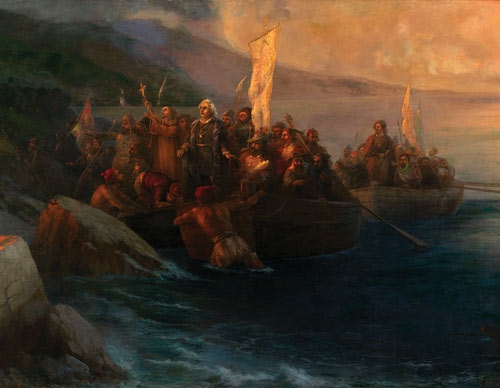
A painting depicts Christopher Columbus and shipmates landing at sunrise Oct. 12, 1492, on the island he named San Salvador.
A painting depicts Christopher Columbus and shipmates landing at sunrise Oct. 12, 1492, on the island he named San Salvador. The Disembarkation of Christopher Columbus with Companions on Three Launches, 1892, by Ivan Aivazovsky / Wikimedia Commons

At a moment when even George Washington and Thomas Jefferson are under attack, it was inevitable that the current unrest would also engulf Christopher Columbus. His case is unique, though, because unlike the others, few people — least of all those who took turns stomping on his statues — know much about him.

They assume that he brought slavery and genocide to the New World. Europeans did, of course, commit many sins. But they did not introduce new evils; all of them — including slavery and genocide — already existed among Indigenous peoples, as they did throughout the world.

One person who knew Columbus personally was the Dominican missionary Bartolomé de las Casas. He earned the name defensor de los indios (“defender of the Indians”) because of his passionate diatribes against exploiters of native peoples in the Americas. Las Casas did not spare Columbus from criticism, but he also defended him against those who blamed him for all the disorders and violence that followed the first contacts with Indigenous peoples.

The great explorer’s missteps, he said, were the result of ignorance and misjudgments about how to proceed: “Truly, I would not dare blame the admiral’s intentions for I knew him well and I knew his intentions were good.”

It’s good, then, to examine some of the contemporary charges against Columbus in order to assess him fairly.

Myth 1: He was a violent man.

Las Casas spoke of Columbus’ “sweetness and benignity.” Far from being a violent man, he often got into difficulties because he would be indulgent — toward natives and Spaniards — and would then take extreme measures against both when things got out of hand. He was a great navigator but a poor governor.

By his third voyage, he was cautioning Ferdinand and Isabella about who they were allowing to sail to the New World. He needed, he said, 60 missionaries to preach Christianity to arrogant and abusive Spaniards, and another 60 upstanding men to help him run the colony.

Myth 2: He committed genocide.

There was no “genocide” during these early voyages, though many natives died from unfamiliar diseases and clashes between two very different cultures. The Americas had been isolated from the rest of the world for millennia, which is why people here, though they had had their own plagues, were especially vulnerable to diseases from outside. Nonetheless, the Spaniards never intended to commit “genocide.” In even a cynical reading, a ready supply of native workers served Spanish interests.

Myth 3: He instituted the slave trade.

Columbus was not interested in the slave trade; his goal was to set up a trading post or, later, an agricultural colony on the island of Hispaniola, today’s Dominican Republic and Haiti. He did, however, take slaves as prisoners of war, or where he found violations of natural law, such as human sacrifice or cannibalism — the only reasons Spain permitted. Slavery was never the admiral’s intention, except as a — not very effective — way to maintain order in unprecedented circumstances.

Myth 4: He had only worldly interests.

People often claim that Columbus was motivated by “God, gold and glory,” but assume God was just a cover for worldly interests. In fact, his religious devotion was sincere. Among other things, we know from his writings that he felt that he had been given a role in spreading the Gospel to all nations, which had to happen before Christ could return. In later years, he often dressed as a Third Order Franciscan.

Myth 5: He did not accomplish anything extraordinary.

Many also claim that Columbus did not “discover” the New World. Those living here already knew where they were, the argument goes, and didn’t need to be discovered. This is a half-truth. Indigenous peoples, of course, knew their own lands. They did not know that they were part of a larger world.

One reason we especially honor Columbus is that he began the process toward the one interconnected world that we now inhabit. Vasco da Gama sailed around Africa and reached “the Indies” five years after Columbus arrived in the New World. But great as that feat was, he only found a new route to longknown lands. Columbus, by skill, imagination and sheer grit gave us the world.

*****

Columbus is often dismissed today on other grounds — usually by people who have come to hate “Western civilization” and, frankly, traditional Christianity. They want to blame him for everything wrong on these shores since 1492. Following that logic, though, he deserves some credit — and gratitude — as well, for the many good things that also followed his discoveries.

ROBERT ROYAL is director of the Faith and Reason Institute in Washington, D.C., and a member of St. John Bosco Council 12846 in Springfield, Va. His latest book, Columbus and the Crisis of the West, will be published by Sophia Institute Press this fall.

On Columbus Day, we ask: Why the Knights of Columbus?


Why the Knights of Columbus?

For much of U.S. history, Columbus has symbolized civic unity and the hope of building an inclusive society

by William J. Connell9/1/2020
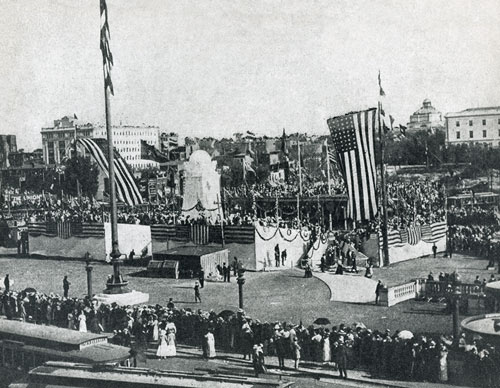
The Columbus Memorial at Union Station in Washington, D.C., is unveiled June 8, 1912. The Order was instrumental in the planning of the monument, and the dedication ceremony included a speech by President William Howard Taft, followed by a parade with soldiers and 20,000 Knights of Columbus.
The Columbus Memorial at Union Station in Washington, D.C., is unveiled June 8, 1912. The Order was instrumental in the planning of the monument, and the dedication ceremony included a speech by President William Howard Taft, followed by a parade with soldiers and 20,000 Knights of Columbus. Knights of Columbus Multimedia Archives

During the long summer of 2020, when scores of statues of Christopher Columbus have been vandalized or removed around the United States, it is important to remember why those statues were erected. How did Columbus come to be such an important figure in the popular imagination during most of the nation’s history?

Above all it had to do with the possibility of building in the Western hemisphere a new civilization — one that would bring together European traditions and ideas with the Native American peoples, traditions and the flora and fauna of the new continent. What remains striking, after more than five centuries, is the hopefulness of this venture, and the belief that there was an opportunity to create a better way of life that immigrants to, and within, the New World still share today.

The first members of the Knights of Columbus were influenced by this vision and also instrumental in promoting it. Just two years after the death of the Knights’ founder, Father Michael McGivney, councils enthusiastically participated in the first national Columbus Day, declared in 1892 for the quadricentennial of the great navigator’s landing. For them and many others, Columbus was celebrated as a figure of civic unity and a symbol that immigrants, particularly Catholics, possessed a rightful share in American identity.

THE ATTRACTION OF ‘COLUMBUS’

As early as the colonial period, the name “Columbia” was used as a figurative synonym for America. The poet Phillis Wheatley, an African American, wrote several striking poems in praise of Columbia during the Revolutionary War. After independence, the capital of the United States was sited in a district called Columbia, while artists represented Columbia as an allegorical female figure embodying the virtues and the hopes of a new civilization no longer bound to Europe.

It was especially after the Civil War, however, that Columbus soared in popularity. Much of this attraction can be explained by the explosion in sea traffic in the second half of the 1800s. The technological shift from sail to steam and the lower cost of travel opened the oceans to the masses on both sides of the Atlantic. As the first transoceanic seafarer, Columbus became a popular hero, and in the decades before and after 1900 he was admired in Europe almost as much as in the Americas. It was no coincidence that the many statues and monuments to him (Barcelona, Genoa, Buenos Aires, New York City) began to be built around that time.

It was also no coincidence that certain immigrant groups — Irish, Italians, Hispanics and other Catholics — that felt marginalized in a still WASP-dominated United States identified themselves with a universally admired historical figure who also happened to have been Italian, to have sailed for Spain, and to have brought Catholic Christianity to the Western Hemisphere. Columbus could be presented as legitimating their presence at a time when anti-Catholicism and anti-immigrant nativism were quite common. This, of course, was the atmosphere in which the Knights of Columbus was founded.

When Father McGivney, the son of Irish immigrants, proposed a name for the fraternal and charitable organization in 1882, his choice was “Sons of Columbus.” After debate with the founding members — all of them laymen, most of them Irish — the group finally settled upon “Knights of Columbus.”

While “Knights” invoked the chivalric orders, with their code of ethics, aspiration to virtue and defense of the most vulnerable, the adoption of Columbus as patron signified that Catholics had been in the New World from the beginning — that is, from the very day that it became “New.”

As founding member William Geary put it, the name conveyed that Catholics “were not aliens” in America but rather participated in the very foundation of this new civilization. With respect to American society at large, the choice of Columbus was a comfortable one, since it embraced an existing and very popular object of admiration.

CATHOLICS HAD BEEN IN THE NEW WORLD FROM THE BEGINNING — THAT IS, FROM THE VERY DAY THAT IT BECAME ‘NEW.’

CELEBRATING CIVIC UNITY

When President Benjamin Harrison first proclaimed Oct. 12, 1892, as Columbus Day, the idea — lost on present-day critics — was that the holiday would recognize both Native Americans, who were here before Columbus, and the many immigrants who were then coming to this country in astounding numbers. Like the Columbian Exposition dedicated in Chicago that year, it was to be about our land and all its people.

The 1892 Columbus Day parade in New York City was telling in this regard. Harrison had especially designated the schools as centers of the Columbus celebration, and thousands of public school students marched, followed by students from Catholic and other private schools, each wearing their respective uniforms. These included the Hebrew Orphan Asylum, the Dante Alighieri Italian College of Astoria and the Native American marching band from the Carlisle Indian School in Pennsylvania, which speaks volumes about the spirit of the original Columbus Day.

On the same day, 6,000 Knights of Columbus marched in a parade in New Haven, Conn., where a 600-voice choir, led by the choir director of St. Mary’s Church, performed a concert that included various national anthems. The event drew some 40,000 people, then the largest crowd in New Haven’s history.

In the years that followed, the Knights of Columbus encouraged Columbus Day celebrations around the country as well as monuments in Columbus’ honor.

In 1906, Colorado became the first state to declare Columbus Day an annual holiday, and within six years, the movement had taken on national proportions, with observances in 30 states.

The Ku Klux Klan was among the holiday’s strongest opponents, since it commemorated a man who was Catholic and a non-Anglo. Despite attempts to put an end to Columbus Day as a state holiday, it continued to be observed. Oct. 12 was established as a national celebration by annual presidential proclamation in 1934; it became a federal holiday in 1968.

What sometimes gets overlooked in current discussions is that we neither commemorate Columbus’ birthday (as is the practice for many public figures) nor his death date (when Christian saints are usually memorialized), but rather the date of his arrival in the New World.

Columbus Day marks the first encounter that brought together the original and future Americans. A lot of suffering followed Columbus’ landing on San Salvador, and a lot of achievement, too. It was a momentous, world-changing occasion, such as has rarely happened in human history.

*****

WILLIAM J. CONNELL holds the La Motta Chair in Italian Studies at Seton Hall University. He is author and editor of several books, including the Routledge History of Italian Americans (2018).

Sunday, October 11, 2020

Even in 2020, even with this so called "cancel culture" the answer is yes, Catholics celebrate Columbus Day

Should Catholics Celebrate Columbus Day?

More than five hundred years afterwards, some are starting to question whether we should be celebrating the discovery of the Americas by Christopher Columbus.
Of course, it seems only natural and fitting that Columbus Day should be a holiday for Americans. But, in recent decades, commentators have shed more light on the dark side of his discoveries—the violence against the native tribes, the forced slavery, and the diseases the European explorers brought with them. Instead of being seen as a cultural hero, Columbus has been recast as a villain in a story of exploitation and conquest.
For Catholics the question is twofold: Was Christopher Columbus ever a hero of the faith? And should we still celebrate him given what we now know about the atrocities unleashed by his discovery?

A world war with Islam

Christopher Columbus, we were taught in school, boldly set sail in westward in search of a sea route to Asia, where he hoped to find spices and gold. Instead, he ended up discovering the Americas in what could be described as one of the most successful failures in history. This much is true. But the bigger story—the real reason and motive behind his epic voyages—has been left out of most textbooks.


When Columbus set out for the East Indies in 1492, Europe was in the midst of a thousand-year world war that began when Muslim forces overran the three Christian cities of Damascus, Jerusalem, and Alexandria in the mid-600’s. The crusades, launched in 1096, had been a well-intentioned but poorly-executed attempt to retaliate against Islam and recover the Holy Land.
The last real crusade had ended in 1272 but Catholic and Muslim forces continued their centuries-long struggle for control over Spain. It’s no coincidence that 1492 also marks the year that the last Muslim holdouts were ejected from the Iberian Peninsula.
Once the battle for Spain had ended, Europeans returned their attention to the East. Both the Portuguese and Spanish monarchs, with the support and urging of the papacy, were determined to strike a decisive blow against Islam. Instead of another battle by land, the plan was to find a sea route to the East Indies, cutting out the Muslim middlemen in the spice trade and forging an alliance with the legendary Prester John, a priest-king believed to be the ruler of a powerful kingdom in the East.
Certainly, the monarchs and the explorers they funded hoped to enlarge their personal wealth and prestige in the process, but the two objectives were not as incompatible as they might seem: the new revenues flowing into European coffers could be used to fund a new, final crusade to Jerusalem.
While the Portuguese sent Vasco da Gama around the coast of Africa, the Spanish backed Columbus in his bid to find a direct route across the ocean. Like da Gama, Columbus saw his mission as part of a broader religious drama. In his letters, Columbus described his vision of the eventual defeat of Islam, expressing hope that the revenues generated from his trip could be used to serve Christendom: “I have already petitioned Your Highness to see that all the profits of this, my enterprise, should be spent on the conquest of Jerusalem,” Columbus wrote.

A man of faith amid failure

Columbus certainly was eying worldly rewards for his efforts. He insisted on being named Admiral of the Ocean, receiving a tenth of all profits, and being appointed the governor of the lands he discovered.
But he was also a man of deep faith. Catholic historian Warren Carroll sees significance in the departure date Columbus chose for his first westward voyage: August 3, 1492, the day after the fiesta of Our Lady of Angels, the patroness of the Franciscan monastery that had lent moral support to his bold plan and Palos, the area from which he would set sail, according to Carroll.
“He was convinced that God had chosen him to reach that land, hidden from the Western world for ages, which the Roman philosopher Seneca had once prophesied would be revealed. His discovery would bring the Catholic Faith, to which he was devoted, to the people who lived in that land,” Carroll writes.
Columbus never lost that sense that he was on a mission for God. When his men started to grumble on his first voyage, Columbus told them that it was “useless to complain, for I had started out to find the Indies and would continue until I had accomplished that mission, with the help of Our Lord.” Columbus was known to sometimes wear the Franciscan habit, and would open all his correspondence with the Sign of the Cross, referring to himself as “Christbearer.” His high view of the faith was evident in a letter he wrote to his son Diego after the death of the Spanish Queen Isabel, who had sponsored his voyages:
The most important thing is to commend lovingly and with much devotion the soul of the Queen our lady, to God. Her life was always Catholic and holy, and prompt in all things in His holy service. Because of this we should believe that she is in holy glory, and beyond the cares of this harsh and weary world.
Columbus lived at a time when biblical places were still situated on medieval maps—and he took the claims of pious geographers seriously. He believed he had found the approach to the Garden of Eden when he ventured up the Orinoco River in present-day Venezuela and that the gold-mines of Solomon were hidden somewhere on Hispaniola, the island home to Haiti and the Dominican Republic.
To be sure, the nobility of his intentions were somewhat marred by brutalities as well. Some were committed by his men without authorization. In fact, one of the earliest atrocities occurred entirely in his absence. After his first voyage, Columbus had left a small garrison on Hispaniola. Upon his return, he learned that the men had become restive and launched an attack on the Indians, ending with the slaughter of the Spanish.
But after continued troubles with the island, Columbus took it out on the native peoples, enslaving a thousand of them—an act that Carroll says is inexcusable. But overall, the historian concludes that Columbus was not the oppressive colonialist revisionists make him out to be:
From this record it should be clear that, despite occasional lashing out at the Indians, Columbus was never their systematic oppressor, but simply unable to control the Spaniards on land who were supposed to be under his command. If he had only been willing to confine himself to what he did so superlatively well—sailing and exploring— few if any could have traduced his memory. But because he insisted on remaining governor of the lands he had discovered, his reputation was blackened by the atrocities that occurred during the period when he still had final responsibility for their governance. But it is Columbus the discoverer and explorer whom we truly celebrate and honor, not Columbus the civil governor. His personal influence on the ultimate fate of the Indians of the Caribbean was slight; in no significant way did he change what their history would have been without him, once the discovery was made. (See “Honoring Christopher Columbus,” in the summer 1992 issue of Faith and Reason, available on EWTN.)

A legacy of evangelization

Columbus never made it to the East Indies and he never played the role that he had imagined for himself in the war between Christendom and Islam. He nonetheless has had a lasting, positive impact on the faith as significant, if not more than what he had envisioned. His discoveries not only paved the way for the evangelization of Latin America but also brought an end to the cannibalism of the Caribs and the tradition of human sacrifices among the Aztecs. Today, Latin America is home to 39 percent of the world’s Catholics and has two of the five countries with the most Catholics, Brazil and Mexico.
The discoveries also came at a pivotal moment for the Church itself. Within a quarter of a century of the first voyage to America, Catholicism would face its greatest crisis of faith since the Arian heresy: the Protestant Reformation.
“Columbus threw open America at the time when a great storm was about to break over the Church. As far, therefore, as it is lawful for man to divine from events the ways of Divine Providence, he seemed to have truly been born, by a singular provision of God, to remedy those losses which were awaiting the Catholic Church on the side of Europe,” Pope Leo XIII wrote in an encyclical to mark the 400th anniversary of the 1492 discoveries.
Columbus, to be sure, was no saint, as Leo XII himself noted. But the pope saw the “impress” of divine virtue in the “excellent power of mind and spirit” exhibited by Columbus. He concludes that Columbus is a hero whom Catholics should celebrate:
For Columbus is ours; since if a little consideration be given to the particular reason of his design in exploring the ‘mare tenebrosum,’ and also the manner in which he endeavored to execute the design, it is indubitable that the Catholic faith was the strongest motive for the inception and prosecution of the design; so that for this reason also the whole human race owes not a little to the Church.