Showing posts with label Divine Mercy. Show all posts

Sunday, April 12, 2026

Sunday Regina Caeli with Pope Leo XIV


Pope at Angelus: Sunday Eucharist “indispensable” for Christian life

On Divine Mercy Sunday, Pope Leo XIV highlights the Eucharist as essential for sustaining faith.

By Vatican News

On Sunday 12 April, Pope Leo XIV addressed the faithful gathered in Saint Peter’s Square for the Regina Caeli. This week, Pope Leo reflected on the Gospel of the Second Sunday of Easter, Divine Mercy Sunday, which emphasises the central role of the Eucharist in sustaining faith.

He recounted the Gospel account of the Apostle Thomas, who encounters the risen Christ eight days after Easter and noted that this meeting takes place within the community, highlighting where believers are called to seek Christ today.

"This scene invites us to reflect on our own encounter with the risen Jesus", the Pope said. He invited the faithful to ask themselves "Where can we find him? How can we recognise him? How can we believe?" Pope Leo XIV explained that faith is not always immediate or easy. "It was not easy for Thomas, and it is not easy for us either", he said, adding that "faith needs to be nourished and sustained".

For this reason, he continued, the Church invites the faithful to gather every Sunday, the "eighth day", to celebrate the Eucharist. "During Mass, we listen to the words of Jesus, we pray, we profess our faith… His Body and Blood nourish us, so that we too may become witnesses of his Resurrection".

The Pope then went on to emphasise that participation in Sunday Mass is essential, as "the Sunday Eucharist is indispensable to the Christian life".

Turning then to the witness of the early Church, Pope Leo pointed to the Martyrs of Abitene, who chose death rather than abandon the celebration of the Eucharist. "They replied that they could not live without celebrating the Lord’s Day", he said.

The Pope explained that it is in the Eucharist that faith grows and is strengthened, and where believers are united as members of one body. “It is there that our efforts, though limited, are united by God’s grace… for the accomplishment of a single great plan of salvation that embraces all humanity".

He also stressed the missionary dimension of Mass, noting that the term itself signifies "sending forth". Christians, he said, are called to bring what they receive into their daily lives, becoming "witnesses of charity and messengers of reconciliation".

Bringing his address to a close, Pope Leo stressed that "In a world that is in such great need of peace this calls on us more than ever to be steadfast and faithful in our Eucharistic encounter with the risen Lord".

Saturday, April 11, 2026

How to receive a Plenary Indulgence for Divine Mercy Sunday


Plenary Indulgence for Divine Mercy Sunday

In a decree dated August 3, 2002, the Apostolic Penitentiary announced that in order “to ensure that the faithful would observe this day (Divine Mercy Sunday) with intense devotion, the Supreme Pontiff himself established that this Sunday be enriched by a plenary indulgence…so that the faithful might receive in great abundance the gift of the consolation of the Holy Spirit.  In this way, they can foster a growing love for God and for their neighbor, and after they have obtained God’s pardon, they in turn might be persuaded to show a prompt pardon to their brothers and sisters.”

The plenary indulgence is granted (under the usual conditions of a sacramental confession, Eucharistic communion and a prayer for the intentions of the Supreme Pontiff) to the faithful who, on Divine Mercy Sunday, in a spirit that is completely detached from the affection for a sin, even a venial sin, recite the Our Father and the Creed, and also adding a devout prayer (e.g. Merciful Jesus, I trust in you!).

Additional provisions are offered for those who are impeded from fulfilling these requirements, but who wish to acquire a plenary indulgence.  The full text of the decree of the Apostolic Penitentiary may be found at: www.mercysunday.com.  While the readings and prayers for Mass on this day remain unchanged (they reflect perfectly on Our Lord’s Divine Mercy) the Holy See offers this reflection:

The Gospel of the Second Sunday of Easter narrates the wonderful things Christ the Lord accomplished on the day of the Resurrection during His first public appearance: “On the evening of that day, the first day of the week, the doors being shut where the disciples were, for fear of the Jews, Jesus came and stood among them and said to them, ‘Peace be with you.’  When He had said this, He showed them His hands and His side.  Then the disciples were glad to see the Lord.  Jesus said to them again, ‘Peace be with you.  As the Father has sent Me, so even I send you,’ and then He breathed on them, and said, ‘Receive the Holy Spirit.  If you forgive the sins of any, they are forgiven; if you retain the sins of any, they are retained’” (Jn 20, 19-23).

In addition, the decree requires that parish priests “should inform the faithful in the most suitable way of the Church’s salutary provision.  They should promptly and generously be willing to hear their confessions.  On Divine Mercy Sunday, after celebrating Mass they should lead the prayers that have been given above, and they should also encourage the faithful to perform acts of mercy as often as they can.”

From the Feb. 2003 edition of the BCL (Bishops Committee on the Liturgy) Newsletter by the U.S. Conference of Catholic Bishops.

April 12th: The 2nd Sunday of Easter IS Divine Mercy Sunday


Easter: April 12th

Second Sunday of Easter (or Sunday of Divine Mercy)


"I shall sing forever the Lord's mercy" (Ps 89 [88]).

Today is the Sunday of Divine Mercy, the Octave Day of Easter.

From Creation, God has revealed his nature as love itself, in Sacred Scripture and most perfectly in the life, Passion, death and Resurrection of his Son, Jesus. In his second encyclical, Dives In Misericordia (Rich in Mercy), Pope Saint John Paul II offers an extended meditation on the mystery of God’s mercy, which he calls “the greatest of the attributes and perfections of God” (Dives in misericordia, 13). He returned to this theme throughout his pontificate:

As a gift to humanity, which sometimes seems bewildered and overwhelmed by the power of evil, selfishness, and fear, the Risen Lord offers His love that pardons, reconciles, and reopens hearts to love. It is a love that converts hearts and gives peace. How much the world needs to understand and accept Divine Mercy!

Lord, who reveals the Father’s love by Your death and Resurrection, we believe in You and confidently repeat to You today: Jesus, I trust in You, have mercy upon us and upon the whole world.
—Pope John Paul II, Regina caeli message for Divine Mercy Sunday, April 3, 2005

The Divine Mercy Sunday origin is from a revelation to Saint Faustina, a Sister of Mercy in Poland who initiated the Divine Mercy devotion. Between 1930 and 1938 Jesus requested numerous times a Feast of Divine Mercy. On May 5, 2000, five days after the canonization of Saint Faustina, the Vatican decreed that the Second Sunday of Easter would henceforth be known as Divine Mercy Sunday.


Commentary on the Divine Mercy Sunday Mass Readings, Cycle A
The First Reading is taken from Acts 2:42-47. On Pentecost Sunday the Holy Spirit, as promised by Christ, descended on the Apostles with external signs which brought the people of Jerusalem in their hundreds to the Upper Room where the Apostles with external signs which brought the people of Jerusalem in their hundreds to the Upper Room where the Apostles lived. St. Peter addressed them and explained what had happened, with the result that “about three thousand souls were baptized and added that day” (Acts 2:41) to the Apostles and disciples, who formed the nucleus of the Christian Church.

In these six short verses of the second chapter of the Acts we are given a picture of the fervent religious life of the first Christian community. As would be expected, these Jerusalem Christians, having the Apostles still among them, and the memory of the resurrection and the descent of the Holy Spirit still fresh in their memories, were animated and moved by a deep religious fervor.

The Second Reading is from the First Letter of St. Peter 1:3-9. This first epistle of St. Peter has always been accepted as authentic, that is, it was written by St. Peter and most probably from Rome which he called “Babylon.” Tradition says he died a martyr there in 64 or 67. The letter, therefore, was written before 67 at the latest. It is in the form of an encyclical letter to the numerous churches of Asia Minor. Its purpose was to recall to the minds of these converts to the Church the basic doctrines of Christianity and to encourage them to endure any persecution that the faithful observance of their new religion might bring on them from their pagan or Jewish neighbors.
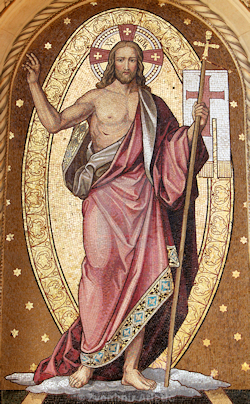
We have just celebrated the feast of the resurrection, and St. Peter’s words today are intended to remind us again of what that unique event means to us and to the Christian faith which we profess. It is the final and convincing proof of the Incarnation. The Christ who had been born as a baby of the Virgin Mary, had lived in Nazareth, had preached the message of salvation, had died on the cross, was none other than what he had said he was, the divine Son of God. He had come to give mankind life and “abundant” life—an eternal life hereafter in the kingdom of his Father.

The first converts to Christianity had grasped this truth, this consoling knowledge, and they rejoiced in it “with unutterable and exalted joy.” We, too, have grasped this truth; we, too, know that through the Incarnation, death and resurrection of Christ, we have been made heirs to an “inheritance which is imperishable, undefiled and unfading.” But do we always let this consoling knowledge, this Christian conviction, govern and regulate our daily lives and actions?

The things of this world are very close to us and hard to ignore. Heaven seems very far away, and may seem to be something we can worry about later. The joys and pleasures of this passing life are very attractive because they surround us so closely now—the thought of the true, unending pleasure and happiness, much as it satisfies and answers to our innate human, intellectual desires and ambitions, can easily be pushed into the background by the hustling and bustling of the present, temporary attractions.

Let us remember that “our faith is more precious than gold”: let us never forget these words of St. Peter.

The Gospel is read for all years (Cycles A, B and C) and is taken from John 20:19-31. Last Sunday’s gospel, also taken from St. John, described the first hint at the resurrection which the Apostles received. Peter and John, convinced that the body had not been taken away, because the winding sheets were left behind, were beginning to believe. But the others were skeptical, the two disciples on the way to Emmaus paid no heed to the women’s story, and Thomas refused to believe the testimony of the other ten, even when this present appearance of our Lord had convinced them.

It may surprise and amaze us that the Apostles were so reluctant to believe that Christ had risen from the dead, to live forever in glory with his Father in heaven. But we must remember that during their two or three years with him they saw nothing in him but a mere man, one with divine powers, but yet a man; certain prophets of the old covenant had some such powers also. Christ had “emptied himself” of his divine nature, and he had foretold his resurrection many times. But that he could be really God, as well as man, was something they could not then grasp, and if he was a mere man death had to be the end.

Their slowness of faith had its value for the future Church and for all of us. If they had been expecting the resurrection, and anxiously looking forward to it, people could say that they imagined it, that they persuaded themselves it had happened. Indeed, there have been men proud of their acuteness of judgment, who have said that the story of the resurrection is a story of mass hallucination, although all the evidence proves the opposite. Their conviction that it could not happen, could not be removed from their minds except by impressive evidence that it had. Hallucination is born in a mind already excepting and hoping for the imagined fact.

We can thank the Apostles and especially Thomas, the last to give in, that our faith in the resurrection and divine glorification of Christ is that much the stronger. Our Christianity which would have ended before the first Easter week had passed, if Christ had not risen in glory, spread rapidly to the then known world and is still spreading because its author was none other than Christ “our Lord and our God.” How prophetic were the words of the Gamaliel at the meeting of the Sanhedrin which tried to prevent the Apostles from preaching the new Christian faith: “if this plan or work is of men, it will overthrown; but if it is of God, you will not be able to overthrow it” (Acts 5:38-39).
—Excerpted from The Sunday Readings , Cycle A, by Fr. Kevin O'Sullivan, O.F.M.


Second Sunday of Easter or Divine Mercy Sunday
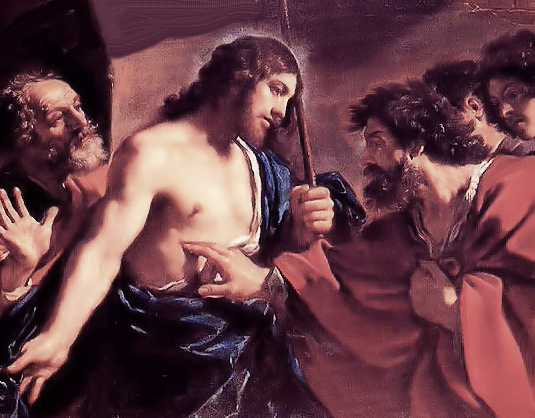
The Holy Gospel that the Liturgy presents to us on this second Sunday of Easter, is one of the most well known, discussed, and appreciated—the meeting of the Risen Lord with St Thomas. The Fathers of the Church have given us numerous insights into this Gospel text. Likewise, it is has proven the inspiration to the numerous artists who have physically represented the events of this Gospel in order to give us a clear idea of what happened, ‘eight days after’ the first apparition of the Risen One, to the disciples congregated in the cenacle.

Jesus’ response to Thomas, after he recognized Him as ‘My Lord and my God’, has a mysterious fascination that must relate not so much to the disciples—those who ‘have seen’—but rather to those, like us, who were added to their number afterwards. ‘You have come to believe because you have seen me. Blessed are those who have not seen and have believed.’ (Jn 20:29)

The attention that these words evoke seems yet more paradoxical if we remember that the Lord had proposed, to the same author of the Gospel, what can be justly referred to as the Christian method, ‘come and see’ (Jn 1:39). How can we possibly reconcile these two phrases by Jesus that form the ideal setting for the whole of the fourth Gospel? Perhaps, in the end, the Lord decided to change His method? What do the words ‘have not seen’ really mean?

The timely recollection of the ‘eight days after,’ which is the Sunday after the Resurrection, permits us to tie our reflection to one of the most significant Eucharistic hymns composed by another Thomas, St Thomas Aquinas. In the Adore Te Devote, which refers to the Eucharist, we read: ‘Sight, touch, taste are all deceived in their judgement of you. But hearing suffices firmly to believe’. Combining these words with today’s Gospel we can justly affirm that the experience ‘to see’ was not denied to us, but it is in contrast with the Apostle Thomas’ physical experience, who was able to put his own finger into the holes in Christ’s hands and side, whilst we can only comprehend it in the faith which is guarded and transmitted by the Church, our Mother and Teacher.

That which we ‘have not seen’ is therefore the glorious Body of the Risen One. However, today we have the ability to ‘listen’ to the Word of God and the Magisterium of the Church and so we can ‘see’ the real Body of Christ which is the Eucharist. We can ‘see’ His Mystical Body which is the Church. We can ‘see’ Him in our lives and in the lives of our many brothers who, after meeting the Lord in a real but mysterious way, are united to Him in His Spirit!

Like Thomas, Christ calls us to fill the holes left by the instruments of the passion in His Body with our own hands so that our lives and the verbal witness that we give proclaim His Resurrection. Our senses could betray us, but we know that we have met the Risen One and we have recognized Him!

The certain hope that Peter, who betrayed the Lord three times for fear of death, proclaims to us with the words, ‘rejoice with an indescribable and glorious joy’ (1 Peter 1:8), become fully comprehensible because blessed are they that ‘have not seen’ the Risen Lord, but seeing the joy of His disciples ‘have believed’ in Him!
—From the Congregation for the Clergy


Jesus to Sr. Faustina
On one occasion, I heard these words: "My daughter, tell the whole world about My inconceivable mercy. I desire that the Feast of Mercy be a refuge and shelter for all souls, and especially for poor sinners. On that day the very depths of My tender mercy are open. I pour out a whole ocean of graces upon those souls who approach the fount of My mercy. The soul that will go to Confession and receive Holy Communion shall obtain complete forgiveness of sins and punishment. On that day all the divine floodgates through which graces flow are opened. Let no soul fear to draw near to Me, even though its sins be as scarlet. My mercy is so great that no mind, be it of man or of angel, will be able to fathom it throughout all eternity. Everything that exists has come forth from the very depths of My most tender mercy. Every soul in its relation to Me will contemplate My love and mercy throughout eternity. The Feast of Mercy emerged from My very depths of tenderness. It is My desire that it be solemnly celebrated on the first Sunday after Easter. Mankind will not have peace until it turns to the Fount of My Mercy.

"[Let] the greatest sinners place their trust in My mercy. They have the right before others to trust in the abyss of My mercy. My daughter, write about My mercy towards tormented souls. Souls that make an appeal to My mercy delight Me. To such souls I grant even more graces than they ask. I cannot punish even the greatest sinner if he makes an appeal to My compassion, but on the contrary, I justify him in My unfathomable and inscrutable mercy. Write: before I come as a just Judge, I first open wide the door of My mercy. He who refuses to pass through the door of My mercy must pass through the door of My justice.

"From all My wounds, like from streams, mercy flows for souls, but the wound in My Heart is the fountain of unfathomable mercy. From this fountain spring all graces for souls. The flames of compassion burn Me. I desire greatly to pour them out upon souls. Speak to the whole world about My mercy."
—Excerpted from Diary of Sr. M. Faustina Kowalska

Saturday, October 4, 2025

The Apostle of Divine Mercy; Sunday's Saint


St. Faustina Kowalska

Feastday: October 5
Patron: of Mercy
Birth: 1905
Death: 1938
Beatified: Pope John Paul II on April 18, 1993
Canonized: Pope John Paul II on April 30, 2000


Saint Maria Faustina Kowalska of the Blessed Sacrament was born as Helena Kowalska, in Glogowiec,Leczyca County, north-west of Lódz in Poland on August 25, 1905. She was the third of 10 children to a poor and religious family.

Faustina first felt a calling to the religious life when she was just seven years old and attended the Exposition of the Blessed Sacrament. After finishing her schooling, Faustina wanted to immediately join a convent. However, her parents refused to let her.

Instead, at 16-years-old, Faustina became a housekeeper to help her parents and support herself.

In 1924, Faustina experienced her first vision of Jesus. While at a dance with her sister, Natalia, Faustina saw a suffering Jesus and then went to a Cathedral. According to Faustina, Jesus instructed her to leave for Warsaw immediately and join a convent.

Faustina packed her bags at once and departed the following morning. When she arrived in Warsaw, she entered Saint James Church in Warsaw, the first church she came across, and attended Mass.

While in Warsaw, Faustina approached many different convents, but was turned away every time. She was judged on her appearances and sometimes rejected for poverty.

Finally, the mother superior for the Congregation of the Sisters of Our Lady of Mercy decided to take in Faustina on the condition that she could pay for her own religious habit. Working as a housekeeper, Faustina began to save her money and make deposits to the Convent.

On April 30, 1926, at 20-years-old, she finally received her habit and took the religious name of Sister Maria Faustina of the Blessed Sacrament and in 1928, she took her first religious vows as a nun.

Over the next year, Faustina traveled convents as a cook. In May 1930 she arrived in Plock, Poland. Soon after, she began to show the first signs of her illness and was sent away to rest. Several months later, Faustina returned to the convent.

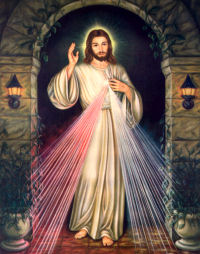
On February 22, 1931, Faustina was visited by Jesus, who presented himself as the "King of Divine Mercy" wearing a white garment with red and pale rays coming from his heart. She was asked to become the apostle and secretary of God's mercy, a model of how to be merciful to others, and an instrument for reemphasizing God's plan of mercy for the world.

In her diary, Faustina writes:

"In the evening, when I was in my cell, I became aware of the Lord Jesus clothed in a white garment. One hand was raised in blessing; the other was touching the garment at the breast. From the opening of the garment at the breast there came forth two large rays, one red and the other pale. In silence I gazed intently at the Lord; my soul was overwhelmed with fear, but also with great joy. After a while Jesus said to me, 'paint an image according to the pattern you see, with the inscription: Jesus, I trust in You.'"

Faustina also describes during that same message, Jesus explained he wanted the Divine Mercy image to be "solemnly blessed on the first Sunday after Easter; that Sunday is to be the Feast of Mercy."

Faustina, not knowing how to paint, asked around her Plock convent for help but was denied. It wasn't until three years later, in 1934, that the first painting of the image was created by Eugene Kazimierowski.

In 1932, Faustina returned to Warsaw. On May 1, 1933, she took her final vows in Lagiewniki and became a perpetual sister of Our Lady of Mercy.

After taking her vows, Faustina was transferred to Vilnius, where she met Father Michael Sopocko, the appointed confessor to the nuns. During her first confession with Sopocko, Faustina told him about her conversations with Jesus and his plan for her. Father Sopocko insisted she be evaluated by a psychiatrist. Faustina passed all the required tests and was determined sane, leading Sopocko to support her religious efforts.

Sopocko encouraged her to start keeping a diary and to record all of her conversations with Jesus. Faustina told Sopocko about the Divine Mercy image, and it was Sopocko who introduced her to Kazimierowski, the artist of the first Divine Mercy painting.

According to Faustina's diary, on Good Friday, April 19, 1935, Jesus told her he wanted the Divine Mercy image publicly honored. On April 26, 1935, Father Sopocko delivered the very first sermon on the Divine Mercy.

In September 1935, Faustina wrote about her vision of the Chaplet of Divine Mercy, used to obtain mercy, trust in Christ's mercy and to show mercy to others.

During the following year, Faustina attempted to set up a new congregation for Divine Mercy, but was reminded that she was perpetually vowed to her current order and sent back to Warsaw. She reported Jesus said to her, "My Daughter, do whatever is within your power to spread devotion to My Divine Mercy, I will make up for what you lack."

In 1936, Faustina fell ill again. She moved to the sanatorium in Pradnik, Krakow and continued to spend most of her time in prayer.

In July 1937, the first holy cards with the Divine Mercy image were created and Faustina provided instructions for the Novena of Divine Mercy, which she reported was a message from Jesus. Throughout the rest of 1937, the Divine Mercy image continued to be promoted and grow in popularity.

Faustina's health significantly deteriorated by the end of 1937. Her visions intensified and she was said to be looking forward to the end of her life. On October 5, 1938, Faustina passed away. She was buried on October 7 and currently rests at the Basilica of Divine Mercy in Krakow, Poland.

Her entire life, in imitation of Christ's, was to be a sacrifice - a life lived for others. At the Divine Lord's request, she willingly offered her personal sufferings in union with Him to atone for the sins of others. In her daily life she was to become a doer of mercy, bringing joy and peace to others, and by writing about God's mercy, she was to encourage others to trust in Him and thus prepare the world for His coming again.

Her special devotion to Mary Immaculate and to the sacraments of Eucharist and Reconciliation gave her the strength to bear all her sufferings as an offering to God on behalf of the Church and those in special need, especially great sinners and the dying.

The message of mercy that Sister Faustina received is now being spread throughout the world; her diary, Divine Mercy in my Soul, has become the handbook for devotion to the Divine Mercy.

In 1965, Archbishop of Krakow, Karol Wojtyla, who would later become Pope John Paul II, opened up the first investigations into Faustina's life and virtues. He submitted a number of documents on her life to the Vatican and requested the official beatification process to start.

One of his documents noted the case of Maureen Digan of Massachusetts. In March 1981, Digan reported she was healed from Lymphedema after praying at Faustina's tomb. She explained, while there, she heard a voice saying, "ask for my help and I will help you," and her pain stopped. After returning to the United States, five different doctors all reported she was healed with no medical explanation. In 1992, the Vatican declared Digan's case miraculous.

St. Faustina Kowalska was beatified on April 18, 1993, and canonized on April 30, 2000, both by Pope St. John Paul II. Her feast day is celebrated on October 5 and she is the patron saint of Mercy.

Sunday, April 27, 2025

Cardinal Parolin offers Mass for Divine Mercy Sunday and day two of the Novemdiales


Cardinal Parolin at Novemdiales Mass: ‘Mercy takes us to heart of faith’

Cardinal Pietro Parolin celebrates Mass on Divine Mercy Sunday in suffrage for Pope Francis, and recalls that mercy offers Christians the golden thread that unites our lives to one another and to Christ.

By Devin Watkins

At Mass on the second day of the Novemdiales, or “nine days” of mourning for the late Pope Francis, Cardinal Pietro Parolin invited Christians to look to Christ’s infinite mercy for peace in the world and in our hearts.

In his homily, the 70-year-old Italian-born Cardinal drew inspiration from the day’s Gospel, which recalls the fear and sadness of the Apostles as they huddled in the Upper Room after Jesus’ death.

He said this image represents the Church’s state of mind at this moment, as Christians mourn the late Pope, who died on Easter Monday and was buried on Saturday.

“The grief at his departure, the sense of sadness that assails us, the turmoil we feel in our hearts, the sense of bewilderment,” he said, “we are experiencing all of this, like the Apostles grieving over the death of Jesus.”

Yet, said Cardinal Parolin, Christ comes precisely in this darkness to reveal Himself in the glory of His resurrection and illumine our hearts.

“Pope Francis reminded us of this since his election and often repeated it to us, placing at the centre of his pontificate that joy of the Gospel,” he said.

Many young people were present at the second Novemdiales Mass, which took place during the scheduled Jubilee for Teenagers.

Cardinal Parolin urged young people to welcome the joy of Easter, even amid the pain of loss, reminding them that Jesus always gives us the “courage to live.”

Recalling the Feast of Divine Mercy, the Cardinal said Pope Francis’ teaching put great emphasis on God’s mercy, which has no limits and works to raise us up and renew us.

“Our affection for him, which is being manifested in this time,” he said, “must not remain a mere emotion of the moment. We must welcome his legacy and make it part of our lives, opening ourselves to God’s mercy and also being merciful to one another.”

Mercy, added Cardinal Parolin, “takes us back to the heart of faith,” and helps us interpret our relationship with God and our identity as the Church according to God’s categories, rather than those of the world.

“The good news of the Gospel is first and foremost the discovery of being loved by a God who has compassionate and tender feelings for each one of us, regardless of our merits,” he said. “It also reminds us that our life is woven with mercy: we can only get back up after our falls and look to the future if we have someone who loves us without limits and forgives us.”

Cardinal Parolin, who served as Secretary of State under Pope Francis, noted that only mercy heals and creates a new world, extinguishing the fires of hatred and violence.

“The risen Lord directs His disciples, His Church, to be instruments of mercy for humanity for those willing to accept God’s love and forgiveness,” said the Cardinal. “Pope Francis was a shining witness of a Church that bends down with tenderness towards those who are wounded and heals with the balm of mercy.”

The late Pope, he added, believed strongly that peace is not possible without recognition of one another and mutual forgiveness.

Turning to employees of the Roman Curia and Vatican City State, Cardinal Parolin thanked them for their untiring service to the Holy See.

“We entrust ourselves to the Blessed Virgin Mary, to whom he was so devoted that he chose to be buried in the Basilica of Saint Mary Major,” concluded Cardinal Parolin. “May she protect us, intercede for us, watch over the Church, and support the journey of humanity in peace and fraternity.”

Friday, October 4, 2024

Saturday Saint of the Day; the Apostle of Divine Mercy


St. Faustina Kowalska


Feastday: October 5
Patron: of Mercy
Birth: 1905
Death: 1938
Beatified: Pope John Paul II on April 18, 1993
Canonized: Pope John Paul II on April 30, 2000


Saint Maria Faustina Kowalska of the Blessed Sacrament was born as Helena Kowalska, in Glogowiec, Leczyca County, north-west of Lódz in Poland on August 25, 1905. She was the third of 10 children to a poor and religious family.

Faustina first felt a calling to the religious life when she was just seven-years-old and attended the Exposition of the Blessed Sacrament. After finishing her schooling, Faustina wanted to immediately join a convent. However, her parents refused to let her.

Instead, at 16-years-old, Faustina became a housekeeper to help her parents and support herself.

In 1924, Faustina experienced her first vision of Jesus. While at a dance with her sister, Natalia, Faustina saw a suffering Jesus and then went to a Cathedral. According to Faustina, Jesus instructed her to leave for Warsaw immediately and join a convent.

Faustina packed her bags at once and departed the following morning. When she arrived in Warsaw, she entered Saint James Church in Warsaw, the first church she came across, and attended Mass.

While in Warsaw, Faustina approached many different convents, but was turned away every time. She was judged on her appearances and sometimes rejected for poverty.

Finally, the mother superior for the Congregation of the Sisters of Our Lady of Mercy decided to take in Faustina on the condition that she could pay for her own religious habit. Working as a housekeeper, Faustina began to save her money and make deposits to the Convent.

On April 30, 1926, at 20-years-old, she finally received her habit and took the religious name of Sister Maria Faustina of the Blessed Sacrament and in 1928, she took her first religious vows as a nun.

Over the next year, Faustina traveled convents as a cook. In May 1930 she arrived in Plock, Poland. Soon after, she began to show the first signs of her illness and was sent away to rest. Several months later, Faustina returned to the convent.

On February 22, 1931, Faustina was visited by Jesus, who presented himself as the "King of Divine Mercy" wearing a white garment with red and pale rays coming from his heart. She was asked to become the apostle and secretary of God's mercy, a model of how to be merciful to others, and an instrument for reemphasizing God's plan of mercy for the world.

In her diary, Faustina writes:

"In the evening, when I was in my cell, I became aware of the Lord Jesus clothed in a white garment. One hand was raised in blessing, the other was touching the garment at the breast. From the opening of the garment at the breast there came forth two large rays, one red and the other pale. In silence I gazed intently at the Lord; my soul was overwhelmed with fear, but also with great joy. After a while Jesus said to me, 'paint an image according to the pattern you see, with the inscription: Jesus, I trust in You.'"

Faustina also describes during that same message, Jesus explained he wanted the Divine Mercy image to be "solemnly blessed on the first Sunday after Easter; that Sunday is to be the Feast of Mercy."

Faustina, not knowing how to paint, asked around her Plock convent for help but was denied. It wasn't until three years later, in 1934, that the first painting of the image was created by Eugene Kazimierowski.

In 1932, Faustina returned to Warsaw. On May 1, 1933 she took her final vows in Lagiewniki and became a perpetual sister of Our Lady of Mercy.

After taking her vows, Faustina was transferred to Vilnius, where she met Father Michael Sopocko, the appointed confessor to the nuns. During her first confession with Sopocko, Faustina told him about her conversations with Jesus and his plan for her. Father Sopocko insisted she be evaluated by a psychiatrist. Faustina passed all the required tests and was determined sane, leading Sopocko to support her religious efforts.

Sopocko encouraged her to start keeping a diary and to record all of her conversations with Jesus. Faustina told Sopocko about the Divine Mercy image and it was Sopocko who introduced her to Kazimierowski, the artist of the first Divine Mercy painting.

According to Faustina's diary, on Good Friday, April 19, 1935, Jesus told her he wanted the Divine Mercy image publically honored. On April 26, 1935, Father Sopocko delivered the very first sermon on the Divine Mercy.

In September 1935, Faustina wrote about her vision of the Chaplet of Divine Mercy, used to obtain mercy, trust in Christ's mercy and to show mercy to others.

During the following year, Faustina attempted to set up a new congregation for Divine Mercy, but was reminded that she was perpetually vowed to her current order and sent back to Warsaw. She reported Jesus said to her, "My Daughter, do whatever is within your power to spread devotion to My Divine Mercy, I will make up for what you lack."

In 1936, Faustina fell ill again. She moved to the sanatorium in Pradnik, Krakow and continued to spend most of her time in prayer.

In July 1937, the first holy cards with the Divine Mercy image were created and Faustina provided instructions for the Novena of Divine Mercy, which she reported was a message from Jesus. Throughout the rest of 1937, the Divine Mercy image continued to be promoted and grow in popularity.

Faustina's health significantly deteriorated by the end of 1937. Her visions intensified and she was said to be looking forward to the end of her life. On October 5, 1938, Faustina passed away. She was buried on October 7 and currently rests at the Basilica of Divine Mercy in Krakow, Poland.

Her entire life, in imitation of Christ's, was to be a sacrifice - a life lived for others. At the Divine Lord's request, she willingly offered her personal sufferings in union with Him to atone for the sins of others. In her daily life she was to become a doer of mercy, bringing joy and peace to others, and by writing about God's mercy, she was to encourage others to trust in Him and thus prepare the world for His coming again.

Her special devotion to Mary Immaculate and to the sacraments of Eucharist and Reconciliation gave her the strength to bear all her sufferings as an offering to God on behalf of the Church and those in special need, especially great sinners and the dying.

The message of mercy that Sister Faustina received is now being spread throughout the world; her diary, Divine Mercy in my Soul, has become the handbook for devotion to the Divine Mercy.

In 1965, Archbishop of Krakow, Karol Wojtyla, who would later become Pope John Paul II, opened up the first investigations into Faustina's life and virtues. He submitted a number of documents on her life to the Vatican and requested the official beatification process to start.

One of his documents noted the case of Maureen Digan of Massachusetts. In March 1981, Digan reported she was healed from Lymphedema after praying at Faustina's tomb. She explained, while there, she heard a voice saying "ask for my help and I will help you," and her pain stopped. After returning to the United States, five different doctors all reported she was healed with no medical explanation. In 1992, the Vatican declared Digan's case miraculous.

St. Faustina Kowalska was beatified on April 18, 1993 and canonized on April 30, 2000, both by Pope St. John Paul II. Her feast day is celebrated on October 5 and she is the patron saint of Mercy.

Sunday, April 7, 2024

Papal Regina Caeli Address 04.07.2024


Pope at Regina Coeli: Have faith in the Risen Christ

On the second Sunday of Easter, Pope Francis emphasises the transformative power of encountering the risen Jesus, urging believers to embrace faith, prayer, and love and spread Easter joy.

By Francesca Merlo

Pope Francis opened his Regina Coeli address on Sunday, 7 April, by noting that the second Sunday of Easter, was dedicated by Saint John Paul II to Divine Mercy.

On this occasion, he said, the Gospel tells us that, by believing in Jesus, Son of God, we can have life in His name. “To have life: what does it mean?" asked the Pope.

To have life

The Holy Father explained that each of us wants to "have life", but that there are various ways of doing so.

"There are those who reduce existence to a frenetic race to enjoy and possess many things", said the Pope, describing this as a road that "at first seems pleasurable", but that "does not satiate the heart". This, therefore, is not the correct path to take to "have life" as it does not lead to happiness.

Fullness is found in Jesus

Pope Francis went on to note that today the Gospel says that this fullness of life, to which every one of us is called, is realised in Jesus. "But how can one gain access to it, how can one experience it?", he asked.

Having life, the Pope continued, means "fixing one's eyes on the crucified and the risen Jesus, encountering Him in the Sacraments and in prayer, recognising that He is present, believing in Him, letting oneself be touched by His grace and guided by His example, experiencing the joy of loving like Him. Every living encounter with Jesus enables us to have more life".

Finally, the Pope invited the faithful to ask themselves: "Do I believe in the power of the resurrection of Jesus, in His victory over sin, fear and death? Do I let myself be drawn into a relationship with Him? And do I let myself be prompted by Him to love my brothers and sisters, and to hope every day?"

He concluded by imploring the Virgin Mary to give us faith in the risen Jesus, to “have life” and to spread the joy of Easter.