Showing posts with label Pope John XXIII. Show all posts

Thursday, October 10, 2024

Friday's Saint of the Day; good Saint Pope John 23rd


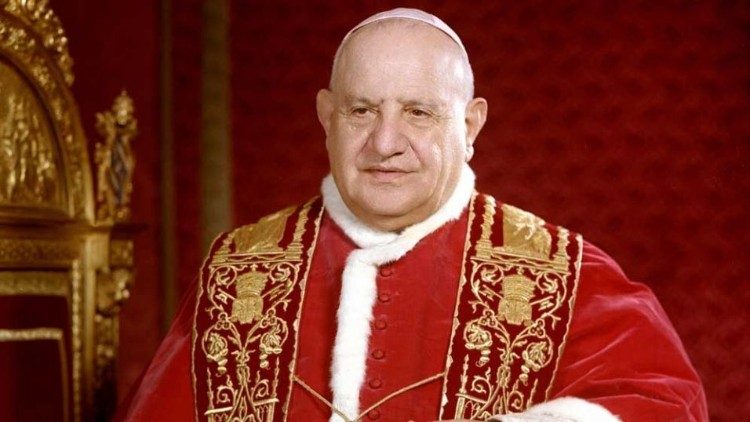
St. John XXIII


Feastday: October 11
Patron: of Papal delegates, Patriarchy of Venice, Second Vatican Council
Birth: 1881
Death: 1963
Beatified: 3 September 2000 by Pope John Paul II
Canonized: 27 April 2014 Saint Peter's Square, Vatican City by Pope Francis
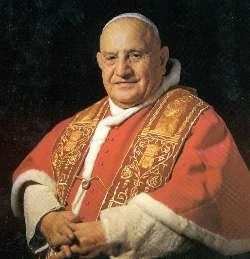


The man who would be Pope John XXIII was born in the small village of Sotto il Monte in Italy, on November 25, 1881. He was the fourth of fourteen children born to poor parents who made their living by sharecropping. Named Angelo Giuseppe Roncalli, the baby would eventually become one of the most influential popes in recent history, changing the Church forever.

Roncalli's career within the Church began in 1904 when he graduated from university with a doctorate in theology. He was ordained a priest thereafter and soon met Pope Pius X in Rome.

By the following year, 1905, Roncalli was appointed to act as secretary for his bishop, Giacomo Radini-Tedeschi. He continued working as the bishop's secretary until the bishop died in August 1914. The bishop's last words to Roncalli were, "Pray for peace."

Such words mattered in August 1914 as the world teetered on the brink of World War I. Italy was eventually drawn into the war and Roncalli was drafted into the Italian Army as a stretcher bearer and chaplain.

Roncalli did his duty and was eventually discharged from the army in 1919. Free to serve the Church in new capacities he was appointed to be the Italian president of the Society for the Propagation of the Faith, handpicked by Pope Benedict XV.

Then in February 1925, Roncalli was summoned to the Vatican and given a new mission. This time he was sent to Bulgaria as the Apostolic Visitor to that country. Later, he was appointed aspostolic delegate to Turkey and Greece and made archbishop of Mesembria.

Beginning in 1935, racial tensions and anti-Jewish sentiment began to explode into actual acts of violence against the Jews and other ethnic minorities. Roncalli started using his influence to save what people he could from the depredation of both local authorities and later the Nazis. During his tenure as archbishop, Roncalli saved thousands of Jews, enough that he was named a "Righteous Gentile" following the war.

In late 1944, the Church was anxious to remove clergy in France that had collaborated with the Nazis in various forms. Roncalli was appointed as the new papal Nuncio and sent to France to negotiate the retirement of bishops who were involved with the Nazis.

In 1952, Roncalli was offered a new position, this time as Patriarch of Venice. At the same time he assumed his new title, Roncalli became the Cardinal-Priest of Santa Prisca. He assumed his new responsibilities on March 15, 1953.

Roncalli's papal predecessor died on October 9, 1958 and he was soon summoned to Rome where he was to participate in the process of selecting a new pope. The College eventually settled on Roncalli for election and he accepted, saying "I will be called John," a surprising choice because of that name's association with schism.

As Pope John XXIII, he immediately began to change the culture in the Vatican. On Christmas, 1958, he resumed the papal practice of making visits to the community within the official Diocese of Rome. He visited the sick, the poor, and prisoners. He apologized for episodes of anti-Semitism within the Church carried on by some of his predecessors.

It was originally expected that Pope John XXIII would only serve a short time before passing away and that he would make no significant changes to Church practice. However, Pope John XXIII was a man of great mercy and kindness and much like Pope Francis of today, he did many things that created sensation in the streets and pews.

Perhaps his most influential decision was the call for an ecumenical council which would be known as Vatican II. As a result of this council, many practices of the classic Church would be altered with a new emphasis on ecumenism and a new liturgy.

Pope John XXIII addressed several topic of importance to Catholics around the world. He prohibited the use of contraceptives which interfere with the procreative will of God. He upheld the traditional view that married couples may not divorce. He also moved to protect the Church from scandal, ordering confidentiality when dealing with matters of clergy accused of the sexual abuse of children. How his request to the bishops of his time was interpreted remains subject to debate.

By late 1962, Pope John XXIII has executed most of the work for which he would be known. He was, like his own sister before him, diagnosed with stomach cancer, which was a terminal diagnosis for that time.

In his last months, he offered to negotiate peace between the Soviet Union and the United States, then at the height of the Cold War. The offer, although declined, was popular in both countries. In the wake of the news, John XXIII was the first pope to be honored as the Time Magazine Man of the Year.

Pope John XXIII did the best he could although his health and doctors were failing. On June 3, 1963, Pope John XXIII died in his bed at age 81.

The world mourned John XXIII and he was posthumously awarded the Presidential Medal of Freedom by President Johnson in December 1963.

Pope John XXIII generally maintained a good reputation among those who remembered him and he was often titled "the Good."

On September 3, 2000, Pope John Paul beatified him. Miracles were attributed to him and his body was found to be in an uncorrupted state, a phenomenon consistent with sainthood. His body was put on display for the veneration of the faithful.

Pope Francis approved John XXIII for canonization on June 3, 2013, the 50th anniversary of his death.

Bl. Pope John XXIII will be canonized on April 27, 2014 alongside Bl. Pope John Paul II in a historic ceremony to be presided by Pope Emeritus Benedict and Pope Francis. It will be a historic ceremony with two living men with the title of pontiff presiding together.

Pope John XXIII's feast day will be October 11, as opposed to the day of his death, which is June 3. This special feast day is intended as a commemoration of the opening of the Second Vatican Council on October 11, 1962.

Monday, November 28, 2022

In meeting with school children the Pope refers to St. John XXIII and Martin Luther King as modern-day prophets


The Pope with participants in the "For Peace. With Care" meeting in the VaticanThe Pope with participants in the "For Peace. With Care" meeting in the Vatican  (Vatican Media)

Pope to Italian schoolchildren: 'Dream big, like John XXIII and Martin Luther King'

Pope Francis meets with 6,000 schoolchildren, teachers, and school leaders, urging them to follow in the footsteps of “modern day prophets” Pope St John XXIII and Martin Luther King Jr.

By Joseph Tulloch

Pope Francis on Monday met with a group of 6,000 Italian schoolchildren, teachers, and school leaders in a meeting organised by the country's National Network of Schools for Peace.

During the session, which was entitled “For Peace. With Care” and held in the Vatican’s Paul VI Hall, the Pope spoke of the importance of constantly building peace, and held up Pope St John XXIII and Martin Luther King as "prophets of our times."

Peace is always urgent

A key theme of the Pope’s address was the importance of always striving to build peace, rather than only doing so when we ourselves are directly impacted by war.

“We often talk about peace when we feel directly threatened,” he said, “as in the case of a possible nuclear attack or a war being fought on our doorstep. Just as we take an interest in the rights of migrants when we have some relative or friend who has emigrated.”

“In fact, we always, always need to pay attention to peace! Just like we need to always pay attention to the other, to our brothers and sisters; they must be taken care of.”

Prophets of peace

The Pope then said that he wanted to remind his listeners of the example of two prominent witnesses to peace.

The first of these was Pope St John XXIII. “He was called the "Good Pope," and also the "Pope of Peace”,” the Holy Father said, “because in those difficult beginnings of the 1960s, marked by strong tensions – the construction of the Berlin Wall, the Cuba crisis, the Cold War and the nuclear threat – he published the famous and prophetic Encyclical Pacem in Terris … It was a call that received great attention in the world, far beyond the Catholic community.”

The Pope also mentioned Martin Luther King Jr., calling him “another prophet of our times”.

“In an American context heavily marked by racial discrimination,” he said, “he made everyone dream with the idea of a world of justice, freedom and equality. He said, "I have a dream that my four little children will one day live in a nation where they will not be judged by the colour of their skin but by their character.”"

The Pope then addressed the gathered schoolchildren directly.

“And you, boys and girls: what is your dream for the world of today? What is your dream for the world and for tomorrow? I encourage you to dream big, like John XXIII and Martin Luther King.”

A Global Educational Compact

Pope Francis also had warm words for the organisers of the event, which was convened response to his appeal several years ago for a Global Compact on Education.

“I congratulate you students and your teachers for the rich program of activities and training you have undertaken," he said. "I am happy to see that it is not only Catholic schools, universities and organisations that are responding to this call, but also public, secular and other religious institutions.”

Thursday, October 13, 2022

60 years ago today at Vatican II: Pope John 23rd takes to radio to talk to the world


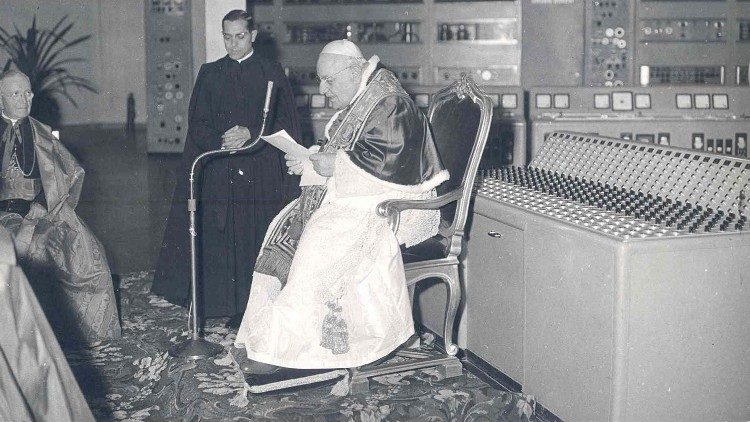
Archive image of Pope John XXIII speaking to the world through the microphones of Vatican RadioArchive image of Pope John XXIII speaking to the world through the microphones of Vatican Radio 

13 October 1962: John XXIII tells journalists to serve the truth and contribute to peace

On the third day of the Second Vatican Ecumenical Council, Pope St. John XXIII receives the journalists accredited to the Council and invites them "to contribute to the 'disarmament of spirits' which is the primary condition for the establishment of true peace on the earth."

By Linda Bordoni

Journalists from across the globe came to Rome in droves to report on the Council whose purpose was to “bring the Church into the modern world”.

Pope St. John XXIII was well aware of the role and the power of the media and had already set in motion a series of innovations to help the press tell the story.

According to those journalists who attended, the most important innovation in the press office of the Council was that the summaries of the debates, prepared by employees in various language groups, were accompanied by explanations from theological experts on the points under discussion, so that the briefings were transformed into an authentic theological school for journalists.

And journalists were amongst the first groups present at the Council to receive the greetings and encouragement of the Pope who met them in the Sistine Chapel on day three of the Council. He spelled out the esteem in which he held representatives of the press, recognized the importance he attached to their role and invited them to contribute to peace on earth.

“On the occasion of the Council,” he said speaking in Spanish, “we have created a press office and a secretariat for the techniques of diffusion. And we have set up a conciliar commission which, together with the lay apostolate, will deal with the press, radio and entertainment.”

“With this we are telling you how important your mission is in our eyes and how much we desire to help you to fulfil it perfectly.”

At the service of truth

The Pope reminded those present of their duty to always be “at the service of truth,” and reflecting on how the message conveyed by different media was able to reach and ultimately “guide the thoughts, feelings and passions of a large part of mankind,” he warned against the  distortion of the truth by the media, which he said, “can have incalculable consequences.”

Acknowledging the temptation to be “more concerned with speed than accuracy, more interested in the ‘sensational’ than in what is objectively true”, John XXIII urged journalists not to allow personal opinions or beliefs blur or obscure the truth.

“If this [truth] is serious in all fields, how much more so when it concerns what is most intimate and most sacred in the world: the religious field and the relationship of the soul with God.”

Feeding curiosity and nurturing good relations

The Pope noted that an ecumenical council brings with it “external and secondary aspects capable of feeding the curiosity of a hasty public.”

“It can also, in the long run, have a beneficial influence on relations between people, in the social and even in the political sphere. But it is first and foremost a great religious event,” he said.

“It is our heartfelt wish that you may help to bring this fact to light.”

By saying this, the Pope continued, “we tell you what tact, what reserve, what concern for understanding and accuracy we have the right to expect from an informer who is anxious to do honour to his noble profession.”

"We ask all of you to make an effort to understand and to make understood the primarily religious and spiritual nature of these solemn conciliar sessions," he said.

The father of the Council went on to list his expectations for the press in the exercise of its mission that he said, must have “salutary effects for the orientation of world opinion about the Catholic Church in general, her institutions and her teachings.”

He warned against prejudices that can flourish when “loyal and objective information cannot get through” and  “which sustain in people's minds roots of mistrust, suspicion and misunderstanding, the consequences of which are deplorable for the progress of harmony among men and among peoples.”

These prejudices, he said, are often based on inaccurate or incomplete information.

“Doctrines are attributed to the Church which she does not profess; attitudes which she may have adopted in particular historical circumstances are reproached and unduly generalised, without taking into account their accidental and contingent character.”

Keep the public interested

“The very announcement of the Council has aroused considerable interest throughout the world,” the Pope said, inviting the journalists to keep the public “interested and sympathetic towards the Council and help to revise, if necessary, erroneous or incomplete opinions.”

“You will be able to make it clear that there is no political machination here. You will be able to understand and to proclaim the true motives which inspire the action of the Church in the world.”

You will be able to bear witness, he continued, “that she [the Church] has nothing to hide, that she follows a straight and straightforward path, that she desires nothing but the truth for the happiness of mankind and fruitful understanding among the peoples of all continents.”

“Thanks to you, many fears can be dispelled. By serving the truth, you will contribute to the ‘disarmament of spirits’, which is the primary condition for the establishment of true peace on earth.”

Wednesday, October 12, 2022

The Orthodox Church acknowledges the importance of the Second Vatican Council


Ecumenical Patriarch Bartholomew recalls importance of Vatican II


ROME — The Second Vatican Council was of great interest to the Orthodox world, Ecumenical Patriarch Bartholomew of Constantinople wrote in an article published in the Vatican newspaper.

The article published Oct. 11 marked the anniversary of the opening of the first session of the Second Vatican Council Oct. 11, 1962, which set in motion major reforms of the church, its structure, liturgy and relations with other Christians and other religions.

After only three months as pontiff, St. John XXIII announced he was convening the council, speaking of the need to update the church and promote Christian unity.

When St. John made the announcement, Patriarch Bartholomew wrote, “hope arose in the Orthodox world, especially in our blessed predecessor Patriarch Athenagoras,” that the event could find new ways toward Christian unity.

However, there was “a certain amount of disappointment” when it was learned the gathering would pertain only to the Roman Catholic Church, he wrote.

Orthodox churches were invited to send observers to the council and would not have voting rights. It was not until St. Paul VI met with Patriarch Athenagoras during a pilgrimage to Jerusalem in 1964 that observers representing the Ecumenical Patriarchate were sent to attend the last two sessions of the council.

Many of the issues the council addressed “aroused keen interest” among the Orthodox, Patriarch Bartholomew wrote. But the one that seemed most important was “the constitution on the sacred liturgy and its appeal to tradition,” not as some relic from the past, “but as a living expression of the church” and its “return to the most ancient sources of the church’s various liturgies.”

The patriarch wrote that St. John XXIII “loved the liturgy, as the church’s highest form of prayer; the liturgy is a sign of unity between God and humanity and between humanity and God. In every rite of the liturgy we find that which unites above everything and for everything.”

“The Second Vatican Council restored this centrality to the Roman liturgy,” he wrote.

All Christians today have “the duty to work to find our unity in that one bread and one chalice, Christ … ‘who is broken but not divided; always eaten, yet never consumed, but sanctifying those who partake,'” he wrote, quoting St. John Chrysostom.

60 years ago at the Second Vatican Council, day 2 and the early days of the Cuban Missile Crisis


Pope St. John XXIIIPope St. John XXIII 

12 October 1962: John XXIII's appeal to States to heed "anguished cry for peace"

On 12 October 1962, day two of the Second Vatican Council and amid the unfolding Cuban Missile Crisis, Pope John XXIII addresses diplomats accredited to the Holy See, noting that Heads of State bear responsibility for the fate of nations and urging them to listen to “the anguished cry” for peace which rises from every part of the world.

By Linda Bordoni

The scores of cardinals, bishops, members of delegations, and experts who flocked to Rome in October 1962 to attend the Second Ecumenical Vatican Council were living an international political crisis that in many ways was dramatically similar to the one we live in today.

Tensions were rising in the so-called Cuban missile crisis, which originated from the Cold War between the Soviet Union and the United States. 15 October is the date on which the US took a picture of the missile installations in Cuba confirming that the Soviets were building missile bases on the island. Pope John XXIII had already undertaken his extraordinary mediation action by starting a dialogue with the non-Catholic population of the Soviet bloc, and on the second day of the Second Ecumenical Council, he addressed representatives of Heads of States – the ambassadors accredited to the Holy See – and told them that “We, and all the heads of state who bear responsibility for the fate of nations,” must omit no effort to achieve peace.

“In addition to its religious significance, the Council has also a social aspect that concerns the life of peoples. Your presence here very plainly shows that.”

Pope St. John XXIII went on to say that it is clear that a Council is concerned primarily with the Catholic Church,  to show the Church’s vigour, to emphasize its spiritual mission, to adapt its methods so that the Gospel teaching may be worthily lived and more readily heeded by the people, and to promote a quest for unity and grace  “to which so many souls aspire from all corners of the earth”.

Finally, he said, "the Council wishes to show the world how to put into practice the teaching of the divine Founder, the Prince of Peace. Whoever conforms his life to this teaching helps to establish peace and to foster true prosperity."

Harmony between nations through respect

Highlighting the duty of the Church and the moral force of Christianity to promote a message of truth, of justice, and of charity, the Pope expressed his mission to work “to establish a true peace; a peace directed toward the elevation of nations through respect for the human person and toward the procuring of a just freedom of religion and worship; a peace which nourishes harmony between nations."

“And there is no reason why this should not exist – even if it calls for some sacrifice on their part.”

Brotherhood

The natural consequences, Pope St. John XXIII continued, “will be love for one another, brotherhood, and the end of strife between men of different races and different mentalities.”

“Such is the great peace which all men await and for which they have suffered so much; it is time that decisive steps be taken.”

He went on to explain that “this very peace which the Church labours to establish: by prayer, by the deep respect she has for the unfortunate, the sick, the aged, and by the spreading of her doctrine which is the doctrine of brotherly love; for men are Brothers and – We say it from a full heart – all sons of the same Father.”

“The Council will certainly help to prepare this new climate and to remove all conflict, particularly war, that scourge of nations, which today would be pointing toward the destruction of humanity.”

Noting that the audience with “the Extraordinary Diplomatic Missions” was taking place in the Sistine Chapel before Michelangelo's vast masterpiece of the Last Judgement, the Pope said: “We must indeed render an account to God: We, and all the heads of state who bear responsibility for the fate of nations.

"In all conscience let them give ear to the anguished cry of «peace, peace,» which rises up to heaven from every part of the world, from innocent children and those grown old, from individuals and from communities.

“May this thought of the reckoning that they are to face,” he added, “spur them to omit no effort toward achieving this blessing, which for the human family is a blessing greater than any other.”

Make sacrifices to save peace

He encouraged them to continue to meet, to engage in discussion, and to reach ”just and generous  agreements that they faithfully observe.”

“Let them be ready to make the sacrifices necessary to save the world's peace.”

Nations, he continued, “will then be able to work in an atmosphere of serenity. All the discoveries of science will assist progress and help to make life on this earth – already marked by so many other inevitable sufferings – ever more pleasant.”

Thus, Pope St. John XXIII pointed out that “The Council that was opened yesterday in your presence showed forth vividly the Church's universality.”

“This imposing assembly «of every people and tongue and nation», by proclaiming the good news of salvation to the world, which for the past 100 years has seen all manner of turmoil, will undoubtedly bring God's enlightening answer to the agonizing problems of our day and will aid in that way the true progress of individuals and of whole nations.”

Tuesday, October 11, 2022

The many fruits of the Second Vatican Council


Church celebrates 60th anniversary of opening of Second Vatican Council

Pope John XXIII officially opened the Second Vatican Council on 11 October 1962 during a solemn ceremony inside St. Peter's Basilica, setting in motion a 4-year event which would see the Church open her doors to the world in a process of “updating” (in Italian: "aggiornamento") for the contemporary age.

By Lisa Zengarini

Pope John XXIII opened Vatican II by delivering his famous 'Gaudet Mater Ecclesiae' speech, in which he indicated the main purpose of the Council.

The Second Vatican Council, marked a milestone in Church history, setting off a process of deep transformation within the Church itself, and in its relations with the modern world, other Christian Churches and non-Christian religions. The process is still ongoing.

The 21st Ecumenical Council in Church history

Vatican II was the 21st ecumenical council to be convened in the Church's bimillennial history, and gathered nearly a century after Pope Pius IX convoked Vatican I (1869-70) which defined the dogmas of papal infallibility and the primacy of papal jurisdiction.

Pope St. John XXIII announced the convocation on 25 January 1959 only three months after his election to the Petrine ministry in October 1958, as he addressed the cardinals gathered in the in Benedictine Monastery of St. Paul in Rome. 

Offering the modern world the "medicine of mercy"

In his unexpected announcement, Pope John explained that his decision was born from the ascertainment of the spiritual impoverishment of modern society resulting from the deep social and political transformations it had been undergoing over the previous decades, which demanded a new response from the Church. He also mentioned the centuries-old divisions in the Christian family.

In his first Encyclical ‘Ad Petri Cathedram’, on 29 June 1959, and at a preparatory meeting on the next day, the late Pope further clarified that the Council was meant primarily to revitalize the Christian faith in an increasingly secularized world, to give new vigour to the Catholic Church’s mission, and to adapt Church practices to new circumstances.

Pope John wanted a pastoral Council and one of renovation, so that the Catholic teachings could be better understood and accepted in 20th-century society. As he said at the opening speech of the Council, while preserving the integrity of its doctrine, the Church wanted to offer the modern world the "medicine of mercy", and not severe condemnations.

Four sessions and 169 General Congregations

The Vatican II solemnly opened on 11 October 1962 in St. Peter's Basilica, after over three years of preparations. The Council met in four sessions between 1962 and 1965 each lasting between 8 and 12 weeks, in the autumn of each of the four years, for a total of 169 General Congregations. It was shortly interrupted after Pope John’s death on 3 June 1963, and resumed after Pope Pope VI’s election, on 11 June that year.  It closed on 8 December 1965.

Non-Catholic observers invited to attend

Between 2,000 and 2,500 Catholic cardinals, patriarchs and bishops from all over the world, assisted by 460 theological experts (periti), attended each session. For the first time Protestants, Orthodox and other non-Catholic observers were invited to assist. 42 lay and religious listeners, men and women, also attended.

16 documents

Overall, the Council issued 16 documents, including four Constitutions (on the Church's structure and nature, on divine Revelation, on the Church in the modern world, and on the liturgy,); nine Decrees (on the Church and the media, ecumenism, Eastern Catholic Churches, bishops, priestly formation, religious life, the laity, priestly ministry and missionary activity. Three Declarations (on non-Christian religions, Christian education and religious freedom were also issued.

The four Constitutions: ‘Lumen Gentium’

One of the most important documents produced by Vatican II is the Dogmatic Constitution ‘Lumen Gentium’ on the Church's structure and nature. It presents the Church as a Mystery and a Communion of baptized believers (the “People of God”) who are called to holiness and who each have specific roles and responsibilities. It reaffirms the missionary character of the Church and confirms the collegiality of the Episcopate "with and under the successor of St. Peter".  It establishes, among other things, the  faculty for the local Episcopates to restore the permanent diaconate for  married men. The role of the laity and their participation in the life and mission of the Church is also emphasized, while the vocation to religious life is considered in relation to the spiritual life of the whole Church.

‘Dei Verbum’

The Dogmatic Constitution ‘Dei Verbum’ on Divine Revelation is another fundamental document of the Council. Its purpose is to spell out the Church’s understanding of the nature of Revelation, that is, the process whereby God communicates with human beings. It is especially relevant for ecumenism, as it touches on questions about Scripture, tradition and the teaching authority of the Church.

‘Sacrosanctum Concilium’

The Constitution ‘Sacrosanctum Concilium’ on the  Sacred Liturgy is remembered by many for having allowed vernacular languages in the liturgy, or for having emphasized the importance of community prayer recognizing  the value and richness of the various rites in the Church according to the different traditions.

‘Gaudium et Spes’

The Pastoral Constitution ‘Gaudium et Spes’ on the Church in the Modern World, called on the Church to engage in dialogue with contemporary society and its problems, bringing church teaching and moral values to bear on a world too often torn by hatred, war and injustice. The document acknowledged that science and culture have things to teach the Church, but also said the Church has a mission to sanctify the world around it.

Landmark changes in the Church, in ecumenical and interreligious relations

In the years after Vatican II the Church witnessed several landmark changes:

- The new Roman Missal was issued in 1970, with a new cycle of readings designed to offer a richer selection of Scripture. The liturgical calendar was simplified. The rites for sacraments were revised, emphasizing the communal aspects of their celebration. The Rite of Christian Initiation of Adults was revived and reformed. As the changes took places, active liturgical participation increased dramatically in many local church communities.

- Lay ministries multiplied. Lay readers and lay ministers of Communion appeared during Mass. Laity were represented on parish councils and diocesan boards, and lay men and women, many with theology degrees, replaced clerics in a number of administrative church positions.

- Throughout the church, there was a renewed attention to Scriptures, in liturgy and in individual spirituality.

- Eastern Catholic churches were encouraged to return to their own traditions, ending a period of Latinization and opening a new appreciation of variety within the universal church.

- Ecumenism flourished, in formal dialogue between Catholic officials and other Christian churches, and in prayer and fellowship encounters at the local level.

- After the council acknowledged the possibility of salvation for non-Christians, dialogue also began with other religions.

- Religious life changed dramatically, as religious orders adopted Vatican norms and rewrote their own constitutions, taking a new look at issues of authority, community and identity.

- The council restored the permanent diaconate as a ministry and allowed married men to be ordained deacons. Today, there are more than 29,000 permanent deacons around the world.

- The council's teaching that the pope and bishops together form a single collegial body led to a new appreciation for bishops and bishops' conferences. The Synod of Bishops was formed to meet regularly and advise the pope.

- Theology was revitalized, especially moral theology, which focused increasingly on biblical sources and the individual conscience, and less on church law or authority.

- The council underlined the church's solidarity with humanity instead of its separation from the secular world, and this led to a mushrooming of social and charitable activities. Church leaders spoke frequently about the church's identification with the poor and suffering, and the pope became a strong human rights advocate.

At the same time, the church experienced some worrisome developments, including a dramatic drop in vocations and an increase in the number of priests and religious seeking laicization. Mass attendance fell in many places, many Catholics abandoned the sacrament of penance, and dissent on certain teachings, such as birth control, was widespread.

Main sources:  CNS and L’Osservatore Romano