Christmas: December 28th
Feast of the Holy Family
Today is the Fourth Day within the Octave of Christmas. The Feast of the Holy Family is a movable feast, assigned to the Sunday within the Octave of Christmas.
Scripture tells us practically nothing about the first years and the boyhood of the Child Jesus. All we know are the facts of the sojourn in Egypt, the return to Nazareth, and the incidents that occurred when the twelve-year-old boy accompanied his parents to Jerusalem. In her liturgy the Church hurries over this period of Christ's life with equal brevity. The general breakdown of the family, however, at the end of the past century and at the beginning of our own, prompted the popes, especially the far-sighted Leo XIII, to promote the observance of this feast with the hope that it might instill into Christian families something of the faithful love and the devoted attachment that characterize the family of Nazareth. The primary purpose of the Church in instituting and promoting this feast is to present the Holy Family as the model and exemplar of all Christian families.
—Excerpted from With Christ Through the Year, Rev. Bernard Strasser, O.S.B.

Feast of the Holy Family—Day Four
 Today is the feast day of the Holy Family, but also every family's feast day, since the Holy Family is the patron and model of all Christian families. Today should be a huge family feast, since it is devoted entirely to the Holy Family as a model for the Christian family life. As Rev. Edward Sutfin states:
"The children must learn to see in their father the foster-father St. Joseph, and the Blessed Mother as the perfect model for their own mother. The lesson to be learned is both practical and theoretical, in that the children must learn how to obey and to love their parents in thought, word and action, just as Christ was obedient to Mary and Joseph. Helping mother in the kitchen and in the house work, and helping father in his odd jobs about the home thus take on a new significance by being performed in a Christ-like spirit." (True Christmas Spirit, ©1955, St. Meinrad Archabbey, Inc.)
The Holy Family
 Marriage is too often conceived as the sacrament which unites a man and a woman to form a couple. In reality, marriage establishes a family, and its purpose is to increase the number of the elect, through the bodily and spiritual fecundity of the Christian spouses.
1. Every marriage intends children. Although Mary and Joseph were not united in a carnal way, their marriage is a true marriage: an indissoluble, exclusive union, wholly subordinated to the child. Mary and Joseph are united only in order to bring Jesus into the world, to protect and raise him. They have only one child, but he contains the whole of mankind, even as Isaac, an only child, fulfilled the promise made to Abraham of a countless progeny.
2. The purpose of every marriage is to establish a Christian family. The Holy Family observed the religious laws of Israel; it went in pilgrimage to Jerusalem every year with other Jewish families (Lk. 2:41). Jesus saddens and amazes his father and his mother because to their will and company he prefers "to be in his Father's house". Thus it may happen that God's will obliges the family to make disconcerting sacrifices. Yet every Christian family must live in harmony and in prayer, which are the pledges of joy and union.
3. "He remained obedient to them." Jesus was God. And through the fullness of grace Mary stood above Joseph. Nevertheless — if we except the event in the Temple — Joseph remained the head of the family; he took the initiative (as when the Holy Family fled to Egypt), and in Nazareth Jesus obeyed his parents.
—Excerpted from Bread and the Word, A.M. Roguet
Commentary on the Mass Readings for the Feast of the Holy Family, Cycle A:
The First Reading is from the Book of Sirach 3:2-6, 12-14. Although all the emphasis in these verse seems to be on the obligation of children to their parents, there is a profound lesson here for parents, too. "Like father like son" is an old and a true saying very often. If the parents fail to do what is right and just in the sight of God they can hardly complain if their children turn out disobedient to God and to them. The young learn more from example than from precept. Today, on this feast day, I would ask all parents to examine themselves and see how how they are fulfilling this grave responsibility—which God has placed on them. Are they preparing their children by word and example, especially by example, to be worthy citizens of heaven where they will be their parents' crown and glory?
The Second Reading is from the Letter of St. Paul to the Colossians 3:12-21. Ninety per cent of the first readers of St. Paul's Letter to the Colossians were pagans before their conversion. To practice the new Christian virtues was no easy task for people reared in the laxity and license of the paganism of their day. Yet they did practice these virtues and produced many saints and martyrs. Let us being in our own family circle to bring sanity back to our world. Let us have the true peace of Christ in our hearts and in our home, each one carrying out the task God has allotted to him. We shall not convert the world immediately but we shall have made a start. The world is the sum-total of its individual families.
The Gospel is from Matthew 2:13-15; 19-23. During this holy season of Christmas, Jesus Mary and Joseph should be remembered frequently by every Christian. To help us to remember them and above all to strive to imitate them, the Church has dedicated this Sunday to the memory of the Holy Family. Although they were God's closest friends, and although they were the holiest family that ever lived, or ever will live, on earth, they had more than their share of this world's troubles and cares. Today's Gospel story tells us of some of these earthly woes and sufferings. They had just settled in Bethlehem, and the Baby Jesus was only a few months old when, to avoid his murder at the hands of the murderous and jealous Herod, they had to flee from Bethlehem and become displaced persons in a foreign and pagan land.
The message of today's Gospel story is a message of encouragement and consolation for every one of us. If the Holy Family suffered such trials and hardships, surely we should be ready and willing to suffer and bear with the trials that God sends us for our own eternal welfare.
—Adapted from The Sunday Readings, by Fr. Kevin O'Sullivan, O.F.M.
Christmas Reflection: Children of God
1. In the middle of the night the Word of God descended into the homes of the Egyptians and slew every first-born among them. Israel was then freed from the Egyptian captivity. The Book of Wisdom reminds us of this marvelous delivery. "While all things were in quiet silence and the night was in the midst of her course, Thy almighty Word leapt down from heaven from the royal throne" (Wisd. 18:14 f.) and released Israel from the chains of the Egyptians from which they yearned so long to be freed. This descent of the angel among the people of Israel is a foreshadowing of the descent of the Son of God to free mankind when He comes to us at Christmas.
2. "God sent His Son, made of woman, made under the law, that He might redeem them who were under the law; that we might receive the adoption of sons" (Epistle). This is the mystery of Christmas, the mystery of the love, wisdom, justice, and mercy of God. We were slaves to the Egyptians; we served the severe taskmasters of this life: the world, the flesh, and the devil. God, looking upon our misery, sends His Son to become a slave, to assume our bondage, to purchase our freedom. Christ becomes subject to all the ills to which the human race is subject; He must be born as men are born, He must grow to manhood, He must suffer, He must die. He must be like to us in all things except sin. He is subject even to the law of Moses, since He is a Hebrew. He faithfully observes this law, which was fashioned for a sinful and stiff-necked people, and which had become for them an insufferable burden.
On this Sunday we find the Son of God, the almighty Word, with His mother and His foster father in the Temple, humbly submitting to the prescriptions of the law of Moses, as if He had been conceived in sin like His fellow men. From His submission to the law one might suppose that He, too, had been conceived in a natural way, by the desires of man and by a human father, not by the will and power of God. For Him the law was not necessary, but He submits to it joyfully and willingly. He has become a slave for us in order to free us from our bondage. Surely there has never been a more sublime example of perfect love and condescension. The Son of God descends from His royal throne and exchanges divine freedom for the chains of men in order that all men may be free. Such an act of divine condescension demands our careful contemplation.
"God sent His Son" to redeem us "that we might receive the adoption of sons." This is freedom, indeed. Not only are we freed from the bondage of sin, but we are made sons of God and share the majesty of the Son of God. "And because you are sons, God hath sent the Spirit of His Son into your hearts, crying: Abba, Father. Therefore now he is not a servant, but a son; and if a son, an heir also through God" (Epistle). But this redemption which the Son of God has wrought in us is not merely a liberation from the slavery of the world, the flesh, and the devil; it elevates us to a higher sphere and introduces us to a new life. "But as many as received Him, He gave them power to be made the sons of God, to them that believe in His name; who are born, not of blood, nor of the will of the flesh, nor of the will of man, but of God" (John 1:12 f.).
We are, then, the children of God. born to Him through the virginal birth of baptism, and are filled with the spirit of His life, by which we are entitled to cry out to God and call Him our Father. "Hallowed be Thy name; Thy kingdom come; Thy will be done." Thy will be done in us and through us. A redemption such as this could have been conceived only by the infinite wisdom of God and executed only through His almighty power. A new race comes into being at Christmas, a race born of the strength of the incarnate Word of God. The child who is born to us at Christmas is born under the law, but holds the scepter of omnipotence in His tiny hands.
The Gospel of the day describes the members of the family who surround the throne of the newborn King. Grouped about His throne we find the Virgin Mother and her virginal spouse, St. Joseph. There, too, is the aged Simeon, now filled with the Spirit of God and uttering his great prophecy: "Behold, this child is set for the fall and for the resurrection of many in Israel, and for a sign which shall be contradicted. And thy own soul a sword shall pierce." Nearby lingers the chaste widow, Anna, the prophetess, whose days and nights were spent in prayer and the service of God. These are the first members of the new race raised to a new life by the Spirit of God. Theirs is the new age, the age in which men will live by the Spirit of God, abounding in all good works.
3. The Incarnate Word of God became subject to the law in order to free us from the servitude of the law and to establish His sovereignty over us. Though subject to the law, He is above the law and confers upon our fallen nature a royal freedom that makes us the children of God.
With profound gratitude we cry out to Him, "The Lord hath reigned; He is clothed with beauty; the Lord is clothed with strength and hath girded Himself" (Introit). "Thou art beautiful above the sons of men; grace is poured abroad in Thy lips" (Gradual). The glory of the divine King, of the Word of God, the reflected splendor of the Father, shines in the eyes and upon the lips of the child in the manger at Bethlehem. He is our brother and our Savior, who for our sake was subject to the law of childhood and childhood's weaknesses. Yet He is the only-begotten of the Father.
The Church, the bride of the divine King, presents herself to Him as a victim. In the celebration of the Holy Eucharist, the almighty Word of God descends upon the altar (into the womb of His bride), and in Holy Communion takes up His abode in the hearts (His crib) of her children, to fulfill what was announced. He becomes subject to the law, as our sacrifice and sacrificial meal, "that He might redeem them who were under the law, that we might receive the adoption of sons." As children of His love we are privileged to address Him as our father, heart to heart. What a tremendous privilege!
—Excerpted from The Light of the World, Volume One by Benedict Baur, O.S.B.
The Holy Family: Jesus, Mary and Joseph
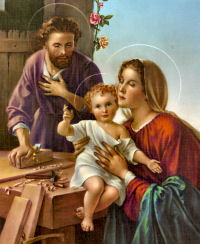 The devotion to the Holy Family was born in Bethlehem, together with the Baby Jesus. The shepherds went to adore the Child and, at the same time, they gave honor to His family. Later, in a similar way, the three wise men came from the East to adore and give honor to the newborn King with gifts of gold, frankincense, and myrrh that would be safeguarded by His family.
We can go further to affirm that in a certain sense Christ, Himself, was the first devotee of His family. He showed His devotion to His mother and foster father by submitting Himself, with infinite humility, to the duty of filial obedience towards them. This is what St Bernard of Clairvaux said in this regard, ‘God, to whom angels submit themselves and who principalities and powers obey, was subject to Mary; and not only to Mary but Joseph also for Mary’s sake [….]. God obeyed a human creature; this is humility without precedent. A human creature commands God; it is sublime beyond measure.’ (First Homily on the ‘Missus Est’).
Today’s celebration demonstrates Christ’s humility and obedience with respect to the fourth commandment, whilst also highlighting the loving care that His parents exercised in His keeping. The servant of God, Pope John Paul II, in 1989, entitled his Apostolic Exhortation, ‘Redemptoris Custos’ (Guardian of the Redeemer) which was dedicated to the person and the mission of Saint Joseph in the life of Christ and of the Church. After exactly a century, he resumed the teaching of Pope Leo XIII, for who Saint Joseph ‘ shines among all mankind by the most august dignity, since by divine will, he was the guardian of the Son of God and reputed as His father among men’ (Encyclical Quamquam Pluries [1889] n. 3). Pope Leo XIII continued, ‘...Joseph became the guardian, the administrator, and the legal defender of the divine house whose chief he was.[…] It is, then, natural and worthy that as the Blessed Joseph ministered to all the needs of the family at Nazareth and girt it about with his protection, he should now cover with the cloak of his heavenly patronage and defend the Church of Jesus Christ.’ Not many years before, blessed Pope Pius IX had proclaimed Saint Joseph, ‘Patron of the Catholic Church’ (1870).
Almost intuitively, one can recognize that the mysterious, exemplary, guardianship enacted by Joseph was conducted firstly, in a yet more intimate way, by Mary. Consequently, the liturgical feast of the Holy Family speaks to us of the fond and loving care that we must render to the Body of Christ. We can understand this in a mystical sense, as guardians of the Church, and also in the Eucharistic sense. Mary and Joseph took great care of Jesus’ physical body. Following their example, we can and must take great care of His Mystical Body, the Church, and the Eucharist which He has entrusted to us. If Mary was, in some way, ‘the first tabernacle in history’ (John Paul II Ecclesia de Eucharistia, n. 55) then we the Tabernacle in which Our Lord chose to reside in person, in His Real Presence, was also entrusted to us. We can learn from Mary and Joseph! What would they ever have overlooked in the care of Jesus’ physical body? Is there something, therefore, that we can withhold for the right and adoring care of His Eucharistic Body? No amount of attention, no sane act of love and adoring respect will ever be too much! On the contrary, our adoration and respect will always be inferior to the great gift that comes to us in the Holy Eucharist.
Looking at the Holy Family, we see the love, the protection, and the diligent care that they gave to the Redeemer. We can not fail to feel uneasiness, perhaps a shameful thought, for the times in which we have not rendered the appropriate care and attention to the Blessed Eucharist. We can only ask for forgiveness and do penance for all the sacrilegious acts and the lack of respect that are committed in front of the Blessed Eucharist. We can only ask the Lord, through the intersession of the Holy Family of Nazareth, for a greater love for their Son Incarnate, who has decided to remain here on earth with us every day until the end of time.
—From the Congregation for the Clergy


