Showing posts with label Christ the King. Show all posts

Saturday, November 22, 2025

Sunday is the Solemnity of Christ the King


Ordinary Time: November 23rd

Solemnity of Our Lord Jesus Christ, King of the Universe


The Solemnity of Our Lord Jesus Christ, King of the Universe, formerly referred to as "Christ the King," was established by Pope Pius XI in 1925 as an antidote to secularism, a way of life which leaves God out of man's thinking and living and organizes his life as if God did not exist. The feast is intended to proclaim in a striking and effective manner Christ's royalty over individuals, families, society, governments, and nations.

Today's Mass establishes the titles for Christ's royalty over men: 1) Christ is God, the Creator of the universe and hence wields a supreme power over all things; "All things were created by Him"; 2) Christ is our Redeemer, He purchased us by His precious Blood, and made us His property and possession; 3) Christ is Head of the Church, "holding in all things the primacy"; 4) God bestowed upon Christ the nations of the world as His special possession and dominion.

Today's Mass also describes the qualities of Christ's kingdom. This kingdom is: 1) supreme, extending not only to all people but also to their princes and kings; 2) universal, extending to all nations and to all places; 3) eternal, for "The Lord shall sit a King forever"; 4) spiritual, Christ's "kingdom is not of this world." —Rt. Rev. Msgr. Rudolph G. Gandas

Today is the The Annual Global Celebration of Youth and Young Adults.


Mass Readings for the Solemnity of Our Lord Jesus Christ, King of the Universe, Cycle C:
The First Reading is from 2 Samuel 5:1-3. Saul, the first king of Israel, was told by the prophet Samuel that the kingship would not remain in his family because he had disobeyed the laws of God. David was chosen by God to replace him and was anointed secretly by Samuel in Bethlehem.

The institution of the feast of the Kingship of Christ was intended to be a rallying-call to all Christians to acknowledge the sovereignty of Christ, not only over all Christians and all men but over all of creation. He is king of all creation because, as the second reading today says, “through him, by him and in him all things subsist.” Therefore, he is the sovereign Master, Ruler, Protector and Judge of all created things. The title of King was chosen to express all these prerogatives, because he himself, in his moment of deepest humiliation, admitted to Pilate that he was King. He is given this title in most of the Old Testament prophecies concerning him.

The story of David's anointing as king over all of Israel is recalled on this feast of the Kingship of Christ, because David was seen in the Old Testament as a type, a representation, of the future messianic king. David, although the greatest of the kings of Israel, was but a poor shadow of Christ the King, whose reign extends, not only over all Israel, but over all the universe and all things created in heaven as well as on earth.

The Second Reading is from St. Paul to the Colossians 1:12-20. St. Paul tells the Colossians how grateful they ought to be to God for having made them Christians and citizens of Christ's kingdom. The Apostle then goes on to describe who and what their new sovereign is, true God and true man, the true image of the invisible God and at the same time the perfect exemplar of true humanity. This portion of St. Paul's epistle was aptly chosen for this great feast of the Kingship of Christ. Also, it calls to our minds how blessed, how fortunate we are to be Christians, citizens of his kingdom on earth with a guarantee of perpetual citizenship in his heavenly kingdom. This will be so only if we do the little he asks of us while here on earth.

Today is for all Christians a national day. Today, let us raise our Christian flag—the crucifix—aloft, and salute it with fervor and a promise of fervent loyalty. My King has suffered for me. For his sake, I am ready to suffer any trial that comes my way. If needs be, I am prepared to die for him. If he does not ask that supreme sacrifice, I am assuredly ready to live a life of faith, hope and sincere love for him, and of gratitude to him. Honor, glory and thanks forever to Christ our King!

The Gospel is Luke 23:35-43, describing the death of Jesus on the cross. All four Evangelists tell us that when Jesus was crucified on Calvary there was an inscription written on the upper arm of the cross which said that he was "King of the Jews.” To the disgust of the Jewish leaders he insisted on putting the title of the crucified criminal, "King of the Jews," over his cross. In doing this, Pilate was proclaiming to the world, that these vengeful leaders of the people had condemned the messianic King, for whom they bad been waiting for centuries, to the shameful death of the cross. He was doing even more. He was proclaiming that the innocent one who hung on that cross was the "King of Kings" the King of this world and of the next.

Today let us renew our loyalty to Christ our King. We are privileged and proud to be his subjects. As members of his Church on earth we are as yet in the preparatory stage of that kingdom. If we do the little that he asks of us, during this period of preparation, we are assured of being full citizens in his eternal kingdom of happiness and peace.


Christ the King as Represented in the Liturgy
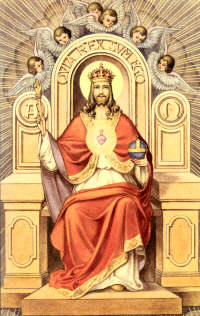
The liturgy is an album in which every epoch of Church history immortalizes itself. Therein, accordingly, can be found the various pictures of Christ beloved during succeeding centuries. In its pages we see pictures of Jesus suffering and in agony; we see pictures of His Sacred Heart; yet these pictures are not proper to the nature of the liturgy as such; they resemble baroque altars in a gothic church. Classic liturgy knows but one Christ: the King, radiant, majestic, and divine.

With an ever-growing desire, all Advent awaits the "coming King"; in the chants of the breviary we find repeated again and again the two expressions "King" and "is coming." On Christmas the Church would greet, not the Child of Bethlehem, but the Rex Pacificus — "the King of peace gloriously reigning." Within a fortnight, there follows a feast which belongs to the greatest of the feasts of the Church year — the Epiphany. As in ancient times oriental monarchs visited their principalities (theophany), so the divine King appears in His city, the Church; from its sacred precincts He casts His glance over all the world....On the final feast of the Christmas cycle, the Presentation in the Temple, holy Church meets her royal Bridegroom with virginal love: "Adorn your bridal chamber, O Sion, and receive Christ your King!" The burden of the Christmas cycle may be summed up in these words: Christ the King establishes His Kingdom of light upon earth!

If we now consider the Easter cycle, the luster of Christ's royal dignity is indeed somewhat veiled by His sufferings; nevertheless, it is not the suffering Jesus who is present to the eyes of the Church as much as Christ the royal Hero and Warrior who upon the battlefield of Golgotha struggles with the mighty and dies in triumph. Even during Lent and Passiontide the Church acclaims her King. The act of homage on Palm Sunday is intensely stirring; singing psalms in festal procession we accompany our Savior singing: Gloria, laus et honor tibi sit, Rex Christe, "Glory, praise and honor be to Thee, Christ, O King!" It is true that on Good Friday the Church meditates upon the Man of Sorrows in agony upon the Cross, but at the same time, and perhaps more so, she beholds Him as King upon a royal throne. The hymn Vexilla Regis, "The royal banners forward go," is the more perfect expression of the spirit from which the Good Friday liturgy has arisen. Also characteristic is the verse from Psalm 95, Dicite in gentibus quia Dominus regnavit, to which the early Christians always added, a ligno, "Proclaim among the Gentiles: the Lord reigns from upon the tree of the Cross!" During Paschal time the Church is so occupied with her glorified Savior and Conqueror that kingship references become rarer; nevertheless, toward the end of the season we celebrate our King's triumph after completing the work of redemption, His royal enthronement on Ascension Thursday.

Neither in the time after Pentecost is the picture of Christ as King wholly absent from the liturgy. Corpus Christi is a royal festival: "Christ the King who rules the nations, come, let us adore" (Invit.). In the Greek Church the feast of the Transfiguration is the principal solemnity in honor of Christ's kingship, Summum Regem gloriae Christum adoremus (Invit.). Finally at the sunset of the ecclesiastical year, the Church awaits with burning desire the return of the King of Majesty.

We will overlook further considerations in favor of a glance at the daily Offices. How often do we not begin Matins with an act of royal homage: "The King of apostles, of martyrs, of confessors, of virgins — come, let us adore" (Invit.). Lauds is often introduced with Dominus regnavit, "The Lord is King". Christ as King is also a first consideration at the threshold of each day; for morning after morning we renew our oath of fidelity at Prime: "To the King of ages be honor and glory." Every oration is concluded through our Mediator Christ Jesus "who lives and reigns forever." Yes, age-old liturgy beholds Christ reigning as King in His basilica (etym.: "the king's house"), upon the altar as His throne.
—Excerpted from The Church's Year of Grace, Pius Parsch

Highlights and Things to Do:

  • plenary indulgence is granted to the faithful who on the solemnity of Our Lord Jesus Christ, King of the Universe, publicly recite the Act of Dedication of the Human Race to Christ the King (Iesu dulcissime, Redemptor); a partial indulgence is granted for its use in other circumstances.
  • A procession for Christ the King on this feast day, either in the Church or at home is appropriate for this feast. The Blessed Sacrament would be carried and the procession would end with a prayer of consecration to Christ the King and Benediction. Try to participate if your parish has a Christ the King procession. If not, try having one at home (minus the Blessed Sacrament).
  • Read Pope Pius XI's encyclical Quas primas (On the Feast of Christ the King) which shows that secularism is the direct denial of Christ's Kingship.

Tuesday, September 30, 2025

Vatican office releases Pope Leo XIV schedule for November through January and the closing of the Jubilee Year


Christmas Mass at St Peter's Basilica (archive photo)Christmas Mass at St Peter's Basilica (archive photo)  (VATICAN MEDIA Divisione Foto)

Pope Leo's liturgical celebrations for November through January

Pope Leo will preside at numerous liturgical celebrations in the coming months, as the Church looks ahead to Christmas and the New Year.

By Christopher Wells

Pope Leo XIV has a full schedule of liturgical celebrations scheduled for the coming months, with the Vatican looking ahead to the first Christmas with our new Pope.

On Tuesday, the Vatican’s Office for the Liturgical Celebrations of the Supreme Pontiff released the Pope’s schedule for November 2025 through January 2026.

Liturgical Celebrations in November

The Holy Father is set to proclaim St John Henry Newman as a Doctor of the Church during Mass for the Solemnity of All Saints, which will be celebrated in Saint Peter’s Square on November 1 in the context of the Jubilee of the World of Education.

Two days later, Pope Leo will offer a Requiem Mass for the repose of the souls of Francis and all Cardinals and Bishops who have died in the course of the past year.

On November 9, the Pope will travel across town to the Papal Archbasilica of Saint John Lateran for the Solemnity of Dedication of the Cathedral of Rome.

The Jubilee of the Poor, which takes place one week later on November 16, will be observed with a Mass celebrated by Pope Leo in St Peter’s Basilica.

Pope Leo will mark the Solemnity of Our Lord Jesus Christ, King of the Universe – the final Sunday of the liturgical calendar – with a Mass in St Peter’s Square, coinciding with the conclusion of the Jubilee of Choirs.

First Christmas with Pope Leo

During the season of Advent, which marks the beginning of the liturgical year, Pope Leo continues the tradition of celebrating the Solemnity of the Immaculate Conception, December 8, in Rome’s Piazza di Spagna, where he will lead the faithful in an Act of Veneration for Mary Immaculate.

That same week, on 12 December, the Holy Father will offer Mass for the Memorial of Our Lady of Guadalupe in the Vatican Basilica.

On the Third Sunday of Advent, 14 December, Pope Leo will celebrate Mass in St Peter’s Basilica for the Jubilee of Prisoners.

The eagerly awaited first Christmas with Pope Leo will begin on Christmas Eve, with the celebration of Holy Mass “during the Night” in St Peter’s Basilica. The Midnight Mass will begin at 10 pm Rome time and will be broadcast live around the world.

On Christmas morning, the Pope will offer Mass “during the Day,” again in the Basilica of St Peter, before appearing on the Central Loggia of the church for the traditional Christmas Blessing “Urbi et Orbi” – of the City of Rome and of the whole World. 

Ushering in the New Year

On New Year’s Eve, 31 December, Pope Leo will preside at First Vespers for the Solemnity of Mary, the Most Holy Mother of God (1 January). During the celebration, he will lead the faithful in the Te Deum, the Church’s hymn of thanksgiving par excellence, for the blessings of the previous year.

The following morning, the Holy Father will celebrate the Mass of the Solemnity, while also marking the 59th World Day of Peace.

The Season of Christmas continues into the new year, with Pope Leo celebrating the Solemnity of Epiphany, 6 January, with Mass in St Peter’s Basilica. At the beginning of the liturgy, the Holy Father will solemnly close the Holy Door, marking the formal end of the 2025 Jubilee Year. The Holy Door will remain closed until the next Jubilee, planned for 2033 to mark the 2000th anniversary of the Redemption won by the Passion, Death, and Resurrection of Jesus Christ.

Finally, Pope Leo will close out the Christmas season with Mass on the Feast of the Baptism of the Lord on 11 January, the first Sunday after Epiphany. During the liturgy in the Sistine Chapel, the Holy Father will baptise some babies, continuing a tradition begun by Pope St John Paul II.

The Vatican’s Calendar of Celebrations, listing ceremonies presided over by Pope Leo, can be found on the website of the Office for Liturgical Celebrations. For tickets for Papal Audiences and Celebrations, please visit the website of the Prefecture of the Papal Household. Tickets for papal celebrations are always free of charge.

Tuesday, December 10, 2024

Every church should have one of these: the Botafumeiro

Catholic college’s grand ‘botafumeiro,’

inspired by Spain, honors Christ THE King


The botafumeiro swings as it is unveiled during vespers at Christendom College's new Christ the King Chapel in Front Royal, Va., Nov. 24, 2024. The botafumeiro is a several-foot-tall, 180-pound silver-plated brass censer with an eight-sided Gothic cathedral cupola perched atop its bowl and is inspired by its namesake used at the cathedral in Santiago de Compostela, Spain, since the Middle Ages. (OSV News photo/Agnes Blum, courtesy Christendom College)


FRONT ROYAL, Va. (OSV News) — It was the feast of Christ the King — Sunday, Nov. 24 — and excited yet hushed murmurs of expectation rippled through the worshippers assembled for vespers at Christendom College’s Christ the King Chapel in Front Royal.

The “botafumeiro” — a several-foot-tall, 180-pound, silver-plated brass leviathan resembling a conventional censer enlarged to massive proportions, with an eight-sided Gothic cathedral cupola perched atop its bowl — was about to swing in commemoration of the chapel’s namesake liturgical celebration.

Catholics are accustomed to watching a single priest employ an incense-emitting thurible on special sacramental occasions, circling the altar as clouds of fragrant incense rise to the heavens like the prayers they are meant to represent.

But Christendom College’s botafumeiro requires a team of eight men to sway it from a robust mechanism of ropes and pulleys housed high in the chapel’s crossing ceiling.

Outside of a visit to the metropolitan cathedral in Santiago de Compostela, Spain — where a “turibulum magnum” has been used since at least the Middle Ages to cense the mass of pilgrims that complete the famous Camino de Santiago pilgrimage there — such a spectacle is a rare sight indeed.

And Christendom’s botafumeiro is also ever-so slightly larger than its Spanish relative.

Unveiled to the public in mid-June during a summer consortium event, the botafumeiro was crafted during a two-year process enlisting the design leadership of Enzo Selvaggi at Heritage Liturgical in Southern California, while renowned silversmith Emilio León — based in Cordoba, Spain — executed it.

The college’s seal can be viewed on the pedestal base.

The botafumeiro arrived from Spain in February. During March, a full-size wooden replica was used for initial testing of a structural engineer-designed system including thick ropes, pulleys, rigging, cabling and a 2-ton chain hoist nestled in a steel A-frame structure.

Additional testing took place in April.

Even so, there is still more to be learned about the chapel’s intriguing new accessory.

“My adviser and I are going to do an analysis of the botafumeiro,” said Jane Twyford, a senior and math major, who was poised with video equipment at the head of the nave aisle.

“We’re going to figure out the velocity of this one; what angle — we have a ribbon up there — that it goes; and then, how many cycles it takes to get its maximum,” Twyford told OSV News.

During the Sunday vespers — which included an introduction, hymn, psalmody, Scripture reading, the Magnificat, intercessions, the collect and conclusion — anticipation built.

Then two staffers — ascending stepladders strategically placed on either side of the botafumeiro — loaded it with incense and then heaped on burning coals brought into the chapel through a side door.

As the schola sang the words of Psalm 141:2 — “Lord, let my prayer like incense rise” — from the choir loft, the botafumeiro began to move.

Slowly — somewhat leisurely — and at a respectable height and speed, at first.

But then — with each ensuing pull upon the ropes — the botafumeiro appeared to be swiftly flinging itself at the chapel rafters, trailing an immense cloud of incense in its wake.

A student guild does the actual swinging, with a focus not just on hefting the botafumeiro aloft, but also — explained senior Christopher Usher — growing in virtue and prayer.

“It’s a privilege to come out and do this today,” Usher told OSV News.

Usher said the experience of putting the botafumeiro in action is “indescribable.”

“You just put your whole body into it,” said Usher, who admitted the strength required is a workout that at times had him almost parallel to the floor as he pulled. “It’s just so edifying, serving the Lord this way.”

When at full swing, the thurible’s 180 pounds are tripled by gravitational forces, making it feel like 540 pounds.

“That was surreal,” added Jimmy Coffey, a junior. “Once they put the incense in, I was like, ‘It’s go time.’ That was a really neat experience to get to do with some of my best friends … especially in a beautiful, unique place like Christendom, especially in Christ the King Chapel.”

Both Usher and Coffey are players for Christendom’s conference champion Crusaders rugby team, another endeavor requiring a fair amount of physical strength.

The gathered worshippers also joined in a consecration of the college to both the Sacred Heart of Jesus and the Immaculate Heart of Mary.

Since its April 2023 opening, Christ the King Chapel has steadily added additional adornments, including a Spanish-made Pietà, several side chapels and a Betrothal Shrine for weddings.

Mass is offered twice daily every day of the week, with tours offered Monday through Friday from 2:30-3:30 p.m.

When not in use, the botafumeiro resides in Christ the King Chapel, where it can be viewed on a daily basis.

Kimberley Heatherington writes for OSV News from Virginia.

Sunday, November 24, 2024

Pope Francis at Sunday Angelus for Christ the King


Pope at Angelus: Listening to the Lord brings light into our hearts and lives

Pope Francis reflects on the day’s reading from the Gospel of John and encourages Christians to let the Word of God be their guide and their certainty.

By Linda Bordoni

Pope Francis on Sunday encouraged the faithful to listen to the voice of the King of the universe who made Himself the servant of all and brought hope and light into our lives.

Speaking before the recitation of the Angelus prayer on the Solemnity of Christ the King, he reflected on the reading from the Gospel of John (Jn 18:33-37) that calls us to acknowledge Christ’s kingship with our whole lives.

The reading presents Jesus who has been handed over to Pontius Pilate to be condemned to death. The Pope notes that during their brief dialogue, “two words in particular are transformed and take on a new meaning: the words ‘king’ and ‘world’.”

Thinking as an imperial official, he explained that Pilate “wants to understand whether the man before him poses a threat, as a king to him represents an authority ruling over all his subjects.”

In response, the Pope continued, “Jesus affirms that He is a King, yes, but in a very different way!”

Jesus is King

“Jesus is a King because He is a witness: He is the one who speaks the truth,” the Holy Father said, explaining that “The royal power of Jesus, the incarnate Word, lies in His true and effective word, which transforms the world.”

“Jesus is a King because He is a witness: He is the one who speaks the truth.”

His kingdom is not of this world

But Jesus is not King of Pilate’s world, the Pope added, a world “where the strong triumph over the weak, the rich over the poor, and the violent over the meek. ”

It’s a world, he said, we unfortunately know all too well.

“Jesus is King, but His kingdom is not of this world. (…) The world of Jesus is the new and eternal one that God prepares for all by giving His life for our salvation,” the Pope said: “It is the kingdom of heaven that Christ brings to earth by pouring out grace and truth.”  Jesus frees us, forgives us, and gives us His peace and justice, the Pope explained.

Listen to the Lord

Pope Francis went on to reflect on how, although Jesus speaks to Pilate from very close, the latter remains distant as he inhabits a different world.

“Pilate”, he added, “does not open himself to the truth, even though it is before him. He will have Jesus crucified and order the inscription on the cross: The King of the Jews, but without understanding the meaning of those words.

Christ came into our world

The Pope concluded reminding us that Christ came into the world, “this very world of ours” and that “whoever belongs to the truth listens to His voice, the voice of the King of the universe who saves us.”

“Listening to the Lord brings light into our hearts and lives,” he said, encouraging Christians to ask themselves whether His Word is their guide and whether they see in Him the merciful face of God who forgives us always.

“Let us pray together with Mary, the handmaid of the Lord, as we await the Kingdom of God with hope.”

Pope Francis presides at Mass for the Solemnity of Christ the King


Pope on Christ the King: Never shrink from love and truth

Pope Francis presides at Mass on the Solemnity of Christ the King, and urges young people to embrace their love for God and life despite the accusations they face from others.

By Devin Watkins

As the Church celebrates the annual World Youth Day on the Solemnity of Christ the King, Pope Francis witnessed the handover of the WYD Cross and icon of Mary Salus Populi Romani.

At the conclusion of Mass in St. Peter’s Basilica on Sunday, several Portuguese young people handed over the WYD symbols to a delegation from South Korea, as they prepare to host World Youth Day in Seoul in 2027.

In his homily, the Pope called these symbols a sign and invitation for Christians to live out the Gospel without becoming discouraged and never ceasing to hope.

As the Church’s liturgical year came to a close, he urged the faithful to feel uplifted by the certainty of Christ’s eternal kingdom.

Young people, said Pope Francis, should take courage from Jesus’ faithfulness to God in the midst of trials and public humiliation.

Like Him, they too sometimes feel “accused” for following Jesus and face pressure to conform to ways that are contrary to the Gospel.

“Do not be afraid of ‘condemnations’!” he said. “Have no worries; sooner or later, their criticism will fall through, their condemnations will prove false, and their superficial values will be revealed for what they are: illusions.”

He noted that love is the only thing that will remain, and so we must embrace the eternal gift of God’s love.

Only love brings happiness

Pope Francis went on to say that Jesus never sought to gain the support or “approval” of authorities, since He rejected the “mentality of power.”

God, he noted, loves each of us as we are, so we have no need to seek worldly approval on social media or by any other means.

“Before Him, the innocence of your dreams are worth more than success and fame, and the sincerity of your intentions are worth more than worldly approval,” he said.

No amount of worldly affection can make us happy, said the Pope, since “only the free gift of love can bring us happiness.”

Bearing witness to truth

The Holy Father then emphasized the importance of truth, which frees us from the chains of self-sufficiency, injustice, and unhappiness.

“Christ, who is the way, the truth and the life, by stripping Himself of everything and dying on the cross for our salvation, teaches us that only in love can we live, grow and flourish in our full dignity,” said the Pope.

He pointed to the Christian witness of Blessed Pier Giorgio Frassati, whom he will canonize during the Jubilee for Young People in early August 2025.

The young Italian, said the Pope, reminds young people that “just getting by” is not their goal. Rather, he said, Christians want to live fully and strive to “bear witness to truth in charity, loving one another as Jesus loved us.”

God’s everlasting love

In conclusion, Pope Francis assured the faithful that world events have not escaped God’s watchful eye, saying “it is not true that history is written by oppressors and tyrants.”

Christ, the just and merciful King, he said, will ultimately sit in judgment over each person.

“He corrects us when we fall, but He never ceases to love us,” concluded the Pope. “If we wish, He picks us up so we can continue our journey with joy.”

Saturday, November 23, 2024

The Solemnity of Christ the King


Ordinary Time: November 24th

Solemnity of Our Lord Jesus Christ, King of the Universe


Solemnity of Our Lord Jesus Christ, King of the Universe: Almighty ever-living God, whose will is to restore all things in your beloved Son, the King of the universe, grant, we pray, that the whole creation, set free from slavery, may render your majesty service and ceaselessly proclaim your praise. Through our Lord Jesus Christ, your Son, who lives and reigns with you in the unity of the Holy Spirit, God, for ever and ever.


The Solemnity of Our Lord Jesus Christ, King of the Universe was established by Pope Pius XI in 1925 as an antidote to secularism, a way of life which leaves God out of man's thinking and living and organizes his life as if God did not exist. The feast is intended to proclaim in a striking and effective manner Christ's royalty over individuals, families, society, governments, and nations.

Today's Mass establishes the titles for Christ's royalty over men: 1) Christ is God, the Creator of the universe and hence wields a supreme power over all things; "All things were created by Him"; 2) Christ is our Redeemer, He purchased us by His precious Blood, and made us His property and possession; 3) Christ is Head of the Church, "holding in all things the primacy"; 4) God bestowed upon Christ the nations of the world as His special possession and dominion.

The Mass also describes the qualities of Christ's kingdom. This kingdom is: 1) supreme, extending not only to all people but also to their princes and kings; 2) universal, extending to all nations and to all places; 3) eternal, for "The Lord shall sit a King forever"; 4) spiritual, Christ's "kingdom is not of this world". — Rt. Rev. Msgr. Rudolph G. Bandas

This feast is celebrated on the last Sunday of October in the previous (1962) calendar.


Commentary on the Sunday Mass Readings for the Solemnity of Christ the King, Year B:

The First Reading is taken from Daniel 7:13-14. Today's extract from the Book of Daniel, written two centuries before Christ came on earth, tells us that the son of man would receive from God his Father, dominion and sovereignty over all peoples, nations and languages. He would be the king of kings and the lord of glory and his kingdom would last forever. Many other messianic prophecies in the Old Testament give Christ the Messiah the title of King.

The Second Reading is from the Book of Revelation 1:5-8. The readings today stress the kingly glory and dignity of Christ after his triumph over sin and death, while they also remind us of how much we owe him. This kingly glory will be visible to all men at his second coming—a vision which will delight his faithful ones but which will strike terror into his enemies. In his Apocalypse St. John reminds us first and foremost of all that Christ has done for us. During his life among us, he has revealed his loving Father. It was his own divine love that made him come as the incarnate Son of God and give his life for us. He triumphed over death and continues to love us in heaven. He established his messianic kingdom, in which we, his subjects, are given the power and the privilege of serving God with a true service—for he has joined us to himself who alone could give fitting service to his Father. John then reminds the faithful followers of Christ and Christ's opponents as well that Christ will return in glory and majesty to dead a reckoning form each one. This a sobering thought for all of us.

The Gospel is from John 18:33-37, when Pilate was talking with Jesus and deciding whether or not to condemn Jesus to death. Pilate questioned Jesus about his kingship and Jesus admitted that he was a king but that his kingdom was not of this world. Long before, he had foreseen this death and had accepted it as part of his Father's plan for making atonement for the sins of mankind. He knew Pilate did not believe that he was the leader of a rebellion against the Roman authorities, but he did not try to influence Pilate's decision in his favor for he wanted the will of his Father carried out to the letter.

Five centuries before, the prophet Isaiah had described the Messiah who was to come as the Servant of God, who suffered torments on our behalf (Is 53:3-7). Had Pilate known this prophecy he would not have been surprised that Jesus uttered no word in his own defense. His Father had sent him to raise up mankind and to make atonement for men's sins; his death on the cross was that supreme act of atonement and without objection he accepted it.

The kings of this earth demand of their subjects that they should be ready, if necessary, to lay down their lives to defend their king and realm. Men have always accepted this and millions have gladly given their lives to defend their country and rulers. We have a king who laid down his life for us and set us an example unlike that of any earthly king. Following his Father's will, he did this to make us worthy to share in the Father's eternal kingdom. The incarnation, which made us adopted children of God, and the crucifixion, which obtained remission of our sins, surely prove to us the love and the esteem in which God holds us. It should also show how important is our future life. Christ did not come on earth to make us healthy, happy or prosperous in this world; he came to open heaven for us where we could be happy forever. This was God's purpose in creating us. This is his purpose for us still. All our other interests in this life are secondary when compared with this.

In honoring Christ today as our King, let us especially thank him for all the humiliations and sufferings he endured on our behalf. If our Christian way of living makes some demands on us let us not forget how trivial they are when compared with what Christ's earthly life cost him. He made these severe sacrifices for us; we are asked to make our small offerings for ourselves. Our self-interest alone should inspire us, but our gratitude to Christ should especially move us to play our part. Let us promise to be grateful and loyal subjects of his for the rest of our days. He has made us members of his kingdom on earth—the Church—and is preparing a place for us in his everlasting kingdom. Let no one be so foolish as to forfeit an eternal happiness because of some earthly attachment to the passing things of this world.
—Excerpted from The Sunday Readings, Cycle B, by Fr. Kevin O'Sullivan, O.F.M.


Christ the King as Represented in the Liturgy
The liturgy is an album in which every epoch of Church history immortalizes itself. Therein, accordingly, can be found the various pictures of Christ beloved during succeeding centuries. In its pages we see pictures of Jesus suffering and in agony; we see pictures of His Sacred Heart; yet these pictures are not proper to the nature of the liturgy as such; they resemble baroque altars in a gothic church. Classic liturgy knows but one Christ: the King, radiant, majestic, and divine.

With an ever-growing desire, all Advent awaits the "coming King"; in the chants of the breviary we find repeated again and again the two expressions "King" and "is coming." On Christmas the Church would greet, not the Child of Bethlehem, but the Rex Pacificus — "the King of peace gloriously reigning." Within a fortnight, there follows a feast which belongs to the greatest of the feasts of the Church year — the Epiphany. As in ancient times oriental monarchs visited their principalities (theophany), so the divine King appears in His city, the Church; from its sacred precincts He casts His glance over all the world....On the final feast of the Christmas cycle, the Presentation in the Temple, holy Church meets her royal Bridegroom with virginal love: "Adorn your bridal chamber, O Sion, and receive Christ your King!" The burden of the Christmas cycle may be summed up in these words: Christ the King establishes His Kingdom of light upon earth!

If we now consider the Easter cycle, the luster of Christ's royal dignity is indeed somewhat veiled by His sufferings; nevertheless, it is not the suffering Jesus who is present to the eyes of the Church as much as Christ the royal Hero and Warrior who upon the battlefield of Golgotha struggles with the mighty and dies in triumph. Even during Lent and Passiontide the Church acclaims her King. The act of homage on Palm Sunday is intensely stirring; singing psalms in festal procession we accompany our Savior singing: Gloria, laus et honor tibi sit, Rex Christe, "Glory, praise and honor be to Thee, Christ, O King!" It is true that on Good Friday the Church meditates upon the Man of Sorrows in agony upon the Cross, but at the same time, and perhaps more so, she beholds Him as King upon a royal throne. The hymn Vexilla Regis, "The royal banners forward go," is the more perfect expression of the spirit from which the Good Friday liturgy has arisen. Also characteristic is the verse from Psalm 95, Dicite in gentibus quia Dominus regnavit, to which the early Christians always added, a ligno, "Proclaim among the Gentiles: the Lord reigns from upon the tree of the Cross!" During Paschal time the Church is so occupied with her glorified Savior and Conqueror that kingship references become rarer; nevertheless, toward the end of the season we celebrate our King's triumph after completing the work of redemption, His royal enthronement on Ascension Thursday.

Neither in the time after Pentecost is the picture of Christ as King wholly absent from the liturgy. Corpus Christi is a royal festival: "Christ the King who rules the nations, come, let us adore" (Invit.). In the Greek Church the feast of the Transfiguration is the principal solemnity in honor of Christ's kingship, Summum Regem gloriae Christum adoremus (Invit.). Finally at the sunset of the ecclesiastical year, the Church awaits with burning desire the return of the King of Majesty.

We will overlook further considerations in favor of a glance at the daily Offices. How often do we not begin Matins with an act of royal homage: "The King of apostles, of martyrs, of confessors, of virgins — come, let us adore" (Invit.). Lauds is often introduced with Dominus regnavit, "The Lord is King". Christ as King is also a first consideration at the threshold of each day; for morning after morning we renew our oath of fidelity at Prime: "To the King of ages be honor and glory." Every oration is concluded through our Mediator Christ Jesus "who lives and reigns forever." Yes, age-old liturgy beholds Christ reigning as King in His basilica (etym.: "the king's house"), upon the altar as His throne.
—Excerpted from The Church's Year of Grace, Pius Parsch

Highlights and Things to Do:

  • plenary indulgence is granted to the faithful who on the solemnity of Our Lord Jesus Christ, King of the Universe, publicly recite the Act of Dedication of the Human Race to Christ the King (Iesu dulcissime, Redemptor); a partial indulgence is granted for its use in other circumstances.
  • A procession for Christ the King on this feast day, either in the Church or at home is appropriate for this feast. The Blessed Sacrament would be carried and the procession would end with a prayer of consecration to Christ the King and Benediction. Try to participate if your parish has a Christ the King procession. If not, try having one at home (minus the Blessed Sacrament).
  • Read Pope Pius XI's encyclical Quas primas (On the Feast of Christ the King) which shows that secularism is the direct denial of Christ's Kingship.