Showing posts with label Pope John Paul I. Show all posts

Monday, August 26, 2024

Today is also the Feast Day of Blessed John Paul I, Pope


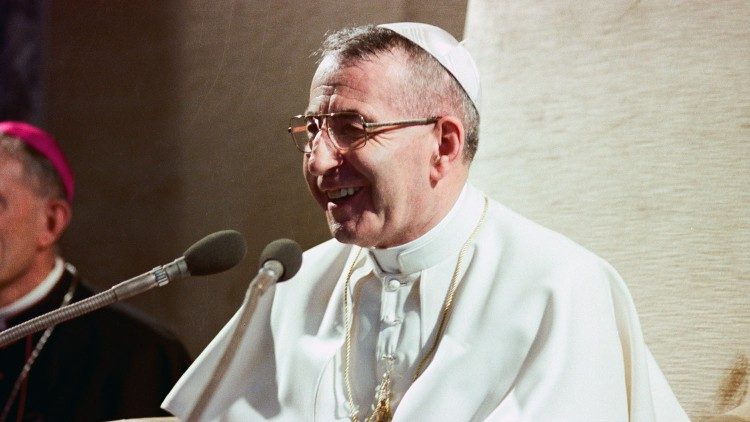
Blessed Pope John Paul IBlessed Pope John Paul I 

Prayer for Blessed John Paul I

On the occasion of the liturgical memorial of the Blessed, 26 August, the day he was elected Pope in 1978, the postulator for his canonization cause is sharing the text of a prayer for his canonization and for his intercession.

By Stefania Falasca, Postulator of the cause of canonization of Blessed Pope John Paul I and Vice-President of the John Paul I Vatican Foundation

Today, 26 August, we celebrate the liturgical memorial of Blessed John Paul I - Albino Luciani (1912-1978).

Beatified by Pope Francis on 4 September 2022, in St. Peter's Square, the Church celebrates the memorial of Blessed John Paul I on the date he was elected Pope.

After a swift 26-hour-long conclave, with almost unanimous support, on 26 August 1978, Albino Luciani was voted as Successor of Peter. 

The exact moment of his election as Bishop of Rome, Argentine Cardinal Eduardo Francisco Pironio remembered in this way: "I was right in front of him, and I looked at him. And all of us Cardinals were waiting for his 'yes.' His yes to Christ, a yes to the Church as a servant, a yes to humanity as a good shepherd. I saw him with a profound serenity, which came from an interiority that cannot be improvised."

On the occasion of his memorial, the postulator today spreads the newly-composed prayer to implore the Blessed's intercession and ask for his canonization.

The Prayer for the Canonization and Intercession of Blessed John Paul I

Blessed John Paul I,
you who with your word and example
taught us to live the grace of Baptism
and the gift of faith, hope, and charity;
you who were a model of evangelical simplicity
and showed us the wisdom of humility;
you who as Pope became close to all
and, as a messenger of the Good News,
manifested your love for the poor
and witnessed to the "unfailing" mercy of God
who "is father, even more, is mother";
you who pursued unity, dialogue, and peace
following Christ, the Prince of Peace;
pray for the Church you so loved and served,
pray for us, your children,
and obtain for us from the Lord to follow you
on the path of virtues and Beatitudes.
Grant now, O Lord,
through the intercession of Blessed John Paul I,
the grace that we implore from you in faith...
And, if it is Your will, allow him to be canonized
for the glory of Your name and the good of Your Church.
Through Jesus Christ our Lord. Amen.


IMPRIMATUR
OFFICIUM POSTULATORIS

The relevance of the message

In the “unique and singular task of the Roman Chair ‘which presides over universal charity,’” the pontificate of Albino Luciani began on 26 August, 1978, with gestures that testified to his decisive will to rediscover the essentially pastoral dimension of the papal office.

Among these, it is notable that his first decision after being elected was not to immediately open the conclave but to invite the elderly Cardinals who had been left out to listen, with the rest of the College, to his first message to the world. In that Urbi et Orbi message, delivered on 27 August, 1978, the course of his pontificate was clearly outlined in the six programmatic "We Wishes", in which he repeatedly declared his intention to continue the implementation of the Second Vatican Council, preserving its legacy and preventing deviations.

These are the six "we wishes" emphasized by Blessed John Paul I: "We wish to continue to put into effect the heritage of the Second Vatican Council. Its wise norms should be followed out and perfected [...] We wish to preserve the integrity of the great discipline of the Church...both in the exercise of the evangelical virtues and in service to the poor, the humble, the defenceless [...] We wish to remind the entire Church that its first duty is that of evangelization [...] We wish to continue the ecumenical thrust...We intend to dedicate our prayerful attention to everything that would favour union. We will do so without diluting doctrine but, at the same time, without hesitance...[...] We wish to pursue with patience but firmness that serene and constructive dialogue that Paul VI had at the base of his plan and programme for pastoral action [...] We wish finally to express our support for all the laudable, worthy initiatives that can safeguard and increase peace in our troubled world..."

Advancing the Church

These were precisely the priorities in the works of a Pope who clearly intended to pursue and advance the Church along the main roads indicated by the Council. "Let me explain. I was at the Council, and I signed the Fathers’ message to the world in '62... I also signed Gaudium et Spes," he would state during the General Audience on hope on 20 September.

"When Paul VI published Populorum Progressio, I was moved, enthusiastic, I spoke, I wrote. Even today, I am truly convinced that the hierarchy, the Magisterium, will never do enough to insist, to recommend serene and constructive dialogue, on the great issues of freedom, the promotion of development, social progress, justice, and peace; and the laity will never commit themselves enough to solving these issues."

Mission as peacemakers

And the following statement — omitted from official editions — though immediately echoed by chancelleries, still leads directly to those commitments listed that weave and define his brief pontificate, particularly on the front of the quest for peace: "In these moments, we are given an example by Camp David."

"The day before yesterday, the American Congress burst into applause that we also heard when Carter quoted Jesus' words: 'Blessed are the peacemakers.' I truly hope that that applause and those words enter the hearts of all Christians, especially us Catholics, and make us truly agents and makers of peace."

Moreover, precisely the promotion of reconciliation and brotherhood among peoples, inviting cooperation for “the building, the very vulnerable increase of peace in a troubled world” and curbing nationalism as well as "the violence that only destroys and sows only rubble" within nations, is set— together with ecumenical and interreligious commitment, documented by a dense agenda of audiences with representatives of non-Catholic Churches — as a priority in John Paul I's programmatic discourse.

Interreligious and ecumenical commitment

The ecumenical and interreligious commitment for unity, brotherhood, and peace pervaded his entire month of pontificate.

It clearly shows his desire to foster unity with the sister Churches of the East, as he had already mentioned in his homily on 3 September, when he named, after the Cardinals, the Patriarchs of the Eastern Churches in his greetings to all the people, a mention later removed from the official text.

On 2 September, he met in successive audiences in the private library with delegates from numerous non-Catholic denominations, who were then present at the celebration on September 3.

At that time, the Pope expressed the need to continue the dialogue between Christian communities initiated by the Council and to seek in prayer the unity desired by Christ.

A gaze at diplomacy

Even the morning of September 5 was dedicated to audiences with the delegations of non-Catholic Churches and communities gathered in Rome, and during these audiences, Metropolitan Nikodim of the Russian Orthodox Church (1929-1978), Metropolitan of Leningrad and Novgorod, Patriarchal Exarch for Western Europe, and President of the Moscow Patriarchate's Office for Relations between the Orthodox Churches and Other Churches, suddenly died in his arms.

These perspectives also return in the address to the diplomatic corps on 31 August, in which he defines the nature and peculiarity of the Holy See’s diplomatic action, which springs from a gaze of faith and is directed — following "the conciliar Constitution Gaudium et Spes as in many messages of the late Paul VI" — along the path of great diplomacy that has borne many fruits for the Church, nourished by charity.

Humanity and fraternity

In continuity with Pope Saints John XXIII and Paul VI, Blessed John Paul I illustrates the contribution that the Church can make to building a humanity founded on brotherhood: both internationally, by collaborating in the search for the best solutions for peace, justice, development, disarmament, and humanitarian aid, and pastorally, by collaborating in the formation of the consciences of the faithful and all people of good will.

Thus, on 4 September, receiving over one hundred representatives of international missions, he reiterated the same themes, emphasizing that "our heart is open to all peoples, to all cultures, and to all races" and stating, "We certainly do not have miraculous solutions for the great world problems, but we can, however, offer something very precious: a spirit that helps to resolve these problems and place them in the essential dimension..."

These clear and fundamental considerations pronounced 46 years ago by a Pope for 34 days on the Chair of Peter are enough to reflect on the pressing relevance of his message, which is akin to that of the current Bishop of Rome. And how important it was to establish a Vatican Foundation dedicated to John Paul I so that his theological, cultural, and spiritual legacy can be fully studied.

Saturday, August 26, 2023

Beatified in 2022, Bl. John Paul I feast day is August 26th; the date of his election as Pope


Pope John Paul I.Pope John Paul I. 

Pope John Paul I – a miracle clears him for beatification

Pope Francis has authorized the Congregation for the Causes of Saints to promulgate the decree on a miraculous healing attributed to the intercession of Pope John Paul I.

Vatican News

Pope Francis on Wednesday received in audience Cardinal Marcello Semeraro, the Prefect of the Congregation for the Causes of Saints, and authorized his dicastery to promulgate the decree recognizing a miracle attributed to the intercession of Albino Luciani or Pope John Paul I.  

The miracle

The Congregation’s website says it is about the healing of an eleven-year-old girl at the end of her life with "severe acute inflammatory encephalopathy, a malignant refractory epileptic illness and septic shock".  Her situation was very serious, characterized by numerous daily seizures and a septic state of bronchopneumonia. The initiative to invoke the Pope had been taken by the parish priest of the parish under whose jurisdiction was the hospital. 

So for Pope John Paul I, who hailed from the northern Italian region of Veneto, the way to beatification has been cleared and Pope Francis will decide upon a date for the ceremony.

Priesthood

Born on October 17, 1912 in Forno di Canale (today Canale d'Agordo), in the province of Belluno, and died on September 28, 1978 in the Vatican, Albino Luciani was Pope for only 34 days, one of the shortest pontificates in history. He was the son of a socialist worker who had worked for a long time as an emigrant in Switzerland.  

In a letter written to Luciani granting him permission to enter the seminary, his father wrote: "I hope that when you become a priest, you will be on the side of the poor, because Christ was on their side" - words that Luciani would put into practice all his life.

Albino was ordained priest in 1935 and in 1958, immediately after the election of John XXIII, who as the Patriarch of Venice knew the him, was appointed bishop of Vittorio Veneto. Son of a land facing emigration due to poverty, but very lively from the social point of view, and of a Church characterized by the figures of great priests, Luciani participated in the entire Second Vatican Council and applied its directives with enthusiasm.

Contraception

A pastor close to his people, he spent a lot of time in the confessional.  During the years the lawfulness of the contraceptive pill was being discussed, he listened to many young families and repeatedly expressed himself in favour of an opening of the Church on its use.  

In 1968, when Pope Paul VI released his encyclical Humanae Vitae, declaring the use of the contraceptive pill morally illicit, the Bishop of Vittorio Veneto promoted the document, adhering to the Pontiff's magisterium.  Pope Paul VI, who appreciated him, appointed him the Patriarch of Venice in 1969 and later made him a cardinal in March 1973.

The people's pastor 

Luciani, who chose the word "humilitas" [humility] for his episcopal coat of arms, is a pastor who lived soberly, firm in what was essential in the faith, open from the social point of view, close to the poor and the workers. He was rigid when it came to the unscrupulous use of money to the detriment of the people, as was demonstrated by his firmness on the occasion of an economic scandal in Vittorio Veneto involving one of his priests.  In his magisterium, he particularly insisted on the theme of mercy.

As Patriarch of Venice, he suffered a lot because of the protests that marked the years following  Vatican II.  In Christmas of 1976, when the factories of the industrial centre of Marghera were occupied, he pronounced words which are still very relevant today. "Showing off luxury, wasting money, refusing to invest it, stashing it away abroad, does not only constitute insensitivity and egoism: it can become provocation and weigh on our heads what Pope Paul VI calls 'the wrath of the poor with unpredictable consequences'".  

A great communicator, he wrote an acclaimed book entitled "Illustrissimi", which contains letters he wrote to the great personalities of the past with judgments on the present. For him, catechesis was of particular importance and the need for those who transmit the contents of the faith to be understood by all.

After the death of Paul VI, on 26 August 1978 he was elected in a conclave that lasted one day.  The double name he assumed on his election was in itself a programme.  By combining John and Paul, he not only offers a tribute of gratitude to the Popes who wanted him as bishop and cardinal, but also marked a path of continuity in the application of the Council, barring the way both to nostalgic retreats into the past and uncontrolled leaps forward.  

He abandoned the use of the royal plural, "We", and in the early days refused the use of the gestatorial chair, bowing to the request of his collaborators only when he realized that by proceeding on foot people who were not in the front rows had difficulty seeing him.

The Wednesday general audiences during his very brief pontificate were catechetical meetings.  He spoke without a written text, quoted poems from memory, invited a boy and an altar boy to approach him and talked to them.

In an impromptu speech, he recalled having suffered hunger as a child and repeated his predecessor's courageous words about the "people of hunger" who challenge the "people of opulence". He went out only once from the Vatican, in the sultry weeks of late summer 1978, to take possession of the cathedral of St. John Lateran, of his Diocese of Rome as Pontiff.  There, he received the homage of the mayor of Rome, Giulio Carlo Argan, a communist, to whom the new Pope quoted the Catechism of St. Pius X, recalling that among "the sins that cry out for vengeance in the sight of God" are "oppressing the poor" and "defrauding workers of their just wages”.

Death

Pope JohnPaul I died suddenly on the night of September 28, 1978. He was found lifeless by the nun who brought coffee to his room every morning. In just a few weeks of his pontificate, he had entered the hearts of millions of people for his simplicity, his humility, his words in defence of the least and his evangelical smile.

Several theories of alleged conspiracies on his sudden and unexpected death were built that served to sell books and produce films. A documented study of the death, which definitively closes the case, was signed by the vice-postulator of the beatification process, Stefania Falasca (Cronaca di una morte, Libreria Editrice Vaticana).

The reputation of the holiness of Pope John Paul I spread very quickly. Many people have prayed and are praying to him. Many simple people and even the bishops of Brazil asked for the opening of his sainthood cause, a long procedure that has now concluded.

Sunday, September 4, 2022

Pope John Paul I beatified today in St. Peter's Square


Pope beatifies John Paul I: May he obtain for us the 'smile of the soul'

Pope Francis presided over the beatification Mass of Pope John Paul I, recalling how his smile communicated the goodness of the Lord. He encouraged everyone to learn from the Lord on how to love without limits and be a Church with a happy, serene and smiling face, that never closes doors.

By Thaddeus Jones

Recalling the example of the "smiling pope," John Paul I, Pope Francis presided over his beatification in Saint Peter's Square on Sunday. The Mass was celebrated by Cardinal Marcello Semeraro, Prefect of the Dicastery for the Causes of Saints, with 25 thousand faithful participating in a rainy and later sun-filled square. 


In his homily, Pope Francis recalled how in today's Gospel we hear of large crowds following Jesus who gives them a challenging message: to become His disciple means to put aside earthly attachments, to love Him more than his or her own family, to carry the cross we bear in our lives. 

Pope prays for world peace, remembering Ukraine

Crowds seek hope

The Pope observed that this admonition of the Lord contrasts with what we often see in our world, where the crowds are taken by the charisma of a teacher or leader, attaching their hopes for the future based on emotions, but they become more susceptible to those who instead shrewdly take advantage of them, telling them what they want to hear for their own profit, glory or power, profiting on society's fears and needs.

God’s style is different

The Pope explained that God's way is different, as he does not exploit our needs or vulnerabilities, or offer easy promises and favours. The Lord is not interested in huge crowds, or seeking approval, the Pope went on to say, pointing out that the Lord appears more worried about those who follow with easy enthusiasm but without a more profound understanding of what is needed.

“Instead of yielding to the allure of popularity, (Jesus) asks each person to discern carefully their reason for following him and the consequences that it will entail.”

Many in the crowds recounted in the Gospel reading were hoping Jesus would become their leader and free them from their enemies, the Pope observed, someone who could easily fix all their problems. This worldly focus on only one's needs, of gaining prestige and status, power and privilege, needs to be challenged he pointed out, as "this is not the style of Jesus...and cannot be the style of his disciples and of his Church."

Carrying one’s cross

The Lord asks a different attitude of us, the Pope said, he wants his disciples to prefer nothing other than this love, even over their deepest affections and greatest treasures.

“To follow him does not mean to become part of a court or a triumphal procession, or even to receive a lifetime insurance policy. On the contrary, it means “carrying one’s cross” (Lk 14:27): shouldering, like him, one’s own burdens and those of others, making one’s life a gift, spending it in imitation of his own generous and merciful love for us. These are decisions that engage the totality of our lives.”

Love without measure

To commit as a disciple of Jesus means to look to the Lord more than ourselves, to learn how to love from the Crucified One, "the love that bestows itself to the very end, without measure and without limits."

“In the words of Pope John Paul, “we are the objects of undying love on the part of God.” An undying love: it never sinks beneath the horizon of our lives; it constantly shines upon us and illumines even our darkest nights.”

When we look upon the Crucified Lord, the Pope continued, we are called to overcome the focus on ourselves, to love God and others everywhere, even those who see things differently, even our enemies.

Love calls for sacrifice


To love can involve "sacrifice, silence, misunderstanding, solitude, resistance and persecution," the Pope pointed out, and it calls on us to take risks, and never to settle for less or we can end up living life "halfway," without taking the decisive steps needed to be the Lord's disciples, truly committing ourselves to Him and helping others.

“As Pope John Paul also said, if you want to kiss Jesus crucified, “you cannot help bending over the cross and letting yourself be pricked by a few thorns of the crown on the Lord’s head.” A love that perseveres to the end, thorns and all: no leaving things half done, no cutting corners, no fleeing difficulties.”

Love without compromise

Recalling the example of Blessed John Paul I, Pope Francis recalled how the new Blessed lived the joy of the Gospel, "without compromises, loving to the very end." He did not seek his own glory, but lived as a "meek and humble pastor." 

“With a smile, Pope John Paul managed to communicate the goodness of the Lord. How beautiful is a Church with a happy, serene and smiling face, that never closes doors, never hardens hearts, never complains or harbours resentment, does not grow angry or impatient, does not look dour or suffer nostalgia for the past.”

In conclusion, the Pope encouraged us to ask Blessed John Paul I to help us obtain from the Lord “the smile of the soul” and to pray in his own words: “Lord take me as I am, with my defects, with my shortcomings, but make me become what you want me to be.” 

Saturday, September 3, 2022

Pope John Paul I believed in service to others


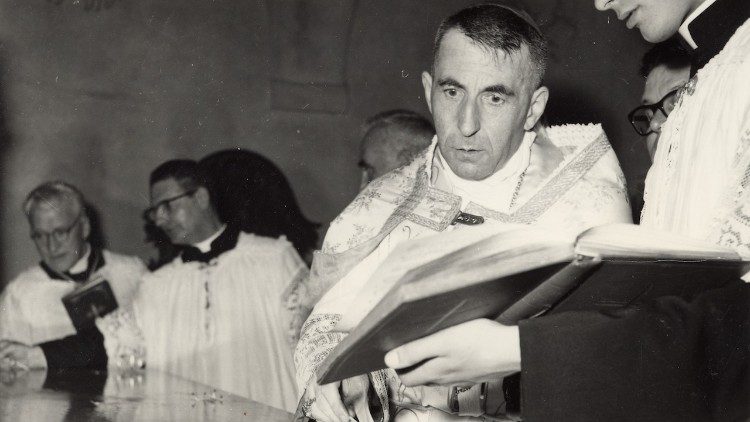
Bishop Vittorio Veneto - Future Pope John Paul I (John Paul I Vatican Foundation) Bishop Vittorio Veneto - Future Pope John Paul I (John Paul I Vatican Foundation)  

Pope John Paul I: “A servant” for the people

As the day for his beatification arrives, newly-released audio from then-Bishop Albino Luciani, future Pope John Paul I, provides a sketch of a pastor living in service to others.

By Andrea Tornielli

"My mother never told me to go and become a priest, never; but she was so good, she loved the Lord so much that when He called me, I spontaneously took this path...".

The voice is unmistakable and one that many faithful still fondly remember.

It is those who, during the 34 days of his pontificate, were beginning to know and love John Paul I, the pope who will now be beatified by his successor, Pope Francis.

It is the voice of Albino Luciani who, on the 29 June 1968, in the large parish church of Santa Maria del Piave in the diocese of Vittorio Veneto, Italy, ordained Don Giuseppe Nadal a priest.

Eleven minutes of a homily provide a sketch of the soon-to-be Blessed.

An audio recording that we can listen to in full here, dated over fifty years ago but still contains words that are very relevant today: they speak of shepherds, "with the smell of sheep," and help us to enter into the heart of the new Blessed Pope.

Mothers as models of faith

Fr. Giuseppe, 79 – now a parish priest in the village of Pieve di Soligo, Italy after serving nearly a decade as a “Fidei donum” missionary in Burundi – provided Vatican Media with the audio recorded in his home parish on the day of his ordination.

At the beginning of the recording, then-Bishop Luciani provides words of reflection for the new priest's family and for the sacrifices they made for him.

The bishop recalls a French writer who had said, "There are some mothers who have a priestly heart and transpose it into their children."

Then he recalls his own mother, Bortola Tancon, whose witness of faith had led him to embrace the priesthood: "It seemed to me that for me there was no other way. The Lord used the family environment."

Priests as servants of the other

"I truly hope," then-Bishop Luciani added, "that the Lord will help the new priest, like the priests I consecrated this morning, and make them dedicated to the people and capable of serving. You hear they say the phrase ministers of God: ministers mean 'servants;' servants of God and servants of the people. A priest is a good priest when he is a servant of others; if he is a servant of himself, he is not is not at the right place."

Bishop Luciani quotes a "holy priest" – Don Francesco Mottola, a priest who would also become later “Blessed” – who had written: "The priest must be like bread, the priest must let himself be ‘eaten’ by the people."

Therefore, he added, "The priest must be available to people at all times; he gave up his family on purpose to be available to other families."

In the homily there is an explicit mention of priestly celibacy: "Some people say, 'Priests don't get married because the Church doesn't value marriage: The Church is afraid to put marriage next to these holy things': not true, not true! St. Peter was married; that's not it. Instead, we think this: the family is a sublime and great thing, and that's precisely why if someone is a father of a family, he has enough to do his duty: children to educate, children to raise; it's all committed to that thing there, it's too big a family for one to be with a family and be able to do such great assignments as the priesthood. It's one thing or the other."

"So," the Bishop of Vittorio Veneto continued, "I repeat: let the priest be the servant of all. This is especially his task, his place: to serve. And the people know how to understand, when they see that the priest is really a servant who undoes himself for others. Then they say, 'We have a good priest;' then they are happy, then they truly are happy."

Living life as an example

After insisting that a Bishop should make "many examinations" and listen to "what people think of him" before ordaining someone a priest, Bishop Luciani insists on living life as a personal testimony; that is, the importance of embodying in life what he professes and preaches.

And he does so with traits that describe his humility.

For the preached word, "first, possibly, it must be lived; I cannot say to you and others, 'Be good,' if I am not good enough first; and if you knew at times what an embarrassment even for the bishop, to stand before people and say, 'Be good, be better, I perhaps have not done enough, even I am not good enough.' It would be wonderful if I, before lecturing others, had done everything I say to others. This is not always possible. You have to be content with the effort; we have also temper, we have also weakness. But the priest, if he wants to be a priest, must not show up to preach to others if he himself has not first at least tried – by repeated effort – to do what he asks others to do."

Finally, a suggestion: in pastoral life and in the celebration of the sacraments, "in confession above all," one must be gentle and treat people well: "I always tell my priests, 'Dear brothers... people must be treated well. If it is true that we are servants we must treat people well; it is not enough to dedicate ourselves to people, but to be gentle with people even if some people are sometimes ungrateful."

And if "there is not always right gratitude, we do not have to work for that gratitude. The Lord is waiting for us there, to see if in spite of everything we are able to continue to do some good to people."

The conclusion is a prayer and a wish to "have priests who are truly holy and truly servants of the people."