Showing posts with label Palm Sunday. Show all posts

Sunday, March 29, 2026

Israeli police prevent Cardinal Pizzaballa and the Custos of the Holy Land from even entering the Church of The Holy Sepulchre in Jerusalem


Church of Holy Sepulchre in JerusalemChurch of Holy Sepulchre in Jerusalem 

Israeli police stop Latin Patriarch from entering Church of Holy Sepulchre

In a joint press release, the Latin Patriarchate of Jerusalem and the Custos of the Holy Land report they were blocked from entering the Church of the Holy Sepulchre in Jerusalem by Israeli police, calling it "a manifestly unreasonable and grossly disproportionate measure."

Vatican News

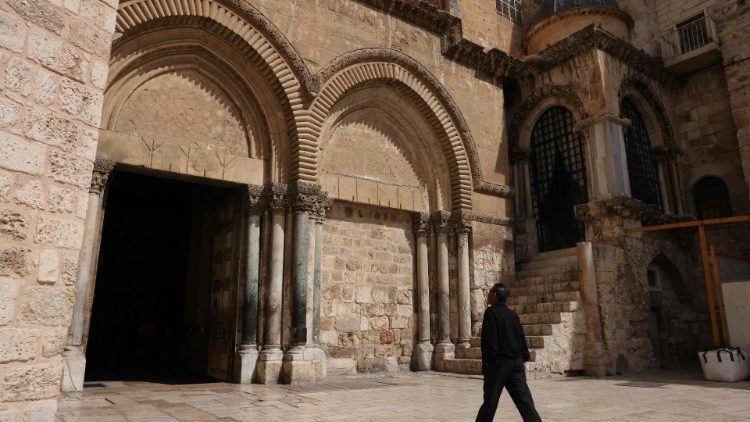
The Latin Patriarchate of Jerusalem and the Custody of the Holy Land have released a joint statement stating that, on the morning of Palm Sunday, the Latin Patriarch of Jerusalem, Cardinal Pierbattista Pizzaballa, together with the Custos of the Holy Land, Fr. Francesco Ielpo, OFM, the official Guardian of the Church of the Holy Sepulchre, were prevented from entering the Church of the Holy Sepulchre in Jerusalem, as they made their way to celebrate the Palm Sunday Mass.

Released on Sunday, the statement said both Church leaders were stopped en route by Israeli police, "while proceeding privately and without any characteristics of a procession or ceremonial act" and were forced to turn back.

"For the first time in centuries, the Heads of the Church were prevented from celebrating the Palm Sunday Mass at the Church of the Holy Sepulchre," the statement noted.

It described the event as "a grave precedent" and disregarding "the sensibilities of billions of people around the world who, during this week, look to Jerusalem."

Blocked despite compliance with restrictions

The statement said the Patriarch and the Custos of the Holy Land have acted with full responsibility since the start of the war, complying with all restrictions requiring that public gatherings be cancelled, attendance prohibited, and arrangements be made to broadcast the celebrations to hundreds of millions of faithful worldwide "who, during these days of Easter, turn their eyes to Jerusalem and to the Church of the Holy Sepulchre."

"Grossly disproportionate measure"

Preventing the entry of Cardinal Pizzaballa and Fr. Ielpo, who hold the highest ecclesiastical responsibility for the Catholic Church and Holy Places, "constitutes a manifestly unreasonable and grossly disproportionate measure."

The joint statement further underscored that "this hasty and fundamentally flawed decision, tainted by improper considerations, represents an extreme departure from basic principles of reasonableness, freedom of worship, and respect for the Status Quo."

The Patriarch and Custos both expressed their "profound sorrow" to the Christian faithful in the Holy Land and around the world "that prayer on one of the most sacred days of the Christian calendar has thus been prevented."

Pope Leo XIV focuses on plight of Christians in the Middle East on Palm Sunday


Pope Leo XIV celebrates Palm Sunday Mass in the VaticanPope Leo XIV celebrates Palm Sunday Mass in the Vatican  (@Vatican Media)

Pope recalls many Middle East Christians who suffer with Christ during Holy Week

Pope Leo XIV decries the fact that many Christians in the Middle East will be unable to celebrate Holy Week rites, urging everyone to remember the many people who share in Christ's suffering as the Church contemplates the Mystery of the Lord's Passion.

By Deborah Castellano Lubov

"Precisely as the Church contemplates the mystery of the Lord’s Passion, we cannot forget those who today truly share in His suffering."

Pope Leo XIV made this observation at the conclusion of his Palm Sunday Mass in the Vatican.

He drew the Church's attention to the plight of Christians in the Middle East, saying their "trial calls upon the conscience of all."

"At the beginning of Holy Week, we are closer than ever in prayer to the Christians of the Middle East, who suffer the consequences of a terrible conflict and in many cases cannot fully live the rites of these holy days," he said.

The Pope invited the faithful to join him in raising their supplication to the Prince of Peace, "that He may sustain peoples wounded by war and open concrete paths of reconciliation and peace."

Before reciting the midday Angelus prayer, the Pope entrusted to the Lord seafarers who are victims of war, saying he prays for the deceased, the wounded, and their families.

"Earth, sky, and sea," he underscored, "are created for life and for peace."

Finally, Pope Leo urged the Church to pray for all migrants who have died at sea, in particular for those who lost their lives in recent days off the coast of the island of Crete.

Pope Leo XIV at Palm Sunday Mass; declares that Jesus does not hear the prayers of those who wage war


Pope at Palm Sunday Mass: ‘Jesus does not listen to prayers of those who wage war’

Pope Leo XIV presides at Mass on Palm Sunday of the Lord's Passion, and reflects on Jesus as the King of Peace who rejects war and refuses to listen to the prayers of those who wage war.

By Devin Watkins

On Palm Sunday of the Lord's Passion, Pope Leo XIV celebrated Mass for the faithful gathered in St. Peter’s Square.

In his homily, the Pope reflected on Jesus’ revelation of Himself as the King of Peace, even as violence loomed around Him.

As Jesus walked the Way of the Cross, we walk with Him and contemplate His passion which He bore for the sake of humanity as a gift of love.

“He remains steadfast in meekness, while others are stirring up violence,” said the Pope. “He offers Himself to embrace humanity, even as others raise swords and clubs.”

Jesus, he added, came to bring life and light to the world, even as darkness and death was about to engulf Him.

Pope Leo pointed out that Jesus desired to bring the world to the Father’s arms and to tear down every barrier that keeps us from God and our neighbor.

Repeating “King of Peace” several times, the Pope highlighted Jesus’ actions in His Passion that bear witness to His desire to bring peace.

When one of His disciples struck the high priest’s servant and cut of his ear, Jesus commanded the disciple to put away his sword, recalling that those who live by the sword die by the sword.

As He was crucified and put to death, Jesus did not arm or defend Himself but allowed Himself to be led like a lamb to the slaughter.

“He revealed the gentle face of God, who always rejects violence,” he said. “Rather than saving Himself, He allowed Himself to be nailed to the cross, embracing every cross borne in every time and place throughout human history.”


Pope Leo XIV went on to recall the prophet Isaiah’s words: “Even though you make many prayers, I will not listen: your hands are full of blood” (Is 1:15).

“Jesus is the King of Peace, who rejects war, whom no one can use to justify war,” said the Pope. “He does not listen to the prayers of those who wage war but rejects them.”

He lamented the many wounds of the human family in our world today, as people cry out to God with the “painful groans of all those who are oppressed by violence and are victims of war.”

“Christ, King of Peace, cries out again from His cross: God is love! Have mercy! Lay down your weapons!  Remember that you are brothers and sisters!” said the Pope.

In conclusion, Pope Leo highlighted the words of Servant of God Bishop Tonino Bello, reflecting on the Blessed Virgin Mary who stood at the foot of her Son’s cross.

“Holy Mary, woman of the third day, grant us the certainty that, in spite of all, death will no longer hold sway over us; that the injustices of peoples are numbered; that the flashes of war are fading into the twilight; that the sufferings of the poor are breathing their last,” he said. “And grant, finally, that the tears of all the victims of violence and pain will soon be dried up like frost beneath the spring sun.”

Saturday, March 28, 2026

Palm Sunday and the beginning of Holy Week


Lent: March 29th

Palm Sunday of the Lord's Passion


From the Gospel at the Procession with the Palms, Year A: The very large crowd spread their cloaks on the road, while others cut branches from the trees and strewed them on the road. The crowds preceding him and those following kept crying out and saying: "Hosanna to the Son of David; blessed is he who comes in the name of the Lord; hosanna in the highest." And when he entered Jerusalem, the whole city was shaken and asked, "Who is this?" And the crowds replied, "This is Jesus the prophet, from Nazareth in Galilee." (Matt 21:7-11)

Today is Palm Sunday of the Lord's Passion during which we commemorate Christ's entry into Jerusalem for the completion of the Paschal Mystery.

The Palm Sunday procession is formed of Christians who, in the "fullness of faith," make their own the gesture of the Jews and endow it with its full significance. Following the Jews' example we proclaim Christ as a Victor... Hosanna to the Son of David! Blessed is He who comes in the Name of the Lord. But by our faith we know, as they did not, all that His triumph stands for. He is the Messiah, the Son of David and the Son of God. He is the sign of contradiction, acclaimed by some and reviled by others. Sent into this world to wrest us from sin and the power of Satan, He underwent His Passion, the punishment for our sins, but issues forth triumphant from the tomb, the victor over death, making our peace with God and taking us with Him into the kingdom of His Father in heaven.


Liturgy for Palm Sunday


The priests and deacons wear red vestments for Mass. There is a special entrance at the beginning of each Mass, either simple or solemn. This includes a blessing of the palms and the gospel reading of the entrance into Jerusalem (Matt 21:1-11; Mark 11:1-10; John 12:12-16; Luke 19:28-40). The introduction by the priest explains the solemnity of Holy Week, and invites the faithful to take full part in the celebration:

Dear friends in Christ, for five weeks of Lent we have been preparing, by works of charity and self-sacrifice, for the celebration of our Lord's paschal mystery. Today we come together to begin this solemn celebration in union with the whole Church throughout the world. Christ entered in triumph into his own city, to complete his work as our Messiah: to suffer, to die, and to rise again. Let us remember with devotion this entry which began his saving work and follow him with a lively faith. United with him in his suffering on the cross, may we share his resurrection and new life.

The palms are blessed with the following prayer:

Almighty God, we pray you bless these branches and make them holy. Today we joyfully acclaim Jesus our Messiah and King. May we reach one day the happiness of the new and everlasting Jerusalem by faithfully following him who lives and reigns for ever and ever. Amen.

As the faithful, we remember and dramatize Christ's triumphal entrance into Jerusalem on a donkey. In Jesus' time, a huge crowd assembled, put their cloaks or branches on the ground, and waved palm branches, acclaiming Christ as the King of Israel, the Son of David. We now wave our palm branches and sing as the priest enters the church:

Hosanna to the Son of David, the King of Israel.
Blessed is he who comes in the name of the Lord.
Hosanna in the highest.

These words of praise are echoed every day at the Holy Sacrifice of the Mass at the Sanctus (Holy, Holy).

Our joy is quickly subdued. We are jolted to reality and see the purpose of Christ coming to Jerusalem by the reading of the Passion at the Gospel. (Written by Jennifer Gregory Miller)

Symbolism of the Palm Sunday Service
In the actions and object proper to today's liturgy the Church displays a rich symbolism, one deserving our special attention. The procession, for instance, is more than a mere memory; for in it we are actually accompanying Christ here and now. How is that true? Because Christ is present in three ways; firstly, in mere symbol, on the Cross which heads the procession; secondly, in His representative the priest; thirdly, in all of us as a community gathered together in His name. We are the Church of this place; and Christ, according to His promise, is in the midst of us.

But also this procession looks to the future. Christ, in His redemptive work, passed from this world into heaven, which is called the New Jerusalem. If our church stands for the earthly Jerusalem of old, it stands also for the New Jerusalem of heaven. When Christ comes again at the end of the world, He will lead our risen bodies, now joined to their souls, into heaven. And so, as we enter now with Christ's representative, the priest, we should think of the day when we hope to enter heaven itself with Christ our King. Our procession is a kind of rehearsal, in a symbolic way, of our final passover on the Last Day.

Now let us turn our minds from the future to the past. Christ and His followers entered Jerusalem, just as we now enter this church. But why did He go to Jerusalem? Was it to be crowned there as King? Not at all. He went there to suffer and die for our sakes, and to win through all His terrible passion and death to His resurrection. Our salvation depends on following Him; we must die with Him if ever we are to rise with Him. And therefore, in the official prayer of the Mass, which the priest lays before God as our spokesman, we ask that "with the lesson of His endurance before us, we may be found worthy to have fellowship in His resurrection." How earnestly we should add our Amen to that prayer.


Monday, March 23, 2026

Palm Sunday Procession in Jerusalem is now a victim of the Iran conflict: CANCELLED


The entrance to the Church of the Holy Sepulchre in Jerusalem The entrance to the Church of the Holy Sepulchre in Jerusalem   (AFP or licensors)

Palm Sunday procession in Jerusalem cancelled due to war

The Latin Patriarchate of Jerusalem cancels this year’s Palm Sunday procession from the Mount of Olives to Jerusalem, due to the ongoing war in the Middle East.

By Beatrice Guarrera

Cardinal Pierbattista Pizzaballa, Latin Patriarch of Jerusalem, has announced that the traditional Palm Sunday procession, which goes from the Mount of Olives up to Jerusalem, has been cancelled and will be replaced by a moment of prayer for the city at a location yet to be determined.

In a statement, the Cardinal explained that the Chrism Mass of Holy Thursday, usually held in the Basilica of the Holy Sepulchre, has been postponed to a later date, as soon as the situation allows and possibly within the Easter season.

Ordinary public celebrations will not be possible

“The restrictions imposed by the conflict and the events of recent days do not bode well for any imminent improvement,” the Cardinal highlighted.

“In constant dialogue with the competent authorities, together with the other Christian Churches, we are evaluating how, in the ways to be agreed upon, we can celebrate the central Mystery of our salvation in the heart of our Churches," he said.


Cardinal Pizzaballa underlined that the situation is constantly evolving, making it impossible to provide definitive indications for Holy Week celebrations. He said the Patriarchate will be forced to organize events day by day.

“It is already clear, however, that ordinary celebrations open to all cannot take place,” the Cardinal continued, explaining the decision to cancel the Palm Sunday procession and postpone the Chrism Mass.

However, the statement did specify that the Patriarchate's churches remain open, and parish priests and clergy will do their best to encourage prayer and the participation of the faithful in Easter celebrations.

Another wound caused by the conflict

"Due to the war, this year we were unable to experience the traditional Lenten journey in Jerusalem, with the solemn celebrations at the Holy Sepulcher and in the Holy Places of the Passion," the statement explained.

“Though we were able to pray and prepare personally, we felt the loss of the community journey towards Easter,” said Cardinal Pizzaballa.

“The harshness of this time of war, which affects us all,” he continued, “today bears the added burden of not being able to celebrate Easter together and with dignity.”

“This is a wound that adds to the many others inflicted by the conflict. But we must not allow ourselves to be discouraged. Though we may not gather as we would like, let us not give up prayer.”

Prayer for peace on Saturday, March 28

The Cardinal recalled Jesus’ words from Chapter 18, verse 1, of the Gospel of Luke: “Pray always and do not lose heart.” He invited people to make up for these restrictions with moments of prayer in families and religious communities.

In particular, he invited everyone to unite in prayer on Saturday, March 28, by reciting the Rosary to ask for peace and serenity, especially for those suffering because of the conflict.

“We will do so with humble hearts, certain that our prayer, even while we are physically distant, is capable of drawing upon the strength of God's love, which unites us in a spirit of hope and trust,” the Cardinal insisted.

Although prayer is already widespread, he proposed a special day in which people can feel united, despite all being in their own places.

“We desire peace, first and foremost, for our troubled hearts. Only prayer can give it,” the Cardinal wrote.

No darkness can have the last word

On Good Friday, Catholic faithful across the world will be invited to support the Holy Land through the traditional collection. The local community prepares to experience this special liturgical time with the Cardinal’s words:

“Easter, which we celebrate in the name of Christ's passion, death, and resurrection, reminds us that no darkness, not even that of war, can have the last word. The empty tomb is the seal of the victory of life over hatred, of mercy over sin. Let us allow this certainty to illuminate our steps and sustain our hope.”


Prayer continues in the Holy Places

In recent days, the Custody of the Holy Land issued a statement explaining that the Franciscan friars present at the Holy Sepulchre "have never ceased, day or night, to carry out the scheduled celebrations, the rites, the daily processions, and the liturgical prayers according to the provisions of the Status Quo.”

“Even during these days,” the statement said, “although access to the Basilica is restricted to the faithful for security reasons, prayer continues unceasingly in the Holy Places.”

The centuries-long presence of the Custody in the Holy Land, and the prayer that rises there every day, is offered in the name of the whole Church and for the good of all humanity, the statement explained.

“In particularly dramatic moments such as those we are now experiencing, this presence intends to make visible the faith, hope, and supplication of every baptized person, so that from these Holy Places a prayer for peace and reconciliation among peoples may continue to rise.”

Sunday, April 13, 2025

The Pope among the people on Palm Sunday in St. Peter's Square


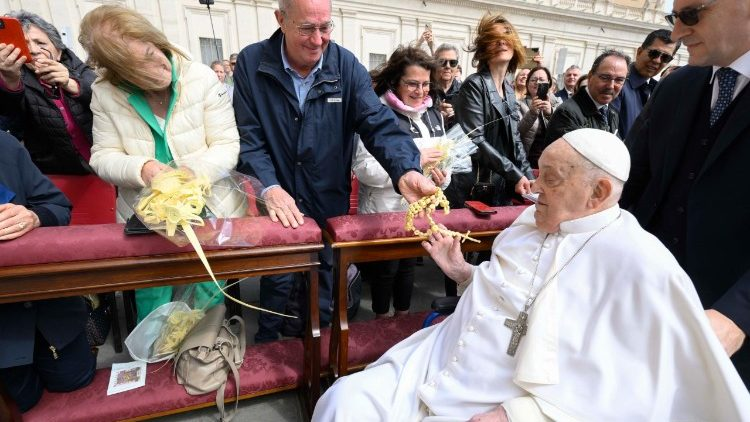
Pope Francis greets pilgrims on Palm Sunday in Saint Peter's Square

Pope Francis wishes pilgrims a "Happy Palm Sunday and Happy Holy Week" in person during a surprise visit to Saint Peter's Square at the conclusion of the Mass presided over by Cardinal Leonardo Sandri on his behalf.

Vatican News

Pope Francis wished a "Happy Palm Sunday and Happy Holy Week" to all those gathered for the Palm Sunday of the Lord's Passion celebration in Saint Peter's Square. The Pope came out into the Square from the Basilica for around ten minutes, immediately following the final blessing of the Mass where he offered his good wishes and then visited in his wheelchair among the faithful. 

Pope Francis greets the faithful at the conclusion of the Palm Sunday Mass   (VATICAN MEDIA Divisione Foto)
Pope Francis' latest visit marked another public occasion among the people, following his presence last Sunday at the Jubilee of the Sick and the World of Healthcare and his visits to Saint Peter's Basilica last week and visit to the Basilica of Saint Mary Major yesterday to pray before the Marian icon of the Salus Populi Romani.


Pope Francis visiting among the faithful in Saint Peter's Square (VATICAN MEDIA Divisione Foto)

Following his greetings to pilgrims in Saint Peter's Square, the Pope returned inside the Basilica where he paused for moments of prayer before the tomb of the Apostle Peter, and then that of Saint Pius X and the monument dedicated to Benedict XV.

Pope Francis during his visit among the faithful on Palm Sunday (VATICAN MEDIA Divisione Foto)

The Palm Sunday homily of Pope Francis is read at Mass in St. Peter's Square


Pope on Palm Sunday: God's mercy calls us to compassion

In his homily read out during the celebration in Saint Peter's Square marking Palm Sunday of the Lord's Passion, Pope Francis calls on us to reflect on the Lord's compassion that knows no limits, "how we are meant to carry our own cross during this Holy Week", and help others "all around us" who bear the cross of suffering.

By Thaddeus Jones

Argentinian Cardinal Leonardo Sandri, Vice Dean of the College of Cardinals, presided over the Palm Sunday celebration of the Lord's Passion in Saint Peter's Square on behalf of Pope Francis who is limiting his exposure to the elements in order to continue recovery from his respiratory conditions. An estimated forty thousand faithful gathered in the Square. 


More than 40,000 faithful present for the celebration (Vatican Media)

Cardinal Sandri read Pope Francis's homily for the Mass marking the beginning of Holy Week celebrations that commemorate the Lord’s passion, death and resurrection. Pope Francis recalled how on Palm Sunday, we remember the crowds who greeted Jesus with festive joy as he entered Jerusalem, and then only a few days later when Jesus would leave the city condemned, bearing the cross on a path of pain and sorrow.

Simon of Cyrene 

Reflecting on the person of Simon of Cyrene in today's Gospel account who was seized by the Roman soldiers and forced to carry Jesus' cross for a time, the Pope looked at how this person became personally involved in the Lord's passion, even if he did not choose to be. "Jesus’ cross becomes Simon’s cross", he noted. He said Simon’s actions appear to be ambivalent. He was forced to carry the cross of Jesus on the way to Calvary, thus becoming personally involved the Lord's passion even if that would not have been his intention. He observed how Simon of Cyrene acts, but does not speak, and that there is no dialogue between him and Jesus, just "the wood of the cross."


Cardinal Leonardo Sandri presiding at the celebration   (VATICAN MEDIA Divisione Foto)

Simon's role in salvation history

To understand Simon of Cyrene's heart, whether he had compassion or not for Jesus in being forced to share in His suffering, we need to look into his heart, the Pope suggested. And "while God’s heart is ever open, pierced by a pain that reveals his mercy, the human heart remains closed." Would Simon have felt anger, pity, compassion or annoyance, the Pope pondered, but we do knot know. At the same time, we do know that he bore the cross of Christ who took upon Himself the sins of all humanity, the Pope continued.  

"Jesus bore them for love of us, in obedience to the Father; he suffered with us and for us. In this unexpected and astonishing way, Simon of Cyrene becomes part of the history of salvation, in which no one is a stranger, no one a foreigner."

Help carry each other's crosses

The Pope then suggested we in our own lives look at how we can follow in Simon's footsteps who teaches us that "Jesus comes to meet everyone, in every situation." All we have to do is look around us, he observed, "the great crowds of men and women whom hatred and violence are compelling to walk the road to Calvary" in our world, a road "God has made...a place of redemption" since He walked it himself, "giving his life for us." 

“How many Simons of Cyrene are there in our own day, bearing the cross of Christ on their shoulders! Can we recognize them? Can we see the Lord in their faces, marred by the burden of war and deprivation? Faced with the appalling injustice of evil, we never carry the cross of Christ in vain; on the contrary, it is the most tangible way for us to share in his redemptive love.”


How Jesus’ passion becomes compassion

In conclusion, the Pope explained how when we hold out our own hands to those who are suffering, lifting up those who have fallen, embracing those who are discouraged, we manifest how "Jesus’ passion becomes compassion" expressed today. During Holy Week, he suggested we look at our own lives, how in order to experience God's "great miracle of mercy" we can carry our own cross, "but also the cross of those who suffer all around us", even that of some unknown person we find along on our way, and so become "for one another, a Simon of Cyrene."

Saturday, April 12, 2025

We have arrived at Palm Sunday of the Lord's Passion' the beginning of Holy Week

 Lent: April 13th

Palm Sunday of the Lord's Passion


So they took branches of palm trees and went out to meet him, crying, "Hosanna! Blessed is he who comes in the name of the Lord, even the King of Israel!" And Jesus found a young ass and sat upon it; as it is written, "Fear not, daughter of Zion; behold, your king is coming, sitting on an ass's colt (Jn 12:13-15)!"

We commemorate Christ's entry into Jerusalem for the completion of the Paschal Mystery. In Liturgical Calendar preceding Vatican II, the Church celebrated Passion Sunday two Sundays before Easter, and then Palm Sunday was the beginning of Holy Week. The Church has combined the two to reinforce the solemnity of Holy Week.

The Palm Sunday procession is formed of Christians who, in the "fullness of faith," make their own the gesture of the Jews and endow it with its full significance. Following the Jews' example we proclaim Christ as a Victor... Hosanna to the Son of David! Blessed is He who comes in the Name of the Lord. But by our faith we know, as they did not, all that His triumph stands for. He is the Messiah, the Son of David and the Son of God. He is the sign of contradiction, acclaimed by some and reviled by others. Sent into this world to wrest us from sin and the power of Satan, He underwent His Passion, the punishment for our sins, but issues forth triumphant from the tomb, the victor over death, making our peace with God and taking us with Him into the kingdom of His Father in heaven.

Today's Station Church >>>


Meditation on Holy Week
Now we enter the holiest part of Lent. The Church has prepared us step by step for this sacred experience. A steady crescendo in the liturgy has been taking place since Ash Wednesday. Each week the sound rose higher, and louder. Although Mother Church often spoke about the Cross and the resurrection, she did so in veiled signs and figures, as if she feared exposing a most precious object to profane eyes. Not until this moment does she remove the curtain. Now we see the Holy of Holies; and more than that, we are asked to participate in the most sublime drama of religious history.

The greatest and holiest of weeks is about to begin. We should not call it a week of mourning, for Cross and resurrection are inseparable. Christ's redemptive work did not end with death, it continues on in the victory of His resurrection. Therefore, we must not separate the passion from the resurrection, but rather regard the Cross as the way to Easter victory.

The liturgy does not make this week one of sorrowful lamentation or tearful sympathizing with our suffering Lord. That was the medieval approach. No, through the whole week there runs a note of victory and joy, a realization that Christ's sacred passion was a prerequisite to Easter glory. We cannot understand the Church's liturgy unless we keep this in mind.

There is no day in the entire coming week when the theme of Easter and victory does not resound loud and clear. Think only of Palm Sunday with its homage to the King; of Holy Thursday with its solemn Mass and consecration of the Holy Oils; of Good Friday with the solemn exaltation of the Cross; of Holy Saturday, the beginning of the Easter solemnities.

Four days take on special importance, viz., Palm Sunday and the sacred Triduum. The remaining three days, Monday through Wednesday, do not differ radically from other days in Passiontide. Palm Sunday may be called the golden gateway leading to the holy mysteries of Easter.
—Dr. Pius Parsch, The Church’s Year of Grace: Septuagesima to Holy Saturday


Liturgy for Palm Sunday
The priests and deacons wear red vestments for Mass. There is a special entrance at the beginning of each Mass, either simple or solemn. This includes a blessing of the palms and the gospel reading of the entrance into Jerusalem (Matt 21:1-11; Mark 11:1-10; John 12:12-16; Luke 19:28-40). The introduction by the priest explains the solemnity of Holy Week, and invites the faithful to take full part in the celebration:

Dear friends in Christ, for five weeks of Lent we have been preparing, by works of charity and self-sacrifice, for the celebration of our Lord's paschal mystery. Today we come together to begin this solemn celebration in union with the whole Church throughout the world. Christ entered in triumph into his own city, to complete his work as our Messiah: to suffer, to die, and to rise again. Let us remember with devotion this entry which began his saving work and follow him with a lively faith. United with him in his suffering on the cross, may we share his resurrection and new life.

The palms are blessed with the following prayer:

Almighty God, we pray you bless these branches and make them holy. Today we joyfully acclaim Jesus our Messiah and King. May we reach one day the happiness of the new and everlasting Jerusalem by faithfully following him who lives and reigns for ever and ever. Amen.

As the faithful, we remember and dramatize Christ's triumphal entrance into Jerusalem on a donkey. In Jesus' time, a huge crowd assembled, put their cloaks or branches on the ground, and waved palm branches, acclaiming Christ as the King of Israel, the Son of David. We now wave our palm branches and sing as the priest enters the church:

Hosanna to the Son of David, the King of Israel.
Blessed is he who comes in the name of the Lord.
Hosanna in the highest.

These words of praise are echoed every day at the Holy Sacrifice of the Mass at the Sanctus (Holy, Holy).

Our joy is quickly subdued. We are jolted to reality and see the purpose of Christ coming to Jerusalem by the reading of the Passion at the Gospel. (Written by Jennifer Gregory Miller)

Symbolism of the Palm Sunday Service
In the actions and object proper to today's liturgy the Church displays a rich symbolism, one deserving our special attention. The procession, for instance, is more than a mere memory; for in it we are actually accompanying Christ here and now. How is that true? Because Christ is present in three ways; firstly, in mere symbol, on the Cross which heads the procession; secondly, in His representative the priest; thirdly, in all of us as a community gathered together in His name. We are the Church of this place; and Christ, according to His promise, is in the midst of us.

But also this procession looks to the future. Christ, in His redemptive work, passed from this world into heaven, which is called the New Jerusalem. If our church stands for the earthly Jerusalem of old, it stands also for the New Jerusalem of heaven. When Christ comes again at the end of the world, He will lead our risen bodies, now joined to their souls, into heaven. And so, as we enter now with Christ's representative, the priest, we should think of the day when we hope to enter heaven itself with Christ our King. Our procession is a kind of rehearsal, in a symbolic way, of our final passover on the Last Day.

Now let us turn our minds from the future to the past. Christ and His followers entered Jerusalem, just as we now enter this church. But why did He go to Jerusalem? Was it to be crowned there as King? Not at all. He went there to suffer and die for our sakes, and to win through all His terrible passion and death to His resurrection. Our salvation depends on following Him; we must die with Him if ever we are to rise with Him. And therefore in the official prayer of the Mass, which the priest lays before God as our spokesman, we ask that "with the lesson of His endurance before us, we may be found worthy to have fellowship in His resurrection." How earnestly we should add our Amen to that prayer.

And at the end of it all we take our palms home, and reverently place them behind our crucifix; and we would do well to use the palms of all the members of our family, placing them in the living room, the kitchen, the bedrooms, the garden — in any place where we pass our time — that they may remain there throughout the year. Why should we do that? Because at the end of the procession the priest says this prayer: "Lord Jesus Christ, our King and Redeemer, we have carried these branches and sung solemn praises in Thy honor. Graciously let Thy grace and blessing rest wherever these branches are brought; with the power of Thy right hand defeat every evil influence and deception of the devil while granting Thy protection to those whom Thou hast redeemed; who are living and reigning with God the Father in the unity of the Holy Spirit, one God for ever and ever. Amen."

The palms are not instruments of magic; they are not like superstitious amulets supposed to possess any power or virtue of their own; but they are the visible signs of the powerful prayer of God's Church which calls down the blessing of God upon all the places where they are put. We who have faith in the Church should have faith in her prayers, and make use of their power to our sanctification and protection.
—From Preparing for Easter by Clifford Howell