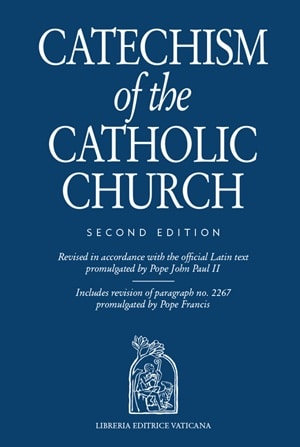
Showing posts with label Catechism of the Catholic Church. Show all posts

Saturday, October 18, 2025

Pope Leo XIV stands against usury


Pope Leo with members of Italy's Anti-Usury CouncilPope Leo with members of Italy's Anti-Usury Council  (@Vatican Media)

Pope Leo: Usury ‘corrupts the human heart’ and enslaves the poor

Pope Leo XIV condemns usury as a grave sin that enslaves the poor and corrupts the human heart, he calls for a renewed commitment to justice and mercy and praises the Church’s anti-usury efforts as a sign of hope in the Jubilee Year.

By Linda Bordoni

Pope Leo XIV has denounced the practice of usury as a “grave sin” that destroys lives, families, and societies, calling it a “corruption of the human heart” that exploits the vulnerable and undermines human dignity.

Speaking to members of Italy’s National Anti-Usury Council on Saturday, the Pope thanked them for their thirty years of commitment to assisting victims of usury and promoting ethical economic practices. He warned that usury, both at the individual and global levels, “remains a painful and ancient wound” that continues to afflict the poor and marginalized.

Usury is not merely an accounting issue

“The phenomenon of usury,” the Pope said, “points to the corruption of the human heart.” Quoting the prophet Isaiah, he recalled that Scripture condemns exploitation and calls believers to “break the chains of injustice and set the oppressed free.”

“How far from God,” the Pope exclaimed, “is the attitude of those who crush people until they become slaves! Usury is not merely an accounting issue—it is a grave sin that can destroy families, consume the mind and heart, and even lead people to despair or suicide.”

He warned that usury often disguises itself as help offered to those in economic hardship but soon “reveals itself for what it is: a burden that suffocates.” The consequences, he said, fall especially on “those already fragile, such as victims of gambling addiction or families facing medical or financial emergencies.”

Entire peoples can be enslaved

Pope Leo XIV extended his warning beyond individual cases, condemning “usurious financial systems that can bring entire peoples to their knees.”

Citing the Catechism of the Catholic Church, he reminded listeners of those “who in commerce engage in usurious and mercantile practices that cause hunger and death among their brothers and sisters in humanity.” Such actions, he said, create “structures of sin” and carry “grave responsibility.”

He asked pointedly: “Are the less fortunate not human beings? Do the weak not share our same dignity? Are those born with fewer opportunities worth less as human beings, destined merely to survive?”

“Our answer to these questions,” the Pope affirmed, “determines the value of our societies and our future. Either we reclaim our moral and spiritual dignity, or we fall into a pit of filth.” (Dilexi te, 95)

A mission rooted in mercy

Thanking the Anti-Usury Council for its ongoing service, Pope Leo XIV described its work as a “sign of hope” in this Holy Year, fully aligned with the spirit of the Jubilee of Mercy.

Reflecting on the Gospel story of Zacchaeus, the Pope said that conversion—like that of the tax collector—is possible when one encounters the gratuitous love of Christ. “When profit becomes our goal,” he said, “others lose their face and become objects to exploit. And in the end, we too lose ourselves and our souls.”

“The conversion of those who commit usury,” he added, “is as important as our closeness to those who suffer because of it.”

Concluding his address, Pope Leo XIV encouraged those engaged in the fight against usury to persevere with courage and unity, supported by the Church’s pastors and inspired by the Gospel.

Sunday, April 14, 2024

Pope visits with school children studying the Catechism


Pope Francis Makes Surprise Visit to 200 Children for Catechism in Rome Suburb

This is the pontiff’s first meeting for the so-called 'School of Prayer,' an initiative promoted by the Vatican as part of this Year of Prayer in preparation for the Jubilee Year 2025.


Pope Francis made a special “getaway” from the Vatican yesterday afternoon and met with a group of 200 children at a parish in metro Rome.

A brief statement released by the Holy See’s Press Office said that the Holy Father went to St. John Mary Vianney Parish in Borghesiana, east of the Italian capital.

There Pope Francis met with a group of 200 children studying catechism and in a relaxed manner answered some of their questions.

Pictures from the meeting posted on social media show the Holy Father happily greeting the children and even giving them playful “high fives.” 

According to the Dicastery for Evangelization, for approximately one hour, the “Pope catechized with the children.”

Responding to their questions, he offered a brief catechesis on the topic of the prayer of thanksgiving, emphasizing that it is one of the most important in the Christian life.

“It’s important to give thanks for everything. For example, if you enter a person’s house and don’t say thank you, or don’t say hello, is that good? The first word is ‘thank you,’ so the second is ‘permission,’” he told the children at the parish in suburban Borghesiana, located in the eastern part of the diocese.

“The third word is ‘forgiveness,’” the Pope continued. “Is a person who never asks for forgiveness good? It’s difficult to ask for forgiveness, sometimes shame and pride go with it. But it’s important when you say I’m sorry a lot. Three words: thank you, permission, sorry.”

Next, Pope Francis asked the children: “But do you pray? How do you pray? What can you say to the Lord?” One of the children said that he and his family pray before eating.

“He said something important. But do you know that there are so many children who don’t have food? Do I thank the Lord for giving me food? Do I thank you for giving me a family?” he asked.

The last question touched on the topic of faith. “But are you Christians?” Pope Francis asked. “Do you have faith? Let’s say it together. Thank you, Lord, for giving me faith.”

During the exchange, one of the children’s most emotional questions was from a 10-year-old named Alice: “How can I thank the Lord in my illness?” 

“Even in dark moments, we have to thank the Lord, because he gives us the patience to tolerate difficulties. Let’s say it together: Thank you, Lord, for giving us the strength to tolerate pain,” the pontiff said. The children also asked him why there was death and loneliness.

“We must always thank him, at all times. I give you some advice,” Pope Francis said. “Before going to sleep, think: ‘What can I thank the Lord for today?’ Give thanks,” he encouraged the children.

At the end of the meeting, the children together with the Holy Father recited a “Prayer of Thanksgiving” composed for the occasion, which will serve as a reminder of an extraordinary moment in their lives.

Before leaving, Pope Francis, greeting and joking with them, gave each of the children a chocolate egg.

To the priests and the 20 catechists present he gave the first six volumes published in the series “Notes on Prayer.”

What is the School of Prayer?

This is the pontiff’s first meeting for the so-called “School of Prayer,” an initiative promoted by the Vatican as part of this Year of Prayer in preparation for the Jubilee Year 2025.

As part of the project, Pope Francis will hold different meetings “with some different categories of people to pray together, including some forms of prayer.”


As Archbishop Rino Fisichella, pro-prefect of the Dicastery for Evangelization, explained to ACI Prensa, CNA’s Spanish-language news partner, these prayer meetings “will depend on the commitments of Pope Francis and will possibly include people and families from the Diocese of Rome.”

Wednesday, October 25, 2023

Cardinal Schonborn says Pope can change the wording in the Catechism of the Catholic Church


Author of Catechism says Pope could change language on LGBTQ+ issues

Elise Ann Allen


ROME – A celebrated prelate who helped write the Catechism of the Catholic Church, and who’s widely recognized as being among the Church’s top theologians, upheld Church teaching on LGBTQ+ issues on Friday but also said the pope has the power to change the catechism’s language describing homosexuals as “disordered.”

Austrian Cardinal Christoph Schönborn of Vienna also pointed to the weakening of European Catholicism, saying the global south – Churches in Africa, Asia and Latin America – is becoming the new center of the Church.

Schönborn participated in an Oct. 23 press briefing during the pope’s Synod of Bishops on Synodality, which is set to close the first of two Rome-based gatherings that will culminate in October 2024. He spoke alongside Cardinal Carlos Aguiar Retes, Archbishop of Mexico; Cardinal Jean-Marc Aveline, Archbishop of Marseille; and Sister Samuela Maria Rigon, Superior General of the Sisters of the Holy Mother of Sorrows.

Asked about LGBTQ+ individuals who feel hurt and disrespected by the catechism’s description of homosexual acts as “intrinsically disordered” and whether that language could be changed, Schönborn, who served as secretary of the catechism’s drafting committee, said the catechism has been changed before.

“It’s a work of the Church and it has been promulgated by the pope,” he said, saying Pope Francis has the authority to change it and that he did so once before when, in 2018, he decided to revise the Church’s position on the death penalty, changing the language of the catechism to say that capital punishment is “unacceptable.”

It is no secret, and I can say so, John Paul II already wished that the death penalty would be explicitly condemned, then I was told that Pope Francis took action and introduced this change,” Schönborn said, noting that St. Theresa of Calcutta had also asked John Paul II to more explicitly condemn the death penalty in the catechism.

In terms of whether there will be further changes, Schönborn said he does not know, and that “the pope is the only one who can decide, because he’s the one who promulgated the catechism.”

Schönborn recommended that the text of the catechism be read “as a whole,” and pointed to the portions saying all people must be respected in their human dignity.

Drawing on aspects of moral theology, he said there are two main elements, one being “an objective order” in terms of the immutability of Church teaching, and there are also “human beings,” who as sinners fall short of God’s design.

“Human beings always have the right to be respected, even though they sin, which we all do. I personally, you, all of you, we all sin, but we are entitled to be respected, we have a right to be respected,” Schönborn said, saying every person is accepted by God, and their spiritual journey depends on their history and whether “this person wants to be accompanied.”

LGBTQ+ issues have been a major point of interest during this month’s Synod of Bishops, and is one of the most frequently asked about topics alongside other hot-button issues such as women’s priestly ordination and the married priesthood.

Participants selected by synod organizers to brief the media in daily press briefings have collectively said there will be no concrete decisions on these or other issues at the end of the Oct. 4-29 discussion, which will wrap up this weekend, and there might be no decisions made at the end of next year’s gathering, which will formally close the process.

Rather, participants have said that the discussion itself, aimed at learning, practicing and implementing synodality – a form of consultative and inclusive governance – is the most important aspect of the synod.

In Monday’s briefing, participants each spoke about their own experiences of the synod and highlighted initiatives in their own local regions and dioceses.

Schönborn praised the methodology of this month’s gathering, which for the first time includes women and laypeople generally as full voting members, and which is structured around small group discussions that take place at a round table, rather than the previous synod hall with auditorium-like seating that was largely divided by ecclesial rank.

He voiced his belief that synodality is a continuation of the Second Vatican Council’s teaching on ecclesiology and the nature of the ecclesial community as composed of all baptized persons “journeying together.”

One thing Schönborn said that has struck him throughout the synod process is “the fact that Europe is no longer the main center of the Church.”

“There are other centers, and this is evident from what we live in the daily meetings of the synod,” he said, and pointed to the Churches in Latin America, Africa, and Asia.

Continental bishops’ conferences in these regions are more developed than in Europe, he said, noting that the Council of European Episcopal Conferences (CCEE) “was unable to have the potential that the FABC was able to develop, it hasn’t been as able to develop as they have, so it’s a bit of a criticism,” he said, referring to the Federation of Asian Bishops Conferences, the continental ecclesial body for Asia. 

Europe, he said, is “lagging behind a bit in the way in which we live synodality among the local churches in Europe. I think we need some stimulus to move forward,” Schönborn said, noting that European bishops’ conferences have never been able to speak with a unified voice on the issue of migration, “and this is sad.”

“Politicians are unable to do that, they don’t know how to do it, and we the Catholic Church, we are unable to come up with a common stance,” he said, and also stressed the need to forge closer ties to the Eastern Catholic Churches, who have an ancient tradition of synodality that is rooted in the liturgy.

Aguiar Retes spoke of his own synodal process in Mexico, saying they launched a local synodal process of listening and dialogue with the diocese’s 426 parishes after the COVID-19 pandemic and are beginning to evaluate the results.

“We will be sharing this in order to answer and respond to the needs that exist in our society,” he said, saying this approach of bringing everyone together and listening to all of their voices is essential, otherwise “we will become small groups of Catholic faithful, as unfortunately is happening in some countries.”

Asked if this month’s synodal discussion and the implementation of synodality will be considered in the next conclave, and in what way, Aguiar Retes said that “if we put into practice what we have defined here, what we have discussed and experienced, I think there is a path before us.”

Unless we do this, if we just listen and don’t reach daily life with our responsibilities, nothing is going to happen. Everything really depends on us and what we do when we go back to our diocese, when we put into practice what we’ve been saying, what we expect as a Church in the future,” he said.

In terms of the synod’s working method of listening, reflection and dialogue, Schönborn said it has been helpful and recalled a conversation about synodality with American economist Jeffrey Sachs, who is a member of the Pontifical Academy of Social Sciences.

In that conversation, Schönborn said, Sachs confided that “if only the United Nations Security Council were to do this, were to adopt this method, then maybe we would have a bit more peace in the world,” as everyone comes to the security council with their own private agenda and instructions from their government.

Sachs’s view, Schönborn said, was that “they all say their own thing and there is no exchange. How can we move forward, go on without such a methodology as you adopted?” This method, he said, “is clearly the right one and it’s also necessary.”

Maria Rigon said she likes the methodology and has appreciated it “because everyone had the opportunity of sharing and being heard, of listening. Everyone could express their opinions, everyone was listened to respectfully, we could all pray on what we heard and share, and we could express opinions. I think this is very constructive.”

Asked about those who question the integrity of the synod since it has been opened to laypeople as delegates, arguing that it is no longer a synod of “bishops,” Schönborn said, “I can’t see the problem.”

“It remains an episcopal synod with real participation of non-bishops, but it’s a real participation,” he said, noting that the synod was created by Pope Saint Paul VI as “a consultative organ for the exercise of papal ministry,” and that this aspect “does not at all diminish the width of votes.”

“Whenever we have voted in a synod, we have voted something we consider important for the Holy Father to consider, to consider it for his own magisterium, in collegiality with the bishops, in communion with the whole Church and mainly in communion with the faith of the Church, which is neither invented by the pope nor invented by the synod, which is the faith of the apostles we all share,” he said.

Schönborn said the nature of the synod has not changed, but has rather been “enlarged,” and that synods have always been attended by lay experts. Their more formal contribution, he said, has been “a very positive experience.”

Tuesday, December 27, 2022

Deacon Greg Kandra says remember the number 2478 throughout the New Year


One key number for the new year

 
reading Catechism
Adobe Stock

As the new year begins, it’s all about numbers, isn’t it?

From the annual countdown in Times Square to our blundering efforts to date a check (and getting the year wrong) to the spinning numbers we see below our feet when we step on the bathroom scale and realize we should have skipped that extra slab of fruitcake … we’re watching the numbers.

Maybe, as part of that, we make resolutions. We resolve to diet, to spend less, to exercise more. Fewer calories! Less carbs! More steps around the block!

That’s all well and good. (Who needs to do all of that? … I’m raising my hand.) But before we let those numbers overtake us — and before we give up trying to keep those resolutions — I’d like to offer a number that may be among the most important ones you encounter in the new year.

Here it is, four digits that can rock your world: 2478.

It’s not a password or the combination to my safety deposit box. But it holds the key to making this new year a time of new beginnings — and, I think, a new way of looking at life.

catechismIf you flip open your copy the Catechism, skip ahead to paragraph 2478.

I’ll make it easy for you. “To avoid rash judgment, everyone should be careful to interpret insofar as possible his neighbor’s thoughts, words and deeds in a favorable way. Every good Christian ought to be more ready to give a favorable interpretation of another’s statement than to condemn it. But if he cannot do so, let him ask how the other understands it. And if the latter understands it badly, let the former correct him with love. If that does not suffice, let the Christian try all suitable ways to bring the other to a correct interpretation so that he may be saved” (CCC, No. 2478).

I’m going to go out on a limb here and say this is arguably one of the most important (and most overlooked) passages in the Catechism. While we routinely refer to this book to concern ourselves (correctly) with understanding Church teachings, avoiding sin and following God’s commands, we can easily forget that the Catechism here serves another necessary function. It reminds us that one of the most vital aspects of the Christian life is, quite simply, to act like Christians. To be decent. To be fair. To “avoid rash judgment.” To treat one another with dignity and charity, and when we disagree, “correct … with love.”

When was the last time anyone did that — especially in the exhausting hothouse of social media? Scan Twitter or Facebook and you won’t see much of that at all.

At a moment when we are — as a nation and a Church — increasingly divided, separated, fractured and polarized, I think we need more than ever to practice the holy art of “giving a favorable interpretation” to others.

Our baptism, after all, calls on us to carry the light of Christ in our lives. But too often, I think, we let the shadows overwhelm us.

The world these days doesn’t help. We are conditioned to argue, criticize and strike back; increasingly, people seem to think if you disagree with someone, you have to hate them, and there’s no better way to express that than with 140-word tweet, peppered with LOTS of CAPITAL LETTERS and PUNCTUATION!?!

But, to borrow a phrase from St. Paul’s advice to the Corinthians: There is “a more excellent way.”

The way, in fact, of love.

This means — let me add more numbers to the mix — taking a breath and, just maybe, counting to 10 before responding to someone, either online or in person.

Want to let fly with a snarky response? Don’t.

Pause. Think. Consider consequences. Most of the time, it just isn’t worth it. Take a moment to “interpret in a favorable way” where someone else is coming from.

In a nutshell: work to believe the best in someone, not the worst.

This also means working to turn every encounter into something almost sacred.

Seek the good. Appreciate the mundane. Be grateful for any connection that reminds us that we are all created in God’s image, and are “fearfully, wonderfully made.”

What I’m suggesting here isn’t daring or different. I’m not saying anything we don’t already know. But it is something we easily forget or neglect.

It’s really an adjustment in attitude. Maybe we need to worry less about the weight we want to lose and think more about the weight we need to take off our shoulders — the heavy burden of always needing to be the winner of every argument, and to consider others in the worst possible light.

There really is a more excellent way.

Want to make a resolution for this year that will really matter? Resolve to think more positively of others.

This year, maybe we need to extend the effort to look at others as equals, not rivals; to see people of possibility, not problems; to think of our time together here on earth as a period of engagement, not enragement.

I’m giving it my best shot. I have a Post-it note above my desk with those numbers scrawled on it: 2478. Every now and then, I’ll dip into the Catechism and remind myself there are other ways of looking at The Other — and it is, I think, one way of healing a wounded world.

It is a way of compassion. A way that seeks to understand.

A way of love.

Frankly, I think, it is the way of Jesus Christ.

Try it. This year, skip dessert. Pass on the cookies. Cut up the credit card.

And consider every morning No. 2478 from the Catechism — a number that in our hostile and broken world may make a difference that really counts.

Deacon Greg Kandra is the creator of “The Deacon’s Bench” blog and the author of “Befriending St. Joseph” (Ave Maria Press, $13.95).

Monday, November 7, 2022

Coming very soon: The Catechism in a Year


Catechism in a Year podcast seeks to deepen the faith of Catholics and non-Catholics alike


With an audience of over 1.5 million around the world, the Bible in a Year podcast is the No. 1 podcast in Religion and Spirituality on Apple Podcasts. And now, Catholics and non-Catholics alike can embark on a new journey as the Catechism in a Year podcast is set to launch on Jan. 1, 2023.

Father Mike Schmitz, host of the Bible in a Year podcast and the highly anticipated Catechism in a Year podcast, and Jeff Cavins, Catholic speaker, author, and creator of “The Bible Timeline: The Story of Salvation” program, discussed the new podcast in a press conference with Ascension.

Schmitz shared his hope that people “will not only grow in information but real transformation” through the podcast.

“Our hope is that the Bible in a Year and Catechism in a Year are going to go one step further in forming people so that they can become like little satellites and share with other people,” Cavins said.

He added: “What we want to do is to make it accessible for the common person — to break down some of these ideas that are kind of ‘woah, I’ve never heard that word before’ and break it down into, OK, how does this play out in your family, with your children, with your finances, with your emotions, in your parish?”

The Catechism in a Year podcast will follow a similar format to the Bible in a Year podcast in that there will be daily episodes (365 total), but they will be slightly shorter, ranging from 15 to 20 minutes rather than the Bible in a Year’s average of 23 minutes.

Cavins explained that the new podcast will feel familiar to those who did Bible in a Year.

“You’re going to feel like, ‘OK, this is a continuation of Bible in a Year,’” he said. “And you’re not going to have to learn a whole lot of new different ways and structures of understanding the faith.”

Special guests will also join the podcast as each new pillar of the Catechism is introduced. “The Catechism of the Catholic Church” is divided into four pillars: faith, liturgy/sacraments, life in Christ, and prayer. Similarly, the podcast will be divided into four parts: “What we believe,” featuring Jeff Cavins; “How we worship,” featuring Bishop Andrew Cozzens; “How we live,” featuring biblical scholar Mary Healy; and “How we pray,” featuring Sister Miriam James Heidland, SOLT.

Additionally, the Ascension edition of “The Catechism of the Catholic Church” will be released to accompany the podcast. It is the first to feature the Foundations of Faith approach, which, according to Ascension, helps visualize the existing structure of the Catechism and create an easier way for people to understand the teachings of the Catholic faith.

Although the Catechism is specific to the Catholic Church, Schmitz believes anyone will be able to listen to the podcast and learn from it.

“I think it’s not going to be exclusive. I think that, hopefully, it’s going to be even more inclusive and more expansive than possibly the Catechism has ever been in the past,” he said.

Cavins added: “I think that the Catechism in a Year is not just for Catholics; it is for everybody because life is for everybody. God’s plan is for everybody.”