Showing posts with label Pope Benedict XVI. Show all posts

Friday, September 11, 2026

From John Paul II to Benedict to Francis; the Popes who have prayed at Ground Zero


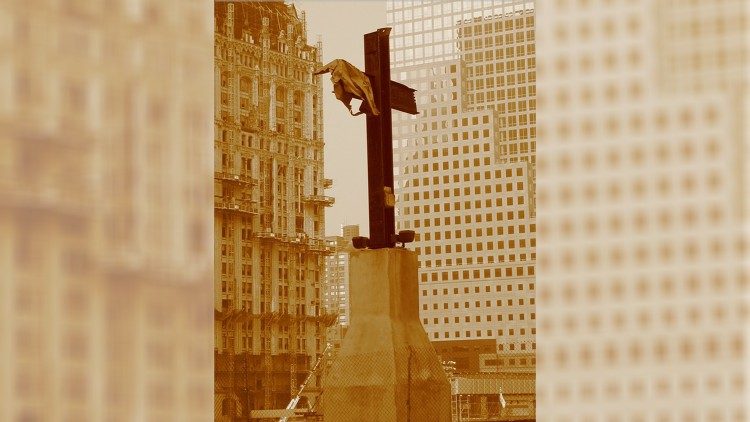
Ground Zero CrossGround Zero Cross 

The Popes and 9/11: Christ’s light in history’s darkest hour

Twenty-five years after the 9/11 attacks on the United States, we recall the words of successive Popes who have repeatedly appealed for peace and reconciliation, reminding us that even in the face of unspeakable horror, evil and death do not have the final word.

By Isabella Piro

On September 11, 2001, the United States had just been struck by four suicide attacks that claimed nearly 3,000 lives in different parts of the country.

Pope John Paul II was at Castel Gandolfo when he received a telephone call from the Director of the Holy See Press Office, JoaquĆ­n Navarro-Valls, informing him of what had happened. Deeply shaken, the Pope immediately withdraws to pray in the private chapel of the Apostolic Palace.

He then sent a telegram expressing his condolences and closeness to US President George W. Bush.

It consisted of six lines written in block capitals—the style of official communications—but Pope John Paul II’s words are profoundly human and express the grief of the entire world. He speaks of “unspeakable horror,” describes the terrorist attacks as “inhuman,” and calls it a “dark and tragic moment” in history.

An affront to human dignity

The following day was Wednesday, and the General Audience was held in St Peter’s Square. At the request of the Bishop of Rome, there was no applause, and the faithful remained in solemn silence.

“Yesterday was a dark day in the history of humanity, a terrible affront to human dignity,” John Paul II said, before voicing the question in everyone’s heart: “How is it possible to commit acts of such savage cruelty?”

The answer to such cruelty, he continued, lies in Christ, the foundation of hope, who ensures that evil and death do not have the final word.


John Paul II in prayer

Not revenge, but unity and dialogue

Meanwhile, the 180th Ordinary General Chapter of the Order of Saint Augustine was taking place in Rome. Among those attending was the American priest Father Robert Francis Prevost, the future Pope Leo XIV, who was elected Prior General on September 14, his birthday.

It therefore fell to him to preside over the closing Mass on September 21 in the Church of Santa Maria del Popolo.

“We cannot fail to remember the tragic events that shook the United States on September 11,” he said in his homily. “The violence that the world witnessed last week in the United States is a tragic expression of a series of problems that are becoming increasingly acute everywhere. Hatred and violence will continue to grow as long as so many people are forced to live in extreme poverty and are oppressed by so many forms of injustice.”

“While many seek revenge,” he concluded, “Augustinians must bear witness to the Gospel and to its values of unity, dialogue, peace, and reconciliation.”

Savagery of terrorism overcome by love

A year later, Pope John Paul II continued to make tireless appeals for peace.

On Wednesday, September 11, 2002, during the General Audience, the Pope recalled the “savage attack” of twelve months earlier, the collapse of the Twin Towers, and the lives of so many innocent people swallowed by the rubble.

He firmly reiterated that terrorism “is and will always be a manifestation of inhuman ferocity” and that oppression, armed violence and war are choices that sow and produce only hatred and death.

“Reason and love,” he concluded, “are the only valid means for overcoming and resolving disputes between individuals and peoples.”

Courage to work for peace

The peace invoked by Pope John Paul II found renewed expression in the prayer of his successor, Pope Benedict XVI.

On April 20, 2008, during his Apostolic Journey to the United States, Pope Benedict visited Ground Zero.

Where the Twin Towers once stood, there was a deep void, almost a metaphor for the abyss of evil. Yet all around it is a construction site—a symbol of hope being reborn and rebuilding what was destroyed.

In silence, the Pope lit a candle in memory of the victims. He then knelt and asked God to bring peace to a violent world and to grant humanity the wisdom and courage to work tirelessly for a world in which genuine peace and love reign among nations and in every human heart.


Pope Benedict XVI prays at Ground Zero

Every human life is precious

Three years later, on September 11, 2011, the tenth anniversary of the terrorist attacks, Pope Benedict XVI sent a letter to the President of the United States Conference of Catholic Bishops, Archbishop Timothy Dolan of New York, who would be created a Cardinal the following February.

Recalling the “brutal assault” of ten years earlier, Pope Benedict described it as a tragedy made even more grave by the perpetrators’ claim that they were acting in God’s name.

He firmly stressed that no circumstances can ever justify acts of terrorism. Every human life, he said, is precious in God’s sight, and no effort should be spared in promoting genuine respect throughout the world for the inalienable rights and dignity of every individual and people.

A palpable grief that cries out to heaven

Pope Francis also visited Ground Zero, which has since become a memorial consisting of two large pools of flowing water, each occupying the footprint of one of the Twin Towers.

The names of the 2,974 victims, representing 90 different nationalities, are inscribed along their edges.

During an interreligious meeting held there on September 25, 2015, Pope Francis described the 9/11 attacks as “a senseless act of destruction” and spoke of a palpable, searing grief that left people stunned and cries out to heaven.

The water flowing through the pools, he said, recalls all those lives that fell victim to people who believed destruction was the only way to resolve conflicts.

Yet the logic of violence, hatred, and revenge can produce only pain, suffering, destruction, and tears. Life, he said, is destined to triumph over the prophets of destruction and death, just as reconciliation and unity will triumph over hatred and division.

“Let us implore from on high the gift of commitment to the cause of peace,” the Bishop of Rome concluded. “Peace throughout this world which God has given us as the home of all and a home for all. Simply peace.”

Pope Francis pays tribute to the victims of the attacks at Ground Zero on September 25, 2015

Never again against one another!

When it comes to peace, “we cannot be indifferent or neutral,” Pope Francis said again on September 11, 2021.

The occasion was the G20 Interfaith Forum in Bologna, held under the theme “Time to Heal: Peace among Cultures, Understanding between Religions.”

In a message to participants, the Pope once again insisted: “Not neutral, but taking a stand for peace! Let us invoke the ius pacis—the right of everyone to resolve conflicts without violence.”

“No more war, no more against others, no more without others!” he concluded, because ultimately “young people and history will judge us on this.”

Wednesday, July 22, 2026

The evolution of Just War Doctrine from Pius XII to Leo XIV

 THE JUST WAR AND THE RECENT POPES


The Catholic Church now completely rejects “just war” theory, declaring all armed conflict outdated in favor of disarmed diplomacy.


AI-generated illustration depicting six recent popes above St. Peter’s Basilica in Vatican City.

The category of the “just war”—born with Augustine, systematized by Aquinas—was, for centuries, the Christian conscience’s attempt to subject violence to moral criteria.

The magisterium of the recent popes has progressively eroded its ground, down to Leo XIV’s explicit move beyond it.

The turn begins in the atomic era. Pius XII restricted the licit recourse to arms to defense alone. As early as 1944, in his Christmas radio message, in fact, he had declared “now out of date” the theory of war as “an apt and proportionate means of solving international conflicts.” It was “out of date” in Pius XII and “outdated” in Leo XIV: the same word nearly eighty years apart.

John XXIII, in “Pacem in Terris” (1963), declared it alienum a ratione—foreign to reason—to imagine that, in the nuclear age, war could serve as an instrument of justice.

The Council, in “Gaudium et Spes,” called for war to be evaluated “with an entirely new attitude” and condemned total war as a crime against God and against man himself.

John Paul II carried this line down into history: his “never again war” rang out against the Gulf War and, later, against the intervention in Iraq, while “Centesimus Annus” had already called war a “self-destruction of mankind.”

Benedict XVI, more sober in tone, had staked out the position while still a cardinal: asked about the war in Iraq (in an interview with Zenit, on May 2, 2003), he observed that modern weapons strike far beyond combatants, and that therefore “today we should be asking ourselves if it is still licit to admit the very existence of a ‘just war.”

With Francis, the doubt becomes a verdict. In “Fratelli Tutti” (No. 258), he writes that it is “very difficult” to invoke rational criteria elaborated in other centuries to speak of a possible “just war,” and he closes with an imperative: “Never again war!”

From “Pacem in Terris” to “Magnifica Humanitas,” the Church has never ceased to recognize the right to self-defense; it has ceased to lend war the comfort of an adjective.

In a footnote, he adds that Augustine “forged a concept of ‘just war’ that we no longer uphold.”

This is not merely the diagnosis of a “world war fought piecemeal”; it is doctrinal development: at Hiroshima, in 2019, he declared immoral not only the use but the very possession of nuclear weapons.

And to Patriarch Kirill, in March of 2022, with Ukraine under invasion, he said that one can no longer speak, as was once done, of “holy war” or “just war.”

Leo XIV takes a further step. In the encyclical “Magnifica Humanitas,” he denounces a “paradigm shift”: the rehabilitation of war as an ordinary instrument of international politics, even as the ethical principles that once limited its use erode.

In this context, he writes, “without prejudice to the right to legitimate defense in the strictest sense,” that the theory of the just war, “too often used to justify any kind of war,” is “now outdated.”  Humanity has more effective instruments at its disposal: dialogue, diplomacy, forgiveness.

And he extends the argument to the newest frontier—artificial intelligence applied to weapons, which removes the lethal decision from the reach of conscience. His programmatic formula, proclaimed from the loggia on the day of his election, is a peace that is “disarmed and disarming.”

Not a rupture but maturation: Tradition deepening its self-understanding. From “Pacem in Terris” to “Magnifica Humanitas,” the Church has never ceased to recognize the right to self-defense; it has ceased to lend war the comfort of an adjective.

Monday, June 1, 2026

From Anglican Nuns to Catholic Nuns


These Catholic nuns were once Anglican sisters!


Matthew Green 

After years of spiritual discernment, a traditional Anglican monastic community made the bold decision to enter full communion with the Catholic Church.

The Sisters of the Blessed Virgin Mary look like any other Catholic nuns. They follow the rule of St. Benedict, they wear black and white habits, and they’re very devoted to the Virgin Mary. A rosary is part of their habit. But these nuns are extraordinary, because they were all previously Anglican nuns, who entered the Catholic Church in 2013! Now, they are the only monastic community in the Personal Ordinariate of Our Lady of Walsingham.

Anglican nuns?

The first comment that might come to mind is, “I didn’t even know the Anglicans had nuns!” Indeed, when the Church of England first separated from the Catholic Church in the 16th century, monasticism was practically wiped out in the Church of England. King Henry VIII dissolved the convents and monasteries and seized their properties.

Then came the Oxford Movement within the Anglican Communion in the 19th century. It emphasized and restored aspects of spirituality, theology, and worship that the Church of England has in common with the Catholic Church, such as monasticism. It also gave us St. John Henry Newman, perhaps the most famous convert from Anglicanism to Catholicism in recent centuries.

It was during the resulting revival of Anglican monasticism that William John Butler — a young Anglican vicar in Wantage, England — founded the Anglican Community of St. Mary the Virgin in 1848. Their rule was based on that of St. Augustine.

The community grew over the years and dedicated itself to various good works, from schools to homes for young mothers or the elderly, and for people recovering from addictions. More recently, in the late 20th century, they gradually shifted from institutional work to “more individual ministries” in hospitals, parishes, and schools, as well as spiritual direction.

Feeling called to Roman Catholicism

In a lengthy testimony on the now-Catholic nuns’ website, Mother Winsome SBVM explains why she and a number of her religious sisters decided to move to Catholicism.


Recent photo of five of the Sisters of the Blessed Virgin Mary. Mother Winsome is in the center of the front row.


Mother Winsome explains that the sisters had “reached the point where the community needed to be reformed at a deep spiritual level.” She was elected Mother Superior in 2006 and found that some sisters “were in danger of losing their monastic vocation replacing it with a notion of a loose association of well-meaning women doing good works.” But that, she points out, is not monastic consecrated life.

During the efforts she and other sisters made to reclaim spiritual ground, they ran into obstacles derived from the structure and nature of the Church of England as a whole. They started to feel the need for the guidance of the Vicar of Christ and the Magisterium, instead of an elected synod.

Benedict XVI opens the door

Pope Benedict XVI was well aware that, due in great part to the theological evolution of the Anglican Communion and the Church of England in particular, significant numbers of Anglicans were interested in becoming Catholics.

Recognizing this pastoral need, and the valuable spiritual inheritance they already carried, in 2009 Benedict XVI published Anglicanorum Coetibus. This document provided a solution: the Personal Ordinariates for former Anglicans (which would come into being two years later). These structures allow Anglicans to enter full communion with Rome while bringing with them aspects of their Anglican liturgical and spiritual heritage.

At this point, Mother Winsome says, some of the sisters approached her in private to tell her that they felt called to accept this invitation from Rome. They proposed joining the Personal Ordinariate of Our Lady of Walsingham. Some specifically cited Cardinal John Henry Newman as an inspiration for taking this step.

Initially, they had no intention of leaving the Community of Saint Mary the Virgin. Many of the sisters had independently expressed feeling the same call, “as part of a community,” while also sensing the call to remain together. And in fact, the Ordinariate was prepared to receive religious in groups. They hoped that the nuns who wanted to become Catholics could do so and remain alongside their Anglican sisters.

This proposal was approved by the whole community, and they began a period of “spiritual exploration” and discernment under the guidance of representatives of the Catholic Church and the Ordinariate in particular. In the end, eleven discerned that they “were being called into the full communion of the Catholic Church.” They also realized they felt called to follow the Rule of Saint Benedict.

Finding a new home

Unsurprisingly, not everyone was happy with their decision. The nuns’ superiors in the Church of England were not supportive. The sisters who wanted to become Catholic would have to find a new physical home and start a new community.

God does not abandon those who entrust themselves to him, and the Catholic Benedictine community of St. Cecilia’s Abbey, Ryde, on the Isle of Wight, opened its doors to them. They had 12 empty rooms they had been preparing for nuns from Paraguay who were supposed to arrive for a year of formation. However, those plans had fallen through.

As it happened, the 11 nuns from the Community of St. Mary the Virgin had been joined by another sister from another community, so there were 12 of them as well. As Mother Winsome observed, “Twelve empty cells, twelve sisters!” It was a providential opportunity, and everyone involved agreed they would take it.

Catholic at last

The twelve nuns were received in the Catholic Church on January 1, 2013. It had taken four years, and they had faced misunderstanding and painful opposition on the part of many of their Anglican brothers and sisters, but it was worth the cost. “It seems to me that each of us was given a very special gift of healing grace, so that we could experience true joy as we were received at last into the full communion of the Catholic Church,” Sister Winsome writes.

In another sign of God’s providence, the ferry they took to reach the abbey on the Isle of Wight turned out to be named “St. Cecilia.”  “Welcome home” were the first words they heard from a sister of St. Cecilia’s abbey.


Eventually, they would become a new Catholic community, the Sisters of the Blessed Virgin Mary. They also found a permanent home of their own at Aston Hall in Aston-by-Stone, Staffordshire. It’s a building with important Catholic ties to two English saints, including St. John Henry Newman. They are the only monastic community in the Ordinariate of Our Lady of Walsingham. 

“We know that we are now in communion with the See of Peter, with all the saints that we love. When the conclave was electing Pope Francis I, we were not on the outside looking in; they were electing OUR Pope, OUR Holy Father. We are now truly part of the Church,” Mother Winsome says, full of joy.