Showing posts with label Lithuania. Show all posts

Monday, January 12, 2026

Archbishop Ganswein is praying for the cause for Pope Benedict XIV toward Sainthood


Gänswein says he prays to Benedict XVI, confirms hope for beatification cause

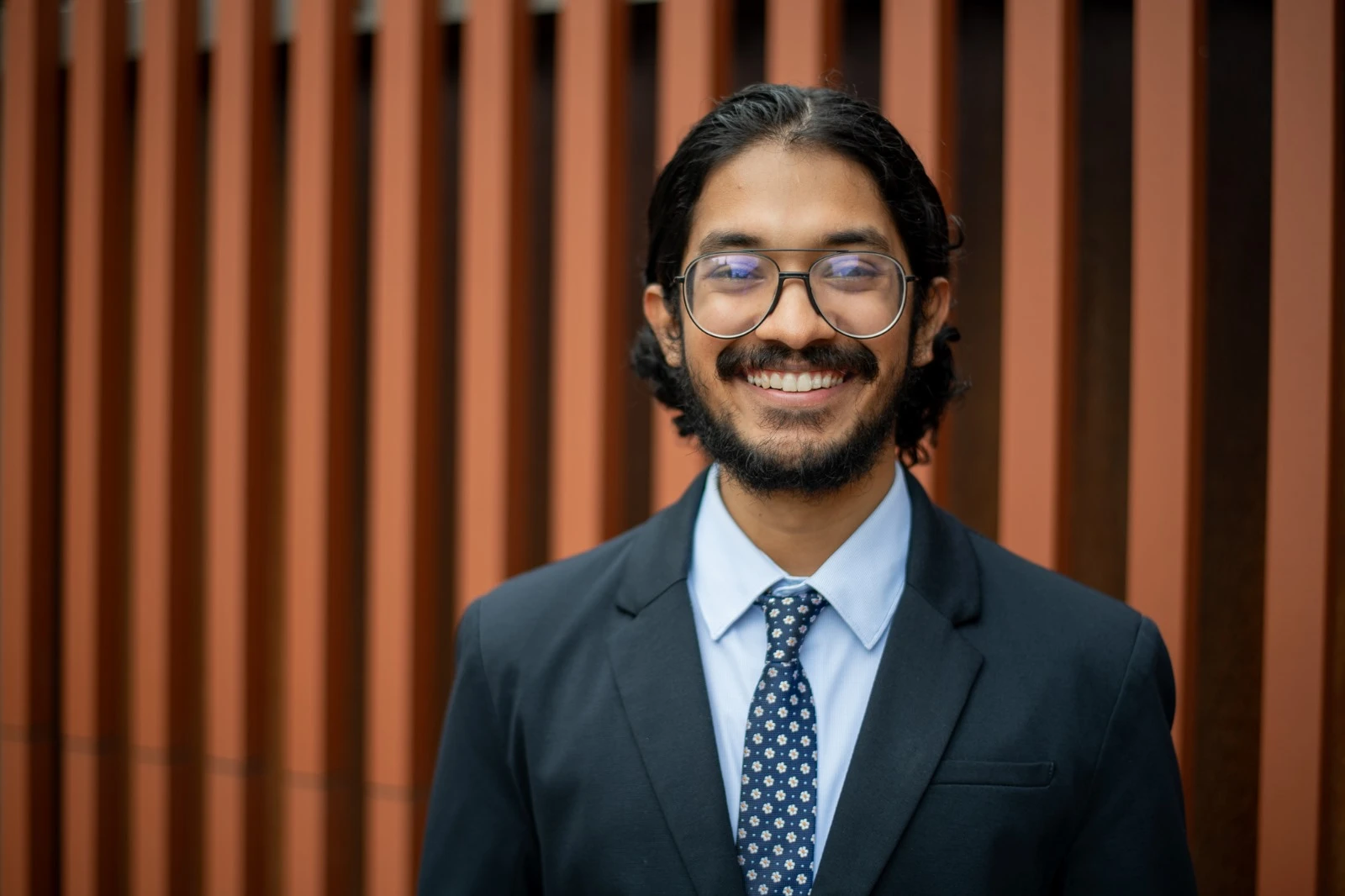


Archbishop Georg Gänswein speaks at an event hosted by the Catholic magazine Kelionė at the Lithuanian 


Archbishop Georg Gänswein, the apostolic nuncio to the Baltic states and longtime personal secretary to Pope Benedict XVI, said he now prays not for but to the late pontiff, asking for his intercession, and expressed hope the beatification cause will open soon.

Speaking at an event hosted by the Catholic magazine Kelionė at the Lithuanian National Library on Jan. 7, Gänswein offered personal reflections on his new diplomatic mission, the celebration of Christmas in Lithuania, and his decades-long collaboration with Joseph Ratzinger.

“I come from the most beautiful part of Germany, but I have lived in Rome for most of my life,” Gänswein said.

“As a bonus and thanks for all my work, I received an assignment to work in the Baltic states,” he said jovially.

Asked about differences between Christmas in Rome and in the Baltic region, the archbishop answered with characteristic humor: “I celebrated Christmas in Rome for 28 years, and in Vilnius for two. The first difference is the cold.” He added that Lithuania’s seasonal displays left a strong impression, drawing attention to “very beautiful Christmas decorations” and saying the Christmas trees “are very beautiful, maybe even more beautiful than in St. Peter’s Square, in the Vatican.”

Gänswein also expressed gratitude that the celebration of Christ’s birth in Lithuania is not merely cultural or superficial. He said he has sensed a reverence in which “its depth is felt here,” pointing to a faith that remains attentive to the mystery at the heart of the season.

During the conversation, the nuncio returned to the influence of Benedict XVI, describing his years beside Ratzinger as a gift of divine providence.

“All the years of cooperation together have left an indelible experience,” he said. “It was not only intellectual and theological formation but also formation of the heart, soul, and everything that we can call life.”

Gänswein recalled to the audience that his first encounter with Ratzinger came when he was still a young seminarian, reading the future pope’s articles and books while Ratzinger was a professor in Germany. “I tried to read and study all of his writings,” he said, explaining that he came to see Ratzinger not only as a theologian and academic but also as “a man full of faith and intelligence.”

After his priestly ordination in 1984, Gänswein served as an assistant parish priest before continuing his studies. He later completed doctoral work and eventually arrived in Rome, where he first met Ratzinger while the cardinal was serving as prefect of the then-Congregation for the Doctrine of the Faith. Gänswein said Ratzinger invited him into collaboration, an invitation he regarded as mysterious and grace filled.

“What did he call me for? I don’t know,” he said, “but I see it as a great gift of Providence.” In 2003, he added, he became Ratzinger’s personal secretary.

Speaking of Benedict XVI after the late pope’s death, Gänswein made a striking remark about prayer and spiritual closeness: “And now, when Pope Benedict XVI has departed to be with the Lord, I notice that I do not pray so much for him, but to him, asking for his help.” He said there were moments, including during his service in the Baltics, when he found himself asking for Benedict’s intercession.

At the same time, he stressed the Church’s caution regarding sainthood causes. “The Church is a very wise and very prudent mother,” he said, noting that in beatification causes she is “twice wise and twice prudent” and that time must pass to discern whether public esteem reflects genuine holiness rather than passing fame.

In a December 2025 interview with German Catholic television network K-TV, Gänswein said: “Personally, I have great hopes that this process will be opened.” The interview aired shortly before a private audience he held with Pope Leo XIV during a discreet mid-December visit to Rome.

The Kelionė gathering also featured talks from other invited speakers.

For Gänswein, however, the evening’s most enduring note returned to what he called the quiet, lifelong schooling he received at Benedict’s side, a formation not only of the mind but also of the whole person and the conviction that gratitude, faith, and truth are never merely ideas but realities meant to be lived.

Saturday, February 26, 2022

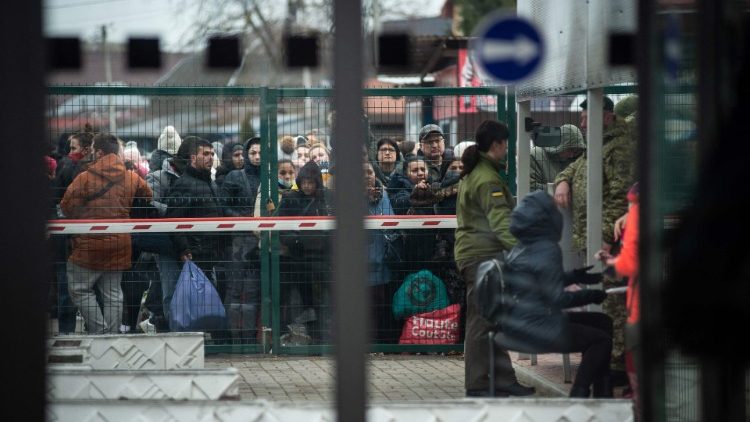
Tiny Lithuania, a possible future Putin target, welcomes Ukranian refugees


Ukrainians wait at the Slovak-Ukrainian border crossing in Velke Slemence, SlovakiaUkrainians wait at the Slovak-Ukrainian border crossing in Velke Slemence, Slovakia  (AFP or licensors)

Archbishop Grušas: Lithuania prepares to welcome Ukraine refugees

Lithuanian Archbishop Gintaras Grušas, President of the Council of European Bishop's Conferences, describes the Bishops response to the military activity in Ukraine, as well as the positive response from the people of Lithuania who prepare to welcome thousands of refugees.

By Francesca Merlo

Archbishop Gintaras Grušas, President of the Council of European Bishop's Conferences describes how “disheartened” he and his fellow bishops were when they heard of the beginning of the military actions in Ukraine. We are “joining in prayers for the people of Ukraine, for the Church in Urkaine, and we are calling for the cessation of military action”, he says.

Prayers for peace

Speaking to Vatican News’ Antonella Palermo, Archbishop Grušas of the Lithuanian Capital, Vilnius, stresses that the Bishops, and the people of Lithuania, are joining the Holy Father “in the call to prayer and fasting”, and are asking all Catholics, Christians, and people of good will to join, too, in this prayer for peace. The Holy Father has called for Wednesday 2 March to be a day of prayer and fasting for Ukraine who has been under military attack from Russia since Thursday.


Welcoming refugees

Archbishop Grušas went on to note that in Lithuaia, “we have already begun to receive refugees” and adds that this “lands nicely with the  theme of our meeting here in Florence”, Italy. Archbishop Grušas is in Florence, Italy, where he is currently attending a meeting of Bishops and Mayors of some of the cities most affected by the migratory crisis of the Mediterranean Sea. With that in mind, Archbishop Grušas continued noting that like in the Tuscan capital, “the Church and the mayors of various cities in Lithuania are working together to accommodate the influx of refugees”.

Possible numbers

He noted that although the greates number of refugees are likely to reach Poland, which sits at the border with Ukraine, many of the Ukrainin nationals already living in Lithuania have started accommodating friends and relatives who have begun to flee from Ukraine.

Just before leaving Lithuania for the meeting in Italy, the anticipated numbers of possible refugees arriving in Lithuania were low, aound 20, 25, 50, says Archbishop Grušas. “Now they’re talking about 100,00 people”. So we are trying to prepare for this as best we can, he added, noting that the people of Lithuania have already organised “various actions for support”, including a demonstration that saw the participation of around 10,000 people. “Like them”, concluded the Archbishop, we are “calling for an end to the war, and the reestablishment of peace”.

Tuesday, September 25, 2018

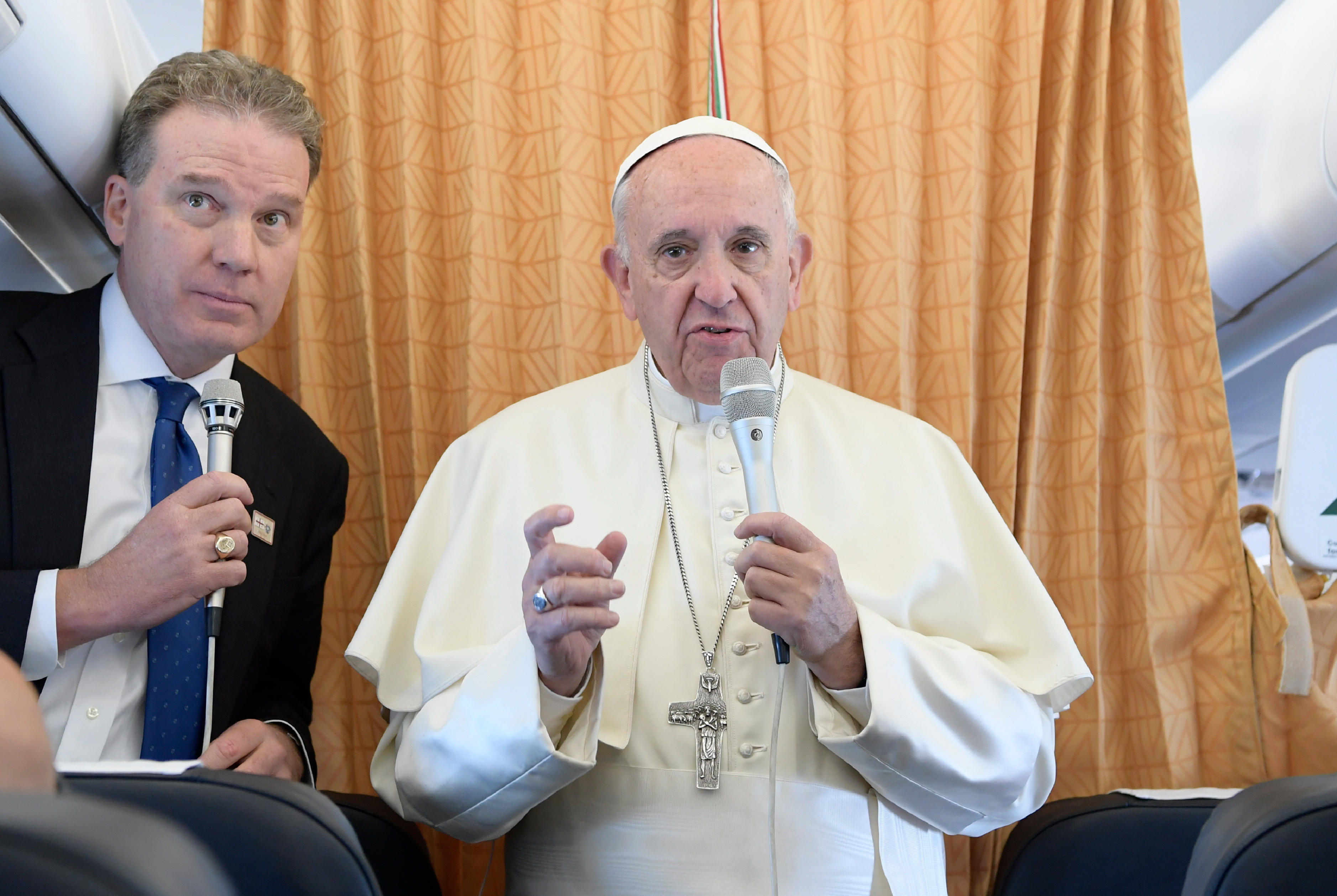
In flight press conference by Pope Francis; always enlightening


papal flight - press conference -Copyright: Vatican Media

During In-Flight Press Conference from Baltic States, Pope Says Whenever There Was a Sentence, I Never Gave a Pardon

Defends Church’s Reaction to Crisis, Stressing Recently It Has ‘Spared No Efforts’

Whenever there was a sentence, I never gave a pardon or reprieve…
Pope Francis during his return flight from his 25th Apostolic Visit to the Baltic States, Sept. 22-25, 2018, made this definitive statement when asked about the abuse scandals in the Church. Zenit was aboard the papal flight, covering his four-day trip to Lithuania, Latvia and Estonia.
While during his aboard press conference he initially reminded journalists that the questions ought to be related to the trip, he also touched on other topics later on, such as the report published today in China and the abuses.
The Pope stressed that the Church, while having certainly made its mistakes, has been “sparing no effort” to work to combat the abuses and cover-ups.
The Pope acknowledged that the abuses are “monstrous” and reaffirmed his commitment to zero-tolerance. To illustrate that the Church has effectively dedicated itself to combatting the crisis, the Pontiff pointed out that the actual number of cases “has diminished because the Church has realized that it must fight in a different way.”
The Pontiff lamented that in the past, particularly the last century, there was cover up due to shame.
“The Church,” Francis noted, “has become aware of this and has spared no effort” to combat it recently, he suggested.
“Even if it’s one single priest who abuses a child,” the Pontiff noted, “this is monstrous, because that man was chosen by God to lead the child to Heaven.”
“Never, never, did I sign a request for a pardon after a sentence has been made,” the Pontiff emphasized when responding about sex abuse, despite his initial insistence to keep the press conference questions on the topic of the trip, rather than to deviate to other themes.
“There is no negotiating on that,” he underscored.
Regarding the China-Holy See Agreement published Saturday, Sept. 22, 2018, and the accusation of Cardinal Joseph Zen, Archbishop Emeritus of Hong Kong, that you have ‘sold out the Church to the Chinese government,” the Pope stressed this decision was not an improvisation, but something that has been long in the making.
“It is I who signed the agreement,” said Francis, “I’m in charge. The others have worked for ten years. It’s not an improvisation. It’s a journey.”
The Holy Father reminded the journalists before him of the roles of President Emeritus of the Pontifical Council for Social Communications, Archbishop Claudio Maria Celli; Vatican Secretary of State Cardinal Parolin; and Roman Curia official, Father Rota Graziosi.
The Holy Father told the press that Cardinal Parolin “studies all of the documents down to the period, comma, notes,” and that this “gives me a great assurance.”
“You know that when you make a peace agreement or a negotiation, both sides lose something,”the Holy Father stated, expressing that it is normal to make little steps back and forth, in order to move forward.
The Holy Father reflected substantially on the trip and his observations, denouncing ‘hate for religion’ and communism.
“I am aware that the situation of the three Baltic countries is always in danger, the fear of invasion, because history itself reminds you of this. And you are right to say that it is not easy, but it is a game to be played every day, with culture, with dialogue. All of us are obliged to help you and be close to you with the heart.”
Another journalist recalled the Pope’s insistence during the trip that the Baltic Countries retain their roots and identity, but recognizing the vast number from those nations that emigrate abroad, he asked what can be done to help them.
“What can be done to defend it?” the Pope reflected, answering: “The memory of the roots, this is important and must be transmitted. Identity is part of belonging to a people and that belonging to a people must be passed on, the roots must be passed on to the new generations, through education and dialogue, especially between the elderly and the young. And you must do so because your identity is a treasure.”
He praised grandparents for their intricate role, in transmitting the faith, noting they are responsible for transmitting the faith. The Holy Father also lamented in his remarks about the persecution in Lithuania. Discussing the cruelty of the past, and how this remains current, the Pontiff decried terrorism, persecutions, and the death penalty. He also pointed out that when euthanasia is administered, that is “a modern-day death penalty.”


Sunday, September 23, 2018

While Pope visits Lithuania a look at the inspirational Hill of Crosses

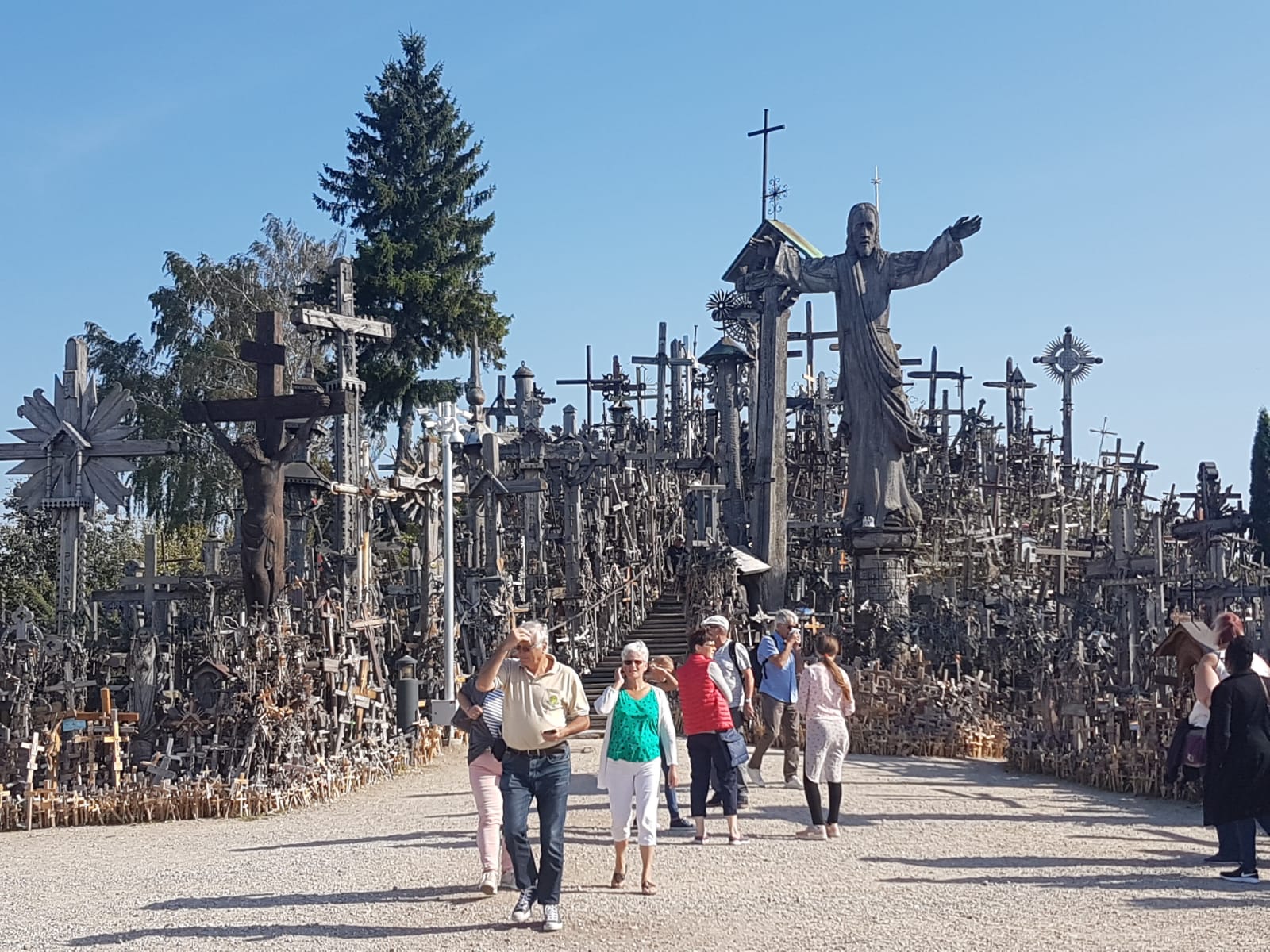
LITHUANIAN SPECIAL: The Hill of Crosses: Not Only Holy Place, But Symbolizes Struggle to Keep the Faith Alive When Was Under Communism

‘Religious freedom, like all other freedoms, must be respected and protected’

To be called a “hill” in Lithuania, it needs to be just a few feet tall, since the landscape, woods and meadows are flat as far as the eye can see. The location of the Hill of the Crosses is not far from the northern Lithuanian city of Siauliai. Someone traveling to Lithuania that wants to understand the country, cannot miss going to the Hill of Crosses.
And indeed “many people, may pilgrims, come here from all over the world to experience the holiness of the place, many pilgrims! From Poland, Spain, Italy, even from Asia,” says Father Andrius Dobrovolska, a priest involved in its history since the visit of Pope St. John Paul II.
The reason for the name is soon told: today, the crosses piled on this little hill, they say, are about 100,000, even if they are unable to count those that had been removed numerous times during Communism and the replaced, little by little, time and time again.
Numbers aside, it is the story that counts, even if the beginnings are rather obscure. Perhaps a votive offering for a miraculous recovery was the first ‘cross’ planted here. Soon the crosses became tens, hundreds, until, after the end of the Second World War, Lithuania fell under atheistic Soviet Communist control.
“The Hill of Crosses is from one point of view a holy place, and on the other, a symbolic place, representing the struggle of the Lithuanians during the Communist period, to keep their faith alive. It became a kind of battlefield because the Communists were constantly trying to destroy it, to break down the crosses, but the people put it back at night. That’s why it’s a symbol of the struggle for independence.”
At least four times, the Communists removed all the crosses, but each time after, there was a new flowering of crosses. The people were not deterred. When the long-awaited independence brought with it religious freedom, the Polish Pope John Paul II decided that such a tenacious faith deserved the Pope’s homage, with a historic visit, dated September 1993; and the photos of the Polish Pope walking among those thousands of crosses have made the story of that extraordinary pontificate too.
“John Paul II came here, he celebrated mass, it was autumn like now, but it was very cold, so he thought it would be nice to have a place for the pilgrims, so that they would have some shelter, even in the case of cold, rain …” recalled Father Andrius.
Hence the request to the Franciscans, to found the convent which now stands next to the hill, where Father Andrius lives together with two other Franciscans, who are busy welcoming hundreds of visitors every day. The story tells that the idea of ​​the convent came to the traveler Pope just a week later, visiting the Sanctuary of La Verna, in Italy.
“The stigmata are the symbol of the cross,” Father Andrius explains, “so St. John Paul II clearly thought that there was a relationship between these two places, because this is the hill of crosses, and La Verna as it is known is the place where St. Francis received the stigmata.”
Then with the passing of the years, the other installations arrived like parking lots, toilets, souvenir shops, since there is now no tourist guide that does not recommend a visit here. Among other things, with many of the crosses being artistically of value, the Hill is also a UNESCO World Heritage Site. But above all they remind those who arrive here were also by chance, believer and Christian or not, a great truth. A tourist says so simply: “religious freedom, like all other freedoms, must be respected and protected.”


Sunday morning Mass and Sunday Angelus from Kaunas, Lithuania

Pope in Kaunas - Vatican Media Photo

FROM KAUNAS: ‘Jesus Christ Is Our One Hope,’ Pope Reminds During Last Mass in Lithuania

In Kaunas, Prays for Victims of Jewish Persecution and Decries Even Any ‘Wiff’ of Anti-Semitism

Jesus Christ is our one hope.
Pope Francis stressed this to faithful during his homily in Kaunas, Lithuania’s second largest city, today, Sept. 23, during his second full day in the country, during his 25th Apostolic Visit to Lithuania, Latvia and Estonia.
In his homily, the Pope reflected on how Saint Mark devotes an entire section of his Gospel to the instruction of the Lord’s disciples. It would seem, he said, that Jesus, at the halfway point of his journey to Jerusalem, wanted them to renew their choice to follow him, knowing that it would entail moments of trial and grief.
“The Christian life always involves experiences of the cross,” Pope Francis said, reflecting: “at times they can seem interminable.”
“Earlier generations,” the Holy Father acknowledged, “still bear the scars of the period of the occupation, anguish at those who were deported, uncertainty about those who never returned, shame for those who were informers and traitors. The Book of Wisdom speaks to us of the just who are persecuted, who suffer insult and punishment solely for their goodness.”
The Pope asked: “How many of you can identify at first hand, or in the history of some family member, with that passage which we just read? How many of you have also felt your faith shaken because God did not appear to take your side? Because the fact of your remaining faithful was not enough for him to intervene in your history?”
Kaunas, the Pope said, knows about this, and Lithuania as a whole, can testify to it, “still shuddering at the mention of Siberia, or the ghettos of Vilnius and Kaunas, among others.”
The disciples did not want Jesus to speak to them of sorrows and the cross, the Successor of Peter said, noting “they wanted nothing to do with trials and hardships.”
Jesus, knowing what the disciples were discussing–the Jesuit Pope pointed out–provided them with an antidote to their struggles for power and their rejection of sacrifice. To make His teaching all the more solemn, he sat down, “as a teacher would, summoned them and set a child in their midst; the kind of child that would earn a penny for doing chores no one else would care to do.”
“Whom would Jesus place in our midst today, here, on this Sunday morning? Who will be the smallest, the poorest in our midst, whom we should welcome a hundred years after our independence? Who is it that has nothing to give us, to make our effort and our sacrifices worthwhile?”
Perhaps, he said, it is the ethnic minorities of our city, or the jobless who have to emigrate. May be it is the elderly and the lonely, or those young people who find no meaning in life because they have lost their roots.
“In their midst” means at the same distance from everybody, so that no one can claim not to notice, no one can argue that it is “somebody else’s responsibility” because “I didn’t see him”, or “I am further away”.
The Pope reminded “what it means to be a Church on the move,” namely being “unafraid to go out and get involved, even when it might seem that we pour ourselves out, lose ourselves, in going forth to the weak, the neglected, those dwelling at the margins of life.”
Yet also knowing that to go forth also means to halt at times, to set aside our worries and cares, and to notice, to listen to and to accompany those left on the roadside.
That is why we are here today, he said, noting: “We want to welcome Jesus, in his word, in the Eucharist, in his little ones.”
“For this reason, and because as a community we feel true and profound solidarity with all humanity – here in this city and throughout Lithuania – and its history , we wish to spend our lives in joyful service, and thus to make known to all that Jesus Christ is our one hope.”
Angelus
After the Mass, the Pope recited his Sunday Angelus address.
“Here in Lithuania,” he recalled, “you have a hill of crosses, where thousands of people, over the centuries, have planted the sign of the cross. I ask you, as we now pray the Angelus, to beg Mary to help us all to plant our own cross, the cross of our service and commitment to the needs of others, on that hill where the poor dwell, where care and concern are needed for the outcast and for minorities.”
“In this way,” he continued, “we can keep far from our lives and our cultures the possibility of destroying one another, of marginalizing, of continuing to discard whatever we find troublesome or uncomfortable.”
The Pope also recalled that 75 years ago, Lithuania witnessed the final destruction of the Vilnius Ghetto. Recalling that this was the climax of the killing of thousands of Jews that had started two years earlier, Francis reminded those before him that in the Book of Wisdom, the Jewish people suffered insults and cruel punishments.
“Let us think back on those times, and ask the Lord to give us the gift of discernment to detect in time any recrudescence of that pernicious attitude, any whiff of it that can taint the heart of generations that did not experience those times and can sometimes be taken in by such siren songs.”
Saying he wished to dedicate a special thought in these days to the Jewish community, he noted that this afternoon, he will pray before the Monument to the Victims of the Ghetto in Vilnius, on the 75th anniversary of its destruction.
“May the Most High bless dialogue and the shared commitment for justice and peace,” he said.
Pope Francis also concluded thanking the president, authorities, bishops and organizers for all their work for bringing his visit together.
***
On Zenit’s Webpage:

Saturday, September 22, 2018

Pope Francis addresses the youth of Lithuania

© Vatican Media

Pope Francis Encourages Lithuanian Youth

‘Don’t ever be afraid to put your trust in Jesus, to embrace his cause, the cause of the Gospel.’

Thousands of young Lithuanians gathers in the square in front of Vilnius Cathedral heard a message of hope and encouragement from Pope Francis on September 22, 2018. After hearing testimonies from two young people – Monica ad Jonas – the Holy Father had a clear and simple message for the crowd:
“Don’t ever be afraid to put your trust in Jesus, to embrace his cause, the cause of the Gospel.”
The Pope warned of the dangers of getting caught up in the things of the world and trying to do everyone on one’s own. But he reminded that even when things seem to be falling apart, God is there and there are those ready to rebuild.
“Like this Cathedral, you have times when you think you are falling apart, fires from which you think you can never rebuild,” Francis explained. “Think of all the times this Cathedral went up in flames and fell apart. Yet there were always people ready to start rebuilding; they refused to let themselves be overwhelmed by hardship: they never gave up. The freedom of your nation, too, was won by men and women who did not flinch before terror and misfortune.”
He continued by reminding the young people (and not so young in the crowd) that it is important to help others and they should not fear following Christ:
“Dear young people, following Christ is something worthwhile! Do not be afraid to take part in the revolution to which he invites us: the revolution of tenderness (cf. Evangelii Gaudium, 88).”

The Holy Father’s Full Address

Thank you, Monica and Jonas, for your witness. I listened to it as a friend, as if we were sitting close to one another in some bar, telling one another about our lives as we drink a beer or a girá after going to the jaunimo teatras.
But your lives are not a piece of theatre; they are real and concrete, like those of everyone else gathered here today in this beautiful square situated between two rivers. Perhaps all this helps us to think back on your stories and to find in them the footprint of God… for God is always passing through our lives.
Like this Cathedral, you have times when you think you are falling apart, fires from which you think you can never rebuild. Think of all the times this Cathedral went up in flames and fell apart. Yet there were always people ready to start rebuilding; they refused to let themselves be overwhelmed by hardship: they never gave up. The freedom of your nation, too, was won by men and women who did not flinch before terror and misfortune. Monica, your father’s life, his condition, and his death, and your illness, Jonas, could have been devastating for you. Yet here you are, sharing your experience, seeing it with the eyes of faith, and helping us to see that God gave you the grace to be strong, to lift yourselves up and to keep moving forward in life.
How was it that God’s grace was poured out on you?
It was through persons whose paths crossed your lives, good people who nourished you by their experience of faith. For you, Monica, your grandmother and your mother, and the Franciscan parish were like the confluence of these two rivers; just as the Vilna flows into the Neris, you let yourself be carried along by that current of grace. Because the Lord saves us by making us part of a people. No one can say, “I am saved on my own”. We are all interconnected, “networked”. God wanted to enter into this web of relationships and he draws us to himself in community; he gives to our lives the deepest sense of identity and belonging (cf. Gaudete et Exsultate, 6). Jonas, you too found in others, in your wife and in the promise that you made on your wedding day, the reason to keep going, to fight, to live.
So don’t let the world make you believe that it is better to do everything on your own. Don’t yield to the temptation of getting caught up in yourself, ending up selfish or superficial in the face of sorrow, difficulty or temporary success. Let us say once again, “Whatever happens to others happens to me”. Let us swim against the current of that individualism which isolates us, makes us egocentric and vain, concerned only for our image and our own well-being
Aim for holiness through your encounters and your fellowship with other people; be attentive to their needs (ibid., 146). Who we really are has to do with our being part of a people. Identity is not the product of a laboratory; it is not concocted in a test tube. Each one of us knows how beautiful it is to belong to a people, but also how demanding it is, and even, at times, painful. But that is the basis of our identity; we are not rootless.
The two of you also spoke about your experience in a choir, praying in the family, Mass, and catechism, and helping those in need. These are powerful weapons that the Lord gives us. Prayer and song keep us from getting caught up in this world alone: in your desire to know God you went out from yourselves and were able to see what was going on in your heart through God’s eyes (cf. ibid., 147). In embracing music, you became open to listening and the interior life; in this way, you developed sensitivity, and that always opens the way to discernment (cf. Instrumentum Laboris, Synod for Youth, 162). Prayer can certainly be an experience of “spiritual warfare”, but it is in prayer that we learn to listen to the Spirit, to discern the signs of the times and to find renewed strength for proclaiming the Gospel each day. How else could we fight the temptation to become discouraged by our frailties and our difficulties, and those of others, and by all the dreadful things that happen in our world? What would we do if prayer did not teach us to believe that everything depends on us, when we are alone and wrestling with adversity? As Saint Alberto Hurtado used to say, “Jesus and I are an absolute majority!” The encounter with Christ, with his word, with the Eucharist, reminds us that it makes no difference how strong the opponent is. It makes no difference whether Žalgiris Kaunas or Vilnius Rytas are in first place; what matters is not the result, but the fact that the Lord is at our side.
Both of you also found support in life through the experience of helping others. You realized that all around us there are people experiencing troubles even worse than our own. Monica, you told us about working with children with disabilities. Seeing the frailty of others gives us perspective; it helps us not to go through life licking own wounds. How many young people leave home for lack of opportunities, and how many are victims of depression, alcohol, and drugs! How many of the elderly are lonely, without anyone to share the present, and fearful that the past will return! You can respond to those challenges by your presence, by your encounter with others. Jesus invites us to step out of ourselves and to risk a face-to-face encounter with others. It is true that believing in Jesus can often demand taking a leap of blind faith, and this can be frightening. At other times, it can make us question ourselves, and force us to abandon our preconceptions. That can involve anguish and we can be tempted to discouragement. But stand firm! Following Jesus is a passionate adventure that gives meaning to our lives and makes us feel part of a community that encourages and accompanies us, and commits us to the service of others. Dear young people, following Christ is something worthwhile! Do not be afraid to take part in the revolution to which he invites us: the revolution of tenderness (cf. Evangelii Gaudium, 88).
If life were a theatre piece or a video game, it would be limited to a precise time, and have a beginning and an end, when the curtain falls or one team wins the game. But life measures time differently; it follows God’s heartbeat. Sometimes it passes quickly, while at other times it goes slowly. We are challenged to take new paths; things change. We grow indecisive mostly out of fear that the curtain will fall, or that the stopwatch will eliminate us from the game or prevent us from advancing. But life always involves moving forward, seeking the right way without being afraid to retrace our steps if we make a mistake. The most dangerous thing is to confuse the path with a maze that keeps us wandering in circles without ever making real progress. As young people, don’t let yourselves get trapped in a maze but follow a path that leads to the future.
Don’t ever be afraid to put your trust in Jesus, to embrace his cause, the cause of the Gospel. Because he never jumps off the ship of our life; he is always there at life’s crossroads. Even when our lives go up in flame, he is always there to rebuild them. Jesus gives us plenty of time, lots of room for failure. Nobody has to emigrate from him; he has a place for everyone. There are many people out there who want to capture your hearts. They want to sow weeds in your field, but if, in the end, we entrust our lives to the Lord, the good grain will always prevail.