Showing posts with label Latvia. Show all posts

Tuesday, September 25, 2018

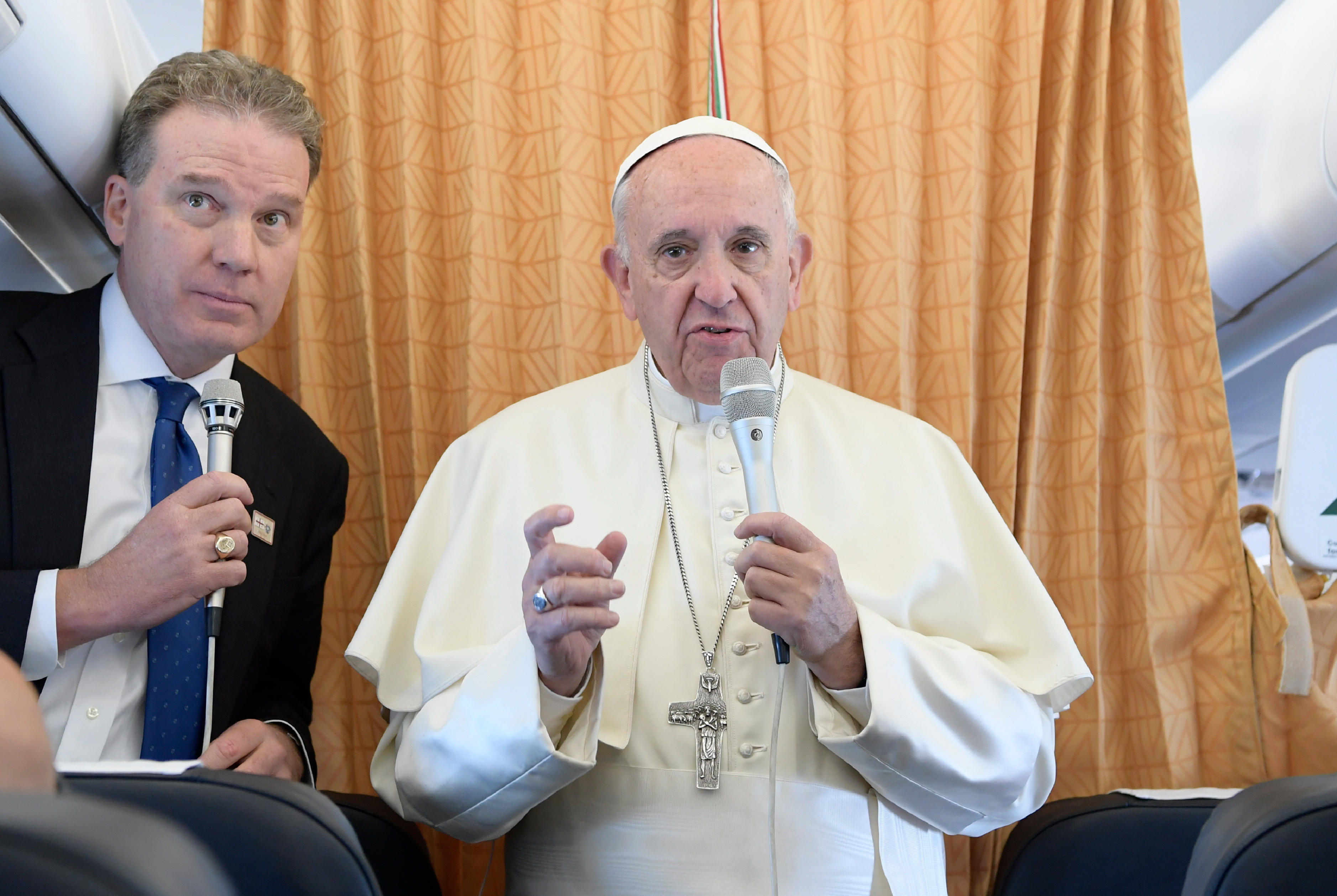
In flight press conference by Pope Francis; always enlightening


papal flight - press conference -Copyright: Vatican Media

During In-Flight Press Conference from Baltic States, Pope Says Whenever There Was a Sentence, I Never Gave a Pardon

Defends Church’s Reaction to Crisis, Stressing Recently It Has ‘Spared No Efforts’

Whenever there was a sentence, I never gave a pardon or reprieve…
Pope Francis during his return flight from his 25th Apostolic Visit to the Baltic States, Sept. 22-25, 2018, made this definitive statement when asked about the abuse scandals in the Church. Zenit was aboard the papal flight, covering his four-day trip to Lithuania, Latvia and Estonia.
While during his aboard press conference he initially reminded journalists that the questions ought to be related to the trip, he also touched on other topics later on, such as the report published today in China and the abuses.
The Pope stressed that the Church, while having certainly made its mistakes, has been “sparing no effort” to work to combat the abuses and cover-ups.
The Pope acknowledged that the abuses are “monstrous” and reaffirmed his commitment to zero-tolerance. To illustrate that the Church has effectively dedicated itself to combatting the crisis, the Pontiff pointed out that the actual number of cases “has diminished because the Church has realized that it must fight in a different way.”
The Pontiff lamented that in the past, particularly the last century, there was cover up due to shame.
“The Church,” Francis noted, “has become aware of this and has spared no effort” to combat it recently, he suggested.
“Even if it’s one single priest who abuses a child,” the Pontiff noted, “this is monstrous, because that man was chosen by God to lead the child to Heaven.”
“Never, never, did I sign a request for a pardon after a sentence has been made,” the Pontiff emphasized when responding about sex abuse, despite his initial insistence to keep the press conference questions on the topic of the trip, rather than to deviate to other themes.
“There is no negotiating on that,” he underscored.
Regarding the China-Holy See Agreement published Saturday, Sept. 22, 2018, and the accusation of Cardinal Joseph Zen, Archbishop Emeritus of Hong Kong, that you have ‘sold out the Church to the Chinese government,” the Pope stressed this decision was not an improvisation, but something that has been long in the making.
“It is I who signed the agreement,” said Francis, “I’m in charge. The others have worked for ten years. It’s not an improvisation. It’s a journey.”
The Holy Father reminded the journalists before him of the roles of President Emeritus of the Pontifical Council for Social Communications, Archbishop Claudio Maria Celli; Vatican Secretary of State Cardinal Parolin; and Roman Curia official, Father Rota Graziosi.
The Holy Father told the press that Cardinal Parolin “studies all of the documents down to the period, comma, notes,” and that this “gives me a great assurance.”
“You know that when you make a peace agreement or a negotiation, both sides lose something,”the Holy Father stated, expressing that it is normal to make little steps back and forth, in order to move forward.
The Holy Father reflected substantially on the trip and his observations, denouncing ‘hate for religion’ and communism.
“I am aware that the situation of the three Baltic countries is always in danger, the fear of invasion, because history itself reminds you of this. And you are right to say that it is not easy, but it is a game to be played every day, with culture, with dialogue. All of us are obliged to help you and be close to you with the heart.”
Another journalist recalled the Pope’s insistence during the trip that the Baltic Countries retain their roots and identity, but recognizing the vast number from those nations that emigrate abroad, he asked what can be done to help them.
“What can be done to defend it?” the Pope reflected, answering: “The memory of the roots, this is important and must be transmitted. Identity is part of belonging to a people and that belonging to a people must be passed on, the roots must be passed on to the new generations, through education and dialogue, especially between the elderly and the young. And you must do so because your identity is a treasure.”
He praised grandparents for their intricate role, in transmitting the faith, noting they are responsible for transmitting the faith. The Holy Father also lamented in his remarks about the persecution in Lithuania. Discussing the cruelty of the past, and how this remains current, the Pontiff decried terrorism, persecutions, and the death penalty. He also pointed out that when euthanasia is administered, that is “a modern-day death penalty.”

Monday, September 24, 2018

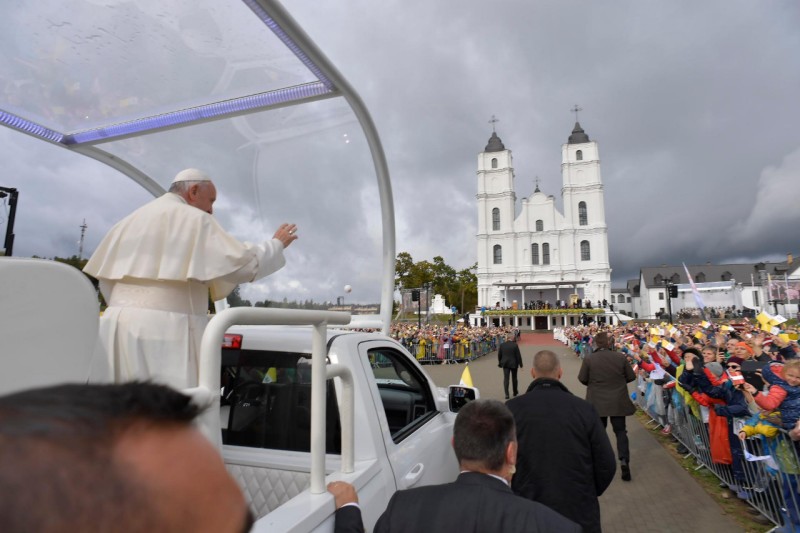
Pope Francis celebrates Mass today in Latvia

© Vatican Media

Latvia: Today we Make our own the Theme of this Visit: ‘Show Yourself as Mother!’

Holy Father Celebrates Mass at Shrine of the Mother of God, Aglona

When we face life’s great challenges, Mary stands beside us.  That was the essence of the message Pope Francis delivered in his September 24, 2018, homily at the Shrine of the Mother of God in Aglona, Latvia.
“Truly, we can say that what Saint Luke tells us at the beginning of the book of the Acts of the Apostles is being repeated here today: we are joined together in prayer, in the company of Mary our Mother (cf. Acts 1:14),” Pope Francis proclaimed. “Today we make our own the theme of this Visit: ‘Show yourself as Mother!’ Show us, Mother, where you continue to sing your Magnificat. Show us the places where your Son is crucified, that we may encounter your steady presence at the foot of the cross.’
The Holy Father pointed out that the Gospel of John speaks of only two times in the life of Jesus where the Lord and his mother interacted.  The first was the wedding feast at Cana, where she told him to make more wine for the guests. The second was at the cross.
“Perhaps the Evangelist wants to show us the Mother of Jesus in these two apparently opposite situations in life – the joy of a wedding feast and sorrow at the death of a child,” Francis explained. “In her growing understanding of the mystery of the Word, Mary points us to the Good News that the Lord wants to share with us today.
“The first thing John mentions is that Mary “stands near the cross of Jesus”, close to her Son. She stood there, at the foot of the cross, with unwavering conviction, fearless and immovable. This is the main way that Mary shows herself – she stands near those who suffer, those from whom the world flees, including those who have been put on trial, condemned by all, deported.”
The Holy Father explained that Mary not only is present to offer us comfort but through her example shows us how to offer comfort to others.  He suggests that we, too, are called to reach out to those who are suffering and to accompany them.
“Like Mary, let us remain steadfast, our hearts at peace in God. Let us be ever ready to lift up the fallen, raise up the lowly and to help end all those situations of oppression that make people feel crucified themselves,” Francis said. “Let us not be afraid to experience the power of tenderness, to get involved and let our lives become complicated for the sake of others.”
The Pope went on to explain that Jesus asked those closest to him to not just be together but to “receive” one another.  He asks Mary to “receive” John as her sone – and John to “receive” Mary as his mother.
“For we can stand at the side of many people, even sharing the same home, neighborhood or workplace; we can share the faith, contemplate and experience the same mysteries, but without embracing or actually ‘receiving’ them with love.,” Francis stressed. “How many married couples could speak of lives lived next to one another, but not together; how many young people feel pained by the distance separating them from adults; how many elderly people feel tolerated, but not lovingly cared for and accepted.
“Mary wants to give us her courage so that we too can remain steadfast, and her humility, so that, like her, we can adapt to whatever life brings.”
Aglona Basilica is the major Roman Catholic shrine of Latvia. Pilgrims flock to the site on August 15 each year to celebrate the Assumption of the Blessed Virgin Mary into Heaven. In 1980, the Church celebrated its 200th anniversary and was officially given the status of a minor basilica by Pope John Paul II. In 1986, it was the site of the celebration of the 800th anniversary of Christianity in Latvia. In September 1993, Pope John Paul II visited the Shrine, joined by a crowd of some 300,000 pilgrims.


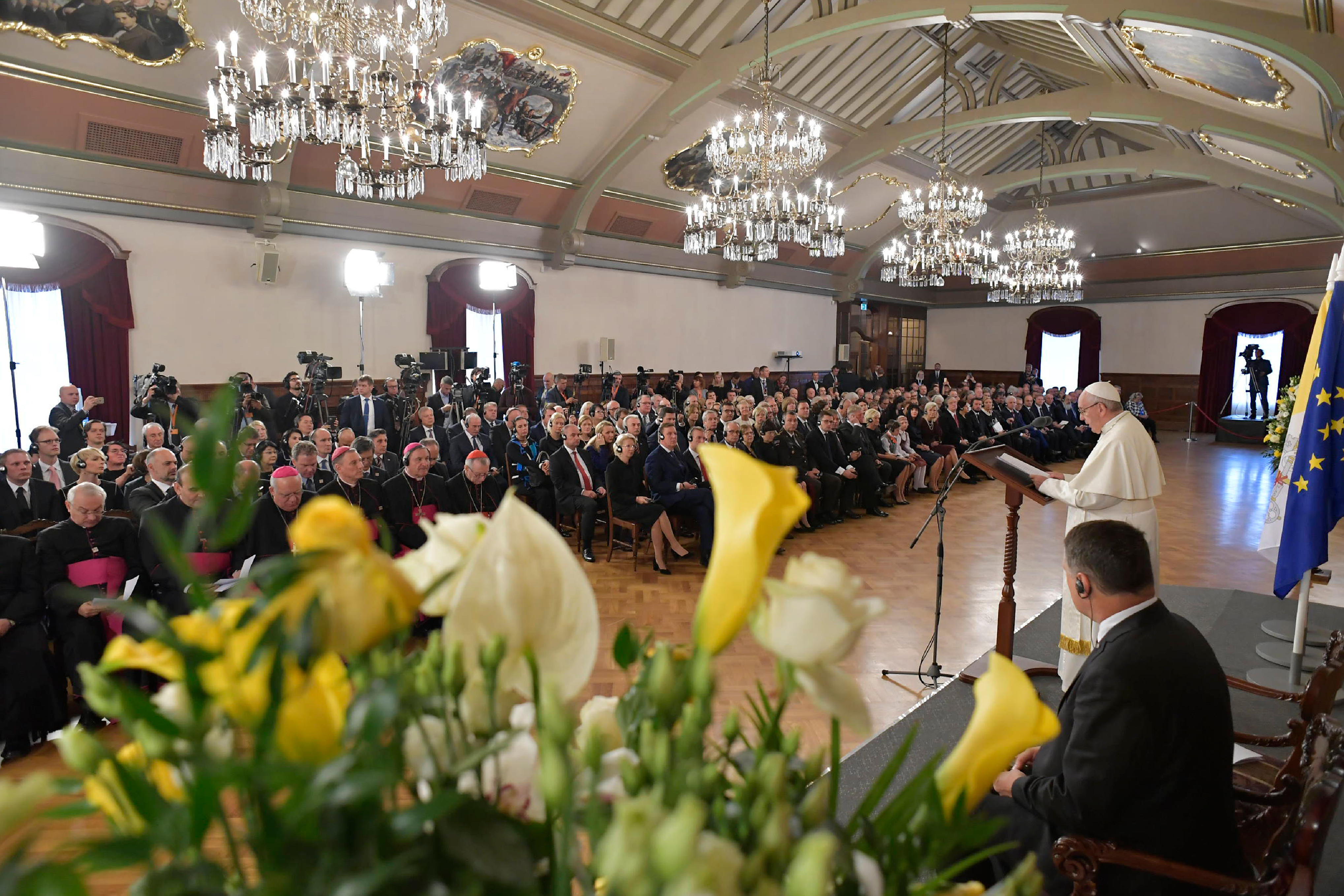
Papal address to civil authorities in Latvia

Pope in Latvia - Vatican Media photo

‘Open a Door to the Future by Looking to Everything That Stands at Service of Life’ Suggests Pope in Latvia

Pope Addresses Authorities, Members of Civil Society and Diplomatic Corps in Latvia

Pope Francis arrived in Latvia this morning, on the third of his four-day trip to the Baltic Nations of Lithuania, Latvia and Estonia, with an address to government authorities and other leaders of society.
Here is the Vatican translation of his address:
__
Mr President,
Members of Government and State Authorities,
Members of the Diplomatic Corps and Representatives of Civil Society,
Dear Friends,
I am grateful, Mr President, for your kind words of welcome, and for the invitation to visit Latvia that you extended to me during our meeting in the Vatican. I am happy to be here for the first time, both in Latvia and in this city, that, like the entire country, has known difficult social, political, economic and spiritual struggles, the fruit of past divisions and conflicts, yet today has become one of the principal cultural, political and shipping centres of the region. Your contributions to culture, art and music in particular are well known beyond your borders. And today I also was able to appreciate these on my arrival at the airport. With the words of the Psalmist, you can indeed say: “You have turned my mourning into dancing (Ps 30:12). Latvia, the land of the Dainas, has turned its sorrows and pain into singing and dancing, and has sought to become a place of dialogue and encounter, of a coexistence that is peaceful and looks to the future.
This year you are celebrating the centenary of your nation’s independence, a significant moment for the life of society as a whole. You know all too well the price of that freedom, which you have had to win over and over again. It is a freedom made possible thanks to your roots that, as Zenta Maurina, who inspired so many of you, observed, “are in heaven”. Without this ability to look up, to appeal to greater horizons that remind us of that “transcendent dignity” with which all of us, as human beings, have been endowed (cf. Address to the European Parliament, 25 November 2014), the rebuilding of your nation would not have been possible. That spiritual capacity to see more deeply, as expressed in small and daily gestures of solidarity, compassion and mutual assistance, has sustained you and in turn has given you the creativity needed to generate new social processes, despite the currents of reductionism and exclusion that always threaten the fabric of society.
I am happy to know that the Catholic Church, in cooperation with other Christian churches, is an important part of those roots. This cooperation shows that it is possible to build communion within differences. It happens when people are motivated to leave superficial conflicts behind and to see one another in their deeper dignity. Indeed, when we, as individuals and communities, learn to look beyond ourselves and our particular interests, then understanding and mutual commitment bear fruit in solidarity. Such solidarity, understood in its deepest and most challenging sense, becomes a way of making history in a region where conflicts, tensions and even groups once considered inimical can attain a multifaceted unity that gives rise to new life (cf. Evangelii Gaudium, 228). The Gospel has nourished the life of your people in the past; today it can continue to open new paths enabling you to face present challenges, to value differences and, above all, to encourage “com-union” between all.
The celebration of this centenary reminds us of how important it is to treasure Latvia’s freedom and independence. These are certainly a gift, but also a task for everyone. To work for liberty is to commit oneself to the integral and integrating development of individuals and the community. If today we can celebrate, it is due to all those who blazed trails and opened a door to the future, and bequeathed to you that same responsibility: to open a door to the future by looking to everything that stands at the service of life, of generating life. At the conclusion of our meeting, we will go to the Freedom Monument, where children, young people and families will be present. They remind us that “the motherhood” of Latvia – analogously echoed in the theme of this Visit – is reflected in the ability to promote truly effective strategies centred more on the concrete faces of these families, elderly persons, children and young people, than in the primacy of economy over life. Latvia’s “motherhood” is also manifested in her ability to generate employment opportunities, so that no one will need to be uprooted in order to build a future. The index of human development is likewise measured by the capacity to increase and multiply. The development of communities is not produced, much less measured, solely by the amount of goods or resources they possess, but rather by their desire to engender life and build for the future. This is only possible to the extent that they are rooted in the past, creative in the present, and confident and hopeful in looking to the future. Then too, it is measured by their capacity for self-sacrifice and commitment, in imitation of the example of past generations.
Mr President, dear friends: As I begin my pilgrimage in this land, I ask God to continue to accompany, bless and prosper the work of your hands in the service of this nation.

Pope Francis moves on to Latvia and encourages their faith despite decades of oppression

Vatican Media Photo

‘Neither the Nazi Nor Russian Regimes Extinguished Light of Faith in Your Hearts; You Persevered in the Faith,’ Pope Praises Elderly Latvians Gathered at Cathedral of St. James in Riga

Francis Encourages Them to “Taste and See Always the Goodness of the Lord Till the Very End of Our Days”

You persevered in the faith….
Pope Francis lauded this achievement of many elderly Latvians sit before him at the Catholic Cathedral of St. James in Riga.  Pope Francis arrived in Latvia this morning, on the third of his four-day trip to the Baltic Nations of Lithuania, Latvia and Estonia, with an address to elderly in the Cathedral.
In his address, he reminded them to not lose their gentleness and much less their hope, and praised that their are the roots of their nation.
Francis began recalling that many present before him were subjected to any number of trials, including the horror of war, then political repression, persecution and exile.
“Yet you remained steadfast; you persevered in faith,” he said, underscoring: “Neither the Nazi regime, nor the Soviet regime could extinguish the faith in your hearts. Neither could they stop some of you from becoming priests, religious sisters, catechists, or from serving the Church in other ways that put your lives at risk.”
“You fought the good fight; you ran the race, you kept the faith.”
The Holy Father encouraged them in their families and homeland to be also an example of both these attitudes: patient endurance and patient expectation.
In this way, he said, you will continue to build your people. “Because of your length of years, you are living witnesses of perseverance in the face of adversity, but also a prophetic gift to remind younger generations that the care and protection of those who have gone before us is loved and valued by God, and cries out to God when it is disregarded.”
“Because of your length of years, do not forget that you are the roots of a people, the roots of young shoots that need to flourish and bear fruit. Protect those roots; keep them alive, so that children and young people can be grafted onto them.”
Pope Francis acknowledged the words inscribed on the pulpit of the Cathedral: “O that today you might hear his voice! Harden not your hearts” (cf. Ps 95:7-8).
“A hardened heart,” Francis warned, “is one that has become sclerotic and lost the joy of God’s constant newness.”
Pope Francis concluded, praying: “May we never cease to be young of heart, to taste and see the goodness of the Lord, always, to the very end of our days.” Zenit is on the papal flight and bringing you the latest from the trip.
Here is the Vatican translation of his address:
__
Dear Brothers and Sisters,
I thank the Archbishop for his kind words and his clear analysis of how things stand. Being in your presence, dear elderly brothers and sisters, reminds me of two phrases in the Letter of the Apostle Saint James, to whom this Cathedral is dedicated. At the beginning and at the end of his Letter, albeit using two different words, he encourages us to remain steadfast. I am certain that we can appreciate the message that James, the brother of the Lord, wants us to hear.
Those of you who are present were subjected to any number of trials: the horror of war, then political repression, persecution and exile, as your Archbishop has described. Yet you remained steadfast; you persevered in faith. Neither the Nazi regime, nor the Soviet regime could extinguish the faith in your hearts. Neither could they stop some of you from becoming priests, religious sisters, catechists, or from serving the Church in other ways that put your lives at risk. You fought the good fight; you ran the race, you kept the faith (cf. 2 Tm 4:7).
Saint James stresses that this constancy in faith overcomes trials and produces perfect works (cf. 1:2-4). Your work, however perfect in those days, must also tend to perfection in today’s new situations. You, who devoted body and soul, who have given your life to winning freedom for your native land, now often find yourselves cast aside. Paradoxical as it may seem, nowadays, in the name of freedom, free men and women subject the elderly to solitude, abandonment, lack of assistance, social exclusion and even poverty. If that is the case, then the so-called train of freedom and progress has ended up with the very people who fought to gain those rights as its last car, onlookers at other people’s party, honoured in words but forgotten in daily life (cf. Evangelii Gaudium, 234).
Saint James tells you nonetheless to persevere, not to give up. “Along this journey, the cultivation of all that is good, progress in the spiritual life and growth in love are the best counterbalance to evil” (Gaudete et Exsultate, 163). Do not yield to disappointment or grief. Do not lose your gentleness, much less your hope.
At the end of his Letter, Saint James once more exhorts us to be patient (5:7). There, he uses a word that implies both patient endurance and patient expectation. In your families and your homeland, I encourage you to be also an example of both these attitudes: patient endurance and patient expectation, both marked by patience. In this way you will continue to build your people. Because of your length of years, you are living witnesses of perseverance in the face of adversity, but also a prophetic gift to remind younger generations that the care and protection of those who have gone before us is loved and valued by God, and cries out to God when it is disregarded. Because of your length of years, do not forget that you are the roots of a people, the roots of young shoots that need to flourish and bear fruit. Protect those roots; keep them alive, so that children and young people can be grafted onto them and come to understand that “all the blossoms on the tree draw life from lies buried beneath” (F. L. BERNÁRDEZ, Sonnet Si para recobrar lo recobrado).
The words inscribed on the pulpit of this Cathedral say: “O that today you might hear his voice! Harden not your hearts” (cf. Ps 95:7-8). A hardened heart is one that has become sclerotic and lost the joy of God’s constant newness. May we never cease to be young of heart, to taste and see the goodness of the Lord, always, to the very end of our days (cf. Ps 34:9).

Friday, September 21, 2018

Ahead of historic Papal trip to the three Baltic countries; hey, my church is universal, because His church is universal

Archbishop of Riga

EXCLUSIVE INTERVIEW: Archbishop of Riga, Zbigņevs Stankevičs, Ahead of Pope’s Trip to Lithuania, Latvia, and Estonia

Latvian Prelate Shares With Zenit Who Will Cover Trip from Papal Flight How His Country’s Christians & Values Have Been Protected by Constitution

Archbishop of Riga, Zbigņevs Stankevičs, says we will welcome Pope Francis with joy in Latvia, because he is the successor of Peter, the Vicar of Christ, who walks on the border between the visible and invisible world. The Pope’s mission is to confirm brothers and sisters in the faith and read the signs of the times, and this will help us to see the priorities where we ought to direct our forces.
In an exclusive interview with ZENIT, who will be following again from the papal flight Pope Francis’ Apostolic Visit to the Baltic Countries, the Latvian Archbishop made this prediction.
ZENIT interviewed the Archbishop of Riga in Poznan, Poland on the sidelines of the Plenary Assembly of the Council of European Conferences, Sept. 13-16, 2018.
Here is our exclusive interview:
***
ZENIT: Archbishop Stankevičs, Latvia is a small and peripheral country in Europe. The Latvian Catholic Church is rather small. Given that Pope Francis receives invitations nearly everywhere, but obviously accepts just a few, what significance does this event have for you?
Latvia is not that small of a country actually! Latvia is, if I remember correctly, bigger than Belgium, for example, but it has few inhabitants, especially today, after almost a third of the inhabitants have emigrated abroad in the last 25 years, looking for work, well-being and a more dignified life. But even at a distance, thanks to internet and TV, they will be able to feel close to the Pope and their homeland.
ZENIT: Pope St. John Paul II visited Latvia in 1993, 25 years ago. Since then, how has Latvia changed?
At that time, it was important to have encouragement and a vision for the future. In the early 1990s, we thought that freedom was the main thing, then immediately everything would arrive: welfare, wealth, abundance … Today, 25 years later, we see that there are still challenges to be faced for which “external” freedom alone is not enough. In the Soviet Era everyone had to work and had a minimum wage to survive. Today, however, everyone must figure out how to make due on their own and a part of our people has not been able to adapt. Therefore, the message Pope Francis will bring, of solidarity with the poor, will be important!
ZENIT: During that time, the country had just come out of the long period of Soviet oppression. What has this history left?
We expect from Pope Francis not only a spiritual impulse, but even a social impulse, precisely because we still need a purification from the post-Soviet mentality. Much has already been done, but much remains to be done to combat corruption, poverty, the culture of waste, because the discarded ones are here also in Latvia. The Soviet oppression left deep wounds both in the sense of responsibility and personal self-esteem, and in the capacity for initiative. You could do only what the party commanded. Second, there is the explosive mixture of theoretical and practical materialism, which today still does so much damage!
ZENIT: Every papal trip is exceptional in its own way, arousing curiosity and attention, not only among Catholics. In Latvia, Catholics are a small minority, relative to the Lutheran and Orthodox Churches. How could you describe the ecumenical relationship in Latvia?
We Catholics are about a quarter or a fifth of the population, next to Lutherans, 30%, Orthodox, under 20%, and other smaller denominations. The collaboration is very good. It is thanks to the fact that in the preamble of the Latvian Constitution, Christian values, alongside universal national and human values, are mentioned as the foundation of Latvia. The Constitution defines marriage as a union between a man and a woman. There is a law that forbids immoral propaganda in schools. In January, with the help of the Baptists, we stopped the attempt to ratify the Istanbul Convention, which opens the possibility of imposing gender ideology through schools and the mass media. All this was a grace, but only because the main Christian confessions spoke with one voice. Now I hope that Francis, who appreciates ecumenism so much, encourages us to go on in the same direction!
ZENIT: How do TV and newspapers report on the upcoming trip?
The Church strives to convey the message of the spiritual dimension of the event, to present it as a chance not to be missed for the whole country. Then there is the press that criticizes the costs of its organizing, or because the parliament has declared a holiday day on the Pope’s day in Latvia, and so they lose millions of euro… In short, they are more concentrated on the external, superficial aspects of the event, leaving out of sight the profound meaning of it. We hope to overcome this obstacle.
ZENIT: A sensitive issue for Latvia is the relationship with the big Russian ethnic minority, whose condition has changed considerably since Latvia is no longer part of the Soviet Union. Pope Francis is the Pope who continually invites us to build bridges, to be reconciled among peoples, to learn to live in harmony. How will this message be received in your country?
Today, we live in a world torn by so many conflicts. Even in Latvia we are certainly not perfect, we still have much to do, but we live together in peace, and in this sense, we can also be a model for the rest of the world. For example, in Riga there are more Russians than Latvians. The city is administered by a Russian mayor, and it is not the first time, but the third. There is no open conflict in the street, in everyday life … This premised, however, the issue is delicate, because even in the absence of conflict there are political parties that try to feed the antagonism between Latvians and Russians. And if Pope Francis arrives carrying a message of reconciliation, then it is foreseeable that immediately some groups will attack him. The question is delicate, yes, caution will be needed to launch the message that we must build bridges and not walls, but without entering into these political controversies.
ZENIT: What is the significance of this coincidence?
For the government and for the politicians, this is a fact of great significance, as if it were a fact of prestige for the country to welcome the Pope in this circumstance. Therefore, the population also considers it. The centenary of independence for the Church is also important, as is the 25th anniversary of Pope Wojtyla’s visit, but this is not the main point. The point really important for us is that spiritual impulse of rebirth that we expect from Pope Francis. Eight years ago, when I became Archbishop of Riga, I said that my “strategic purpose” would be the spiritual rebirth of Latvia. And I said it not only to Catholics, but also to all other Christians and all men of good will.
ZENIT: In this historic moment for Europe, nationalist feelings are resurrecting in many of the continent’s countries. Is this true for Latvia? But nationalism, in your opinion, is always to be condemned?
It depends on what the contents of this concept of “nationalism” are. From my point of view, I would distinguish “patriotism” and “nationalism”; the former is good, the second is not, although some experts argue that there are various levels of nationalism, and the “softer” ones can be accepted. I say this: love for one’s own homeland is something necessary, it is part of the fourth commandment, “Honor thy father and mother”: but with nationalism we already get to feel a sense of superiority towards others, and this it is not acceptable.
ZENIT: How much is there a sense of national identity alive among Latvians abroad?
Those who were forced to leave during the war and their descendants have a very marked patriotic feeling. Those who have left with the last wave of emigration experience a feeling of greater disappointment towards their country, and it was their choice to leave. Nonetheless, there is also a part of Latvians abroad that would like to return home. Someone does it, but up to now the two migratory flows, in and out, have not yet been balanced between themselves. We hope to arrive at least as soon as possible at an equilibrium.