Showing posts with label Estonia. Show all posts

Sunday, September 7, 2025

Prayers offered by Pope Leo after canonization Mass and Sunday Angelus; announces new Blessed's in Estonia & Hungary


Pope Leo during Sunday's canonization of Pier Giorgio Frassati and Carlo Acutis, just before leading the Angelus prayerPope Leo during Sunday's canonization of Pier Giorgio Frassati and Carlo Acutis, just before leading the Angelus prayer  (@Vatican Media)

Pope Leo appeals for peace in Holy Land, Ukraine, areas of world marred by war

Before leading the recitation of the Angelus prayer with the faithful in Saint Peter's Square, Pope Leo XIV asks everyone to pray constantly for peace in the Holy Land, Ukraine, and all lands plagued by war, emphasizing that "God wants peace!"

Vatican News

Following the Mass and canonization of Pier Giorgio Frassati and Carlo Acutis in Saint Peter’s Square, Pope Leo XIV said to the intercession of the Saints and the Virigin Mary, may we all entrust our constant prayers for peace in our world, as "God does not want war. God wants peace!"

The Pope encouraged everyone to continue their prayers for the people of the Holy Land, Ukraine, and every part of the world plagued by war. To world leaders, he repeated his call that they listen to the voice of their consciences, since "the apparent victories achieved through weapons, sowing death and destruction, are in fact defeats, and they never bring peace or security."

“God does not want war. God wants peace! And God supports those who commit to breaking the spiral of hatred and walking in the path of dialogue.”

Two new Blesseds in Hungary and Estonia

Pope Leo also recalled that in the nations of Estonia and Hungary, the Church is celebrating two new Blesseds.

In Tallinn, the capital of Estonia, Jesuit Archbishop Eduard Profittlich was beatified on Saturday 6 September. He was killed in 1942 during the Soviet regime’s persecution of the Church at that time.

Also on Saturday, in Veszprém, Hungary, Mária Magdolna Bódi was beatified, a young laywoman killed in 1945 because she resisted soldiers who tried to assault her. The Pope said the Church is enriched by the witness of these two new blesseds.

Pope Leo also thanked everyone - over eighty thousand present - for taking part in Sunday's canonization, a long-awaited celebration, offering his greetings to all the bishops, priests, official delegations and distinguished authorities, and faithful from around the world for their participation and presence.

Wednesday, December 18, 2024

Pope Francis approves beatification for an Estonian Archbishop and other decrees


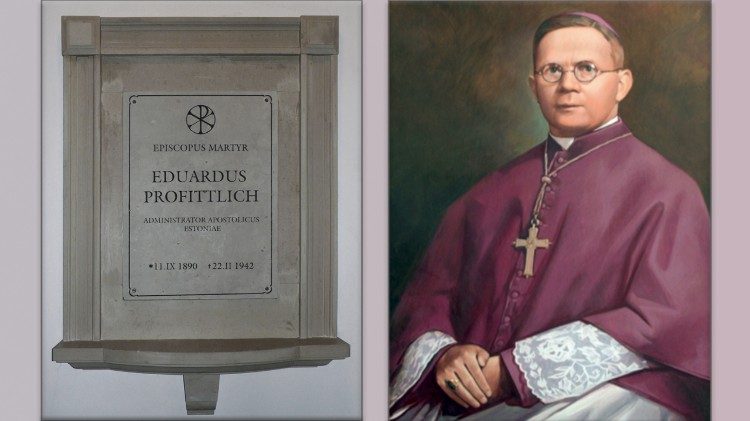
Archbishop Eduard Profittlich and a memorial plaque in the Cathedral at Tallinn, EstoniaArchbishop Eduard Profittlich and a memorial plaque in the Cathedral at Tallinn, Estonia 

Pope approves beatification of martyred Estonian Archbishop Profittlich

Pope Francis has approved the beatification of Archbishop Eduard Profittlich, a German-born Jesuit who served in Estonia and was martyred in the Soviet Union in 1942.

By Devin Watkins

Pope Francis held an audience on Wednesday with Cardinal Marcello Semeraro, Prefect of the Dicastery for the Causes of Saints, and authorized him to promulate decrees related to the causes of 21 men and women.

The Pope officially recognized the martyrdom of Archbishop Eduard Profittlich, SJ, who served as the Apostolic Administrator of Estonia from 1931 until his death in 1942, clearing the way for his beatification.

Soviet Union authorities arrested the German-born Archbishop a year after invading Estonia, and he was deported to a prison in Siberia and sentenced to death. Archbishop Profittlic died from exposure in Kirov prison on February 22, 1942 before his sentence could be carried out.

Beatification a message for Church’s peripheries

Bishop Philippe Jourdan, bishop of Tallinn, welcomed Pope Francis’ approval of Archbishop Profittlich’s beatification, noting that the event comes as the local Church celebrates the 100th anniversary of the creation of the Apostolic Administration of Estonia in 1924.

Speaking to Vatican News, Bishop Jourdan expressed his joy that the Church in Estonia will have its first Blessed.

“It’s very important for the local Church,” he said, “because the goal of the Church is to help people to be saved and to be holy.”

Having a Blessed from the Estonian Church, he added, brings the Christian mission of holiness into the present and helps people believe sainthood is attainable.

The news comes just three months after Pope Francis elevated the Apostolic Administration of Estonia to the Diocese of Tallinn. “Archbishop Profittlich was a bit like Moses,” said the French-born Bishop. “He wanted to see the Promised Land, but he could not see it with his own eyes.”

Given its small numerical size, Bishop Jourdan said Estonia is on the “periphery” of the Church in a way, noting that the beatification will make them feel at her centre.

“Even if the current situation is complicated,” he said, “I would say it is wonderful news for the Catholics of Russia, since the Archdiocese of Moscow began the process of beatification of Archbishop Profittlich 21 years ago.”


Example of faith, hope and peace

Marge-Marie Paas, the Communications Director of the Diocese of Tallinn, spearheaded Archbishop Profittlich’s cause for beatification, serving as the diocesan postulator which established the historical facts of his life and evaluated the theological content of his extant works.

Ms. Paas told Vatican News that the martyred Archbishop will be “an example of faith and hope for many people.”

“His episcopal motto was ‘Faith and Peace’,” she noted. “I’m sure that Archbishop Profittlich is encouraging us to keep faith and peace in our hearts always, even during the most challenging times.”

Martyrs of Compiègne

On Wednesday, Pope Francis also extended to the universal Church the cult of the martyrs of Compiègne: Blessed Teresa of Saint Augustine (born: Maria Maddalena Claudia Lidoine) and her 15 companions of the Order of Discalced Carmelites of Compiègne, martyrs, killed in hatred of the faith on July 17, 1794, in Paris (France), enrolling them in the catalog of Saints (Equivalent Canonization).

The Pope recognized the martyrdom of Servant of God Elia Comini, a priest of the Society of Saint Francis de Sales, born in Calvenzano di Vergato (Italy) on May 7, 1910, and killed in odium fidei on October 1, 1944, in Pioppe di Salvaro (Italy).

He also approved decrees regarding the heroic virtues of the Servant of God Áron Márton, Bishop of Alba Iulia, born on August 28, 1896, in Csíkszentdomokos (today Romania) and died on September 29, 1980, in Alba Iulia (Romania); the heroic virtues of the Servant of God Giuseppe Maria Leone, Priest of the Congregation of the Most Holy Redeemer, born on May 23, 1829, in Casaltrinità (today Trinitapoli, Italy) and died in Angri (Italy) on August 9, 1902; and, the heroic virtues of the Servant of God Pierre Goursat, Lay Faithful, born on August 15, 1914, in Paris (France) and died there on March 25, 1991.

Thursday, February 17, 2022

Possibly a Saint from Estonia


Servant of God Eduard Profittlich, SJServant of God Eduard Profittlich, SJ 

Estonians renew push for beatification of martyr Archbishop Profittlich

The Apostolic Administration of Estonia holds a webinar to shine the spotlight on the ongoing beatification process of its martyred former archbishop, Eduard Profittlich.

By Devin Watkins

Hopes are high among Estonian Catholics as the local Church continues its push for the beatification of Archbishop Eduard Profittlich, SJ.

The German Jesuit served as the Apostolic Administrator of Estonia from 1931 until his deportation to Siberia and martyrdom in the Soviet prison in Kirov on 22 February 1941.

His cause for beatification is currently winding its way through the Congregation for the Causes of Saints, after completion of the diocesan phase in late 2019.

Currently known as a Servant of God, the late Archbishop Profittlich offers a moving witness of faith for the people of Estonia today, as well as for Catholics further afield.

Great martyr of the Church

As the 80th anniversary of his death approaches, the Apostolic Administration of Estonia hosted an online conference on Tuesday evening to offer an update on his beatification process.

The event saw the participation of a host of Church leaders, Jesuits, and lay Catholics interested in Profittlich’s life and witness. It was moderated by Fr. Stephan Lipke, SJ, with the Jesuit-run St. Thomas Institute in Moscow, which co-hosted the conference.

Archbishop Paolo Pezzi, the Metropolitan of Moscow, kicked off the webinar by calling it an opportunity to celebrate the life of a “great martyr of the Church.”

He said Profittlich ranks among the great Bishops to have served and died in the territories of the former Soviet Union, adding that he offers the faithful around the world an excellent example of “what it means to be Catholic.”


Sharing fate of his flock

Speaking from Tallinn, just meters from where his predecessor ministered, Bishop Philippe Jourdan, the current Apostolic Administrator of Estonia, expressed his hopes that the beatification process would offer new life to the local Church’s evangelization efforts.

Profittlich, he said, was a very well-known figure in Estonia during his lifetime, even among the country’s Lutheran majority, which counted around 78 percent of the population in the 1930s.

As a German citizen, Profittlich was offered the chance to leave Estonia after its fall to the Soviet Union in 1940.

“The example of Archbishop Profittlich is very important for Estonian society, especially the fact that he chose to stay to stay in Estonia to share the destiny of so many Estonians.”

Over 20,000 Estonians were deported to Soviet prison camps during the 1940s.

The Bishop added that Estonia’s President Alar Karis even recently asked him about Profittlich’s cause, saying he was following it “with great joy.”

Missionary vocation

Maria Chiara Dommarco, a historian on Catholicism in Russia during the reigns of Lenin and Stalin, offered a review of the Vatican’s goal of evangelizing Soviet Russia, especially during the pontificates of Benedict XV and Pius XI.

She said the young Jesuit Profittlich manifested an ardent desire to take on that missionary mantle. He was eventually sent to Estonia, where he served the Church wholeheartedly and established fruitful dialogue with Orthodox and Protestant Christians.

“The Jesuit’s free and conscious adhesion to his vocation, even to the point of witnessing martyrdom, was born and developed within the dialogue (mediated and then directly) with the authority of the Holy See.”

Faithful servant

Ms. Marge-Marie Paas, the diocesan postulator for Profittlich’s cause for beatification, then took the floor to review the path to holiness of the first Catholic Bishop in Estonia since the Protestant Reformation.

"Archbishop Eduard Profittlich," she said, "carried out all his responsibilities with great love, and through consistent effort he was able to accomplish all that God expected of him, especially being faithful to Christ, His Church, and His Kingdom."

Profittlich’s faithful dedication to his mission, added Ms. Paas, was crowned by God with martyrdom. He accepted to stay in Estonia fully knowing the fate he would likely suffer, a choice she said he made willingly, in deep prayer, and with the consent of the Pope.

Crown of martyrdom

As a martyr—a witness to Christ—many Estonians believe Profittlich now intercedes for the faithful before God, and Estonian Catholics are hoping to receive the Church’s recognition of this through his beatification.

A few short months before his arrest by the Soviets and deportation to Siberia, Archbishop Profittlich wrote to Pope Pius XII to request guidance as to whether to flee Estonia.

“I am also ready, in all peace of mind, to endure sacrifice for the Kingdom of God in this land, and for all the work and all the sufferings that, in these changed circumstances, will be necessary for the sake of the Kingdom of God.”

Ms. Paas summed up Profittlich’s holy example for the Church, saying he “sacrificed his life for the Kingdom of God… and he became a witness to new life and Truth.”

Tuesday, September 25, 2018

In flight press conference by Pope Francis; always enlightening


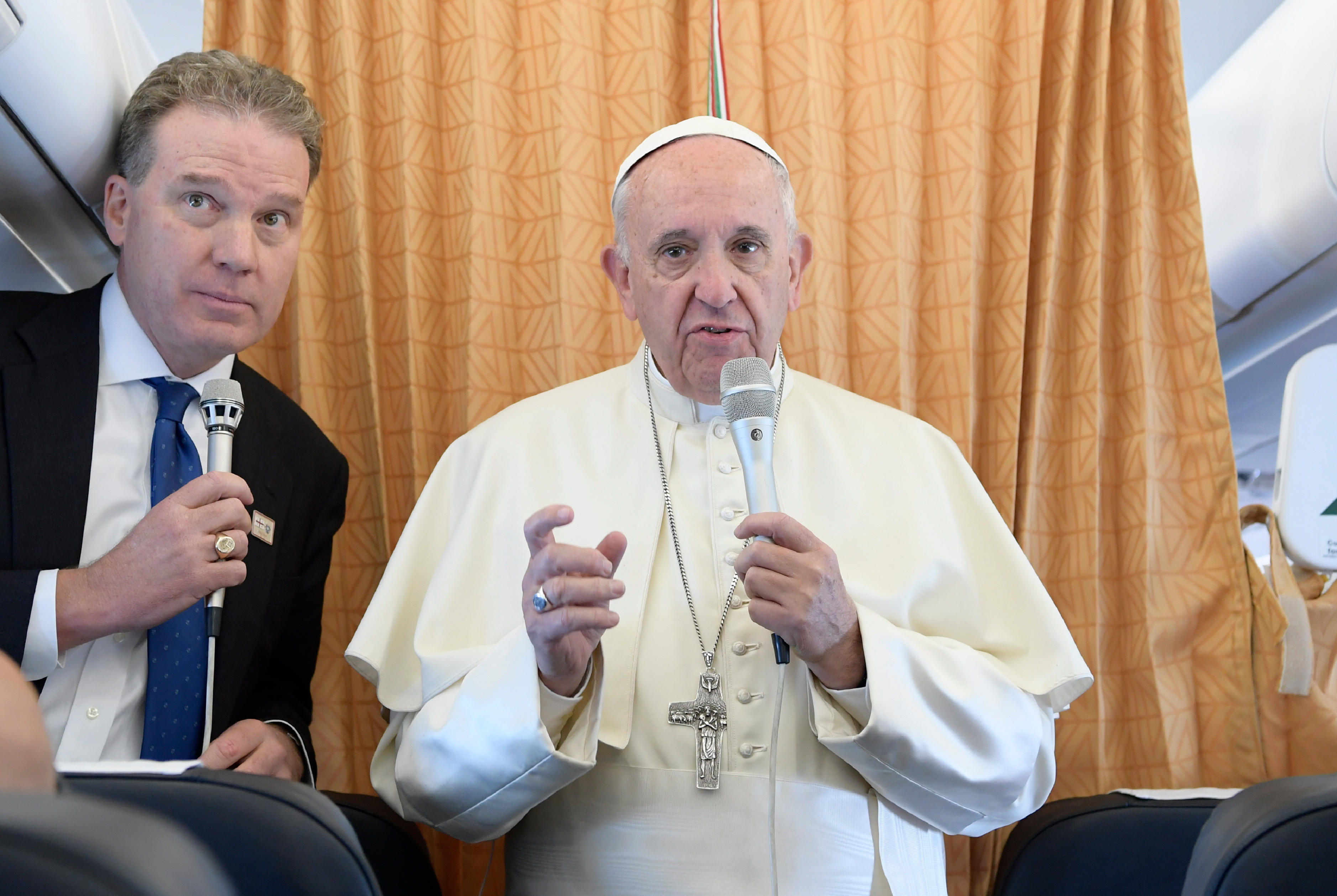
papal flight - press conference -Copyright: Vatican Media

During In-Flight Press Conference from Baltic States, Pope Says Whenever There Was a Sentence, I Never Gave a Pardon

Defends Church’s Reaction to Crisis, Stressing Recently It Has ‘Spared No Efforts’

Whenever there was a sentence, I never gave a pardon or reprieve…
Pope Francis during his return flight from his 25th Apostolic Visit to the Baltic States, Sept. 22-25, 2018, made this definitive statement when asked about the abuse scandals in the Church. Zenit was aboard the papal flight, covering his four-day trip to Lithuania, Latvia and Estonia.
While during his aboard press conference he initially reminded journalists that the questions ought to be related to the trip, he also touched on other topics later on, such as the report published today in China and the abuses.
The Pope stressed that the Church, while having certainly made its mistakes, has been “sparing no effort” to work to combat the abuses and cover-ups.
The Pope acknowledged that the abuses are “monstrous” and reaffirmed his commitment to zero-tolerance. To illustrate that the Church has effectively dedicated itself to combatting the crisis, the Pontiff pointed out that the actual number of cases “has diminished because the Church has realized that it must fight in a different way.”
The Pontiff lamented that in the past, particularly the last century, there was cover up due to shame.
“The Church,” Francis noted, “has become aware of this and has spared no effort” to combat it recently, he suggested.
“Even if it’s one single priest who abuses a child,” the Pontiff noted, “this is monstrous, because that man was chosen by God to lead the child to Heaven.”
“Never, never, did I sign a request for a pardon after a sentence has been made,” the Pontiff emphasized when responding about sex abuse, despite his initial insistence to keep the press conference questions on the topic of the trip, rather than to deviate to other themes.
“There is no negotiating on that,” he underscored.
Regarding the China-Holy See Agreement published Saturday, Sept. 22, 2018, and the accusation of Cardinal Joseph Zen, Archbishop Emeritus of Hong Kong, that you have ‘sold out the Church to the Chinese government,” the Pope stressed this decision was not an improvisation, but something that has been long in the making.
“It is I who signed the agreement,” said Francis, “I’m in charge. The others have worked for ten years. It’s not an improvisation. It’s a journey.”
The Holy Father reminded the journalists before him of the roles of President Emeritus of the Pontifical Council for Social Communications, Archbishop Claudio Maria Celli; Vatican Secretary of State Cardinal Parolin; and Roman Curia official, Father Rota Graziosi.
The Holy Father told the press that Cardinal Parolin “studies all of the documents down to the period, comma, notes,” and that this “gives me a great assurance.”
“You know that when you make a peace agreement or a negotiation, both sides lose something,”the Holy Father stated, expressing that it is normal to make little steps back and forth, in order to move forward.
The Holy Father reflected substantially on the trip and his observations, denouncing ‘hate for religion’ and communism.
“I am aware that the situation of the three Baltic countries is always in danger, the fear of invasion, because history itself reminds you of this. And you are right to say that it is not easy, but it is a game to be played every day, with culture, with dialogue. All of us are obliged to help you and be close to you with the heart.”
Another journalist recalled the Pope’s insistence during the trip that the Baltic Countries retain their roots and identity, but recognizing the vast number from those nations that emigrate abroad, he asked what can be done to help them.
“What can be done to defend it?” the Pope reflected, answering: “The memory of the roots, this is important and must be transmitted. Identity is part of belonging to a people and that belonging to a people must be passed on, the roots must be passed on to the new generations, through education and dialogue, especially between the elderly and the young. And you must do so because your identity is a treasure.”
He praised grandparents for their intricate role, in transmitting the faith, noting they are responsible for transmitting the faith. The Holy Father also lamented in his remarks about the persecution in Lithuania. Discussing the cruelty of the past, and how this remains current, the Pontiff decried terrorism, persecutions, and the death penalty. He also pointed out that when euthanasia is administered, that is “a modern-day death penalty.”


Pope Francis to Estonian Youth

© Vatican Media

Estonia: Pope Speaks to Youth of Love

‘It calls us and sends us forth. It only asks that we open our heart.’

Estonian youth got a pep talk on love and the joy of the Christian faith on September 25, 2018.
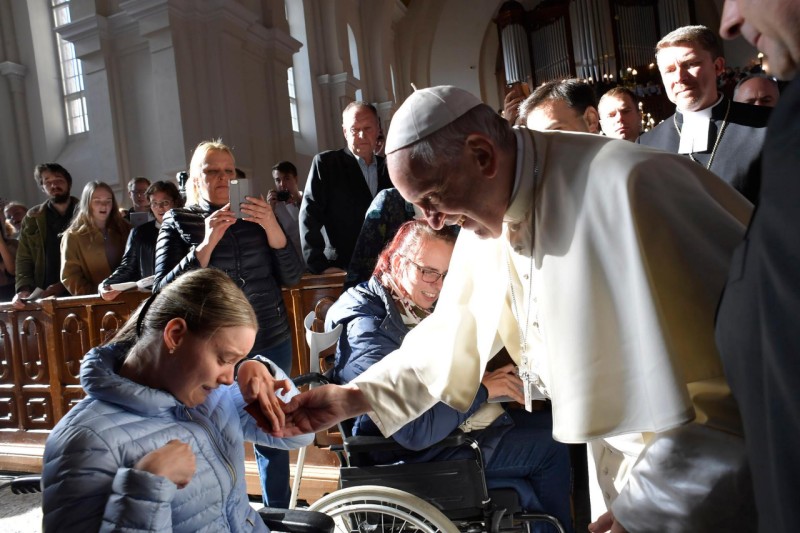
The venue was the Ecumenical Meeting with young people, in the Kaarli Lutheran Church, Tallinn. And the motivational speaker was Pope Francis. His enthusiasm was palpable:
“Boys and girls, love is not dead. It calls us and sends us forth. It only asks that we open our heart. Let us ask for the apostolic strength to bring the Gospel to others – but to offer it, not impose it — and to resist the tendency to see our Christian life as if it were a museum of memories.
“The Christian life is life, is future, is hope! It’s not a museum…The Lord surprises us because life surprises us always. Let us go forward, to meet these surprises.”
The event truly was ecumenical. On his arrival, the Lutheran Archbishop and the Pastor of the Church welcomed the Holy Father. A group of children of various Christian schools offered flowers to the Pope in the atrium while a song was being intoned. Pope Francis then entered the Church in procession together with the Lutheran Archbishop, the Pastor of the Church of Saint Charles and the Apostolic Administrator of Tallinn.
After the welcome words of two youngsters, a Catholic and a Lutheran, the singing of sings, a brief greeting of the Lutheran Archbishop and some brief testimonies of a Lutheran, an Estonian, an Orthodox an a Catholic representative, the Holy Father gave his address.
In his remarks, the Pope lamented the evidence that many young people don’t think the Church has anything relevant for them.  And he suggested this isn’t something entirely new; Jesus was disappointed by the lack of response he received in many places.
“Today, I am here to tell you that we want to mourn with you when you mourn, to accompany your joys with our applause and our laughter, and to help you to be followers of the Lord,” Francis promised. “You, boys and girls, young people, know this: when a Christian community is truly Christian, it does not engage in proselytism. It only listens, welcomes, accompanies and walks, but does not impose anything.”

Full Text of Pope’s Remarks to Youth


Pope Francis moves on to Estonia

Vatican Media Photo

FROM ESTONIA: Pope to Estonian Authorities: Blaze New Trails for Future Generations, You Can Always Count on Catholic Church’s Support

Pope Kicks Off Last Day of Baltic States’ Trip in Estonia With Authorities, Young People, Charitable Encounter, and Mass

“I wish to assure you that you can count always on the support and help of Catholic Church, a small community in your midst, yet one most desirous of contributing to the fruitfulness of this land.”
Pope Francis stressed to authorities and other leaders of society upon arriving in Estonia this morning, on his fourth and last day of his Sept. 22-25 trip to the Baltic Nations of Lithuania, Latvia and Estonia.
“I am very pleased to meet with you here in Tallinn, the northernmost capital that the Lord has allowed me to visit,” the Pope began his address saying.
The visit, he noted, allowed him to express his desire to learn more about their culture, and “especially the capacity for resilience that has enabled you to begin anew in the face of so many situations of adversity.”
‘The Land of Mary’
For centuries, the Pontiff recalled, these lands have been known as “the Land of Mary,” Maarjmaa; the name, he said, is not simply part of their history, but also part of their culture. “Thinking of Mary,” the Holy Father said, “reminds me of two words: memory and fruitfulness. Mary is a woman of memory who treasures all living things in her heart (cf. Lk 2:19) and the fruitful mother who begets the life of her Son.”
He went to discuss Estonia as a land of both memory and of fruitfulness.
Turning to memory, the Pope acknowledged their people had to endure, at different times in history, moments of bitter suffering and tribulation.
“As you consider your past and present,” he said, “you have good reason to look to the future with hope and to confront new challenges. To be a land of memory is to keep remembering that what you have attained today is due to the efforts, the hard work, the spirit and the faith of your predecessors.”
“Cultivating a grateful memory,” he continued, “makes it possible for you to identify today’s achievements as the fruit of a history made up of all those men and women who strove to make freedom possible. In turn, it challenges you to honor them by blazing new trails for generations yet to come.”
No Worse Alienation Than to Feel Uprooted
“Turning to fruitfulness,” he said, “this demands contexts in which roots can be planted and give rise to a vital network capable of ensuring that the members of its communities feel “at home.” There is no worse form of alienation than to feel uprooted, belonging to no one.
“A land will be fruitful, and its people bear fruit and give birth to the future, only to the extent that it can foster a sense of belonging among its members, create bonds of integration between generations and different communities; and avoid all that make us insensitive to others and lead to further alienation.”
Count on the Catholic Church
In this effort, the Holy Father underscored: “I wish to assure you that you can count always on the support and help of Catholic Church, a small community in your midst, yet one most desirous of contributing to the fruitfulness of this land.”
Pope Francis concluded, praying: “May the Lord bless you and the beloved Estonian people,” and in a special way, “may He bless the elderly and the young, so that, by cherishing memory and upholding it, they may make this land a model of fruitfulness.”
Following this address, the Holy Father went to an ecumenical youth encounter in the Lutheran St. Charles church, given that the Catholic cathedral was not large enough to accommodate those expected. He listened to testimonies and gave an address which told them they are never alone, God always accompanies them.
Later, he would have lunch with the papal entourage in the convent of the Brigidine Sisters in Pirita, followed by a meeting with those assisted by charitable works of the Church in the Cathedral of Saints Peter and Paul, the Holy Mass in Freedom Square and the farewell ceremony in Tallinn  International Aiport.
Zenit Vatican Correspondent Deborah Castellano Lubov is following the Pope’s Apostolic Trip to the Baltic States on the papal flight and was present there in the presidential palace’s Rose Garden for the address. Here is the Vatican translation of his address:
__
Madam President,
Members of Government and State Authorities,
Distinguished Members of the Diplomatic Corps,
Your Excellencies, Ladies and Gentlemen,
I am very pleased to meet with you here in Tallinn, the northernmost capital that the Lord has allowed me to visit. I thank you, Madam President, for your words of welcome and for this opportunity to meet the representatives of the people of Estonia. I know that among you there is also a delegation from the sectors of civil society and from the world of culture. This allows me to express to them my desire to learn more about your culture, and especially the capacity for resilience that has enabled you to begin anew in the face of so many situations of adversity.
For centuries these lands have been known as “the Land of Mary”, Maarjmaa. A name that is not simply part of your history, but also part of your culture. Thinking of Mary reminds me of two words: memory and fruitfulness. Mary is a woman of memory who treasures all living things in her heart (cf. Lk 2:19) and the fruitful mother who begets the life of her Son. Hence, I would like to think of Estonia as a land of memory and of fruitfulness.
A land of memory
Your people had to endure, at different times in history, moments of bitter suffering and tribulation. Struggles for a freedom and independence that was constantly disputed or threatened. Nonetheless, in the last twenty-five years or so – since you once again took your proper place in the family of nations – Estonian society has taken “giant steps” forward. Your country, despite its small size, is a leader as concerns the indices of human development and the capacity for innovation; it also ranks high in the areas of freedom of the press, democracy and political freedom. You have also forged bonds of cooperation and friendship with a number of countries. As you consider your past and present, you have good reason to look to the future with hope and to confront new challenges. To be a land of memory is to keep remembering that what you have attained today is due to the efforts, the hard work, the spirit and the faith of your predecessors. Cultivating a grateful memory makes it possible for you to identify today’s achievements as the fruit of a history made up of all those men and women who strove to make freedom possible. In turn, it challenges you to honour them by blazing new trails for generations yet to come.
A land of fruitfulness
As I observed at the beginning of my ministry as Bishop of Rome, “in our time, humanity is experiencing a turning point in its history, as we can see from the advances being made in so many fields. We can only praise the steps being taken to improve people’s welfare” (Evangelii Gaudium, 52). Still, we do well never to forget that “the good life” and a life well lived are not the same thing.
One of the evident effects of technocratic societies is a loss of meaning in life and the joy of living. As a result, slowly and silently the capacity for wonder is dampened, often leaving citizens in an existential ennui. A sense of belonging and commitment to others, of being rooted in a people, a culture and a family, can gradually be lost, depriving the young in particular of their roots and the foundations needed to build their presence and their future. Depriving them of the capacity to dream, to risk and to create. To put all our “trust” in technological progress, as the only way possible, can lead to a loss of the capacity to create interpersonal, intergenerational and intercultural bonds. Ultimately, that vital fabric so important for us to feel part of one another and share in a common project in the broadest sense of the word. Consequently, one of the most important obligations incumbent on all of us who have social, political, educational and religious responsibilities has to do precisely with how we can keep building bonds.
A land of fruitfulness demands contexts in which roots can be planted and give rise to a vital network capable of ensuring that the members of its communities feel “at home”. There is no worse form of alienation than to feel uprooted, belonging to no one. A land will be fruitful, and its people bear fruit and give birth to the future, only to the extent that it can foster a sense of belonging among its members, create bonds of integration between generations and different communities; and avoid all that make us insensitive to others and lead to further alienation. In this effort, dear friends, I wish to assure you that you can count always on the support and help of Catholic Church, a small community in your midst, yet one most desirous of contributing to the fruitfulness of this land.
Madam President, Ladies and Gentlemen: I thank you once more for your welcome and hospitality. May the Lord bless you and the beloved Estonian people. In a special way, may he bless the elderly and the young, so that, by cherishing memory and upholding it, they may make this land a model of fruitfulness. Thank you.