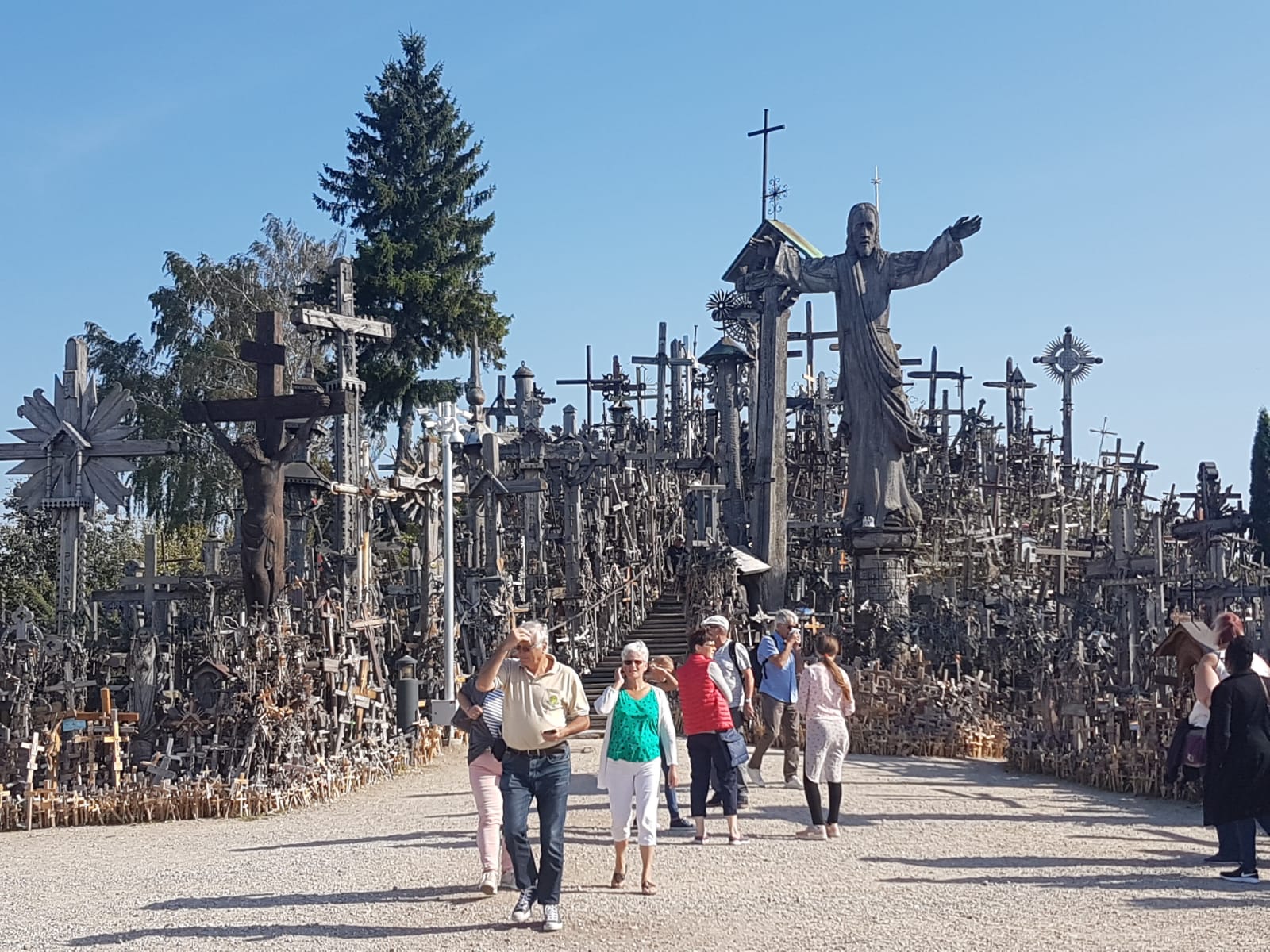
LITHUANIAN SPECIAL: The Hill of Crosses: Not Only Holy Place, But Symbolizes Struggle to Keep the Faith Alive When Was Under Communism
‘Religious freedom, like all other freedoms, must be respected and protected’
To be called a “hill” in Lithuania, it needs to be just a few feet tall, since the landscape, woods and meadows are flat as far as the eye can see. The location of the Hill of the Crosses is not far from the northern Lithuanian city of Siauliai. Someone traveling to Lithuania that wants to understand the country, cannot miss going to the Hill of Crosses.
And indeed “many people, may pilgrims, come here from all over the world to experience the holiness of the place, many pilgrims! From Poland, Spain, Italy, even from Asia,” says Father Andrius Dobrovolska, a priest involved in its history since the visit of Pope St. John Paul II.
The reason for the name is soon told: today, the crosses piled on this little hill, they say, are about 100,000, even if they are unable to count those that had been removed numerous times during Communism and the replaced, little by little, time and time again.
 Numbers aside, it is the story that counts, even if the beginnings are rather obscure. Perhaps a votive offering for a miraculous recovery was the first ‘cross’ planted here. Soon the crosses became tens, hundreds, until, after the end of the Second World War, Lithuania fell under atheistic Soviet Communist control.
“The Hill of Crosses is from one point of view a holy place, and on the other, a symbolic place, representing the struggle of the Lithuanians during the Communist period, to keep their faith alive. It became a kind of battlefield because the Communists were constantly trying to destroy it, to break down the crosses, but the people put it back at night. That’s why it’s a symbol of the struggle for independence.”
At least four times, the Communists removed all the crosses, but each time after, there was a new flowering of crosses. The people were not deterred. When the long-awaited independence brought with it religious freedom, the Polish Pope John Paul II decided that such a tenacious faith deserved the Pope’s homage, with a historic visit, dated September 1993; and the photos of the Polish Pope walking among those thousands of crosses have made the story of that extraordinary pontificate too.
“John Paul II came here, he celebrated mass, it was autumn like now, but it was very cold, so he thought it would be nice to have a place for the pilgrims, so that they would have some shelter, even in the case of cold, rain …” recalled Father Andrius.
Hence the request to the Franciscans, to found the convent which now stands next to the hill, where Father Andrius lives together with two other Franciscans, who are busy welcoming hundreds of visitors every day. The story tells that the idea of the convent came to the traveler Pope just a week later, visiting the Sanctuary of La Verna, in Italy.
“The stigmata are the symbol of the cross,” Father Andrius explains, “so St. John Paul II clearly thought that there was a relationship between these two places, because this is the hill of crosses, and La Verna as it is known is the place where St. Francis received the stigmata.”
Then with the passing of the years, the other installations arrived like parking lots, toilets, souvenir shops, since there is now no tourist guide that does not recommend a visit here. Among other things, with many of the crosses being artistically of value, the Hill is also a UNESCO World Heritage Site. But above all they remind those who arrive here were also by chance, believer and Christian or not, a great truth. A tourist says so simply: “religious freedom, like all other freedoms, must be respected and protected.”

No comments:
Post a Comment