Showing posts with label Archbishop Naumann. Show all posts

Monday, September 29, 2025

Archbishop Naumann rebukes Cardinal Cupich for honoring Senator Durbin; a source of scandal


Archbishop Naumann Accuses Cardinal Cupich of ‘Pastoral Neglect’ for Honoring Pro-Abortion Senator

The retired archbishop of Kansas City, Kansas — a past chairman of the U.S. bishops’ pro-life committee — is the latest American prelate to publicly chastise Chicago Cardinal Blase Cupich for honoring U.S. Sen. Dick Durbin, a long-standing advocate of legalized abortion


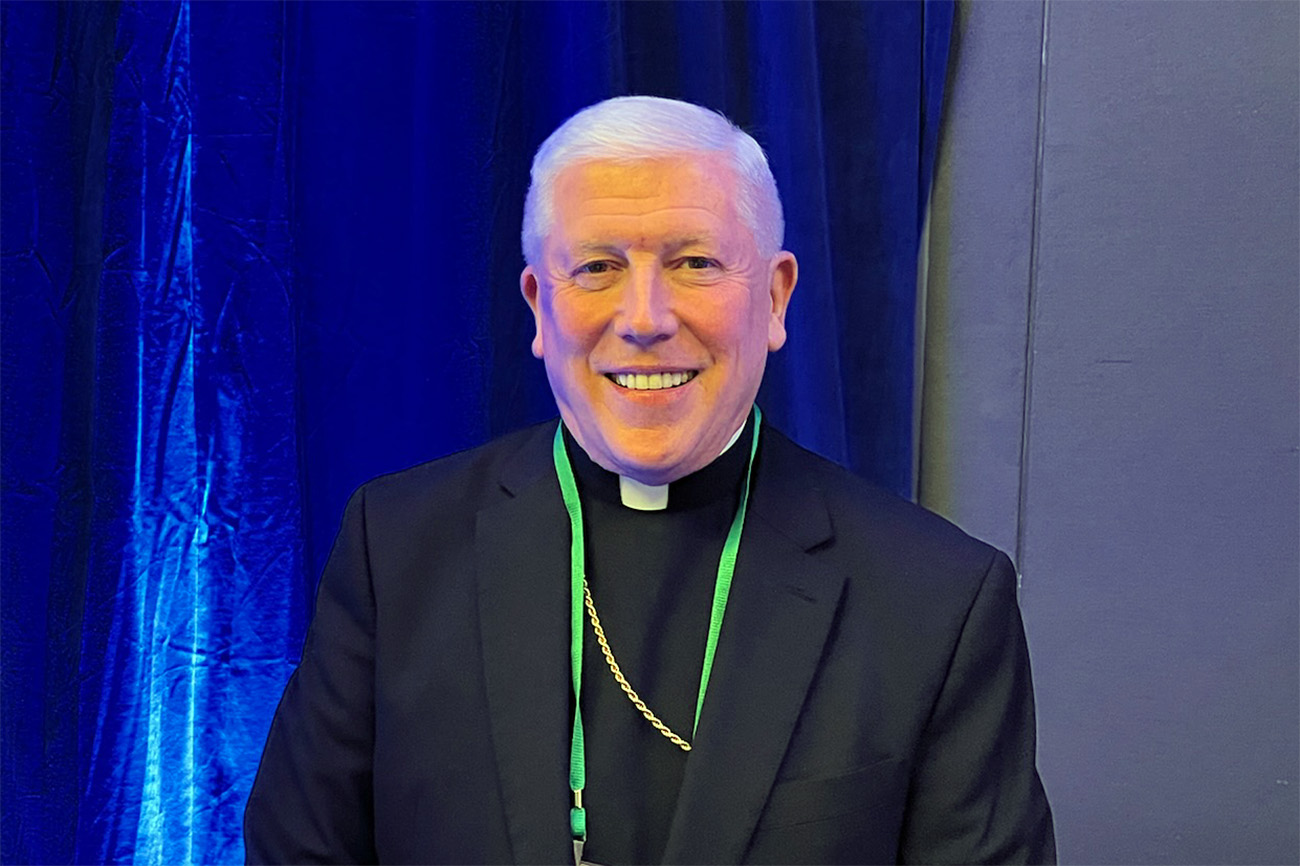
Archbishop Joseph Naumann of Kansas City, Kansas (photo: Scott Maentz / Flickr (CC BY 2.0) via CNA)

Another U.S. bishop has publicly rebuked Chicago Cardinal Blase Cupich for his plan to honor pro-abortion Sen. Richard Durbin with a lifetime achievement award.

In a statement released to the Register on Saturday, Archbishop Joseph F. Naumann, the recently retired ordinary of Kansas City, Kansas, said it is a “source of scandal” for the cardinal to recognize the Illinois senator in this way, calling it a case of “pastoral neglect.”

Archbishop Naumann is the latest American prelate to chastise Cardinal Cupich for deciding to honor Durbin — a Catholic politician whose own bishop banned him from receiving Communion in the Diocese of Springfield, Illinois — at the Chicago archdiocese’s Keep Hope Alive immigration-ministry fundraising dinner on Nov. 3.

Cardinal Cupich has steadfastly defended the move, saying the award is meant to recognize Durbin’s efforts to advance Catholic social teaching in immigration, care for the poor, environmental protection and the promotion of world peace.

“At the heart of the consistent ethic of life is the recognition that Catholic teaching on life and dignity cannot be reduced to a single issue, even an issue as important as abortion,” Cardinal Cupich said in a Sept. 22 statement.

In the same statement, the cardinal invoked the Vatican’s call for bishops to “reach out to and engage in dialogue with Catholic politicians within their jurisdictions ... as a means of understanding the nature of their positions and their comprehension of Catholic teaching.”

But Archbishop Naumann, a past chairman of the U.S. Conference of Catholic Bishops’ pro-life committee, said such a rationale “makes no sense.”

“Dialogue does not require giving awards to Catholic political leaders who disregard the most fundamental of human rights, the right to life of the unborn,” he said in his statement.

Archbishop Naumann emphasized that the USCCB “has consistently identified the protection of unborn children and their mothers from the tragedy of abortion as the primary human rights issue of our time.”

He explained that the bishops’ conference takes this position because abortion: “attacks the life of the most innocent and vulnerable;” “harms the family and the most fundamental of human relationships by pitting the welfare of mothers against the lives of their own children;” destroys innocent life on a “horrific magnitude,” and harms the women involved “physically, emotionally and spiritually.”

“Moreover, legalized abortion encourages the irresponsibility of men by absolving them from providing for the children they have fathered as well as caring for their mothers,” Archbishop Naumann said.

“Ignoring the policies and recommendations of the Bishops Conference is not synodal and serves to fracture unity,” he added. 

To date, eight active diocesan ordinaries in the U.S. have publicly disagreed with Cardinal Cupich's move to honor Durbin. Springfield Bishop Thomas Paprocki was the first to voice his opposition. Since then, the following prelates have issued statements opposing the honor and calling for Cardinal Cupich to reconsider his decision: Archbishop Salvatore Cordileone of San Francisco; Bishop James Conley of Lincoln, Nebraska; Bishop James Wall of Gallup, New Mexico; Bishop David Ricken of Green Bay, Wisconsin; Bishop Carl Kemme of Wichita, Kansas, Bishop James Johnston of St. Joseph-Kansas City, Missouri and Bishop Michael Olson of Fort Worth, Texas.


Editor's note: This story was amended the evening of Sept. 27, 2025, after posting, to correct the tally of current diocesan bishops who have spoken out against honoring Sen. Dick Durbin.

Friday, May 30, 2025

New Archbishop installed in Archdiocese of Kansas City


‘Pope Francis gave me to you — I belong to you now,’ says Kansas City’s new archbishop


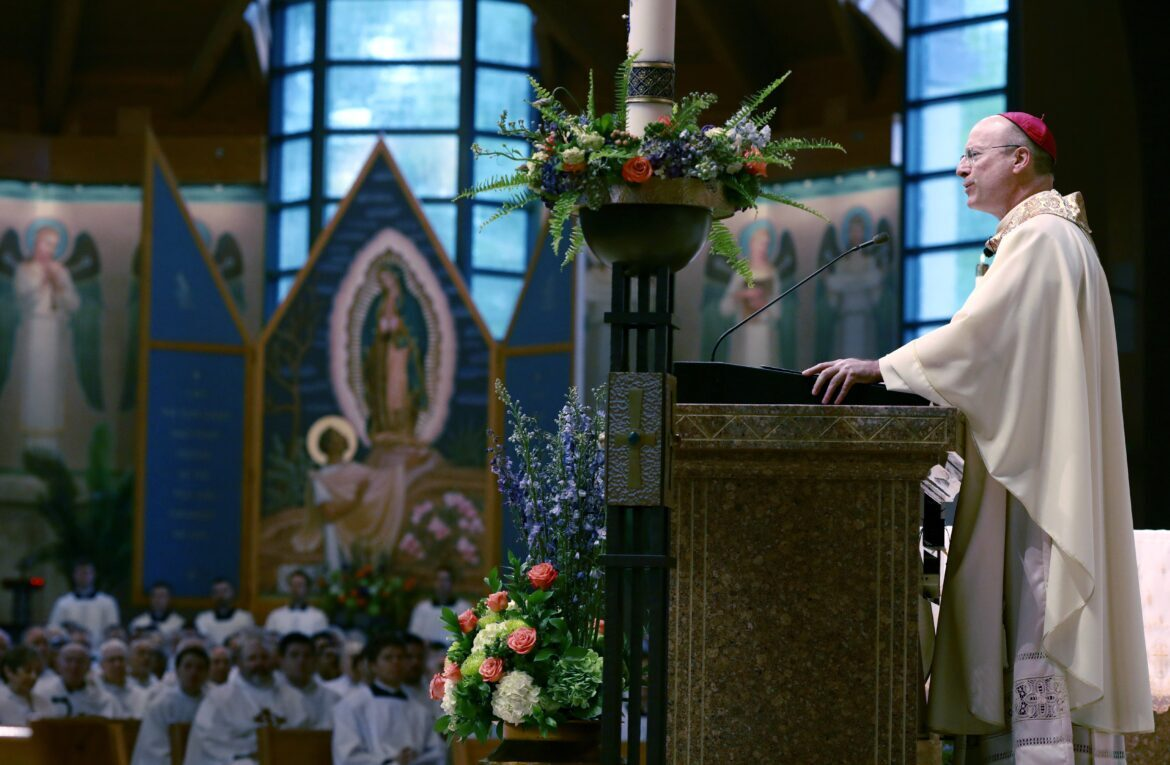
Archbishop W. Shawn McKnight delivers the homily at his installation Mass at Church of the Nativity in Leawood, Kan., on May 27, 2025. He was installed as the 12th bishop and fifth archbishop of the Archdiocese of Kansas City in Kansas. (OSV News photo/Jay Soldner, The Leaven)

LEAWOOD, Kan. (OSV News) — “As your new archbishop, I come to you with a sense of mission to proclaim Jesus Christ risen from the dead, and to lead our local church in Kansas City in Kansas in the fulfillment of our mission together,” said Archbishop W. Shawn McKnight.

He was installed as the 12th bishop and fifth archbishop of the Archdiocese of Kansas City in Kansas during an installation Mass at Church of the Nativity in Leawood May 27.

He succeeds Archbishop Joseph F. Naumann, 75, Kansas City’s shepherd since Jan. 15, 2005. Pope Francis named then-Bishop McKnight of Jefferson City, Missouri, to Kansas City on April 8. 

Archbishop McKnight’s message to northeast Kansas was part of a brief six-minute homily.

‘I Have a Big Heart of Gratitude’

“You got away with a short sermon,” he said, which drew a laugh at the end of Mass, “but only because I have a big heart of gratitude that will take some time (to express).”

He then went on to thank various individuals and groups for their support of him over the years, including his loved ones who have died.

“I am eternally grateful for the faith, love and devotion of my deceased parents, Mary and Gary (Schaffer),” he said, “who nourished and supported me throughout my journey.

“To them and all three sets of my grandparents, I owe a debt of gratitude.”

Cardinal Christophe Pierre

The installation Mass was officiated by Cardinal Christophe Pierre, apostolic nuncio to the United States, who thanked those gathered for their prayers during the conclave and election of Pope Leo XIV.

“I am happy to be here representing him, and I have the privilege of conveying to you his affection and his spiritual communion,” he said.

Ministers of the liturgy were Archbishop McKnight, Cardinal Pierre, Archbishop Naumann, Cardinal Blase J. Cupich of Chicago and Cardinal Robert W. McElroy of Washington. Priests from the archdiocese and beyond concelebrated.

Several deacons and religious, Archbishop McKnight’s family and friends, ecumenical and interfaith leaders, and lay representatives from parishes around the archdiocese were also in attendance.

Various Styles of Music at Mass

The Mass featured various styles of music, including by the Nativity choir and the gospel choir from Our Lady & St. Rose Parish in Kansas City, Kansas.

It also showcased the diverse cultural tapestry of the archdiocese, as each intercession was offered in a different language by a representative of that language group.

A highlight of the Mass came early on when Cardinal Pierre read the apostolic mandate to the congregation, and Archbishop McKnight accepted it.

The archdiocesan college of consultors inspected the apostolic mandate; Father John Riley, chancellor and vicar general of the archdiocese, certified the inspection; and then Archbishop McKnight brought forward the apostolic mandate to show the faithful.

‘Bring Glad Tidings to the Lowly’

In his homily, the archbishop echoed Pope Francis’ desire for the church to “effectively bring glad tidings to the lowly, to heal the broken-hearted, to proclaim liberty to captives and release prisoners, and to comfort all who mourn.

“This was the mission of Jesus of Nazareth, and it is ours today,” he said.

The archbishop also asked for prayers from his new flock as he begins his ministry.

“Pope Francis gave me to you — I belong to you now,” he said. “Please pray for me, that I may lead our local church with a sense of co-responsibility, recognizing the right and obligation of all the baptized to take up their unique roles in the life and mission of the church.”

‘Closer to the Chiefs and Royals!’

At the end of Mass, Archbishop McKnight expressed his gratitude to Pope Francis for his appointment as archbishop and his happiness “that if I had to leave the Diocese of Jefferson City, he at least moved me closer to the Chiefs and Kansas City Royals!”

The archbishop, 56, congratulated Archbishop Naumann for more than 20 years of service to the archdiocese.

“Thank you for your service, devotion and witness of faith over a long expanse of time,” he said. “I hope you will find retirement enjoyable and fulfilling, and that God may bless your new episcopal ministry with abundant graces.”

Archbishop McKnight recognized the three cardinals who were present for the Mass and thanked them for their election of Pope Leo — the first American pope.

Pilgrims in Rome and Papal Election

“I think everyone in this room never thought that would be possible,” he said. “In God’s providence, I was in Rome on pilgrimage for the Holy Year with 30 pilgrims from the Diocese of Jefferson City while you three were at work in the Sistine Chap

“Thank you, cardinals, for finishing quickly enough so that my band of pilgrims could be present for such a historic and blessed occasion. Thank you for serving as instruments of the Holy Spirit in the gift of Pope Leo to us all.”

Archbishop McKnight thanked the bishops present, as well as the clergy and faithful of the Diocese of Jefferson City, where he served as bishop for the past seven years, and his home diocese, the Diocese of Wichita, Kansas, where he was ordained a priest on May 28, 1994.

He also expressed appreciation for the archdiocesan chancery staff who assisted his transition to northeast Kansas.

“It isn’t easy for anyone to move, but to move a sitting bishop to an archdiocese takes more than a village,” he said.

After the Mass, the archbishop took questions from the media in the Nativity chapel and greeted attendees at a reception at the parish school gym.

This story was originally published by The Leaven, the news outlet of the Archdiocese of Kansas City. Moira Cullings is on the staff of The Leaven.

Tuesday, April 8, 2025

Bishop/Archbishop assignments today in Baltimore and Kansas City


Pope Francis Appoints Bishop Bruce Lewandowski as Bishop of Providence

Pope Francis has appointed Most Reverend Bruce A. Lewandowski, CSsR, auxiliary bishop of the Archdiocese of Baltimore, as Bishop of Providence.


WASHINGTON - Pope Francis has appointed Most Reverend Bruce A. Lewandowski, CSsR, auxiliary bishop of the Archdiocese of Baltimore, as Bishop of Providence. The appointment was publicized in Washington, D.C. on April 8, 2025, by Cardinal Christophe Pierre, apostolic nuncio to the United States.

The Diocese of Providence is comprised of 1,085 square miles in the State of Rhode Island and has a total population of 1,097,379, of which 598,990, are Catholic.


Pope Francis Accepts Resignation of Archbishop Joseph Naumann of the Archdiocese of Kansas City in Kansas; Appoints Bishop W. Shawn McKnight as Successor

Pope Francis has accepted the resignation of Archbishop Joseph F. Naumann, 75, from the pastoral governance of the Archdiocese of Kansas City in Kansas, and has appointed Bishop W. Shawn McKnight of Jefferson City, as his successor.


Friday, April 4, 2025

Kansas Priest senselessly murdered in Kansas


Portrait of Father Raj "Arul" Carasala, pastor of Sts. Peter and Paul Parish in Seneca, Kansas, who was fatally shot in his rectory April 3, 2025. Archbishop Joseph F. Naumann of Kansas City, who traveled to Seneca to console the community and celebrate a Mass, called the attack a "senseless act of violence" and mourned the loss of a "beloved priest, leader and friend." (OSV News photo courtesy of Archdiocese of Kansas City)


Kansas pastor fatally shot in his rectory

(OSV News) — The pastor of a parish in Seneca, Kansas, was shot in his rectory and later died of his injuries at a local hospital April 3.

In a message shared on social media, Archbishop Joseph F. Naumann of Kansas City in Kansas said he was “heartbroken to share the tragic news” of the death of Father Raj “Arul” Carasala. “This senseless act of violence has left us grieving the loss of a beloved priest, leader, and friend,” he said.

“Fr. Carasala was a devoted and zealous pastor who faithfully served our Archdiocese for over twenty years, including as dean of the Nemaha-Marshall region,” he continued. “His love for Christ and His Church was evident in how he ministered to his people with great generosity and care. His parishioners, friends, and brother priests will deeply miss him.”

By late afternoon April 3, the Kansas Bureau of Investigation announced an arrest had been made in connection to the shooting death of Father Arul, 57. Gary L. Hermesch, 66, of Tulsa, Oklahoma, was arrested and booked into the Nemaha County Jail for first-degree murder.

Archbishop Naumann calls Father Carasala’s death ‘ a senseless tragedy’

A message from the diocese’s vicar general shared by the parish’s social media said Archbishop Naumann had gone to Seneca to console and pray with Sts. Peter and Paul parishioners and area priests.

The Knights of Columbus led the rosary at 6 p.m. April 3, followed by a 7:30 p.m. Mass celebrated by Archbishop Naumann. A cantor sang “Be Still My Soul” a cappella as mourners filled the church.

In his opening remarks, Archbishop Naumann again called Father Carasala’s death a “senseless tragedy.”

“Father Arul spent his life making this Blessed Sacrament available to us, and so I think this would please him to see this church full tonight and drawing ourselves into the presence of the Risen Lord,” the archbishop said.

Father Carasala originally from India and served in Kansas since 2004

Father Carasala had served since 2011 as pastor of Sts. Peter and Paul Parish in Seneca, a town with a population around 2,100 about 115 miles northwest of Kansas City. According to a biography on the parish’s website, he was ordained a priest for the Diocese of Cuddapah in southeast India in 1994 and began ministering in Kansas in 2004, where he served at several parishes before his last assignment. He became an American citizen in 2011.

“In this time of sorrow, let us entrust Fr. Carasala to the mercy of God and lift up in prayer his family in Cuddapah, India, his parish community at Saints Peter and Paul in Seneca, and all who mourn his passing. Let us also pray for the perpetrator, that God may touch and transform his heart,” Archbishop Naumann said in his social media statement.

“There is no ongoing threat to the community, but I recognize the pain and shock that such an event brings. In moments like these, we turn to our Lord, who is close to the brokenhearted,” he continued. “As we grieve, may we find strength in our faith and in the hope of Christ’s Resurrection.”

Wednesday, November 20, 2024

Catholic Bishops to focus on abortion's impact on the family

 Chair of US bishops' 'pro-life' committee wants Catholics to see abortion's impact on families

BALTIMORE (RNS) — Toledo, Ohio, Bishop Daniel Thomas took the reins from Arlington, Virginia, Bishop Michael Burbidge on Wednesday (Nov. 13).


Aleja Hertzler-McCain

November 19, 2024


BALTIMORE (RNS) — Ever since the 2022 Dobbs v. Jackson Women’s Health Organization Supreme Court case struck down the national right to abortion, anti-abortion advocates, including the Unites States’ Catholic bishops, have struggled to gain voters’ support in limiting access to the procedure at the state level.

On Election Day, abortion rights amendments passed in seven of 10 states, extending an unbroken series of losses for abortion foes dating back to Kansas’ amendment battle in 2022. Even as Florida’s amendment failed to pass (along with South Dakota’s and Nebraska’s), Floridians — 57% of whom voted “yes” — only narrowly missed hitting the 60% required for approval.

American Catholic voters have undoubtedly been part of the abortion access amendments’ success. Surveys find that about 6 in 10 Catholics support keeping abortion legal, in defiance of Catholic teaching and despite their bishops’ identifying it in 2019 as their “preeminent priority.”

How the bishops navigate this landscape will depend in part on Toledo, Ohio, Bishop Daniel Thomas, who was elected last fall to lead their Committee on Pro-Life Activities and began his three-year term on Wednesday (Nov. 13). 

In electing Thomas by an almost two-thirds majority, the bishops declined to elevate San Francisco Archbishop Salvatore Cordileone, who had banned former House Speaker Nancy Pelosi from receiving Communion over her backing of abortion rights. Their decisive vote was seen as a rejection of the more militant and strident position on the issue.

But the Toledo bishop, who celebrated his 10th anniversary in his diocese last month, calling his service 10 years of “unmerited grace,” intends to advance the conference’s opposition to abortion. He has served as a consultor to the Committee on Pro-Life Activities since 2016, becoming a member in 2022. In July, he led a breakout session at the National Eucharistic Congress on “Christ’s Eucharistic Love and Mercy: Our Source for Healing After Abortion.”

On the first day of the bishops’ recent meeting in Baltimore, Thomas sat down with RNS for an interview, and he echoed some of the rhetoric of his predecessor, Bishop Michael Burbidge of Arlington, Virginia, who called abortion rights amendments “extreme.” This interview has been lightly edited for length and clarity.


What is your strategy for leading this committee? 

The first strategy, of course, is the gospel of life of Jesus Christ. We take our word directly from Jesus: “I am the way, the truth, and the life.”

Then the strategy is for us to try to promote life, the dignity and sanctity of every human life, from conception until natural death. Of course, the strategy itself is to use everything in our means to announce that reality, to defend that reality, to offer our service, our advocacy, our education, all through the conference for the good of all the dioceses and obviously the shepherds throughout the United States.

So the effort is to literally provide that resource to them, and then also to provide a united national voice because it’s the national conference of Catholic bishops.

Kansas City, Kansas, Archbishop Joseph Naumann, a former chair of the Pro-Life Activities Committee, said earlier today that the results of abortion rights ballot initiatives should be a wake-up call for the conference. Do you see it that way? What is your response to Catholics who voted for abortion rights?

The strategy is going to have to be, how do we best address those realities? How do we best address our Catholics who perhaps, for one reason or another, simply don’t understand really how radical some of these ballot initiatives have been. We want to be able to inform and to evangelize and to equip Catholics so they can best understand what it is we believe about the human person, what it is we believe about a conception — that this is a human being, that this is a child of God, and that we can help those understand not just what abortion does to children, but what abortion does to women, and also to men, what it does to family.

So for us, the fundamental reality, of course, is the defense of life, and for us, violence against children is, as the U.S. bishops have said repeatedly, a preeminent concern because that concern is the most basic fundamental right, the right to life.

What needs to change to get more everyday Catholics to subscribe to church teaching on this issue? 

The conversion of hearts and minds is what needs to change. So the strategy will be to try to help people to understand not just what is it we’re saying, but why is it we’re saying that. 

For years, a lot of people said, well, I don’t necessarily follow religion, I follow science. Well, now science supports what the church has taught for forever. Simple things, like the science of a sonogram has taken us light years into the appreciation of women, for the life of the child in their womb. 

I do believe that in the end, helping people to understand not just, here is the teaching, but why we teach what we teach, and we teach that because we teach it out of love. We teach it out of respect. We teach it out of the understanding that this is what Jesus invites us to teach and to proclaim.

It’s also because Jesus himself became a human person in the womb of Mary. There is no greater representative of the reality of respect for life in the womb than the very fact that Jesus himself came as a vulnerable child in the womb. I think that’s the opening, if you will, to the conversion of hearts and minds. 

My colleague Jack Jenkins and NPR reporter Rosemary Westwood have reported that, in this last year compared to previous years, U.S. Catholic bishops’ spending on abortion-related ballot amendments was down. Have there been conversations at the national level about when it makes sense to spend or not spend? Or has that been a decision taken individually by each bishop? 

I couldn’t speak of course to what an individual state, province, for example, spends on ballot initiatives. I can say that there’s no possible way that the church can outspend the extraordinary amount of money that has poured into these various states for the ballot initiatives. Several bishops have told me that the money in their states did not come from their own people or from the area. It came from radical people from outside the state. I had that experience as a bishop in Ohio, where, sadly, (abortion rights) was voted for. It’s a question of conversion of minds and hearts. It’s certainly not, in the end, a question of money. 

In three years, what will you hope to have accomplished?

I would hope in three years I will have assisted in some very small way the leadership of the committee for the conference. And for all of our bishops, shepherds, and the people of God, I would hope I would have steered them to the one who is the way, the truth and the life. If we’ve steered them to Jesus, if we’ve proclaimed Jesus, if we’ve taught Jesus, and if we’ve announced Jesus in all we do, then that’s all I could possibly hope for.

Friday, December 15, 2023

Illegal immigration and new rules plays havoc for foreign born Priests in the United States


‘A Lightning Bolt’ — Visa Rule Change Upends Placements for Foreign-Born Priests

The unprecedented flood of undocumented immigrants has resulted in unanticipated restrictions on the availability of visas for religious workers from other countries.


REDWOOD CITY, Calif. — Only nine months ago, Father Edgardo Rodriguez, a Salvadoran priest beloved in his California parish, was on a clear path to securing permanent residency in the United States.

He expected to live out his vocation in the Archdiocese of San Francisco, where he had served since 2018 and applied for incardination with the support of Archbishop Salvatore Cordileone.

Instead, to the shock of Father Rodriguez, his parish community and the archdiocese, the priest was notified by U.S. immigration authorities last April that he would have to return to his home country for one year and apply for reentry, restarting the entire process for securing a lawful permanent residency card, commonly called the green card. 

“We lost a great priest,” said Father Thomas Martin, the pastor of St. Pius Church and administrator of St. Anthony Church in Redwood City, California, where Father Rodriguez ministered to a large community of Hispanic Catholics and “cared for the poor and marginalized.”

Father Rodriguez is not alone. A U.S. visa rule change that was finalized in April has disrupted what was once a seamless and predictable process for priests like Father Rodriguez. Instead of obtaining a green card in a timely manner, thousands of religious workers, including Catholic priests seeking permanent residency in the United States, now face a sudden — and lengthy — backlog of visa applicants that prevents them from obtaining a green card before their initial visa expires. 

Thus far, the visa rule change has received scant attention in Church circles or Catholic media, and many foreign-born priests who had expected to obtain a green card in the next couple of years are still unaware of the looming roadblock.

But the stakes are high for international priests who hope to minister in this country — and for the many U.S. dioceses that depend on them to fill as much as 50% of parish placements. 

“The impact of this change is just beginning to be felt,” Archbishop Joseph Naumann of Kansas City, Kansas, told the Register, expressing both disappointment and puzzlement at the government’s reasons for making the change.

“We are getting no reassurance from federal agencies” that this can be fixed, said Archbishop Naumann, though “the federal branch that created the problem could resolve it.”

Father Joel Henson, the Archdiocese of Los Angeles’ vicar for clergy, told the Register that two international priests have already returned to their home country after it became clear that they could not obtain a green card before their initial visa expired. Deacons now administer those parishes and recruit local priests to provide the sacraments.

Father Henson reported that 50% of priests in the archdiocese, the largest in the nation, are foreign born. Many have already obtained permanent residency or U.S. citizenship. But 10% of the priests hold a temporary R-1 immigrant religious worker visa capped at five years, and Father Henson could not say how many priests in this group hoped to remain permanently in the U.S. and so could face similar difficulties.

Rule Change

Until April, an international priest’s path to a green card was straightforward and generally granted once the newcomer was approved for incardination by the local bishop.

The process for most international priests still begins with an R-1 nonimmigrant religious worker visa. Once the applicant has successfully served in a parish or other assignment for a couple of years, the diocese sponsors the priest for   permanent residency, generally through an EB-4 (employment-based) special immigrant category, which allots 10,000 visas per year. 

Until this year, applicants in the special immigrant category, which also includes juvenile immigrants and former employees of federal agencies abroad, “never faced a backlog,” said Miguel Naranjo, director of the Religious Immigration Services section of the Catholic Legal Immigration Network, Inc. (CLINIC), which works with U.S. dioceses and religious communities to bring foreign-born church workers and seminarians into the U.S. 

Then, earlier this year, “the State Department and Homeland Security announced in the federal register that there had been a misapplication or a misinterpretation of the law in the way the government had calculated the number [of applicants who could apply for a visa from this category].”

The ballooning immigration crisis at the southern border of the U.S. provided the context for the shift in federal immigration policy. 

“A large number of juveniles have come across the border and applied to that special immigrant category,” explained Naranjo, and the government put limits on applicants from El Salvador, Guatemala and Honduras. 

The government now argues that its past treatment of this class of applicants was a mistake that must be addressed by increasing the number applying from the three Central American countries to make up for the past restrictions. 

Naranjo estimated that the resulting backlog for other applicants in this category will be lengthy.

“It will be five, seven or even 10 years before a religious worker or anyone else in the special immigrant category will be able to obtain permanent resident status,” he said.

He described the decision as “a lightning bolt that came out of nowhere.”


Seeking Solutions

Naranjo’s organization has joined with the U.S. Conference of Catholic Bishops and other religious leaders of all faiths to advocate for a resolution.

If the new rule cannot be rescinded, the USCCB and other U.S. faith leaders have proposed that the one-year delay before religious workers can reapply for a new R-1 nonimmigrant religious worker visa be reduced to six months or even 90 days. A shorter period outside the country, they say, would limit the costs to the applicant and the disruption to pastoral placements in the U.S.

“That one-year period is really problematic for dioceses and other Catholic institutions that are employing these religious workers,” David Spicer, senior policy advisor for migration and refugee services at the USCCB, told the Register. “Having a priest away from his parish for a year isn’t sustainable.” 

Spicer noted that the rule change could also affect Catholic schools and nursing homes staffed by foreign-born men and women religious, as well as pastoral programs that depend on well-formed lay immigrants who share the language and culture of newly arrived Catholics. 

Experts advising religious leaders are also exploring other visa program options for international religious workers.

Randy McGrorty, the CEO for Catholic Legal Services in the Archdiocese of Miami, told the Register that his office typically handles applications for 12 church workers per year, and it is now exploring a visa program facilitated by institutions of higher education, though he was not prepared to provide details at this time.

Another possibility is the H-1B visa program, which is designed for applicants who wish to perform services in a specialty occupation, like computer science. But this program features significant costs and other burdensome conditions that make it less appealing for most religious employers.


Stakes Are High

Religious leaders of all faiths have also asked members of Congress for help, but that polarized legislative body has been slow to address immigration issues, and there is little hope it will act quickly now.

Indeed, over many decades, the U.S. bishops have been at the forefront of the campaign for immigration reform, while urging the faithful to welcome asylum-seekers who arrive in this country.

Now, as U.S. states and cities struggle to feed and house an unprecedented surge of undocumented migrants, local dioceses have also become entangled in the nation’s broken immigration system in an unexpected way.

The government is “struggling to deal with the volume of people coming into the country,” said Archbishop Nauman, and “one of the consequences” of that escalating crisis is the visa rule change for religious workers.

Asked to assess the impact of this change in his archdiocese, Archbishop Naumann predicted that over the next five years, at least “six priests and 13 religious will have to leave the U.S. for a year before reapplying for another R-1 visa.” 

Obtaining the new visa will allow them to return to the U.S. for another five years. But it will not get them any closer to securing permanent residency, unless and until the backlog in the special immigrant category is cleared up. 

“This prevents us from having foreign-born priests long term,” he said. “In many ways, it takes five years before they hit their stride.”

The archbishop is also concerned about the impact of the backlog on priests and religious who already have green card applications pending. 

Though their paperwork has been finalized, the backlog will likely prevent them from receiving their EB-4 immigrant visa for as long as a decade. And that delay will effectively bar them from leaving the country to visit family back home during this period, he noted. If they travel without a green card, they could jeopardize their application for permanent residency. 


‘This Affects Everyone’

Given the challenges ahead, Archbishop Naumann is worried about the broader impact of visa problems on the Church in the U.S., which has depended on immigrant priests, religious and lay ministers to advance its mission since its infancy.

At the same time, he also expressed gratitude for the foreign-born priests and religious women in the archdiocese  and singled out a group of Indian women religious who staff a Catholic nursing facility.

“It is a grace,” he said, “to have excellent nurses who also bring a faith dimension to their work.” 

Pallottine Father Frank Donio, executive director of the Conference of Major Superiors of Men, echoed the archbishop’s remarks as he emphasized the international origins and character of the Church in the United States.

“Many Catholic religious communities came here from Ireland, France, Poland, Italy, Germany and Spain to serve European immigrants, while we have always had priests from Latin America,” said Father Donio. “Now, there are priests from Asia and Africa. The reality of priests and brothers coming to this country to serve the needs of the people is part of the past and the present.”

With that history in mind, he stressed that the U.S. visa rule change will force international religious orders to rethink pastoral placements and other staffing responsibilities in this country.

“This affects everyone,” said Father Donio. “That is why we are working together with the USCCB, the Leadership Conference of Women Religious and other religious communities” to find a resolution. 

For now, however, Church leaders, chancery officials and legal experts contacted by the Register could offer no immediate hope for a solution. But they suggested that religious orders might have more wiggle room to address staffing problems, while dioceses would have to get more creative and flexible.

And back in Redwood City, Father Thomas Martin is keeping a spot open for Father Rodriguez. 

“He will return here,” said Father Martin, with confidence. “He has the permission of his archbishop [in El Salvador] to excardinate. We speak every two weeks.” 

Saturday, March 4, 2023

Archbishop Naumann joins Bishop Paprocki in defending Traditional Latin Mass communities


Archbishop Naumann and Bishop Paprocki Speak Out in Support of Traditional Latin Massgoers in Their Dioceses

In the wake of new restrictions on the traditional Latin Mass, two American bishops spoke with EWTN’s Raymond Arroyo Thursday about how their dioceses have responded.


L to R: Bishop Thomas Paprocki of the Diocese of Springfield, Illinois, and Archbishop Joseph Naumann from the Archdiocese of Kansas City, Kansas, speak with EWTN's Raymond Arroyo on ‘The World Over with Raymond Arroyo’ on March 2. (photo: EWTN)

In the wake of new restrictions on the traditional Latin Mass, two American bishops spoke with EWTN’s Raymond Arroyo Thursday about how their dioceses have responded.

Bishop Thomas Paprocki of the Diocese of Springfield, Illinois, and Archbishop Joseph Naumann of the Archdiocese of Kansas City, Kansas, both defended the traditional Latin Mass communities within their dioceses during their interviews on The World Over with Raymond Arroyo March 2. 

Pope Francis issued a motu proprio titled Traditionis Custodes on July 16, 2021, which put heavy restrictions on the traditional Latin Mass. The order directed bishops to designate locations for the traditional Latin Mass but stated none of the locations should be within parish churches. Because a lot of dioceses already had thriving Latin Mass communities within parishes, some bishops offered dispensations, which allowed those Masses to continue as before.

Cardinal Arthur Roche, the prefect for the Dicastery for Divine Worship and the Discipline of the Sacraments, issued a rescript on Feb. 21, which is a formal clarification from the Vatican. It stated that such dispensations are reserved to the Holy See and ordered bishops who had issued those dispensations to “inform the Dicastery for Divine Worship and the Discipline of the Sacraments, which will evaluate the individual cases.”

Bishop Paprocki said during the EWTN interview that he questions “the wisdom” of the rescript and suggested that it “seems to contradict what Pope Francis himself said when he issued the motu proprio,” which Bishop Paprocki interpreted to say that bishops had discretion to decide how to implement the restrictions “on a case-by-case basis” within their dioceses.

In addition, Bishop Paprocki questioned the legal basis for not allowing the dispensations already granted by bishops to remain in effect.

“I would argue Canon 9 says that laws in the Church are not retroactive, so any dispensations that have already been given remain in effect,” Bishop Paprocki said. “But I would also recognize the validity of this new rescript and the restriction that is being placed upon diocesan bishops.”

Bishop Paprocki added that these judgments are best made by the bishop based on the principle of subsidiarity, which maintains that “decisions should be made at a local level” unless there’s an overriding reason.

“I’ve yet to see what that reason would be” in the case of these dispensations, Bishop Paprocki said.

Instead, he said, “you’ve got a prefect in Rome basically making decisions about what’s happening in the local diocese and the local parishes.”

When the motu proprio was originally issued, the Diocese of Springfield had two parish churches that offered the Latin Mass. Bishop Paprocki noted that one of the parishes has a priest from the Priestly Fraternity of St. Peter (FSSP), which was given a dispensation from the Vatican. The bishop designated the other church as a non-parish church. 

“My predecessor merged two parishes together, but he kept the two churches open,” Bishop Paprocki told Arroyo. “And so when the Holy Father, in his motu proprio Traditionis Custodes, said that you can’t have the traditional Latin Mass at a parochial church, I simply designated one of those churches as non-parochial. And so, therefore, we’re in compliance with that decree.”

Archbishop Naumann noted that the Archdiocese of Kansas City has not been greatly affected by the Vatican’s orders because there are two traditional Latin Mass communities operated by FSSP, which has a dispensation from the Vatican.

“I would say the people in those communities, I find them to be very sincere,” Archbishop Naumann said. “And they love the Lord; they love the Church; they love the Eucharist. I think what the Pope was trying initially to correct is, there was an attitude, I think, amongst some, that there was a superiority [of] the Tridentine Mass, to the Novus Ordo, and I think that was an error. But I don’t think that’s how most people in those communities see things. And I think they’re confused by the limitations that are being put upon even bishops in making pastoral judgments.”