Showing posts with label Archbishop Shawn McKnight. Show all posts

Tuesday, August 19, 2025

A new Bishop in Missouri


Pope Leo XIV Names New Bishop for Jefferson City, Missouri

Bishop-elect O’Donnell has most recently served as pastor of St. Margaret Mary Parish in Omaha.


Father Ralph O'Donnell, bishop-elect of Jefferson City, Missouri. (photo: Courtesy photo / Diocese of Jefferson City )


Pope Leo XIV has named Father Ralph O’Donnell of the Archdiocese of Omaha as the new bishop of Jefferson City, Missouri. He will succeed Archbishop Shawn McKnight, who in May was installed as archbishop of Kansas City, Kansas.

Bishop-elect O’Donnell has most recently served as pastor of St. Margaret Mary Parish in Omaha.

Born on Aug. 31, 1969, in Omaha, he earned a bachelor’s degree in religious studies from Conception Seminary College and a Master of Divinity degree from the University of St. Mary of the Lake/Mundelein Seminary. He later obtained a master’s degree in spirituality from Creighton University.

Ordained a priest in 1997, O’Donnell has served in various pastoral and administrative roles, including vocations director, seminary vice rector, and executive director of the U.S. bishops’ Secretariat for Clergy, Consecrated Life, and Vocations (2015–2019).

Wednesday, June 4, 2025

When Permanent Deacons realize there are Bishops who "get it" about the Permanent Diaconate.


Deacons feel ‘seen’ by Archbishop McKnight


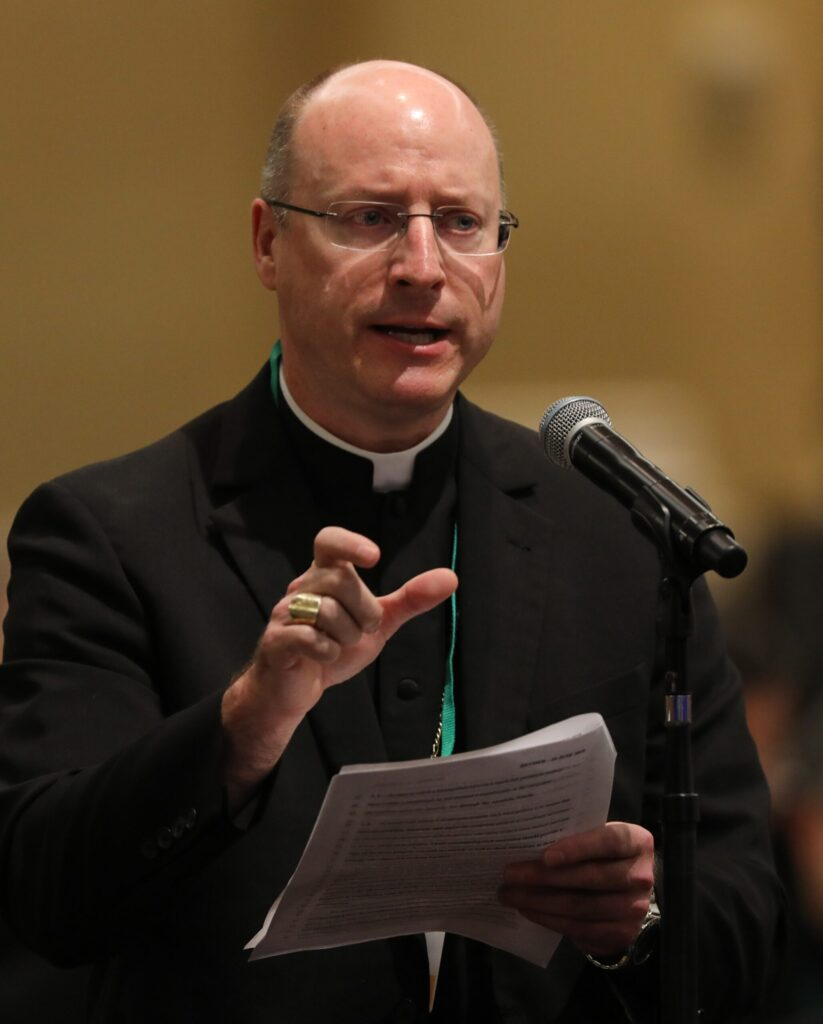
Bishop W. Shawn McKnight of Jefferson City, Mo., speaks from the floor on the first day of the spring general assembly of the U.S. Conference of Catholic Bishops in Baltimore June 11, 2019. CNS PHOTO/BOB ROLLER


by Tom Hoopes
Special to The Leaven

ATCHISON — Deacons in northeast Kansas have a special reason to be grateful for the archdiocese’s new leader: He is regarded as one of the nation’s foremost scholars of the diaconate.

Just ask the best-known deacons in America.

Deacon Greg Kandra, an award-winning journalist and author who created the blog “The Deacon’s Bench” told The Leaven that “Archbishop McKnight is unique among American bishops,” having devoted hours to the diaconate as “a serious ministry deserving of serious study.”

Deacon Bill Ditewig, author of “Courageous Humility: Reflections on the Church, Diakonia and Deacons,” told The Leaven that Archbishop McKnight’s “views are particularly valuable because they are well-researched, moderate and balanced.”

Deacon Leon Suprenant, director of the archdiocesan office of the permanent diaconate, is another nationally known deacon.

He said Archbishop McKnight “is one of the very few ‘experts’ in the field. And it is huge and exciting — and scary! — for me . . .  to have a bishop who obviously is interested in — and so knowledgeable about — the permanent diaconate.”

Archbishop McKnight’s doctoral dissertation was a deep dive into the theology, history and current status of the diaconate. He has taught classes on the subject at the Pontifical College Josephinum in Ohio and at St. Meinrad Seminary in Indiana.

“He also gained valuable practical experience on the diaconate when he headed the Secretariat of Clergy, Consecrated Life and Vocations for the U.S. bishops, said Deacon Ditewig, who is the former executive director of the U.S. bishops’ Secretariat for the Diaconate. In Washington, Deacon Ditewig found Archbishop McKnight to be “a wonderful collaborator, with a great sense of humor, and passionate about ministry and giving our best to the people we serve.”

Archbishop McKnight published “Understanding the Diaconate” in 2018.

“The book significantly contributes to the literature on the diaconate, by providing a clear foundation for the deacon’s function  —  based on history, theology, sociology and pastoral ministry,” said theologian Ella Johnson at St. Ambrose University in Davenport, Iowa, in a review. “It should be required for every ordained deacon and those in formation.”

In the book, Archbishop McKnight wrote: “The deacon’s role cannot be reduced to a simple set of tasks, whether charitable or liturgical.”

He wrote that the deacon lives in the tension between his role as representative of both the informal church community (“communitas”) and of the formal, ecclesial, structure of the church. Archbishop McKnight sees the “parable-in-action” of the Last Supper an icon of the deacon’s role.

Deacons, for their part, feel “seen” by Archbishop McKnight.

“There is a distinctive identity to the diaconate which Archbishop McKnight deeply understands and appreciates,” said Deacon Suprenant. “We are neither ‘priests lite’ nor a ‘fifth-degree Knights of Columbus,’ but ‘servants on the move,’ bringing the grace of holy orders to those on the peripheries or ‘thresholds’ — to those generally beyond the reach of the priests and parish structures.”

“He ‘gets’ us,” agreed Deacon Kandra. “He has remembered more history of the diaconate than most of us have forgotten. He knows the ancient roots of the diaconate. His scholarship is amazing — I think he dreams in Greek — and he clearly wants to make the diaconate vital and vibrant in parishes today.”

Deacon Stan Sluder serves at St. Benedict Parish in Atchison, where he is executive vice president of Benedictine College, overseeing the college’s new medical school project. He has been a deacon in Kansas for two years, after being ordained in the Archdiocese of Santa Fe.

Deacon Sluder says Archbishop McKnight’s emphasis on the deacon’s role outside the liturgy is key.

“There are many ways to accomplish what I do in the liturgy,” he said. “It is the work in the prison and the nursing homes that is my most important contribution. There is not a long line of people waiting to do what I do in the prison.”

More than that, he said, “When I show up at a nursing home as a layperson, it is just me showing up, and that’s a great service to the people. But, as they taught us in formation, after you are ordained, when you show up, it is the whole church that shows up for those people.”

Deacon Kandra said time will tell how the diaconate will develop.

At a New Orleans diaconal congress in 2018, marking 50 years since the permanent diaconate was restored in 1968, Archbishop McKnight shared words Deacon Kandra and other deacons in the audience haven’t forgotten.

“If you get the diaconate right,” he said, “everything else just falls into place.”

Archbishop McKnight “realizes that the modern diaconate is very much a work in progress, and it will take decades, maybe centuries, before the vision of Vatican II is fully realized,” Deacon Kandra said.

Deacon Suprenant agreed.

“We still have a ways to go in practice,” he said, “but he sees all this and will encourage our deacon community as we develop.”

Friday, May 30, 2025

New Archbishop installed in Archdiocese of Kansas City


‘Pope Francis gave me to you — I belong to you now,’ says Kansas City’s new archbishop


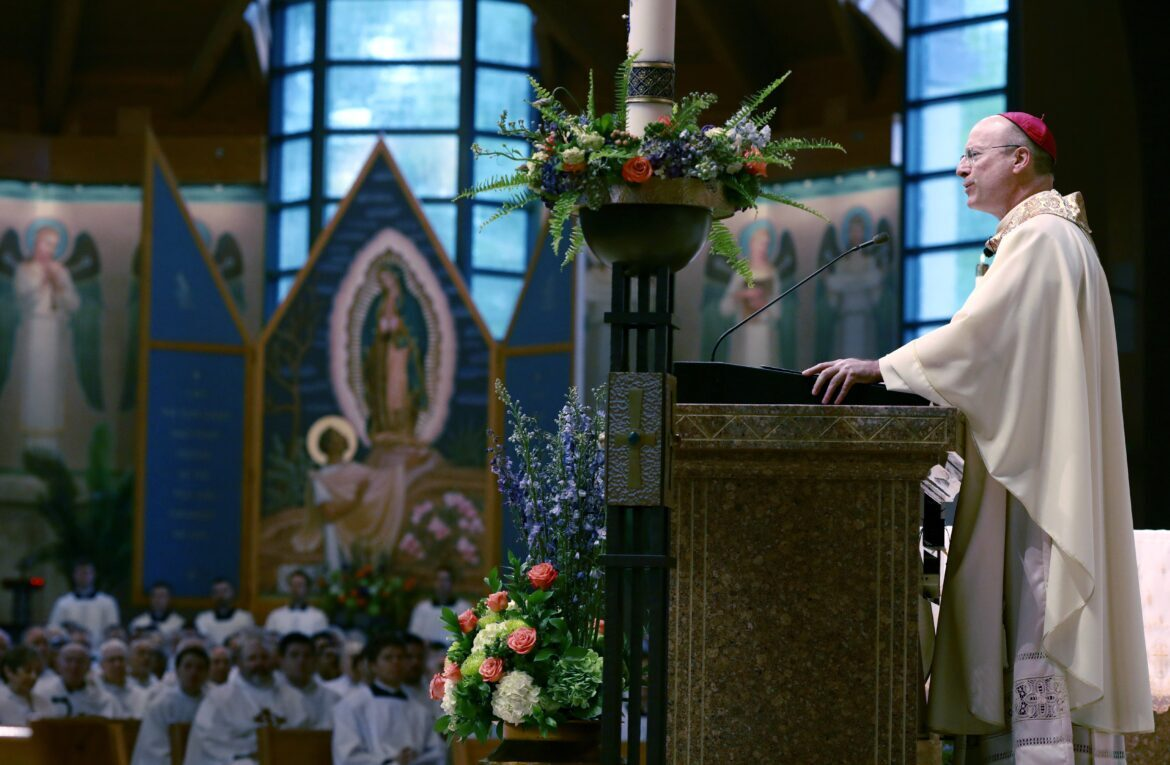
Archbishop W. Shawn McKnight delivers the homily at his installation Mass at Church of the Nativity in Leawood, Kan., on May 27, 2025. He was installed as the 12th bishop and fifth archbishop of the Archdiocese of Kansas City in Kansas. (OSV News photo/Jay Soldner, The Leaven)

LEAWOOD, Kan. (OSV News) — “As your new archbishop, I come to you with a sense of mission to proclaim Jesus Christ risen from the dead, and to lead our local church in Kansas City in Kansas in the fulfillment of our mission together,” said Archbishop W. Shawn McKnight.

He was installed as the 12th bishop and fifth archbishop of the Archdiocese of Kansas City in Kansas during an installation Mass at Church of the Nativity in Leawood May 27.

He succeeds Archbishop Joseph F. Naumann, 75, Kansas City’s shepherd since Jan. 15, 2005. Pope Francis named then-Bishop McKnight of Jefferson City, Missouri, to Kansas City on April 8. 

Archbishop McKnight’s message to northeast Kansas was part of a brief six-minute homily.

‘I Have a Big Heart of Gratitude’

“You got away with a short sermon,” he said, which drew a laugh at the end of Mass, “but only because I have a big heart of gratitude that will take some time (to express).”

He then went on to thank various individuals and groups for their support of him over the years, including his loved ones who have died.

“I am eternally grateful for the faith, love and devotion of my deceased parents, Mary and Gary (Schaffer),” he said, “who nourished and supported me throughout my journey.

“To them and all three sets of my grandparents, I owe a debt of gratitude.”

Cardinal Christophe Pierre

The installation Mass was officiated by Cardinal Christophe Pierre, apostolic nuncio to the United States, who thanked those gathered for their prayers during the conclave and election of Pope Leo XIV.

“I am happy to be here representing him, and I have the privilege of conveying to you his affection and his spiritual communion,” he said.

Ministers of the liturgy were Archbishop McKnight, Cardinal Pierre, Archbishop Naumann, Cardinal Blase J. Cupich of Chicago and Cardinal Robert W. McElroy of Washington. Priests from the archdiocese and beyond concelebrated.

Several deacons and religious, Archbishop McKnight’s family and friends, ecumenical and interfaith leaders, and lay representatives from parishes around the archdiocese were also in attendance.

Various Styles of Music at Mass

The Mass featured various styles of music, including by the Nativity choir and the gospel choir from Our Lady & St. Rose Parish in Kansas City, Kansas.

It also showcased the diverse cultural tapestry of the archdiocese, as each intercession was offered in a different language by a representative of that language group.

A highlight of the Mass came early on when Cardinal Pierre read the apostolic mandate to the congregation, and Archbishop McKnight accepted it.

The archdiocesan college of consultors inspected the apostolic mandate; Father John Riley, chancellor and vicar general of the archdiocese, certified the inspection; and then Archbishop McKnight brought forward the apostolic mandate to show the faithful.

‘Bring Glad Tidings to the Lowly’

In his homily, the archbishop echoed Pope Francis’ desire for the church to “effectively bring glad tidings to the lowly, to heal the broken-hearted, to proclaim liberty to captives and release prisoners, and to comfort all who mourn.

“This was the mission of Jesus of Nazareth, and it is ours today,” he said.

The archbishop also asked for prayers from his new flock as he begins his ministry.

“Pope Francis gave me to you — I belong to you now,” he said. “Please pray for me, that I may lead our local church with a sense of co-responsibility, recognizing the right and obligation of all the baptized to take up their unique roles in the life and mission of the church.”

‘Closer to the Chiefs and Royals!’

At the end of Mass, Archbishop McKnight expressed his gratitude to Pope Francis for his appointment as archbishop and his happiness “that if I had to leave the Diocese of Jefferson City, he at least moved me closer to the Chiefs and Kansas City Royals!”

The archbishop, 56, congratulated Archbishop Naumann for more than 20 years of service to the archdiocese.

“Thank you for your service, devotion and witness of faith over a long expanse of time,” he said. “I hope you will find retirement enjoyable and fulfilling, and that God may bless your new episcopal ministry with abundant graces.”

Archbishop McKnight recognized the three cardinals who were present for the Mass and thanked them for their election of Pope Leo — the first American pope.

Pilgrims in Rome and Papal Election

“I think everyone in this room never thought that would be possible,” he said. “In God’s providence, I was in Rome on pilgrimage for the Holy Year with 30 pilgrims from the Diocese of Jefferson City while you three were at work in the Sistine Chap

“Thank you, cardinals, for finishing quickly enough so that my band of pilgrims could be present for such a historic and blessed occasion. Thank you for serving as instruments of the Holy Spirit in the gift of Pope Leo to us all.”

Archbishop McKnight thanked the bishops present, as well as the clergy and faithful of the Diocese of Jefferson City, where he served as bishop for the past seven years, and his home diocese, the Diocese of Wichita, Kansas, where he was ordained a priest on May 28, 1994.

He also expressed appreciation for the archdiocesan chancery staff who assisted his transition to northeast Kansas.

“It isn’t easy for anyone to move, but to move a sitting bishop to an archdiocese takes more than a village,” he said.

After the Mass, the archbishop took questions from the media in the Nativity chapel and greeted attendees at a reception at the parish school gym.

This story was originally published by The Leaven, the news outlet of the Archdiocese of Kansas City. Moira Cullings is on the staff of The Leaven.