Showing posts with label Ohio. Show all posts

Friday, September 20, 2024

Ohio Bishops remind that all people, even immigrants,


Ohio’s Catholic bishops are urging the faithful and all people of goodwill to treat Haitian migrants in Springfield with “respect and dignity” as the small city seeks to dispel internet rumors about the population. 

“As the residents of Springfield, Ohio, struggle with violent threats and life disruptions fueled by unfettered social media posts, we exhort the Catholic faithful and all people of goodwill not to perpetuate ill will toward anyone involved based on unfounded gossip,” read a letter signed by bishops in all six Catholic dioceses in Ohio.

“Instead, we ask for prayers and support for all the people of Springfield as they integrate their new Haitian neighbors and build a better future together,” added the letter, published by the Ohio Catholic Conference.

Bishops of the Eastern Catholic eparchies also signed the message.

More than half of Haiti is Catholic and a large majority of the country belongs to some Christian denomination. 

“They’re eating the dogs — the people that came in,” Trump said. “They’re eating the cats. They’re eating the pets of the people that live there. And this is what’s happening in our country and it’s a shame.”

The Springfield Police Division issued a statement to the media saying that there have been no credible reports of immigrants harming or abusing pets.

In the letter, the bishops noted that the Haitian migrants in Springfield were granted temporary protected status to legally remain in the country. The letter states that Haitians and others are “feeling inhumane conditions in their countries” to enter the United States. 

“Like all people, these Haitians should be afforded the respect and dignity that are theirs by right and allowed the ability to contribute to the common good,” the bishops added. 

The bishops also wrote in the letter that the influx of migration “has caused a strain on the city’s resources.” However, they also emphasized that people can “view newcomers first as children of God” while also “understanding the need to enforce reasonable limits to legal immigration.”

“We applaud all those community groups working hard to advance the flourishing of Springfield, given the need to integrate newcomers into the social fabric,” the bishops wrote. “If we remain true to our principles, we can have a dialogue about immigration without scapegoating groups of people for societal issues beyond their control.”

The bishops warned: “Today, our nation is divided by partisanship and ideology, which blind us to the image of God in our neighbor, especially the unborn, the poor, and the stranger.” They added that “these negative sentiments are only exacerbated by gossip, which can spread quickly across social media with no concern for the truth or those involved.”

“From the beginning, the human race was made in the image of God, which distinguishes us from all other created things,” the bishops continued.

“The arrival of Jesus Christ in human history confirms the dignity God has given to each of us, without exception,” they added. “It is our belief in the dignity of human life that guides our consciences and rhetoric when engaging in politics or personal conversation. Each of us, therefore, must turn to God and ask for eyes to see the infinite dignity of every person.”

Tuesday, July 16, 2024

Another look at the faith journey of Senator JD Vance


What JD Vance has said about his faith

The Ohio senator and recently named running mate of Donald Trump spoke with the Deseret News in 2016 about his religious journey


Sen. J.D. Vance, R-Ohio, arrives to speak at the Conservative Political Action Conference, CPAC 2024, at the National Harbor in Oxon Hill, Md., Friday, Feb. 23, 2024. | Jose Luis Magana, Associated Press


JD Vance will bring a unique religious perspective to former President Donald Trump’s 2024 presidential campaign, since he’s done more spiritual exploration than many politicians.

Vance, who was unveiled as Trump’s running mate on Monday, grew up believing in God but not affiliating with a faith group, attended an evangelical Christian church off and on as a teen and then entered a period of near-atheism in his twenties. He ultimately chose to join the Catholic Church as an adult.

Here’s what Vance has said about his faith over the years.

JD Vance’s religion

Vance, who will turn 40 on Aug. 2, felt close to God growing up, but he wasn’t invested in organized religion, as he told the Deseret News in 2016.

His family drew comfort from Christian beliefs amid chaotic times, but rarely chose to turn to religious leaders or local churchgoers for help.

Still, Vance credits local churches, and his dad’s evangelical Christian church, in particular, with showing him that there was something better out there than the poverty, drug addiction and conflict his family was dealing with.

“Going to church showed me a lot of really positive traits that I hadn’t seen before. I saw people of different races and classes worshipping together. I saw that there were certain moral expectations from my peers of what I should do,” he told the Deseret News.

RELATED
JD Vance: Faith made me believe in a hopeful future

But by the time Vance enrolled in Yale Law School in 2010, he was disengaged from church and from God.

“I would have called myself an atheist,” he told the Deseret News in 2016.

At law school, though, Vance began to have new appreciation for the power of faith. He connected with Catholics and members of The Church of Jesus Christ of Latter-day Saints and recognized that their religious beliefs were propelling them forward, not holding them back.

When he graduated from law school in 2013, Vance wasn’t committed to a specific religious community but he was curious about them again. He told the Deseret News in 2016 that he could see himself joining a faith group in the future.

“I’ve been going to church for the past year or so. Not as much as I should, but more than I have been. I’ve been thinking very seriously about converting to Catholicism,” he said.

JD Vance conversion to Catholicism

About three years after his conversation with the Deseret News, Vance did indeed get baptized and received into the Catholic Church.

Rod Dreher broke the news in August 2019 by publishing a Q&A with Vance about his faith in The American Conservative.

Vance told Dreher that Catholicism appealed to him on both an intellectual and emotional level. He enjoyed studying Catholic teachings, and also connecting with Catholic loved ones.

“When I looked at the people who meant the most to me, they were Catholic,” Vance said.

He told Dreher that past scandals in the Catholic Church, including the clergy sex abuse crisis, delayed his conversion decision. Ultimately, he decided that he needed to take a “longer view” on religious institutions.

“The hope of the Christian faith is not rooted in any short-term conquest of the material world, but in the fact that it is true, and over the long term, with various fits and starts, things will work out,” Vance said.

Vance’s bio on X reads, “Christian, husband, dad. U.S. Senator for Ohio.”

Does faith inform JD Vance’s politics?

If Trump and Vance win in November, Vance would become only the second Catholic vice president in U.S. history, according to the National Catholic Register. The first was President Joe Biden, who served as vice president under former President Barack Obama.

Vance has said in the past that, even before he joined the Catholic Church, he shared many policy goals with Catholics. He told Dreher in 2019 that he wanted to be known for promoting the common good.

“I hope my faith makes me more compassionate and to identify with people who are struggling,” he said.

But since being sworn in as a U.S. senator in January 2023, Vance has angered some more conservative Catholics, especially when it comes to abortion.

Like Trump, he does not support a federal abortion ban, and instead says abortion policy should be left up to individual states.

Earlier this month, he again echoed Trump by expressing support for allowing abortion pills to remain widely accessible.

46
Comments

C.J. Doyle, executive director of the Catholic Action League of Massachusetts, criticized Vance’s recent comments in an interview with the National Catholic Register.

“Vance has no principles, at least none that aren’t for sale, and the asking price is cheap,” he said.

But Vance is far from the first Catholic politician to be out of step with the Catholic Church’s teachings on abortion, which state that life begins at conception and that any “procured abortion” is a moral evil, according to the U.S. Conference of Catholic Bishops.

Biden, who attends Catholic worship services regularly and who carries rosary beads with him, is personally troubled by abortion, but has spoken repeatedly during his time as president about the importance of protecting abortion rights, according to NBC News.

Monday, July 15, 2024

The new Vice-Presidential selection by Donald Trump is a convert to Catholicism


Trump names Ohio Sen. J.D. Vance, a Catholic, as his running mate

WASHINGTON (OSV News) — Former President Donald Trump on July 15 named Ohio Sen. J.D. Vance, a Catholic, as his running mate on the Republican ticket in November.

Trump was widely expected to name his running mate at the Republican National Convention, which began the same day.

“After lengthy deliberation and thought, and considering the tremendous talents of many others, I have decided that the person best suited to assume the position of Vice President of the United States is Senator J.D. Vance of the Great State of Ohio,” Trump wrote in a post on his social media platform Truth Social. “J.D. honorably served our Country in the Marine Corps, graduated from Ohio State University in two years, Summa Cum Laude, and is a Yale Law School Graduate, where he was Editor of The Yale Law Journal, and President of the Yale Law Veterans Association.”


Vance is ideologically aligned with Trump on issues

Vance, author of “Hillbilly Elegy,” was elected to the U.S. Senate in 2022 after a contentious primary election in the Buckeye State, in which he got Trump’s endorsement. Vance, who is Catholic, is married to Usha Vance, a litigator. The couple has three young children.

Trump said Vance “will be strongly focused on the people he fought so brilliantly for, the American Workers and Farmers in Pennsylvania, Michigan, Wisconsin, Ohio, Minnesota, and far beyond.”

Vance, was at one time a staunch critic of Trump, but became a closer ally of the former president as he campaigned for the U.S. Senate, and is ideologically aligned with Trump on issues like foreign policy.

If elected, Vance would be just the second Catholic to serve as vice president in U.S. history. The first is President Joe Biden, who served vice president for two terms before his own election to the White House in 2020 made him the second Catholic to serve as U.S. president.

Tuesday, March 19, 2024

Great priestly vocation news from Columbus Ohio


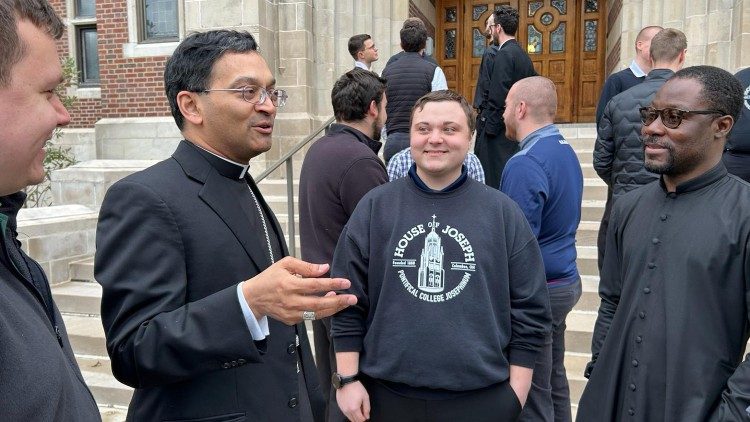
Bishop Earl Fernandes with the seminarians from the Diocese of ColumbusBishop Earl Fernandes with the seminarians from the Diocese of Columbus 

US Diocese of Columbus doubles number of seminarians in two years

As Pope Francis releases his message for the World Day of Prayer for Vocations, Bishop Earl Fernandes from the Diocese of Columbus, in the US state of Ohio, describes how renewed pastoral efforts and prayer have led 16 new men to enter the diocesan seminary last year, with 12 more expected this year.

By Fr. PaweÅ‚ Rytel-Andrianik and Tomasz Zielenkiewicz 

“When I was installed as bishop almost two years, there were no ordinations to the priesthood in our diocese. At the end of my episcopal ordination, I said to the congregation that more men will be ordained bishops than priests this year.”

Bishop Earl Fernandes, bishop of the US Diocese of Columbus, Ohio, recalled that anecdote in an interview with Vatican News on the same day Pope Francis released his message for the 61st World Day of Prayer for Vocations, which the Church celebrates on April 21, 2024.

Speaking to Vatican News, Bishop Fernandes said that 16 men entered the seminary last year, adding that the diocese has recorded an increase in the number of Catholics.

The diocese expects almost a dozen more young men to enter the seminary this year as well, he noted, attributing the rise in numbers to prayer and renewed pastoral outreach efforts.

Bishop Fernandes pointed out that the Pope's message was published on feast day of St Joseph, which also marks the solemn inauguration of Pope Francis' pontificate 11 years ago. 

“Joseph was a simple man—a husband, a foster father—who answered the Lord's call," said Bishop Fernandes. "So too, we have many priests who say yes to the Lord, dedicating their lives to service, giving, and offering people hope—the hope that comes from the Holy Eucharist, the hope that comes from being forgiven."


“We chose young priests to meet once a month with young men in the area, and they discern their vocation to the diocesan priesthood or religious life, as well as read Fr. Brett Brannan’s book “To Save a Thousand Souls: A Guide for Discerning a Vocation to Diocesan Priesthood,” said Bishop Fernandes.  

As part of the vocations drive, the Diocese of Columbus has also organized retreats called “Quo vadis?” for high school students.

“The young people spend three days in prayer, listening to testimonies, talking to priests who understand what priestly formation is but also enjoy fraternity to see that it involves more than just prayer, study, and work. This has also been very fruitful,” said Bishop Fernandes.

He also highlighted the importance of prayer on the part of lay faithful, as well as women and men religious, in the diocese.

“We constantly urge people to pray and fast in the intentions of vocations," he said.

“The idea is that they, like the apostles, should proclaim the joy of the Gospel,” concluded Bishop Fernandes. “We sincerely hope that our seminarians will have a true missionary impulse, so that they can be the Church that the Holy Father Francis calls us to be—a Church that goes forward.”

Thursday, December 21, 2023

The battle against the evil of abortion is far from over as evidenced in recent elections


US Catholic leadership foresees challenges after repeated election defeats for abortion opponents


Updated 7:03 AM CST, December 20, 2023

Repeatedly in recent years, the U.S. Conference of Catholic Bishops has stipulated that “the threat of abortion remains our preeminent priority.” In the face of recent election setbacks for abortion opponents, leading bishops and their lay allies are reassessing how to move forward with that stance.

The latest rebuff came Nov. 7 in Ohio, when voters decisively approved a constitutional amendment that ensures access to abortion and other forms of reproductive health care. It was the seventh consecutive state where voters decided to protect abortion access since the U.S. Supreme Court overturned the nationwide constitutional right to abortion in June 2022.

The Ohio result was particularly stinging for abortion opponents, coming in a state where tough anti-abortion measures had been approved by the Republican-controlled legislature.

“Today is a tragic day for women, children, and families in Ohio,” the state’s Catholic bishops said in a joint statement as the outcome became clear.

“We must look ahead,” the bishops added. “Despite the obstacles this amendment presents, the Catholic Church in Ohio will continue to work for policies that defend the most vulnerable, strengthen the child-parent relationship, and support women in need.”

Brian Hickey, executive director of the Catholic Conference of Ohio, noted that support for the abortion-rights amendment was particularly strong among younger voters, signaling that it could take many years to build an anti-abortion majority in the state’s electorate. Exit polls suggested that more than 75% of voters aged 18 to 29 backed the amendment.

“How do we reach this next generation of Ohioans?” Hickey asked during an interview with The Associated Press. “We know there is a lot of work to do.”

The chairman of the U.S. bishops’ Committee on Pro-life Activities, Bishop Michael Burbidge of Arlington, Virginia, recalled how he and his colleagues celebrated 18 months ago after the Supreme Court — in its so-called Dobbs decision — struck down the much-debated Roe v. Wade ruling of 1973. The result was to end the nationwide right to abortion, and leave it to individual states to decide whether to ban it or allow it.

“There was a moment to celebrate, but we also knew it was only a brief moment, because rightfully this issue is back in the states,” Burbidge said. “These ballot-measure results are very unsettling.”

Burbidge said the Catholic leadership needed to convey more clearly that it is “pro-women” -- even as it supports state legislation aimed at limiting their options regarding unwanted pregnancies.

“Not even our parishioners are aware of all of the support the Catholic Church will give to single moms in need — counseling, financial assistance, housing — so mothers know they are being accompanied,” he told the AP. “We will be with them every step of the way.”

“We look at the results, and they are not favorable,” Burbidge added. “We have a good message to convey. ... Even if it hits some more bumps in the road, some disappointments, eventually we believe that what is true, what is just, will triumph.”

2024 will bring many opportunities for disappointments and triumphs. Abortion is sure to be a key issue in many political contests, and efforts are underway in several states — including Arizona, Arkansas, Florida, Missouri and Nebraska — to get Ohio-style abortion-rights measures on the ballot.

Burbidge and Hickey said the Catholic leadership, as it moved ahead in the abortion debate, should avoid sounding harsh and punitive. Hickey, for example, suggested that abortion restrictions would receive greater public support if they offered exceptions, perhaps allowing abortions for women impregnated by rape.

“We need to have those conversations,” Hickey said. “The Catholic Church is a place for refuge. It’s not a place for condemnation.”

Some Catholic abortion opponents favor an aggressive approach, whether or not it sways voter sentiment.

“The church will never compromise, it cannot compromise. It will always stand for the truth that every single human life is sacred,” said Brian Burch, president of the conservative advocacy group CatholicVote.

“But it’s very clear the public is completely divided on this,” he added. “Recent trends show the public is not willing to go where many pro-life entities had hoped to go in the wake of Dobbs.”

Burch said state legislatures with anti-abortion majorities should avoid punishing women who get abortions. But he approves of penalties against medical personnel who provide abortions, and favors new laws that could punish people for pressuring a woman to get an abortion.

“The abortion divide has become more heightened because of Dobbs,” he said. “There is no question the Democrats will use the issue next year. It’s a political gamble and I hope they’re wrong.”

Frank Pavone, national director of Priests for Life, hopes the Democrats do highlight the issue – and says abortion opponents should engage head-on in the ensuing debate, rather than skirting the issue.

“We need an honest debate about abortion — a debate that starts with a clear, objective and public description of what the abortion procedure is,” Pavone says in a strategy memo he’s distributing to political candidates. “Abortion supporters refuse to describe what they defend ... abortion itself is the last thing they want to talk about.”

Pavone was a Catholic priest from 1988 until 2022, when the Vatican removed him from the priesthood for “blasphemous communications” on social media, and persistent disobedience of his bishop. Over many years, he had drawn attention for partisan political activities that accompanied his anti-abortion activism.

In common with Burbidge, Hickey and Burch, Pavone advocates showing compassion for women considering abortion.

But Catholics who support abortion rights question how this rhetoric can be reconciled with a stance that would deny these women the freedom to choose for themselves how to proceed.

“Solidarity with women — what does that mean?” asked Jamie Manson, president of Catholics for Choice.

“Women do not have equality in the church. We’re not allowed to lead, to be ordained,” she said. “I don’t know what ‘solidarity’ means when you have an entrenched second-class status for women.”

Manson would like to see a new kind of conversation within Catholic ranks.

“Many Catholic women have had an abortion — they have a story to tell,” she said. “What I’m hoping and pushing for is for Catholic leaders to listen to why women made that choice and have no regrets.”

For now, the U.S. bishops conference has signaled it will press ahead with existing strategies on abortion. Last month, a week after the abortion-rights amendment was approved in Ohio, the bishops elected Daniel Thomas, the bishop of Toledo, Ohio, to succeed Burbidge in November 2024 as chairman of the Committee on Pro-Life Activities.

Thomas had forcefully appealed for Ohioans to defeat the amendment, calling it “extreme, dangerous and unacceptable.”

Manson depicted the election of Thomas as “ironic,” given that Catholic dioceses in Ohio had spent hundreds of thousands of dollars unsuccessfully opposing the amendment.

“The Catholic bishops are doubling down on their losing abortion strategy through 2024,” she said. “The Catholic Church will continue to spend big in elections — and they will continue to lose.”

___

Associated Press religion coverage receives support through the AP’s collaboration with The Conversation US, with funding from Lilly Endowment Inc. The AP is solely responsible for this content.

Tuesday, December 12, 2023

The potential of two Ohio dioceses merging into one


Catholic Dioceses of Columbus and Steubenville again discussing potential merger

Shahid Meighan
Columbus Dispatc


The Catholic Dioceses of Columbus and Steubenville are considering a merger, over one year after a previous merger attempt was halted due to push back from many within the dioceses.

Bishop Paul J. Bradley, the Apostolic Administrator of the Diocese of Steubenville, and Bishop Earl K. Fernandes of the Diocese of Columbus, issued a joint statement Monday announcing that they were in "preliminary discussions regarding the potential merger of the dioceses."

"While no decision has been made, due diligence is needed so an educated and responsible decision can be discerned in a timely manner. Ultimately, the decision is up to the Holy Father," the bishops said.

The announcement of the potential merger comes amid a combination of declining church attendance, a nationwide shortage of priests, and the scheduled closure of more than a dozen Catholic churches across central Ohio that are part of the Columbus diocese.

Earlier this year, The Dispatch reported that Bishop Fernandes, who leads the 23-county Columbus diocese, was closing 15 churches as part of the diocese's "Real Presence Real Future" plan. Some of them included:

Other churches scheduled for closure were Corpus Christi Church and St. Ladislas Church on the South Side; Holy Rosary/ St. John Church on the Near East Side; Parroquia Santa Cruz on the North Side; St. Philip the Apostle on the East Side; Our Lady of the Miraculous Medal on the Southeast Side; and St. Matthias Church and St. Anthony Church on the Northeast Side. St.

A nationwide shortage of Catholic priests also played a factor in the closings. According to data from Georgetown University researchers, there was a 42% drop in Catholic priests from 1965 to 2022. The Catholic church is also grappling with a 20% decline in church membership since 2000, according to a Gallup poll.

In 2017, the Steubenville diocese faced a financial scandal after David A. Franklin, the former comptroller of the diocese, was sentenced to a year in prison for tax crimes and embezzlement. He was sentenced to prison in December 2020, and was ordered to pay more than $1.3 million in restitution.

Catholic dioceses across the state also came under fire earlier this year when SNAP (Survivors Network of those Abused by Priests) and two other nonprofits called on Ohio Attorney General Dave Yost to launch an investigation into the state's six Catholic dioceses over accusations of rampant sexual abuse. Several Ohio Catholic priests have been convicted in recent years for sexual misconduct and assault, including:


Another possible factor in the potential merger discussions is Steubenville Bishop Bradley's age. He turned 78 years old in October, three years past the age at which Pope Paul VI's apostolic letter stated bishops are expected to submit their resignation to the pope.

Bishop Paul J. Bradley, Apostolistic Administrator of the Catholic Diocese of Steubenville

According to The Pillar, he is among 13 U.S. diocesan bishops who would be at least 75 years old by the end of this year, the largest number since 1967.

Meanwhile, Columbus Bishop Fernandes, who was the youngest diocesan bishop in the U.S. when appointed on April 2, 2022, turned 51 in September.