Showing posts with label Donald Trump. Show all posts

Tuesday, June 9, 2026

NY Times explores the meeting of Pope Leo XIV and Spain's Prime Minister Pedro Sanchez


One Is the Pope, the Other an Atheist. They Both Oppose Trump.

Pope Leo XIV and Prime Minister Pedro Sánchez of Spain, who met on Monday, have recently clashed with President Trump. Their motivations, however, may be different.


Pope Leo XIV welcoming Prime Minister Pedro Sánchez of Spain at the Vatican last month, in a photo made available by Vaticanmedia. Credit...
Vatican Media, via Agence France-Presse — Getty Images


When Pope Leo met in Madrid with Spain’s left-wing prime minister, Pedro Sánchez, on Monday morning, they represented, at least to many liberals, a powerful duo joining forces to lead the opposition to President Trump.

“They have the same voice,” when it comes to speaking out against Mr. Trump, Cardinal José Cobo of Madrid said.

Pope Leo has drawn the president’s fury for criticizing the war in Iran and later saying he had “no fear” of the Trump administration. Mr. Sánchez has battled Mr. Trump on everything from NATO spending to the migration policy to his opposition to the wars in Gaza and Iran.

Their motivations, though, are seemingly different.

If the pope was dragged into the fight by Mr. Trump, Mr. Sánchez happily jumped in. Mr. Sánchez is perhaps Europe’s most accomplished political escape artist, after wriggling free from countless crises during his eight years in power. His most recent high-wire act has been to seize on international quarrels with Mr. Trump to raise his global profile and distract from troubles at home, especially the corruption scandals and accusations now swirling around his former allies and family.

Appearing with the pope “will help Sánchez with his external public image,” said Joseba Louzao, a professor at Cardinal Cisneros University and author of “A Brief History of the Catholic Church in Spain.”

Meeting the pope at the Vatican’s embassy in Madrid on Monday, Mr. Sánchez sought to underline their connection by giving the pontiff a Spanish olive bonsai tree that was, the Spanish government said in a statement to reporters, “a universal symbol of peace, dialogue and understanding, values shared by Spain and the Vatican.”

Mr. Sánchez’s relationship with the pope may not matter much in Spain, an increasingly polarized country where feelings about the prime minister were already deeply entrenched, Mr. Louzao said. The great hope for Mr. Sánchez, he suggested, would be Mr. Trump seizing on Monday’s Madrid meeting to attack them together — potentially upgrading the prime minister’s global status and invigorating his base.

On the face of things, the two men have little in common. Mr. Sánchez is a self-declared atheist, a staunch defender of abortion rights and an opponent of Catholic involvement in public education. But to hear him tell it, he is also singing from the same hymn sheet as Pope Leo.

He and the pope have “a certain degree of harmony” he said during a May 27 trip to meet Leo in the Vatican, whether it be their shared opposition to war, their concerns about giant tech companies, or their defense of migrants. “The Catholic Church and the Government of Spain are once again, I believe, very much in tune,” Mr. Sánchez added.

He called Leo “a moral compass” as they navigated with “common sense against irrationality and the law of the jungle.”

When Spain let passengers from a cruise ship infested with hantavirus dock in the Canary Islands in May, Mr. Sánchez responded to local criticism by citing “the explicit recognition expressed by none other than the pope for the solidarity and empathy shown by the people of the Canary Islands.”

Spain’s Catholic prelates have tried to avoid too strong a comparison.

Joan Planellas, the archbishop of Tarragona, acknowledged that when it came to immigration, opposition to war and the need to regulate tech giants. “Certainly, on these topics that seem more left-wing, if we speak politically, there is a certain harmony.” But not on abortion, euthanasia and other “delicate topics,” he said.

Cardinal Cobo added that Mr. Sánchez’s agreement with the pope on some issues did not mean he should use him as a political shield, especially because they still disagreed on many matters.

Eloy Alberto Santiago, the bishop of Tenerife in the Canary Islands, where Leo, joined by Mr. Sánchez, will meet with migrants, said that while the church was a driver behind the Spanish government’s recent move toward giving papers to hundreds of thousands of undocumented immigrants, it did not mean “we identify with a party or a government.”

Government officials have also said the prime minister is wary of drawing too close to the pope. They said it ran the risk of seeming tacky and transparently political and could provoke a backlash within the prime minister’s left-wing base, which disagrees deeply with the Catholic church on issues such as gay rights, abortion and feminism. In that regard, Mr. Sánchez and Leo have a common interest in not seeming too buddy-buddy.

“The alignment is already so visible that there is no need to overemphasize it or try to co-opt his figure,” said Jorge Tamames, a fellow at the Elcano Royal Institute, a think tank in Madrid

The church, he said, will move cautiously amid the “wasp’s nest” of Spanish politics, but the pope’s positions on the major issues of the day “are so irreconcilable with the right or with the far-right” that “a contrast is inevitable, and the government doesn’t need to force it.”

Mr. Sánchez’s allies also hope the pope’s visit helps point out the distance between right-wing leaders who flaunt their Catholicism and the actual leader of the Roman Catholic Church. Spain’s far-right party, Vox, has tried to win over Catholic voters by presenting itself as the protector of Catholic traditions, even though it has also criticized Catholic bishops for supporting migrants.

To prevent Mr. Sánchez from deriving political capital from the visit, conservatives have sought to characterize him as trying to use Leo as a shield.

Isabel Díaz Ayuso, the president of the Madrid region, who also visited the pope in the Vatican this month, has accused Mr. Sánchez of “trying to appropriate” Pope Leo’s visit. “In the last eight years, he has been incapable of having a single gesture toward Catholics,” Ms. Ayuso said.

Alberto Núñez Feijóo, the leader of the main conservative Spanish opposition party, mocked Mr. Sánchez as trying to wrap himself in the clean robes of the popular pope.

“If he wants to get closer to the pope, he should remember the seventh commandment,” Mr. Feijóo said, “‘Thou shalt not steal,’ and the eighth commandment, ‘Thou shalt not lie.’”

Speaking to the Spanish Parliament on Monday, under its frescoed dome, Leo appeared to allude to those political divisions.

“It falls to me today to speak a calm and firm word to those who bear the grave responsibility of legally ordering social coexistence,” Leo said, before Mr. Sánchez and all his political enemies.

“Political pluralism should not degenerate into the constant disparagement of one’s adversary,” Leo said, adding, “firmness does not require contempt; disagreement does not entail humiliation.”

He emphasized that he was not trying to wade into politics or stepping over dividing lines between church and state. If anything, the pope seemed careful to keep a foot on both partisan sides. He appealed to conservatives by speaking in defense of “the unborn child” — and to liberals by calling migration a “tragic drama” that challenged the conscience of nations.

He echoed Mr. Sánchez’s slogan of “no war,” by calling for “diplomatic courage” to resolve global disputes with “means offered by international law.”

“It is therefore a cause for concern that, in various parts of the world — and in Europe as well — rearmament is once again being presented as an almost inevitable response to the fragility of the international situation,” Leo said.

When the pope finished, Mr. Sánchez joined the rest of the chamber in a long-standing ovation.

But Luis Argüello, the archbishop of Valladolid and president of the Spanish Bishops Conference, warned Mr. Sánchez and the left against suggesting that “‘the church is closer to us.’”

Spain’s left, the archbishop said in an interview, should apply the church’s teaching to actions “inside our own nation,” including, he said, “on matters relating to corruption.”



Monday, January 20, 2025

Pope Francis sends his blessings to President Trump and the American people


Donald Trump at a rally in Washington DC the day before his inaugurationDonald Trump at a rally in Washington DC the day before his inauguration  (2025 Getty Images)

Pope to President Trump: 'I invoke divine blessings upon beloved American people'

Pope Francis sends a message for the inauguration of Donald J. Trump as the 47th US President, offering divine blessings upon the 'beloved American people,' President Trump, and his family, and praying that the Lord will help guide efforts toward peace.

By Deborah Castellano Lubov

"I ask God to guide your efforts in promoting peace and reconciliation among peoples."

Pope Francis expressed this prayer in a message he sent on Monday to the President of the United States of America, Donald J. Trump, on the occasion of his inauguration as 47th President in the nation's history.

"On the occasion of your inauguration as the forty-seventh President of the United States of America," the Pope began, "I offer cordial greetings and the assurance of my prayers that Almighty God will grant you wisdom, strength, and protection in the exercise of your high duties."

"Inspired by your nation’s ideals of being a land of opportunity and welcome for all, it is my hope that under your leadership the American people will prosper and always strive to build a more just society, where there is no room for hatred, discrimination or exclusion."

"At the same time," the Pope noted, "as our human family faces numerous challenges, not to mention the scourge of war, I also ask God to guide your efforts in promoting peace and reconciliation among peoples."

"With these sentiments," the Holy Father concluded, "I invoke upon you, your family, and the beloved American people an abundance of divine blessings."

Saturday, January 18, 2025

Vatican based editorial on the upcoming Presidency of Donald Trump


The President's motorcade waits outside the White House in Washington D.C.The President's motorcade waits outside the White House in Washington D.C. 

Donald Trump and the America to Come

An editorial in L’Osservatore Romano reflects on the most urgent challenges awaiting the new U.S. president just hours before the inauguration ceremony. For the occupant of the White House, it will be crucial to work on overcoming the polarizations that have marked American political life for years. The “disunited” States of America would indeed pose a grave threat to an already fractured and fragmented world.

By Alessandro Gisotti

No, history did not “end” with the fall of the Berlin Wall and the dissolution of the Soviet Union. What was once an illusion held by some political scientists and politicians at the end of the last century has proven dramatically wrong.

In fact, as early as the dawn of the 21st century, this became clear with the "unthinkable" event of the terrorist attack on the Twin Towers, which served as a grim awakening for those who imagined an era of global stability marked by liberal economics.

In the more than 30 years since that historic day when the Wall fell—taking with it one of the most oppressive totalitarian systems in history—humanity has experienced an ever-growing number of conflicts that have evolved from local to regional crises, culminating in what Pope Francis has prophetically termed the “Third World War fought piecemeal.” History, therefore, is far from over.

Over this quarter-century, a period the Pope describes as marking a “change of era” more than “an era of change,” the economic, political, and military forces of the world’s great powers have been reshaped.

Today, we live in a multipolar world, making the pursuit of agreements—particularly in times of crisis—more complex and less straightforward. Yet, this is the world we live in, and the principle of realism requires all leaders (especially those with the most power) to recognize that the great challenges of our time demand new paradigms and creativity that reject the mindset of “this is how it’s always been done.”

It is within this historical context that, on Monday, Donald Trump will be sworn in for the second time to defend the Constitution of the United States and serve the American people.

As has been widely noted, this event has many unprecedented aspects and is met with both hope and concern, as no one overlooks the enduring influence of the United States on international political and economic dynamics, even in a world without a single superpower.

President-elect Trump has repeatedly stated his commitment to ending the war in Ukraine and has pledged that under his presidency, the U.S. will not engage in any new conflicts. It remains to be seen what stance he will take toward international organizations.

Immigration, the environment, and economic development (increasingly driven by technology) are among the key issues on which the 47th occupant of the White House will be closely scrutinized, not only by the American people but also by the international community.

Historically, the United States has excelled when it has opened itself to the world (after all, the United Nations is essentially “an American invention”) and, together with its allies, built a system that—with the limitations of any human endeavor—has ensured freedom, economic development, and progress in human rights. This has happened under both Republican and Democratic presidents. An America turned inward would therefore be a “contradiction.”

President Trump is called to work to overcome the divisions and polarizations that have defined American political life for years and that saw in the assault on the Capitol on January 6, 2021 one of the saddest days in national history. This is undoubtedly a difficult task but a necessary one for the new administration. The “disunited” States of America would pose a grave threat to an already fractured and fragmented world.

Ten years ago, Pope Francis—the first Pope from the Americas—addressed the United States Congress with a speech highlighting the founding values of the American nation. Revisiting this speech could be useful also for President Donald Trump and Vice President J.D. Vance.

That address, widely applauded across party lines at Capitol Hill, identified four great Americans as guiding stars who, even in turbulent times, can help chart the course for those entrusted with political responsibility.

“A nation,” concluded Pope Francis, “can be considered great when it defends liberty as Lincoln did, when it fosters a culture which enables people to ‘dream’ of full rights for all their brothers and sisters, as Martin Luther King sought to do; when it strives for justice and the cause of the oppressed, as Dorothy Day did by her tireless work, the fruit of a faith which becomes dialogue and sows peace in the contemplative style of Thomas Merton.”

These are the values that made America great and that the world still needs today.

Thursday, January 16, 2025

Israel, Hamas ceasefire; cause for rejoicing especially for Gaza Catholics

 Israel, Hamas reach ceasefire, hostage agreement, as Gaza Catholics rejoice


Supporters of Israeli hostages, who were kidnapped during the deadly Oct. 7 2023, attack by Hamas, react to a Gaza ceasefire deal as they attend a protest in Tel Aviv, Israel, Jan. 15, 2025, that was organized to demand a deal to bring every hostage home at once. (OSV News photo/Ronen Zvulun, Reuters)


(OSV News) — After more than a year of war and thousands killed or wounded, negotiators representing Israel and Hamas agreed to a ceasefire deal.

A six-week initial ceasefire phase and the gradual withdrawal of Israeli forces from the Gaza Strip are included in the accord.

The agreement, announced Jan. 15 following several months of negotiations brokered by Egypt, Qatar and the United States, also included a deal that would see the release of Israeli hostages in exchange for Palestinian prisoners.

Although negotiators have reached an agreement, the deal has yet to be ratified by the Israeli parliament. As of publishing time, neither Israel or the Palestinian Authority had issued an official statement announcing the deal.

Speaking at the Jan. 15 press briefing at the White House, President Joe Biden acknowledged that the deal has been a team effort of the outgoing and incoming administration.

“In these past few days, we’ve been speaking as one team,” Biden said.

“We’re handing off to the next team a real opportunity for a brighter future in the Middle East,” Biden says. “I hope they take it.”

Hostages and Missing Families Forum

The Hostages and Missing Families Forum, a group representing the families of 98 Israeli hostages taken by Hamas, welcomed news of the agreement “with overwhelming joy and relief.”

While hailing the deal as a significant step forward, the group acknowledged “deep anxiety and concerns” over the “possibility that the agreement might not be fully implemented, leaving hostages behind.”

“We urgently call for swift arrangements to ensure all phases of the deal are carried out,” the group said. “We will not rest until we see the last hostage back home,” they said as people were seen rejoicing on the streets of Tel Aviv, Reuters news agency reported.

SIR, the news service of the Italian bishops’ conference, reported celebrations also erupting in Gaza following news of the ceasefire.

Gaza Pastor and Parishioners’ Hopes

Father Gabriel Romanelli, pastor of Holy Family Parish in Gaza, said that people were beginning “to nurture the hope of returning to their homes — for those who still have them — and understanding what is left and how to rebuild.”

“For everyone, it also means returning to live without the constant nightmare of planes, bombs, fighting, and violence,” he told SIR. “Everyone hopes the truce holds, although we know it will be a very long and complicated path.”

Father Romanelli said the parish will celebrate a Mass of thanksgiving for the ceasefire and that the faithful will continue to pray “for all those working to provide relief to the people.”

In a statement published not long after news of the agreement, Biden, who will officially end his term Jan. 20, confirmed that he “laid out the precise contours of this plan” which was endorsed “unanimously by the UN Security Council.”

While he welcomed the news, the president remembered the lives of those killed during Hamas’ Oct. 7, 2023, attack and the “many innocent people killed in the war that followed,” also referring to the suffering of Palestinians during his subsequent White House press briefing as “hell.”

“Too many innocent people have died; too many communities. have been destroyed,” Biden said.

Trump and ‘Peace Through Strength”

President-elect Donald Trump, who is set to be sworn in as president in less than a week, took to his social media platform, Truth Social, and seemingly took credit for the “EPIC ceasefire agreement.”

The deal, he said, “could have only happened as a result of our Historic Victory in November, as it signaled to the entire World that my Administration would seek peace and negotiate deals to ensure the safety of all Americans, and our Allies.”

Trump said his upcoming administration would work closely with Israel to ensure that Gaza “NEVER again becomes a terrorist safe haven” and that “we will continue promoting PEACE THROUGH STRENGTH,” he said, capitalizing certain words.

“This is only the beginning of great things to come for America, and indeed, the World,” Trump wrote. “We have achieved so much without even being in the White House.”

Pope’s Calls for Ceasefire 

Although the Vatican has yet to release a statement regarding the deal, the announcement comes after Pope Francis made multiple calls for an end to the conflict in the Holy Land, and in other parts of the world.

“Let us pray that the fighting will cease on every front, and that there will be a decisive effort for peace and reconciliation,” the pope said during his Angelus address Jan. 1, adding that “War is always a defeat,” and thanking those “in the many areas of conflict who work for dialogue and negotiations.”

Following an event in Rome, Italian Cardinal Matteo Zuppi of Bologna, president of the Italian bishops’ conference, who also serves as the pope’s special envoy for peace in Ukraine, reacted to news of the ceasefire, and expressed his hope that “it will serve to prevent further suffering.”

“Let us trust in peace,” the cardinal said, according to SIR.

Hamas’ brutal attack on southern Israeli communities on Oct. 7, 2023, killed 1,200 Israelis, with over 250 taken hostage, and a subsequent Israel-Hamas war in the Gaza Strip killed 46,600 people, according to the Gaza Health Ministry, run by Hamas. Women, children and older people account for just over half of identified victims.

Junno Arocho Esteves writes for OSV News from Malmö, Sweden.

Tuesday, January 14, 2025

Cardinal Dolan to deliver opening prayer at Trump's inauguration next week

 Cardinal Dolan will lead prayer at Trump’s second inauguration Jan. 20

January 11, 2025


New York Cardinal Timothy M. Dolan delivers the invocation Jan. 20, 2017, before U.S. President Donald Trump’s swearing-in as the country’s 45th president at the U.S. Capitol in Washington. The cardinal has accepted an invitation to give the opening prayer at Trump’s installation as the 47th U.S. president Jan. 20, 2025. (OSV News photo/Carlos Barria, Reuters)


WASHINGTON (OSV News) — After congressional lawmakers formally certified Jan. 6 President-elect Donald Trump’s victory in the 2024 presidential election, Trump is scheduled to return to the White House Jan. 20, four years after he left the Oval Office in the wake of a failed reelection bid. 

The upcoming ceremony — which is also expected to include an opening prayer from Cardinal Timothy M. Dolan of New York — will make Trump just the second president to serve nonconsecutive terms in the White House, after only President Grover Cleveland. Others, including President Martin Van Buren, tried and failed to return to the White House. 

Trump will also retake the title of the oldest president on Inauguration Day. At his first inauguration in 2017, Trump claimed that title from the late President Ronald Reagan. Biden took it in 2021, and Trump will retake it this year. 

The U.S. Constitution states the terms of the president and the vice president “shall end at noon on the 20th day of January,” with their successors to follow at that time. If that date falls on a Sunday, the ceremony is delayed to the following day, as in the case of then-President Barack Obama’s second inauguration in 2013. But in 2025, the date is a Monday, meaning the ceremony can take place as normal. It will also coincide with another federal holiday, Martin Luther King Jr. Day.

Although the Trump Vance Inaugural Committee has not yet publicly released a detailed schedule of events, Trump, alongside Vice President-elect JD Vance, will take their oaths of office in a ceremony at the U.S. Capitol, after which Trump is expected to deliver an inaugural address. 

Former presidents and other officials are expected to attend the ceremony, as will Biden and Vice President Kamala Harris. Trump did not attend Biden’s 2020 inauguration amid his unfounded claims that the election was stolen from him. 

The ceremony will be followed by an inaugural luncheon at the Capitol’s Statuary Hall, as well as a review of the troops, a presidential parade and reception, and inaugural balls, according to the committee’s website. 

A National Prayer Service will take place the next day at Washington National Cathedral.

An inaugural ceremony typically features interfaith participation. In comments to New York’s PIX11 Morning News on Christmas Eve, Cardinal Dolan said he will join the opening prayer during the ceremony as he did for Trump’s previous inauguration.

“The president was kind enough to ask me to do the opening prayer,” Cardinal Dolan said.

Another noteworthy element of the ceremony will be that flags will be flown at half-staff, as the result of an order issued by Biden to mark the nation’s mourning for the late President Jimmy Carter. Trump criticized the order, arguing it takes away from the pomp and circumstance of the event. 

Vance will be just the second Catholic to be vice president after Biden became the first in 2009. 

Monday, December 30, 2024

The Catholic vote, Latinos included, shifted to Trump


Catholic voters' shift toward GOP includes Latinos, new study shows


Supporters hold a sign before Republican presidential nominee former President Donald Trump arrives to speak during a campaign event Sept.12, 2024, in Tucson, Ariz. (AP/Alex Brandon, File)


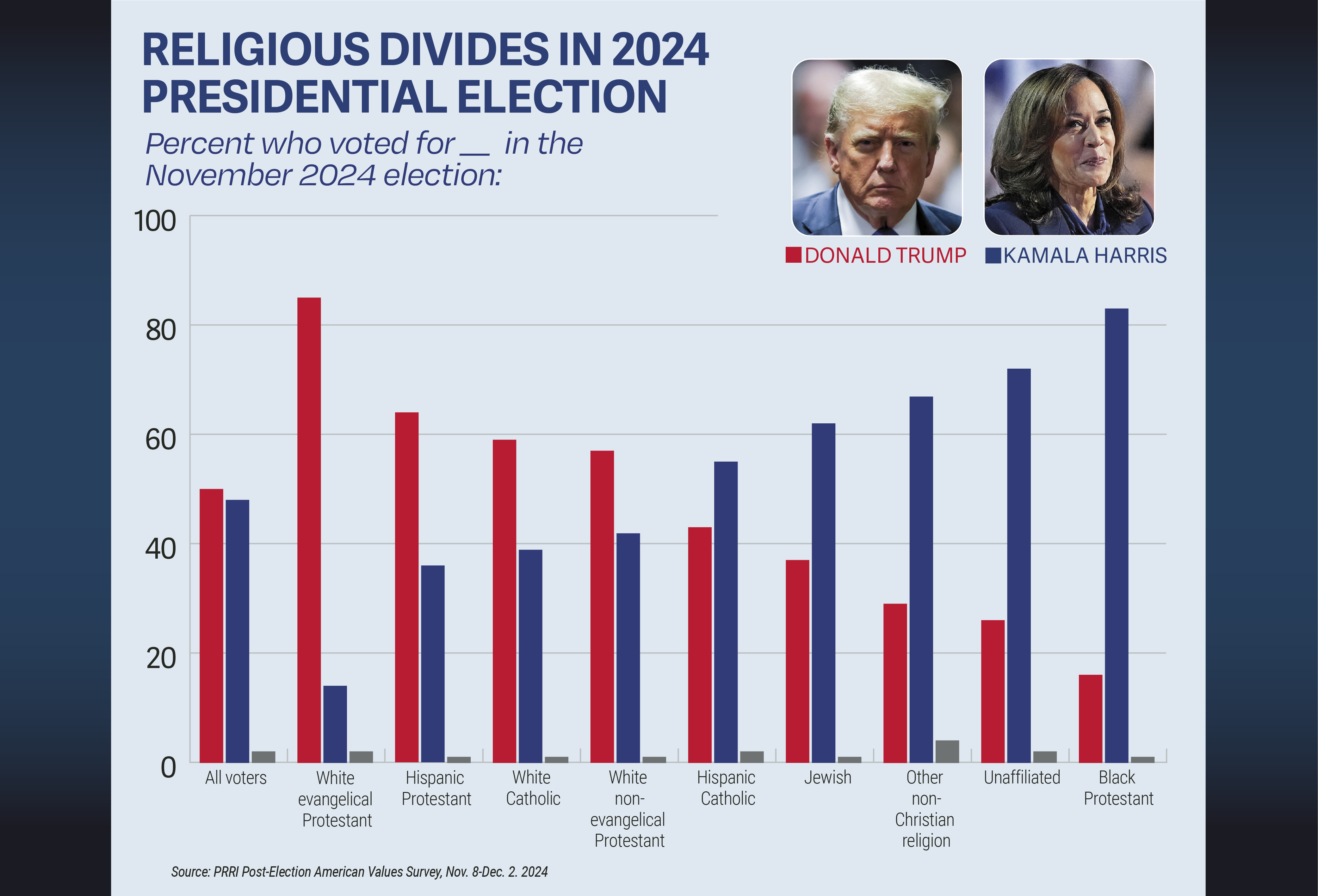
Hispanic Catholics are moving away from the Democratic party, even as a majority of them still voted for Kamala Harris in 2024, a new post-election analysis reveals. The shift among Hispanic Catholics is even larger than that of white Catholics, or Hispanic voters overall.

But the much-trumpeted shift of Catholic voters overall toward Donald Trump may have been greatly overstated in exit polls as Trump's 53% of the vote was a mere 3 percentage points higher than 2020 and one point higher than 2016.

These are some of the findings of a new study by the Public Religion Research Institute.

"I'd be really cautious about making sweeping generalizations about massive realignment, but it's clear that Trump made inroads with many groups," said Melissa Deckman, chief executive of the research institute.

The data offer fresh insights into a much-discussed phenomenon of the Catholic voter in the 2024 election. Despite their sometimes exaggerated role, Catholics' influence remains a matter of interest and continues to dominate political discussion of electoral politics in America. Because of the importance of the issue in public debate, the National Catholic Reporter has named the Catholic voter its Newsmaker of the Year.

Some of the largest Hispanic Catholic gains for Trump came from counties on the southern border, such as Maverick County, Texas. Voters there chose a Republican for president for the first time in 50 years. The county is 95% Hispanic and predominantly Catholic, with three parishes in its boundaries. It is home to Eagle Pass, a small border town where deaths of migrants trying to make their way to the United States by crossing the nearby Rio Grande River have been concentrated.


Such towns are full of working-class Hispanics, who may have been convinced by Trump's economic populist messaging, analysts said.

"We can't underestimate the economy as a factor in shaping the outcome of the election," said Dylan Corbett, executive director of HOPE Border Institute, a Catholic group that serves refugees and migrants. "They've borne the brunt of the COVID-19 pandemic, the housing affordability crisis, rising food prices and the overall economic inequality we can't seem to kick as a country."

In this year's presidential election, 55% of Hispanic Catholics voted for Harris, according to the study by the Public Religion Research Institute. By comparison, an earlier Pew Research Center study showed 66% support among Hispanic Catholics for the Democratic candidate, Joe Biden, in 2020 — a double-digit shift in four years.

Overall, the presidential race was still very close, and while Trump won the popular vote, he did not break the halfway mark. But small changes in voter turnout can have major consequences — and the shifts among religious Hispanic voters were more than small.

The Public Religion Research Institute's survey primarily confirmed previous patterns, said Deckman, chief executive of the institute. Ultimately, white religious voters — including white Catholics — were a deciding factor for Trump.

"Religious lines are pretty clearly drawn when it comes to voting behavior," Deckman said. "White people of faith tended to back Trump overall, while religious people of color tended to support Kamala Harris."

The only exception is Hispanic evangelicals — two-thirds of whom supported Trump in 2024.

The numbers for white Catholic voters are far from the 85% of white evangelicals who supported Trump, but the trend over decades continues to show growing support among white Catholics for the Republican Party.

Yet a shift among Catholic voters overall toward Trump may have been overstated in exit polls. The research institute's data for Catholics overall — with 53% of Catholics saying they voted for Trump — is only 3 points higher than 2020 and 1 point higher than 2016. Additional "verified voter" data available in the spring tends to be more accurate, analysts say.

Still, white Catholics "are slowly but surely becoming a clear base of support for Republicans," Ryan Burge, an expert on data about religion and politics, noted even before the election.

Burge has analyzed the counties where Trump made the largest gains since 2020 — and found a correlation between counties with a higher concentration of religious people and bigger gains for Trump. (The full analysis will be published on his Substack in January.)

A list of top counties where Trump improved by 10 points or more is particularly interesting: Every single one is in an area that is predominantly Catholic, and all are in counties where eight in 10 residents are Hispanic. Six of the nine counties are in Texas, along the Mexican border.

The largest gain was in Maverick County, where Trump received nearly 60% of the vote. This is not only a significant increase from 2020, it represents a 36-point shift in the last two election cycles, a swing Burge calls "unbelievable in the modern landscape."

Shifts among Hispanics, many of them Catholic, in those border counties must be about immigration — not abortion — Burge concludes. By comparison, he said, there weren't comparably sized swings in non-border cities such as Houston or Dallas.

"The most logical, simplest explanation is that this is about immigration," said Burge, an associate professor of political science at Eastern Illinois University.

While it might seem obvious to assume that immigrants would support immigration, voting patterns suggest that is not always true. Some researchers have found that established, successful immigrants oppose immigration because of fears that newly arrived migrants will contribute to negative stereotypes about all immigrants.

The Catholic Church supports immigration reform and opposes mass deportations, the opposite of Trump's positions. Pope Francis has been especially vocal about the plight of migrants. However, the U.S. bishops have been significantly more outspoken about "culture war" issues such as abortion or transgender rights — the latter a theme that Trump picked up on in his campaign.

Other surveys of Hispanic Catholics indicate only a slight increase in affiliation with the Republican Party over the past decade, while also seeing a corresponding increase in affiliation with the Democrats (offset by a decline in those identifying as independent). Hispanic Catholics are also less likely to identify as conservative today as they were a decade ago.

That, combined with data showing Hispanic Catholics do not support many GOP policies, leads Deckman to suspect they moved toward Trump in 2024 because of concerns about inflation and the economy. In counties like Maverick in Texas, more than one in five lives below the poverty line, according to the U.S. Census.

"The economy is the most important issue for most Americans, but it is disproportionately important for Hispanic Americans," Deckman said.

Harris also failed to draw a strong contrast on the issue of immigration, running on a platform that included getting tough on the border, Corbett said.

"This should be a wake-up call that we need urgently a politics that addresses the needs of working class families, puts effective policies in place to manage migration at the border, and offers a legalization program for the millions of undocumented essential workers keeping our economy going," he said.

How else to explain the paradoxical results of Hispanic voters moving toward Trump? Some clues may be in the contrast between Hispanic Catholics and Hispanic evangelicals — a 21-point difference in support for Trump, according to the research institute study.

Polarization has led to political parties differentiating themselves based on religious identities, so that to be evangelical is to be Republican, according to Efrén Pérez, who studies race, ethnicity and politics at the University of California at Los Angeles, where he is a professor of political science and psychology.

"That convergence between partisan identity and religious identity is part of what's happening with this change in the patterns of the Latino vote," Pérez said during a webinar about the PRRI data. "They're sort of just picking the right team, so to speak."

It's possible that as Catholic identity is also increasingly associated with Republicanism, the same pattern may happen with Hispanic Catholics.

Yet Pérez wonders how durable the 2024 results may be, given Trump's uniqueness as a candidate. Latinos also tend to be low-propensity voters who don't pay significant attention to politics, he said.

"It could be that we are talking about voters who are kites in the air, where they are highly responsive to the messaging that comes their way during campaigns, because they're still trying to get their political moorings."