Friday, November 1, 2019

All Souls Mass in the Catacombs of Priscilla

File photo of the Catacombs of Priscilla, with an unopened tomb (bottom R) File photo of the Catacombs of Priscilla, with an unopened tomb (bottom R) 


Pope to celebrate Mass in Roman catacombs on All Souls Day


Pope Francis is set to visit the Catacombs of Priscilla, in Rome, on Saturday, to mark the Commemoration of all the Faithful Departed with the celebration of Holy Mass.


By Devin Watkins
Large numbers of early Christian martyrs were buried in the Catacombs of Priscilla, which was known as the regina catacumbarum – the “queen of the catacombs”.
At the Angelus on Friday, Pope Francis announced plans to celebrate Mass in this ancient Roman cemetery on Saturday, the feast of All Souls.
“In these days in which there unfortunately circulate negative cultural messages regarding death and the dead, I invite you not to neglect, if possible, a visit and a prayer in a cemetery.”
He called it “an act of faith.”

Cemetery of the martyrs

The Catacombs of Priscilla were originally a sand quarry located along the Via Salaria belonging to the Acilius Glabrio family. A member of this noble family, Priscilla, allowed the early Church to use the property as a cemetery.
Many Christians were buried there from the 2nd to the 4th centuries, along with at least 7 popes, including Pope Marcellinus (296-304) and Pope Marcellus I (308-309).
The catacombs also contain what some experts consider the oldest known depiction of the Virgin Mary, in a fresco dating from the middle of the 2th century.

Angelus Address for All Saints Day

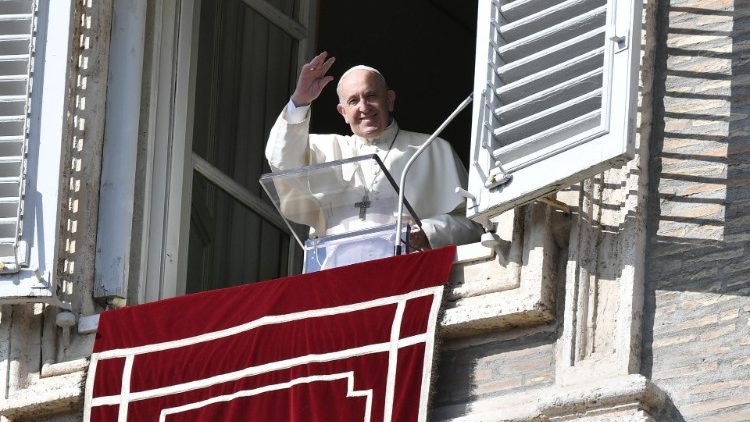
Pope Francis waves to the faithful in St. Peter's Square Pope Francis waves to the faithful in St. Peter's Square  (Vatican Media)


Pope at All Saints Angelus: ‘Holiness is both gift and call’


At the Angelus prayer on Friday, Pope Francis reflects on the Solemnity of All Saints, and reminds us that holiness is both a gift and an invitation.


By Devin Watkins
“Today's Solemnity of All Saints reminds us that we are all called to holiness.”
That was how Pope Francis summed up the feast, in his Angelus address to pilgrims in St. Peter’s Square.
He said the Saints are not some distant, unreachable human beings. But rather they trod the same difficult path of life along which we travel, with all its successes and failures.
Holiness, said the Pope, cannot be achieved through our own strength. It is “the fruit of God’s grace and our free response to it”, making it both a gift and a call.

Free gift

As a gift given by God, holiness cannot be bought but only welcomed with the help of the Holy Spirit.
“It is a matter of growing ever more in the awareness that we are grafted onto Christ, as the branch is united to the vine,” he said, “and therefore we can and must live with Him and in Him as children of God.”

Call to answer

Pope Francis said the Saints show us that holiness is also a call extended to all Christ’s disciples.
“It is the path of fullness that every Christian is called to follow in faith, proceeding towards the final goal: definitive communion with God in eternal life.”
Holiness requires us to embrace God’s gift responsibly and to “take on a serious and daily commitment to sanctification in all the conditions, duties, and circumstances of our lives, seeking to live everything with love, with charity.”

Imitate our predecessors

The Saints who now stand before the throne of God admitted during life that they needed the divine light and so abandoned themselves to it in trust, said the Pope.
“They constitute the ‘Holy City’ to which we look with hope as our definitive goal, as we make our way through this ‘earthly city’, fatigued by the bitterness of the journey.”
So, he said, “we are encouraged to imitate them.”

Lift eyes to Heaven

Remembering the Saints, concluded Pope Francis, “impels us to raise our eyes to Heaven: not to forget the realities of the earth, but to face them with more courage and hope.”
And he asked the Virgin Mary to accompany us “as a sign of consolation and sure hope.”

Amazon Synod translation of final document, chapter 3

Cardinal Barreto Accompanied Pope Francis At The Opening Of The Amazonian Synod © Vatican Media

Amazon Synod: Zenit Translation of Final Document, Chapter Three

Full Document Published in Several Installment

Here is the third installment of Zenit’s English translation of the Final Document and Voting on the Final Document of the Synod of Bishops handed to the Holy Father Francis, at the end of the Special Assembly of the Synod of Bishops for the Pan-Amazonian Region (October 6-17, 2019) on the theme: “Amazonia: New Pathways for the Church and for An Integral Ecology”:
This installment includes the third chapter of the final synod document. Zenit will publish the remainder of the text in the following days. We will publish the official Vatican English version when it is available.
******
CHAPTER III
NEW PATHS OF CULTURAL CONVERSION
“And the Word became flesh and dwelt among us” (Jn 1:14)
  1. Latin America has immense biodiversity and great cultural diversity. In it, Amazonia is a land of forests and water, wastelands and wetland, savannahs and mountain ranges, but above all, a land of innumerable peoples, many of them ancient, ancestral inhabitants of the territory, villages of ancient perfume that continue scenting the Continent against all despair. Our conversion must also be cultural; we must make ourselves the other, learn from the other. We must be present, respect and recognize their values, live and practice inculturation and interculturality in our proclamation of the Good News. To express and live the faith in Amazonia is an on-going challenge. It is incarnate not only in the pastoral but in the concrete actions vis-a-vis the other, in the care of health, in education, in solidarity and support of the most vulnerable. In this section, we would like to share all this.
The face of the Church in the Amazonian peoples
  1. There is a multi-cultural reality in Amazonia’s territories, which calls for a look that includes all and that uses expressions that enable one to identify and connect all the groups, and reflect identities that are recognized, respected and promoted both in the Church as well as in society, which must see in the Amazonian peoples a valid interlocutor for dialogue and encounter. Puebla spoke of the faces that inhabit Latin America and verified that in the native peoples there is a miscegenation that has grown and continues to grow with encounter and misunderstandings between the different cultures that make up the Continent. This face, also of the Church in Amazonia, is a face that is incarnate in its territory, which evangelizes and opens paths so that peoples feel accompanied in different processes of evangelical life. Present also is a renewed missionary sense on the part of the inhabitants of the villages themselves, carrying out the prophetic and Samaritan mission of the Church, which must be strengthened with openness to dialogue with other cultures. Only an inserted and inculturated missionary Church will make native particular churches arise, with an Amazonian face and heart, rooted in the cultures and traditions proper of the peoples, united in the same faith in Christ and diverse in their way of living, expressing and celebrating it.
a. The cultural values of the Amazonian peoples
  1. We find teachings for life in the people of Amazonia. The native peoples and those that arrived subsequently, who forged their identity in co-existence, contributed cultural values in which we discover seeds of the Word. In the jungle not only the vegetation is intertwined, one species sustaining another, the peoples also inter-relate among themselves in a network of alliances that brings everyone gain. The jungle lives of inter-relations and inter-dependencies and this happens in all realms of life. Thanks to this, the fragile balance of Amazonia was maintained for centuries.
  1. The thought of the indigenous peoples offers an integrating vision of reality, which is able to understand the multiple existing connections between all that is created. This contrasts with the prevailing current of Western thought, which tends to fragment to understand reality, but is unable to articulate the whole of relations between the different fields of knowledge. The traditional management of what nature offers them has been done in a way that today we call sustainable management. In addition, we find other values of the native peoples, such as reciprocity, solidarity, community sense, equality, the family, its social organization and the sense of service.
b. The Church present and ally of the peoples in their territories
  1. Greed for land is at the root of the conflicts that lead to ethnocide, as is the murder and criminalization of social movements and their leaders. The demarcation and protection of the land is an obligation of the National States and of their respective governments. However, a good part of indigenous territories are without protection and those already demarked are being invaded by extractive fronts, such as mining, forest extraction, by great infrastructure projects, by illicit crops and by large estates that promote monoculture and extensive cattle raising.
  2. Therefore, the Church commits herself to be an ally to the Amazonian peoples, to denounce attempts against the life of indigenous communities, projects that affect the environment, the lack of demarcation of their territories, as well as the economic model of predatory and ecocide development. The presence of the Church, among the indigenous and traditional communities, needs this awareness that the defense of the land has no other end than the defense of life.
  3. The life of the indigenous, mestizo, riverine people, peasants, quilombolas and/or Afro-descendants and traditional communities is threatened by the destruction, the environmental exploitation and the systematic violation of their territorial rights. It is necessary to defend the rights to free determination, the demarcation of territories and previous, free and informed consultation. These peoples have “social, cultural and economic conditions that distinguish them from other sectors of the national community, and that are governed totally or partially by their own customs and traditions or by special legislation” (Conv. 169 ILO, art. 1, 1a). For the Church, the defense of life, the community, the earth and the rights of the indigenous peoples is an evangelical principle, in defense of human dignity: “I came that they may have life, and have it abundantly” (Jn 10:10b).
  4. The Church promotes the integral salvation of the human person, valuing the culture of the indigenous peoples, talking about their vital needs, accompanying the movements in their struggles for their rights. Our pastoral service constitutes a service for the full life of the indigenous peoples, which moves us to proclaim the Good News of the Kingdom of God and to denounce the situations of sin, structures of death, violence and injustices, promoting the inter-cultural, inter-religious and ecumenical dialogue (Cf. DAp 95).
  1. The Indigenous Peoples in Voluntary Isolation (PIAV) or Indigenous Peoples in Isolation and Initial Contact (PIACI) need a specific chapter. There are in Amazonia about 130 peoples or segments of peoples, that don’t maintain systematic or permanent contacts with the enveloping society. Systematic abuses and violations of the past cause their migration to more inaccessible places, seeking protection, trying to keep their autonomy and opting to limit or avoid relations with third parties. Today their life continues to be threatened by the invasion of their territories from different fronts and by their low demography, remaining exposed to ethnic cleansing and their disappearance. From his meeting with Indigenous Peoples in Puerto Maldonado in January of 2018, Pope Francis reminded us that they “are the most vulnerable among the vulnerable (. . . ) Continue defending these more vulnerable brothers. Their presence reminds us that we cannot have common goods at the rhythm of the greed of consumption” (Fr. PM). An option for the defense of the PIAV/PIACI does not exempt the local Churches from pastoral responsibility over them.
  1. This responsibility must be manifested in specific actions for the defense of their rights, concretized in actions of influence so that States assume the defense of their rights through the legal and inviolable guarantee of the territories they occupy in a traditional way, including adopting precautionary measures in the regions where, there being only traces of their presence, the latter is not confirmed officially and establishing mechanisms of bilateral cooperation between States, when these groups occupy trans-border areas. Respect for their self-determination must be guaranteed at all times, as well as their free decision on the type of relationship they want to establish with other groups. Therefore, it will be necessary that all the People of God, and especially the neighboring towns to the territories of the PIAV/PIACI, be sensitized on respect for these people and the importance of the inviolability of their territories. As Saint John Paul II said in Cuiaba in 1991: “The Church, dear Indian brothers, and sisters, has been and will continue to be always by your side to defend the dignity of human beings, their right to have their own and peaceful life, respecting the values of their traditions, customs, and cultures.”
Paths for an inculturated Church
  1. With the Incarnation, Christ put aside His prerogative as God and became man in a concrete culture to identify Himself with the whole of humanity. Inculturation is the incarnation of the Gospel in the native cultures (what is not assumed isn’t redeemed,” Saint Irenaeus, Cf. Puebla 400) and, at the same time, the introduction of these cultures in the life of the Church. The peoples are the protagonists in this process, accompanied by their agents and Pastors.
a. The living of the faith expressed in popular piety and inculturated catechesis
  1. Popular piety is an important means that links many peoples of Amazonia with their spiritual experiences, their cultural roots and their community integration. They are manifestations with which the people express their faith, through images, symbols, traditions, rites and other sacramentals. The pilgrimages, processions and patronal feasts must be appreciated, accompanied, promoted and sometimes purified, given that they are privileged moments of evangelization, which must lead to the encounter with Christ. Marian devotions are very rooted in Amazonia and in the whole of Latin America.
  2. Non-clericalization is characteristic of Brotherhoods, Fraternities and groups linked to popular piety. The laity assumes a leadership that is hardly attained in other ecclesial realms, with the participation of brothers and sisters that carry out services and direct prayers, blessings, traditional sacred songs; lead novenas, organize processions, promote patronal feasts, etc. it is necessary to “give an appropriate catechesis and to accompany the faith already present in popular religiosity. A concrete way could be to offer a process of Christian initiation … that leads us to be increasingly like Jesus Christ, causing a progressive appropriation of His attitudes” (DAp 300).
b. The mystery of the faith reflected in an inculturated theology
  1. Indian theology, the theology of an Amazonian face and popular piety are already a richness of the indigenous world, of its culture and spirituality. When the missionary and pastoral agent takes the word of Jesus’ Gospel, he identifies with the culture and the encounter takes place form which witness, service, proclamation and apprenticeship of languages is born. The indigenous world, with its myths, narratives, rites, songs, dance and spiritual expressions enriches the inter-cultural encounter. Puebla already recognized that “the cultures are not empty terrains, lacking in genuine values. The Church’s evangelization is not a process of destruction, but of consolidation and strengthening of those values: a contribution to the growth of the ‘seeds of the Word’” (DP 401, cf. GS 57) present in the cultures.
Paths for an inter-cultural Church
a. Respect of cultures and rights of the peoples
  1. We are all invited to approach the Amazonian peoples as equals, respecting their history, their cultures, their ‘good living’ style (PF 06.10.19). Colonialism is the imposition of specific ways of living of some peoples over others, including economically, culturally and religiously. We reject an evangelization of colonialist style. To proclaim the Good News of Jesus implies to recognize the seeds of the Word already present in the cultures. The evangelization we propose today for Amazonia is the inculturated proclamation that generates processes of interculturality, processes that promote the life of the Church with an Amazonian identity and face.
b. The promotion of intercultural dialogue in a global world
56. In the Church’s evangelizing task, which must not be confused with proselytism, we must include clear processes of inculturation of our missionary methods and schemes. Proposed concretely to the centers of research and pastoral of the Church is that, in alliance with the indigenous peoples, they study, compile and systematize the traditions of the Amazonian ethnic groups to foster an educational endeavor that begins from their identity and culture, helps in the promotion and defense of their rights, keeps and spreads its value in the Latin American cultural setting
  1. Educational actions are interpellated today by the need for inculturation. It is a challenge to look for methodologies and contents that are appropriate for the peoples where the ministry of teaching is to be exercised. In this connection, knowledge of their languages, their beliefs, and aspirations, their needs and hopes is important, as well as the collective construction of educational processes that have, both in the form and in the contents, the cultural identity of the Amazonian communities, insisting on formation in integral ecology as transversal axis.
c. The challenges for health, education, and communication
  1. The Church assumes as an important task to promote education in preventive health and offer health care in places where the State’s care doesn’t reach. It requires favoring initiatives of integration that benefit the health of Amazonians. It is also important to promote the socialization of ancestral knowledge in the field of traditional medicine proper to each culture.
  1. Among the complexities of the Amazonian territory, we highlight the fragility of education, especially in the indigenous peoples. Although education is a human right, the educational quality is deficient and school desertion very frequent, especially by girls. Education evangelizes, promotes social transformation, empowering people with a healthy critical sense. “A good school education at an early age puts seeds that can produce effects throughout a life” (LS 213). It is our task to promote education for solidarity, which stems from the awareness of a common origin and of a future shared by all. (cf. LS 2202). It is necessary to exact from governments the implementation of a public, intercultural and bilingual education.
  2. The world, increasingly globalized and complex, has developed an unprecedented information network. However, such a flow of instantaneous information does not imply better communication or connection among peoples. We want to promote in Amazonia a communicative culture that fosters dialogue, the culture of encounter, and the care of the “common home.” Motivated by an integral ecology, we want to empower areas of communication already existing in the region, to thus promote urgently an integral ecological conversion. To do so, it is necessary to collaborate with the formation of native agents of communication, especially Indians. Not only are they privileged interlocutors for evangelization and human promotion in the territory, but, in addition, they help us to spread the culture of ‘good living’ and the care of creation.
  1. For the purpose of developing the different connections with the whole of the Amazon and of improving its communication, the Church wishes to create a Pan-Amazonian ecclesial communications network, which includes the different means used by the particular Churches and other ecclesial organisms. Their contribution can have resonance and help in the ecological conversion of the Church and the planet. REPAM can collaborate with advice and support of the formative processes, the follow-up, and strengthening of communication in the Pan-Amazonian region.
New paths for the cultural conversion
  1. In this connection, we propose the creation of a school network of bilingual education for Amazonia (similar to Faith and Joy), which articulates educational proposals that respond to the needs of the communities, respecting, valuing and integrating in them the cultural and linguistic identity
  1. We want to sustain, support and foster educational experiences of bilingual, intercultural education, which already exist in the ecclesiastical jurisdictions of Amazonia and involve the Catholic Universities so that they work and commit themselves to the network.
  2. We will look for new forms of conventional and non-conventional education, such as long-distance education, in keeping with the needs of the places, times and persons.

Amazon Synod translation of final document, chapter two

Vatican Media Screenshot

Amazon Synod: Zenit Translation of Final Document, Chapter Two

Full Document Published in Several Installment

Here is the second installment of Zenit’s English translation of the Final Document and Voting on the Final Document of the Synod of Bishops handed to the Holy Father Francis, at the end of the Special Assembly of the Synod of Bishops for the Pan-Amazonian Region (October 6-17, 2019) on the theme: “Amazonia: New Pathways for the Church and for An Integral Ecology”:
This installment includes the second chapter of the final synod document. Zenit will publish the remainder of the text in the following days. We will publish the official Vatican English version when it is available.
******
CHAPTER II
NEW WAYS OF PASTORAL CONVERSION
“Unless one is born of water and the Spirit, he cannot enter the Kingdom of God” (Jn 3:5).
  1. A missionary Church going forth calls us to a pastoral conversion. For Amazonia, this journeying also implies “navigating,” by our rivers, our lakes, among our people. In Amazonia, water unites us; it doesn’t separate us. Our pastoral conversion will be Samaritan, in dialogue, accompanying people with concrete faces of Indians, of peasants, of Afro-descendants and migrants, of young people, of inhabitants of the cities. All of this will imply a spirituality of listening and of proclamation. It is thus that we will journey and navigate in this chapter.
The Church is missionary going forth
  1. By nature the Church is missionary and she has her origin in the “fontal love of God” (AG 2). The missionary dynamism that stems from the love of God radiates, expands, overflows and spreads throughout the universe. “By Baptism, we are inserted in the dynamic of love through the encounter with Jesus, who gives a new horizon to life” (DAp 12). This overflowing drives the Church to a pastoral conversion and transforms us into living communities that work in a team and in a network, at the service of evangelization. The mission understood thus isn’t something optative, an activity of the Church among others, but her very nature. The Church is mission! “Missionary action is the paradigm of the whole work of the Church” (EG 15). To be a missionary disciple is something more than fulfilling tasks or doing things. It is situated in the order of being. “Jesus points out to us, His disciples, that our mission in the world can’t be static, but is itinerant. A Christian is an itinerant” (Francis, Angelus, 30/06/2019).
a. Samaritan, merciful and solidary Church
  1. We want to be an Amazonian, Samaritan Church incarnate in the way in which the Son of God was incarnate: “He took our infirmities and bore our diseases” (Mt 8:17b). He who made himself poor to enrich us with His poverty (2 Co 8:9) through His Spirit He exhorts today’s missionary disciples to go forth to encounter all, especially native peoples, the poor, the excluded from society and others. We also want a Magdalene Church, that feels loved and reconciled, that proclaims with joy and conviction Christ crucified and resurrected; a Marian Church that generates children to the faith and educates them with affection and patience, also on peoples’ riches. We want to be a serving, kerygmatic, educating, inculturated Church in the midst of the peoples we serve.
b. Church in ecumenical, inter-religious and cultural dialogue
  1. The multi-ethnic, multi-cultural and multi-religious reality of Amazonia calls for an attitude of open dialogue, recognizing likewise the multiplicity of the interlocutors: the indigenous peoples, riverine people, peasants and Afro-descendants, the other Christian Churches and religious Denominations, organizations of the civil society, popular social movements, the State, in fine all persons of goodwill that seek the defense of life, the integrity of Creation, peace, and the common good. In Amazonia, “relations between Catholics and Pentecostals, Charismatics and Evangelical aren’t easy. The sudden appearance of new communities, linked to the personality of some preachers, contrasts strongly with the beginnings and ecclesiological experience of the historical Churches, and it can conceal the danger of being dragged by emotional waves of the moment or of closing the experience of faith in protected and tranquilizing environments. The fact that not a few Catholic faithful feel attracted to these communities is a motive of friction, but it can become, on our part, a motive for personal examination and pastoral renewal” (Pope Francis, 28.09.2018). The ecumenical, inter-religious and inter-cultural dialogue must be assumed as the indispensable path of evangelization in Amazonia (Cf. DAp 227). Amazonia is an amalgam of creeds, the majority Christian. In the face of this reality, real paths of communion are opened to us: “The manifestations of good sentiments aren’t enough. Concrete gestures are needed that penetrate the spirit and shake the consciences, driving each one to interior conversion, which is the foundation of all progress on the path of ecumenism” (Benedict XVI, Message to the Cardinals in the Sistine Chapel, 20/04/2005). The centrality of the Word of God in the life of our communities is a factor of union and dialogue. Many common actions can be taken around the Word of God: translations of the Bible into local languages, joint editions, diffusion and distribution of the Bible and meetings between Catholic men and women theologians and others of different Confessions.
  2. In Amazonia, the inter-religious dialogue is carried out especially with the indigenous religions and Afro-descendants cults. These traditions deserve to be known, understood in their expressions and in their relationship with the forest and Mother Earth. Together with them, Christians, based on their faith in the Word of God, engage in dialogue, sharing their lives, their concerns, their struggles, their experiences of God, to deepen mutually their faith and to act together in defense of the “common home.” In this connection, it is necessary that the churches of Amazonia develop initiatives of encounter, study and dialogue with the followers of these religions. Sincere and respectful dialogue is the bridge towards building “good living.” In the exchange of gifts, the Spirit leads increasingly to the truth and the good (Cf. EG 250).
Missionary Church that serves and accompanies the Amazonian peoples
  1. This Synod intends to be a strong call to all the baptized of Amazonia to be missionary disciples. The sending to the mission is inherent to Baptism and is for all the baptized. Through it we all receive the same dignity of being sons and daughters of God, and no one can be excluded from Jesus’ mission to His disciples. ”Go into all the world and preach the Gospel to the whole creation” (Mk 16:15). Hence we believe it is necessary to generate a greater missionary impetus among the native vocations, Amazonia must also be evangelized by Amazonians.
a. Church with an indigenous, peasant and Afro-descendant face
  1. It is urgent to give the indigenous pastoral its specific place in the Church. We start from plural realities and different cultures, to define, elaborate and adopt pastoral actions, which enable us to develop an evangelizing proposal amid the indigenous communities, situating ourselves within the framework of an indigenous pastoral and of the earth. The pastoral of the indigenous peoples has its own specificity. The colonizations motivated by extractive zctivities throughout history, with the different migratory currents, put them in a situation of high vulnerability. In this context, as Church, it continues to be necessary to create and maintain a preferential option for the indigenous peoples, in virtue of which diocesan organisms of indigenous pastoral must establish and consolidate themselves with a renewed missionary action, which listens, dialogues, is incarnated and has a permanent presence. The preferential option for the indigenous peoples, with their cultures, identities, and histories, calls us to aspire to an indigenous Church with their own priests and ministers, always united and in total communion with the Catholic Church.
  2. Recognizing the importance of the attention that the Church is called to give in Amazonia to the phenomenon of urbanization and the problems and perspective related to it, a reference to the rural world as a whole is necessary and to the rural pastoral in particular. From the pastoral point of view, the Church must give answers to the phenomenon of the depopulation of the countryside, with all the consequences that derive from it (loss of identity, prevailing laicism, exploitation of rural work, family disintegration, etc.).
b. Church with a Migrant Face
  1. Given its increase and volume, at present, the phenomenon of migrations has become unheard of political, social and ecclesial challenge (Cf. DA, 517, a). In the face of this, many ecclesial communities have received migrants with great generosity, remembering that ”I was a stranger and you welcomed me” (Mt 25:35). The forced displacements of indigenous, peasant, Afro-descendants and riverine families, expelled from their territories by the pressure on the same or by the asphyxiation given the lack of opportunities, calls for a joint pastoral in the periphery of the urban centers. In this connection, it will be necessary to create missionary teams for their accompaniment, coordinating with the parish and other ecclesial and extra-ecclesial conditions of hospitality, offering inculturated liturgies and in the languages of the migrants; promoting areas of cultural exchanges, fostering integration in the community and in the city and motivating them in this work of leadership.
c. Church with a Young Face
  1. Outstanding among the different faces of the Amazonian realities are those of the young people present in the whole territory. They are young people with indigenous faces and identities, Afro-descendants, riverine people, those in extractive activities, migrants, and refugees, among others. Young people residents in rural and urban areas, who dream daily, seeking better conditions of life, with the profound desire to have a full life; young students and workers, with a strong presence and participation in different social and ecclesial areas. Among Amazonian youth, there are sad realities, such as poverty, violence, illnesses, child prostitution, sexual exploitation, use and trafficking of drugs, early pregnancy, unemployment, depression, human trafficking, new forms of slavery, trafficking of organs, difficulties in accessing to education, health care, and social care. Lamentably, in the last years, there has been a significant increase in suicide among young people, as well as the growth of the imprisoned youth population and crimes between and against young people, especially Afro-descendants and those on the periphery. Living in the same great territory of Amazonia, they have the same dreams and yearning as other young people in this world: to be considered, respected, to have study and job opportunities and a future of hope. However, they are living an intense crisis of values, or a transition to other ways of conceiving the reality, where the ethical elements are changing, including for young Indians. The task of the Church is to accompany them to face all situations that destroy their identity or damage their self-esteem.
  2. Young people are also intensely present in the territory’s migrant contexts. The reality of young people in urban centers merits special attention. Increasingly, cities are recipients of all the ethnic groups, peoples and problems of Amazonia. Rural Amazonia is being depopulated; the cities are facing enormous problems of juvenile delinquency, lack of work, ethnic fights and social injustices. Here, in particular, the Church is called to be a prophetic presence among young people, giving them adequate accompaniment and appropriate education.
  3. In communion with the Amazonian youth reality, the Church proclaims the Good News of Jesus to young people, provides vocational discernment and accompaniment, the place of appreciation of the local culture and identity, youth leadership, the promotion of the rights of youth, the strengthening of creative, innovative and differentiated areas of evangelization through a renewed and daring youth ministry. A pastoral always in process, centered on Jesus Christ and his plan, dialogic and integral, committed in all the existing youth realities in the territory. The young Indians have enormous potential and take part actively in their communities and organizations, contributing as leaders and animators, in defense of their rights — especially in the territory –, health and education. On the other hand, they are the main victims of the insecurity of indigenous lands and the lack of specific and quality public policies. The spread of alcohol and drugs often reaches the indigenous communities, gravely harming young people and impeding them from living in freedom, to build their dreams and take part actively in the community.
  4. The leadership of young people appears clearly in the documents of the Synod on Young People (160, 46) in the Papal Exhortation Christus Vivit (170) and in the Encyclical Laudato Si’ (209). Young people want to be protagonists and the Amazonian Church wants to recognize their space. She wants to be a companion in listening, acknowledging to young people a teleological place, as “prophets of hope,” committed to dialogue, ecologically sensitive and attentive to the “common home”; a Church that welcomes and walks with young people, especially in the peripheries. In face of this, three urgencies arise: to promote new ways of evangelization through the social media (Francis, Chrisitus Vivit 86); to help an Indian youth achieve a healthy interculturality, to help them all to confront the crisis of anti-values that destroys their self-esteem, and makes them lose their identity.
d. Church that follows new ways in the urban pastoral
  1. Humanity’s strong tendency to concentrate in cities, migrating from the small to the larger, also happens in Amazonia. The accelerated growth of the Amazonian metropolises is accompanied by the generation of urban peripheries. At the same time, lifestyles, ways of living together, languages and values configured by the metropolises and transmitted, and are increasingly implanted both in indigenous communities as well as in the rest of the rural world. The family in the city is a place of synthesis between the traditional culture and the modern. However, families often suffer poverty, precarious housing, lack of work, increase in the consumption of drugs and alcohol, discrimination and child suicide. In addition, there is a lack of dialogue in family life, and the traditions and language are lost. The families are also faced with new health problems, which require adequate education, for instance, in the matter of maternity. The rapid present changes affect the Amazonian family. So we find new family formats: one-parent families under the responsibility of women, increase of separated families, consensual unions and gathered families, diminution in institutional marriages. The city is an explosion of life, because “God lives in the city” (DAg 514). In it, there are anxieties and searches for the meaning of life, conflicts but also solidarity, fraternity, desire for goodness, truth, and justice” (Cf. EG 71-75). To evangelize the city or the urban culture means “to achieve and, so to speak, modify by the force of the Gospel the criteria of judgment, the values that count, the centers of interest and the lines of thought, the sources of inspiration and humanity’s models of life, that appear in contrast to the Word of God and the plan of salvation” (EN 19).
  2. It is necessary to defend the right of all persons to the city. The claimed right to the city is defined as the equitable enjoyment of the cities within the principles of sustainability, democracy, and social justice. Nevertheless, it will also be necessary to influence public policies and to promote initiatives that improve the quality of life in the rural world, thus avoiding its uncontrolled displacement.
  3. The grassroots ecclesial communities have been and are a gift of God to the local Churches of Amazonia. However, it is necessary to acknowledge that, with the of time some ecclesial communities have settled, weakened or even disappeared, but the great majority continues to be persevering and is the pastoral foundation of many parishes. Today the great dangers of the ecclesial communities come primarily from secularism, from individualism from the lack of the social dimension and the absence of missionary activity. Therefore, it is necessary that Pastors encourage each and all of their faithful to missionary discipleship. The ecclesial community will have to be present in the areas of participation in public policies, where actions are articulated to revitalize the culture, coexistence, leisure, and celebration. We must fight so that the “favelas” and “villas miseria,” are assured of basic fundamental rights; water, energy, housing, and promote integral ecological citizenship. Institute the ministry of hospitality in urban communities of Amazonia for fraternal solidarity with migrants, refugees, homeless people and persons that have abandoned rural areas.
  4. Special care must be given to the reality of Indians in the urban centers, as they are the ones most exposed to the enormous problems of juvenile delinquency, lack of work, ethnic fights and social injustices. It is one of the greatest challenges of today: increasingly cities are the places of destiny of all the ethnic groups and peoples of Amazonia. An indigenous pastoral of the city must be articulated that attends to this specific reality.
e. A spirituality of listening and proclamation
  1. Pastoral action is sustained by a pastoral based on listening to the Word of God and the cry of the people, to then be able to proclaim the Good News with a prophetic spirit. We acknowledge that the Church that listens to the clamor of the Spirit in the cry of Amazonia can make her own the joys and hopes, sadness and anxieties of all, but especially of the poorest (Cf. GS 1), who are favorite daughters and sons of God. We discover that the plentiful waters of the Spirit, like those of the Amazon River, which overflow periodically, lead us to that super-abundant life that God offers us to share in the proclamation.
New Pathways for Pastoral Conversion
  1. The itinerant missionary teams in Amazonia are weaving and building community on the way, and they help to strengthen ecclesial synodality. They can add several charisms, institutions, and Congregations, laymen and laywomen, men and women religious, priests; to add themselves to reach together where one alone cannot. The tours of the missionaries that leave their headquarters and spend some time visiting, community after community, and celebrating the Sacraments, give standing to what is called the “pastoral of a visit.” It is a type of pastoral method that responds to the present conditions and possibilities of our churches. Thanks to those methods, and by the action of the Holy Spirit, those communities have also developed a rich ministeriality, which is a motive of thanksgiving.
  2. We propose an itinerant network that brings together the different efforts of the teams that accompany and dynamize the life and faith of the communities in Amazonia. The ways of political influence for the transformation of the reality must be discerned with the Pastors and laity, geared to pass from pastoral visits to a more permanent presence. The Congregations and/or Provinces of men and women religious of the world, that are not yet involved in missions, are invited to establish at least a missionary front in any of the Amazonian countries.

Morning Papal Homily from Thursday

© Vatican Media

Santa Marta: Love that Plays its Last Card

The Love of God ‘is tears of tenderness in Jesus’

The love of God is a love “always waiting”, which “plays its last card … until the end”, Pope Francis affirmed during the morning Mass that he celebrated at the Holy House. Martha, October 31, 2019. And the love of God “is tears of tenderness in Jesus”.
On the Damascus Way, the pope emphasized in his homily, St. Paul “fell in love with Christ”, a “strong love”, “great”, “serious”, to the point of “feeling that the Lord always accompanied, in beautiful things as in bad ones.
And the pope to ask, “Do I love the Lord like that? When bad times come, how many times do you want to say, “The Lord has abandoned me, he does not love me anymore” and we would like to leave the Lord? But Paul was sure that the Lord never gives up. He understood in his life the love of Christ. This is the path that Paul shows us: the path of love, always, in good and bad times, always. ”
The love of Christ “can not be described”, insisted the pope: “he gave his life for me and there is no greater love than to give one’s life for another”. He gave the example of maternal love, which “gives his life for his child, accompanies him always in his life, in difficult times … but it is still little … The love of Jesus is a close love from us … from each of us, with a name and a name. ”
In the Gospel of Luke, the love of Jesus is so “concrete” that he “weeps”, Pope Francis observed: “The love of Christ leads him to tears, to tears for each one of us. What tenderness there is in this expression. If Jesus could “condemn Jerusalem, say harsh things” it was because he regretted that she “does not let herself be loved”.
“If we can not feel, to understand the tenderness of the love of God in Jesus for each one of us, never, we will never be able to understand what is the love of Christ,” he said. It is a love that is always waiting, patient, the love that plays its last card with Judas (calling it) “Friend”, who gives him his exit door, until the end. He also loves great sinners with this tenderness, until the end.
In conclusion, Pope Francis invited to think “to Jesus so tender, to Jesus who weeps, as he cried in front of the tomb of Lazarus, as he cried while looking at Jerusalem”.