Showing posts with label Synod. Show all posts

Saturday, September 12, 2026

Pope Leo XIV addresses the Fratelli Tutti Synod Meeting


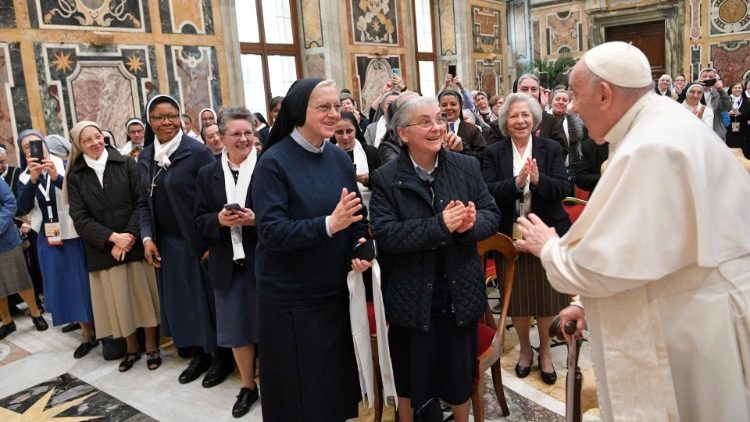
Pope Leo with participants in the 'Fratelli tutti: North-South Socio-Environmental Dialogue' meetingPope Leo with participants in the 'Fratelli tutti: North-South Socio-Environmental Dialogue' meeting  (@Vatican Media)

Pope: Progress must not leave new ruins in its wake

Pope Leo meets participants in the ‘Fratelli tutti: North-South Socio-Environmental Dialogue’ meeting and stresses our shared responsibility in the face of social, economic and technological challenges.

By Sebastián Sansón Ferrari

Differences do not necessarily have to lead to division. They can become a creative force when accompanied by shared responsibility and directed towards the common good.

That was one of the key themes of Pope Leo XIV’s message to participants in the Fourth ‘Fratelli Tutti’ Synodal Meeting, whom he received in audience in the Vatican today, Saturday 12 September 2026. The event had been held from Thursday 10 to Saturday 12 September in Rome.

In his wide-ranging address, delivered both in Spanish and in English, the Pope greeted representatives of the Latin American and Caribbean Episcopal Council, the Ecclesial Conference of the Amazon and the United States Conference of Catholic Bishops.

He also thanked representatives of international organizations, regional development banks, businesses, foundations, trade unions, employers’ associations, universities, ecclesial networks and social organizations for their presence.

The breadth of representation, he said, gives the meeting particular significance, and reflects a willingness to continue a dialogue which can translate into models of development that are “more human, sustainable and in solidarity”.

READ THE POPE'S FULL ADDRESS HERE


“A courageous and confident dialogue”

The Pope linked this effort to an essential dimension of the Church’s mission. He recalled that, at the beginning of his pontificate, he had told the College of Cardinals on 10 May 2025 of the need for a “courageous and confident dialogue with the contemporary world in its different components and realities”.

Dialogue with the world, he explained, is not a secondary activity for the Church but part of its evangelizing mission. The Church proclaims the Gospel amid the concrete circumstances in which peoples live and is therefore called to look squarely at the reality of men and women.

In this context, the Pope recalled that the Church is called to “embrace reality” and to expose the contradictions that can accompany scientific and technological progress, whose unprecedented possibilities bring new responsibilities.

What kind of humanity do we want to build?

Faced with technological development, Leo XIV urged people to go beyond simply accepting or rejecting particular tools. The decisive question, he said, is “what kind of humanity we want to build and what place each person will have in it”.

The Pope placed this question within the horizon of Christian faith: God has entered history and, in Jesus Christ, has taken on humanity. The Church is therefore called to discern, within history, what truly serves the human person and what may ultimately turn against it.

The transformations of our time, he added, demand a responsibility that exceeds the capacity of any single institution. Hence the need to recover the logic of subsidiarity, recognizing each actor’s own responsibility while also acknowledging the need to work together.

In this regard, he welcomed the initiative of promoting a North-South Shared Responsibility Agenda for Multisectoral Cooperation.

“When public institutions, businesses, workers, universities, communities and social organizations share their knowledge, capacities and resources in the service of the common good, a conviction that has matured within the Church’s social doctrine and that my Predecessors have developed in different ways takes concrete shape: major social challenges require shared responsibility, participation and collaboration among the different bodies of society.”

Catholic Social Teaching as a process of discernment

In the English-language section of his address, the Pope focused on the res novae, the new realities shaping our time, calling for institutions capable of regulating without stifling.

He also highlighted the responsibility of businesses, which must recognize human dignity, and not just profit, as a measure of success.

In this regard, the Pope highlighted Catholic Social Teaching, highlighting that it is not a manual of principles and rules to be applied mechanically, but rather “a process of shared discernment”.

It does not replace the decisions that different actors are called to make, the Pope said. Instead, CST provides criteria for judging whether those decisions genuinely respect human dignity and serve the common good.

A culture of negotiation

Pope Leo also encouraged the cultivation of a “healthy culture of negotiation”.

Negotiation, he said, can open paths where differences appear to have closed every possibility of encounter. In this way, those involved in the process can also contribute to the diplomacy of peace that the world needs.

Pope Leo brought his address to a conclusion by expressing the hope that the progress of our time would not leave new ruins in its wake, so that what we build might truly become “a home and a refuge for all”.

Tuesday, July 7, 2026

As 10th anniversary of Amoris Laetitia draws near; framework of Preparatory Document for October meeting is published


Pope Leo blessing a childPope Leo blessing a child  (ANSA)

Vatican publishes Preparatory Document for October Meeting on 'Amoris Laetitia'

The Vatican publishes the Preparatory Document for the October 2026 Meeting on 'Amoris Laetitia,' marking ten years since the publishing of the late Pope Francis' Post-Synodal Apostolic Exhortation on the family.

By Vatican News

The Dicastery for the Laity, Family and Life and the General Secretariat of the Synod have published the Thematic framework, the Preparatory Document that will lead the Meeting convened by Pope Leo XIV, to be held in the Vatican from 7-14 October 2026 with the Heads of the Eastern Catholic Churches and the Presidents of the Episcopal Conferences.

The Document has been sent to the Heads of the Eastern Catholic Churches sui iuris and to the Presidents of the Episcopal Conferences and is being made public today.

The thematic framework is intended to prepare for and accompany the work of the Meeting that Pope Leo XIV will hold with them in the Vatican from 7 to 14 October 2026.

The Meeting was first announced by the Holy Father in his message of 19 March 2026, marking the tenth anniversary of the Post-Synodal Apostolic Exhortation Amoris Laetitia.

Acknowledging the profound changes that continue to affect families, the Pope expressed his desire “to proceed, in mutual listening, to a synodal discernment on the steps to be taken in order to proclaim the Gospel to families today, in light of Amoris laetitia and taking into account what is currently being done in the local Churches.”

At the conclusion of the recent extraordinary Consistory on 27 June, Pope Leo XIV returned to the theme of the family: “Where the family is supported and accompanied, there grows a school of relationships, solidarity and hope; where it is wounded or isolated, the whole of society bears the consequences.”

On the same occasion, he announced that several families would also take part in the Meeting, sharing their lived experience. 

In Rome, the Bishops from around the world will be invited to engage with the themes proposed in the Thematic framework and to listen attentively to one another, so that, upon returning to their local Churches, they may renew, together with families, a shared pastoral commitment in support of the family, human life, and the vocation to marriage.

The days of the Meeting are intended to provide a genuine space for encounter, listening, and discernment: welcoming the lived experience of families, sharing concrete stories of life, reflecting on the pastoral initiatives through which the ecclesial community accompanies families, and engaging in dialogue with experts.

For this reason, the Episcopal Conferences and the Eastern Catholic Churches are invited to begin reflecting on the proposed themes in the months leading up to the Meeting, placing particular emphasis on listening to the families of their local Churches.

This is, therefore, an eminently pastoral journey, one that places families at its centre not merely as recipients of the Church's pastoral care, but as active subjects of her mission, through whom the Gospel takes flesh in everyday relationships, choices, struggles, and hope.

Although the Meeting is not an Assembly of the Synod of Bishops, it will be conducted in a synodal style because – as Pope Leo XIV indicated at the conclusion of the Consistory – it shares the spirit of the Synod’s implementation process, marked by listening, prayer, and discernment.

Five thematic areas are being proposed for reflection, both in preparation for and during the Meeting.

The themes are: Families today: reality, beauty and challenges — Discerning the signs of the times through the experience of families and the Church’s pastoral commitment today; Young people and the discovery of the vocation to marriage — Listening to young people and accompanying them in discovering the value of marriage; Married life. The first years of marriage: a decisive time — Listening to and accompanying couples in the early years of married life and at every stage of life; In the difficulties of life: accompanying and supporting — Walking with families in complex situations; Christian families as subjects of the Church’s mission — Embracing conjugal and family love as an impetus for mission.  

The Thematic framework is available in several languages on https://www.laityfamilylife.va and https://www.synod.va.

Sunday, October 26, 2025

Pope Leo XIV presides over Sunday Mass for Jubilee of Synodal Teams


Pope Leo presides over Holy Mass for the Jubilee of Synodal Teams and Participatory BodiesPope Leo presides over Holy Mass for the Jubilee of Synodal Teams and Participatory Bodies  (@Vatican Media)

Pope: Let us build a humbler, more welcoming Church

Speaking to members of Synodal Teams and Participatory Bodies, Pope Leo urges everyone to humble themselves like the tax collector in the Gospel parable and to find unity amid tensions within the Church.

By Kielce Gussie

During the Mass for the Jubilee of the Synodal Teams and Participatory Bodies in St. Peter's Basilica, Pope Leo XIV invited all the participants to reflect on the “mystery of the Church.” He reminded them that she is not simply a religious institution with hierarchies and structures. Rather, the Church is “the visible sign of the union between God and humanity”, where God brings everyone together as one family united in love.

Through contemplating what ecclesial communion—created and preserved by the Holy Spirit—means, the Pope explained we can begin to understand what synodal teams and participatory bodies are.

“They express what occurs within the Church, where relationships do not respond to the logic of power but to that of love”, he underlined, stressing that the most important thing in the Christian community is the spiritual life.

Love is the supreme rule

Above all else, Pope Leo urged all the participants to remember that love is the highest rule in the Church. “No one is called to dominate; all are called to serve,” he explained, “No one is excluded; we are all called to participate.”


Therefore, we are all called to seek the whole truth together. This invitation to "togetherness" reiterates the call to communion within the Church. Recalling the words of his predecessor, Pope Francis, in his last Lenten message, the Holy Father reflected on idea of “walking together”. The Argentine pontiff stressed that “Christians are called to walk at the side of others, and never as lone travelers.”

Together but alone

The call to walk together, Pope Leo highlighted, is what the Pharisee and the tax collector from the Gospel parable were missing. While they are in the same place, they are divided and they do not communicate. “Both take the same path, but they do not walk together. Both pray to the Father, but without being brothers and without having anything in common.”

The Pope explained this separation stems above all from the Pharisee’s attitude as his prayer, “though seemingly addressed to God, is only a mirror in which he looks at, justifies and praises himself.” He feels superior to the tax collector and looks down on him. Thus, he focuses on himself rather than on his relationship with God and others.

This, Pope Leo warned, can happen in the Christian community. When egos prevail over the community, leading to an individualism that renders true and brotherly relationships impossible. It can also happen when someone thinks they are better than others.

But, he continued, instead of placing our focus on the Pharisee, we should look to the tax collector. His humility reminds us that within the Church, we all need God and each other. We need to listen and love each other and enjoy walking together because Christ belongs to the humble.

Unity amidst tension

Pope Leo highlighted how synodal teams and participatory bodies are an image of the Church living in communion with one another. Listening to the Holy Spirit with a sense of dialogue, fraternity, and parrhesia (speaking the truth openly and courageously), we can respond to the call to walk together seeking God.

The Pope explained that if we reject clericalism and vainglory, we can create a more welcoming and collegial Church. With this approach, we can live confidently in the midst of tensions in the Church—unity and diversity, tradition and novelty, authority and participation.

“It is not a question of resolving them [the tensions] by reducing one to the other, but of allowing them to be purified by the Spirit, so that they may be harmonized and oriented toward a common discernment,” the Holy Father argued. Members of synodal teams and participatory bodies have an understanding that ecclesial discernment takes interior freedom, humility, prayer, and trust. It is never just one person’s opinion.

Pope Leo called on all those present to dream of and dare to build a humbler Church, who “bends down to wash the feet of humanity; a Church that does not judge as the Pharisee does the tax collector, but becomes a welcoming place for all”.

Thursday, April 13, 2023

Pope Francis meets with women religious


Pope Francis with members of the Union of Superiors General in ItalyPope Francis with members of the Union of Superiors General in Italy  (Vatican Media)

Pope tells Religious Superiors to keep bringing hope to our 'lost' world

Pope Francis meets with the Union of Major Superiors in Italy to mark their 70th Chapter and offers them three points of reflection on the important role they play, especially regarding women and synodality.

By Francesca Merlo

Choosing three aspects on the theme 'On Synodal Path, Women Witnesses of the Risen Lord', Pope Francis addressed Italy's Union of Major Superiors, in the Vatican for their 70th Chapter. 

Women witnesses

The first aspect, based on their chosen theme, the Pope began, is "women witnesses of the Risen Lord". The Holy Father explained that the first witnesses of the Lord's Resurrection were, in fact, women. "Those courageous women allowed themselves to be surprised and moved by the power and light of the Risen One and set out to seek him", said the Pope, adding that they were always fully aware of how important it is to have the Lord alive in our hearts. 

The choices made

The second aspect the Pope spoke about was tied to them being "on the synodal path". In this regard, Pope Francis reminded those present that the presence of Jesus does not close us in on ourselves, but rather "pushes us towards an encounter with others and towards a decision to walk with others". In fact, he continued, "these women chose neither to keep the joy of the encounter to themselves nor to make the journey alone: they chose to walk with others".

Pope Francis stressed the importance of always remembering that "in order to "walk together" it is necessary that we allow ourselves to be educated by the Spirit to a truly synodal mentality, entering with courage and freedom of heart into a process of conversion". This is the main road of the Church, he added.

Hope from women

The third and final aspect the Holy Father addressed was to be "sowers of hope". He noted that the encounter with the Risen Jesus fills the heart with hope and makes us become "generators of hope" and therefore "proclaiming and bringing God's salvation to this world of ours, which is often lost, which needs answers that encourage, that give hope, that reinvigorate the journey." Continue on this path, stressed the Pope.

Finally, Pope Francis told the sisters present that "the Lord is calling you to be with renewed enthusiasm "women witnesses of the Risen Lord, on a synodal path and sowers of hope", before blessing them and entrusting each of them to the Lord and to Mary Most Holy. 

Thursday, March 16, 2023

Per OSV: The great Synodal debate; is the Church in upheaval?


Editorial: What to make of the great synodal debate?

synodal debate
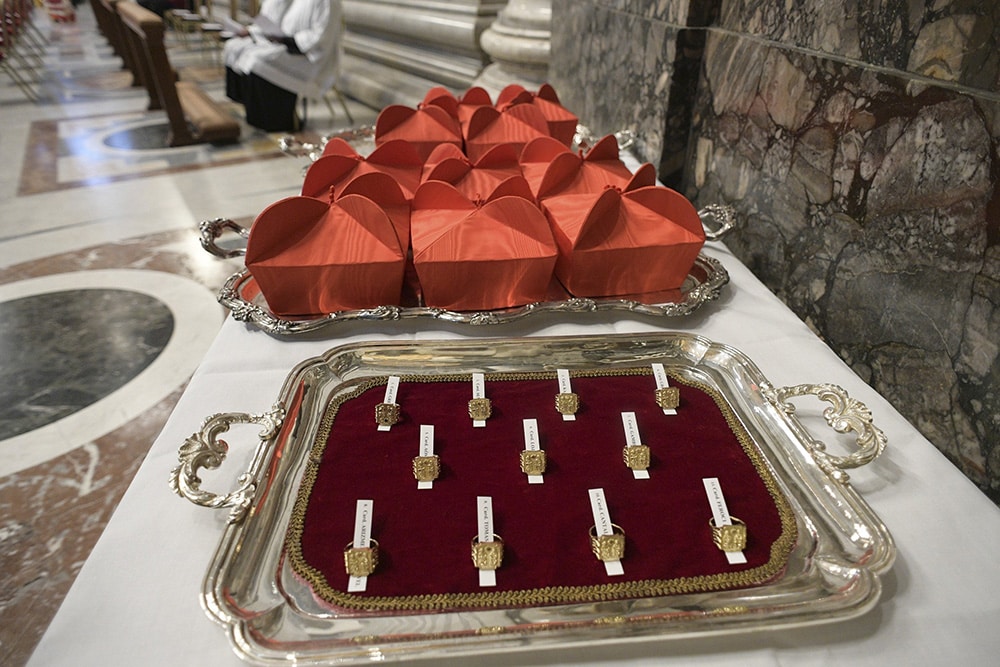
Red birettas and rings are pictured at a consistory led by Pope Francis for the creation of 13 new cardinals in St. Peter's Basilica at the Vatican in this Nov. 28, 2020, file photo. Two U.S. prelates have recently traded what one called some "strong words" in the media, debating the reception of holy Communion, sexual sin, pastoral outreach to marginalized Catholics and allegations of heresy among church leadership. (OSV News photo/Vatican Media)

The Catholic Church today can, in an important sense, be described as a church in upheaval. A significant part of that reality arises from the fact that the Church does not exist in isolation from our broader culture. At some points in history, that culture has both been animated by, and has deeply animated and served, the Church’s work of worship and evangelization. But when the culture and the Church increasingly diverge, tensions foment, and furors erupt. We are in one such moment today.

That rupture between Church and culture sparks debate among even the highest-ranking prelates because no easy solution is readily available. There is no clear plan to navigate the tempest of our culture. Some Church leaders are more open to embracing current cultural trends in hopes of putting them to use in the service of the Gospel. Others are more wary and long for clear warnings of potential danger to protect the flock.

Experiencing this kind of turbulence, we may be tempted to paint a picture of the earliest age of the Church in which the disciples always agreed. After all, Scripture attests to such harmonious moments, like the day of Pentecost, when they were all gathered together as one (cf. Acts 2:1).

But even in the Lord’s own time, when Our Savior walked among men, disagreement was to be found. Recall Judas’ infamous objection to the woman who anoints Christ’s feet with oil: “Why was this oil not sold for three hundred days’ wages and given to the poor?” (Jn 12:5).

Or perhaps even more germane, consider the great debate about whether Christians needed to follow Jewish religious law, like circumcision or abstinence from pork. Scripture tells us, “Because there arose no little dissension and debate by Paul and Barnabas with them, it was decided that Paul, Barnabas, and some of the others should go up to Jerusalem to the apostles and presbyters about this question” (Acts 15:2). The disciples had received the Holy Spirit, and yet there were fiercely opposing views on how the followers of Jesus would resolve the dispute concerning whether it was necessary to continue to observe Mosaic law.

Since those early days of Christian history, it has always been so. Consider that Arianism, the view that Jesus was not co-eternal but created by the Father, was at one point held by a majority of the Christian world. It took centuries for orthodox teaching to be widely accepted, even after the matter was settled formally at the Council of Nicea in 325.

Why would our own age, so full of unrest, be any different than these former times? Longing for a Church without discord is truly commendable. But the Church is composed of and led by human beings, and therefore the working out of the way forward will more often than not be a rumbustious affair.

The language we are now seeing used by some of the Church’s most prominent shepherds signals the urgency of these debates. Take, for example, Cardinal Walter Kasper’s recent caution concerning synodal efforts in Germany. “The Synodal Path repeatedly emphasizes that it doesn’t want any schism, and I believe that,” Cardinal Kasper said. “But one can also stumble into a schism,” he continued. “Sort of like how the great powers stumbled into World War I, although nobody really wanted it.”

In the United States, Bishop Thomas J. Paprocki of Springfield, Illinois, recently wrote in First Things magazine, “Unfortunately, it is not uncommon today to hear Catholic leaders affirm unorthodox views that, not too long ago, would have been espoused only by heretics.” Bishop Paprocki’s article resonated with many because it acknowledged the destructive nature of sexual sin.

Words like “schism” and “heresy” are not to be bandied about lightly. When used seriously, by reflective men, they are heavy terms, and the fact that they have been deployed should be the cause of serious reflection by bishops, clergy and laity alike. And while we lament the conditions that have led to their use, appearance on the scene should hardly be distressing. They are welcome words to see in public discourse, because at least the discourse has become public.

Debates that have long simmered behind closed rectory doors have now entered the common life of the Church. As hard as it may be to believe, this is the first step toward healing and progress. Unity can only be achieved and charity can only be lived when opposing views are enunciated clearly and boldly. Then those divergent views can be examined and accepted or rejected on their merits and conformity with Scripture, Tradition and the Magisterium.

Rather than discouraged, we should be encouraged by these public exchanges among Catholic leaders. Only when division is brought to light can resolution be found.

Our Sunday Visitor Editorial Board: Father Patrick Briscoe, Gretchen R. Crowe, Scott P. Richert, Scott Warden, York Young

Wednesday, March 15, 2023

The new Synod Preparatory Commission includes the Bishop of Brownsville, Texas


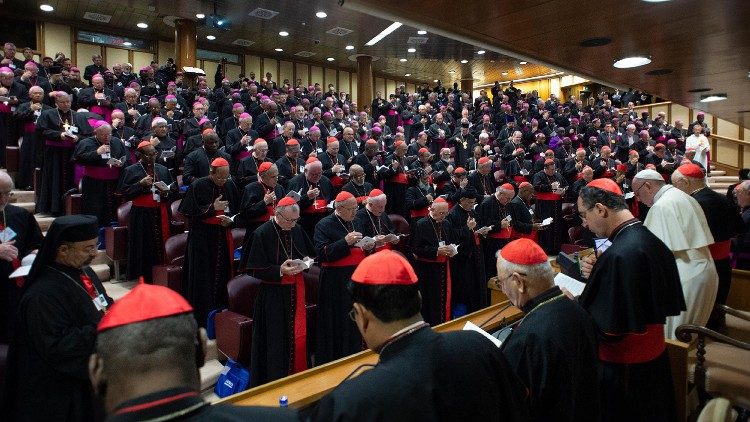
File photo of Synod of BishopsFile photo of Synod of Bishops 

Preparatory Commission for General Assembly of Bishops established

Cardinal Mario Grech, Secretary General of the Synod appoints seven members of the Preparatory Commission for the General Assembly of the Synod of Bishops in October.

By Michele Raviart

Cardinal Mario Grech, Secretary-General of the Synod, has established the Preparatory Commission for the Ordinary General Assembly of the Synod appointing seven members, including a sister.

She is Mercedarian Sister Shizue "Filo" Hirota from Tokyo, Japan, a consultant for the Catholic Council for Justice and Peace of the Japanese Catholic Bishops' Conference.

The Preparatory Commission was set up in accordance with Art 10, par. l-2 of the Apostolic Constitution Episcopalis Communio, on the structure of the Synod

The members

The other members of the commission are: Jesuit Father Giacomo Costa, who will serve as coordinator; Archbishop Timothy John Costelloe of Perth, President of the Australian Bishops’ Conference;  Bishop Daniel E. Flores of Brownsville, Texas; Bishop Lucio A. Muandula of Xai-Xai, Mozambique; Father Dario Vitali, a professor of theology at the Pontifical Gregorian University in Rome; and Polish Msgr. Tomasz Trafny, a member of the Synod Secretariat staff, who will serve as Secretary of the Commission. Cardinal Jean-Claude Hollerich of Luxembourg, General Relator of the upcoming synod, will also participate in the work of the Commission.

Worldwide Marian Prayer

It was also proposed by the Secretariat of the Synod that on Wednesday 31 May, the liturgical memorial of the Visitation of the Blessed Virgin Mary, a worldwide Marian prayer in preparation for the 16th Synod of Bishops be held.

The purpose, a note explains, is to "make the People of God aware of the importance of the Process underway and to urge the faithful to accompany it with prayer" and to place "under Our Lady's specific protection the entire Synodal Process in the Church, especially the work of the General Assembly".

A moment of intense prayer

The invitation was issued by Cardinal Grech and addressed to the heads of the Eastern Churches and to the Presidents of the Bishops' Conferences,  to hold "a moment of intense prayer that will express the beauty of popular religiosity around Marian shrines."

The shrines will be chosen by individual Bishops' Conferences in each country. The prayer should include the participation of the different ecclesial vocations (laity, priests, consecrated life).

Individual parish communities, in agreement with their Diocesan Bishop, are also invited to hold a moment of prayer on that day for the work of the Synod.